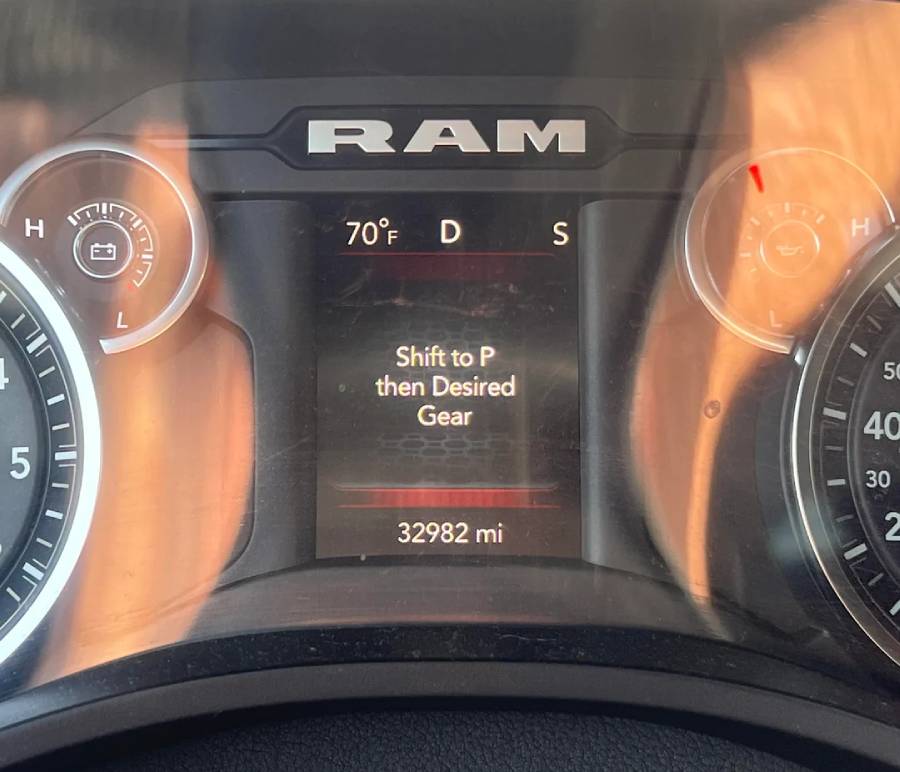
The “Shift To P Then Desired Gear” message means the vehicle wants you to shift the transmission into Park (P) before selecting the gear you want to use. In some situations, the message is an operational prompt and disappears after you move the gear selector to Park and then select Drive, Reverse, or another permitted gear. A message that remains on the display or repeatedly returns after the correct shift sequence requires further diagnosis.
The warning is connected to how the vehicle detects and validates gear position. The gear selector, gear-position sensing components, electrical connections, and transmission control system work together to determine whether Park has been selected before another shift request is accepted. A fault affecting this process can prevent the vehicle from recognizing the expected gear position even when the driver has moved the selector correctly.
Diagnosing the message therefore requires more than clearing the warning or immediately replacing a transmission component. The correct approach is to determine when the message appears, check whether the vehicle recognizes Park correctly, inspect related symptoms, and use diagnostic data when necessary. This guide explains what “Shift To P Then Desired Gear” means, the potential causes, how to diagnose and fix the problem, whether you can continue driving, and when professional diagnosis is necessary.
What Does “Shift To P Then Desired Gear” Mean?
“Shift To P Then Desired Gear” means the vehicle is instructing the driver to move the gear selector to Park (P) before selecting the intended gear again. The message indicates that the transmission control system needs to recognize the Park position before it can accept or correctly process the next gear-selection request. The desired gear may be Drive (D), Reverse (R), Neutral (N), or another available position depending on the vehicle and operating condition.
The message does not automatically mean the transmission has failed. It can function as an operational instruction when the required shift sequence has not been completed. Moving the selector to Park allows the vehicle to establish the expected gear position before another selection is made. The driver can then select the desired gear and check whether the message disappears.
A different situation exists when the message remains displayed or returns even after the driver correctly shifts into Park. A recurring “Shift To P Then Desired Gear” message indicates that the vehicle may not be consistently recognizing or validating the expected gear position. The cause then needs to be diagnosed rather than assuming that repeatedly moving the shifter between positions will solve the underlying problem.
Why Does My Car Say “Shift To P Then Desired Gear”?
Your car says “Shift To P Then Desired Gear” because the gear-selection system has not recognized the condition required to complete the requested shift. The system expects the transmission or gear selector to reach and register Park before processing the next gear request. When that expected state is not established, the vehicle displays the message instead of treating the requested shift as complete.
Modern gear-selection systems depend on more than the physical movement of the shifter. The vehicle must also determine which gear position has been selected and communicate that information to the relevant control system. This creates a sequence in which the driver moves the selector, the vehicle detects the selected position, the control system evaluates that information, and the requested transmission operation is accepted when the required conditions are satisfied.
The point at which this sequence fails helps determine why the message appears. For example, the driver may have moved the shifter into Park while the vehicle does not correctly register that position. In that case, the physical position selected by the driver and the position recognized by the vehicle do not match. The warning can consequently remain active even though the driver appears to have followed the instruction on the display.
The frequency of the message is therefore an important diagnostic clue. A message that disappears immediately after shifting to Park represents a different situation from one that returns during repeated gear changes or remains present after Park has been selected. A persistent or recurring warning requires the gear-selection process to be checked for a specific fault rather than diagnosing the transmission from the warning message alone.
What Causes the “Shift To P Then Desired Gear” Message?
The “Shift To P Then Desired Gear” message appears when the vehicle cannot complete or verify the required gear-selection sequence. The fault can occur at different points between the physical movement of the gear selector and the electronic confirmation of the selected gear. The exact cause depends on the vehicle’s transmission and shifter design, so the warning message alone is not enough to identify a failed component.
A gear selector or shift mechanism problem is one possible cause. The selector must move into the required position and allow the vehicle to recognize that position. Wear, mechanical damage, or a fault within an electronic shifter assembly can create a difference between the gear selected by the driver and the position recognized by the vehicle. This becomes particularly relevant when the display continues requesting Park even though the driver has already moved the selector to P.
A gear-position sensing fault can produce a similar result. The transmission control system relies on position information to determine whether Park, Reverse, Neutral, or Drive has been selected. A faulty transmission range sensor, gear-position sensor, or equivalent position-detection component can provide incorrect or inconsistent information. The system may then refuse to validate the shift sequence because the reported gear position does not correspond with the expected position.
Damaged wiring and poor electrical connections can also interrupt gear-position information. A loose connector, damaged wire, corrosion, or another circuit fault can prevent a valid signal from reaching the relevant control module. Electrical faults are especially worth investigating when the warning is intermittent because vibration, temperature changes, or movement of a damaged connection can alter whether the circuit operates correctly.
System voltage and control-system faults also belong in the diagnostic process, but they should not be assumed from the warning alone. Insufficient or unstable electrical supply can interfere with electronic vehicle systems, while a control or communication fault can prevent gear-position information from being processed correctly. These possibilities require supporting evidence such as related symptoms, diagnostic trouble codes, voltage measurements, or scan data before a battery or control module is identified as the cause.
The correct diagnosis is therefore based on evidence rather than replacing the first component associated with the warning. The technician or vehicle owner should determine whether Park is physically selected, whether the vehicle reports the same position, whether related circuits are operating correctly, and whether diagnostic trouble codes identify a specific fault path. This sequence separates a simple shift-sequence issue from a mechanical, sensor, electrical, or control-system problem.
What Symptoms Can Appear With the “Shift To P Then Desired Gear” Message?
The main symptom is the “Shift To P Then Desired Gear” warning appearing when the vehicle does not accept or correctly recognize the expected gear-selection sequence. The warning may occur once and disappear after Park is selected, or it may remain active or return repeatedly. The second pattern provides stronger evidence that the gear-selection system requires diagnosis.
A mismatch between the selected gear and the displayed gear position is another relevant symptom. For example, the driver may move the selector into Park while the instrument cluster or transmission data does not consistently indicate P. This mismatch helps narrow the problem toward gear-position detection, the selector mechanism, its electrical circuit, or the associated control system rather than treating the warning as an isolated display problem.
Difficulty selecting or engaging the requested gear can accompany the message when the underlying problem affects more than the warning logic. The driver may select a position but find that the vehicle does not respond as expected. A persistent inability to recognize Park or reliably select the intended gear is more significant than a message that clears immediately after the correct shift sequence.
Additional warning messages, warning lights, or stored diagnostic trouble codes can provide further evidence. These indicators should be evaluated together rather than assuming they all originate from the same failed component. A diagnostic scan can show whether the vehicle has recorded transmission, gear-position, communication, or electrical faults that correspond with the conditions under which the “Shift To P Then Desired Gear” message appears.
Intermittent and persistent symptoms should also be distinguished during diagnosis. An intermittent message that appears only under specific conditions can indicate a different failure pattern from a warning that occurs every time the driver attempts to select a gear. Recording when the warning appears, which gear was selected, whether Park was recognized, and which other symptoms occurred at the same time gives the diagnostic process more useful evidence.
How Do You Diagnose the “Shift To P Then Desired Gear” Message?
Diagnose the “Shift To P Then Desired Gear” message by first confirming whether the vehicle recognizes Park correctly, then checking diagnostic data for faults in the gear-selection system. The objective is to locate the point where the physical gear position and the position recognized by the vehicle stop matching. Replacing a shifter, sensor, or control module before identifying that point can result in unnecessary repairs.
What Should You Check Before Using a Diagnostic Scanner?
Check the gear selector position, gear indicator, warning behavior, and related symptoms before connecting a diagnostic scanner. Start with the vehicle stationary and follow the normal gear-selection procedure specified for the vehicle. Move the selector to Park and observe whether the instrument cluster recognizes P. Then select the desired gear according to the normal operating procedure and determine whether the message disappears.
Pay particular attention to differences between the physical selector position and the gear shown on the instrument cluster. A selector that is physically in Park while the vehicle displays another position provides useful diagnostic evidence. Also record whether the warning occurs every time the vehicle shifts, appears only intermittently, or occurs when moving between specific gear positions. These observations help establish the conditions that reproduce the fault.
Inspect accessible electrical connections related to the shifter or gear-position system when the vehicle’s service information identifies them and they can be checked safely. Loose connections, visible wiring damage, or corrosion can interfere with the signals used to report gear position. Visual inspection alone cannot confirm that a circuit is electrically sound, so further testing is required when no visible damage is found.
How Do You Diagnose the Problem With an OBD-II Scanner?
Use a compatible diagnostic scanner to check stored trouble codes and compare commanded, selected, or reported gear-position data when the vehicle provides those parameters. A basic code reader may provide limited information, while a scan tool capable of communicating with the relevant transmission and vehicle control modules can provide more useful diagnostic data.
Read the stored diagnostic trouble codes before clearing them. A code can identify the system or circuit in which the vehicle detected an abnormal condition, although it does not automatically prove that the component named in the code description has failed. For example, a gear-position-related code can result from a sensor problem, wiring fault, connector problem, or another condition affecting the signal. The code should therefore determine the next test rather than the replacement part.
Live data can provide stronger evidence when gear-position information is available. Move through the permitted gear positions according to the vehicle’s service procedure and compare the selector’s physical position with the position reported by the control system. If Park is physically selected but scan data consistently reports another position, the diagnostic path should focus on the components and circuits responsible for detecting and transmitting gear position.
Electrical and mechanical testing should follow the manufacturer’s diagnostic procedure once the fault area has been narrowed down. Different vehicles use different shifter designs, position sensors, modules, circuits, and communication strategies. For this reason, connector pinouts, voltage specifications, resistance values, adjustment procedures, and component tests should come from service information for the exact vehicle rather than from a universal specification.
How Do You Fix the “Shift To P Then Desired Gear” Message?
Fix the “Shift To P Then Desired Gear” message by correcting the condition that prevents the vehicle from recognizing or completing the required gear-selection sequence. The appropriate repair can range from simply returning the selector to Park and selecting the desired gear again to repairing a confirmed mechanical or electrical fault.
Start by shifting the vehicle into Park according to its normal operating procedure and then select the desired gear again. If the message disappears and does not return, the warning may have resulted from the required shift sequence not being completed. Repeatedly performing this procedure is not a repair when the message continues to return under normal operation.
Repair the gear selector or shift mechanism when diagnosis confirms that it cannot correctly reach, communicate, or maintain the required position. The exact repair depends on the vehicle design. A mechanical selector, cable-operated arrangement, and electronic shift-by-wire system do not use identical components, so the failed part must be identified before repair or replacement.
Repair or replace a gear-position sensing component when testing confirms that its output does not correspond with the actual transmission or selector position. Depending on the vehicle, gear-position detection may involve a transmission range sensor, selector-position sensor, switches, or another integrated component. Adjustment may also be relevant on designs where the position-detection component requires alignment.
Repair damaged wiring or electrical connections when circuit testing identifies excessive resistance, an open circuit, a short, poor terminal contact, corrosion, or another electrical defect. Restoring the circuit allows accurate gear-position information to reach the appropriate control system. Clearing a code without repairing the electrical fault can make the warning disappear temporarily while leaving its cause unchanged.
Control-system repair, programming, or module replacement should occur only after diagnosis supports that direction. A warning message by itself is not sufficient evidence that the transmission control module has failed. Power supply, grounds, wiring, communication circuits, sensors, and other related components should be tested according to the vehicle-specific diagnostic procedure before an expensive control module is replaced.
After completing the repair, clear applicable diagnostic trouble codes and operate the gear-selection system through the conditions that previously triggered the message. Confirm that Park is recognized correctly, the requested gears can be selected normally, and the warning does not return. A successful repair removes the underlying fault rather than only removing the message from the display.
Can You Drive With the “Shift To P Then Desired Gear” Message?
You should only continue driving after a “Shift To P Then Desired Gear” message if the warning clears and the vehicle recognizes and selects the required gears normally. A warning that remains active, repeatedly returns, or occurs with abnormal gear selection requires diagnosis because the vehicle may not be correctly detecting or validating the selected gear.
First, shift into Park according to the vehicle’s normal operating procedure and then select the desired gear again. Check whether the gear indicator matches the position you selected and whether the vehicle responds normally. If the message disappears and there are no other gear-selection symptoms, the system has accepted the requested sequence. Monitor the vehicle for the warning to return.
Do not treat the message as a harmless notification when the displayed gear does not match the selector position, Park is not consistently recognized, the requested gear cannot be selected, or the vehicle behaves unexpectedly after a gear is selected. These symptoms indicate that the problem extends beyond the wording of the warning itself. Continuing to operate a vehicle with unreliable gear selection can create a safety risk because the driver cannot depend on the transmission responding to the selected position as expected.
Stop driving and arrange appropriate diagnosis when the vehicle cannot reliably select or maintain the intended gear. The same approach applies when the message occurs with additional transmission warnings or significant changes in vehicle behavior. The warning text alone does not establish whether a vehicle is safe to drive; the vehicle’s ability to recognize and execute gear selections correctly is the more important factor.
How Serious Is the “Shift To P Then Desired Gear” Message?
The seriousness of a “Shift To P Then Desired Gear” message depends on whether it is a temporary shift instruction or a recurring gear-selection fault. A message that clears after the driver shifts to Park and then selects the desired gear has a different significance from a warning that remains active despite the correct procedure.
A temporary message is the lowest-severity situation when the vehicle subsequently recognizes Park, accepts the desired gear, and operates normally. The driver should still note the conditions under which the warning appeared, particularly if it has occurred more than once. Repeated occurrences provide evidence that the issue is no longer limited to a single unsuccessful shift sequence.
A recurring warning requires greater attention because it indicates that the expected gear-selection condition is not being consistently recognized. The underlying problem may involve the selector, gear-position detection, an electrical circuit, or another part of the control process. Diagnosis becomes more important when the warning appears during the same shift repeatedly or becomes more frequent over time.
A persistent warning accompanied by unreliable gear recognition is the most serious condition covered by this message. For example, Park may be physically selected while the vehicle does not recognize P, or the selected gear may not correspond with the position displayed by the vehicle. These symptoms justify prompt diagnosis because correct gear-position information is necessary for predictable operation of the transmission system.
How Much Does It Cost to Fix the “Shift To P Then Desired Gear” Message?
There is no single repair price for a “Shift To P Then Desired Gear” message because the warning identifies a gear-selection problem rather than one specific failed component. The final cost depends on the confirmed cause, vehicle model, component design, labor time, diagnostic requirements, and whether programming or calibration is required after the repair.
A simple shift-sequence issue may require no component replacement if the message clears after Park is correctly selected and does not return. A confirmed wiring or connector problem instead requires locating the affected circuit and repairing the damaged connection. A failed gear-position sensor or shifter assembly requires a different repair, while a control-system problem can involve additional diagnosis, programming, or component replacement.
Diagnostic cost should therefore be considered separately from repair cost. Paying for diagnosis can prevent a more expensive incorrect repair because the same warning can originate from different points in the gear-selection process. Replacing a gear-position sensor, shifter assembly, battery, or control module solely because it appears on a list of possible causes does not establish that the replacement will eliminate the warning.
The most accurate estimate is obtained after the vehicle has been scanned and the suspected fault has been tested. A repair estimate should identify the diagnosed problem, required part or circuit repair, labor, and any calibration or programming separately. A price range based only on the warning message can be misleading because two vehicles displaying the same message may require completely different repairs.
Why Does the “Shift To P Then Desired Gear” Message Keep Coming Back?
The “Shift To P Then Desired Gear” message keeps coming back when the condition that prevents the vehicle from consistently recognizing or validating the required gear position has not been corrected. Clearing the warning, restarting the vehicle, or shifting back to Park can remove the message temporarily without repairing an underlying mechanical, electrical, sensing, or control-system fault.
An intermittent gear-position signal is one reason a warning can disappear and later return. The vehicle may recognize Park correctly during one shift and receive inconsistent position information during another. A problem involving the selector, position-detection component, wiring, or electrical connection can therefore produce a warning that does not appear during every drive cycle. The conditions present when the message returns provide useful diagnostic evidence.
A recurring message after a previous repair can indicate that the original root cause was not identified. Replacing a component because it was associated with the warning does not confirm that the component caused the problem. For example, replacing a gear-position-related part will not correct damaged wiring elsewhere in the circuit if the wiring is responsible for the incorrect position signal. The repair must address the fault demonstrated by diagnostic testing.
Clearing diagnostic trouble codes also does not repair the condition that generated them. Clearing codes removes stored diagnostic information and can turn off related warnings until the control system detects the fault again. Read and record relevant codes and diagnostic data before clearing them whenever possible because that information can help identify the system, circuit, and operating conditions associated with the problem.
A warning that repeatedly returns should therefore be diagnosed under the conditions that trigger it. Record whether it occurs when leaving Park, returning to Park, selecting Reverse or Drive, starting the vehicle, or under another repeatable condition. Also note the gear shown on the instrument cluster and any additional warnings. Reproducing the fault makes it easier to compare the driver’s selected position with the position recognized by the vehicle.
When Should You Have the “Shift To P Then Desired Gear” Message Diagnosed by a Mechanic?
Have the “Shift To P Then Desired Gear” message professionally diagnosed when it repeatedly returns, the vehicle does not consistently recognize Park, the displayed gear does not match the selected position, or normal gear selection becomes unreliable. These conditions indicate that the problem requires more than repeatedly following the instruction shown on the display.
Professional diagnosis is particularly appropriate when the problem requires electrical circuit testing or access to transmission and gear-selection data that a basic OBD-II code reader cannot provide. A technician with an appropriate diagnostic scan tool can compare gear-position data, retrieve relevant trouble codes, reproduce the fault, and perform vehicle-specific tests on the suspected circuit or component.
Seek prompt assistance when the vehicle cannot reliably select the intended gear or its behavior no longer corresponds with the selected position. Do not continue experimenting with the shifter on public roads to determine whether the problem will disappear. Move the vehicle to a safe location when possible and follow the manufacturer’s procedures for securing, transporting, or towing the vehicle if normal gear operation cannot be confirmed.
A mechanic should also inspect the vehicle when the warning returns after a previous repair. The next diagnostic process should confirm whether the original fault remains, a related circuit has failed, or the previous repair addressed a symptom rather than the root cause. Diagnostic trouble codes, freeze-frame information where available, live data, circuit tests, and vehicle-specific service information provide stronger evidence than replacing another component based solely on the warning text.
The repair is complete when the vehicle consistently recognizes the correct gear positions, accepts the intended shift sequence, and the “Shift To P Then Desired Gear” message no longer returns under the conditions that previously triggered it. This verification distinguishes a root-cause repair from temporarily clearing the warning.