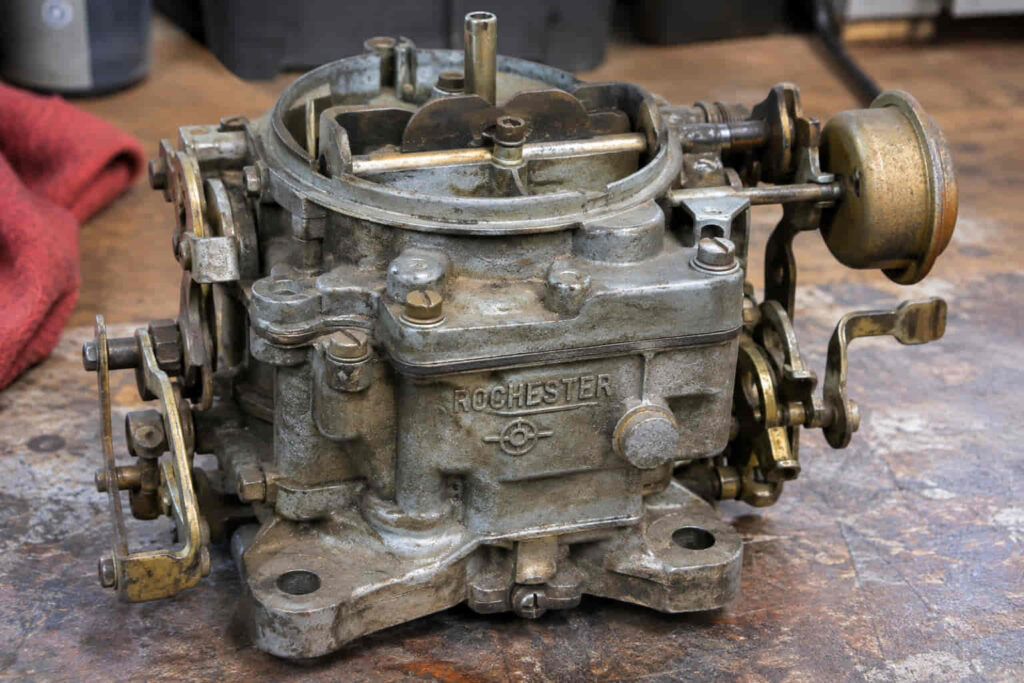
Identifying a Rochester carburetor requires checking its model family, identification number, and physical design. Rochester produced several carburetor types, including the Monojet, 2G series, Dualjet, and Quadrajet, with different configurations for specific engines and vehicle applications. Although these carburetors have recognizable external features, appearance alone is not always enough to determine the exact model or select compatible replacement parts.
The most reliable identification process begins with the number of barrels and the carburetor’s overall construction. Next, locate the identification tag or stamped number, depending on the model and production period. This information can be compared with Rochester or General Motors application references to establish the carburetor’s original specifications. Casting numbers and date-related markings may provide additional clues, but they should not be treated as substitutes for a complete carburetor identification number.
Correct identification matters when restoring a classic Chevrolet, Pontiac, Buick, Oldsmobile, or GMC vehicle, purchasing a rebuild kit, or replacing a damaged carburetor. Two units that look nearly identical may have different fuel metering components, choke arrangements, or calibration specifications.
This guide explains how to recognize Rochester carburetor families, locate and interpret identification markings, distinguish similar models, and verify compatibility before ordering repair or replacement parts.
What Types of Rochester Carburetors Are There?
Rochester carburetors are classified into several model families based on their barrel configuration, fuel metering design, and intended engine application. The major families include the Rochester B-series and Monojet 1-barrel carburetors, the Rochester 2G-series and Dualjet 2-barrel carburetors, and the Rochester Quadrajet 4-barrel carburetor. Identifying the correct family is the first step in Rochester carburetor identification because each design has distinct structural features and identification methods.
Rochester 1-barrel carburetors use a single throttle bore to deliver the air-fuel mixture to the engine. The Rochester B, BC, and BV models were used in various applications, including older Chevrolet inline engines. The Monojet, commonly identified by its MV-family designations, represents another Rochester 1-barrel family. Although these carburetors share the same basic barrel count, their float bowl construction, choke mechanisms, and internal components differ. A carburetor cannot be identified as a Monojet simply because it has one barrel.
The Rochester 2G family includes the 2G, 2GC, and 2GV variants. These carburetors use two throttle bores and were installed on numerous General Motors engines. Their model designations distinguish variations within the family, particularly in choke arrangements. The Dualjet is also a Rochester 2-barrel carburetor, but it belongs to a different design family. Its construction is more closely associated with the later Quadrajet-style architecture than with the traditional 2G series. Therefore, barrel count alone cannot establish whether an unidentified Rochester 2-barrel unit is a 2G or a Dualjet.
The Rochester Quadrajet is a 4-barrel carburetor recognized by its relatively small primary throttle bores and substantially larger secondary bores. This arrangement supports fuel metering during normal driving while providing additional airflow when engine demand increases. Quadrajet carburetors were produced in numerous configurations for different General Motors engines, model years, emissions requirements, and transmission applications. Two Quadrajets may share nearly identical external dimensions while using different internal calibrations or control components.
The carburetor family identifies the basic design, but the complete identification number is needed to determine the specific version. This distinction is essential when selecting a rebuild kit, replacement carburetor, or factory-correct restoration component. For example, identifying a unit as a Rochester Quadrajet narrows the search to one family, but it does not establish which jets, metering rods, gaskets, or choke components belong to that particular carburetor.
How Can You Identify a Rochester Carburetor by Its Appearance?
You can identify a Rochester carburetor’s general model family by examining its throttle bores, float bowl, air horn, fuel inlet, and choke assembly. These components provide visible clues about the carburetor’s construction, even when the identification tag is missing or the stamped number is difficult to read. However, visual identification should be treated as an initial classification method rather than proof of the exact carburetor part number.
The most direct visual feature is the number and arrangement of throttle bores. A Rochester 1-barrel carburetor has one main air passage, while a 2-barrel model has two. A Quadrajet has four throttle bores arranged in primary and secondary pairs. The Quadrajet’s unequal bore sizes are particularly distinctive because its primary bores are smaller than its secondary bores. Looking at the throttle body from below, when the carburetor is safely removed, can help distinguish these configurations. The four openings on a Quadrajet also differ from the more uniform arrangement found on many conventional 4-barrel carburetors.
Float bowl and air horn construction provide additional identification clues. The air horn forms the upper section of many Rochester carburetors and supports components associated with airflow, fuel delivery, and choke operation. The float bowl contains the fuel reservoir and associated metering components. Their shapes and positions vary between the B-series, Monojet, 2G-series, Dualjet, and Quadrajet families. For example, a traditional Rochester 2G has a different overall body layout from a Dualjet, despite both using two barrels. Comparing the complete body shape is therefore more reliable than examining the throttle openings alone.
The choke assembly can help narrow the identification further. Rochester carburetors were manufactured with different choke operating arrangements, including manually controlled, thermostatically controlled, and electrically assisted systems, depending on the model and application. The position of the choke housing, linkage arrangement, and associated connections can provide useful evidence. However, choke components may have been modified or replaced during previous repairs, so their appearance should be verified against the carburetor’s identification markings whenever possible.
Fuel inlet placement and external linkage design also help distinguish Rochester carburetor configurations. Fuel connections may enter the carburetor body at different angles or locations, while throttle linkages can vary according to the vehicle’s engine and transmission requirements. Vacuum ports, mounting arrangements, and emissions-related fittings provide additional application clues. These differences become particularly useful when comparing two carburetors from the same family. For example, two Quadrajets may have similar air horns and throttle bodies but different vacuum connections or linkage arrangements.
A reliable visual identification combines several physical features instead of relying on a single component. Begin by establishing the barrel configuration, then compare the body design, choke system, fuel inlet, and external connections with reference photographs or service documentation for the suspected model family. Once the family has been identified, locate the carburetor’s identification number to confirm its specific version. This approach reduces the risk of confusing similar Rochester models or selecting parts based only on their appearance.
Read more: quadrajet carburetor rebuild
Where Is the Identification Number on a Rochester Carburetor?
The identification number on a Rochester carburetor is typically found on a metal identification tag or stamped directly into the carburetor body, depending on the model and production period. Rochester used different marking methods across its carburetor families, so there is no single identification number location that applies to every unit. The correct inspection method begins with identifying the carburetor family and then checking the locations associated with that design. A complete identification number is more useful than a casting number because it helps establish the carburetor’s original configuration and application.
Many earlier Rochester carburetors used a small metal identification tag secured beneath an air horn screw or another designated fastener. These tags may be round or another shape, depending on the carburetor model. Rochester B-series and 2G-series carburetors are among the models for which original identification tags are important references. The tag generally carries a carburetor identification number that can be compared with service literature and parts catalogs. However, older carburetors frequently have missing tags because they were removed during cleaning, rebuilding, or previous repairs. An absent tag does not necessarily indicate that the carburetor is an aftermarket replacement.
On many Rochester Quadrajet carburetors, the identification number is stamped vertically into the driver’s-side area of the main body, near the secondary throttle section. This location is especially relevant to later production Quadrajets, while some earlier units used identification tags. The stamped number may be difficult to see because accumulated dirt, fuel residue, oxidation, or installed engine components can obstruct the marking. For example, a Quadrajet installed on a Chevrolet V8 may require careful inspection of the side of the float bowl area to locate its identification digits. The exact location should be confirmed against the appropriate model reference rather than assumed from a single photograph.
Rochester Monojet and Dualjet carburetors also require model-specific inspection because identification markings and their locations vary by version. Depending on the unit, the relevant number may be found on a designated stamped surface or an original identification tag. The safest approach is to examine the accessible exterior surfaces, document any visible markings, and compare their placement with a reference for the suspected carburetor family. A number found on an individual casting should not automatically be treated as the complete carburetor identification number.
Before reading a marking, remove loose dirt with a soft brush and use adequate lighting to examine the surface. A flashlight directed across the metal at a shallow angle can make lightly stamped digits easier to distinguish. Avoid aggressive scraping, grinding, or abrasive cleaning because these methods can erase shallow markings and damage the carburetor body. Photograph the number from multiple angles before attempting further cleaning. If the carburetor remains installed, inspect only when the engine is off and cool, and keep tools away from exposed fuel connections.
A reliable identification requires recording the entire number exactly as it appears, including any adjacent markings that may be relevant to production or calibration. Missing or misread digits can lead to an incorrect application match. When the number is incomplete, the carburetor’s physical configuration and service references can help narrow the possibilities, but they should not be used to invent unreadable characters.
How Do You Read a Rochester Carburetor Identification Number?
Reading a Rochester carburetor identification number requires identifying the complete stamped or tagged number and comparing it with a reference for the corresponding carburetor family. Rochester numbering systems changed over time, and the meaning of individual digits depends on the series and production period. Although some Rochester numbers contain recognizable patterns associated with manufacturing eras and applications, a universal digit-by-digit decoding rule cannot accurately identify every Rochester carburetor.
Rochester Quadrajet identification numbers provide a useful example of these differences. Many earlier Quadrajets have seven-digit identification numbers beginning with prefixes such as 702 or 704, while numerous later versions use eight-digit numbers beginning with 1705 or 1708. These patterns can help narrow the production era and numbering family, but they do not independently establish the exact vehicle application. For example, two Quadrajets with similar prefixes may have different calibration specifications, choke arrangements, or emissions-related components. The full identification number must therefore be checked against a reliable application listing.
The complete number is important because a Rochester carburetor family can contain numerous application-specific calibrations. Carburetors intended for different engines may use similar external castings while having different fuel metering components, throttle linkages, or vacuum connections. Even units installed on vehicles from the same model year may differ according to engine specifications and emissions requirements. Reading only the first few digits can identify a broad numbering family, but it does not provide enough information to confirm the correct rebuild kit or replacement carburetor.
Identification numbers must also be distinguished from casting numbers and production date markings. A casting number identifies a manufactured component or casting design rather than necessarily identifying the complete carburetor assembly. Date-related markings may provide information about when a component or carburetor was produced, but their format and interpretation depend on the model and reference system. For example, a raised number cast into the float bowl may appear significant but may be shared by multiple carburetor configurations. Using that number as a complete identification number can produce incorrect parts matches.
The most dependable interpretation method is to record the full identification number and compare it with Rochester service information, General Motors parts catalogs, or a reputable carburetor application reference. The reference should identify the corresponding carburetor family and, where documented, the original engine or vehicle application. Physical features such as the choke system, throttle linkage, and fuel inlet should then be checked for consistency. This additional comparison is useful because carburetors may have been rebuilt with replacement components or modified for a different vehicle.
A Rochester carburetor should be considered positively identified only when its number and relevant physical specifications support the same model or application. If the number is missing, incomplete, or inconsistent with the carburetor’s construction, the result should remain provisional until additional evidence is available. This prevents incorrect identification from carrying over into rebuild kit selection, replacement purchases, or factory-correct restoration work.
How Do You Identify a Rochester 1-Barrel Carburetor?
A Rochester 1-barrel carburetor can be identified by its single throttle bore, overall body construction, and model-specific choke and fuel bowl arrangement. The two major Rochester 1-barrel families commonly encountered on older General Motors vehicles are the B-series and Monojet. Although both deliver the air-fuel mixture through one main throttle passage, they use different designs and should not be treated as interchangeable carburetors. Identifying the family correctly is necessary before determining the original application or selecting replacement components.
The Rochester B-series includes the B, BC, and BV designations, which represent variations of the same general carburetor family. These carburetors were used on various older GM engines, including Chevrolet inline-six applications. The B-series is recognizable by its characteristic body construction, with the air horn, fuel bowl, and throttle body forming distinct sections of the assembly. Differences between the B, BC, and BV variants are associated with choke arrangements rather than the number of barrels. The B is associated with manual choke operation, while the BC and BV use automatic choke arrangements with different control configurations.
The Rochester Monojet is a separate 1-barrel design and should be identified by its body layout rather than barrel count alone. Monojet carburetors, including MV-family variants, were used on later GM engine applications. Their float bowl construction, air horn shape, and fuel metering system differ from those of the earlier B-series. For example, a Monojet removed from a later Chevrolet inline-six engine may have the same single throttle opening as an older Rochester B, but its internal components and gasket arrangement are not necessarily compatible.
The choke mechanism provides an additional identification clue when distinguishing 1-barrel models. A manual choke typically uses a cable-operated linkage to control the choke plate, while an automatic choke uses a temperature-responsive mechanism and associated linkage. However, choke components may have been modified during previous repairs. A carburetor with an added manual choke conversion should therefore be identified through its underlying body design and original markings rather than the current choke control alone.
Fuel inlet position, mounting configuration, and throttle linkage arrangement help narrow the application after the carburetor family has been established. These details matter because Rochester produced different configurations for specific engines and vehicle installations. A replacement carburetor must fit the intake manifold and connect correctly to the fuel supply and throttle controls. Two Rochester 1-barrel carburetors that appear similar from above may have different mounting dimensions or linkage requirements.
The most dependable way to confirm a Rochester 1-barrel model is to combine its physical design with its original identification markings and application documentation. When the identification tag is missing, comparing the body construction, choke arrangement, mounting flange, and fuel connections can establish the likely family. However, these features may not identify the exact calibration. A complete identification number or a verified application reference is still needed before ordering a model-specific rebuild kit.
How Do You Identify a Rochester 2G, 2GC, or 2GV Carburetor?
Rochester 2G, 2GC, and 2GV carburetors belong to the same 2-barrel family, and their primary differences involve choke operation and associated control arrangements. All three use two throttle bores to supply the engine with an air-fuel mixture, and their general body architecture is similar. The model designation helps identify the choke configuration, but it does not establish the exact calibration, engine application, or replacement parts requirements.
The Rochester 2G is generally associated with a manual choke arrangement. Its choke plate is operated through a mechanical linkage connected to a driver-controlled cable or another application-specific control. This configuration can be recognized by examining the choke shaft and the linkage attached to it. However, a manual choke mechanism alone does not prove that the carburetor was originally manufactured as a 2G because older carburetors can be modified with replacement or conversion components.
The Rochester 2GC uses an automatic choke arrangement with a thermostatic control mechanism mounted on the carburetor. The choke system adjusts the choke plate position as the engine warms, reducing the need for manual operation. A visible choke housing and its connecting linkage can help distinguish a 2GC from a manual-choke 2G. For example, a Rochester 2-barrel unit with a carburetor-mounted automatic choke assembly may belong to the 2GC family, provided the remaining body features and identification markings are consistent with that designation.
The Rochester 2GV also uses an automatic choke system, but its arrangement is associated with a remotely mounted thermostatic choke mechanism. Instead of relying on a conventional carburetor-mounted choke housing, the system uses linkage connected to a separate temperature-responsive control. This distinction is useful when inspecting an original engine installation because the choke components may extend beyond the carburetor body itself. A disconnected or missing remote choke assembly can make a 2GV difficult to distinguish from another 2G-family variant unless the original linkage configuration and identification number are examined.
The three variants share many recognizable design characteristics, including a two-bore throttle body, a common general body layout, and related fuel metering architecture. However, Rochester manufactured numerous versions for different engines and production periods. Changes in throttle linkage, vacuum connections, fuel inlet configuration, and internal calibration can affect compatibility. Consequently, a 2GC from one GM application should not automatically be considered a direct replacement for another 2GC simply because both use the same model designation.
Correct identification requires checking the choke system together with the carburetor’s body configuration and original identification number. Begin by establishing that the unit belongs to the Rochester 2G family, then determine whether its choke arrangement corresponds to the 2G, 2GC, or 2GV designation. Finally, verify the complete identification number against an appropriate application reference. This sequence helps distinguish the model family from its specific calibration and reduces the risk of purchasing incompatible gaskets, accelerator pump components, or replacement carburetors.
How Do You Identify a Rochester Quadrajet Carburetor?
A Rochester Quadrajet carburetor is identified by its spread-bore 4-barrel design, which combines two relatively small primary throttle bores with two substantially larger secondary bores. This configuration is the most distinctive structural feature of the Quadrajet family. The primary bores handle airflow during light-throttle operation, while the larger secondary bores provide additional airflow as engine demand increases. Unlike a square-bore carburetor with four similarly sized throttle openings, the Quadrajet uses visibly different primary and secondary bore sizes.
The Quadrajet also features an air valve assembly above the secondary bores. These air valve plates regulate incoming airflow through the secondary section according to engine demand. They are separate from the secondary throttle plates located farther down in the carburetor. This distinction is useful during identification because the visible plates near the top of a Quadrajet are not simply another set of throttle blades. For example, a carburetor with four throttle bores and spring-controlled secondary air valves is consistent with the Quadrajet design, although its complete identification number is still required to establish the exact version.
Quadrajet models can be further distinguished by their choke systems, external controls, and production-specific components. Rochester manufactured Quadrajets with different choke arrangements, vacuum connections, and emissions-related controls. Some later versions incorporated electronic feedback systems that adjusted fuel metering in response to engine operating conditions. These differences matter because a conventional Quadrajet and an electronically controlled version may share the same basic spread-bore construction but require different service procedures and replacement components.
The Quadrajet family includes several model designations, such as 4MV, 4MC, and later M-series and electronically controlled variants. These designations help describe the carburetor’s configuration, but they do not replace its complete identification number. For instance, two Quadrajets fitted to different Chevrolet or Pontiac engines may have similar external housings while using different metering rods, jets, and control arrangements. Matching the complete number with a reliable application reference is necessary to determine the original calibration.
The most reliable Quadrajet identification combines its spread-bore construction, secondary air valve system, model-specific controls, and complete identification number. Physical inspection establishes that the carburetor belongs to the Quadrajet family, while the identification number provides the basis for verifying its production configuration. This distinction is particularly important when restoring an original GM vehicle or selecting parts for a Quadrajet rebuild.
How Do You Identify a Rochester Dualjet Carburetor?
A Rochester Dualjet carburetor can be identified as a 2-barrel Rochester design that shares important architectural features with the Quadrajet family rather than the older 2G-series carburetors. The Dualjet was developed for applications requiring a two-barrel carburetor with design characteristics related to the Quadrajet’s primary metering system. Its construction makes it visually different from many traditional Rochester 2G models, even though both have two throttle bores.
The Dualjet’s air horn, float bowl, and main body arrangement provide the strongest visual identification clues. Its general construction resembles the primary side of a Quadrajet, without the Quadrajet’s separate pair of large secondary bores and associated secondary air valve assembly. This difference helps distinguish the two families during inspection. For example, a Rochester carburetor with Quadrajet-like body features but only two throttle bores may be a Dualjet rather than a damaged or incomplete Quadrajet.
Dualjet carburetors also differ from traditional Rochester 2G models in their fuel metering architecture and body construction. Certain Dualjet versions use primary metering arrangements related to Quadrajet designs, while later variants incorporate additional emissions-control features. As a result, parts selected for a Rochester 2G cannot automatically be used in a Dualjet. Similar barrel counts do not establish compatibility between their gaskets, accelerator pump components, or fuel metering assemblies.
The Dualjet family includes different production versions with variations in choke operation, external linkages, and control systems. Some later applications used electronically controlled carburetor configurations. These differences can affect identification and parts selection, particularly when the carburetor has been removed from its original engine. Inspecting the body layout alongside its fuel inlet, choke linkage, and control connections helps narrow the possible version, but those features alone may not confirm the original vehicle application.
A Rochester Dualjet should be positively identified through its body design and complete identification number, not merely by the presence of two throttle bores. Comparing the carburetor with Dualjet-specific service references helps distinguish it from the 2G family and confirms which replacement components are appropriate. This is especially important when purchasing a rebuild kit because different Dualjet versions may require application-specific gaskets, metering components, and choke parts.
How Do You Verify a Rochester Carburetor’s Original Vehicle Application?
You can verify a Rochester carburetor’s original vehicle application by matching its complete identification number with factory parts catalogs, Rochester service specifications, or reliable carburetor application charts. These references connect specific carburetor assemblies to vehicle and engine configurations. Identifying the carburetor family alone is insufficient because Rochester manufactured multiple calibrations for different General Motors applications. A correct match should account for the vehicle manufacturer, model year, engine, and any transmission or emissions specifications listed in the reference.
The identification number is the starting point because it provides a more specific reference than the carburetor’s appearance. Once the number has been recorded, search for an exact match in documentation covering the appropriate production period. The resulting application information should then be compared with the vehicle’s specifications. For example, a Quadrajet listed for a particular Chevrolet V8 application should not automatically be considered correct for every Chevrolet equipped with the same engine displacement. Differences in model year, transmission, emissions equipment, and engine calibration may require a different carburetor assembly.
Factory service manuals and original parts catalogs serve different purposes during application verification. A parts catalog can associate a carburetor assembly or service part number with particular vehicle applications, while a service manual explains the configuration, adjustments, and operating specifications used on those vehicles. Rochester application charts provide another way to connect identification numbers with original equipment. When references disagree, verify that they cover the same production year, vehicle configuration, and numbering system before accepting a match. Superseded service part numbers can also differ from original production numbers, so the relationship between them must be established rather than assumed.
Physical compatibility provides a second level of verification. Compare the carburetor’s mounting flange, throttle linkage, choke controls, fuel inlet, and vacuum connections with the documented vehicle configuration. These features help reveal whether a unit has been modified or assembled with components from another application. For instance, a carburetor may carry an identification number associated with one engine while having a replacement throttle linkage installed for use on another vehicle. The identification number may establish the carburetor’s original application, but its current configuration must be inspected separately.
The carburetor currently installed on a classic vehicle is not necessarily the carburetor originally supplied with that vehicle. Rochester units were frequently replaced, rebuilt, or exchanged during decades of service. A functioning replacement may be mechanically compatible without being factory-correct. This distinction matters for restoration projects because an owner seeking original equipment specifications needs to verify both the carburetor identification number and the vehicle’s factory configuration. A carburetor that operates correctly on an engine does not, by itself, prove that it was installed during vehicle production.
The most dependable verification combines an exact identification number match, appropriate application documentation, and agreement between the carburetor’s physical configuration and the vehicle’s specifications. If the documentation identifies a different original application, record that discrepancy before purchasing replacement parts or making calibration changes. This approach separates three questions that are often confused: what the carburetor was originally built for, what vehicle it is currently installed on, and whether its present configuration is suitable for that vehicle.
How Do You Identify a Rochester Carburetor Without an ID Tag?
A Rochester carburetor without an identification tag can often be classified by its construction, but determining its exact calibration may be impossible without additional evidence. Missing tags are common on older carburetors because identification plates can be removed during rebuilding or lost when components are replaced. The absence of a tag does not make the carburetor unidentifiable in every respect. It changes the identification process from a direct number lookup to a comparison of structural features, surviving markings, and documented applications.
Begin by examining the complete carburetor assembly rather than focusing on one visible component. The relationship between the air horn, float bowl, and throttle body helps establish the likely Rochester family. Choke controls, mounting arrangements, and external linkage design can then narrow the possible configurations. These observations should be compared with photographs and diagrams from model-specific service literature. For example, an untagged Rochester 2-barrel carburetor may initially resemble several models, but its body construction and choke linkage can help determine whether it belongs to the traditional 2G family or the later Dualjet family.
Before concluding that the identification number is missing, inspect the carburetor for an original stamped number. Some Rochester models used body stamping rather than a removable tag, and the marking may remain intact beneath dirt or oxidation. Use adequate lighting and inspect the appropriate surfaces for the suspected model. Record every legible character without filling in missing digits from memory or assumptions. A partially readable number may be useful when combined with verified physical characteristics, but it should not be treated as an exact identification.
The next step is to compare application-specific components with documented examples. Throttle linkage geometry, fuel inlet configuration, choke connections, and vacuum fittings can help distinguish versions within the same family. However, these parts are not conclusive evidence because carburetors are frequently modified during service. A rebuilt Rochester unit may contain a replacement air horn or throttle body from another assembly. If its components appear inconsistent, the carburetor may no longer correspond to a single original production configuration.
Casting numbers can support identification of individual components, but they cannot automatically establish the identity of the complete carburetor. A casting design may have been used across multiple calibrations, and replacement components may carry markings that differ from those originally installed. For example, identifying a float bowl casting associated with a particular Rochester family can narrow the search, but it does not prove which jets, metering rods, or choke components were originally supplied with the complete assembly. Treat casting information as supporting evidence rather than a substitute for the missing identification tag.
When the exact model remains uncertain, document the carburetor’s visible features and compare them with several independent references covering the suspected family. Clear photographs of the complete assembly, mounting flange, choke mechanism, and surviving markings can also help a carburetor specialist assess the unit. If the purpose of identification is to purchase a rebuild kit, the existing gaskets and internal components may need to be inspected and measured against supplier specifications before ordering.
An untagged Rochester carburetor should only be assigned a specific identification number when reliable evidence supports that exact match. Otherwise, the appropriate result is a confirmed family identification with an unresolved calibration. This distinction prevents a visually similar carburetor from being assigned the wrong application and reduces the risk of installing incompatible repair parts.
What Is the Difference Between a Rochester Casting Number and an Identification Number?
A Rochester carburetor identification number identifies a specific carburetor assembly or calibration, while a casting number identifies the design of an individual cast component. This distinction is essential because multiple Rochester carburetor assemblies can use the same basic casting while containing different fuel metering components, choke systems, and application-specific parts. A casting number can help identify the component family, but it does not necessarily establish the complete carburetor’s original specifications.
Casting numbers are formed during the manufacturing process and are commonly visible as raised characters on metal components such as the float bowl, air horn, or throttle body. Their purpose is to identify a particular casting design or manufacturing component. Because Rochester could use a common casting across several carburetor configurations, the same raised number may appear on units intended for different engines. For example, two Rochester carburetors may share a float bowl casting but use different jets, metering rods, or external control components to meet separate engine calibration requirements.
An identification number provides a more specific reference because it is associated with the carburetor assembly rather than an individual casting. Depending on the model and production period, Rochester applied these numbers to removable identification tags or designated stamped surfaces. When matched with the correct application documentation, the identification number can establish the original carburetor configuration and the service parts associated with it. However, the number describes the assembly as originally identified; it does not guarantee that every component remains original after decades of rebuilding or modification.
Production date markings represent another category of information. A date code may help establish when a carburetor or component was manufactured, but it serves a different purpose from an assembly identification number. Date codes are particularly relevant during factory-correct vehicle restoration, where production timing can help assess whether a component is consistent with the vehicle’s build period. Their interpretation depends on the specific Rochester numbering system, and a date marking should not be used independently to determine the carburetor’s model or calibration.
The practical difference becomes important when ordering replacement parts. A parts supplier may request the complete carburetor identification number because it connects the assembly to a particular rebuild kit or component specification. Supplying only a casting number may identify the general design without distinguishing the required gasket, accelerator pump, or metering components. For example, two visually similar Quadrajet assemblies can share major castings while requiring different service parts. The correct identification number provides a more reliable starting point for selecting those parts.
When a carburetor contains replacement components, even a valid identification number should be checked against the actual assembly. A substituted air horn, throttle body, or internal metering component can create differences from the original specification. Casting numbers can help investigate these changes, but they should be interpreted as component evidence rather than proof of the complete assembly’s identity.
How Do You Find the Correct Rebuild Kit for a Rochester Carburetor?
The correct Rochester carburetor rebuild kit is selected by matching the carburetor’s complete identification number with the kit manufacturer’s application information and verifying the components inside the existing assembly. Rochester carburetors were produced in numerous configurations, and kits intended for the same general model family are not always interchangeable. A kit advertised for a Rochester 2G, Monojet, Dualjet, or Quadrajet must still match the specific carburetor version being serviced.
A rebuild kit generally contains service components such as gaskets, seals, an accelerator pump assembly, and fuel inlet needle-and-seat parts, although the exact contents vary by manufacturer and kit. These components must fit the carburetor’s internal passages, fuel bowl, and operating mechanisms. For example, an incorrectly shaped air horn gasket can interfere with fuel or air passages, while an unsuitable accelerator pump component may prevent the pump circuit from delivering the intended fuel discharge during throttle movement. Correct fitment therefore affects carburetor operation, not merely ease of assembly.
Gasket configuration is one of the most important compatibility checks because visually similar Rochester models can use different sealing patterns. The air horn gasket must align with the carburetor’s fuel passages, air passages, and mounting points. Differences in internal construction or production revisions can change these openings even when the external body shape remains similar. Before installing a replacement gasket, compare it with the original gasket and the carburetor’s mating surfaces. Every required passage must remain open, and the gasket must seal the intended areas without covering functional openings.
Accelerator pump and fuel inlet components also require careful matching. Accelerator pump assemblies can differ in dimensions, seal design, and linkage connections, while needle-and-seat assemblies may vary in their physical configuration. Installing an incompatible part can cause poor throttle response, incorrect fuel control, or assembly problems. For instance, a pump that does not fit its bore or connect correctly to the operating linkage may fail to deliver the intended fuel shot when the throttle opens. Matching these components to the actual carburetor is especially important when previous repairs may have changed its internal configuration.
An identification number match should be supported by inspection of the existing carburetor before the rebuild kit is installed. Compare the supplied gaskets, pump components, and fuel inlet parts with the removed components and the relevant service specifications. If the carburetor has an unknown repair history, differences should be investigated rather than corrected by forcing parts into place. A replacement air horn or throttle body may require a different component configuration from the one associated with the original identification number.
When the identification number is missing, selecting a rebuild kit requires additional verification. The carburetor family, body construction, gasket patterns, and relevant component dimensions can help narrow the available kits. A specialist supplier may be able to match the required parts using clear photographs and measurements, but the result should be confirmed against the supplier’s fitment specifications. Purchasing a universal kit based only on barrel count creates unnecessary compatibility risk.
A suitable rebuild kit must match both the documented carburetor model and the components actually present in the assembly. This combined approach is more reliable than choosing parts from a generic model description. It also helps prevent repeated disassembly, incorrect fuel metering, and additional repair expenses caused by installing components intended for a different Rochester configuration.
What Should You Check Before Buying a Replacement Rochester Carburetor?
Before buying a replacement Rochester carburetor, verify its identification number, engine application, mounting configuration, throttle linkage, choke system, and fuel connections. A carburetor that looks identical to the original unit may still have different calibration specifications or external components. These differences can affect installation, drivability, fuel delivery, and compatibility with the vehicle’s existing controls. The correct replacement must match the engine’s requirements and connect properly to the intake manifold and related systems.
The original carburetor identification number provides the most useful starting point for selecting a replacement. When that number is available, compare it with the replacement unit’s identification and the supplier’s application information. A matching carburetor family does not guarantee identical specifications because Rochester manufactured different calibrations for specific engines and production periods. For example, two Quadrajet carburetors may share the same spread-bore design while using different metering components, choke controls, or emissions-related connections. A replacement should therefore be evaluated by its documented application rather than appearance alone.
Mounting compatibility must be confirmed before installation because Rochester carburetors use different flange designs and throttle bore arrangements. The mounting bolt pattern, flange dimensions, and intake manifold opening must be compatible with the replacement unit. A carburetor that does not seat correctly can create sealing problems or require an adapter. If an adapter is used, its suitability must be verified for the particular manifold and carburetor combination. The throttle plates must also have sufficient clearance to open and close without contacting the manifold or adapter.
Throttle linkage compatibility is equally important because the carburetor must respond correctly to accelerator movement. Check the throttle lever arrangement, cable or rod attachment points, return spring configuration, and any transmission-related connections. On vehicles with automatic transmissions, certain throttle or transmission control linkages require specific geometry and adjustment. An incompatible connection can affect transmission operation and, in some applications, cause serious transmission damage. For example, installing a replacement carburetor without confirming the required transmission control linkage can create problems even when the engine starts and idles normally.
The replacement carburetor’s choke system must be compatible with the vehicle’s original control arrangement or an appropriately engineered conversion. Rochester carburetors were manufactured with manual, thermostatic, and electrically assisted choke systems. These arrangements require different controls, connections, and operating conditions. A replacement with an electric choke may need a suitable electrical supply, while a carburetor designed for a remote thermostatic choke requires the corresponding control mechanism. Installing a carburetor with an incompatible choke arrangement can cause difficult cold starts, excessive fuel enrichment, or poor operation during engine warm-up.
Fuel inlet location and connection type should also be checked before purchasing. Rochester models differ in fuel inlet orientation, fitting configuration, and the space available around the carburetor. A replacement that requires major changes to the existing fuel line may introduce additional installation requirements and potential leak points. Vacuum connections and emissions-related fittings must also be compatible with the engine’s operating systems. Unused ports must be handled according to the correct application specifications rather than connected or blocked arbitrarily.
A factory-correct restoration requires a more specific match than a functional replacement. A carburetor intended to reproduce the vehicle’s original configuration should be verified against the appropriate factory application documentation, including the relevant production period and equipment specifications. By contrast, a replacement selected primarily for reliable operation may be acceptable when its mounting, calibration, controls, and emissions requirements are properly matched to the engine. These are different purchasing objectives, and the distinction should be established before choosing a unit.
The final purchasing decision should be based on documented compatibility and the condition of the replacement carburetor. Used or rebuilt units may contain substituted components, worn throttle shafts, damaged threads, or incomplete choke and linkage assemblies. Request the full identification number and clear photographs of the relevant components before purchasing an unfamiliar unit. A correctly identified Rochester carburetor is the right replacement only when its specifications and physical connections are suitable for the vehicle in which it will operate.