The Honda K24 is a 2.4 liter inline four engine in the Honda K Series. It delivers strong low end torque, reliable performance, and excellent durability. Honda installed the K24 in many popular models, including the Accord, CR V, Element, Civic Si, and Acura TSX.
Most K24 engines share the same foundation. They use a 2,354 cc displacement, an 87 mm bore, a 99 mm stroke, an aluminum engine block, an aluminum cylinder head, and a DOHC valvetrain. Honda also uses a timing chain instead of a timing belt, which reduces routine maintenance.
Each K24 engine code has different specifications. The K24A, K24Z, and K24W families use different compression ratios, cylinder heads, camshaft profiles, intake systems, fuel systems, and ECU calibrations. These differences change horsepower, torque, redline, fuel economy, and tuning potential.
This guide explains the complete K24 engine specs in one place. You will learn how each variant differs, which Honda and Acura models use each engine, and which K24 version fits your replacement, performance, or engine swap project.
What Are the Standard Honda K24 Engine Specs?
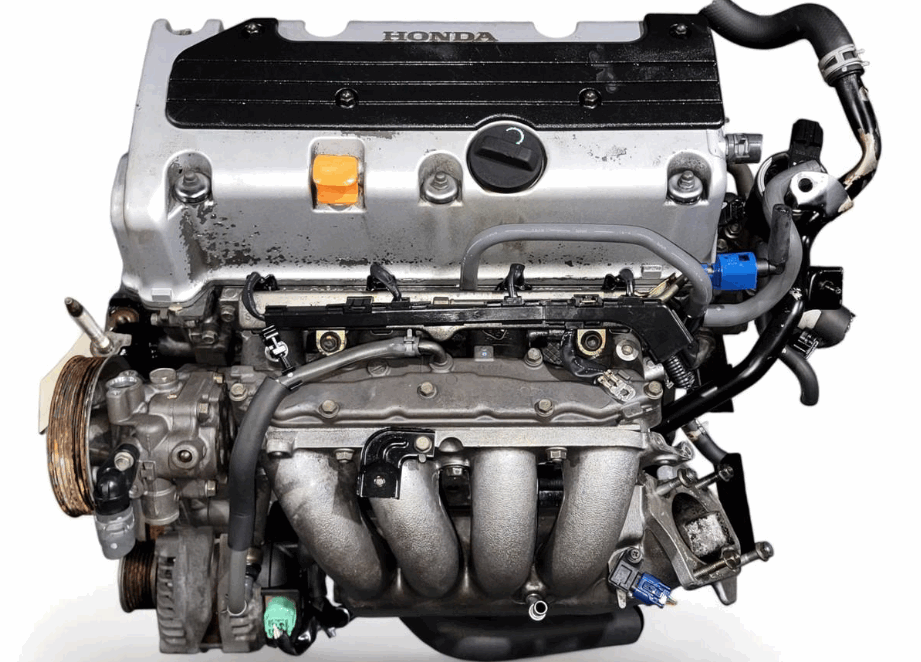
The Honda K24 is a naturally aspirated 2.4 liter inline four engine that belongs to the Honda K Series. Most K24 variants share a displacement of 2,354 cc, an 87 mm bore, and a 99 mm stroke. Honda also equips the engine with an aluminum block, an aluminum cylinder head, a DOHC valvetrain, and four valves per cylinder. These core specifications remain consistent across most factory versions, although power output and internal components vary by engine code.
The K24 uses a longer stroke than bore, which creates an undersquare engine design. This layout increases piston travel during each combustion cycle and helps the engine produce strong torque at low and medium engine speeds. As a result, the K24 delivers smooth acceleration in daily driving while maintaining good efficiency. Honda paired this design with i VTEC technology to improve airflow and optimize valve timing across different engine speeds.
Another important specification is the timing chain. Honda uses a timing chain instead of a timing belt, so the valve timing system requires less routine maintenance over the engine’s service life. The K24 also features sequential multiport fuel injection on most K24A and K24Z engines, while later K24W engines use direct injection as part of the Earth Dreams technology program. These fuel systems improve combustion efficiency, but they also create important differences between engine families.
Although every K24 shares the same basic architecture, no single specification applies to every version. Compression ratio, cylinder head design, intake manifold, camshaft profile, ECU calibration, horsepower, torque, and redline all depend on the engine code. For this reason, identifying the correct K24 variant is essential before comparing specifications, ordering replacement parts, or planning an engine swap.
| Specification | Standard Honda K24 Engine |
|---|---|
| Engine Family | Honda K Series |
| Configuration | Inline four |
| Displacement | 2,354 cc |
| Bore | 87 mm |
| Stroke | 99 mm |
| Valvetrain | DOHC, 16 valves |
| Block Material | Aluminum |
| Cylinder Head Material | Aluminum |
| Timing System | Timing chain |
| Aspiration | Naturally aspirated |
| Fuel System | Multiport fuel injection or direct injection depending on the variant |
How Much Horsepower and Torque Does a K24 Engine Produce?
Honda K24 engine specs vary across different engine codes, so horsepower and torque are not the same for every version. Factory output ranges from approximately 160 to 205 horsepower and from 161 to 174 lb ft of torque. Honda tuned each engine for a specific purpose. Some variants focus on fuel efficiency and everyday driving, while others deliver stronger performance for sportier models.
Engine design plays a major role in these differences. Compression ratio, camshaft profile, cylinder head design, intake manifold, exhaust system, and ECU calibration all influence power delivery. For example, the K24A2 uses a higher compression ratio and a performance focused i VTEC system. This combination helps the engine produce more horsepower at higher engine speeds while maintaining strong mid range torque. In contrast, the K24A1 prioritizes smooth torque and long term reliability for SUVs and family vehicles.
Vehicle application also affects factory performance. Honda matched each K24 variant with a transmission, final drive ratio, and engine calibration that suited the vehicle’s weight and intended use. As a result, two engines with the same displacement can deliver noticeably different driving characteristics. Later K24W engines also introduced direct injection technology, which improved combustion efficiency and increased torque across a broader rpm range.
Factory horsepower ratings represent crankshaft output measured under controlled conditions. Wheel horsepower is always lower because the drivetrain absorbs part of the engine’s power before it reaches the tires. For this reason, factory specifications provide the most reliable baseline when comparing different K24 engine variants.
| Engine Code | Horsepower | Torque | Primary Application |
|---|---|---|---|
| K24A1 | 160 hp | 162 lb ft | Honda CR V |
| K24A2 | 200 to 205 hp | 164 lb ft | Acura TSX |
| K24A4 | 160 hp | 161 lb ft | Honda Accord |
| K24A8 | 166 hp | 161 lb ft | Honda Accord |
| K24Z3 | 190 hp | 162 lb ft | Honda Accord |
| K24Z7 | 201 hp | 170 lb ft | Honda Civic Si |
| K24W7 | 201 hp | 174 lb ft | Acura TLX |
What Are the Specs of the Most Popular K24 Engines?
Several Honda K24 engines have become popular because they combine strong performance, proven reliability, and wide availability. Although every variant shares the same 2.4 liter displacement, each engine offers different specifications. Compression ratio, cylinder head design, fuel system, and ECU tuning all influence power output. Therefore, comparing the most common variants is the best way to identify the right engine for your needs.
First, the K24A1 delivers around 160 horsepower and 162 lb ft of torque. Honda developed this engine for the first generation CR V, where dependable low end torque and long term durability mattered more than peak power. As a result, it remains a practical choice for daily driving and affordable engine replacements.
Next, the K24A2 stands out as the most desirable performance variant. It features a higher compression ratio, a high flowing cylinder head, and a more aggressive i VTEC system. Consequently, factory output reaches up to 205 horsepower. Because of these upgrades, many enthusiasts choose the K24A2 for naturally aspirated builds and engine swap projects.
Meanwhile, the K24A4 and K24A8 prioritize smooth operation and fuel efficiency in the Honda Accord. In addition, both engines offer excellent reliability and low maintenance costs. Later, Honda introduced the K24Z and K24W families with updated cylinder heads, improved emissions systems, and newer engine management technology. For example, the K24Z7 produces about 201 horsepower in the Civic Si, while the K24W7 adds direct injection for greater efficiency.
Overall, every K24 variant serves a different purpose. Therefore, always compare the engine code, compression ratio, horsepower, torque, and fuel system before choosing a replacement engine or planning a performance build.
How Do K24A, K24Z, and K24W Engines Differ?
Honda developed the K24A, K24Z, and K24W families for different generations of vehicles and engineering goals. Although they share the same 2.4 liter displacement, they differ in cylinder head design, fuel system, emissions technology, and aftermarket support. Therefore, understanding these differences helps you choose the right engine for maintenance, replacement, or performance upgrades.
First, the K24A family offers the greatest flexibility for enthusiasts. Most K24A engines use a traditional K Series cylinder head with strong aftermarket support and excellent parts compatibility. As a result, these engines are common choices for engine swaps and naturally aspirated builds. The K24A2 stands out because it combines a high compression ratio with an advanced i VTEC system that delivers strong power across the rev range.
Next, Honda introduced the K24Z family to meet stricter emissions standards and improve packaging. Several K24Z engines feature a revised cylinder head and an integrated exhaust manifold. Consequently, they require different exhaust components than earlier K24A engines. However, the K24Z7 still delivers excellent performance and remains a popular option for the ninth generation Civic Si.
Finally, the K24W family represents the latest stage of K24 development. These engines use direct injection, updated electronics, and Earth Dreams technology to improve fuel economy and reduce emissions. In addition, they produce strong torque at lower engine speeds. However, their fuel system and electronic controls are more complex than those of earlier K24 engines. Therefore, performance upgrades and engine swaps usually require additional planning and specialized components.
Overall, the K24A suits traditional performance builds, the K24Z balances efficiency and power, and the K24W focuses on modern technology and fuel economy. For that reason, the engine code should always guide your decision instead of the displacement alone.
Which Honda and Acura Models Use a K24 Engine?
Honda installed the K24 engine in a wide range of passenger cars, SUVs, and performance models. Although every K24 shares the same basic architecture, Honda selected different engine codes for specific vehicles and markets. Therefore, identifying the original application is essential when comparing specifications or sourcing replacement parts.
First, the Honda Accord became one of the most common vehicles to use the K24 engine. Depending on the model year and market, it received the K24A4, K24A8, K24Z2, or K24Z3. These engines focused on smooth acceleration, dependable reliability, and balanced fuel economy. As a result, the Accord remains one of the easiest platforms for finding used K24 engines and replacement components.
Next, Honda equipped the CR V and Element with the K24A1 to deliver stronger low end torque for everyday driving. The Civic Si later adopted the K24Z7, which increased factory output to approximately 201 horsepower. Meanwhile, newer Accord models introduced the K24W family with direct injection and Earth Dreams technology to improve efficiency and reduce emissions.
In addition, Acura used the K24 engine in several premium models. The Acura TSX featured the performance focused K24A2, while later ILX and TLX models received K24W variants with updated electronics and fuel systems. Consequently, Acura models often provide attractive engine options for enthusiasts who want higher factory performance without extensive modifications.
The table below summarizes the most common K24 applications.
| Vehicle | Common Engine Code | Primary Focus |
|---|---|---|
| Honda Accord | K24A4, K24A8, K24Z2, K24Z3 | Daily driving and efficiency |
| Honda CR V | K24A1 | Low end torque and reliability |
| Honda Element | K24A4 | Utility and durability |
| Honda Civic Si | K24Z7 | Factory performance |
| Acura TSX | K24A2 | Sport performance |
| Acura ILX | K24W | Efficiency and refinement |
| Acura TLX | K24W7 | Modern performance and fuel economy |
Overall, the vehicle name alone does not identify a K24 engine. Therefore, always verify the engine code before purchasing parts, comparing specifications, or planning an engine swap.
How Can You Identify a Honda K24 Engine?
Identifying a Honda K24 engine starts with finding the engine code. Although many K24 variants look similar, each engine code represents a specific combination of internal components and factory specifications. Therefore, checking the code is the most accurate way to confirm the engine before ordering parts or planning an engine swap.
First, locate the engine code on the front of the engine block. Honda stamps the code into a machined surface near the transmission mounting area. Once you find the stamp, clean the surface and read the complete code carefully. A code such as K24A2 or K24Z7 immediately identifies the engine family and helps you verify its original application.
Next, compare the engine with its factory configuration. The intake manifold, exhaust manifold, valve cover, and fuel system often provide useful clues. For example, most K24A and K24Z engines use multiport fuel injection, while K24W engines feature direct injection with a high pressure fuel pump. In addition, several K24Z variants use an integrated exhaust manifold that differs from earlier K24A designs.
Meanwhile, you should also confirm the original vehicle and model year. Honda sometimes installed different K24 variants in the same model across different markets. As a result, the vehicle name alone cannot guarantee the correct engine code. Matching the stamped code with the vehicle identification information reduces the risk of buying incompatible parts.
Overall, the engine code provides the most reliable identification method. Therefore, verify the code before comparing specifications, replacing components, or selecting aftermarket upgrades. This simple step saves time, prevents costly mistakes, and ensures the engine matches your intended application.
Which K24 Engine Is Best for Performance?
The K24A2 is widely regarded as the best factory K24 engine for performance builds. Although several K24 variants offer strong reliability, the K24A2 combines higher horsepower, a performance oriented cylinder head, and excellent aftermarket support. Therefore, it has become the preferred choice for enthusiasts who want to build a naturally aspirated or turbocharged Honda engine.
First, the K24A2 features a 10.5:1 compression ratio, an advanced i VTEC system, and high flowing intake and exhaust ports. These upgrades improve airflow and help the engine produce up to 205 horsepower from the factory. As a result, the K24A2 responds well to bolt on modifications, upgraded camshafts, and ECU tuning. Many builders also pair it with a six speed manual transmission to maximize performance.
Meanwhile, the K24A1, K24A4, and K24A8 provide a more affordable starting point. These engines cost less on the used market and remain highly reliable. However, they use less aggressive cylinder heads and lower compression ratios than the K24A2. Consequently, many owners upgrade the cylinder head, intake manifold, and camshafts before targeting higher power levels.
In addition, the K24Z7 offers an attractive balance between performance and availability. It produces about 201 horsepower in the ninth generation Honda Civic Si and includes modern engine management technology. However, its cylinder head and exhaust design reduce compatibility with some traditional K Series performance parts. For that reason, modification costs can increase compared with a K24A2 build.
Overall, the best K24 engine depends on your budget and performance goals. If you want the strongest factory foundation, the K24A2 remains the benchmark. On the other hand, budget minded enthusiasts can achieve excellent results with other K24 variants after selecting the right supporting components and engine tuning.
How Much Power Can a Stock K24 Engine Handle?
A stock Honda K24 engine can support impressive power, but there is no single horsepower limit for every variant. Although many enthusiasts focus on peak horsepower, engine condition plays a much bigger role in long term reliability. Therefore, the safest power level depends on the engine code, maintenance history, tuning quality, and intended use.
First, the factory connecting rods and pistons become the main limiting components as power increases. They can handle moderate performance upgrades when the engine receives proper tuning and regular maintenance. However, excessive boost, poor fuel quality, or aggressive ignition timing can shorten engine life. As a result, two engines with similar modifications may deliver very different levels of reliability.
Next, professional ECU tuning is one of the most important factors in a high performance K24 build. A well calibrated tune controls the air fuel ratio, ignition timing, and engine temperature under different driving conditions. Consequently, the engine produces consistent power while reducing the risk of detonation or excessive cylinder pressure. In contrast, an incorrect tune can damage internal components even at relatively modest power levels.
Moreover, supporting modifications are just as important as engine internals. Upgraded fuel injectors, a higher capacity fuel pump, an efficient cooling system, and a stronger clutch all help the engine operate safely under increased load. In addition, regular oil changes and routine inspections improve long term durability after performance modifications.
Overall, a stock K24 responds well to carefully planned upgrades and professional tuning. Therefore, focus on building a balanced combination instead of chasing the highest dyno number. Ultimately, reliable performance comes from proper engineering, quality components, and consistent maintenance rather than horsepower alone.
What Are the Main Differences Between K24 and K20 Engine Specs?
The Honda K24 and K20 belong to the same K Series engine family, but they deliver different driving characteristics. Although both engines share a similar design, the K24 uses a larger displacement and a longer stroke. Therefore, it produces more low end and mid range torque than the K20. The K20, by comparison, favors higher engine speeds and delivers stronger performance at the top of the rev range.
First, the K24 has a displacement of 2,354 cc with an 87 mm bore and a 99 mm stroke. The K20 typically displaces about 1,998 cc and uses a shorter stroke. As a result, the K24 develops more torque during normal driving and provides smoother acceleration without requiring high engine speeds. Meanwhile, the K20 revs more freely because its shorter stroke reduces average piston speed.
Next, each engine supports a different performance strategy. The K24 suits street cars, daily drivers, and turbocharged builds that need strong torque across a wide rpm range. In contrast, the K20 appeals to enthusiasts who prefer naturally aspirated performance and high revving characteristics. Consequently, many Honda builders combine a K24 bottom end with a K20 cylinder head to create a hybrid engine that delivers both torque and high rpm airflow.
Moreover, aftermarket support is excellent for both engines. Performance parts, ECU solutions, and upgrade kits are widely available for each platform. However, component compatibility depends on the engine code and model year. Therefore, builders should always confirm parts before starting a project.
| Specification | K24 | K20 |
|---|---|---|
| Displacement | 2,354 cc | 1,998 cc |
| Bore | 87 mm | 86 mm |
| Stroke | 99 mm | 86 mm |
| Power Character | Strong low and mid range torque | Strong high rpm performance |
| Typical Application | Street, swap, and turbo builds | Naturally aspirated performance |
| Common Hybrid Use | Bottom end | Cylinder head |
Overall, neither engine is universally better than the other. Instead, the right choice depends on your driving style, performance goals, and budget. For that reason, many enthusiasts select the K24 for torque focused builds, while others choose the K20 for maximum engine speed and responsive power delivery.
Is the Honda K24 Engine Reliable?
The Honda K24 has earned a strong reputation for long term reliability and durability. Although every engine requires regular maintenance, the K24 often delivers well over 200,000 miles with proper care. Therefore, it remains one of the most trusted four cylinder engines for daily driving, engine swaps, and performance projects.
First, the K24 uses a timing chain instead of a timing belt. This design reduces routine maintenance and improves long term durability. The aluminum block also helps reduce vehicle weight without sacrificing structural strength. As a result, the engine performs efficiently while maintaining dependable reliability under normal driving conditions.
Next, routine maintenance has a greater impact on reliability than the engine code itself. Regular oil changes, coolant replacement, and valve clearance inspections help protect critical components. In addition, using the correct engine oil and replacing worn filters improve lubrication and reduce internal wear. Consequently, a well maintained K24 often outlasts engines that receive irregular service.
However, no engine is completely free from problems. High mileage K24 engines may develop timing chain tensioner wear, VTC actuator noise, oil leaks, or increased oil consumption. For example, neglected cooling systems can cause overheating, which may damage the cylinder head or head gasket. Fortunately, most of these issues become manageable when owners identify them early and perform timely repairs.
Overall, the K24 remains one of Honda’s most dependable engine families. Therefore, buyers should focus on maintenance history rather than mileage alone. Before purchasing a used engine, inspect service records, check for oil leaks, and perform compression or leak down tests whenever possible. These steps provide a much clearer picture of engine condition than the odometer reading by itself.
What Should You Check Before Buying a Used K24 Engine?
Buying a used K24 engine can save money, but the engine’s condition matters more than its price. Although many K24 engines remain reliable after high mileage, poor maintenance can shorten their service life. Therefore, a careful inspection helps you avoid unexpected repairs and expensive replacement parts.
First, verify the engine code stamped on the engine block. The code confirms the exact variant and helps you match the engine with your vehicle. Next, confirm the original model year and application because Honda installed different K24 versions in similar vehicles. As a result, checking the engine code prevents compatibility issues during installation.
In addition, inspect the engine for visible signs of damage. Look for oil leaks, coolant stains, broken sensors, cracked housings, or damaged wiring. Meanwhile, remove the oil filler cap and check for sludge or heavy deposits that may indicate poor maintenance. Clean engine oil and coolant usually suggest that the previous owner serviced the engine regularly.
Moreover, perform a compression test and, if possible, a leak down test. These inspections reveal the condition of the pistons, piston rings, valves, and head gasket. For example, uneven compression across the cylinders may indicate internal wear that requires costly repairs. Likewise, listen for abnormal timing chain or VTC actuator noise when the engine runs, as these components can wear with age.
Finally, ask for maintenance records, service receipts, or warranty information whenever they are available. Overall, a documented service history provides more confidence than mileage alone. Therefore, choose an engine with verified maintenance, healthy compression, and the correct engine code instead of selecting the lowest priced option.
What K24 Engine Specs Matter Most for an Engine Swap?
Engine swaps involve much more than matching displacement or horsepower. Although every K24 engine shares the same basic architecture, important specifications vary between engine codes. Therefore, selecting the correct variant is the first step toward a successful and reliable swap.
First, confirm the engine code before purchasing any parts. The engine code determines the cylinder head design, compression ratio, fuel system, and ECU compatibility. As a result, it also affects wiring, tuning options, and aftermarket support. A K24A2, for example, offers different performance potential than a K24W7 even though both engines have the same displacement.
Next, consider transmission compatibility and engine mounting points. Most K24A engines work well with traditional Honda manual transmissions and benefit from extensive aftermarket support. In contrast, newer K24W engines require different electronic systems and additional components because they use direct injection technology. Consequently, swap costs can increase when newer engines replace older platforms.
Moreover, pay close attention to the fuel system, intake layout, and exhaust design. These components influence installation, tuning, and long term reliability. For example, several K24Z engines use an integrated exhaust manifold that requires different headers than earlier K24A engines. Likewise, K24W engines need high pressure fuel system components that are unnecessary for multiport fuel injection engines.
Finally, define your project goals before choosing an engine. A daily driver benefits from reliability and simple maintenance, while a track car may require stronger airflow and greater tuning flexibility. Overall, the best K24 engine swap combines the correct engine code, compatible electronics, and realistic performance goals. Therefore, evaluate the complete package instead of focusing on horsepower alone.
Conclusion: Which K24 Engine Should You Choose?
Choosing the right Honda K24 engine depends on your goals rather than the displacement alone. Although every K24 engine shares the same 2.4 liter foundation, each variant offers different specifications, performance characteristics, and compatibility. Therefore, understanding the engine code is far more important than simply knowing the engine family.
First, compare the core specifications before making a decision. Compression ratio, horsepower, torque, cylinder head design, and fuel system all influence how the engine performs in real world conditions. In addition, ECU compatibility and transmission options play a major role in both replacement projects and engine swaps.
Next, consider how you plan to use the engine. A factory replacement should match the original engine code whenever possible because this approach simplifies installation and maintains factory reliability. In contrast, a performance build may benefit from a K24A2 or another variant with stronger aftermarket support and greater tuning potential. As a result, selecting the right engine early can reduce costs and prevent compatibility issues later.
Finally, inspect any used engine carefully before purchasing it. Service history, compression results, and overall condition provide a better indication of reliability than mileage alone. Overall, the Honda K24 remains one of the most versatile four cylinder engines ever produced. Whether you need a dependable daily driver, a reliable replacement engine, or a solid foundation for a performance build, comparing the exact engine code and specifications will help you make the right choice with confidence.