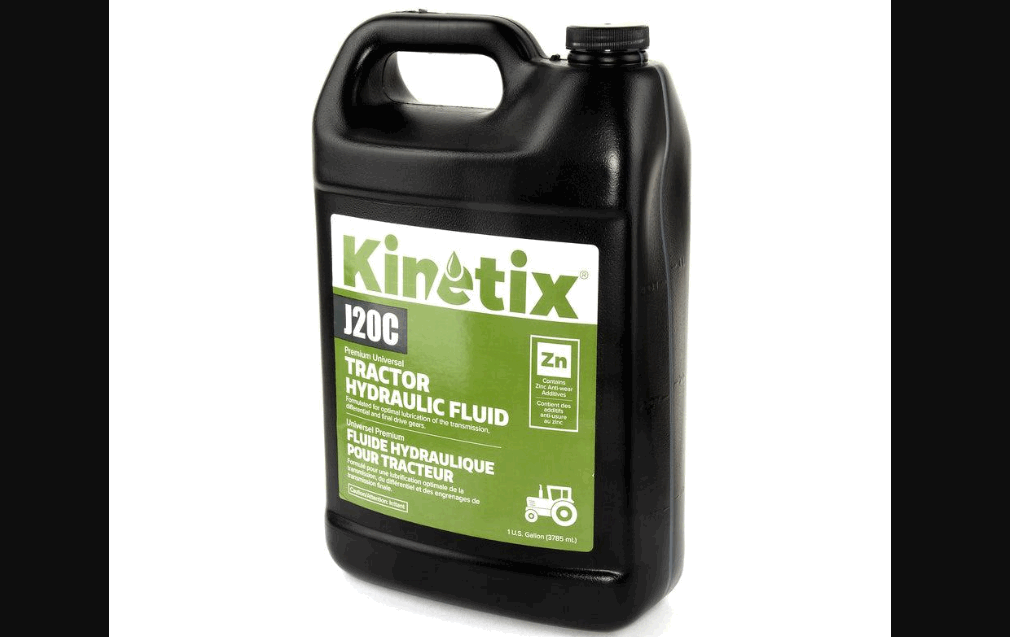
J20C hydraulic oil equivalents meet the performance requirements of the John Deere JDM J20C specification. These fluids support compatible hydraulic, transmission, and drivetrain systems. They provide lubrication, wear protection, friction control, and stable hydraulic performance. John Deere Hy Gard closely relates to the J20C specification. Several lubricant manufacturers also offer compatible Universal Tractor Hydraulic Fluids.
However, similar viscosity does not make two fluids equivalent. A generic tractor hydraulic fluid may not provide the friction characteristics that a J20C application requires. Always check the equipment manual and the lubricant manufacturer’s specifications before choosing a replacement.
This requirement matters because many tractors use one fluid across several systems. The same fluid may serve the hydraulic system, transmission, wet brakes, differential, and other drivetrain components. Using the wrong fluid can affect hydraulic response, lubrication, braking behavior, and transmission performance.
This guide explains how to identify a suitable J20C hydraulic oil equivalent. It covers the J20C specification, viscosity, John Deere Hy Gard, and Universal Tractor Hydraulic Fluid compatibility. It also compares J20C with J20D and explains how to select the correct replacement for your equipment.
What Is Equivalent to J20C Hydraulic Oil?
A J20C hydraulic oil equivalent is a tractor transmission and hydraulic fluid that meets the John Deere JDM J20C performance requirements. John Deere Hy Gard serves as the primary reference fluid for this application. Several aftermarket Universal Tractor Hydraulic Fluids also claim J20C compatibility. Always confirm this claim on the product label or current technical data sheet.
The correct equivalent must support more than hydraulic operation. Many tractors use one fluid for the transmission, hydraulic system, wet brakes, differential, and final drive. These systems require specific friction, lubrication, and wear protection properties. For this reason, similar viscosity alone does not make a hydraulic oil an appropriate J20C replacement.
Universal Tractor Hydraulic Fluid can replace J20C when its manufacturer explicitly states that the fluid meets or supports the required J20C application. Generic hydraulic oils require more caution. For example, an ISO viscosity grade describes viscosity at defined test conditions. It does not confirm the friction characteristics or drivetrain performance required by a tractor transmission and hydraulic system.
| Fluid or Specification | J20C Replacement Status | What to Check |
|---|---|---|
| John Deere Hy Gard | Primary reference option | Equipment manual |
| J20C compatible UTF or UTHF | Suitable when specified | Product data sheet |
| J20D fluid | Not automatically interchangeable | Temperature and equipment requirements |
| Generic hydraulic oil | Do not assume equivalence | Performance specifications |
| Older John Deere specifications | Check before substitution | Manufacturer requirements |
The safest replacement is therefore a fluid whose manufacturer clearly identifies J20C compatibility for the intended equipment. Check both the machine manual and lubricant documentation before filling, topping off, or changing the system.
What Does the John Deere J20C Specification Mean?
The John Deere J20C specification defines performance requirements for fluids used in compatible tractor transmission and hydraulic systems. It covers more than viscosity. A suitable fluid must support lubrication, hydraulic operation, wear protection, and friction control across the systems that share the oil.
This distinction helps explain why J20C differs from a basic hydraulic oil classification. Many tractors use a common fluid reservoir for several components. The fluid may lubricate the transmission while also operating the hydraulic system. It may also serve wet brakes, differentials, and other drivetrain components. Each application places different demands on the same fluid.
Friction performance is especially important in systems with wet brakes and transmission components. The correct fluid helps these parts operate smoothly while maintaining adequate lubrication. Wear protection also helps protect pumps, gears, bearings, and other moving components. In addition, oxidation resistance helps the fluid maintain its properties during extended operation and exposure to heat.
Viscosity remains an important part of fluid selection, but it cannot prove J20C equivalence by itself. Two oils can have similar viscosity while using different additive packages and friction characteristics. Those differences can change their performance inside a tractor.
For this reason, check the complete performance claim when selecting a J20C hydraulic oil equivalent. Look for a clear J20C reference in the lubricant manufacturer’s current documentation. Then compare that information with the fluid requirement in the equipment manual. This process provides a stronger basis for replacement than viscosity, product name, or fluid color alone.
What Is the Viscosity of J20C Hydraulic Oil?
J20C hydraulic oil does not use a single ISO viscosity grade as its main definition. J20C defines fluid performance for compatible tractor transmission and hydraulic systems. Therefore, you should not identify a J20C equivalent by viscosity alone. The complete performance specification matters more when choosing a replacement.
Viscosity describes how strongly a fluid resists flow at a given temperature. Cold conditions increase oil viscosity and make the fluid flow more slowly. Higher temperatures reduce viscosity and allow the fluid to flow more easily. A tractor fluid must maintain suitable behavior across its expected operating temperature range. This characteristic supports hydraulic response and protects lubricated components during operation.
However, matching viscosity does not guarantee matching performance. A generic hydraulic oil may have similar viscosity characteristics to a tractor fluid. It can still lack the friction properties needed by wet brakes or transmission components. Its additive system may also provide different levels of wear protection and oxidation resistance.
The same distinction applies when comparing J20C with ISO 46 hydraulic oil. ISO 46 primarily identifies a viscosity grade. J20C addresses broader performance requirements for specific transmission and hydraulic applications. The two classifications therefore describe different aspects of a lubricant.
Check the equipment manual before selecting oil based on viscosity. Then verify that the replacement fluid manufacturer lists the appropriate J20C application or performance claim. This approach considers both operating conditions and system requirements. It also reduces the risk of choosing an oil that has similar viscosity but lacks the required drivetrain performance.
Is John Deere Hy Gard the Same as J20C?
John Deere Hy Gard and J20C are closely related, but the two terms do not describe the same type of entity. Hy Gard is a John Deere transmission and hydraulic fluid product. J20C is a John Deere fluid performance specification. This distinction matters when you compare Hy Gard with aftermarket alternatives.
John Deere uses Hy Gard for applications that require specific transmission and hydraulic fluid performance. The fluid supports several functions in compatible equipment. These include hydraulic operation, transmission lubrication, wet brake performance, and drivetrain protection. J20C provides the performance reference that helps users identify fluids for the appropriate applications.
This relationship also explains why people often use “Hy Gard equivalent” and “J20C equivalent” in similar searches. A replacement does not need the Hy Gard brand name to qualify for consideration. Instead, check whether the lubricant manufacturer identifies its product as suitable for the required J20C application. You should also confirm that claim against the equipment manual.
Do not assume that every Universal Tractor Hydraulic Fluid matches Hy Gard or J20C requirements. Products within this category can use different formulations and support different equipment specifications. A similar product name, color, or viscosity does not establish equivalent performance.
When comparing Hy Gard with another fluid, start with the specification rather than the brand. Check the equipment requirement first. Next, review the alternative fluid’s current technical documentation for its J20C claim and intended applications. This method provides a clearer way to identify an appropriate J20C hydraulic oil equivalent.
Can Universal Tractor Hydraulic Fluid Replace J20C?
Universal Tractor Hydraulic Fluid can replace J20C when the fluid manufacturer identifies it as suitable for the required J20C application. The term Universal Tractor Hydraulic Fluid alone does not confirm compatibility. Always check the product specifications before using a UTF or UTHF as a J20C replacement.
Manufacturers formulate tractor hydraulic fluids for several functions. One fluid may operate the hydraulic system and lubricate the transmission. It may also support wet brakes, differentials, final drives, and other compatible components. These systems require more than suitable viscosity. They also depend on the correct friction, wear protection, and lubrication characteristics.
Use 5 checks when evaluating a Universal Tractor Hydraulic Fluid. First, read the equipment manual and confirm the required fluid specification. Second, find the J20C reference in the lubricant manufacturer’s current product documentation. Third, check the intended equipment applications. Fourth, compare the fluid with the operating temperature requirements. Fifth, confirm its suitability for wet brakes and transmission components when the equipment uses these systems.
Do not choose a replacement only because the container says “universal.” Products in the UTF or UTHF category can support different specifications and applications. A generic hydraulic oil also differs from a tractor transmission and hydraulic fluid, even when both products have similar viscosity.
The safest approach combines equipment requirements with lubricant documentation. Choose a Universal Tractor Hydraulic Fluid only after confirming the relevant J20C claim and application. This process provides a stronger basis for replacement than price, brand, viscosity, or the word “universal” on the product label.
What Is the Difference Between J20C and J20D Hydraulic Fluid?
J20C and J20D are John Deere fluid specifications for different operating requirements. The main difference involves their viscosity characteristics and temperature applications. J20C suits standard operating conditions, while J20D addresses applications that require better fluid behavior at lower temperatures.
Temperature affects how quickly a fluid flows through a hydraulic system. Oil becomes more resistant to flow as temperatures fall. A lower viscosity fluid can improve circulation and hydraulic response during cold starts. However, this difference does not make J20D a universal replacement for J20C.
Both specifications relate to fluids that may serve several tractor systems. These systems can include the transmission, hydraulics, wet brakes, and drivetrain components. The equipment manufacturer selects a fluid specification based on the system design and expected operating conditions.
| Factor | J20C | J20D |
|---|---|---|
| Specification type | Transmission and hydraulic fluid | Transmission and hydraulic fluid |
| Viscosity characteristics | Higher than J20D | Lower than J20C |
| Temperature focus | Standard operating conditions | Colder operating conditions |
| Typical selection | Normal service requirements | Low temperature service requirements |
| Interchangeability | Follow equipment requirements | Do not assume direct substitution |
Can You Use J20D Instead of J20C?
Do not use J20D instead of J20C based only on their similar applications. First, check whether the equipment manufacturer allows the substitution. The lower viscosity of a J20D fluid can support cold temperature operation, but the equipment still determines the correct requirement.
Check the owner’s manual before switching specifications. You should also review the lubricant manufacturer’s current technical data. These two sources provide a stronger basis for choosing between J20C and J20D than viscosity alone.
What Equipment Uses J20C Hydraulic Oil?
J20C hydraulic oil serves compatible tractors and equipment that require a common transmission and hydraulic fluid. John Deere equipment represents the main application because J20C is a John Deere specification. Other equipment may also use fluids with comparable requirements when the manufacturer lists the appropriate specification. Always use the equipment manual to confirm the correct fluid.
A J20C compatible fluid can perform several jobs within one machine. The hydraulic system uses the fluid to transfer power and operate components such as cylinders and hydraulic implements. The transmission relies on the fluid for lubrication and smooth operation. This shared fluid design allows one lubricant to support several connected systems.
Wet brakes create another important application. These brakes operate in contact with the fluid and depend on suitable friction characteristics. The wrong fluid can change how the brake surfaces interact. Differentials, final drives, and other drivetrain components may also share the same lubricant on compatible equipment. This arrangement makes complete fluid performance more important than viscosity alone.
Do not assume that every John Deere tractor or agricultural machine requires J20C. Fluid requirements vary by model, system design, operating conditions, and manufacturer recommendations. Older equipment may specify an earlier fluid standard. Other machines may require a different specification.
Check the lubrication or maintenance section of the equipment manual before adding fluid. Identify the required specification and compare it with the lubricant manufacturer’s current documentation. This method confirms whether a J20C hydraulic oil equivalent suits the specific tractor, transmission, hydraulic system, and operating conditions.
How Do You Choose the Correct J20C Hydraulic Oil Equivalent?
Choose a J20C hydraulic oil equivalent by matching the fluid specification with the requirements of your equipment. Do not rely on brand, price, color, or viscosity alone. A suitable replacement must support the hydraulic, transmission, and friction requirements that apply to the machine.
Start with the equipment manual. Find the lubrication section and identify the required transmission and hydraulic fluid specification. This step establishes the standard that a replacement must satisfy. It also prevents confusion between J20C and other fluid specifications used in similar equipment.
Next, check the lubricant manufacturer’s current product documentation. Look for a clear reference to the required J20C application or performance level. Then confirm that the fluid suits the intended system. This check matters when one reservoir supplies the transmission, hydraulics, wet brakes, and drivetrain components.
Temperature also affects fluid selection. Compare the lubricant’s operating characteristics with the conditions in which you use the equipment. Cold starts and high operating temperatures place different demands on fluid viscosity and circulation.
Use 6 factors when selecting a replacement: the required specification, equipment manufacturer guidance, lubricant compatibility claim, viscosity characteristics, operating temperature, and system requirements. Wet brakes and transmission components deserve particular attention because they depend on suitable friction properties.
A similar hydraulic oil is not automatically an equivalent hydraulic oil. Match the complete fluid requirement before making the switch. Finally, confirm both the equipment manual and lubricant documentation before filling the system. This process provides a reliable basis for choosing a J20C hydraulic oil equivalent.
What Happens If You Use the Wrong Fluid Instead of J20C?
Using the wrong fluid instead of J20C can affect hydraulic performance, transmission operation, wet brakes, and component protection. The exact result depends on how the replacement differs from the required fluid. Incorrect viscosity, friction characteristics, or additive performance can change how several shared systems operate.
Incorrect viscosity can affect hydraulic response and lubrication. A fluid that flows too slowly in cold conditions can reduce hydraulic response during startup. A fluid that becomes too thin under operating conditions may provide inadequate lubrication for certain components. The equipment design determines the viscosity characteristics that the system requires.
Incorrect friction properties can cause problems in transmissions and wet brakes. Wet brake systems depend on controlled friction between surfaces that operate in fluid. An unsuitable lubricant can change this interaction and contribute to noise, chatter, or inconsistent brake behavior. Transmission components may also require specific friction characteristics for smooth operation.
Insufficient wear protection creates another risk. Pumps, gears, bearings, and other moving parts rely on the lubricant to reduce direct surface contact. Poor fluid performance can increase friction and accelerate component wear over time. Fluid oxidation and contamination can further reduce lubricant performance during service.
Avoid these problems by matching the replacement to the equipment requirement. Check the manual for the required specification. Then confirm the lubricant manufacturer’s J20C compatibility claim and intended applications. Similar viscosity or a generic hydraulic oil label does not provide enough evidence. The complete fluid performance determines whether an alternative suits a J20C application.
Can You Mix J20C Hydraulic Oil With Other Tractor Fluids?
You should only mix J20C hydraulic oil with another tractor fluid after confirming their compatibility. Two fluids may mix physically without providing the same performance. For this reason, physical miscibility does not prove that two tractor fluids work correctly in the same system.
Start by checking the specification of both fluids. The replacement fluid should support the requirements listed for the equipment. You should also review the lubricant manufacturer’s current technical information. Do not mix fluids based only on similar viscosity, color, product name, or the term Universal Tractor Hydraulic Fluid.
Mixing incompatible fluids can change the properties of the lubricant in the system. Different formulations may provide different friction characteristics, viscosity behavior, or additive performance. These differences matter when one fluid serves the hydraulics, transmission, wet brakes, and drivetrain components.
Topping off also differs from a complete fluid change. Topping off leaves most of the existing lubricant inside the system. As a result, the new fluid immediately becomes part of the existing fluid mixture. A complete change removes much more of the old fluid, although some residual oil can remain in lines and components.
Take extra care when you do not know which fluid is already in the machine. Check the service history or identify the existing product before adding another lubricant. Follow the equipment manufacturer’s service procedure when compatibility remains uncertain.
The safest approach is simple. Confirm the required specification, identify the existing fluid, and verify compatibility before mixing. If you cannot confirm these points, avoid using an unfamiliar fluid only because its viscosity appears similar to J20C.
What Should You Remember When Choosing a J20C Hydraulic Oil Equivalent?
Choose a J20C hydraulic oil equivalent by matching the replacement fluid with the requirements of your equipment. Start with the John Deere J20C specification rather than brand, price, color, or viscosity alone. The correct fluid must support the systems and operating conditions that apply to the machine.
Keep the difference between a product and a specification clear. John Deere Hy Gard is a lubricant product, while J20C defines fluid performance requirements. An aftermarket Universal Tractor Hydraulic Fluid may provide a suitable alternative when its manufacturer lists the appropriate J20C application. The word “universal” alone does not confirm compatibility.
Check viscosity characteristics and operating temperature before switching fluids. Also consider the transmission, hydraulic system, wet brakes, and other components that share the lubricant. Do not assume that J20D, generic hydraulic oil, or another tractor fluid can replace J20C without checking the equipment requirements.
Use two sources for the final decision. First, check the equipment manual for the required fluid specification. Second, review the lubricant manufacturer’s current technical documentation for its compatibility claim. These checks help you select a J20C hydraulic oil equivalent that matches the intended application and reduces the risk of performance problems.