Toyota is generally more reliable than Hyundai for long-term ownership, but the difference depends heavily on the specific model, model year, powertrain, mileage, and maintenance history. Toyota has built a stronger track record for vehicle longevity and consistent mechanical durability, while Hyundai has narrowed the reliability gap with newer vehicles and competitive warranty coverage. A well-maintained Hyundai can therefore be a more reliable purchase than a neglected Toyota.
Comparing Hyundai vs Toyota reliability requires more than looking at a single brand-level reliability score. Engine and transmission durability, repair frequency, common mechanical problems, recalls, maintenance requirements, and performance at higher mileage all affect how dependable a vehicle remains as it ages. Reliability can also vary substantially within the same manufacturer because different models and model years use different engines, transmissions, electrical systems, and other components.
This comparison examines Hyundai and Toyota across those factors, then compares individual models and used vehicles. The goal is to determine not only which brand has the stronger overall reliability record, but also when a Hyundai may be the better choice and which factors should be checked before choosing either brand for long-term ownership.
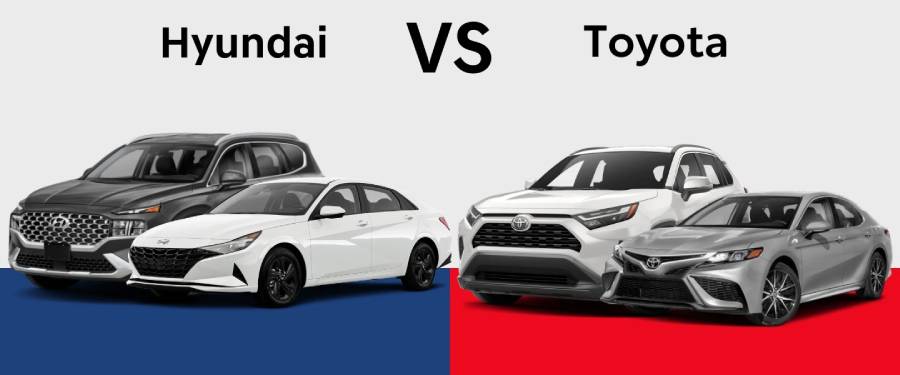
Is Toyota More Reliable Than Hyundai?
Toyota is more reliable than Hyundai overall when long-term durability, consistency across models, and high-mileage ownership are the main criteria. Toyota’s advantage is its established record of producing vehicles and powertrains that remain operational at high mileage with routine maintenance. Hyundai has improved its vehicle quality, but reliability varies more by model, model year, engine, and transmission.
The reliability difference becomes more important as vehicles age. A reliable vehicle must do more than avoid problems during its first few years; it must limit major mechanical failures as mileage increases. Engines, transmissions, cooling systems, electrical components, and other powertrain-related parts determine whether an older vehicle continues operating without repairs that cost a substantial percentage of its remaining value. Toyota’s advantage is strongest in this long-term ownership context rather than during the earliest years of ownership.
Hyundai should not be classified as an unreliable brand based solely on Toyota’s stronger long-term record. Reliability exists at the model and powertrain level as well as the manufacturer level. A Hyundai with a dependable powertrain and complete maintenance history can provide better reliability than a Toyota from a problematic model year or one that has been poorly maintained. Vehicle condition becomes increasingly important when comparing used cars.
The practical difference is therefore consistency. Toyota is the stronger choice when a buyer wants to reduce uncertainty about long-term reliability across the brand. Hyundai requires closer evaluation of the specific vehicle, particularly its model year, engine, transmission, service history, and recall history.
How Do Hyundai and Toyota Reliability Ratings Compare?
Toyota generally performs better than Hyundai in brand-level reliability comparisons, but no single reliability rating can establish which individual vehicle will be more dependable. Reliability organizations use different methodologies, data sets, vehicle ages, and definitions of a problem. Two ratings can therefore produce different rankings without either measurement necessarily being incorrect.
A predicted reliability rating, for example, estimates how a newer vehicle is likely to perform based on available data. Repair-based measurements instead examine factors such as how frequently vehicles require repairs, how expensive those repairs are, and how severe the problems become. Owner surveys introduce another data source by recording problems reported by drivers. These methods measure related but different aspects of vehicle reliability.
Model coverage also affects brand averages. Toyota and Hyundai sell vehicles with different engines, transmissions, hybrid systems, electrical architectures, and production histories. One poorly performing powertrain can reduce the reliability results of several models that use it, while consistently dependable high-volume models can strengthen a manufacturer’s overall rating. For this reason, a brand score should be treated as the beginning of the comparison rather than the final purchasing criterion.
The strongest reliability comparison uses multiple layers of evidence: brand-level data identifies the overall pattern, model-level data narrows the comparison, and model-year and powertrain data identifies the risk of the specific vehicle. For a used Hyundai or Toyota, maintenance records, mileage, accident history, unresolved recalls, and a pre-purchase inspection add vehicle-specific evidence that a brand rating cannot provide.
Do Toyota Vehicles Last Longer Than Hyundai Vehicles?
Toyota vehicles generally have the stronger record for long-term longevity, particularly when the comparison extends into high-mileage ownership. The advantage does not mean every Toyota will reach a specific mileage or that Hyundai vehicles have a fixed shorter lifespan. Vehicle longevity depends on the interaction between powertrain durability, maintenance history, driving conditions, vehicle age, and the severity of repairs accumulated over time.
Mileage alone is not an adequate measurement of longevity. A vehicle that reaches high mileage after repeated engine or transmission replacements represents a different reliability outcome from one that reaches the same mileage with its original major powertrain components. Long-term reliability is therefore better evaluated by examining how frequently major repairs occur as mileage increases and whether the cost of those repairs remains economically reasonable relative to the vehicle’s value.
Toyota’s advantage comes from consistency across long ownership periods. Models such as the Corolla, Camry, RAV4, and Highlander have helped establish the brand’s reputation for durability, but the Toyota badge itself does not guarantee a specific lifespan. Different generations use different engines, transmissions, hybrid components, and electrical systems, so a reliability assessment should identify the model year and powertrain rather than applying one mileage expectation to every Toyota.
Hyundai vehicles can also remain dependable at high mileage when the model has a reliable powertrain and receives proper maintenance. However, Hyundai’s historical reliability record varies more between specific engines and model years. This makes maintenance documentation and powertrain identification particularly important when evaluating an older Hyundai. A lower-mileage vehicle with incomplete service records is not automatically a safer purchase than a higher-mileage vehicle with documented maintenance.
For buyers planning to keep a vehicle for many years, Toyota provides the stronger brand-level longevity proposition, while Hyundai requires more model-specific investigation. Oil-change history, cooling-system maintenance, transmission servicing, previous repairs, accident history, and unresolved recalls should be evaluated before predicting how long either vehicle will remain dependable.
Are Toyota Engines More Reliable Than Hyundai Engines?
Toyota engines are generally more reliable than Hyundai engines at the brand level because Toyota has demonstrated greater consistency in long-term engine durability. The difference becomes most relevant after years of use, when lubrication, cooling, timing components, seals, sensors, and internal engine components have accumulated substantial operating time.
Engine reliability is determined by more than whether an engine continues running. A dependable engine should operate for an extended period without excessive oil consumption, recurring overheating, internal component damage, or another failure requiring major repair or replacement. Maintenance remains critical because insufficient lubrication, incorrect fluids, overheating, and delayed servicing can damage an otherwise durable engine.
Toyota is not free from engine problems. Reliability varies between engine families, production periods, vehicle applications, and model years. A problem associated with one Toyota engine should therefore not be presented as evidence that all Toyota engines share the same defect. The same rule applies more strongly to Hyundai because several Hyundai models can share a powertrain while other vehicles from the manufacturer use substantially different engine designs.
What Engine Problems Are Common in Hyundai and Toyota Vehicles?
Hyundai and Toyota engine problems must be identified by engine family, model, and model year rather than attributed to either brand as a whole. Hyundai’s historical problem areas have included severe engine-related issues in certain vehicles and powertrains, while Toyota has also experienced engine-specific defects and recalls affecting particular production periods. The existence of these problems changes the reliability assessment of the affected vehicles but does not establish the reliability of every vehicle produced by either manufacturer.
There are 4 engine-related warning areas that deserve particular attention when comparing a used Hyundai with a used Toyota: abnormal oil consumption, knocking or other internal-engine noise, overheating or coolant loss, and documented engine repairs or replacements. These indicators matter because they can reveal lubrication, combustion, cooling, or internal mechanical problems that are substantially more expensive than routine maintenance.
Recall and service history provide additional context. An engine affected by a manufacturer campaign may have received an inspection, software update, component replacement, or complete engine replacement depending on the specific issue. Buyers should therefore verify the vehicle identification number and repair documentation rather than assuming that the presence of a historical recall means the individual vehicle remains defective.
The most useful engine-reliability rule is consequently specificity over brand reputation. Toyota has the stronger overall engine-reliability record, but the correct used-car comparison is Toyota engine A in model year X versus Hyundai engine B in model year Y, followed by the maintenance and repair history of the individual vehicles. This approach identifies actual mechanical risk more accurately than comparing the two manufacturer names alone.
Are Toyota Transmissions More Reliable Than Hyundai Transmissions?
Toyota transmissions are generally more reliable than Hyundai transmissions for long-term ownership, but transmission type and model year are more useful predictors than the manufacturer name alone. Both brands use multiple transmission designs, including conventional automatic transmissions and continuously variable transmissions (CVTs), while Hyundai has also used dual-clutch transmissions (DCTs) in selected models. These designs have different operating characteristics and potential failure points.
Toyota’s reliability advantage comes primarily from consistency. A transmission that shifts smoothly when new can still become an expensive ownership problem if internal components, control systems, or related hardware fail as mileage increases. Long-term transmission reliability therefore depends on both failure frequency and repair severity. A minor sensor replacement and a complete transmission replacement should not receive equal weight when evaluating reliability.
Hyundai transmission reliability requires more model-specific analysis because different vehicles use substantially different transmission technologies. Conventional automatics, CVTs, and DCTs should not be grouped into a single category. A DCT, for example, uses clutch-based operation that can produce driving characteristics and maintenance concerns different from those of a conventional torque-converter automatic. Evaluating the exact transmission installed in the vehicle prevents problems associated with one design from being incorrectly attributed to every Hyundai.
There are 5 transmission warning signs that buyers should investigate in either brand: delayed engagement, slipping, abnormal vibration or shuddering, harsh or inconsistent shifting, and transmission warning messages. These symptoms do not prove that the transmission requires replacement, but they justify further diagnosis because transmission repairs can become major ownership expenses.
Maintenance history also changes the comparison. Correct fluid specifications, appropriate service intervals, previous transmission repairs, towing history, and operating conditions can influence transmission life. Toyota remains the safer brand-level choice for transmission reliability, but a documented and properly maintained Hyundai transmission can be a lower-risk purchase than a Toyota transmission with symptoms or an unknown service history.
Does Hyundai or Toyota Have More Reliability Problems and Recalls?
Neither total problem reports nor total recall counts alone can determine whether Hyundai or Toyota is more reliable. Reliability problems must be evaluated according to the affected component, number of affected vehicles, model years involved, failure severity, and whether an effective repair is available. A recall involving a minor component does not carry the same reliability implications as a defect capable of causing major engine or powertrain failure.
There are 5 major problem categories worth comparing between Hyundai and Toyota: engine problems, transmission problems, electrical faults, fuel-system problems, and safety-related component failures. Engine and transmission defects generally have greater long-term ownership consequences because repairs can be expensive and may determine whether an older vehicle remains economical to own. Electrical or accessory problems can occur more frequently without producing the same financial impact.
Recalls require separate interpretation. A manufacturer issues a safety recall to correct a defect that meets recall criteria, so a higher recall count does not automatically mean lower mechanical reliability. The number can also be affected by vehicle sales volume, the number of model years included, and whether one campaign covers a large population of vehicles. Comparing raw recall totals without these qualifiers can therefore produce a misleading brand-level conclusion.
The status of the individual vehicle matters more for a used-car buyer. A vehicle may have been included in several recalls but already received every required repair. Another vehicle may have only one applicable recall that remains unresolved. Checking the vehicle identification number against the relevant recall database identifies which campaigns apply to the specific vehicle and whether additional action is required.
Toyota’s stronger overall reliability record should therefore be evaluated separately from recall counts. For both Hyundai and Toyota, the most informative evidence combines model-specific problem history, failure severity, model year, powertrain configuration, recall status, and documented repairs. This approach measures the reliability risk of the vehicle being considered rather than treating every recall or owner complaint as equivalent evidence.
Is Hyundai or Toyota Cheaper to Maintain and Repair?
Toyota generally provides the stronger long-term maintenance and repair proposition because reliability affects how often owners face unscheduled repairs as a vehicle ages. Hyundai can remain inexpensive to maintain during routine ownership, but scheduled maintenance cost alone does not determine which brand is cheaper over the full ownership period. The comparison must separate predictable maintenance from unexpected repairs.
Routine maintenance includes recurring services such as engine oil and filter changes, tire rotations, brake servicing, fluid replacement, filters, and other manufacturer-specified work. These expenses occur even when a vehicle has no reliability problems. A Toyota requiring scheduled maintenance is therefore not less reliable simply because the owner spends money servicing it. The same principle applies to Hyundai.
Unscheduled repair costs provide a stronger reliability signal. These expenses result from components that fail, malfunction, or require replacement outside normal maintenance. The financial effect depends on 3 factors: repair frequency, repair severity, and component cost. A vehicle requiring several inexpensive repairs can produce a different ownership outcome from one requiring a single engine or transmission replacement.
Toyota’s long-term advantage becomes more relevant as vehicles accumulate mileage because avoiding major mechanical repairs can preserve the economic value of keeping an older car. Hyundai’s warranty coverage can reduce the owner’s financial exposure to eligible repairs during the applicable warranty period, but warranty protection does not make a mechanical failure disappear from a reliability assessment. Reliability measures whether problems occur; warranty coverage determines who pays for qualifying repairs.
Which Brand Costs Less to Repair as It Ages?
Toyota is generally the lower-risk choice for repair costs as vehicles age because its long-term reliability advantage reduces exposure to major unscheduled repairs. This distinction becomes increasingly important after warranty coverage ends, when the owner assumes the full cost of most mechanical failures.
Four variables determine whether an aging Hyundai or Toyota will actually be cheaper to repair: the specific powertrain, accumulated mileage, previous maintenance, and existing mechanical condition. An older Toyota with neglected fluids, oil consumption, transmission symptoms, or deferred repairs can cost more to restore than a well-maintained Hyundai of similar age. Brand averages cannot override the physical condition of an individual vehicle.
Repair severity should also receive more weight than the number of workshop visits. Replacing a wear item or inexpensive sensor has a different financial consequence from replacing an engine, transmission, hybrid component, or another major assembly. Buyers comparing high-mileage vehicles should therefore examine service invoices and previous major repairs rather than relying exclusively on advertised mileage.
For long-term ownership, Toyota offers greater predictability at the brand level, while Hyundai’s actual repair-cost competitiveness depends more heavily on the model, powertrain, warranty status, and maintenance history. A pre-purchase inspection becomes particularly valuable once either vehicle has accumulated substantial age or mileage.
Which Hyundai and Toyota Models Are the Most Reliable?
Reliability should be compared between specific Hyundai and Toyota models rather than assuming the brand average applies equally to every vehicle. Corolla, Camry, RAV4, and Highlander contribute to Toyota’s broader reputation for durability, while Hyundai models such as Elantra, Sonata, Tucson, and Santa Fe require evaluation by generation, model year, and powertrain. A model name alone is still too broad to establish reliability.
A useful comparison starts with vehicles that serve similar purposes. The Hyundai Elantra can be evaluated against the Toyota Corolla in the compact-car segment, while the Sonata and Camry represent midsize sedans. Tucson and RAV4 occupy comparable compact-SUV roles, while Santa Fe and Highlander can enter the discussion for buyers considering larger family-oriented SUVs. These pairings make it possible to evaluate reliability without allowing differences in vehicle category to distort the comparison.
| Hyundai model | Comparable Toyota model | Reliability factors to compare |
|---|---|---|
| Hyundai Elantra | Toyota Corolla | Engine, transmission, model year, mileage |
| Hyundai Sonata | Toyota Camry | Powertrain, repair history, model year |
| Hyundai Tucson | Toyota RAV4 | Engine, transmission, drivetrain, recalls |
| Hyundai Santa Fe | Toyota Highlander | Powertrain, mileage, maintenance history |
Model year is critical because a vehicle name can remain in production through several generations and powertrain changes. An engine or transmission introduced during one generation may have little mechanical relationship to the system used in an earlier version of the same model. Statements such as “the Camry is reliable” or “the Sonata has engine problems” are therefore too broad unless the relevant generation, model year, or powertrain is identified.
There are 5 levels buyers should use to narrow a reliability comparison: manufacturer, model, model year, powertrain, and individual vehicle condition. Manufacturer-level information establishes the broad pattern, while each subsequent level makes the assessment more specific. By the final level, maintenance records, diagnostic results, accident history, recall completion, and a physical inspection can provide stronger evidence than the badge on the vehicle.
Toyota retains the advantage when the decision must be made at the brand level. When two specific cars are available for purchase, however, the better-maintained vehicle with the stronger model-year and powertrain record can be the more reliable choice regardless of whether the badge says Hyundai or Toyota.
Is a Used Toyota More Reliable Than a Used Hyundai?
A used Toyota is generally the safer choice for long-term reliability, but the condition and history of the individual vehicle can outweigh the brand-level advantage. Used-car reliability depends on what happened before the current buyer acquired the vehicle. Mileage, maintenance, repairs, accidents, driving conditions, and unresolved mechanical problems can substantially change the reliability of two otherwise comparable cars.
There are 6 factors to check when comparing a used Hyundai with a used Toyota: model year, mileage, service history, accident history, powertrain, and unresolved recalls. Model year identifies the generation and mechanical configuration being evaluated. Mileage indicates accumulated use but should be interpreted together with service history because mileage alone does not reveal how well the vehicle was maintained.
Maintenance records provide stronger evidence about the individual vehicle. Regular oil changes, correct fluid servicing, cooling-system maintenance, and documented repairs indicate whether previous owners followed the maintenance requirements that protect major mechanical components. Missing records increase uncertainty because existing engine or transmission wear may not be visible during a short test drive.
Powertrain identification is particularly important. Two vehicles carrying the same model name can use different engines or transmissions depending on model year, trim, drivetrain, and market. A reliability issue associated with one configuration should not automatically be applied to another. Buyers should therefore research the exact engine and transmission installed in the vehicle rather than relying only on reviews of the model name.
A pre-purchase inspection provides the final vehicle-specific layer of evidence. An inspection can identify fluid leaks, abnormal noises, suspension wear, braking problems, warning codes, previous collision repairs, and other defects that a brand reliability score cannot detect. When two used vehicles are being compared, a well-maintained Hyundai with a clean inspection can be a lower-risk purchase than a neglected Toyota with a stronger brand reputation.
Does Hyundai’s Warranty Make It a Better Choice Than Toyota?
Hyundai’s warranty can reduce the financial risk of ownership, but a longer warranty does not make Hyundai inherently more reliable than Toyota. Reliability and warranty coverage measure two different things. Reliability describes how consistently a vehicle operates without faults, while a warranty determines whether the manufacturer will cover qualifying repairs under specified conditions.
This distinction matters because two vehicles can produce the same repair bill but create different costs for their owners. A covered Hyundai repair may cost the owner little or nothing for the qualifying work, while a similar failure outside warranty could create a substantial expense. The Hyundai still experienced a reliability event; the warranty simply changed its financial consequence.
Warranty value also decreases as the comparison moves toward older used vehicles. Coverage depends on factors such as vehicle age, mileage, ownership status, applicable warranty terms, and the component requiring repair. Buyers should verify the coverage applicable to the specific vehicle rather than assuming the original new-car warranty automatically provides identical protection to every subsequent owner.
Toyota approaches the ownership equation differently. Its reliability advantage can reduce dependence on warranty protection when a vehicle remains mechanically dependable after coverage ends. This becomes valuable for buyers planning to keep a car well into higher mileage, when major repairs are more likely to be paid directly by the owner.
The decision therefore depends on ownership priorities. Hyundai’s warranty can make a qualifying vehicle financially attractive during the covered ownership period, while Toyota’s stronger long-term reliability record becomes more important when the planned ownership period extends beyond warranty coverage. Warranty should be treated as financial protection rather than evidence that one vehicle is mechanically more dependable.
Read more: Why Is My Toyota Camry AC Blowing Hot Air? Causes, Fixes, and Repair Costs
Should You Buy a Hyundai or Toyota for Long-Term Reliability?
Choose Toyota if long-term reliability is the primary purchasing criterion; choose Hyundai when a specific model offers a strong reliability record, better value, and warranty coverage that fits the planned ownership period. Toyota has the stronger brand-level case because its reliability advantage is based on consistency across long-term ownership rather than one isolated metric.
Toyota is particularly suited to buyers planning to accumulate high mileage or keep a vehicle for many years. In this situation, avoiding severe engine, transmission, and other mechanical repairs becomes increasingly important because warranty coverage eventually expires and repair expenses shift to the owner. Greater reliability can also make ownership costs more predictable as the vehicle ages.
Hyundai becomes more competitive when the comparison focuses on specific vehicles rather than manufacturer averages. A Hyundai from a dependable model year with an appropriate powertrain, complete maintenance records, remaining warranty coverage, and a clean mechanical inspection can represent a sound long-term purchase. Paying more for a Toyota badge does not automatically produce a better reliability outcome if the Toyota being considered has poor maintenance history or existing mechanical problems.
For new and relatively recent vehicles, warranty protection and expected ownership duration deserve additional weight. For older used vehicles, maintenance history and mechanical condition become progressively more important. The reliability hierarchy therefore changes from brand-level evidence when researching broadly to vehicle-specific evidence when making the final purchase.
The final comparison should use 6 criteria in order: model, model year, engine, transmission, mileage, and maintenance history. Recall status and a pre-purchase inspection should then be used to identify unresolved risks. Toyota remains the stronger overall choice in a Hyundai vs Toyota reliability comparison, but the specific vehicle determines whether that advantage applies to the car actually being purchased.