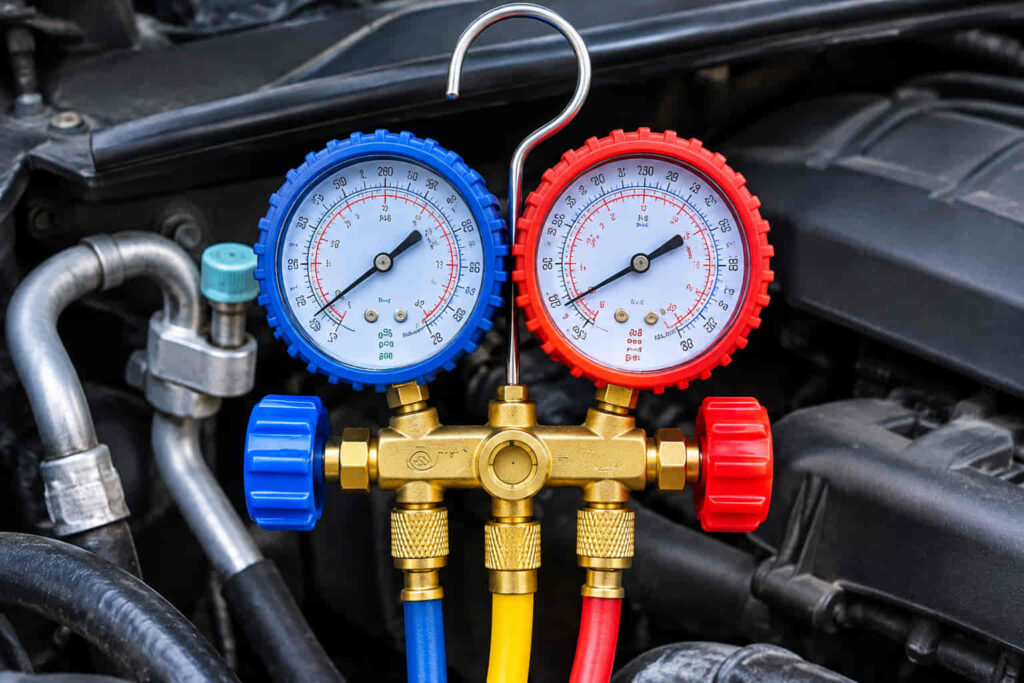
A car AC pressure chart shows reference low-side and high-side refrigerant pressures under specific temperature and operating conditions. For example, Mastercool’s R134a pressure chart lists 40–50 psi on the low side and 175–210 psi on the high side at an ambient temperature of 80°F (27°C). However, normal car AC pressure varies according to refrigerant type, outside temperature, compressor operation, condenser airflow, and vehicle specifications. These reference values should not be treated as universal pressure requirements.
Car air conditioning systems use refrigerant pressure differences to transfer heat from the passenger compartment to the outside environment. When the compressor operates, it creates separate high-pressure and low-pressure regions within the refrigeration circuit. After the compressor stops and system pressures equalize, static pressure reflects the refrigerant’s temperature-dependent properties. R134a and R1234yf have different pressure-temperature characteristics, making refrigerant identification essential when interpreting gauge readings.
Understanding car AC pressure readings helps identify abnormal cooling conditions without confusing general reference ranges with confirmed mechanical faults. This guide provides verified R134a and R1234yf pressure charts, explains how to interpret manifold gauge readings, examines common high-side and low-side pressure abnormalities, and identifies when professional AC diagnosis is necessary. Pressure readings alone cannot reliably determine the correct refrigerant charge.
What Should Car AC High- and Low-Side Pressures Be?
Normal car AC low-side pressure generally ranges from 25 to 55 psi, while high-side pressure ranges from 135 to 345 psi across the ambient temperatures covered by Mastercool’s R134a reference chart. These ranges apply to different temperature conditions rather than representing universal operating specifications. For example, at an outside temperature of 80°F (26.7°C), Mastercool lists 40–50 psi on the low side and 175–210 psi on the high side. Actual operating pressures depend on refrigerant type, ambient temperature, compressor operation, condenser airflow, and vehicle design.
The low-pressure side of an automotive air conditioning system carries refrigerant from the evaporator toward the compressor. Refrigerant absorbs heat from cabin air as it evaporates, allowing the HVAC blower to distribute cooled air through the dashboard vents. Low-side pressure influences the refrigerant’s evaporation temperature and must remain within the operating conditions established by the system’s design. An unusually low reading can indicate insufficient refrigerant flow, but pressure alone cannot establish the cause.
The high-pressure side carries compressed refrigerant toward the condenser, where heat is released into the surrounding air. The compressor raises refrigerant pressure and temperature, allowing the condenser to reject heat at a temperature above the outdoor environment. High-side pressure therefore responds strongly to ambient temperature and condenser airflow. For example, poor condenser cooling can increase discharge pressure even when the refrigerant charge is correct.
Both gauge readings must be evaluated together under the appropriate operating conditions. A low-side reading that appears acceptable does not guarantee normal system operation if the high-side pressure is abnormal. Mastercool recommends comparing manifold gauge readings with the vehicle’s service information for proper diagnosis. Refrigerant pressure charts provide useful reference values, but they cannot independently confirm the correct refrigerant charge or identify every AC component failure.
What Is the R134a Car AC Pressure Chart by Ambient Temperature?
The R134a car AC pressure chart shows reference low-side and high-side refrigerant pressures at different ambient temperatures while the air conditioning system is operating. According to Mastercool’s Professional R134a Manifold Gauge Set instructions, low-side pressure ranges from 25–35 psi at 65°F (18.3°C) to 50–55 psi at 105°F (40.6°C). Over the same temperature range, reference high-side pressure increases from 135–155 psi to 340–345 psi. These values demonstrate how operating pressures change as outdoor temperatures rise.
R134a Car AC Operating Pressure Chart
| Ambient Temperature | Low-Side Pressure | High-Side Pressure |
|---|---|---|
| 65°F (18.3°C) | 25–35 psi | 135–155 psi |
| 70°F (21.1°C) | 35–40 psi | 145–160 psi |
| 75°F (23.9°C) | 35–45 psi | 150–170 psi |
| 80°F (26.7°C) | 40–50 psi | 175–210 psi |
| 85°F (29.4°C) | 45–55 psi | 225–250 psi |
| 90°F (32.2°C) | 45–55 psi | 250–270 psi |
| 95°F (35.0°C) | 50–55 psi | 275–300 psi |
| 100°F (37.8°C) | 50–55 psi | 315–325 psi |
| 105°F (40.6°C) | 50–55 psi | 340–345 psi |
Source: Mastercool Professional R134a Manifold Gauge Set, Part #89660, operating instructions. These are general reference ranges for R134a systems under operating conditions, not universal specifications for every vehicle.
To interpret the chart, identify the ambient temperature and compare the measured low-side and high-side pressures with the corresponding reference ranges. Mastercool’s diagnostic instructions specify operating the vehicle’s AC with the cooling mode and blower set to high while observing the manifold gauges. The vehicle manufacturer’s test procedure remains the controlling reference because compressor speed, airflow, humidity, and system design can affect actual readings.
Ambient temperature has a particularly strong influence on high-side pressure because the condenser must release refrigerant heat into the surrounding air. At 70°F (21.1°C), the Mastercool chart lists a high-side range of 145–160 psi, compared with 275–300 psi at 95°F (35°C). The higher outdoor temperature makes heat rejection more demanding, increasing the pressure required for refrigerant condensation under the reference operating conditions.
Low-side pressure changes less dramatically across the same temperature range because it is governed by evaporator operating conditions and the system’s refrigerant metering and compressor controls. A reading outside the chart’s reference range should prompt further investigation rather than an immediate refrigerant adjustment. Accurate diagnosis requires the correct refrigerant identification, vehicle-specific specifications, and consideration of airflow and component operation. This operating-pressure chart must not be used to evaluate static pressure with the compressor stopped.
Read more: register car in maryland from out of state
What Does the R1234yf Car AC Pressure-Temperature Chart Show?
The R1234yf car AC pressure-temperature chart shows the relationship between refrigerant saturation temperature and pressure, allowing technicians to determine the expected pressure of R1234yf at a specific temperature. According to Chemours’ automotive refrigerant data, R1234yf has a saturation pressure of 89.0 psig at 80°F (26.7°C), compared with 86.7 psig for R134a. These values represent refrigerant pressure under saturation conditions, not the normal high-side and low-side operating pressures of a running car air conditioning system.
R1234yf and R134a have similar but distinct pressure-temperature characteristics. Both refrigerants absorb heat as they evaporate inside the evaporator and release heat as they condense inside the condenser. However, their thermodynamic properties produce different saturation pressures at the same temperature. The following chart compares their pressure-temperature relationships using manufacturer-published data.
R134a vs. R1234yf Pressure-Temperature Chart
| Refrigerant Temperature | R134a Pressure | R1234yf Pressure |
|---|---|---|
| 60°F (16°C) | 57.4 psig | 60.6 psig |
| 70°F (21°C) | 71.1 psig | 73.9 psig |
| 80°F (27°C) | 86.7 psig | 89.0 psig |
| 90°F (32°C) | 104.3 psig | 105.9 psig |
| 100°F (38°C) | 124.2 psig | 124.9 psig |
| 110°F (43°C) | 146.4 psig | 145.9 psig |
| 120°F (49°C) | 171.2 psig | 169.2 psig |
Source: Chemours Opteon Refrigerant Piping Handbook, Page 17, Automotive AC Pressure-Temperature Chart. All pressure values are expressed in pounds per square inch gauge (psig). Celsius values are rounded as published by Chemours.
Refrigerant saturation pressure increases as temperature rises. For example, R1234yf pressure increases from 60.6 psig at 60°F (15.6°C) to 124.9 psig at 100°F (37.8°C). This relationship allows technicians to compare measured refrigerant pressure with the saturation temperature indicated by the chart. In an equalized system containing both liquid and vapor refrigerant, static pressure generally corresponds to the saturation pressure at the refrigerant’s actual temperature.
A pressure-temperature chart cannot replace vehicle-specific operating pressure specifications. When the compressor runs, the refrigerant circuit develops separate high-pressure and low-pressure regions associated with different saturation temperatures. Consequently, the 89.0 psig R1234yf value at 80°F must not be interpreted as the required low-side or high-side operating pressure when the outside temperature reaches 80°F. Accurate diagnosis requires the correct refrigerant type, system operating conditions, and manufacturer service information.
What Is the Difference Between Static and Running Car AC Pressure?
Static car AC pressure is the refrigerant pressure measured after the compressor stops and the system has had sufficient time to equalize, while running pressure is measured with the compressor operating and creating separate low-pressure and high-pressure regions. Static pressure primarily reflects the refrigerant’s temperature-dependent saturation properties when liquid and vapor are present. Running pressure reflects active refrigerant compression, expansion, heat absorption, and heat rejection throughout the air conditioning circuit.
When the AC compressor stops, the pressure difference between the high side and low side gradually decreases as refrigerant redistributes through the system. Once the pressures equalize and the refrigerant reaches thermal equilibrium, both service gauges should indicate approximately the same pressure. For example, an R134a system containing liquid and vapor refrigerant at 80°F (26.7°C) has an expected saturation pressure of approximately 86.7 psig. An equivalent R1234yf system at the same refrigerant temperature has an expected saturation pressure of approximately 89.0 psig, according to Chemours.
Static pressure does not reveal the exact amount of refrigerant inside a car AC system. As long as liquid and vapor coexist under equilibrium conditions, the pressure is largely determined by refrigerant temperature rather than the total refrigerant mass. Therefore, a partially depleted system can display a static pressure consistent with the pressure-temperature chart. The U.S. Environmental Protection Agency explains that technicians cannot determine the remaining refrigerant quantity simply from pressure readings before recharging a vehicle.
Running pressure behaves differently because the compressor continuously draws refrigerant vapor from the low-pressure side and compresses it into the high-pressure side. The condenser releases heat from the compressed refrigerant, while the expansion device reduces pressure before refrigerant enters the evaporator. As a result, the manifold gauges display different pressures during normal operation. For example, Mastercool’s R134a operating chart lists 40–50 psi on the low side and 175–210 psi on the high side at an ambient temperature of 80°F (26.7°C), compared with a saturation pressure of 86.7 psig at an R134a refrigerant temperature of 80°F.
The distinction between static and running pressure is essential when diagnosing weak AC cooling. Static readings help evaluate the system’s pressure-temperature relationship after stabilization, while running readings provide information about compressor operation, refrigerant flow, and heat transfer. Neither measurement independently confirms the correct refrigerant charge. A reliable diagnosis combines pressure measurements with refrigerant identification, temperature readings, operating conditions, and vehicle-specific service specifications.
How Do You Read a Car AC Manifold Gauge Set?
To read a car AC manifold gauge set, identify the blue low-pressure gauge and red high-pressure gauge, confirm the refrigerant type, and compare both readings with the manufacturer’s pressure specifications under matching operating conditions. The blue gauge measures refrigerant pressure on the compressor suction side, while the red gauge measures pressure on the compressor discharge side. Accurate interpretation requires knowing whether the AC compressor is operating, the outside temperature, and the measurement units displayed on each gauge.
An automotive manifold gauge set typically contains two pressure gauges connected to color-coded hoses and service couplers. The blue low-side gauge measures suction pressure and commonly includes a vacuum scale, while the red high-side gauge measures discharge pressure. A central yellow service hose is used with compatible refrigerant recovery, evacuation, or charging equipment. Pressure scales may display pounds per square inch gauge (psig), bar, or kilopascals (kPa). For reference, 1 bar equals approximately 14.5 psi, so the measurement units must be identified before comparing readings with an AC pressure chart.
Refrigerant identification is essential because R134a and R1234yf require compatible service equipment and have different pressure-temperature characteristics. The vehicle’s refrigerant identification label specifies the refrigerant used by the factory-installed system. The U.S. Environmental Protection Agency explains that automotive refrigerants use distinct service fittings to reduce the risk of mixing incompatible refrigerants. A manifold gauge designed for one refrigerant should not be connected to another system using unapproved adapters. Technicians must also follow equipment instructions and keep manifold service valves in the correct positions during pressure testing to prevent unintended refrigerant flow.
Running pressure readings must be interpreted under stable, manufacturer-specified testing conditions. Ambient temperature, engine or compressor speed, AC temperature settings, blower speed, condenser fan operation, and compressor cycling can influence the measured values. For example, Mastercool’s R134a reference chart lists low-side pressure of 40–50 psi and high-side pressure of 175–210 psi at an ambient temperature of 80°F (26.7°C). These readings are useful for comparison only when the vehicle’s operating conditions are appropriate for the reference chart.
Both gauges must be evaluated together because the pressure difference between the high and low sides reflects compressor operation and refrigerant flow. If the low-side pressure appears normal but the high-side pressure is abnormally elevated, condenser airflow or other high-pressure circuit problems may require investigation. Conversely, unusually low readings on both sides can indicate insufficient refrigerant, although other faults can produce similar symptoms. HELLA recommends comparing pressure measurements with vehicle-specific specifications and evaluating outlet air temperature before diagnosing AC system faults. Refrigerant recovery, charging, and repairs should be performed with approved equipment by appropriately qualified personnel.
How Does Outside Temperature Affect Car AC Pressure?
Outside temperature affects car AC pressure by changing the conditions under which the condenser releases heat into the surrounding air. As ambient temperature increases, the condenser generally requires a higher refrigerant condensing temperature to transfer heat effectively. This raises high-side operating pressure under comparable system conditions. Low-side pressure can also change, although its behavior depends more heavily on evaporator temperature, compressor control, refrigerant metering, and the vehicle’s cooling demand.
The condenser is responsible for transferring heat from the compressed refrigerant to outside air. When outdoor temperatures are relatively low, the temperature difference between the hot refrigerant and surrounding air allows effective heat rejection. As outdoor temperature rises, this difference becomes smaller unless the refrigerant condensing temperature also increases. DENSO explains that automotive condensers release heat absorbed from the passenger compartment, allowing refrigerant vapor to change into liquid. Restricted condenser airflow or excessively high ambient temperatures make this heat transfer process more demanding.
Mastercool’s R134a operating pressure chart illustrates the relationship between outdoor temperature and high-side pressure. At 70°F (21.1°C), the reference high-side pressure ranges from 145–160 psi, while at 95°F (35°C), it increases to 275–300 psi. This comparison demonstrates why an operating pressure that appears elevated during cooler weather may be within the reference range under hotter conditions. The figures are general manufacturer reference values rather than universal pressure specifications for every automotive AC system.
Vehicle operating conditions further influence the relationship between ambient temperature and refrigerant pressure. While driving, air moving through the front grille helps the condenser release heat. At idle, cooling fans must provide sufficient airflow to maintain heat rejection. A malfunctioning condenser fan or blocked condenser fins can therefore cause high-side pressure to rise, especially during hot weather. HELLA identifies insufficient condenser airflow as a possible cause of excessive discharge pressure and reduced cooling performance.
Accurate pressure diagnosis requires measuring ambient temperature in an appropriate location away from excessive engine-compartment heat and comparing stabilized readings with vehicle-specific specifications. High outdoor temperatures do not automatically indicate a system fault, just as normal-looking pressures do not guarantee effective cooling. Evaluating high-side and low-side pressures alongside condenser airflow, compressor operation, and vent temperature provides a more reliable assessment of automotive air conditioning performance.
What Do Abnormally High or Low Car AC Pressure Readings Mean?
Abnormally high or low car AC pressure readings can indicate refrigerant charge problems, restricted refrigerant flow, insufficient condenser cooling, or compressor malfunctions. The diagnostic meaning depends on the relationship between low-side suction pressure and high-side discharge pressure rather than either measurement alone. HELLA identifies four important pressure patterns involving both sides reading low, both sides reading high, low suction pressure with elevated discharge pressure, and high suction pressure with insufficient discharge pressure. Each pattern provides clues about how refrigerant moves through the air conditioning system.
When both low-side and high-side pressures fall below the expected operating ranges, insufficient refrigerant is a possible cause. Refrigerant leaks reduce the quantity available for circulation, affecting evaporation inside the evaporator and heat rejection at the condenser. DENSO identifies simultaneously low suction and discharge pressures as a common symptom of insufficient refrigerant. However, restricted refrigerant flow and certain component faults can produce overlapping symptoms. A low-pressure reading must therefore be evaluated alongside cooling performance, refrigerant line temperatures, and leak inspection results before identifying the underlying problem.
When both pressure readings are higher than expected, possible causes include excessive refrigerant charge, inadequate condenser airflow, and abnormal heat rejection. A condenser blocked by dirt or road debris cannot release refrigerant heat efficiently, increasing condensing temperature and discharge pressure. A defective cooling fan can produce a similar effect, particularly when the vehicle is stationary. For example, an AC system that develops elevated operating pressures during traffic stops but performs better at highway speeds may have a condenser airflow problem. HELLA and DENSO both associate elevated suction and discharge pressures with condenser cooling deficiencies or excessive refrigerant charge.
Low suction pressure combined with unusually high discharge pressure can indicate a restriction in the refrigerant circuit, depending on the location and severity of the blockage. A restricted expansion valve, receiver-drier, or liquid line can limit refrigerant entering the evaporator while refrigerant accumulates upstream. This changes the pressure relationship across the system and may produce poor cooling or abnormal temperature differences along refrigerant lines. However, not every restriction creates the same gauge pattern because the response depends on compressor control, refrigerant charge, and the affected component.
High suction pressure combined with abnormally low discharge pressure can indicate inadequate compressor pressure development or excessive refrigerant flow through a faulty expansion device. A compressor with damaged internal valves may fail to maintain the pressure difference necessary for effective refrigeration. As a result, the low side remains too high while the high side fails to reach its expected operating pressure. DENSO identifies defective compressor valves as a possible cause of insufficient pressure separation.
Pressure readings must be interpreted under stable, manufacturer-specified operating conditions. Ambient temperature, compressor engagement, condenser fan operation, and refrigerant type influence the expected values. An unusual gauge pattern identifies an area for further investigation but does not establish a definitive fault. Accurate diagnosis combines pressure measurements with vent temperature, refrigerant line temperatures, electrical inspection, and vehicle-specific service information.
Can You Tell Whether Car AC Refrigerant Is Low From Pressure Alone?
No, car AC pressure readings alone cannot reliably determine whether the refrigerant charge is below the manufacturer’s specified amount. Pressure is influenced by refrigerant temperature, ambient conditions, compressor operation, and the performance of individual refrigeration components. Although unusually low suction and discharge pressures can suggest insufficient refrigerant, similar readings may occur with restricted refrigerant flow or other system faults. A pressure gauge measures operating conditions, not the exact mass of refrigerant inside the circuit.
Static pressure is particularly unreliable for determining refrigerant quantity. When the compressor is stopped and the system reaches thermal equilibrium, refrigerant pressure primarily follows its saturation temperature as long as liquid and vapor coexist. This means a partially depleted system can display approximately the same static pressure as a correctly charged system at the same refrigerant temperature. For example, an R134a system containing both liquid and vapor at 80°F (26.7°C) can show a saturation pressure near 86.7 psig without confirming that the system contains its specified refrigerant charge.
Running pressure provides additional diagnostic information but still cannot establish the exact refrigerant quantity. Compressor speed, condenser airflow, evaporator heat load, and expansion device operation affect both gauge readings. The Mobile Air Conditioning Society explains that an AC system can produce apparently acceptable pressures and vent temperatures while containing an incorrect refrigerant charge. Adding refrigerant until the gauges match a general pressure chart can therefore lead to undercharging or overcharging, both of which reduce system performance.
The most reliable way to establish the correct refrigerant charge is to recover the existing refrigerant using approved service equipment and recharge the system with the manufacturer-specified mass. The U.S. Environmental Protection Agency explains that refrigerant top-offs cannot accurately establish how much refrigerant was originally present and do not permanently repair leaks. When refrigerant loss is suspected, qualified technicians should inspect the system for leakage, repair identified faults, and verify the charge using appropriate recovery and charging procedures.
Car AC pressure charts should therefore be used as diagnostic references rather than refrigerant charging instructions. Comparing high-side and low-side readings with ambient temperature and vehicle-specific specifications can help identify abnormal operating conditions. Confirming refrigerant quantity requires accurate mass measurement and appropriate service procedures, not pressure readings alone.
Why Is Car AC High-Side Pressure Too High?
Car AC high-side pressure becomes excessively high when the refrigeration system cannot release heat efficiently or when refrigerant conditions interfere with normal compressor discharge pressure. The primary causes include insufficient condenser airflow, excessive refrigerant charge, noncondensable gases inside the system, and restrictions in the high-pressure circuit. High-side pressure must be evaluated against the vehicle manufacturer’s specifications under the correct ambient temperature and operating conditions because a reading considered abnormal in cool weather may be expected during hotter conditions.
Insufficient condenser cooling is a major cause of elevated high-side pressure. The condenser transfers heat from compressed refrigerant to the surrounding air, allowing refrigerant vapor to condense into liquid. When dirt, insects, or road debris obstruct the condenser fins, airflow decreases and heat rejection becomes less effective. A malfunctioning radiator or condenser cooling fan produces similar conditions, particularly when the vehicle is stationary. DENSO identifies restricted condenser airflow and poor cooling fan performance as causes of abnormally high discharge pressure. For example, a vehicle that maintains acceptable AC pressure while driving but develops elevated high-side pressure at idle may have a condenser fan or airflow problem.
Excessive refrigerant charge can also increase discharge pressure by disrupting the system’s normal heat transfer and refrigerant distribution. Overcharging reduces the operating margin available for effective condensation and can increase the pressure required to reject heat. Noncondensable gases, including air introduced during improper servicing, create additional pressure within the high-pressure circuit without contributing to useful refrigeration. HELLA identifies excessive refrigerant, contaminated refrigerant, and noncondensable gases as possible causes of high discharge pressure and abnormal compressor noise.
Refrigerant restrictions can produce elevated pressure in certain parts of the circuit by limiting flow through components such as the receiver-drier, liquid line, or expansion device. The resulting pressure pattern depends on the location of the restriction, compressor characteristics, and service-port positions. A technician may find abnormal temperature differences across a restricted component along with unusual manifold gauge readings. However, high-side pressure alone cannot distinguish a blockage from excessive refrigerant or inadequate condenser cooling.
Diagnosing excessive high-side pressure requires comparing both manifold gauge readings with ambient temperature, condenser airflow, compressor operation, and manufacturer-specific service information. High pressure accompanied by unusual compressor noise, ineffective cooling, or repeated protective shutdowns warrants professional inspection. Do not release refrigerant to lower pressure or add refrigerant based solely on general chart values. The correct repair depends on identifying the underlying fault and restoring the system to its specified operating conditions.
When Should a Car AC Pressure Problem Be Diagnosed by a Technician?
A car AC pressure problem should be diagnosed by a qualified technician when high-side or low-side readings remain outside vehicle-specific specifications, cooling performance deteriorates, the compressor operates abnormally, or a refrigerant leak is suspected. Professional diagnosis is also appropriate when both gauges display unusual pressure relationships despite stable testing conditions. These symptoms can result from several mechanical or refrigerant-related faults, making pressure readings alone insufficient for identifying the necessary repair.
A professional AC inspection combines manifold pressure measurements with outlet air temperature, ambient temperature, compressor operation, refrigerant line temperatures, and condenser fan performance. HELLA recommends using vehicle manufacturer specifications when evaluating system pressures because refrigeration components and operating characteristics differ between vehicles. For example, unusually high discharge pressure accompanied by weak cooling at idle may require inspection of condenser airflow, while low pressure on both sides may prompt refrigerant leak testing and evaluation of refrigerant circulation.
Refrigerant recovery and charging require specialized equipment capable of identifying, recovering, evacuating, and charging the correct refrigerant. R134a and R1234yf systems use different refrigerant service requirements, and R1234yf has an A2L mildly flammable classification. In the United States, the Environmental Protection Agency requires technicians servicing motor vehicle air conditioning systems for compensation to hold Section 609 certification and use approved refrigerant handling equipment. Intentional refrigerant venting is prohibited under applicable EPA regulations.
Professional diagnosis is especially important when an AC system repeatedly loses cooling performance after recharging, develops abnormal compressor noise, or experiences excessive discharge pressure. These conditions may indicate unresolved refrigerant leaks, inadequate condenser cooling, defective compressor components, or restrictions in the refrigerant circuit. Identifying the fault before replacing components or adjusting refrigerant charge helps prevent unnecessary repairs and supports reliable cooling performance.
A car AC pressure chart provides a technical reference for recognizing abnormal operating conditions, but it does not replace comprehensive system testing. Accurate repair decisions require compatible diagnostic equipment, verified refrigerant identification, manufacturer service information, and the correct refrigerant charge. Using these measurements together allows technicians to restore AC performance without treating isolated gauge readings as definitive evidence of component failure.