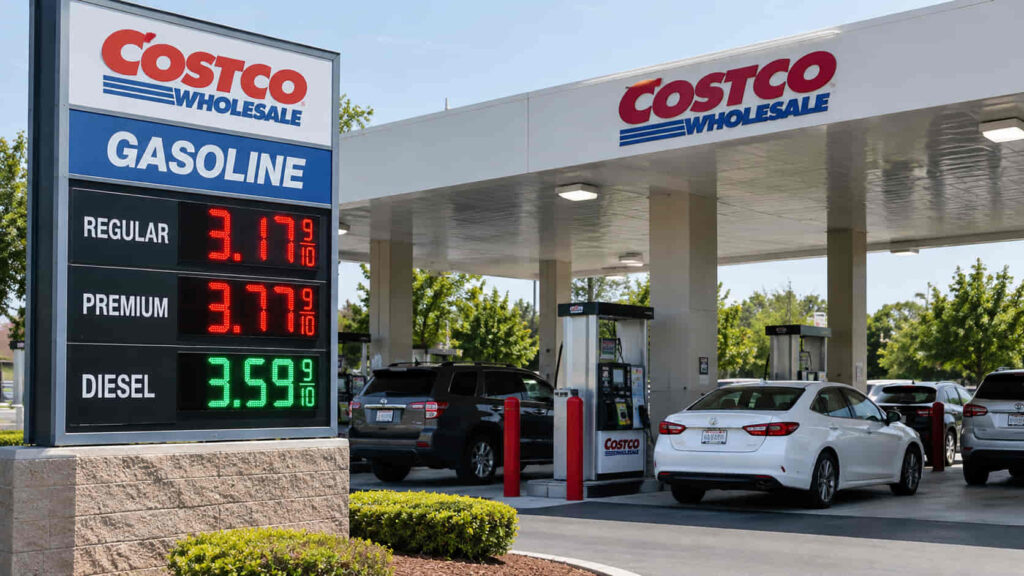
Yes, Costco gas is generally cheaper than gasoline at many nearby traditional gas stations, although it is not always the lowest-priced option. Costco’s membership-based business model, high fuel sales volume, and competitive pricing strategy help keep pump prices lower than those of many conventional retailers. However, the actual price difference depends on location, fuel grade, and daily market conditions.
A CNBC comparison using GasBuddy data from March 26, 2026, found that Costco gasoline was $0.19 per gallon cheaper in Chicago, $0.20 cheaper in Rochester, New York, and $0.56 cheaper in Los Angeles than the stations selected for comparison. These historical examples demonstrate how savings vary between markets. At a $0.20-per-gallon discount, filling a 15-gallon tank at Costco saves $3 before accounting for membership fees or additional travel costs.
Whether Costco gas is worth buying depends on your annual fuel consumption and total expenses. A standard Costco Gold Star membership costs $65 per year, meaning drivers who join exclusively for gas must purchase enough discounted fuel to recover that cost. Additional driving distance and waiting time can further reduce the financial benefit. This guide compares Costco gas prices with competing stations, explains why Costco sells fuel at lower prices, and examines annual savings, membership value, fuel quality, and rewards.
Is Costco Gas Cheaper Than Other Gas Stations?
Costco gas is generally cheaper than gasoline sold at many traditional gas stations, including major brands such as Shell, Chevron, and Exxon. The price advantage comes from Costco’s membership-based retail model, high fuel sales volume, and competitive pricing strategy. However, Costco does not guarantee the lowest gasoline price in every market. The actual savings depend on local competition, fuel grade, and the prices available at nearby stations on the day of purchase.
A 2026 CNBC comparison using GasBuddy data found that Costco offered lower gasoline prices than selected traditional stations in Los Angeles, Chicago, and Rochester, New York. On March 26, 2026, Costco charged $5.39 per gallon in Los Angeles compared with $5.95 at the station selected for comparison. In Chicago, the corresponding prices were $4.29 and $4.48 per gallon, while Rochester showed Costco at $3.71 compared with $3.91. These figures demonstrate Costco’s competitive pricing across different markets, although they represent historical observations rather than nationwide averages or current pump prices.
Costco’s price advantage also appears in longer-term gasoline market research. A California Energy Commission joint-agency report published in 2026 examined historical retail gasoline prices and found that Costco consistently ranked below major branded competitors across California during the period analyzed through 2024. The report identified a substantial pricing gap between Costco and brands such as Chevron and Shell. This comparison suggests that Costco’s lower gasoline prices reflect a recurring retail pricing strategy rather than isolated promotional discounts.
Regional competition still affects whether Costco offers the lowest available price. Independent gas stations, grocery-affiliated fuel retailers, and other warehouse clubs can match or undercut Costco in particular locations. A May 2026 analysis by the San Francisco Chronicle found that Costco gasoline was generally 6 to 20 cents cheaper per gallon across the Bay Area, although some counties had competing stations offering equivalent or lower prices. For example, a Costco station in South San Francisco charged $5.69 per gallon while the lowest-priced stations identified in San Francisco charged $5.79. The geographic difference illustrates why drivers should compare stations within a practical travel distance rather than assume the warehouse club always provides the best deal.
The most accurate way to determine whether Costco gas is cheaper is to compare the same gasoline grade at nearby stations at approximately the same time. Regular gasoline should be compared with regular gasoline, while premium fuel requires a separate comparison at a matching octane rating. This approach accounts for local pricing conditions and avoids misleading comparisons between fuel grades or distant markets. Costco frequently offers a meaningful discount, but the actual financial advantage depends on the prices available where the driver regularly purchases fuel.
How Much Cheaper Is Costco Gas Per Gallon?
Costco gas can cost approximately 19 to 56 cents less per gallon than selected traditional gas stations, based on price comparisons recorded in three U.S. cities on March 26, 2026. This observed range is not a guaranteed Costco discount or a national average. Gasoline price differences fluctuate with wholesale fuel costs, local competition, transportation expenses, and regional taxes. The amount saved on each fill-up depends on the difference between Costco’s pump price and the price of a realistic alternative station.
The March 2026 CNBC comparison recorded the largest discount among the three selected cities in Los Angeles, where Costco gasoline cost $5.39 per gallon compared with $5.95 at the traditional station used for comparison. The $0.56 difference represents savings of $8.40 when purchasing 15 gallons. Chicago showed a smaller price advantage, with Costco at $4.29 and the comparison station at $4.48 per gallon. Filling the same 15-gallon tank in Chicago would save $2.85. Rochester, New York, recorded a $0.20-per-gallon difference, producing $3 in savings on a 15-gallon purchase.
The savings per gallon are calculated by subtracting Costco’s gasoline price from the price charged by the competing station. For example, when a nearby station sells regular gasoline for $3.80 per gallon and Costco charges $3.60, the price difference is $0.20 per gallon. Purchasing 12 gallons saves $2.40, while purchasing 20 gallons saves $4. These calculations show that vehicles with larger fuel tanks can generate greater savings per visit when the price difference remains constant. However, a larger purchase does not necessarily make a separate trip to Costco worthwhile if additional driving costs exceed the discount.
Gasoline prices also vary significantly between metropolitan areas and individual stations within the same city. Differences in local fuel supply, operating costs, retail competition, and taxation affect the final price displayed at the pump. For example, a Costco station operating near several aggressively priced independent retailers may offer a smaller discount than a location surrounded by higher-priced branded stations. Price changes throughout the week can further narrow or widen the difference, meaning a comparison made several days earlier may no longer reflect the best available option.
The actual value of Costco’s per-gallon discount becomes clearer when drivers compare their normal purchase quantities and nearby alternatives. A $0.10 discount saves $1.50 on a 15-gallon purchase, while a $0.40 discount saves $6 on the same amount. Both examples represent direct fuel-price savings before accounting for membership fees, additional driving distance, or waiting time. Costco’s lower pump prices can reduce fuel spending, but the size of that advantage must be calculated using current local prices rather than assuming a fixed discount applies at every warehouse.
Read more: car ac pressure chart
Why Is Costco Gas Cheaper Than Regular Gas Stations?
Costco gas is generally cheaper than regular gas stations because Costco combines high-volume fuel sales, a membership-based business model, lower gasoline profit margins, and efficient station operations. Unlike conventional fuel retailers that rely heavily on gasoline and convenience store sales, Costco uses competitively priced fuel to attract members and encourage repeat visits to its warehouses. This strategy allows the company to maintain lower pump prices while generating revenue from other parts of its retail business.
Costco’s membership model supports its gasoline pricing strategy by providing a recurring source of revenue independent of individual fuel purchases. Members pay an annual fee to access Costco warehouses and most fuel stations, creating an established customer base that regularly purchases gasoline and other products. According to Costco’s fiscal 2026 annual report, the company generated approximately $5.9 billion in membership fee revenue. This revenue supports Costco’s broader low-margin retail model, although it does not mean membership fees directly subsidize every gallon of gasoline sold.
High gasoline sales volume allows Costco to operate with lower gross profit margins than many conventional retailers. Costco’s 2026 annual report states that its gasoline business generally has a lower gross margin percentage and lower selling, general, and administrative expenses than its non-gasoline operations. Selling substantial quantities of fuel at competitive prices helps generate customer traffic and encourages additional warehouse purchases. For example, a member who visits Costco to save $0.20 per gallon may also purchase groceries or household supplies during the same trip, creating revenue beyond the gasoline transaction.
Efficient fuel station operations further support Costco’s pricing structure. Costco stations use a predominantly self-service model, pay-at-the-pump technology, and one-way traffic patterns designed to move vehicles through fueling lanes efficiently. Extra-long fuel hoses allow drivers to use pumps regardless of which side of the vehicle contains the fuel door, reducing unnecessary lane restrictions. These operational features help accommodate high customer volumes without relying on a traditional convenience store attached to each station. Costco’s published fuel station guidance confirms that its operating approach emphasizes high-volume sales and efficient vehicle movement.
Costco’s lower gasoline prices result from its overall retail strategy rather than a guarantee that every gallon is sold at the lowest market price. Wholesale fuel costs, local taxes, transportation expenses, and competition still influence the prices displayed at individual stations. As a result, Costco can maintain a consistent value-oriented pricing strategy while charging different prices across cities and regions. Understanding this business model explains why Costco frequently undercuts traditional gas stations without assuming that its fuel is always the cheapest available.
Is a Costco Membership Worth It Just for Gas?
A Costco membership is worth buying just for gas when the annual fuel savings exceed the membership fee and additional costs of reaching a Costco gas station. A standard Gold Star Membership costs $65 per year, while an Executive Membership costs $130 per year, plus applicable sales tax. Drivers who join exclusively for gasoline must purchase enough discounted fuel to recover the annual fee. Whether they reach that break-even point depends primarily on their yearly fuel consumption and the average price difference between Costco and nearby competitors.
The break-even calculation divides the annual membership fee by the expected savings per gallon. At a $0.20-per-gallon discount, a $65 Costco membership requires 325 gallons of gasoline purchases per year to recover its cost. For a vehicle receiving 15 gallons during each fill-up, that equals approximately 22 fill-ups annually. A driver purchasing 500 gallons per year at the same discount would save $100 before membership costs, leaving $35 in annual savings after subtracting the $65 fee. These figures assume the price difference remains constant and exclude additional driving expenses.
Membership value changes significantly when Costco’s price advantage is smaller. At a discount of $0.10 per gallon, a driver needs 650 gallons annually to recover a $65 membership fee. Purchasing only 400 gallons at that discount would generate $40 in gross savings, resulting in a $25 shortfall after the membership cost. Conversely, a $0.30-per-gallon discount reduces the break-even requirement to approximately 217 gallons per year. These examples demonstrate that the relationship between fuel consumption and local gasoline prices matters more than Costco’s reputation for offering inexpensive fuel.
Existing Costco members receive a different financial benefit because they do not need to purchase an additional membership solely to access gasoline. For someone already paying the membership fee to buy groceries, household products, or other merchandise, gasoline discounts provide additional savings without a separate membership charge. However, a driver considering Costco exclusively for fuel must also account for the distance to the nearest station and the time spent waiting to refuel. A small discount may not justify a special trip when a competitively priced gas station is already located along the driver’s regular route.
Upgrading to an Executive Membership does not automatically increase gasoline savings. Costco’s Executive Membership costs an additional $65 annually and offers a 2% Reward on qualifying purchases, but gasoline purchases are excluded from the Executive 2% Reward program. Therefore, upgrading from Gold Star to Executive solely to buy gasoline does not provide additional savings through that membership reward. Eligible credit card cashback is a separate benefit and must be evaluated under its own terms.
A Costco membership is most financially attractive for drivers who purchase substantial amounts of gasoline, have access to consistently lower local Costco prices, or already visit Costco for other shopping needs. The appropriate decision comes from comparing annual fuel savings with actual membership and travel expenses rather than evaluating the pump price alone.
How Much Money Can You Save on Costco Gas in a Year?
You can save approximately $80 to $160 per year on Costco gas if you purchase 400 to 800 gallons annually at an average discount of $0.20 per gallon. These amounts represent gross fuel savings before membership fees, additional travel expenses, and other costs. Actual savings depend on how much gasoline your vehicle consumes and the difference between Costco’s prices and those at nearby competing stations. Drivers who already have a Costco membership may retain more of these savings than those who join exclusively to purchase gasoline.
Annual gasoline savings are calculated by multiplying the number of gallons purchased each year by the average price difference per gallon. For example, a driver who travels 12,000 miles annually in a vehicle averaging 30 miles per gallon consumes approximately 400 gallons of gasoline. At a Costco discount of $0.20 per gallon, purchasing all 400 gallons at Costco would save $80 annually. A vehicle averaging 20 miles per gallon over the same distance requires 600 gallons, producing $120 in gross savings. A less fuel-efficient vehicle averaging 15 miles per gallon consumes 800 gallons and generates $160 in savings at the same discount. These examples assume comparable fuel grades and a consistent price difference throughout the year.
Net annual savings are lower when a driver purchases a Costco membership solely to access discounted gasoline. Costco’s Gold Star Membership costs $65 annually, plus applicable sales tax. Subtracting that fee from the previous examples leaves $15 in savings for a driver purchasing 400 gallons, $55 for someone purchasing 600 gallons, and $95 for someone purchasing 800 gallons. These results exclude extra driving costs and assume every gallon is purchased at Costco. For existing members who would maintain their memberships regardless of gasoline purchases, the incremental membership expense is effectively zero, making the fuel-price savings more financially attractive.
The average price difference can influence annual savings as much as fuel consumption. A driver purchasing 600 gallons annually saves $60 at a $0.10-per-gallon discount, $120 at a $0.20 discount, and $240 at a $0.40 discount. After subtracting a $65 Gold Star membership fee, those scenarios produce a $5 loss, a $55 saving, and a $175 saving, respectively, before additional expenses. This comparison demonstrates why the same Costco membership can be worthwhile in one local gasoline market but provide little financial benefit in another.
The most accurate estimate of Costco gas savings accounts for additional transportation costs and the number of gallons actually purchased at Costco. Driving extra miles to reach a warehouse consumes fuel, while long queues can increase the time required for each fill-up. For example, a driver who purchases only half of their annual gasoline at Costco should calculate savings using that quantity rather than their entire yearly fuel consumption. Drivers who combine gasoline purchases with regular warehouse shopping can also avoid making separate trips, reducing the additional transportation expense.
Costco gasoline provides the greatest measurable financial benefit when drivers consistently purchase substantial fuel quantities at a meaningful local discount without incurring significant extra costs. Comparing annual gallons, average price differences, membership expenses, and travel requirements gives a more accurate savings estimate than relying on the price displayed at the pump alone.
Is Costco Premium Gas Cheaper Than Other Gas Stations?
Costco premium gas is often cheaper than premium gasoline at nearby traditional gas stations, but the price advantage depends on local competition, octane rating, and current fuel prices. Costco applies its competitive gasoline pricing approach to both regular and premium grades. However, the discount available on regular gasoline cannot automatically be used to estimate premium fuel savings because the price differences between fuel grades vary across retailers and locations.
Costco typically sells regular gasoline rated at 87 octane and premium gasoline rated at 91 octane, according to its official gasoline guidance. Some competing stations also offer 93-octane premium, creating an important distinction when comparing prices. Octane rating measures a fuel’s resistance to engine knock, rather than its overall cleanliness or quality. A driver should therefore compare gasoline that meets the vehicle manufacturer’s minimum octane requirement instead of assuming that every product labeled premium has identical specifications.
The financial advantage of Costco premium gasoline can be calculated using the same price-per-gallon comparison as regular fuel. For example, if Costco sells a suitable premium grade for $4.05 per gallon and a nearby station charges $4.40 for fuel meeting the same octane requirement, the difference is $0.35 per gallon. Filling a 16-gallon tank would save $5.60, while purchasing 500 gallons annually would generate $175 in gross savings. These prices are hypothetical examples used to demonstrate the calculation, not verified pump prices at particular stations.
Premium gasoline savings are especially relevant to owners of vehicles that require higher-octane fuel. Engines designed to operate with premium gasoline may depend on the specified octane level to maintain their intended performance and resist knocking under demanding operating conditions. However, buying premium fuel simply because Costco offers a discount does not necessarily benefit a vehicle designed for regular gasoline. Costco advises customers to follow the octane recommendation in their vehicle owner’s manual.
To determine whether Costco premium gas is cheaper, compare the premium prices at your nearest Costco and competing stations on the same day. Confirm that the fuel meets the vehicle’s required octane rating, then calculate the total savings using your normal purchase quantity. This approach avoids misleading comparisons between regular and premium gasoline and provides a realistic measure of Costco’s value for drivers who need higher-octane fuel.
Do Costco Gas Rewards Make Fuel Cheaper?
Costco gas rewards can make gasoline effectively cheaper by providing cash back on eligible fuel purchases, although the rewards do not reduce the price displayed at the pump. The Costco Anywhere Visa Card by Citi currently offers 5% cash back on gasoline purchased at Costco and 4% on eligible gasoline purchases at other stations. These rates apply to a combined $7,000 in qualifying annual spending, after which purchases earn 1% cash back. The additional savings depend on the cardholder’s fuel spending, the gasoline price, and whether the purchase qualifies under the card’s reward terms.
The Costco Anywhere Visa Card provides a financial advantage beyond Costco’s already competitive pump prices. For example, purchasing 15 gallons at a hypothetical Costco price of $3.60 per gallon costs $54 before rewards. A qualifying 5% cash back rate generates $2.70 in rewards, reducing the effective cost to $51.30, or $3.42 per gallon. If a nearby station charges $3.80 per gallon without an applicable reward, the same purchase costs $57, creating a total difference of $5.70 after accounting for Costco’s cash back. These figures illustrate the calculation rather than represent actual gasoline prices.
The value of Costco’s credit card rewards must be compared with the rewards available at competing gas stations. The same Costco Anywhere Visa Card offers 4% cash back on eligible gasoline purchases outside Costco, subject to the combined annual spending limit. For example, at a hypothetical price of $3.80 per gallon, a qualifying 4% reward reduces the effective price to $3.648 per gallon. Costco gasoline priced at $3.60 with 5% cash back has an effective cost of $3.42 per gallon, producing a difference of $0.228 per gallon. Comparing both reward-adjusted prices provides a more accurate assessment than applying Costco’s cash back while ignoring available discounts at competing stations.
Cash back is not an immediate fuel discount. Costco Anywhere Visa rewards are generally distributed through an annual credit card reward certificate after the February billing statement closes. Cardholders can redeem eligible certificates according to Citi and Costco’s redemption terms, including redemption at Costco warehouses. The card has no separate annual fee with an active paid Costco membership, but eligibility requires credit approval. Drivers should therefore distinguish between money saved immediately at the pump and rewards received after qualifying purchases.
Costco’s Executive Membership 2% Reward does not apply to gasoline purchases. The Executive Membership program provides an annual reward on qualifying merchandise and other eligible transactions, but Costco explicitly excludes gasoline from its 2% Reward calculation. This means upgrading to Executive Membership solely to earn additional rewards on fuel purchases does not provide that benefit. The Costco Anywhere Visa cash back program is separate, and eligible cardholders can earn its gasoline rewards regardless of whether they hold a Gold Star or Executive Membership.
Costco gasoline rewards provide the greatest benefit when drivers already maintain a Costco membership, use an eligible rewards card, and consistently purchase fuel at competitive local prices. However, rewards should be included in the overall savings calculation alongside membership fees and additional transportation expenses. The lowest effective fuel cost comes from comparing the pump price after applicable rewards, rather than assuming the highest advertised cash back rate automatically produces the best deal.
Is Costco Gas Good Quality Despite Being Cheaper?
Yes, Costco gasoline meets TOP TIER Detergent Gasoline standards, meaning its lower price does not indicate inferior fuel quality. Kirkland Signature Gasoline contains deposit-control additives designed to limit the buildup of harmful deposits inside gasoline engines. Costco states that both its regular and premium gasoline contain five times the minimum detergent additive level required by the U.S. Environmental Protection Agency (EPA). These additives help maintain the cleanliness of fuel injectors and intake valves, which are important components for consistent engine performance.
TOP TIER is a gasoline performance standard supported by major automobile manufacturers, including Ford, General Motors, Toyota, Honda, and BMW. The standard requires participating fuel brands to meet detergent performance criteria beyond the federal minimum requirements. Detergent additives help prevent deposits from accumulating on fuel system components, reducing the likelihood of deposit-related performance problems. For example, fuel injector deposits can interfere with proper fuel delivery, while intake valve deposits may contribute to rough engine operation in susceptible engines. Using gasoline with effective detergent additives helps control these deposits over time.
Costco’s Kirkland Signature Gasoline is officially recognized as a TOP TIER-approved gasoline brand in the United States. In May 2026, the TOP TIER program also identified Costco among the national brands that had announced adoption of the newer TOP TIER+ standard. This updated standard extends detergent performance requirements to address the needs of modern gasoline direct-injection engines while retaining protections for conventional gasoline engines. These certifications provide an independently defined basis for evaluating fuel detergency rather than relying exclusively on Costco’s marketing claims.
Gasoline quality should also be distinguished from octane rating. Octane measures a fuel’s resistance to engine knock, while detergent additives help control deposits within the engine. Costco sells regular and premium gasoline designed to meet different octane requirements, but choosing a higher-octane grade does not automatically provide better results for vehicles designed to operate on regular gasoline. For example, a vehicle manufacturer specifying 87-octane fuel generally does not require premium gasoline simply because the more expensive grade is available. Drivers should select the fuel grade recommended in their owner’s manual.
High-quality detergent gasoline helps maintain engine cleanliness but does not guarantee a measurable fuel economy improvement in every vehicle. Engines with existing deposits may recover some performance after effective deposit removal, while clean and properly maintained engines may experience little noticeable change. Actual fuel economy also depends on driving conditions, tire pressure, vehicle maintenance, and engine design. Costco’s TOP TIER certification supports the quality of its additive formulation, but it should not be interpreted as proof that every driver will achieve a specific increase in miles per gallon.
Costco’s ability to sell gasoline at lower prices is primarily connected to its high-volume retail operations and membership-based business strategy rather than reduced detergent standards. Kirkland Signature Gasoline provides a practical combination of competitive pricing and independently recognized fuel quality. For drivers comparing Costco with other stations, the most useful decision factors are the correct octane grade, current local price, available rewards, and total cost of purchasing fuel.
Is Costco Gas Always Cheaper Than Sam’s Club and Nearby Stations?
Costco gas is not always cheaper than Sam’s Club or nearby gas stations, although both warehouse clubs frequently offer competitive fuel prices compared with traditional retailers. The lowest price depends on local competition, fuel grade, membership requirements, and daily price adjustments. Costco and Sam’s Club operate membership-based fuel stations, allowing them to attract customers through discounted gasoline while generating revenue from other retail activities. However, neither company maintains a guaranteed nationwide price advantage over the other.
Sam’s Club uses a fuel pricing strategy similar to Costco’s, offering member-oriented gasoline prices at hundreds of locations across the United States. According to Sam’s Club, individual fuel centers set prices based on local market conditions, and members can check location-specific prices through the company’s website or mobile application. Costco also publishes gasoline prices for individual warehouses through its fuel station locator. These pricing systems explain why Costco may be cheaper in one city while Sam’s Club offers a lower price in another. Comparing national brand reputations is therefore less useful than checking the actual stations available along a driver’s regular route.
Small differences between Costco and Sam’s Club gasoline prices can significantly reduce the advantage of choosing one warehouse club over the other. For example, if Costco charges a hypothetical $3.55 per gallon while Sam’s Club charges $3.49 for the same fuel grade, Sam’s Club is $0.06 cheaper per gallon. Purchasing 15 gallons at Sam’s Club would save $0.90 compared with Costco. However, if the Sam’s Club station requires several additional miles of driving, the transportation cost could eliminate that advantage. The comparison must also consider whether the driver already belongs to either warehouse club, because purchasing an additional membership solely for a small gasoline discount changes the financial calculation.
Independent gasoline stations and grocery-affiliated fuel retailers can also compete with Costco through lower posted prices, loyalty discounts, or fuel rewards programs. A traditional gas station offering a temporary promotional discount may undercut Costco even when its standard price is higher. Similarly, grocery loyalty programs can reduce the effective price of gasoline for shoppers who have accumulated eligible rewards. These discounts should be evaluated according to their conditions rather than treated as reductions available to every customer. For example, a station advertising a cash-only price should be compared with Costco using the payment method the driver can actually use.
The most reliable comparison uses the same gasoline grade, current local prices, and the total cost of reaching each station. Drivers can check Costco’s official fuel station locator, the Sam’s Club fuel center finder, and local gasoline price information before choosing where to refuel. Credit card rewards and membership expenses should also be considered when they differ between available options. Costco often provides excellent gasoline value, but the cheapest station is the one offering the lowest effective cost for a driver’s specific location and purchasing circumstances.
When Is Driving to Costco for Gas Not Worth It?
Driving to Costco for gas is not worth it when the savings from its lower pump price are smaller than the additional fuel costs, membership expenses, and inconvenience associated with reaching the station. A lower price per gallon does not automatically produce a lower total cost. The financial benefit depends on how much gasoline the driver purchases, how far the vehicle must travel beyond its normal route, and whether the trip serves another purpose. Drivers making a separate journey to Costco generally face higher additional transportation costs than those who refuel during an already planned shopping trip.
The cost of driving extra miles can be calculated using the vehicle’s fuel economy and the gasoline price. For example, consider a driver whose vehicle averages 25 miles per gallon and who must travel an additional 10 miles round trip to reach Costco. The extra distance consumes approximately 0.4 gallon of gasoline. At an assumed fuel price of $3.60 per gallon, that additional driving costs $1.44 in fuel. If Costco is $0.20 cheaper per gallon and the driver purchases 15 gallons, the pump-price savings equal $3. Subtracting the extra fuel expense leaves only $1.56 in savings before accounting for membership costs, vehicle wear, or waiting time.
Small gasoline purchases make extra trips to Costco less financially attractive because the price discount applies to fewer gallons. At a $0.20-per-gallon discount, purchasing five gallons saves only $1, while purchasing 20 gallons saves $4. If reaching Costco requires $1.44 in additional fuel, the five-gallon purchase creates a $0.44 net fuel-cost loss, whereas the 20-gallon purchase retains $2.56 in savings before other expenses. These examples demonstrate why the amount purchased matters when evaluating a warehouse gas station. Drivers with larger fuel tanks may benefit more from each visit, provided the additional travel distance remains reasonable.
Waiting time can further reduce Costco’s practical value, particularly during busy shopping hours or periods of high gasoline demand. Costco fuel stations are designed for high-volume operations, but queues can still develop when many members arrive simultaneously. Waiting with the engine running may consume additional fuel, while time spent in line represents an opportunity cost even when it does not create a direct cash expense. For example, saving $2 on a fill-up may be unattractive to a driver who must spend an additional 25 minutes traveling and waiting. The importance of that time depends on the driver’s schedule and personal preferences rather than a universal dollar value.
Combining gasoline purchases with regular Costco shopping is one of the most effective ways to preserve the financial benefit of cheaper fuel. When a driver already plans to visit the warehouse, the additional distance required to reach the gas pumps may be minimal. This reduces transportation expenses and allows the gasoline discount to contribute more directly to overall savings. Existing Costco members also avoid treating the full annual membership fee as a new expense for each fuel purchase, although drivers who joined exclusively for gasoline must still recover that cost through their annual fuel savings.
Costco is most worthwhile when its local price advantage is meaningful, the station is conveniently located, and the driver purchases enough gasoline to offset any additional expenses. Comparing the total cost of each fill-up, rather than focusing only on the advertised price per gallon, provides the most accurate basis for deciding whether a trip to Costco will actually save money.
How Can You Check Costco Gas Prices Near You?
You can check Costco gas prices near you through Costco’s official Fuel Station Locator or the Costco mobile app. Both options provide location-specific gasoline prices, allowing drivers to compare nearby Costco warehouses before visiting. On Costco’s website, open the Fuel Station Locator and select a warehouse in your area to view its available fuel prices, gas station hours, and holiday closures. The Costco app also displays current regular and premium gasoline prices for participating locations, making it convenient to check prices before leaving home.
Comparing Costco prices with nearby competitors requires checking the same fuel grade at approximately the same time. Costco recommends GasBuddy as a resource for comparing local gasoline prices. Drivers can use GasBuddy to review prices reported at independent stations, major fuel brands, and competing warehouse clubs. However, prices reported through third-party platforms may be outdated or differ from the amount displayed at the pump. AAA provides regional gasoline price averages that help explain broader market conditions, but those averages should not replace direct comparisons between individual stations.
The distance to each gas station also matters when evaluating a potential discount. For example, a Costco location offering gasoline at $3.50 per gallon may appear more attractive than a nearby station charging $3.70, but the additional travel distance could reduce the financial benefit. These figures are hypothetical. Checking the station’s location, operating hours, and current prices before traveling helps drivers avoid unnecessary trips and choose a practical fueling option.
Costco gas stations generally require an active Costco membership, although customers using prepaid Costco Shop Cards are an exception. Costco confirms that nonmembers with eligible prepaid Shop Cards can purchase fuel without holding their own membership. Payment options at Costco fuel stations include Visa cards, most PIN debit cards, and Costco Shop Cards. Confirming the applicable access and payment requirements before visiting helps prevent delays at the pump.
Checking local prices regularly provides the most reliable answer to whether Costco gas is cheaper for a particular driver. Costco’s competitive pricing can produce meaningful savings, but the final decision should reflect the actual fuel grade, nearby alternatives, applicable rewards, and additional travel costs rather than a nationwide price assumption.