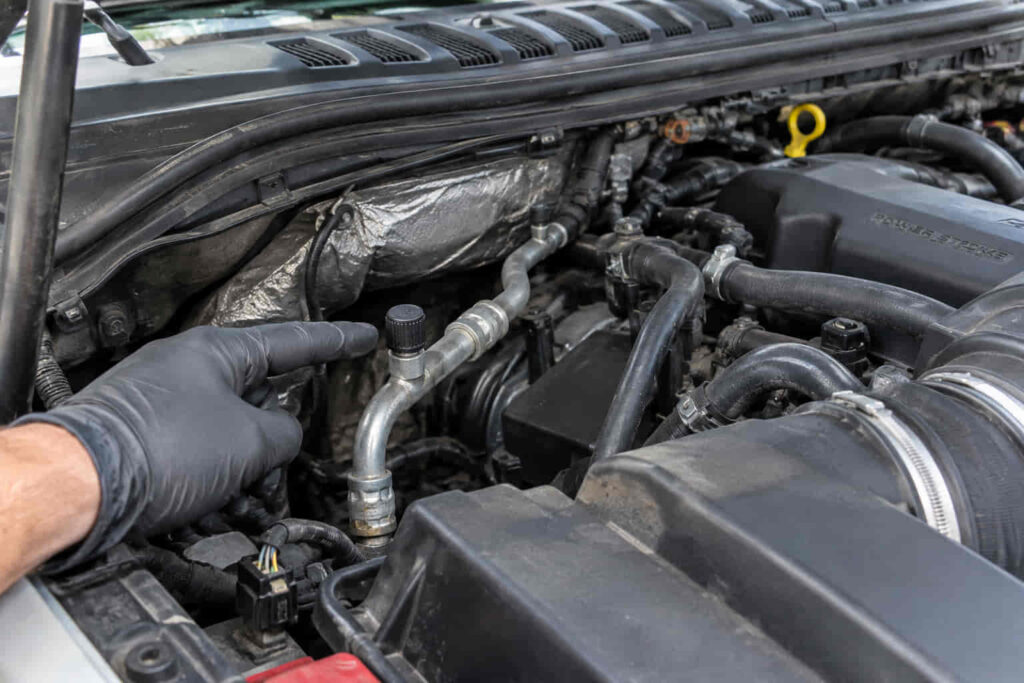
The AC recharge port on a 6.7 Powerstroke is typically located on the passenger side of the engine compartment, near the firewall, along the low-pressure refrigerant line. On many Ford F-250 and F-350 Super Duty trucks equipped with the 6.7L Power Stroke diesel engine, this service port is attached to the larger aluminum AC line that carries refrigerant from the evaporator toward the compressor. A removable plastic cap protects the fitting from dirt and moisture.
The low-pressure AC port is different from the high-pressure service port, which connects to the pressurized discharge side of the air conditioning system. Identifying the correct fitting is essential because the two ports serve different purposes and operate under different pressure conditions. Although the general location is similar across several Ford Super Duty models, the exact placement and accessibility can vary by model year and vehicle configuration.
Before servicing the AC system, owners must also verify the refrigerant type and specifications listed for their particular truck. Ford warns that automotive AC systems contain refrigerant under high pressure and should be serviced by qualified personnel. This guide explains where to find the 6.7 Powerstroke AC recharge port, how to identify the low-pressure fitting, which model-year differences matter, and when professional AC diagnosis is necessary.
Where Is the AC Recharge Port on a 6.7 Powerstroke?
The AC recharge port on a 6.7 Powerstroke is typically located on the passenger side of the engine compartment, near the firewall, on the low-pressure refrigerant line. This line connects the air conditioning evaporator outlet to the compressor inlet and carries low-pressure refrigerant through the AC system. On many Ford F-250 and F-350 Super Duty trucks equipped with the 6.7L Power Stroke diesel engine, the service port is accessible from the passenger side of the engine bay and is protected by a removable plastic cap. Its exact position depends on the truck’s model year and refrigerant line configuration.
To locate the low-pressure AC port, open the hood with the engine switched off and examine the passenger side of the engine compartment near the rear firewall. Look for the aluminum refrigerant lines extending from the air conditioning components mounted near the firewall. The low-pressure line is generally the larger-diameter line because it carries refrigerant vapor returning from the evaporator toward the compressor. Following this line along its visible route helps identify the service fitting without confusing it with nearby coolant hoses or other engine components. The fitting normally has a protective cap that prevents dirt and moisture from reaching the service valve.
The low-pressure service port is part of the AC suction circuit rather than the high-pressure discharge circuit. Refrigerant absorbs heat inside the evaporator before returning through the suction line to the compressor. The compressor then increases the refrigerant’s pressure and sends it toward the condenser through a separate high-pressure line. This relationship explains why identifying the suction line is more reliable than searching for a particular cap color. For example, a Ford Super Duty owner who finds two capped fittings in the engine compartment should trace the associated refrigerant lines and verify their functions before identifying either fitting as the recharge port.
The exact port arrangement can vary between Ford Super Duty generations because changes to engine compartment packaging, refrigerant line routing, and surrounding equipment affect accessibility. Ford’s 2023 Super Duty service documentation identifies the low-side service port separately from the high-side port and illustrates their positions within the refrigerant circuit. Owners of earlier vehicles, including 2011–2016 and 2017–2022 configurations, should consult the service information applicable to their model year rather than assuming that every 6.7L Power Stroke truck uses an identical port location.
Locating the recharge port does not mean the AC system is ready to receive additional refrigerant. The correct service fitting, refrigerant specification, and system condition must be verified before maintenance begins. Ford warns that automotive air conditioning systems contain refrigerant under high pressure and should be serviced by qualified personnel. Identifying the low-pressure port visually is the first step toward understanding the system, but diagnosing insufficient cooling requires more than locating the fitting.
How Can You Identify the Low-Pressure AC Port on a 6.7 Powerstroke?
You can identify the low-pressure AC port on a 6.7 Powerstroke by locating the suction line between the evaporator outlet and compressor inlet, checking the service fitting, and confirming its position against the correct Ford service diagram. The low-pressure line generally has a larger diameter than the high-pressure liquid or discharge lines. The service port is installed directly into the refrigerant line or a connected component and usually has a removable cap that protects the internal valve.
The suction line provides the most useful identification clue because its function is consistent across automotive vapor-compression air conditioning systems. After refrigerant absorbs heat in the evaporator, it returns toward the compressor as low-pressure vapor. This vapor occupies more volume than high-pressure liquid refrigerant, which helps explain why suction lines commonly have a larger internal diameter. On a Ford Super Duty, the suction line may include aluminum sections and flexible hose connections, depending on its routing through the engine compartment. Identifying its connection to the evaporator outlet and compressor inlet helps distinguish it from the high-pressure circuit.
The low-pressure and high-pressure service fittings are designed for different functions and must not be treated as interchangeable connections. Ford service documentation identifies separate low-side and high-side gauge port valves, each requiring the appropriate service coupling. Although a low-pressure fitting may have a black or blue protective cap, cap colors are not standardized enough to confirm the port’s identity. A previous repair may also have replaced the original cap. For this reason, the fitting design, connected refrigerant line, and model-specific service diagram provide stronger identification evidence than cap color alone.
A practical example is a Ford F-250 owner who discovers a capped fitting near the passenger-side firewall but cannot determine whether it belongs to the low-pressure circuit. Rather than connecting a recharge hose based on the fitting’s appearance, the owner should compare the refrigerant line routing with the appropriate Ford HVAC component diagram. The service information identifies the compressor inlet line and the low-side service port separately from the compressor outlet line and high-side service port, allowing the correct fitting to be identified without relying on guesswork.
Never depress the service valve, force a connector onto an unidentified fitting, or release refrigerant to confirm that a port is active. Refrigerant escaping under pressure can cause serious cold-contact injuries, and an incorrect connection can damage servicing equipment. If the port cannot be identified from its line routing and the applicable service documentation, a qualified automotive AC technician should verify it before any pressure testing or refrigerant charging is attempted.
Read more: how to make ac cooler in car
Where Is the High-Pressure AC Port on a 6.7 Powerstroke?
The high-pressure AC port on a 6.7 Powerstroke is located on the high-pressure side of the air conditioning system, with the 2011 Ford F-250 6.7L service manual identifying it on the compressor-to-condenser discharge line near the condenser fitting. Unlike the low-pressure recharge port, which is installed on the suction line returning refrigerant to the compressor, the high-pressure service port provides access to the discharge side of the refrigerant circuit. Its exact physical position must be confirmed using the service information for the truck’s model year and configuration.
The high-pressure line carries compressed refrigerant from the AC compressor toward the condenser, where heat is transferred to the surrounding air. Because compression increases refrigerant pressure and temperature, this section of the system operates under substantially different conditions from the low-pressure suction line. The high-pressure service port allows technicians to measure discharge-side pressure and evaluate system performance using compatible diagnostic equipment. For example, comparing high-side and low-side pressure readings under specified operating conditions helps technicians investigate compressor performance, refrigerant flow restrictions, and condenser cooling problems.
The high-pressure and low-pressure AC ports have different service fittings and cannot be used interchangeably. Ford identifies separate service gauge port valves for the two sides of the system, with each requiring an appropriate coupling. The protective caps also help seal the service valves and prevent refrigerant leakage. Although the fittings may appear similar when viewed inside a crowded engine compartment, their positions within the refrigerant circuit determine their functions. A fitting connected to the compressor discharge line must not be mistaken for the low-pressure recharge port.
The high-pressure service port should only be accessed with equipment designed for the refrigerant and pressure conditions involved. Connecting a low-side recharge hose to an unidentified fitting, forcing an incompatible connector, or releasing refrigerant to test a valve can cause injury or equipment damage. Owners who cannot confidently distinguish the two ports should consult the applicable Ford service diagram or have a qualified automotive AC technician identify them before servicing the system.
Does the AC Recharge Port Location Change Between 6.7 Powerstroke Model Years?
The AC recharge port location and accessibility can differ between 6.7 Powerstroke model years because Ford has revised Super Duty engine compartment layouts, refrigerant line assemblies, and surrounding components across vehicle generations. However, the low-pressure port continues to serve the suction side of the air conditioning system, regardless of its exact physical position. Owners should identify the correct fitting using the service diagram for their specific model year rather than assuming that every Ford F-250, F-350, F-450, or F-550 with a 6.7L diesel engine has an identical port arrangement.
On 2011–2016 Ford Super Duty trucks, the air conditioning system uses separate high-pressure and low-pressure service fittings. The 2011 Ford F-250 6.7L service manual identifies the low-pressure valve on the evaporator-to-compressor suction line and the high-pressure valve on the compressor-to-condenser discharge line near the condenser fitting. This provides a reliable method for locating the ports by following their refrigerant lines. However, the precise position of each fitting should still be confirmed for the vehicle being serviced because engine compartment equipment can affect visibility and access.
For 2017–2022 Ford Super Duty models, the correct approach is to follow the low-pressure suction line and verify the fitting against the model-specific HVAC documentation. These trucks belong to a later Super Duty generation with revised vehicle packaging and component arrangements. Although the refrigerant circuit still connects the evaporator, compressor, and condenser, owners should not assume that a port visible from a particular angle on a 2011 truck will be equally accessible on a 2020 model. For example, an owner following an older online tutorial may need to examine a different section of the refrigerant line to identify the correct fitting on a newer truck. The general suction-line identification method remains useful, but it does not establish an exact location without model-specific documentation.
The 2023 Ford Super Duty generation introduces another set of vehicle-specific component layouts. Ford’s 2023 F-250 6.7L service documentation identifies the low-side service port as location C and the high-side service port as location D within its climate control component diagram. The same documentation distinguishes the AC compressor inlet line from the compressor outlet line, allowing technicians to trace the low-pressure and high-pressure circuits separately. Ford also uses model-specific procedures for servicing refrigerant lines and other HVAC components, reflecting the need to account for the vehicle’s particular engine and equipment configuration.
The most reliable way to identify the AC recharge port across different 6.7 Powerstroke model years is to use the vehicle’s exact year, model, engine configuration, and corresponding Ford service information. The engine designation alone does not establish every detail of the HVAC layout, especially when comparing pickup models with chassis-cab configurations. Owners should also verify the refrigerant specification on the vehicle’s AC label before connecting servicing equipment. These checks help prevent incorrect port identification, incompatible equipment connections, and mistakes during air conditioning maintenance.
How Do You Access the AC Recharge Port on a Ford 6.7 Powerstroke?
To access the AC recharge port on a Ford 6.7 Powerstroke, park the truck safely, switch off the engine, open the hood, and locate the low-pressure refrigerant line running between the evaporator and AC compressor. On many Ford F-250 and F-350 Super Duty models, the low-pressure service fitting can be found by examining the passenger side of the engine compartment near the firewall. The port is normally protected by a removable cap, although its exact location and accessibility depend on the vehicle’s model year and refrigerant line arrangement.
The most reliable way to find the service port is to identify the AC suction line rather than search for a particular cap color or shape. The suction line carries low-pressure refrigerant vapor from the evaporator toward the compressor and generally has a larger diameter than the high-pressure refrigerant lines. Its routing may include aluminum tubing and flexible hose sections positioned around other engine components. For example, a Ford F-250 owner inspecting the passenger-side engine compartment may find several aluminum lines near the firewall. Following the larger AC suction line and comparing its routing with the appropriate Ford service diagram helps distinguish the low-pressure fitting from nearby connections.
Access to the low-pressure service port can be restricted by surrounding engine components, particularly on diesel-powered Super Duty trucks. Air intake assemblies, electrical wiring, batteries, and other equipment may partially obstruct the view of the refrigerant lines. These components can make the service fitting difficult to identify from a single viewing angle. However, the presence of nearby equipment does not mean the owner should remove it to locate the port. The correct approach is to inspect the visible refrigerant line routing and consult the service diagram for the truck’s specific model year and configuration.
Ford’s 2023 Super Duty climate control documentation identifies the low-side service port separately from the compressor inlet line, high-side service port, and compressor outlet line. This distinction allows the correct connection to be located through the system’s component layout rather than by appearance alone. Earlier 6.7 Powerstroke models follow the same basic refrigerant circuit, but the position of the service fitting relative to surrounding components may differ. A diagram for a 2023 F-250 should therefore not be treated as an exact location reference for a 2011 or 2017 truck without confirming the relevant configuration.
The service port should only be visually identified until the refrigerant type and servicing requirements have been verified. Even with the engine switched off, the AC system can retain substantial refrigerant pressure. Owners should not press the service valve, loosen refrigerant connections, or force a charging hose onto an unidentified fitting. Ford recommends that refrigerant system servicing be performed by qualified personnel because incorrect handling can cause injury or damage. Locating the fitting accurately provides the information needed for proper diagnosis without unnecessarily disturbing the sealed AC system.
What Refrigerant Does a 6.7 Powerstroke AC System Use?
Ford specifies R-134a refrigerant for the air conditioning systems in its documented 2021, 2023, and 2024 Super Duty configurations equipped with the 6.7L Power Stroke diesel engine. These owner’s manuals identify R-134a under Ford specification WSH-M17B19-A and specify compatible PAG compressor oil under specification WSH-M1C231-B. However, owners should verify the refrigerant identification label inside the engine compartment and consult the owner’s manual for their exact vehicle before servicing the system. Engine displacement alone does not establish the refrigerant specifications for every Ford truck or model year.
According to Ford’s 2021 Super Duty owner’s manual, the 6.7L diesel air conditioning system has a specified refrigerant capacity of 27 ounces (0.765 kilograms) and a refrigerant oil capacity of 3.7 fluid ounces (110 milliliters). Ford’s 2023 and 2024 Super Duty manuals publish the same refrigerant quantity and oil capacity for the configurations covered by those documents. These values represent the manufacturer’s specified system capacities, not the amount of refrigerant that should automatically be added to a partially charged system. For example, adding 27 ounces of refrigerant to an AC system that still contains refrigerant would exceed the specified capacity and could cause excessive operating pressure.
R-134a and R-1234yf are different automotive refrigerants and must not be mixed or substituted without an approved system conversion. R-134a is a hydrofluorocarbon refrigerant used in numerous automotive air conditioning systems, while R-1234yf is a hydrofluoroolefin refrigerant used in other vehicle applications. Their service requirements and connector designs differ. The U.S. Environmental Protection Agency requires unique service fittings for approved motor vehicle refrigerants to help prevent accidental mixing and contamination. Using adapters to connect incompatible refrigerant servicing equipment is not an acceptable substitute for identifying the correct refrigerant.
The refrigerant identification label provides essential information about the system’s required refrigerant and specified charge quantity. Owners should check the label inside the engine compartment, then compare its information with the correct Ford owner’s manual or factory service documentation. This verification is particularly important when a truck has an uncertain maintenance history or the AC system has previously undergone repairs. A vehicle with replaced refrigerant components may require additional inspection to confirm that the system still matches its original specifications.
Using the correct refrigerant does not guarantee that an AC recharge will resolve poor cooling performance. Refrigerant circulates through a sealed system, and a substantial loss of charge generally indicates leakage or another condition requiring diagnosis. Adding refrigerant without determining the existing charge can overfill the system, increase operating pressure, and damage components. Ford warns that the refrigerant circuit operates under high pressure and should be serviced by qualified personnel. A proper service procedure verifies the refrigerant type, checks for leaks, recovers the existing charge when necessary, and restores the specified refrigerant quantity using suitable equipment.
Understanding the correct refrigerant specification is therefore as important as locating the low-pressure service port. The port identifies where appropriate servicing equipment connects, while the manufacturer’s refrigerant label and service documentation establish which refrigerant, oil, and charge quantity the system requires. Both pieces of information must be verified before AC maintenance begins.
Can You Safely Recharge the AC Through the Low-Pressure Port on a 6.7 Powerstroke?
The AC system on a 6.7 Powerstroke can be recharged through the appropriate low-pressure service connection using compatible equipment, but Ford specifies that refrigerant servicing should be performed by qualified personnel. The low-pressure port provides access to the suction side of the air conditioning circuit, where refrigerant returns from the evaporator toward the compressor. Before any refrigerant is added, the correct refrigerant type, existing system condition, and manufacturer-specified charge quantity must be established. Connecting a recharge hose without this information can result in overcharging, improper system operation, or personal injury.
Ford Super Duty owner’s manuals identify R-134a refrigerant for several 6.7L diesel configurations, including documented 2021, 2023, and 2024 models. The published refrigerant capacity for these Super Duty configurations is 27 ounces (0.765 kilograms). However, the specified system capacity represents the total refrigerant charge, not the amount that should be added during a routine recharge. For example, a system containing an unknown quantity of refrigerant cannot safely be assumed to need another 27 ounces. The correct specification must also be confirmed against the refrigerant label and service information for the individual vehicle.
Refrigerant pressure measurements help technicians evaluate AC performance, but a single low-side pressure reading cannot reliably establish the amount of refrigerant remaining in the system. Pressure varies with ambient temperature, compressor operation, airflow, and other operating conditions. An undercharged system and a system with a refrigerant flow restriction can produce different faults that require separate diagnostic procedures. According to the EPA, adding refrigerant without first determining the existing charge can result in either undercharging or overcharging, both of which reduce cooling performance.
Professional evacuation and recharge service provides a more accurate method of restoring the specified refrigerant quantity. During this procedure, appropriate equipment recovers the existing refrigerant, allows the system to be evaluated, and restores the charge according to manufacturer specifications. If refrigerant loss is associated with a leak, repairing the damaged component helps prevent the problem from returning. For example, replacing a leaking AC line connection and restoring the specified refrigerant charge addresses the underlying problem more effectively than repeatedly adding refrigerant as cooling performance declines.
The refrigerant circuit must remain sealed during normal operation because escaping refrigerant can cause cold-contact injuries and contribute to environmental emissions. Ford warns that the system contains refrigerant under high pressure, while EPA regulations prohibit intentional refrigerant venting during servicing. Under Section 609 of the Clean Air Act, technicians servicing motor vehicle air conditioning systems for compensation must hold appropriate certification and use approved refrigerant-handling equipment. Identifying the low-pressure recharge port is useful for understanding the system, but safe recharging requires accurate diagnosis, compatible equipment, and the correct refrigerant charge.
Why Is My 6.7 Powerstroke AC Blowing Warm Air Even When the Recharge Port Is Accessible?
A 6.7 Powerstroke AC system can blow warm air because of low refrigerant charge, refrigerant leaks, compressor problems, restricted condenser airflow, or malfunctioning HVAC temperature controls. Locating the low-pressure recharge port does not establish which component is responsible for poor cooling. Each possible fault affects a different part of the refrigeration or air distribution process, so identifying the symptoms is necessary before deciding whether the system requires refrigerant or mechanical repairs.
Low refrigerant charge is one potential cause because the air conditioning system depends on the correct quantity of refrigerant to absorb heat inside the evaporator and release it through the condenser. When refrigerant escapes through a leaking hose, seal, condenser, or another component, the system’s ability to transfer heat can decline. For example, a Ford F-250 that gradually loses cooling performance over several weeks may have a small refrigerant leak. Adding refrigerant may temporarily improve cooling, but the problem can return if the leak remains unrepaired.
A malfunctioning AC compressor can also prevent the system from producing cold air even when refrigerant remains present. The compressor raises refrigerant pressure and maintains circulation through the refrigeration circuit. Mechanical damage, electrical control problems, or a defective compressor control component can interfere with this process. A compressor that is not operating correctly may prevent the system from establishing the pressure conditions necessary for effective cooling. However, compressor operation should be evaluated using the appropriate Ford diagnostic procedures rather than relying solely on whether a pulley or clutch appears to be moving.
Restricted condenser airflow provides another explanation for inadequate cooling, particularly when the problem is more noticeable while the truck is stationary. The condenser transfers heat from compressed refrigerant to the surrounding air, and restricted airflow reduces its ability to release that heat. Dirt, debris, damaged condenser fins, or a cooling fan problem can interfere with heat transfer. For example, an AC system that cools more effectively at highway speeds than while idling may warrant inspection of condenser airflow and the associated cooling components.
HVAC blend door problems can cause warm air from the dashboard vents even when the refrigerant circuit is operating properly. The blend door controls how conditioned air passes through the vehicle’s heating and cooling system. If its actuator or mechanical linkage fails, the air reaching the passenger compartment may remain warm despite a low temperature setting. Ford has documented temperature blend door and actuator problems affecting certain 2017–2022 Super Duty vehicles. A truck that fails to change outlet temperature when the climate control setting is adjusted may therefore require HVAC control diagnosis rather than an AC recharge.
The correct repair depends on identifying which part of the system is failing. A technician can evaluate refrigerant charge, pressure behavior, compressor operation, condenser airflow, electrical controls, and temperature door movement using the applicable Ford service procedures. Recharging the AC without diagnosing the cause of warm airflow can leave the actual problem unresolved and may introduce additional refrigerant-related faults. Determining whether the problem involves refrigerant circulation or cabin airflow is the most reliable starting point for restoring cooling performance.
When Should a 6.7 Powerstroke AC System Be Inspected by a Professional?
A 6.7 Powerstroke AC system should be inspected by a qualified technician when the low-pressure service port cannot be identified confidently, cooling repeatedly fails, refrigerant leaks are suspected, or the system requires internal repairs. These problems cannot be resolved reliably by locating the recharge port or adding refrigerant. Ford warns that the air conditioning system contains refrigerant under high pressure and that opening the system without proper training and equipment can cause personal injury.
Repeated cooling problems after an AC recharge often indicate an underlying mechanical or refrigerant system fault. A technician can evaluate refrigerant pressures under specified operating conditions, inspect connections for leaks, test compressor operation, and examine condenser airflow and HVAC controls. For example, a Ford F-250 that temporarily produces cold air after recharging but begins blowing warm air again may have a refrigerant leak requiring repair. Repeatedly adding refrigerant without identifying the cause can lead to incorrect charge levels and additional component damage.
Professional servicing is also necessary when the refrigerant specification is uncertain, a service valve is damaged, or refrigerant recovery is required. Qualified technicians use approved recovery equipment, leak detection procedures, and manufacturer specifications to restore proper system operation. In the United States, technicians servicing motor vehicle air conditioning systems for compensation must hold EPA Section 609 certification and use approved refrigerant-handling equipment. Verifying the correct refrigerant, repairing defective components, and restoring the manufacturer-specified charge provides a more reliable solution than repeatedly topping off an inadequately diagnosed AC system.