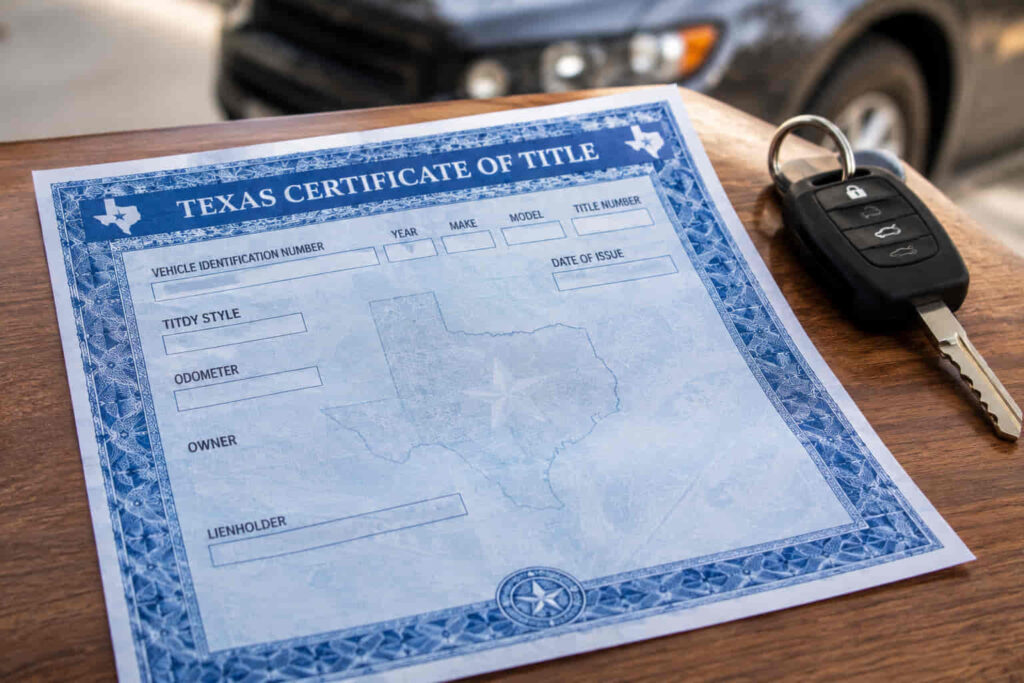
A blue title in Texas is a standard vehicle Certificate of Title issued by the Texas Department of Motor Vehicles (TxDMV) to document legal vehicle ownership. The term “blue title” refers to the color of the official title document rather than a separate vehicle title classification. A Texas blue title can represent a vehicle with a clean title history or a rebuilt salvage vehicle, depending on the title brands recorded on the document.
A blue title does not automatically mean a vehicle has never been involved in an accident, suffered significant damage, or undergone major repairs. For example, a vehicle previously classified as salvage may receive a regular Texas title after meeting the state’s rebuilt salvage requirements. However, the title must retain the appropriate rebuilt salvage brand, distinguishing it from an unbranded title.
Understanding what a blue title means is essential when buying, selling, or transferring a vehicle in Texas. Buyers must examine the title’s branding, verify the Vehicle Identification Number (VIN), and review available vehicle history records before completing a purchase. This guide explains how Texas blue titles work, how they differ from clean and salvage titles, and how to verify a vehicle’s title status to avoid ownership disputes and undisclosed vehicle damage.
What Is a Blue Title in Texas?
A blue title in Texas is a standard Certificate of Title issued by the Texas Department of Motor Vehicles (TxDMV) that identifies a vehicle’s legal owner and records essential ownership information. The term “blue title” comes from the blue-colored paper used for regular Texas vehicle titles. It is not a separate legal title classification, and the document’s color alone does not determine whether a vehicle has a clean, rebuilt, or previously damaged history.
A Texas blue title contains identifying information that connects a specific vehicle to its recorded owner. This includes the Vehicle Identification Number (VIN), year, make, model, owner information, and applicable lienholder details. The VIN serves as a unique identifier that allows buyers, sellers, and government agencies to match the title with the vehicle. For example, a buyer purchasing a used Ford F-150 in Houston can compare the 17-character VIN displayed on the dashboard with the VIN printed on the title to confirm that both identify the same vehicle.
The legal significance of a blue title depends on the information recorded on the document, particularly its title brands. A vehicle with an unbranded Texas title has no salvage or rebuilt designation recorded on that title. However, Texas also issues regular certificates of title for qualifying rebuilt salvage vehicles. These documents carry a “Rebuilt Salvage” brand that identifies the vehicle’s previous salvage classification. Consequently, two vehicles may have blue-colored titles while having substantially different damage histories and market values.
A blue title also differs from vehicle registration. The certificate of title establishes the state’s record of vehicle ownership, while registration authorizes a vehicle to operate on public roads when applicable legal requirements are satisfied. A vehicle owner may possess a valid blue title even when the vehicle’s registration has expired. Similarly, holding a blue title does not independently establish that a vehicle is mechanically safe, accident-free, or eligible for immediate road use.
For Texas vehicle buyers, the most important distinction is between the physical title document and the vehicle’s recorded title status. The blue paper identifies the type of ownership document, while title brands and official vehicle records provide information about its legal classification. Checking both helps buyers determine whether a vehicle has a regular unbranded title, a rebuilt salvage designation, or other recorded conditions that affect ownership and resale.
Read more: how to remove a gps tracker from a car
Does a Blue Title Mean a Clean Title in Texas?
A blue title in Texas does not automatically mean a vehicle has a clean title. Although blue is the standard color associated with regular Texas Certificates of Title, the vehicle’s legal classification depends on the title brands recorded by the Texas Department of Motor Vehicles (TxDMV). A blue title may be unbranded or display a designation such as “Rebuilt Salvage,” which indicates that the vehicle previously received a salvage classification.
A clean title generally refers to a vehicle title without a recorded salvage, rebuilt salvage, flood damage, or other significant damage-related brand. An unbranded title indicates that the issuing authority has not recorded those classifications on the document. However, it does not guarantee that the vehicle has never been damaged or repaired. For example, a used Chevrolet Silverado involved in a collision may retain an unbranded Texas title when the damage does not meet the legal requirements for salvage classification. The vehicle’s accident history and title status therefore represent two different types of information.
A rebuilt salvage vehicle provides another example of why title color and title status should not be treated as interchangeable. Under Texas law, a vehicle previously classified as salvage may qualify for a regular Certificate of Title after being rebuilt and meeting applicable requirements. The resulting title carries a “Rebuilt Salvage” brand to preserve the vehicle’s previous classification. Although the document may be printed on blue paper, the rebuilt designation remains part of the vehicle’s title history and must not be confused with an unbranded clean title.
The distinction also affects vehicle valuation and purchasing decisions. Two vehicles of the same make, model, year, and mileage may have different resale values because one has an unbranded title while the other carries a rebuilt salvage designation. A rebuilt vehicle may have undergone structural repairs, component replacement, or other restoration work following significant damage. Buyers should evaluate the quality of those repairs rather than assuming that the issuance of a regular title guarantees the vehicle’s mechanical condition.
To determine whether a Texas blue title is clean, buyers should examine the title’s printed brands and compare the VIN against official title-history records. The TxDMV recommends checking vehicle title information through its Title Check service, which connects consumers with approved National Motor Vehicle Title Information System (NMVTIS) providers. These records help identify reported salvage classifications, title brands, and other relevant vehicle-history information. A physical inspection by a qualified mechanic provides an additional assessment of the vehicle’s actual condition.
Ultimately, a clean title describes a vehicle’s recorded title status, while a blue title describes the commonly recognized appearance of a Texas ownership document. The two terms are related but not equivalent. Verifying title brands and available vehicle-history records is necessary to distinguish an unbranded vehicle from one with a documented salvage or rebuilt history.
What Is the Difference Between a Blue Title and a Salvage Title in Texas?
The main difference between a blue title and a salvage title in Texas is the vehicle’s legal classification and damage history. A blue title generally refers to a regular Certificate of Title issued by the Texas Department of Motor Vehicles (TxDMV), while a salvage title identifies a vehicle that meets the state’s legal definition of a salvage motor vehicle. A regular title documents vehicle ownership, whereas a salvage title establishes that the vehicle has sustained qualifying damage or meets another statutory salvage condition.
Under Texas Transportation Code Section 501.091, a salvage motor vehicle generally includes a vehicle that has been damaged to the extent that its repair costs, excluding repainting and sales tax on the total repair cost, exceed its actual cash value immediately before the damage. This determination involves the cost of restoring the vehicle to its predamage condition rather than simply whether it remains operational. For example, a vehicle worth $12,000 before a collision may qualify as salvage when its estimated qualifying repair costs reach $14,000. Texas law also contains specific exclusions and additional classification requirements, so repair costs alone do not determine every vehicle’s title status.
A Texas salvage vehicle title also differs from a regular blue title in its permitted use. A vehicle classified as salvage cannot be registered for ordinary highway operation while it retains that classification. The owner must complete the applicable rebuilding and titling process before the vehicle can qualify for a regular title and registration. This restriction reflects the legal status of the vehicle rather than a determination that every salvage vehicle is physically beyond repair. A salvage vehicle may still contain functional components or be economically repairable under certain circumstances.
A salvage vehicle can receive a regular Texas Certificate of Title after being rebuilt and satisfying the applicable state requirements. However, the resulting document must display the “Rebuilt Salvage” brand, which identifies its previous salvage classification. The brand remains part of the vehicle’s title history even after the vehicle has been repaired and returned to road use. For example, a Toyota Camry that received a Texas salvage title following substantial collision damage may later receive a blue-colored regular title marked “Rebuilt Salvage” after completing the required rebuilding and title application procedures.
The distinction between salvage and rebuilt salvage status is particularly important when evaluating vehicle safety and resale value. A salvage classification documents a qualifying damage-related event, while a rebuilt salvage designation indicates that the vehicle subsequently underwent the process required to obtain a regular title. Neither designation independently establishes the quality of the repairs. Structural alignment, airbag replacement, electrical systems, and safety-related components require separate evaluation because title issuance does not guarantee that every repair meets the original manufacturer’s specifications.
Texas also recognizes nonrepairable motor vehicles, which must not be confused with salvage vehicles eligible for rebuilding. A nonrepairable classification applies when a vehicle meets the state’s statutory criteria for that designation. Unlike a salvage vehicle that may qualify for a rebuilt title, a vehicle classified as nonrepairable cannot legally return to ordinary highway operation through the rebuilt salvage titling process. This distinction prevents buyers from assuming that every severely damaged vehicle can eventually receive a regular blue title.
For used-car buyers, the practical difference between a blue title and a salvage title extends beyond document appearance. A regular unbranded title generally presents fewer title-related complications, while salvage and rebuilt salvage classifications require closer examination of the vehicle’s history, repair documentation, insurance options, and resale implications. Buyers should verify the VIN, inspect the recorded title brands, and obtain an independent vehicle inspection before purchasing a vehicle with a previous salvage designation.
What Information Appears on a Texas Blue Title?
A Texas blue title contains the vehicle’s identifying details, recorded ownership information, lienholder information when applicable, and any title brands assigned by the Texas Department of Motor Vehicles (TxDMV). These records establish the connection between a vehicle and its titled owner while documenting legal conditions that may affect ownership transfers. The information printed on the certificate also allows buyers to verify that the seller’s documents correspond to the vehicle being purchased.
The Vehicle Identification Number (VIN) is one of the most important details on a Texas Certificate of Title. Most modern passenger vehicles have a standardized 17-character VIN that identifies the manufacturer, vehicle characteristics, and production information. The title also records the vehicle’s year, make, model, and body style. For example, a 2020 Ford F-150 should have a VIN on its title that matches the identification number displayed on the vehicle’s dashboard and manufacturer identification label. A mismatch may indicate a documentation error, an incorrect title, or potential vehicle identification fraud that requires investigation before ownership changes.
Owner information identifies the individual or legal entity recorded as the vehicle’s titled owner. Depending on the ownership arrangement, the certificate may identify more than one owner. Buyers should compare the seller’s identification with the ownership information on the title and confirm that the person transferring the vehicle has the legal authority to do so. A title issued in another person’s name does not automatically authorize the current possessor to sell the vehicle. This distinction is particularly important in private-party transactions, where buyers must establish a valid chain of ownership.
Lienholder information identifies a lender or another secured party with a recorded financial interest in the vehicle. When a vehicle is financed, the lender generally retains a security interest until the outstanding obligation is satisfied. Texas also uses an Electronic Lien and Title (ELT) system, meaning a title associated with an active lien may be maintained electronically rather than issued immediately as a paper certificate. Buyers should confirm that any recorded lien has been properly released before completing a purchase. For example, purchasing a vehicle with an unresolved auto loan may create complications when applying for a new title because the lender’s security interest remains attached to the vehicle.
Title brands provide additional information about the vehicle’s officially recorded history. A Texas Certificate of Title may display designations such as “Rebuilt Salvage” when the vehicle has previously received a qualifying salvage classification and subsequently completed the applicable rebuilding process. These brands are different from ordinary vehicle descriptions because they identify legal classifications that may influence resale value, insurance eligibility, and purchasing decisions. Buyers should examine the title’s remarks and branding fields rather than relying on the blue color of the document as evidence of an unbranded vehicle history.
A Texas title may also include an odometer disclosure or mileage-related designation, depending on the vehicle’s age and applicable disclosure requirements. Odometer information helps document the vehicle’s reported mileage during ownership transactions, although it does not independently guarantee the accuracy of the vehicle’s entire mileage history. For example, an odometer reading that is substantially lower than mileage recorded during an earlier inspection or title transaction warrants further investigation. Comparing title information with maintenance records and vehicle history reports helps identify inconsistencies.
The certificate’s title number and issuance information provide additional references for identifying the official ownership record. These details are useful when resolving title discrepancies, requesting replacement documents, or completing administrative transactions with the appropriate Texas county tax assessor-collector’s office. A valid title must also be properly assigned during a sale, with the required seller and buyer information completed according to Texas title transfer procedures.
Examining these details allows buyers to evaluate three separate issues: whether the vehicle matches its identification documents, whether the seller has the authority to transfer ownership, and whether the title contains recorded conditions affecting the transaction. A Texas blue title establishes documented ownership information, but verifying its VIN, ownership records, liens, and title brands is necessary before relying on it in a vehicle purchase.
Can a Car With a Blue Title Have Previous Accident Damage?
Yes, a car with a blue title in Texas can have previous accident damage, even when the title has no salvage or rebuilt designation. A regular Texas Certificate of Title documents vehicle ownership and applicable title brands, but it does not provide a complete record of every collision, repair, or structural defect. A vehicle may retain an unbranded title after an accident when the damage does not meet the legal criteria for salvage classification.
The distinction depends on how Texas classifies vehicle damage rather than whether an accident occurred. Under Texas Transportation Code Section 501.091, salvage classification generally applies when qualifying repair costs exceed the vehicle’s actual cash value immediately before the damage, subject to statutory conditions and exclusions. For example, a vehicle worth $20,000 before an accident might require $6,000 in body repairs and still retain an unbranded title because the repair costs fall below the applicable salvage threshold. However, the absence of a salvage brand does not establish that the vehicle’s structural components, safety systems, or mechanical parts were unaffected.
Accident damage may also remain absent from a vehicle’s title history when repairs occur outside the insurance claims process. An owner who pays directly for collision repairs may not generate an insurance total-loss record, and the accident may never result in a title brand. Similarly, vehicle history reporting services depend on information supplied by participating insurers, repair facilities, government agencies, and other data providers. A collision that was not reported to these sources may not appear in a commercial vehicle history report. Therefore, a clean vehicle history report should not be interpreted as definitive proof that the vehicle has never sustained damage.
Previous accidents can affect vehicle safety even when the exterior has been professionally restored. Structural repairs may involve frame straightening, welded components, replacement body panels, or adjustments to the vehicle’s suspension geometry. Modern vehicles also contain advanced driver assistance systems, including automatic emergency braking, lane departure warning, and adaptive cruise control, that may require calibration after certain collision repairs. For example, a vehicle with a replaced front bumper may appear undamaged while its radar sensor remains improperly aligned, potentially affecting the performance of its collision avoidance system.
Flood damage presents another risk that cannot be ruled out solely by examining a blue title. Water exposure can damage electrical connectors, electronic control modules, wiring harnesses, and interior components without producing immediately visible mechanical problems. A vehicle may have experienced water intrusion without receiving a flood-related title brand, particularly when the incident was not documented through the relevant reporting channels. Buyers should inspect for corrosion, persistent moisture, unusual odors, and electrical malfunctions when evaluating vehicles with uncertain histories.
The most reliable approach combines title verification, vehicle history research, and a physical inspection. The Texas Department of Motor Vehicles recommends using its Title Check service to access vehicle title information through approved National Motor Vehicle Title Information System (NMVTIS) providers. These reports can reveal reported title brands, salvage records, and other available historical information. An independent inspection by a qualified automotive technician adds a separate evaluation of the vehicle’s physical condition, including signs of collision repairs, structural damage, and malfunctioning safety components.
A blue title confirms neither an accident-free history nor the absence of hidden damage. Its primary purpose is to document ownership and recorded title classifications. Buyers should evaluate the vehicle’s condition and available historical records separately, particularly when purchasing a used car from a private seller or a dealership without complete maintenance and repair documentation.
How Can You Check Whether a Blue Title Is Clean in Texas?
To check whether a blue title is clean in Texas, examine the title for damage-related brands, verify the Vehicle Identification Number (VIN), and review the vehicle’s title history through the Texas Department of Motor Vehicles (TxDMV) Title Check service. A clean title generally means the vehicle has no recorded salvage, rebuilt salvage, or other significant damage-related title brand. However, confirming an unbranded title requires checking official records rather than relying on the document’s blue color or the seller’s description.
The first step is to inspect the original Texas Certificate of Title and identify any brands or remarks printed on the document. A title marked “Rebuilt Salvage” indicates that the vehicle previously received a salvage classification before qualifying for a regular title. Buyers should also examine the ownership and lienholder information to identify restrictions that may affect the transaction. For example, a seller may advertise a vehicle as having a clean blue title even though the certificate displays a rebuilt salvage designation. Reading the actual title prevents confusion between the document’s appearance and its recorded legal status.
The VIN provides the primary connection between the physical vehicle and its official title records. Most passenger vehicles manufactured since 1981 have a standardized 17-character VIN, typically visible through the lower driver’s side windshield and on the manufacturer’s identification label near the driver’s door. Buyers should compare these identifiers with the VIN printed on the title. A mismatch requires further investigation because it may indicate a clerical error, an incorrect ownership document, or vehicle identification tampering. For example, a used Honda Accord with a VIN on its dashboard that differs from the VIN on its Texas title should not be purchased until the discrepancy has been resolved.
The TxDMV Title Check service provides access to approved National Motor Vehicle Title Information System (NMVTIS) providers that offer vehicle history reports. NMVTIS collects information from participating state motor vehicle agencies, insurance carriers, salvage businesses, and other required reporting entities. Depending on the available records, a report may identify previous title brands, reported salvage or total-loss events, odometer information, and certain historical title records. Buyers can access the service through the official TxDMV Title Check page and select an approved provider to obtain a report.
Checking title records from multiple states is particularly important when purchasing a vehicle previously registered outside Texas. A vehicle may have received a salvage or flood-related brand in another state before being transferred to Texas. Interstate title-history records help buyers identify previous classifications that may not be obvious from the seller’s description or current registration documents. This verification also reduces the risk of title washing, a practice in which a vehicle’s damage history is concealed or misrepresented through improper title transactions.
Vehicle history reports should be evaluated alongside the physical condition of the car because reporting databases are not complete records of every accident or repair. A vehicle may have undergone significant bodywork without an insurance claim or official salvage classification. Buyers should compare reported mileage, ownership changes, and damage events with maintenance documentation and inspection findings. An independent mechanic can identify evidence of structural repairs, flood exposure, or mechanical problems that title records alone cannot establish.
A clean Texas blue title is most reliably verified when the physical certificate, VIN, official title-history records, and vehicle inspection findings are consistent. An unbranded title confirms the absence of certain recorded title classifications, but it does not guarantee that the vehicle has never been damaged. Completing these checks before payment helps buyers identify undisclosed title problems, evaluate the vehicle’s condition, and reduce the risk of purchasing a car with an inaccurate ownership or damage history.
Can You Buy or Sell a Car With a Blue Title in Texas?
Yes, you can legally buy or sell a car with a blue title in Texas, provided the seller has the authority to transfer ownership and the transaction meets the Texas Department of Motor Vehicles (TxDMV) title transfer requirements. A regular Texas Certificate of Title serves as the primary ownership document used in vehicle sales. However, the presence of a blue title does not automatically establish that the vehicle is free of liens, has an unbranded history, or is eligible for immediate registration.
When selling a vehicle with a blue title, the recorded owner must properly assign the title to the buyer. This generally requires completing the applicable assignment information, including the buyer’s name, sale date, seller’s signature, and required odometer disclosure. The information must be accurate and consistent with the vehicle’s ownership records. For example, a private seller in Dallas who owns a 2019 Toyota Camry outright can transfer the vehicle by completing the title assignment and providing the documentation required for the buyer’s Texas title application. An incomplete assignment or missing signature may delay the transfer until the documentation is corrected.
An outstanding vehicle lien creates an additional requirement during the sale. A lien represents a lender’s legal security interest in the vehicle, typically associated with an unpaid auto loan. When a lien remains recorded, the seller must arrange for its release before the buyer can obtain clear ownership without that security interest. Texas uses an Electronic Lien and Title (ELT) system, so vehicles with active liens may have electronic title records rather than paper certificates. Buyers purchasing financed vehicles should coordinate the loan payoff and lien release directly with the lender instead of relying solely on the seller’s assurance that the debt has been paid.
A blue title displaying a “Rebuilt Salvage” brand does not automatically prevent a vehicle from being sold in Texas. A properly titled rebuilt salvage vehicle can generally be transferred through the regular ownership process, subject to applicable documentation requirements. However, the rebuilt designation remains part of the vehicle’s recorded history and may influence its market value, financing options, and insurance availability. For example, a rebuilt 2021 Chevrolet Silverado may sell for less than a comparable vehicle with an unbranded title because buyers must account for its previous salvage classification and the quality of its repairs. Sellers should accurately represent the vehicle’s title status and avoid describing a branded vehicle as having a clean title.
Buyers should also distinguish between purchasing a vehicle and obtaining authorization to operate it on public roads. A valid ownership title does not replace registration, required insurance, or other applicable Texas vehicle requirements. A buyer may legally acquire a vehicle that is not currently registered, but driving it requires compliance with the state’s road-use rules. Before completing a transaction, buyers should confirm whether the vehicle has valid registration and determine what documentation is needed to operate it after the sale.
Texas buyers are generally required to apply for a vehicle title within 30 calendar days of the purchase date. The application process typically involves the properly assigned title, Form 130-U (Application for Texas Title and/or Registration), applicable fees, and motor vehicle sales tax. Sellers should also submit a Vehicle Transfer Notification to TxDMV, preferably within 30 days of the sale, to help establish a record that the vehicle has changed possession. These procedures reduce the risk of ownership disputes and administrative problems following the transaction.
A successful blue title transaction depends on verified ownership, accurate title assignment, resolution of recorded liens, and compliance with Texas transfer requirements. Buyers should confirm that the seller can legally transfer the vehicle and that the title’s recorded status matches the vehicle being purchased before exchanging payment. Completing these checks helps prevent title fraud, unexpected financial obligations, and delays in registering the vehicle under the new owner’s name.
How Do You Transfer a Blue Title in Texas?
To transfer a blue title in Texas, the seller must properly assign the vehicle’s Certificate of Title to the buyer, and the buyer must submit the required ownership transfer documents to the appropriate county tax assessor-collector’s office. The Texas Department of Motor Vehicles (TxDMV) generally requires a completed title assignment, Form 130-U (Application for Texas Title and/or Registration), applicable fees, and motor vehicle sales tax. Buyers must generally apply for a title transfer within 30 calendar days of purchasing the vehicle to avoid late transfer penalties.
The transfer begins with the seller completing the assignment section of the original Texas Certificate of Title. This section records the buyer’s information, transaction details, seller’s signature, and any required odometer disclosure. The names and signatures must correspond to the ownership information on the title, and the seller must have legal authority to transfer the vehicle. For example, when a vehicle is titled jointly to two individuals, the required signatures depend on how ownership is recorded. Buyers should confirm that all necessary owners have authorized the transfer before accepting the title.
The buyer must complete Form 130-U, which provides TxDMV with the information needed to process the ownership change. The application includes details about the vehicle, purchaser, seller, transaction value, and intended registration. The buyer submits the completed form with the assigned title and supporting documents to the county tax assessor-collector’s office. Depending on the transaction, additional documentation may be required to establish lien release, satisfy identification requirements, or address discrepancies in the existing title record.
Texas generally imposes a motor vehicle sales tax of 6.25% on taxable vehicle purchases. For private-party transactions, the taxable value is generally based on the greater of the purchase price or 80% of the vehicle’s Standard Presumptive Value (SPV), subject to applicable exceptions. For example, a vehicle purchased for $15,000 with an applicable taxable value of $15,000 would generate $937.50 in motor vehicle sales tax before title, registration, and other fees. Buyers should verify the applicable taxable value and exemptions because the amount paid for a vehicle does not always determine the final tax assessment.
A standard Texas title application generally carries a title fee of $28 or $33, depending on the county. Registration fees and other charges are separate and depend on the vehicle and transaction. Buyers seeking registration must also satisfy applicable Texas financial responsibility and vehicle inspection requirements. Since January 1, 2025, most noncommercial vehicles in Texas have no longer required annual safety inspections, although emissions testing remains mandatory in designated counties for qualifying vehicles. These requirements affect registration eligibility but do not change the underlying ownership transfer process.
Vehicles with recorded liens require additional attention during a title transfer. When a lender holds a security interest, the lien must be properly released or otherwise addressed through the applicable transfer process. A seller who has recently paid off an auto loan should obtain confirmation that the lender has released its interest in the vehicle. For example, a buyer purchasing a financed vehicle from a private seller should verify the payoff arrangements and lien release before assuming that the seller can deliver a title free of outstanding security interests.
The seller should also submit a Vehicle Transfer Notification to TxDMV within 30 days of the transaction. This notification creates an official record identifying the date of sale and the person who acquired the vehicle. It helps protect the previous owner from certain parking, toll, and other vehicle-related liabilities arising after the sale. However, submitting the notification does not replace the buyer’s responsibility to apply for a new title. Both actions serve separate administrative purposes and should be completed promptly.
Once the county tax office accepts the application and processes the ownership change, the vehicle’s title record is updated to reflect the new owner. A paper Certificate of Title is generally issued when the vehicle is eligible for a paper title and no electronic lien arrangement prevents its issuance. If the vehicle carries a rebuilt salvage brand, that designation remains associated with its title history after the transfer. Changing ownership does not eliminate previous salvage classifications or other legally required title brands.
Transferring a Texas blue title requires accurate ownership documentation, timely application, payment of applicable taxes and fees, and resolution of any recorded liens. Completing the process within the required timeframe establishes the buyer’s ownership record and reduces the risk of penalties, rejected applications, and future title disputes.
What Should You Do If a Texas Blue Title Has Incorrect Information?
If a Texas blue title contains incorrect information, contact the Texas Department of Motor Vehicles (TxDMV) or the appropriate county tax assessor-collector’s office to determine the required correction procedure. Errors involving the owner’s name, Vehicle Identification Number (VIN), vehicle description, odometer reading, or lienholder information should be resolved before the vehicle is sold or transferred. The correction process depends on the type of error, how it occurred, and whether the incorrect information appears on the original ownership record or was entered during a subsequent transaction.
Minor clerical errors, such as a misspelled owner’s name or an incorrect vehicle model, may require supporting documentation to establish the correct information. For example, an owner whose name appears incorrectly on a Texas Certificate of Title may need to provide identification and additional records confirming the discrepancy. Errors involving the VIN require closer examination because the identification number connects the title to a specific vehicle. TxDMV may require additional verification or documentation before correcting a vehicle identification discrepancy.
Mistakes made while completing a title assignment can also interfere with an ownership transfer. Incorrect buyer information, missing signatures, altered sale dates, or improperly completed odometer disclosures may cause the county tax office to reject the application. Texas provides Form VTR-130-SOF, Statement of Fact for a Vehicle Title Transfer, for certain title transfer corrections and explanations. However, this form does not automatically resolve every type of error, and additional documentation may be required depending on the circumstances. Buyers and sellers should follow the instructions provided by the county tax office rather than attempting to correct the document independently.
Title branding discrepancies require particular attention because they can affect a vehicle’s legal classification and resale value. A vehicle previously classified as rebuilt salvage cannot obtain an unbranded title merely because its owner requests removal of the designation. Texas title brands are governed by applicable vehicle title laws and historical records. If a title displays an incorrect brand, the owner must provide evidence supporting the correction and follow the appropriate TxDMV review process. A legitimate correction differs from title washing, which involves concealing or misrepresenting a vehicle’s previous damage-related classification.
Owners should avoid using correction fluid, erasing information, or making unauthorized changes to a Texas Certificate of Title. Physical alterations can raise concerns about document authenticity and may prevent the title from being accepted during a sale. When an original title is damaged, lost, or unsuitable for transfer, the owner may need to request a certified copy using Form VTR-34, Application for a Certified Copy of Title, if eligible. A certified copy replaces the ownership document but does not independently change the vehicle’s recorded title history or correct inaccurate information.
The correct way to resolve a Texas blue title error is to identify the discrepancy, obtain supporting documentation, and follow the correction procedure required by TxDMV or the county tax office. Resolving title errors before transferring ownership helps prevent rejected applications, inaccurate vehicle records, and disputes between buyers and sellers.