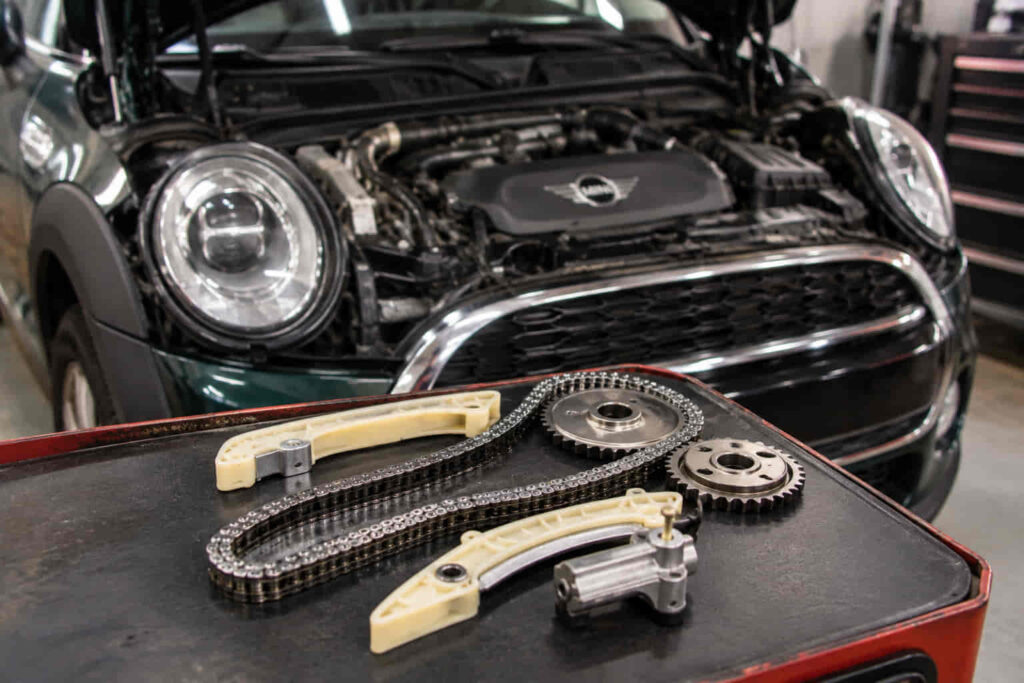
MINI Cooper timing chain replacement typically costs $1,000 to $2,500 in the United States, including parts and labor. The final price depends on the vehicle’s model year, engine type, local labor rates, and whether additional timing system components require replacement. Repairs involving damaged valves or other internal engine components can cost substantially more.
Labor accounts for a significant portion of the replacement cost because accessing the timing chain requires removing engine components and precisely aligning the crankshaft and camshafts. A complete timing chain service may include replacing the chain, tensioner, guides, seals, and related hardware. MINI Cooper models equipped with N12, N14, N16, and N18 engines have different service requirements from newer models using B38 or B48 engines.
Replacing a worn timing chain before it slips or breaks helps prevent more expensive engine damage. Warning signs include rattling during cold starts, engine timing faults, and unusual mechanical noise. However, these symptoms require professional diagnosis because other engine problems can produce similar results.
This guide explains MINI Cooper timing chain replacement costs by model, parts and labor expenses, factors affecting repair prices, and how to determine whether replacement is worth the investment.
How Much Does a MINI Cooper Timing Chain Replacement Cost?
A MINI Cooper timing chain replacement generally costs $1,000 to $2,500, including replacement parts and professional labor. Parts typically account for approximately $150 to $600, while labor can range from $800 to $1,900, depending on the engine configuration, repair shop, and components being replaced. These are estimated U.S. repair costs rather than fixed prices, and individual quotes may fall outside these ranges.
The timing chain connects the crankshaft and camshaft rotation to maintain accurate engine valve timing. Replacing it involves accessing the timing system, removing worn components, installing the replacement chain, and verifying that the engine timing is correctly synchronized. The procedure requires specialized timing tools and careful mechanical alignment, making labor the largest expense in many MINI Cooper timing chain repairs.
Timing chain parts typically cost $150 to $600, depending on whether the repair requires an individual chain or a complete timing chain kit. A complete kit generally includes the timing chain, tensioner, and chain guides. Additional components, including sprockets, gaskets, seals, and mounting hardware, may increase the parts bill. Replacing related worn components during the same service helps avoid paying for overlapping disassembly labor if those components fail later.
Labor costs typically range from $800 to $1,900 because timing chain replacement requires extensive engine disassembly and precise reassembly. The total labor charge depends on the engine’s layout, the number of hours required, and the repair facility’s hourly rate. MINI dealerships and independent repair specialists may charge different rates for the same procedure. An accurate estimate should identify the engine variant and specify which timing system components are included.
The replacement cost increases when a stretched or damaged timing chain has affected other engine components. A chain that jumps timing can disrupt valve operation and potentially cause piston-to-valve contact in an interference engine. Repairs involving bent valves, damaged cylinder heads, or other internal components require additional diagnostic work and may cost substantially more than a standard timing chain replacement. For this reason, diagnosing abnormal timing chain noise before a mechanical failure occurs can help limit the overall repair expense.
Read more: how to remove water marks from car
How Does MINI Cooper Timing Chain Replacement Cost Vary by Model?
MINI Cooper timing chain replacement costs vary by model, production year, and engine configuration because each engine has different timing system components and service procedures. First-generation BMW-era MINI models, second-generation vehicles with Prince-family engines, and newer MINI models with BMW modular engines do not share identical replacement requirements. The engine code is therefore more useful than the model name alone when estimating repair expenses.
The MINI Cooper S R56, produced from 2007 to 2013, is an important example because its turbocharged N14 and later N18 engines have documented timing chain and tensioner concerns. Replacing the timing chain assembly on these vehicles generally falls within the estimated $1,000 to $2,500 repair range, although the final price depends on the condition of the chain guides, tensioner, sprockets, and surrounding components. Earlier N14-equipped vehicles deserve particular attention when investigating cold-start rattling or suspected timing chain wear. However, a rattling noise alone does not establish that the chain requires replacement.
MINI Cooper Countryman timing chain replacement costs depend primarily on the vehicle’s generation and engine. First-generation Countryman R60 models were available with N16 and N18 engines, while later Countryman models introduced different BMW engine families. These differences affect replacement parts, component accessibility, and labor requirements. A Countryman equipped with an N18 engine should not automatically receive the same repair estimate as a newer Countryman with a B-series engine, even when both vehicles display similar engine warning symptoms.
MINI Cooper Clubman models also have different timing chain configurations across production generations. The R55 Clubman uses engines from the N-series family, while the later F54 Clubman uses newer BMW modular engine designs. Repair costs depend on the specific engine, the parts required, and the manufacturer’s service procedure. Engine identification is particularly important because timing chain kit compatibility and labor requirements cannot be determined reliably from the Clubman name alone.
Newer MINI Cooper models equipped with B38 and B48 engines require separate cost assessments. Their timing system designs and access procedures differ from those of older N-series engines, so replacement estimates based on an R56 Cooper S may not accurately represent the cost of servicing a newer F56 Cooper. A repair facility should verify the vehicle identification number, engine code, and required replacement procedure before providing a final quote.
What Factors Affect MINI Cooper Timing Chain Replacement Cost?
The main factors affecting MINI Cooper timing chain replacement cost are engine design, replacement parts, labor rates, and the extent of existing engine damage. These variables determine both the complexity of the repair and the total amount charged by the service provider. Two MINI Cooper vehicles from the same model year can receive different repair estimates when their engine configurations, maintenance histories, or timing system conditions differ.
Engine design directly influences labor requirements because the timing chain’s location determines which components must be removed to access it. Some MINI engines require more extensive disassembly or specialized service procedures than others. Technicians must also secure the crankshaft and camshafts in their specified positions before installing and tensioning the replacement chain. Incorrect timing alignment can cause poor engine performance, fault codes, or mechanical damage, making proper tools and engine-specific procedures essential.
The scope of parts replacement also changes the total cost. Replacing a timing chain tensioner alone generally involves fewer parts and less work than replacing the complete timing chain assembly, provided the engine design permits separate tensioner service. However, a new tensioner does not correct a stretched chain or damaged guides. When inspection identifies wear across several timing system components, replacing the appropriate complete kit can prevent repeated disassembly and additional labor expenses.
Labor rates vary according to the repair facility’s location, specialization, and service pricing. A MINI dealership generally uses manufacturer-approved repair procedures and original equipment parts, while an independent BMW/MINI specialist may offer different labor rates and parts options. The lowest hourly rate does not necessarily produce the lowest final bill because the required labor time, diagnostic charges, and replacement components also affect the total price.
Existing engine damage creates the largest potential increase in replacement costs. A timing chain that stretches beyond acceptable limits can alter camshaft timing, while a chain that jumps teeth may cause serious internal damage. In an interference engine, incorrect valve timing can allow the pistons and valves to collide, potentially bending valves or damaging the cylinder head. These failures require additional inspection and repair beyond the timing chain assembly itself. Identifying timing system problems before the chain loses synchronization reduces the risk of a substantially more expensive engine repair.
Is MINI Cooper Timing Chain Replacement Cheaper at an Independent Mechanic?
MINI Cooper timing chain replacement is generally cheaper at an independent mechanic than at a MINI dealership, primarily because independent repair shops often charge lower hourly labor rates. Both types of facilities can perform timing chain replacement, but the total cost depends on the technician’s experience, engine-specific repair procedures, replacement parts, and warranty coverage. An independent BMW/MINI specialist is particularly relevant because timing chain service requires precise engine timing and familiarity with MINI powertrain designs.
MINI dealerships use manufacturer-approved service procedures, diagnostic equipment, and original equipment replacement parts. These services are reflected in the dealership’s labor pricing and parts charges. Dealership technicians also have access to manufacturer repair information, including engine-specific timing specifications and technical service documentation. This makes dealership service an option for owners who prioritize manufacturer-backed repair procedures, particularly when the vehicle has complex timing faults or potential warranty coverage.
Independent MINI specialists can reduce replacement expenses through lower labor rates and alternative parts sourcing. Some independent facilities install original equipment manufacturer (OEM) components or reputable aftermarket timing chain kits instead of purchasing every replacement part through a dealership. However, parts quality and kit completeness must be verified because the timing chain, guides, and tensioner operate together to maintain accurate valve timing. Installing incompatible or poor-quality components can lead to repeated repairs and additional labor charges.
The difference between dealership and independent repair costs should be evaluated using itemized estimates rather than hourly labor rates alone. A complete quote should identify the timing chain kit, tensioner, guides, seals, replacement hardware, estimated labor hours, and any diagnostic charges. It should also explain whether additional components will be replaced only after inspection. Comparing estimates with identical repair scopes prevents a lower initial quote from becoming more expensive when necessary parts are added later.
Warranty coverage is another factor in choosing a repair facility. Dealerships and independent specialists offer different parts and workmanship warranty terms, which should be confirmed before authorizing the repair. Owners of older MINI Cooper models should also check whether their specific vehicle qualifies for an applicable manufacturer service campaign, warranty extension, or other repair assistance. Eligibility depends on the vehicle identification number, model, production date, and applicable program conditions rather than the MINI Cooper name alone.
What Are the Signs of a Failing MINI Cooper Timing Chain?
The main signs of a failing MINI Cooper timing chain include rattling during engine startup, persistent mechanical noise, engine timing fault codes, rough idling, and reduced engine performance. These symptoms develop when the timing chain, tensioner, or guides can no longer maintain the intended relationship between crankshaft and camshaft rotation. However, the same symptoms can result from unrelated engine problems, so a timing chain replacement should follow proper mechanical diagnosis rather than symptom recognition alone.
A metallic rattling noise during a cold start is a commonly reported warning sign in certain MINI Cooper engines, particularly older N14-equipped Cooper S models. The timing chain tensioner helps maintain chain tension as the engine operates, while the guides control chain movement. When these components become worn or fail to maintain adequate tension, the chain can move excessively and produce noise against surrounding components. Startup rattling requires investigation because similar sounds can also originate from other engine accessories or mechanical systems.
A failing timing chain can also trigger the check engine light when chain wear or incorrect timing affects the relationship between crankshaft and camshaft positions. The engine control module monitors these positions using dedicated sensors and can record camshaft-to-crankshaft correlation faults when the measured relationship falls outside the expected range. Diagnostic trouble codes such as P0016 or P0017 can indicate a timing correlation problem, but they do not independently confirm timing chain failure. Faulty sensors, oil-control problems, and variable valve timing components must also be considered during diagnosis.
Rough idling, engine hesitation, and reduced acceleration can occur when incorrect camshaft timing disrupts valve operation. The engine relies on precisely coordinated intake and exhaust valve events to maintain combustion efficiency and stable performance. When timing becomes inaccurate, cylinder filling and combustion can deteriorate, resulting in uneven engine operation or reduced power. These symptoms become more concerning when they appear alongside abnormal timing chain noise or confirmed timing correlation faults.
Severe timing chain failure can prevent the engine from starting or cause it to stop running unexpectedly. A chain that breaks or jumps sufficiently far out of synchronization can disrupt valve timing and potentially allow internal engine components to collide. Continuing to operate an engine with suspected severe timing chain problems increases the risk of additional damage. A MINI Cooper displaying loud mechanical rattling, sudden power loss, or a no-start condition associated with timing faults should be inspected before further operation, and towing is the safer option when serious mechanical failure is suspected.
Early diagnosis helps distinguish a worn tensioner or another repairable timing system problem from extensive chain wear or internal engine damage. A qualified technician can review diagnostic fault codes, inspect relevant mechanical components, and perform engine-specific timing checks to determine the necessary repair. Confirming the actual failure before replacing parts helps avoid unnecessary expenses while reducing the risk of leaving a serious timing problem unresolved.
How Long Does a MINI Cooper Timing Chain Last?
A MINI Cooper timing chain is designed for long-term engine operation and does not have a universal replacement interval. Its service life depends on the engine generation, lubrication quality, maintenance history, and condition of the timing chain tensioner and guides. Unlike a timing belt, which typically requires replacement at a manufacturer-specified mileage or age, a timing chain generally remains in service until inspection or operating symptoms indicate excessive wear or mechanical failure.
Certain second-generation MINI Cooper models equipped with N12, N14, N16, and N18 engines have known timing system concerns, although failure rates and repair requirements differ between engine variants and production years. The N14 engine, used in earlier turbocharged MINI Cooper S models, is particularly associated with timing chain tensioner problems and startup rattling. These concerns do not establish a fixed replacement mileage for every vehicle. A chain’s condition must be assessed using engine-specific diagnostic procedures rather than mileage alone.
Engine oil maintenance directly affects timing chain longevity because the chain, sprockets, and tensioning components depend on adequate lubrication. Oil degradation, insufficient oil levels, and contamination can accelerate wear on metal contact surfaces and interfere with the operation of oil-dependent tensioning mechanisms. Following the appropriate MINI oil specifications, maintaining the correct oil level, and addressing oil leaks help protect the timing system from avoidable wear.
Timing chain condition should be investigated when a MINI Cooper develops persistent startup rattling, abnormal mechanical noise, or camshaft timing faults. A technician can assess chain tension, inspect accessible timing components, and check crankshaft-to-camshaft synchronization according to the engine’s service procedure. Replacing a worn chain before it loses synchronization helps prevent the additional expenses associated with internal engine damage.
Can You Drive a MINI Cooper With a Bad Timing Chain?
Driving a MINI Cooper with a confirmed failing timing chain is not recommended because incorrect valve timing can cause engine damage or sudden engine failure. The severity of the risk depends on whether the problem involves a worn tensioner, excessive chain slack, damaged guides, or a chain that has already jumped timing. Continued operation places additional stress on the timing system and can turn a repairable component failure into a substantially more expensive engine repair.
A loose or stretched timing chain can gradually alter the synchronization between the crankshaft and camshafts. The crankshaft controls piston movement, while the camshafts determine when the intake and exhaust valves open and close. The timing chain maintains the relationship between these movements. When chain wear or tensioner failure allows the timing relationship to shift, the engine may develop rough idling, reduced power, abnormal combustion, or diagnostic timing faults.
The most serious consequence occurs when the timing chain jumps teeth or breaks in an interference engine. In this engine design, pistons and valves occupy overlapping areas of the combustion chamber at different points in the operating cycle. Accurate valve timing prevents them from contacting each other. A major timing failure can cause piston-to-valve contact, resulting in bent valves, damaged pistons, or cylinder head damage. Repairing these components requires substantially more work than replacing an intact timing chain assembly.
A MINI Cooper with loud metallic rattling, severe engine misfires, sudden power loss, or a suspected timing chain jump should not be driven until the cause has been identified. Switching off the engine and arranging professional inspection or towing reduces the risk of further mechanical damage. Mild startup noise also deserves prompt diagnosis, although it does not automatically confirm timing chain failure or establish that the vehicle is unsafe to operate.
The financial difference between early intervention and delayed repair depends on the condition of the engine when the problem is discovered. Replacing worn timing components before a mechanical failure generally involves fewer repairs than restoring an engine with damaged valves or pistons. A professional diagnosis is therefore necessary to determine whether the vehicle requires a tensioner repair, a complete timing chain replacement, or additional internal engine work.
Is It Worth Replacing the Timing Chain on an Older MINI Cooper?
Replacing the timing chain on an older MINI Cooper is worth considering when the engine is otherwise healthy and the repair cost is reasonable compared with the vehicle’s market value and expected remaining service life. A timing chain replacement restores proper engine synchronization, but it does not address unrelated mechanical problems or guarantee additional years of reliable operation. The decision should account for the vehicle’s age, mileage, maintenance history, current condition, and anticipated future repairs.
The relationship between replacement cost and vehicle value provides a starting point for evaluating the repair. For example, a MINI Cooper worth $6,000 that requires a $1,500 timing chain replacement has a repair expense equal to 25% of its estimated market value. This calculation does not automatically make the repair worthwhile, but it establishes how much of the vehicle’s value would be spent on restoring the timing system. Owners should also consider whether the vehicle has other expensive problems involving the transmission, cooling system, turbocharger, or suspension. These additional expenses affect the overall financial value of keeping the car.
Engine condition is particularly important because timing chain replacement is most economical before internal damage occurs. A MINI Cooper with a worn chain but otherwise normal engine compression and no evidence of valve damage may require only the appropriate timing system components. By contrast, a vehicle with a broken chain, bent valves, or damaged pistons may need extensive cylinder head repairs or engine replacement. The cost of restoring a severely damaged engine can exceed the economic value of an older vehicle, especially when other major repairs are also necessary.
Maintenance history also influences whether a timing chain replacement is a sound investment. A MINI Cooper with documented oil changes, consistent servicing, and few outstanding mechanical problems offers a more predictable basis for continued ownership than a neglected vehicle with multiple unresolved faults. Mileage alone does not determine whether the car is worth repairing. A higher-mileage MINI Cooper with a well-maintained engine may be a better repair candidate than a lower-mileage example with poor lubrication history and significant mechanical wear.
The final decision should compare the complete repair estimate with the cost of replacing the vehicle. Replacement expenses include more than another car’s advertised purchase price because taxes, registration, inspection, and potential maintenance may increase the amount required. When a timing chain replacement restores a mechanically sound MINI Cooper for substantially less than the cost of obtaining a comparable vehicle, repairing the existing car can be the more economical choice.
How Can You Reduce MINI Cooper Timing Chain Replacement Costs?
The most effective ways to reduce MINI Cooper timing chain replacement costs are to obtain comparable repair estimates, confirm the exact engine configuration, replace only necessary components, and address timing system problems before they cause internal engine damage. These measures reduce unnecessary spending without compromising the accuracy of engine timing or the reliability of the completed repair.
Comparing quotes from qualified MINI repair specialists helps identify differences in labor charges, parts pricing, and repair scope. A dealership and an independent BMW/MINI specialist may recommend the same timing chain service but calculate the final bill differently. Each estimate should specify the replacement components, estimated labor hours, diagnostic charges, and warranty terms. A lower quote is not necessarily better when it excludes chain guides, seals, or other components that the manufacturer requires for the procedure.
Confirming the engine code prevents incorrect parts selection and inaccurate labor estimates. MINI Cooper models use different engine families, including N12, N14, N16, N18, B38, and B48 configurations, with distinct timing system designs and service requirements. Providing the vehicle identification number allows a repair facility to identify compatible replacement components and the appropriate service procedure. This reduces the likelihood of ordering incorrect parts or discovering unexpected compatibility problems after disassembly.
Replacing only the components that require service can control repair expenses, but the decision must follow the manufacturer’s procedures and the results of mechanical inspection. A faulty timing chain tensioner does not always mean the chain itself has failed. However, replacing the tensioner alone is not an adequate solution when the chain has stretched beyond specification or the guides are damaged. When several timing components show wear, replacing the appropriate complete kit during one repair can prevent duplicated labor costs.
Preventive maintenance reduces the risk of avoidable timing system deterioration. Maintaining the correct engine oil level, using oil that meets the applicable MINI specifications, and following the appropriate service schedule support lubrication of the chain and related components. Abnormal startup rattling, persistent mechanical noise, and timing-related fault codes should be investigated promptly rather than ignored until engine performance deteriorates.
Owners should also verify whether their MINI Cooper qualifies for any applicable warranty extension, manufacturer service campaign, or repair assistance program before authorizing payment. Coverage depends on the specific vehicle, applicable program terms, and repair circumstances. Combining accurate diagnosis, appropriate replacement parts, and qualified labor offers the most reliable approach to controlling timing chain replacement expenses while protecting the engine from additional damage.