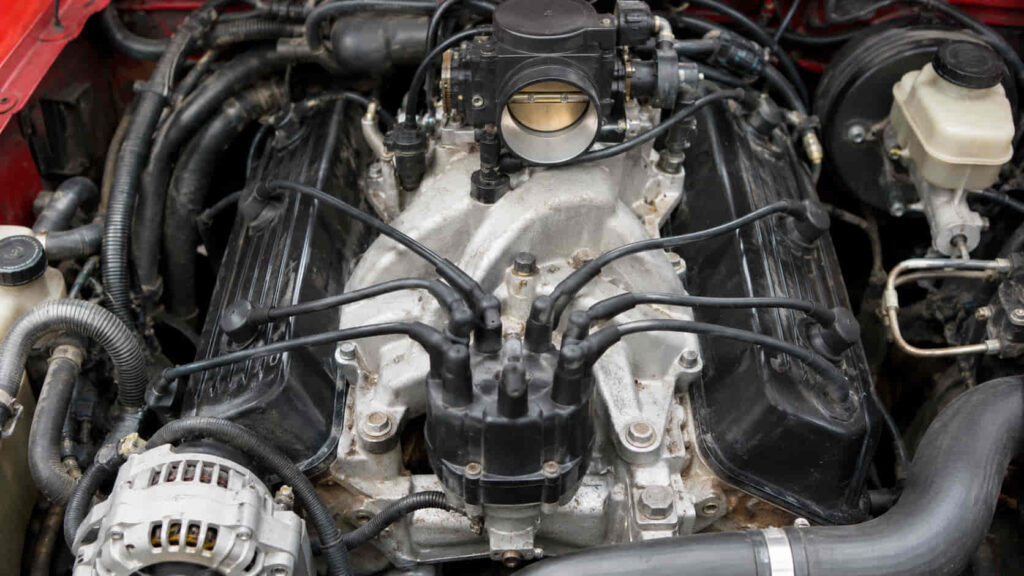
The Chevy 4.3 firing order is 1-6-5-4-3-2, which identifies the sequence in which the six cylinders fire during engine operation. This firing order applies to Chevrolet 4.3L V6 engines and is essential when checking ignition connections, replacing spark plug wires, or diagnosing engine misfires. Following the correct sequence ensures that each cylinder receives its ignition spark at the appropriate point in the engine’s operating cycle.
On the common longitudinal Chevy 4.3L V6 configuration, cylinders 1, 3, and 5 are located on the driver’s side, while cylinders 2, 4, and 6 are on the passenger’s side. Cylinder 1 sits at the front of the driver’s-side bank. Understanding this cylinder numbering arrangement is necessary because the physical location of each cylinder differs from the firing sequence and the terminal positions on a distributor cap.
Chevrolet used different ignition system configurations across generations of the 4.3L V6 engine. Older distributor-equipped engines require correct spark plug wire routing, while later electronic ignition systems use different components to deliver the spark. Identifying the engine version is therefore important before applying a specific wiring diagram.
This guide explains the Chevy 4.3 firing order, cylinder numbering diagram, distributor connections, spark plug wire routing, and methods for identifying ignition-related problems.
What Is the Firing Order of a Chevy 4.3 V6 Engine?
The Chevy 4.3L V6 firing order is 1-6-5-4-3-2, meaning cylinder 1 fires first, followed by cylinders 6, 5, 4, 3, and 2 before the sequence repeats. This firing order establishes the combustion sequence for the engine’s six cylinders. It is a fundamental specification for identifying ignition connections and diagnosing problems related to incorrect spark plug wire placement.
The Chevrolet 4.3L V6 is a four-stroke engine, so each cylinder completes its intake, compression, power, and exhaust strokes over two crankshaft revolutions. These revolutions represent 720 degrees of crankshaft rotation. With six evenly spaced firing events during that cycle, a cylinder begins its power stroke every 120 degrees of crankshaft rotation. The firing order determines which cylinder produces the next power stroke, while the engine’s mechanical timing and ignition controls ensure that combustion occurs at the correct point in the cycle.
The sequence begins with cylinder 1 and continues directly to cylinder 6, even though those cylinders are positioned on opposite sides of the engine. Cylinder 5 fires next, followed by cylinder 4, cylinder 3, and finally cylinder 2. This arrangement demonstrates why firing order must not be confused with cylinder numbering. The numbers describe the identity of individual cylinders, but their order in the firing sequence does not represent their physical arrangement inside the engine.
For distributor-equipped Chevy 4.3 V6 engines, the firing order is essential when routing spark plug wires between the distributor cap and the cylinders. Each wire must connect the appropriate distributor terminal to its corresponding spark plug. Connecting the wires in the wrong sequence can cause sparks to reach cylinders at incorrect points in their operating cycles, resulting in misfires, rough running, or difficulty starting the engine. On later engines with electronically controlled ignition systems, the same firing-order concept applies, although the components used to deliver the spark differ.
How Are the Cylinders Numbered on a Chevy 4.3 V6?
The Chevy 4.3L V6 uses cylinders 1, 3, and 5 on the driver’s side and cylinders 2, 4, and 6 on the passenger’s side in its common longitudinal engine configuration. Cylinder numbering begins at the front of the engine and progresses toward the rear along each cylinder bank. This layout allows technicians to identify individual cylinders when replacing spark plugs, inspecting ignition connections, or investigating cylinder-specific misfire codes.
When viewing a longitudinally mounted Chevy 4.3 V6 from the front of the vehicle, the driver’s-side cylinder bank contains cylinders 1, 3, and 5, arranged from the front toward the firewall. The passenger-side bank contains cylinders 2, 4, and 6 in the same front-to-rear direction. Therefore, cylinders 1 and 2 are nearest the front of the engine, cylinders 3 and 4 occupy the middle positions, and cylinders 5 and 6 are closest to the rear.
The front of the engine refers to the end where the crankshaft pulley and accessory drive are located, not necessarily the direction from which a person is standing and looking at the vehicle. This distinction matters because the driver’s side appears on the viewer’s right when looking into the engine compartment from the front of a typical left-hand-drive Chevrolet vehicle. Identifying the engine’s front and the vehicle’s driver side before tracing the cylinders helps prevent left-to-right numbering mistakes.
Cylinder numbering is especially important when working with diagnostic trouble codes. For example, a P0303 code identifies a misfire detected in cylinder 3, which is the middle cylinder on the driver’s-side bank in the common longitudinal layout. A P0306 code identifies cylinder 6, located at the rear of the passenger-side bank. These codes identify where the engine control system detected a misfire, but they do not establish whether the underlying cause is a spark plug, ignition component, fuel delivery problem, or mechanical fault.
Cylinder numbering identifies where each cylinder is located, while firing order identifies when each cylinder fires. Understanding both systems makes it possible to interpret a Chevy 4.3 firing order diagram correctly and trace ignition connections without confusing the physical cylinder positions with the combustion sequence.
Read more: how much frame rust is too much
Where Is Cylinder Number 1 on a Chevy 4.3 V6?
Cylinder 1 on a Chevy 4.3L V6 is located at the front of the driver’s-side cylinder bank in the standard longitudinal engine layout. It is the first cylinder on the bank containing cylinders 1, 3, and 5, positioned closest to the engine’s accessory-drive end. Identifying this cylinder correctly is essential when tracing spark plug wires, locating a cylinder-specific misfire, or establishing a reference point for ignition system inspection.
The most reliable way to locate cylinder 1 is to identify the front of the engine before examining the cylinder banks. On a typical Chevy 4.3 V6 installation, the crankshaft pulley and accessory belt drive are at the front, while the transmission connects to the rear. From this orientation, the driver’s-side bank contains cylinder 1 at its forward end, followed by cylinders 3 and 5 toward the firewall. This method is more dependable than judging left and right from the position where a person is standing, since the apparent sides reverse when looking into the engine compartment from the front of the vehicle.
Cylinder 1 also serves as an important reference during ignition system maintenance. On distributor-equipped engines, the number-one spark plug wire connects cylinder 1 to the distributor cap terminal assigned to that cylinder. However, the location of cylinder 1 does not automatically identify the number-one terminal on the distributor cap. Terminal identification depends on the distributor configuration and the applicable service information. Assuming that a particular cap terminal represents cylinder 1 without verification can lead to incorrect wire routing.
When inspecting the engine, follow the ignition connection from the front spark plug on the driver’s-side bank to its corresponding distributor terminal or ignition coil connection, depending on the engine version. Perform this inspection with the engine switched off and allow hot components to cool before handling ignition parts. If the vehicle has undergone engine replacement or ignition system modifications, confirm the installed engine and its service specifications rather than relying solely on the vehicle’s model year.
How Do You Read a Chevy 4.3 Firing Order Diagram?
A Chevy 4.3 firing order diagram combines the cylinder locations with the ignition sequence 1-6-5-4-3-2. The cylinder layout identifies where each cylinder is positioned, while the firing sequence shows the order in which the cylinders begin their power strokes. Reading these two pieces of information together allows a technician to identify the next cylinder in the sequence without confusing firing order with physical cylinder placement.
In the standard longitudinal configuration, the driver’s-side cylinder bank is numbered 1, 3, and 5 from front to rear, while the passenger-side bank is numbered 2, 4, and 6 in the same direction. The firing sequence starts at cylinder 1 on the front of the driver’s-side bank, moves to cylinder 6 at the rear of the passenger-side bank, and then continues to cylinder 5 at the rear of the driver’s-side bank. Cylinder 4 fires next, followed by cylinder 3 and cylinder 2. After cylinder 2 fires, the sequence returns to cylinder 1.
The diagram therefore represents a repeating ignition cycle rather than a physical path connecting adjacent cylinders. A firing order of 1-6-5-4-3-2 does not mean that the cylinders are arranged in that order inside the engine. It also does not mean that spark plug wires should be installed by following the cylinder numbers around a distributor cap without checking the cap’s terminal assignments.
For distributor-equipped Chevy 4.3 engines, the firing order must be interpreted alongside the distributor’s rotor rotation and the correct terminal layout. Some distributor cap designs use internal connections that make the external terminal arrangement different from a simple circular firing-order diagram. A diagram showing only the six cylinder numbers cannot establish the correct wire positions on every distributor cap.
For example, if a technician is tracing the ignition connection for cylinder 5, the firing order shows that cylinder 6 fires immediately before it and cylinder 4 fires immediately afterward. This information helps verify the intended ignition sequence, but the technician must still identify the correct terminals using the service diagram for the installed ignition system. On engines without a conventional distributor, the firing order remains relevant even though spark delivery is controlled through a different arrangement of ignition components.
The correct way to interpret a Chevy 4.3 firing order diagram is to separate cylinder location, firing sequence, and ignition component connections. Once these three elements are identified independently, the diagram becomes a practical reference for checking spark plug wire routing and diagnosing ignition-related problems.
How Do You Connect Spark Plug Wires on a Chevy 4.3 V6?
To connect spark plug wires on a distributor-equipped Chevy 4.3L V6, match each distributor cap terminal to its designated cylinder while following the firing order 1-6-5-4-3-2. The correct connections depend on the distributor cap design and the engine’s ignition system. Although the firing sequence remains the reference for ignition operation, it does not establish the physical position of every terminal on the cap.
Before removing the existing wires, identify the engine’s model year and ignition configuration. Earlier Chevy 4.3 V6 engines use distributor arrangements that differ from the later Vortec designs. Some caps have terminals arranged around the distributor, while other designs route ignition connections internally through the cap. Consequently, a generic diagram showing six terminals in a circle should not be used as a universal wiring guide. The correct service diagram must match the installed distributor and cap.
When replacing an intact set of spark plug wires, the safest practical approach is to transfer one wire at a time. Identify the cylinder connected to the existing wire, remove that wire from its spark plug and distributor terminal, and install the replacement in the same locations before proceeding to another cylinder. This preserves the original routing and reduces the chance of exchanging connections between cylinders. The replacement wires should also follow the intended routing paths and remain clear of exhaust components, sharp edges, and moving engine parts.
If the wires have already been disconnected or their original positions are uncertain, first identify the correct terminal assignments using the service information for the specific engine. On a conventional distributor, cylinder 1 and the rotor’s operating direction provide references for interpreting the firing sequence. However, the number-one terminal must be established correctly rather than selected by appearance. Once the terminal assignments are confirmed, connect each wire to the spark plug for its designated cylinder.
A common mistake is connecting the wires according to the physical cylinder arrangement instead of the distributor’s specified terminal layout. For example, cylinders 1 and 3 are adjacent on the driver’s-side bank, but cylinder 3 does not fire immediately after cylinder 1. Cylinder 6 fires next in the 1-6-5-4-3-2 sequence. The difference between cylinder location and firing sequence explains why an incorrectly routed wire can produce a misfire even when the wire is securely attached at both ends.
After installation, inspect each connection to ensure the terminals are fully seated and the wires are not stretched, pinched, or touching hot surfaces. The engine should remain switched off while ignition connections are handled. If the engine runs poorly after wire replacement, recheck the routing against the correct distributor diagram before replacing additional ignition components.
Which Direction Does the Chevy 4.3 Distributor Rotor Turn?
The distributor rotor on conventional distributor-equipped Chevy 4.3L V6 engines turns clockwise when viewed from above during normal engine operation. This direction matters because the rotor distributes ignition energy to successive distributor cap terminals as the engine operates. The firing sequence remains 1-6-5-4-3-2, but the way that sequence corresponds to the external terminals depends on the distributor cap design.
The distributor is mechanically driven by the engine’s camshaft, so its rotor completes one revolution for every two crankshaft revolutions. This relationship matches the four-stroke operating cycle, during which each cylinder completes one combustion event. The rotor’s position must correspond to the appropriate cylinder as the ignition system triggers the spark. If the distributor is installed incorrectly, the rotor may not align with the intended terminal at the required point in the cycle.
On older conventional distributor caps, clockwise rotor rotation provides the direction used to interpret the firing sequence around the terminals after the number-one terminal has been correctly identified. However, this rule should not be applied blindly to every external cap layout. Later distributor designs can use internal conductor paths that change the relationship between the rotor’s movement and the visible wire connections. For these engines, the manufacturer-specified terminal diagram takes priority over a simplified clockwise wiring illustration.
Rotor rotation during normal operation must also be distinguished from the movement observed when a distributor is installed or removed. As the distributor gear engages or disengages the camshaft gear, the rotor can turn through a small angle even though the crankshaft is stationary. This installation movement results from the gear engagement process and does not indicate that the rotor normally operates in the opposite direction.
For example, service procedures for certain 1996–2000 Chevrolet 4.3L V6 applications describe the rotor moving approximately 42 degrees counterclockwise during distributor removal and clockwise during installation. These instructions concern distributor positioning during service, not the sequence of external spark plug wire connections. Confusing these movements can lead to incorrect assumptions about rotor direction or distributor alignment.
Correct distributor operation requires both the proper firing sequence and the correct rotor-to-terminal alignment. When replacing spark plug wires, use the distributor cap diagram for the installed engine. When removing or reinstalling the distributor itself, follow the applicable alignment procedure because an incorrectly positioned distributor can cause ignition synchronization problems even when the wires are connected to their designated terminals.
How Do You Verify the Correct Spark Plug Wire Order on a Chevy 4.3?
To verify the spark plug wire order on a distributor-equipped Chevy 4.3L V6, trace each wire from its distributor cap terminal to the correct cylinder and compare the connections with the engine-specific wiring diagram. The firing order is 1-6-5-4-3-2, but the distributor cap’s terminal arrangement must be identified before that sequence can be used to check the wiring. A wire connected securely at both ends can still cause an ignition problem if it leads to the wrong cylinder.
Begin by identifying the engine’s cylinder locations and the distributor cap configuration. On the common longitudinal Chevy 4.3 V6 layout, cylinders 1, 3, and 5 are on the driver’s side, while cylinders 2, 4, and 6 are on the passenger’s side. With the engine switched off and the ignition components cool, follow each spark plug wire from its cylinder to the corresponding distributor terminal. Compare the terminal assignments with the service diagram for the installed engine rather than assuming that the external cap terminals follow a simple circular pattern.
Checking the wires individually helps identify crossed connections without disturbing correctly installed components. For example, if the wires for cylinders 3 and 5 have been exchanged, both spark plugs may receive ignition energy at the wrong points in the engine cycle. The engine may run unevenly, hesitate under acceleration, or produce misfire-related diagnostic trouble codes. Tracing the wires from their endpoints can reveal this type of installation error even when the wires appear properly seated.
Wire condition should be evaluated separately from routing accuracy. Damaged insulation, loose terminals, and deteriorated boots can interfere with spark delivery even when every wire connects to the correct cylinder. A wire routed too close to an exhaust manifold may also experience heat-related deterioration. These faults require inspection of the wire itself rather than changes to the firing sequence.
If the wiring matches the correct diagram but the engine continues to misfire, the next diagnostic step should address other possible causes, including worn spark plugs, distributor cap defects, rotor problems, or fuel delivery issues. A correct firing order does not guarantee that the entire ignition system is functioning properly. Verification is complete only when the connections match the engine specifications and any remaining symptoms are evaluated independently.
Does the Chevy 4.3 Firing Order Change by Model Year?
The standard firing order for Chevrolet 4.3L V6 engines is 1-6-5-4-3-2, but the ignition system used to deliver the spark varies across engine generations and model years. This distinction matters because a firing order can remain the same even when the distributor, ignition coils, and wiring arrangement change. Vehicle owners should therefore verify the engine version before following a spark plug wire diagram or ignition repair procedure.
Earlier Chevrolet 4.3L V6 engines used distributor-based ignition systems in which a rotor directed ignition energy through a distributor cap to the spark plug wires. Later Vortec 4300 versions retained distributor-based arrangements but introduced different distributor and cap designs. These differences affect the location of external wire terminals and the procedures used to inspect or service the ignition system. A diagram intended for an older conventional distributor may not match the cap fitted to a later Vortec engine.
The 4.3L EcoTec3 V6 introduced in Chevrolet’s 2014 full-size truck generation uses a substantially different engine design and electronically controlled ignition. Instead of relying on a conventional distributor to distribute spark through a cap, this engine uses individual ignition coils controlled by the engine management system. Its ignition connections and diagnostic procedures therefore differ from those of earlier distributor-equipped engines, even though the six-cylinder firing sequence remains 1-6-5-4-3-2.
The engine’s model year alone is not always sufficient to identify the correct ignition components. Chevrolet and GMC vehicles used different 4.3L V6 versions across applications, and a vehicle may also have received an engine replacement or aftermarket ignition modifications. The engine identification information, installed ignition hardware, and applicable service documentation provide a more reliable basis for selecting a wiring diagram.
For example, a Chevrolet S10 equipped with an older distributor-based 4.3L V6 requires spark plug wire routing information specific to its distributor cap. A 2014 Chevrolet Silverado equipped with the 4.3L EcoTec3 V6 requires information for its electronically controlled ignition coils instead. Both engines use the same basic firing sequence, but the procedures for identifying and testing ignition connections are different.
The practical rule is to verify the engine generation before using a Chevy 4.3 firing order diagram for repair work. The firing sequence identifies the order in which the cylinders fire; the engine-specific service information identifies how the ignition system delivers the spark. Using both sources of information prevents confusion between a correct firing order and an incompatible wiring diagram.
Do All Chevy 4.3 V6 Engines Have a Distributor?
Not all Chevy 4.3L V6 engines use a distributor. Earlier Chevrolet 4.3L V6 engines rely on a distributor to route ignition energy to individual spark plugs, while later 4.3L EcoTec3 engines use electronically controlled ignition coils. This difference changes how technicians inspect ignition components, identify electrical connections, and diagnose misfires. The firing order remains an engine operating specification, regardless of whether a mechanical distributor delivers the spark.
On traditional distributor-equipped Chevy 4.3 V6 engines, the ignition coil generates the high voltage required to fire the spark plugs. The distributor rotor directs that voltage through the distributor cap to the appropriate spark plug wire. As the rotor turns, ignition energy reaches successive cylinders according to the engine’s firing sequence. Correct distributor alignment, cap condition, and wire routing are therefore necessary for reliable ignition operation.
Later Vortec 4300 engines continued using distributor-based ignition but incorporated different distributor cap configurations. Some designs use internal conductor paths that connect the rotor’s contact positions to external wire terminals. As a result, the physical arrangement of the spark plug wire connections may not follow the simple circular pattern shown in older distributor diagrams. Using a wiring illustration intended for a different distributor design can lead to incorrect connections even when the firing order itself is correct.
The 4.3L EcoTec3 V6 introduced in Chevrolet’s 2014 full-size trucks uses a distributorless ignition system with individual ignition coils. Instead of mechanically distributing high voltage through a rotating rotor, the engine control module coordinates ignition events electronically using engine position information. Each cylinder has a dedicated ignition coil, eliminating the conventional distributor cap and its associated high-voltage wire routing arrangement.
This distinction directly affects maintenance procedures. A distributor-equipped Chevy 4.3 V6 may require inspection of the cap, rotor, ignition coil, and spark plug wires when investigating an ignition problem. A distributorless EcoTec3 engine requires diagnosis of its individual coils, electrical connections, spark plugs, and control signals. Attempting to apply a distributor cap wiring diagram to an EcoTec3 engine would provide no useful guidance because that component is not part of its ignition system.
The correct approach is to identify the installed engine and ignition configuration before selecting a repair procedure. Model year, engine identification, and the visible ignition components help establish which system is present. Once the configuration is confirmed, the appropriate service information can be used to inspect the components responsible for delivering the spark.
What Happens If the Chevy 4.3 Spark Plug Wires Are Installed in the Wrong Order?
Installing Chevy 4.3 spark plug wires in the wrong order can cause engine misfires, rough idling, reduced power, hard starting, or a no-start condition. These problems occur because the distributor sends ignition energy to a cylinder at the wrong point in its operating cycle. Although the spark plug may still produce a spark, the cylinder cannot generate its intended power stroke unless ignition occurs at the appropriate time relative to piston movement and valve operation.
A four-stroke Chevy 4.3L V6 completes its combustion cycle over 720 degrees of crankshaft rotation. Each cylinder must receive ignition energy near the end of its compression stroke, according to the engine’s timing strategy. When two spark plug wires are connected to incorrect distributor terminals, the affected cylinders may receive sparks during other parts of their operating cycles. The result is incomplete or absent combustion in those cylinders, which disrupts the engine’s normal power delivery.
The severity of the symptoms depends on which wires are incorrectly connected and how many cylinders are affected. If two wires are exchanged, the engine may still start but run unevenly because the affected cylinders are not contributing power correctly. If several connections are wrong, the engine may struggle to start or fail to run. These symptoms can resemble problems caused by worn spark plugs, defective ignition components, or fuel delivery faults, so they should not be treated as proof of incorrect wire routing without inspection.
Incorrect ignition connections can also contribute to catalytic converter damage when repeated misfires allow unburned fuel to enter the exhaust system. The catalytic converter processes exhaust gases at high temperatures, and excessive unburned fuel can cause its temperature to rise beyond normal operating conditions. A flashing check engine light commonly indicates a misfire severe enough to risk catalyst damage. If the light flashes while the engine is running, driving should be stopped safely and the problem diagnosed before continued operation.
For example, a Chevy 4.3 V6 that begins running roughly immediately after spark plug wire replacement should have its ignition connections checked before additional parts are replaced. A technician can compare the wire routing with the correct distributor cap diagram and verify that each terminal connects to its designated cylinder. If the connections are correct, further diagnosis can determine whether the misfire originates from the ignition system, fuel delivery, or an internal engine condition.
Correcting a crossed spark plug wire connection restores the intended ignition routing, but it does not automatically resolve every misfire. A damaged wire, defective distributor cap, worn spark plug, or unrelated mechanical fault may remain after the routing is corrected. For distributorless Chevy 4.3 engines, ignition diagnosis must instead focus on the appropriate coil and control system because conventional distributor wire-order errors do not apply to those configurations.
How Can You Tell If a Chevy 4.3 Has an Ignition Misfire?
A Chevy 4.3L V6 may have an ignition misfire if the engine shakes at idle, hesitates during acceleration, loses power, or triggers a check engine light. A misfire occurs when a cylinder fails to produce its expected combustion event. Although faulty spark plugs, ignition wires, distributor components, or ignition coils can cause this problem, similar symptoms can also result from fuel delivery faults, vacuum leaks, or insufficient cylinder compression. Identifying the symptoms is therefore the beginning of diagnosis rather than confirmation of an ignition failure.
An engine misfire disrupts the regular sequence of power strokes that keeps the crankshaft rotating smoothly. In a properly operating Chevy 4.3 V6, the cylinders produce power in the 1-6-5-4-3-2 firing order. When one cylinder contributes less torque than expected, the engine may vibrate, especially at idle when individual combustion events have a noticeable effect on smoothness. Under acceleration, the same problem may appear as hesitation or reduced power because the affected cylinder cannot deliver its normal contribution.
Diagnostic trouble codes provide a more specific starting point for identifying a misfiring cylinder. Code P0300 indicates a random or multiple-cylinder misfire, while codes P0301 through P0306 identify misfires detected in individual cylinders. For example, P0301 refers to cylinder 1, and P0305 refers to cylinder 5. These codes identify where the engine control system has detected irregular combustion, but they do not establish which component caused it. A P0301 code does not automatically mean that the cylinder 1 spark plug or ignition wire is defective.
A diagnostic scan tool can help narrow the investigation by displaying stored trouble codes, pending codes, and available operating data. Freeze-frame information may show the engine speed, load, and other conditions present when a fault was recorded. This context matters because a misfire occurring mainly at idle may require a different diagnostic approach from one that appears under acceleration. Misfire counters, when supported by the vehicle and scan tool, can also help identify whether the problem consistently affects one cylinder or several cylinders.
On distributor-equipped Chevy 4.3 engines, ignition diagnosis should consider the spark plug, plug wire, distributor cap, rotor, and ignition coil. A damaged plug wire may allow high voltage to escape before reaching the spark plug, while worn distributor contacts can interfere with reliable spark delivery. On distributorless EcoTec3 engines, diagnosis instead focuses on components such as the individual ignition coils, spark plugs, electrical connections, and control signals. The correct inspection procedure depends on the installed ignition system.
A flashing check engine light requires particular attention because it can indicate a misfire severe enough to damage the catalytic converter. When combustion fails repeatedly, unburned fuel may enter the exhaust system and increase converter temperatures. If the warning light flashes, the driver should stop safely and arrange diagnosis rather than continue operating the vehicle under load. A steady check engine light also warrants investigation, although it does not necessarily indicate the same immediate level of catalyst risk.
The most reliable diagnosis combines symptom observation, trouble-code information, and component testing. If the engine began misfiring immediately after ignition maintenance, checking the recent work is a logical starting point. If no ignition connections were disturbed, the technician should avoid assuming that the firing order is incorrect and instead evaluate the possible ignition, fuel, air, and mechanical causes. This approach identifies the actual fault without replacing functioning components unnecessarily.
How Do You Confirm the Firing Order for Your Chevy 4.3 Engine?
To confirm the firing order for a Chevy 4.3L V6, identify the exact engine version and compare its specifications with the appropriate factory service information. The commonly specified firing order is 1-6-5-4-3-2, but verifying the installed engine is essential when selecting a distributor wiring diagram, ignition component layout, or repair procedure. Different generations of Chevrolet’s 4.3L V6 use different ignition hardware, even when their firing sequence is the same.
Start by establishing the vehicle’s model year, model, and engine identification. The vehicle identification number can help identify the original engine configuration, while the engine’s identification markings and installed components provide additional evidence. General Motors also uses engine identification codes to distinguish specific powertrain versions. These details are especially important when a vehicle has undergone an engine replacement, since the engine currently installed may not match the configuration originally supplied with the vehicle.
The engine’s ignition system determines which service diagram is appropriate. Earlier distributor-equipped Chevy 4.3 V6 engines require information showing the correct distributor cap terminal assignments and spark plug wire connections. Later Vortec versions may use distributor caps with different external terminal arrangements, making an older circular wiring diagram unsuitable. The EcoTec3 4.3L V6 uses electronically controlled individual ignition coils and therefore requires a different approach to ignition inspection.
Factory service information is the preferred reference because it identifies specifications and procedures for a particular engine application. An owner’s manual may help establish general vehicle information, but it does not necessarily contain detailed distributor terminal diagrams or ignition repair instructions. When precise wiring information is needed, the relevant factory service manual or an equivalent professional repair database provides a more appropriate source.
For example, an owner working on a Chevrolet S10 with a distributor-equipped 4.3L V6 should verify the engine version and locate the distributor cap diagram specified for that application. The diagram must identify the correct terminal for each cylinder rather than merely displaying the firing order. By contrast, an owner servicing a Chevrolet Silverado with the 4.3L EcoTec3 V6 should consult the ignition coil and engine control information for that engine instead of looking for distributor cap connections.
The firing order should also be distinguished from ignition timing and distributor installation procedures. Firing order establishes the sequence of cylinder combustion events, while ignition timing determines when the spark occurs relative to piston position. On applicable distributor-equipped engines, distributor positioning and synchronization are separate service considerations. Correctly connecting the spark plug wires does not necessarily correct a distributor that has been installed or aligned improperly.
If a Chevy 4.3 engine has been modified or replaced, verify its actual configuration before following a model-year-specific repair guide. Aftermarket ignition components, replacement distributor caps, and engine swaps can make generic illustrations misleading. The installed components should be compared with the appropriate technical documentation, and any uncertainty about terminal assignments should be resolved before starting the engine.
Confirming the firing order is ultimately a matter of matching three pieces of information: the engine’s specified firing sequence, its cylinder identification, and the ignition system used to deliver the spark. When those details agree with the correct service documentation, the technician can inspect or repair the ignition system without relying on assumptions about the vehicle’s age or the appearance of its components.