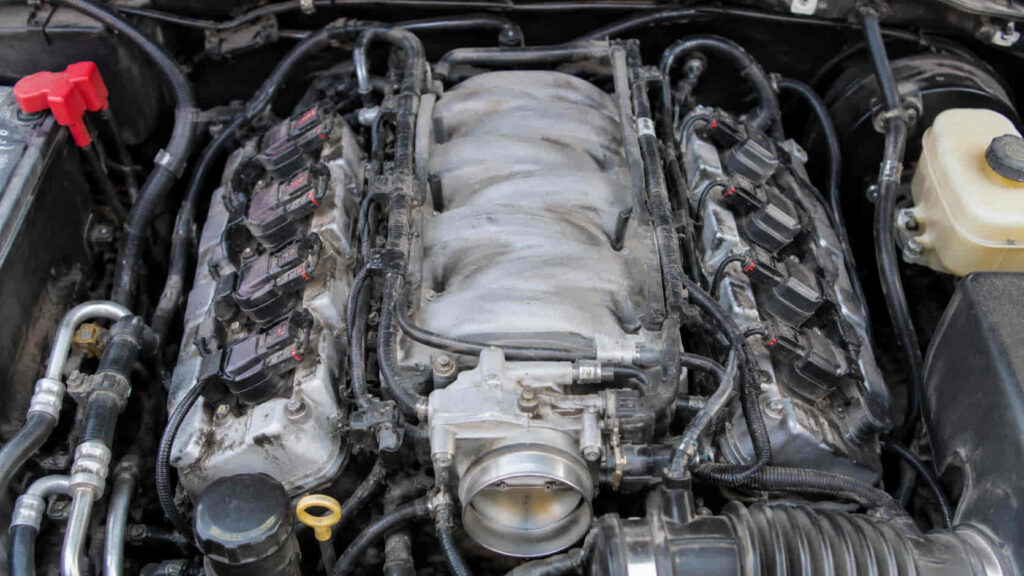
The Ford 5.4 Triton V8 firing order is 1-3-7-2-6-5-4-8. This sequence identifies the order in which the engine’s eight cylinders complete their power strokes. The cylinders are numbered 1 through 4 on the passenger side and 5 through 8 on the driver side, with numbering running from the front of the engine toward the firewall in common longitudinal Ford truck applications.
Understanding the difference between firing order and cylinder numbering is essential when diagnosing ignition problems. Firing order describes the engine’s combustion sequence, while cylinder numbering identifies the physical location of each cylinder. For example, cylinder 3 is the third cylinder from the front on the passenger-side bank, even though it fires second in the 5.4 Triton’s firing sequence.
The Ford 5.4L Triton V8 was used in vehicles such as the Ford F-150, Expedition, E-Series, and Lincoln Navigator. Correct cylinder identification helps owners and technicians locate ignition coils, inspect spark plugs, and investigate cylinder-specific diagnostic trouble codes. This guide explains the 5.4 Triton firing order, cylinder layout, engine bank locations, and practical applications for diagnosing engine misfires.
What Is the Firing Order of the Ford 5.4 Triton V8?
The Ford 5.4L Triton V8 firing order is 1-3-7-2-6-5-4-8. This sequence identifies the order in which the engine’s eight cylinders produce their power strokes. The firing order is determined by the engine’s crankshaft and camshaft configuration, ensuring that combustion events occur in the correct sequence as the engine operates. It is a fixed engine specification rather than an adjustment made during routine maintenance.
The 5.4L Triton is a four-stroke V8 engine, meaning each cylinder completes intake, compression, power, and exhaust strokes during a 720-degree crankshaft cycle. With eight cylinders firing at evenly spaced intervals, a combustion power stroke occurs every 90 degrees of crankshaft rotation. Cylinder 1 fires first in the specified sequence, followed by cylinders 3, 7, 2, 6, 5, 4, and 8 before the sequence repeats. This arrangement distributes combustion events across the engine according to its mechanical design.
The firing order should not be confused with ignition coil placement or the physical arrangement of cylinders. Modern 5.4L Triton engines use electronically controlled ignition timing, so the engine control module determines when each spark plug fires based on crankshaft position and operating conditions. Technicians use the firing order as a reference when interpreting engine operation, identifying cylinders, and investigating ignition-related problems. However, the firing sequence alone cannot determine whether a spark plug, ignition coil, fuel injector, or mechanical component is responsible for a misfire.
How Are the Cylinders Numbered on a 5.4 Triton Engine?
The Ford 5.4L Triton V8 has cylinders 1, 2, 3, and 4 on the passenger side and cylinders 5, 6, 7, and 8 on the driver side in its common longitudinal vehicle installations. Both cylinder banks are numbered from the front of the engine toward the rear, with the front closest to the radiator and the rear closest to the firewall. This numbering arrangement is essential for locating the correct ignition components during maintenance and troubleshooting.
On the passenger-side bank, cylinder 1 is positioned nearest the front of the engine, followed by cylinders 2, 3, and 4 toward the firewall. On the driver-side bank, cylinder 5 is nearest the front, followed by cylinders 6, 7, and 8 toward the rear. When standing in front of the vehicle and looking into the engine compartment, the passenger-side cylinders appear on your left, while the driver-side cylinders appear on your right. This viewing perspective is important because confusing your own left and right with the vehicle’s sides can lead to incorrect cylinder identification.
Cylinder numbering identifies physical locations, while firing order identifies the combustion sequence. For example, cylinder 7 is the third cylinder from the front on the driver-side bank, but it is the third cylinder in the 1-3-7-2-6-5-4-8 firing sequence. Similarly, cylinder 2 is physically located behind cylinder 1 on the passenger-side bank, yet it fires fourth in the sequence. Understanding this distinction helps prevent technicians from inspecting or replacing components on the wrong cylinder when diagnosing a specific engine misfire.
Read more: is ppf worth it
What Does the Ford 5.4 Triton Cylinder Diagram Look Like?
The Ford 5.4 Triton cylinder diagram shows cylinders 1 through 4 on the passenger-side bank and cylinders 5 through 8 on the driver-side bank, with both banks numbered from the front of the engine toward the firewall. This arrangement applies to the common longitudinal installations of the 5.4L Triton V8 in Ford trucks and SUVs. The diagram identifies each cylinder’s physical location, which is different from the engine’s firing order of 1-3-7-2-6-5-4-8.
When viewing the engine compartment from the front of the vehicle, cylinders 1, 2, 3, and 4 appear on your left, while cylinders 5, 6, 7, and 8 appear on your right. Cylinder 1 is closest to the radiator on the passenger side, and cylinder 5 is closest to the radiator on the driver side. Cylinders 4 and 8 are positioned nearest the firewall on their respective banks. This orientation helps identify the correct spark plug or ignition coil without confusing the vehicle’s left and right sides with your viewing position.
The cylinder diagram is particularly useful when diagnosing a misfire associated with a specific cylinder. For example, diagnostic trouble code P0304 identifies a misfire detected in cylinder 4, which is the rearmost cylinder on the passenger-side bank. Code P0306 identifies cylinder 6, the second cylinder from the front on the driver-side bank. Matching these cylinder numbers to their physical positions allows technicians to inspect the appropriate ignition and fuel system components before determining the cause of the problem.
Where Are Bank 1 and Bank 2 on a Ford 5.4 Triton?
Bank 1 is located on the passenger side of the Ford 5.4L Triton V8 and contains cylinders 1, 2, 3, and 4, while Bank 2 is located on the driver side and contains cylinders 5, 6, 7, and 8. In the common longitudinal engine layout, Bank 1 is the side containing cylinder 1, which is the frontmost cylinder on the passenger side. This designation remains the same regardless of the engine’s firing sequence.
Engine banks are important because certain diagnostic trouble codes identify problems affecting an entire bank rather than a single cylinder. For example, code P0171 indicates that the engine control module has detected a lean condition on Bank 1, while P0174 identifies a lean condition on Bank 2. These codes help narrow the area of investigation, but they do not establish the exact cause. Vacuum leaks, fuel delivery problems, inaccurate airflow measurements, and other faults can contribute to lean conditions, so further testing is necessary.
Bank identification also matters when locating oxygen sensors and interpreting sensor-related trouble codes. A designation such as Bank 1 Sensor 1 refers to the upstream oxygen sensor associated with the cylinder bank containing cylinder 1. Bank 2 Sensor 1 identifies the corresponding upstream sensor for the opposite bank. Sensor placement and access vary by vehicle model and exhaust configuration, making the correct service information important during repairs.
The most reliable way to distinguish the two banks is to locate cylinder 1 rather than relying only on left-side or right-side descriptions. On the 5.4L Triton V8, cylinder 1 establishes the passenger-side bank as Bank 1, while cylinders 5 through 8 form Bank 2. Understanding this relationship helps prevent incorrect sensor replacement, ignition component identification, and misinterpretation of bank-specific diagnostic codes.
Is the Firing Order the Same on 2-Valve, 3-Valve, and 4-Valve 5.4 Triton Engines?
The Ford 5.4L Modular V8 uses the firing order 1-3-7-2-6-5-4-8 across its 2-valve, 3-valve, and commonly used 4-valve configurations. The number of valves per cylinder changes the cylinder-head design and valvetrain components, but it does not change the standard firing sequence. This distinction matters when identifying the correct cylinder because the engine variants can have different ignition components, service procedures, and accessibility requirements.
The 2-valve 5.4L Triton engine uses two valves per cylinder and was installed in vehicles such as earlier Ford F-150 trucks, Expeditions, and E-Series vans. The 3-valve version uses three valves per cylinder and was introduced in later applications, including the 2004–2010 Ford F-150. Both configurations retain the same cylinder numbering arrangement, with cylinders 1 through 4 on the passenger-side bank and cylinders 5 through 8 on the driver-side bank in their longitudinal installations. Therefore, a cylinder-specific misfire code identifies the same physical cylinder position regardless of whether the engine has two or three valves per cylinder.
The 4-valve 5.4L Modular V8 was used in selected performance and luxury applications, including certain Lincoln Navigator models and the Ford SVT Lightning’s related Modular engine family. Although the 4-valve cylinder heads differ from the 2-valve and 3-valve designs, the standard 5.4L firing order remains unchanged. However, ignition hardware, spark plug specifications, engine packaging, and repair procedures can differ substantially between applications. Identifying the engine by model year, vehicle model, and engine configuration is therefore necessary before following component-specific service instructions.
The firing order should be treated as a common engine specification, not evidence that all 5.4L Triton versions use interchangeable ignition parts. For example, spark plug designs and removal procedures differ between certain 2-valve and 3-valve engines, and applying the wrong service procedure can create unnecessary repair problems. Before replacing ignition components, confirm the vehicle’s engine variant and consult the appropriate service information for its model year.
How Do You Locate the Ignition Coils on a Ford 5.4 Triton?
The ignition coils on Ford 5.4L Triton engines equipped with a coil-on-plug ignition system are positioned above the spark plugs, with one coil assigned to each cylinder. This arrangement allows the engine control module to control ignition events electronically without using a conventional distributor and long spark plug wires. Each coil delivers high voltage to its corresponding spark plug through a short insulating boot, making correct cylinder identification essential when diagnosing an ignition-related misfire.
The physical location of each ignition coil follows the engine’s cylinder numbering rather than its firing sequence. On the passenger-side bank, the coils correspond to cylinders 1, 2, 3, and 4 from the front of the engine toward the firewall. On the driver-side bank, the coils correspond to cylinders 5, 6, 7, and 8 in the same front-to-rear direction. For example, the ignition coil for cylinder 3 is the third coil from the front on the passenger side, while the coil for cylinder 7 is the third coil from the front on the driver side. The firing order does not change these physical locations.
Access to the ignition coils varies by vehicle model and engine configuration. On many 5.4L Triton applications, the coils sit in recessed areas of the cylinder heads and connect to electrical wiring harnesses. Engine covers, intake components, hoses, and other nearby parts may restrict access, particularly around the rear cylinders. Before inspecting a coil, the engine should be switched off and allowed to cool, and the appropriate vehicle-specific service procedure should be followed. Damaged connectors, deteriorated coil boots, or contamination around the spark plug wells can complicate inspection and replacement.
A cylinder-specific misfire code helps identify which ignition coil to inspect, but it does not prove that the coil itself has failed. For example, a P0302 code indicates a detected misfire in cylinder 2, directing attention to the second cylinder from the front on the passenger-side bank. The cause could involve the ignition coil, spark plug, fuel injector, compression, or another operating condition. A technician may compare components or perform appropriate diagnostic tests to isolate the fault before replacing parts. Using the correct cylinder layout prevents unnecessary repairs and ensures that testing begins at the intended location.
How Do You Identify a Misfiring Cylinder on a 5.4 Triton?
A misfiring cylinder on a Ford 5.4L Triton V8 can be identified by reading cylinder-specific diagnostic trouble codes with an OBD-II scanner and matching the reported cylinder number to the engine’s physical layout. The engine control module monitors crankshaft speed variations to detect combustion irregularities. When a cylinder fails to contribute its expected power, the system may record a misfire code that identifies the affected cylinder.
Diagnostic trouble codes P0301 through P0308 correspond to cylinders 1 through 8. For example, P0301 indicates a detected misfire in cylinder 1, located at the front of the passenger-side bank. P0304 identifies the rearmost cylinder on the passenger side, while P0305 refers to the frontmost cylinder on the driver side. A P0308 code points to cylinder 8, located nearest the firewall on the driver-side bank. Code P0300 indicates random or multiple-cylinder misfires rather than identifying one specific cylinder.
After identifying the affected cylinder, the next step is to inspect the components and operating conditions that influence combustion. On a coil-on-plug 5.4L Triton engine, these include the ignition coil, spark plug, electrical connector, fuel injector, and cylinder compression. A worn spark plug can require more voltage to produce a reliable spark, while a deteriorated coil boot can allow electrical energy to escape before reaching the plug. Fuel delivery problems or insufficient compression can also produce a misfire even when the ignition components function correctly.
A cylinder-specific code identifies where the misfire was detected, not which component caused it. For example, replacing the ignition coil immediately after retrieving P0303 may not resolve the problem if cylinder 3 has a damaged spark plug or a mechanical fault. Confirming the cylinder location and performing appropriate diagnostic tests helps distinguish ignition failures from fuel delivery and compression problems. If the check engine light flashes while the engine is running, avoid continued driving because an active misfire can damage the catalytic converter.
What Are the Most Common Mistakes When Reading the 5.4 Triton Firing Order?
The most common mistake when reading the Ford 5.4 Triton firing order is confusing the combustion sequence, 1-3-7-2-6-5-4-8, with the physical arrangement of the cylinders. The firing order describes when each cylinder produces its power stroke, whereas cylinder numbering identifies where each cylinder is located. The engine’s eight cylinders are not physically arranged in firing-order sequence, so following the numbers from left to right or front to back will not reproduce the firing order.
Another common mistake is reversing the passenger-side and driver-side cylinder banks when viewing the engine from the front of the vehicle. In the typical longitudinal 5.4L Triton installation, cylinders 1 through 4 are on the passenger side, and cylinders 5 through 8 are on the driver side. However, when a person stands in front of the radiator facing the engine, the passenger-side bank appears on the viewer’s left. Confusing the viewer’s perspective with the vehicle’s orientation can lead to inspecting the wrong ignition coil or spark plug.
Incorrectly identifying Bank 1 and Bank 2 can also cause diagnostic errors. Bank 1 is defined by the location of cylinder 1, not by an assumption that the left or right side of every V8 engine uses the same bank designation. On the 5.4L Triton, Bank 1 contains cylinders 1 through 4, while Bank 2 contains cylinders 5 through 8. This distinction is particularly important when interpreting oxygen sensor codes, fuel-trim information, and bank-specific diagnostic trouble codes.
A further mistake is assuming that all 5.4L engine variants use identical ignition components because they share the same firing order. The 2-valve, 3-valve, and 4-valve versions differ in cylinder-head design and certain service requirements. Although the standard firing sequence remains the same, component selection and repair procedures must match the specific engine application. Checking the cylinder diagram, confirming the vehicle’s model year, and identifying the correct engine configuration before starting repairs reduces the risk of replacing the wrong parts.
How Can the 5.4 Triton Firing Order Help Diagnose Engine Problems?
The Ford 5.4 Triton firing order helps diagnose engine problems by providing a reference for the combustion sequence, while the cylinder numbering diagram identifies the physical location of each cylinder. Together, these specifications allow technicians to connect diagnostic trouble codes with the correct ignition components and engine cylinders. The firing order of 1-3-7-2-6-5-4-8 is especially useful when evaluating cylinder-specific misfires and interpreting how combustion events occur throughout the engine’s operating cycle.
When an OBD-II scanner reports a cylinder-specific misfire, the cylinder layout determines where the inspection should begin. For example, a P0307 code identifies a misfire detected in cylinder 7, the third cylinder from the front on the driver-side bank. A technician can locate that cylinder and inspect its ignition coil, spark plug, electrical connections, and related components. This approach avoids confusing the cylinder’s physical position with its place in the firing sequence. However, the diagnostic code does not establish whether the underlying problem involves ignition, fuel delivery, or mechanical compression.
The firing order also provides context when investigating repeated misfires across different cylinders. Because combustion events follow a fixed sequence, technicians can compare misfire data with engine operating conditions and determine whether the symptoms are isolated to individual cylinders or affect multiple areas of the engine. For instance, repeated misfires on cylinders within the same bank may justify investigating shared conditions such as an intake air leak or fuel delivery issue. This pattern is a diagnostic clue rather than proof of a particular failure, and the results must be confirmed through appropriate testing.
Accurate cylinder identification should come before ignition component replacement or further mechanical diagnosis. On the 5.4L Triton V8, cylinders 1 through 4 are located on the passenger side, while cylinders 5 through 8 are located on the driver side in common longitudinal installations. Confirming these positions, reviewing the stored diagnostic codes, and testing the affected components provides a more reliable repair process than replacing parts based on the firing order alone.