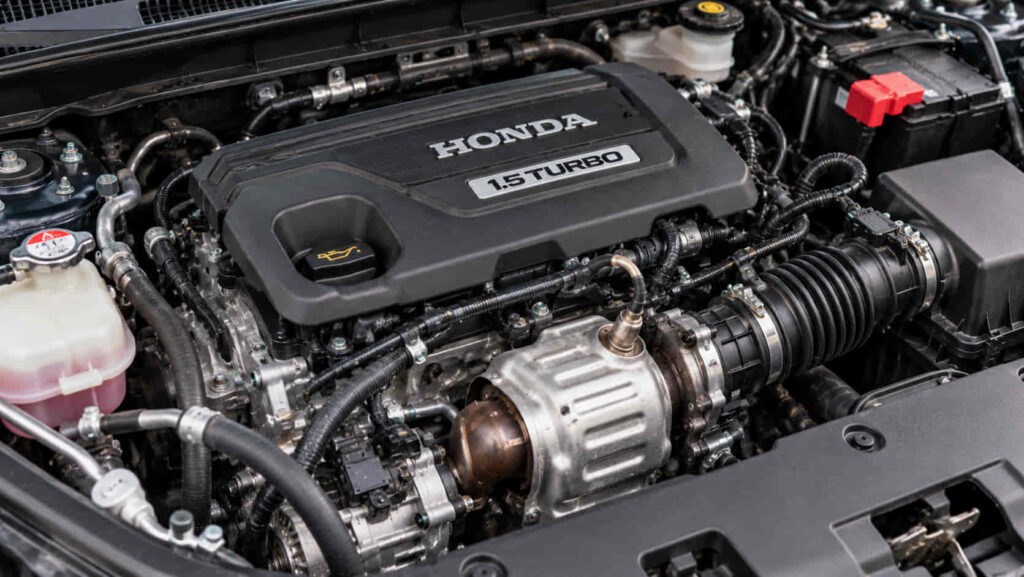
Yes, the Honda 1.5 Turbo can be a reliable engine, but its long-term durability depends heavily on the model year, maintenance history, driving conditions, and whether certain known problems have been addressed. Honda’s turbocharged 1.5-liter four-cylinder delivers impressive fuel economy and strong low-speed torque, yet it has also been associated with fuel dilution, cylinder head gasket failures, and fuel injection complaints.
The Honda 1.5 Turbo belongs to the L15 engine family. It has been used in popular vehicles including the Honda Civic, Civic Si, CR-V, and Accord since the 2016 model year.
Depending on the application, factory output ranges from approximately 174 horsepower in early Civic models to 205 horsepower in certain earlier Civic Si configurations. The engine combines direct fuel injection, turbocharging, electronic engine management, and variable valve timing.
Its small displacement helps improve fuel efficiency, while the turbocharger provides additional power when needed. However, the combination of direct injection and turbocharging also creates operating conditions that differ from those of Honda’s traditional naturally aspirated engines.
Two issues deserve particular attention: engine oil dilution and cylinder head gasket durability.
In October 2018, Honda Canada announced product updates and warranty extensions for certain 2016–2018 Civic and 2017–2018 CR-V vehicles after receiving reports of excessive fuel and moisture dilution in the engine oil.
More recently, on August 26, 2026, American Honda announced a broad cylinder head gasket warranty extension covering eligible vehicles across several Honda model lines. The relevant service bulletins include specific 1.5-liter turbocharged Civic, Accord, and CR-V applications.
For many eligible vehicles, the cylinder head gasket coverage extends to 10 years or 150,000 miles, whichever comes first. Some older vehicles have special eligibility periods ending May 31, 2027.
These developments make it especially important to evaluate the Honda 1.5 Turbo according to its actual production generation and vehicle identification number.
However, documented service campaigns do not mean that every engine will experience the same failure.
A properly maintained Honda 1.5 Turbo can still provide substantial long-term service. The most important ownership decisions involve monitoring oil condition, protecting the cooling system, diagnosing misfires promptly, and checking for applicable manufacturer service campaigns.
This guide examines Honda 1.5 Turbo reliability, its seven most important maintenance and failure concerns, engine lifespan, model-year differences, ownership costs, and whether a used Civic, Accord, or CR-V equipped with this engine is worth purchasing.
Is the Honda 1.5 Turbo a Good Engine?
The Honda 1.5 Turbo is a capable and efficient gasoline engine, but it has a more complicated reliability history than some of Honda’s older naturally aspirated four-cylinder engines.
Honda developed the engine to deliver strong performance without the displacement of a larger gasoline engine.
The turbocharger increases the amount of air entering the cylinders, allowing the engine to produce substantial torque at relatively low RPM.
Direct fuel injection precisely controls fuel delivery.
Variable valve timing helps balance performance and efficiency.
These technologies allow the engine to deliver useful acceleration in vehicles such as the Civic and CR-V.
The engine also has a lightweight aluminum construction, a forged-steel crankshaft in relevant configurations, and a compact design.
However, reliability depends on more than the quality of these components.
Fuel dilution can affect lubricant condition.
Cylinder head gasket problems may cause coolant loss and engine misfires.
Direct-injection components can also require specialized diagnosis.
The engine is therefore best described as a generally capable powertrain with important application-specific reliability risks.
A well-maintained vehicle with completed service campaigns and no evidence of coolant loss may still be an attractive purchase.
However, buyers should not rely solely on Honda’s historical reputation for reliability.
The actual vehicle’s condition matters.
How Long Does the Honda 1.5 Turbo Last?
A well-maintained Honda 1.5 Turbo may reach 150,000–200,000 miles or more, but this is a practical ownership target rather than a manufacturer-certified average engine lifespan.
Some engines operate beyond 200,000 miles.
Others require substantial repairs earlier.
The difference depends on mechanical condition, operating environment, and maintenance.
An engine used primarily for short trips in cold weather may experience different oil dilution conditions from one regularly driven long distances at normal operating temperature.
A vehicle used for demanding acceleration or carrying heavy loads may also experience additional thermal stress.
However, higher mileage does not automatically mean that an engine is near failure.
A 150,000-mile Honda with complete maintenance records and no abnormal symptoms may be in better condition than a lower-mileage vehicle with unresolved overheating or coolant loss.
For the 1.5 Turbo, the condition of the cylinder head gasket is especially important.
A significant gasket leak can require major repairs even when the crankshaft, pistons, and other components remain relatively healthy.
Engine lifespan should therefore be evaluated separately from repair-free ownership.
A Honda 1.5 Turbo may provide long-term transportation while still requiring a major repair during its service life.
There is no reliable publicly verified failure-rate dataset that establishes one universal expected mileage for every L15 turbo engine.
Read more: 3208 Cat Engine Specs
1. Honda 1.5 Turbo Oil Dilution Problems
Fuel dilution is one of the best-documented Honda 1.5 Turbo engine problems, particularly in certain early Civic and CR-V applications driven repeatedly over short distances in very cold weather.
Fuel dilution occurs when unburned gasoline enters the crankcase and mixes with engine oil.
Small amounts of fuel can enter the lubricant during normal engine operation.
However, excessive dilution changes the oil’s properties.
The problem becomes more concerning when the engine does not reach a sufficiently warm operating temperature for extended periods.
Cold starts require different fuel delivery conditions from those used when the engine is fully warm.
Short trips can make it difficult for the engine to eliminate accumulated moisture and fuel from the crankcase.
Honda Canada publicly acknowledged reports of unusually high oil levels in certain 1.5-liter turbocharged vehicles.
The company identified repeated short trips in very low ambient temperatures as an important operating condition.
Symptoms could include a rising oil level, abnormal fuel odor in the oil, misfires, or warning lights.
In certain circumstances, diluted oil could also affect engine lubrication.
However, not every engine with a slight gasoline smell in its oil has a serious dilution problem.
The appropriate diagnosis involves checking the oil level, service history, operating conditions, and applicable Honda technical information.
Did Honda Fix the 1.5 Turbo Oil Dilution Problem?
Honda introduced software updates and related product improvements for selected early 1.5 Turbo vehicles, but the existence of a completed update does not guarantee that fuel dilution can never occur again.
In October 2018, Honda Canada announced a product update covering certain 2017–2018 CR-V and 2016–2018 Civic vehicles.
The company explained that the improvements were intended to help the engine warm up faster and reduce excessive fuel and moisture accumulation.
The service included updated vehicle software and an engine oil change.
Certain vehicles also required replacement of the air-conditioning control unit.
Honda provided extended warranty coverage for specific engine components under the applicable Canadian campaigns.
American Honda also issued service bulletins addressing certain 2017–2018 CR-V applications.
These included service bulletin 18-114 and related software update procedures.
However, the program’s applicability depended on vehicle identification and other conditions.
Owners should therefore check whether their specific VIN received the relevant product update.
An engine that has received the update should still be maintained correctly.
Fuel dilution can be influenced by operating conditions as well as engine management.
Repeated short trips and inadequate operating temperature may continue to affect lubricant condition under some circumstances.
The appropriate response is regular oil monitoring and compliance with the manufacturer’s maintenance requirements.
2. Honda 1.5 Turbo Head Gasket Failure
Cylinder head gasket failure is a major Honda 1.5 Turbo reliability concern, and Honda’s 2026 warranty-extension campaign confirms that the manufacturer recognizes a gasket-related condition in several covered applications.
The cylinder head gasket seals the joint between the engine block and cylinder head.
It helps contain combustion pressure while keeping engine oil and coolant in their designated passages.
When the gasket loses its ability to seal correctly, coolant may enter a combustion chamber.
The engine may then develop a misfire.
Coolant loss and overheating can also occur.
In some cases, the engine computer stores diagnostic trouble codes P0300 through P0304.
These codes identify random or cylinder-specific misfires.
However, the presence of a misfire code alone does not prove that the head gasket has failed.
Ignition coils, spark plugs, and fuel injectors can also cause misfires.
Honda’s 2026 service bulletins describe reduced head gasket effectiveness under certain conditions.
The prescribed repair involves replacing the gasket when coolant leakage into a combustion chamber is confirmed.
If the cylinder head or engine block has become warped, additional component replacement may be necessary.
The manufacturer also describes inspection procedures for determining the extent of damage.
A vehicle showing unexplained coolant loss, persistent cold-start misfires, or overheating should be inspected promptly.
Continuing to drive with an active coolant leak can increase the cost of repair.
Honda 1.5 Turbo Head Gasket Warranty Extension in 2026
In August 2026, American Honda announced a significant cylinder head gasket warranty extension covering multiple Honda model years and powertrains, including many 1.5 Turbo applications.
For eligible vehicles, the general extension provides coverage for 10 years from the original purchase date or 150,000 miles, whichever comes first.
However, coverage is not universal.
The applicable service bulletin and VIN eligibility must be checked.
Honda bulletin 26-003 covers eligible 2018–2022 Accord 1.5 Turbo vehicles equipped with a CVT.
Bulletin 26-004 covers the relevant 2018–2020 Accord manual-transmission applications according to its September 2026 revision.
Bulletin 26-008 covers eligible 2016–2021 Civic 1.5 Turbo CVT applications.
Bulletin 26-009 addresses specified Civic 1.5 Turbo manual-transmission and Civic Si applications.
For newer models, bulletin 26-011 covers 2022–2024 Civic 1.5 Turbo CVT vehicles, while bulletin 26-010 includes relevant 2022–2024 manual-transmission Civic and 2022–2026 Civic Si applications.
Honda also published CR-V coverage through bulletins 26-016 and 26-017 for eligible vehicles in the relevant 2017–2026 production period.
Certain older vehicles have separate grace-period bulletins.
For example, the special program for eligible 2016–2017 Civic 1.5 Turbo CVT vehicles under bulletin 26-099 extends to May 31, 2027, subject to the stated 150,000-mile limit.
The corresponding special program for the 2017 CR-V 1.5 Turbo is described in bulletin 26-098.
These warranty extensions are a major development for owners.
However, an extended warranty is not the same as an automatic recall requiring every covered engine to receive a new gasket.
Honda requires the appropriate diagnosis and confirmation of the relevant condition.
Owners should contact an authorized Honda dealer and request a VIN-specific eligibility check.
3. Honda 1.5 Turbo Fuel Injector Problems
Fuel injector problems can cause rough running, misfires, rich fuel mixtures, and check engine lights in certain Honda 1.5 Turbo applications.
The engine uses direct fuel injection.
Instead of spraying gasoline into the intake ports, the system delivers fuel directly into the combustion chambers.
This allows precise control over fuel delivery.
However, the injectors operate under demanding conditions and require clean fuel.
An injector that delivers an incorrect amount of gasoline can affect the air-fuel mixture.
The engine may run excessively rich or misfire.
A leaking injector can also contribute to abnormal fuel accumulation.
However, not every misfire indicates injector failure.
Honda’s July 2021 dealer communication specifically requested certain components from 2018–2021 Accord 1.5 Turbo, Civic Si, and CR-V vehicles after diagnostic procedures traced P0300–P0304 or P0172 faults to fuel injectors.
This demonstrates that Honda was investigating selected fuel-injector-related complaints.
However, that communication was a request for parts and technical investigation, not proof of a universal injector defect across every 1.5 Turbo engine.
A mechanic should evaluate fuel pressure, injector operation, electrical controls, and related diagnostic data.
Replacing every injector without proper testing may create unnecessary expense.
Fuel injector faults should also be distinguished from cylinder head gasket leakage because both can produce similar misfire symptoms.
4. Honda 1.5 Turbo Misfires and Rough Idle
Misfires and rough idle are important warning symptoms on a Honda 1.5 Turbo because they can originate from ignition components, fuel injection, oil dilution, or cylinder head gasket problems.
A gasoline engine requires appropriate spark, fuel delivery, compression, and mechanical timing.
A fault in any of these areas can interfere with combustion.
A damaged spark plug may fail to ignite the mixture consistently.
An ignition coil problem can create a similar condition.
A fuel injector delivering too much or too little gasoline can also cause a misfire.
However, misfire diagnosis becomes more serious when coolant is entering the combustion chamber.
The engine may run roughly after a cold start.
A cylinder-specific diagnostic trouble code may appear.
In certain cases, the misfire improves after the engine warms.
However, this pattern alone does not confirm a head gasket failure.
A professional diagnosis may involve examining spark plugs, checking fuel system data, pressure-testing the cooling system, and inspecting the combustion chamber.
Honda’s 2026 head gasket bulletins describe specific inspection procedures.
The manufacturer also notes that qualifying head gasket repairs may be necessary even when the expected misfire codes are absent.
Therefore, a lack of stored P0300-series codes does not automatically rule out the problem.
Persistent rough running should be investigated before additional damage occurs.
5. Honda 1.5 Turbo Carbon Buildup
Carbon buildup on intake valves is a potential maintenance concern associated with direct-injection gasoline engines, including the Honda 1.5 Turbo, but it should not automatically be assumed to affect every vehicle.
Traditional port-injected engines spray fuel into the intake ports.
That fuel passes over the intake valves during normal operation.
Direct-injection engines deliver fuel into the combustion chamber instead.
Consequently, gasoline does not provide the same cleaning action on the back of the intake valves.
Oil vapor and other combustion-related deposits can accumulate under certain operating conditions.
However, the severity of buildup varies.
Engine design, crankcase ventilation, operating temperature, and mileage can influence deposit formation.
Symptoms may include rough idle, reduced performance, or abnormal combustion behavior.
However, these symptoms are not specific to carbon deposits.
A mechanic should rule out ignition, fuel injection, and mechanical problems before recommending intake cleaning.
If significant deposits are confirmed, specialized cleaning may be appropriate.
However, routine aggressive cleaning is not automatically required for every 1.5 Turbo.
The manufacturer’s service information should guide the decision.
6. Honda 1.5 Turbo Turbocharger Problems
The Honda 1.5 Turbo uses a small turbocharger designed for responsive acceleration, but its long-term condition depends on adequate lubrication, cooling, and proper operation.
Honda developed the turbocharged L15 engines to produce strong torque at relatively low engine speeds.
The turbocharger uses exhaust energy to compress incoming air.
The additional airflow allows the engine to produce greater output than a naturally aspirated engine of similar displacement.
However, turbocharger components operate at high rotational speeds and elevated temperatures.
They depend on proper lubrication.
An engine that operates with degraded or insufficient oil may place additional stress on the turbocharger.
A damaged turbocharger can produce abnormal noise, poor boost response, smoke, or reduced power.
However, those symptoms are not conclusive.
A charge-air leak, wastegate control problem, sensor fault, or fuel delivery issue can create similar complaints.
Therefore, replacing the turbocharger should follow proper diagnosis.
The 2022 Civic introduced updated turbocharging components and supporting engine improvements compared with its predecessor.
However, these changes do not eliminate the possibility of mechanical problems.
For long-term ownership, using approved engine oil and responding promptly to abnormal operation remain essential.
7. Honda 1.5 Turbo Cooling System and Overheating Problems
Cooling system condition is especially important for Honda 1.5 Turbo longevity because overheating can worsen cylinder head gasket problems and damage other engine components.
The engine uses liquid cooling to control operating temperature.
Coolant circulates through the engine and transfers heat to the radiator.
The system includes a water pump, thermostat, hoses, and other components.
If coolant circulation becomes inadequate, operating temperature may rise.
However, overheating can have more than one cause.
A leaking radiator can reduce coolant quantity.
A damaged hose or water pump may cause coolant loss.
A stuck thermostat can interfere with circulation.
A cylinder head gasket leak can also affect the cooling system.
This distinction is important because an owner may repeatedly add coolant without identifying where it is going.
Unexplained coolant loss should never be treated as normal.
A sweet exhaust odor, repeated misfires, or coolant disappearing without a visible external leak may justify further testing.
The engine should not continue operating when it is genuinely overheating.
Severe overheating can warp the cylinder head or damage other components.
Prompt diagnosis may prevent a repairable problem from becoming a more extensive engine failure.
Is the Honda Civic 1.5 Turbo Reliable?
The Honda Civic 1.5 Turbo can be a dependable compact-car engine, but its reliability should be evaluated according to generation, transmission, maintenance history, and applicable service campaigns.
The turbocharged engine first appeared in the tenth-generation Civic for the 2016 model year.
Early versions commonly produced approximately 174 horsepower.
The engine provided strong fuel economy and useful low-speed torque.
However, certain 2016–2018 Civic applications were included in Honda Canada’s oil dilution product-update campaign.
The issue was especially associated with repeated short trips in very cold weather.
Later Civic engines received engineering updates.
For the 2022 Civic, Honda introduced revised turbocharging components and other changes.
The 1.5-liter turbo in selected 2022 Civic trims produced 180 horsepower and 177 lb-ft of torque.
However, newer engines should not automatically be described as immune to every known concern.
Honda’s 2026 head gasket warranty extensions include eligible Civic 1.5 Turbo applications across multiple model years.
Therefore, buyers should check the VIN and maintenance records.
A Civic that starts cleanly, maintains its coolant level, has no persistent misfires, and has completed applicable service work may be a reasonable long-term choice.
The overall condition of the transmission and other vehicle systems should also be considered.
Is the Honda CR-V 1.5 Turbo Reliable?
The Honda CR-V 1.5 Turbo offers good everyday performance and efficiency, but early oil dilution concerns and the newer cylinder head gasket warranty extensions make service history especially important.
The turbocharged engine arrived in the fifth-generation CR-V for the 2017 model year.
Honda initially offered it in several higher trim levels.
The engine produced 190 horsepower and 179 lb-ft of torque.
It was paired with a continuously variable transmission.
The 2017–2018 CR-V became one of the best-known applications associated with fuel dilution complaints.
Honda addressed the issue through specific product updates.
However, the CR-V’s reliability considerations now extend beyond oil dilution.
Honda’s 2026 head gasket campaign includes eligible CR-V applications from 2017 through 2026 under different service bulletins.
This does not mean that every CR-V produced during that period has a defective gasket.
It means affected vehicles may qualify for a specified warranty repair when the required condition is confirmed.
For a used CR-V, the buyer should inspect coolant condition, engine oil history, and any misfire records.
The vehicle’s VIN should also be checked for applicable Honda campaigns.
The 1.5 Turbo remains available in the 2026 CR-V gasoline lineup in the United States.
Is the Honda Accord 1.5 Turbo Reliable?
The Honda Accord 1.5 Turbo delivers strong fuel efficiency and everyday performance, but cylinder head gasket durability is a particularly important consideration for used examples.
The turbocharged 1.5-liter engine became a major part of the Accord lineup beginning with the 2018 model year.
In common United States configurations, it produced 192 horsepower and 192 lb-ft of torque.
The engine provides substantial low-speed torque for a four-cylinder powertrain.
However, several owners have reported coolant loss, misfires, and head gasket repairs.
The issue became significant enough for American Honda to introduce a formal warranty extension in 2026.
For the relevant 2018–2022 Accord CVT models, bulletin 26-003 identifies the cylinder head gasket condition and provides extended coverage for eligible vehicles.
The bulletin describes overheating, coolant loss, and misfires as possible symptoms.
Certain manual-transmission Accord applications are covered by a separate bulletin.
The manufacturer also provides guidance for inspecting cylinder head and engine block warpage.
This is important because severe overheating may damage components beyond the gasket itself.
For a used Accord, the buyer should request service records and confirm whether a head gasket repair has already been performed.
The VIN should also be checked for current warranty eligibility.
A well-maintained Accord 1.5 Turbo may still provide dependable service, but an unresolved coolant leak is a serious warning sign.
Is the Honda Civic Si 1.5 Turbo Reliable?
The Honda Civic Si 1.5 Turbo provides stronger performance than ordinary Civic turbo models, but its durability depends on maintenance, driving style, modifications, and the condition of its fuel and cooling systems.
The Civic Si uses a performance-oriented version of Honda’s turbocharged L15 engine.
Earlier versions produced approximately 205 horsepower.
The newer generation is rated at approximately 200 horsepower in the United States.
These engines are designed to deliver responsive acceleration and useful midrange torque.
However, performance-oriented driving can create additional mechanical and thermal demands.
The engine may spend more time under boost.
A modified engine can experience greater combustion pressure than its original factory calibration was designed to manage.
This is particularly relevant when aftermarket tuning increases boost pressure.
However, the existence of a modification does not automatically establish the cause of every mechanical problem.
The complete engine condition must still be evaluated.
Honda’s 2026 head gasket warranty extensions also include eligible Civic Si applications.
Therefore, a prospective buyer should check the applicable service bulletin and VIN.
A stock or properly maintained Civic Si with complete records may be an attractive choice.
However, extensive modifications or an unresolved coolant leak should be investigated carefully.
Are Newer Honda 1.5 Turbo Engines More Reliable?
Newer Honda 1.5 Turbo engines have received engineering changes, but the 2026 head gasket warranty campaign demonstrates that later production years should not automatically be considered free from reliability concerns.
Honda revised the turbocharged L15 platform over time.
The 2022 Civic introduced changes to the turbocharger and exhaust arrangement.
Honda also improved crankshaft and oil pan rigidity in the updated engine.
These developments were intended to improve performance, efficiency, and refinement.
However, a design update does not automatically establish a lower long-term failure rate.
That requires operating data across comparable vehicles and conditions.
The latest warranty campaign is especially relevant.
Honda’s 2026 bulletin group includes selected vehicles manufactured well after the original 2018 oil dilution updates.
Therefore, buyers should avoid assuming that a 2023 or 2024 engine cannot develop a head gasket problem.
The exact engine generation also depends on market.
For example, Honda continues to sell the 1.5-liter turbocharged Civic in Vietnam, while the United States Civic lineup uses a different mix of naturally aspirated, hybrid, and turbocharged models.
The correct vehicle specification should be identified according to market and model year.
Newer engines may offer improvements, but maintenance history and VIN-specific service information remain essential.
Which Honda 1.5 Turbo Years Should You Avoid?
There is no manufacturer-supported ranking proving that one Honda 1.5 Turbo model year is universally the least reliable, but some production periods deserve more careful inspection.
The 2016–2018 Civic and 2017–2018 CR-V are particularly important when evaluating the original oil dilution issue.
A buyer should confirm whether the applicable Honda product update was completed.
However, a vehicle from those years is not automatically a poor purchase.
Its current condition and service history still matter.
The 2018–2022 Accord deserves special attention because of the head gasket warranty extension.
Older and newer Civic turbo applications should also be checked against the relevant 2026 Honda bulletins.
The same is true for CR-V models.
A general model-year recommendation cannot replace checking the vehicle’s VIN.
Some vehicles may have already received a successful repair.
Others may have no symptoms.
A lower-mileage car can also be in worse condition than a higher-mileage vehicle that received correct maintenance.
Instead of automatically rejecting an entire model year, the buyer should investigate the engine’s actual history.
The best used vehicle is the one with documented service, normal operating behavior, and no unresolved mechanical problems.
Does the Honda 1.5 Turbo Have a Timing Belt or Chain?
The Honda 1.5 Turbo uses a timing chain rather than a conventional scheduled-replacement timing belt.
The timing chain synchronizes crankshaft and camshaft rotation.
Correct timing allows the intake and exhaust valves to operate at the intended points in the combustion cycle.
The chain operates inside the engine and depends on proper lubrication.
Unlike a timing belt, it is not generally replaced at a fixed mileage interval under normal conditions.
However, this does not mean that the timing system can never develop problems.
A damaged tensioner, unusual chain wear, or lubrication issue can affect operation.
Abnormal timing noise or camshaft correlation diagnostic codes should therefore be investigated.
The correct repair depends on the actual fault.
A timing chain should not automatically be replaced simply because the odometer has reached 100,000 miles.
Likewise, an engine with a confirmed timing system problem should not continue operating merely because the component has no ordinary scheduled replacement interval.
The appropriate Honda service manual remains the primary reference.
What Oil Does the Honda 1.5 Turbo Use?
Many Honda 1.5 Turbo applications specify SAE 0W-20 engine oil, but the correct viscosity and lubricant standard depend on vehicle model and market.
Honda’s United States service information for the 2016 Civic 1.5-liter engine identifies Honda Genuine Motor Oil 0W-20 or a suitable premium-grade 0W-20 detergent oil.
The lubricant must meet the relevant API certification requirements.
However, Honda’s specifications can differ by country.
For example, Honda Vietnam’s service documentation lists several permitted viscosity grades for certain engines.
Therefore, owners should not automatically apply the United States lubricant specification to every international market.
The engine’s owner’s manual should determine the correct oil.
Oil condition is particularly important for turbocharged engines.
The turbocharger depends on effective lubrication.
Engine bearings and camshaft components also require the correct oil film.
Fuel dilution can affect lubricant characteristics.
Owners should therefore monitor unusual changes in oil level and condition.
Using a thicker oil is not an established repair for fuel dilution or head gasket failure.
The correct solution is to diagnose the problem while maintaining the approved lubricant specification.
How Much Oil Does the Honda 1.5 Turbo Take?
The oil capacity of a Honda 1.5 Turbo depends on the exact engine and vehicle application, with a documented 2016 Civic 1.5L requiring approximately 3.7 US quarts during an oil and filter change.
That equals approximately 3.5 liters.
The same Civic documentation identifies approximately 3.4 US quarts, or 3.2 liters, for an oil change without replacing the filter.
However, this should not be used as a universal figure for every Accord or CR-V.
Different applications may have different sump configurations.
The final level should always be verified using the dipstick.
This is especially important when checking for fuel dilution.
An unexpectedly high oil level may indicate that liquid fuel is accumulating in the crankcase.
However, the engine must be checked under the specified conditions.
Honda instructs owners to park on level ground and allow the oil to settle before measuring.
A rising level should not simply be corrected by draining excess oil without investigating the cause.
If fuel dilution is suspected, the vehicle should be inspected and the correct maintenance procedure followed.
How Often Should You Change Honda 1.5 Turbo Oil?
Honda recommends following the vehicle’s Maintenance Minder system and changing the engine oil at least once a year when the applicable manual specifies that limit.
The Maintenance Minder calculates service needs using operating conditions and estimated oil life.
However, it does not directly measure every possible type of oil contamination.
For a vehicle with known fuel dilution concerns, the owner should pay additional attention to oil level and condition.
A mechanic may recommend more frequent service when the vehicle operates under unusually demanding conditions.
However, any interval change should be based on the specific engine and operating environment.
Regular short trips can create different conditions from extended highway operation.
Hot-weather driving also affects engine temperature and lubricant stress.
The correct viscosity and filter remain important.
Owners should keep records of oil and filter changes.
A complete service history helps identify potential problems and supports future warranty or repair discussions.
However, more frequent oil changes cannot guarantee prevention of every possible cylinder head gasket defect.
Maintenance protects the engine, but it does not substitute for correcting a documented mechanical problem.
Does Premium Gas Make the Honda 1.5 Turbo More Reliable?
Premium gasoline is not automatically necessary for every Honda 1.5 Turbo, and using a higher octane grade than the manufacturer requires does not guarantee longer engine life.
Honda specifies regular unleaded gasoline for many standard 1.5-liter turbo applications in the United States.
For example, the 2026 Accord 1.5 Turbo is designed to operate on regular unleaded fuel.
The 2017 CR-V turbo engine also uses regular gasoline under Honda’s published specifications.
However, performance-oriented versions may have different recommendations.
The applicable owner’s manual should determine the correct fuel.
Octane rating describes a fuel’s resistance to knock under standardized testing conditions.
A higher octane number does not automatically mean that the fuel is cleaner or provides superior engine lubrication.
Using the correct fuel is important.
However, fuel quality, contamination, and maintenance also matter.
A vehicle experiencing misfires or abnormal combustion should be diagnosed rather than assuming that premium gasoline will resolve the problem.
Likewise, a head gasket leak is a mechanical sealing concern that cannot be repaired by changing fuel octane.
Can Tuning Damage a Honda 1.5 Turbo?
Aggressive aftermarket tuning can increase the mechanical and thermal stresses on a Honda 1.5 Turbo, particularly when boost pressure and combustion output exceed the factory calibration.
The engine is designed around specific operating limits.
The turbocharger, pistons, connecting rods, cooling system, and fuel injection equipment must work within those limits.
Increasing boost pressure can raise cylinder pressure.
Additional fuel delivery may also change combustion temperatures.
However, the effect depends on the exact modification.
A professionally developed calibration is different from an uncontrolled adjustment.
Nevertheless, any modification can affect reliability and warranty eligibility.
The engine’s head gasket is an especially important consideration when increasing cylinder pressure.
However, one should not assume that tuning caused every reported head gasket failure.
Honda has documented gasket concerns in certain vehicles under normal manufacturer service campaigns.
For buyers seeking dependable daily transportation, an unmodified engine with a strong service history is generally easier to evaluate.
A heavily modified used Civic Si may require more extensive inspection.
Honda 1.5 Turbo vs Honda 2.0 Naturally Aspirated Reliability
Honda’s naturally aspirated 2.0-liter four-cylinder engines generally have fewer forced-induction components than the 1.5 Turbo, but this does not prove that every 2.0-liter engine is more reliable in every application.
A naturally aspirated engine does not require a turbocharger.
This eliminates one mechanical system and its associated controls.
However, both engines still depend on proper lubrication, fuel delivery, cooling, and maintenance.
The 1.5 Turbo provides greater torque at relatively low engine speeds.
This can improve everyday acceleration.
The naturally aspirated 2.0-liter engine may deliver simpler operation in certain vehicle generations.
However, Honda uses different 2.0-liter engines across several Civic generations.
Some have port fuel injection.
Others use different direct-injection or hybrid arrangements.
Therefore, the comparison must be model-specific.
Honda’s 2026 head gasket warranty program also includes selected vehicles equipped with engines other than the 1.5 Turbo.
This demonstrates why the presence or absence of a turbocharger should not be treated as the sole determinant of engine durability.
For a buyer prioritizing simplicity, a suitable naturally aspirated engine may be attractive.
For a buyer wanting stronger low-speed torque and fuel efficiency, a well-maintained 1.5 Turbo can still be reasonable.
Honda 1.5 Turbo vs Honda 2.0 Turbo Reliability
The Honda 1.5 Turbo and Honda 2.0 Turbo are different engines designed for different performance requirements, and their reliability should be compared according to the exact vehicle application.
The 1.5 Turbo emphasizes efficiency and everyday torque.
The 2.0 Turbo was offered in certain performance-oriented Civic and Accord applications.
It generally produces substantially more power.
However, the larger engine also has different internal components, turbocharging equipment, and calibration.
A higher-output engine is not automatically less durable.
Likewise, the smaller 1.5 Turbo is not guaranteed to last longer simply because it consumes less fuel.
The proper comparison should consider maintenance history, operating loads, and known service concerns.
For example, a stock Accord 2.0 Turbo with complete service records may be preferable to a neglected Accord 1.5 Turbo with repeated coolant loss.
The reverse may also be true.
Purchase price and fuel consumption are additional considerations.
The best engine depends on the driver’s needs and the condition of the individual vehicle.
What Are the Signs of a Failing Honda 1.5 Turbo Engine?
Warning signs include unexplained coolant loss, persistent misfires, rising engine oil level, abnormal oil contamination, overheating, and significant changes in engine performance.
However, these symptoms can have multiple causes.
A rising oil level may indicate fuel dilution.
A dropping coolant level may result from an external leak or an internal gasket problem.
Rough idle can be caused by spark plugs, ignition coils, fuel injectors, or mechanical faults.
A loss of acceleration may be related to turbocharger control.
However, it can also be caused by fuel or transmission problems.
The correct diagnosis should start with an inspection of fluids and stored diagnostic trouble codes.
If the engine is losing coolant without a visible external leak, a qualified technician may need to inspect the combustion chambers.
If the oil smells strongly of fuel and the level continues rising, further investigation is necessary.
An engine displaying a genuine overheating warning should be stopped as soon as safely possible.
Continuing to operate an overheating engine may cause severe damage.
Early diagnosis can significantly reduce the risk of turning a limited repair into a complete engine replacement.
How Much Does a Honda 1.5 Turbo Repair Cost?
Honda 1.5 Turbo repair costs vary widely depending on whether the problem involves routine ignition components, fuel injectors, the turbocharger, or a cylinder head gasket.
A spark plug or ignition coil replacement is generally less labor-intensive than removing the cylinder head.
A fuel injector repair can be more complex because the engine uses direct injection.
Turbocharger replacement also requires specialized access and installation procedures.
A cylinder head gasket repair can involve substantial labor.
The cylinder head must be removed.
Its sealing surfaces must be inspected.
If warpage or other mechanical damage is present, additional components may require replacement.
This can significantly increase cost.
However, the 2026 Honda head gasket warranty extension may change the financial situation for eligible owners in the United States.
The appropriate dealer should verify the VIN and diagnose the condition before the owner authorizes major repairs at personal expense.
A warranty extension is not proof that every repair will be covered.
The vehicle must meet the applicable conditions.
For repairs outside warranty, the best estimate is an itemized quotation based on the confirmed fault and vehicle model.
How to Make the Honda 1.5 Turbo Last Longer
The best way to improve Honda 1.5 Turbo longevity is to follow the correct maintenance schedule, monitor engine oil and coolant, address warning signs promptly, and avoid operating the engine with unresolved mechanical problems.
Lubrication is an essential starting point.
Use the approved oil grade and replace it according to the applicable service requirements.
The oil level should be checked regularly.
An unexpected increase may justify investigation for fuel dilution.
The cooling system must also remain healthy.
Unexplained coolant loss should be addressed promptly.
A vehicle that repeatedly overheats should not continue operating until the underlying fault is corrected.
Ignition and fuel system maintenance are also important.
Persistent misfires can increase combustion irregularities and should be diagnosed.
The turbocharger depends on suitable lubrication and normal engine operating conditions.
Owners should also avoid unapproved modifications that introduce unnecessary mechanical stress.
A complete maintenance history is valuable.
It helps distinguish a properly cared-for engine from one with neglected repairs.
However, even careful maintenance does not eliminate the possibility of a manufacturer-recognized gasket problem.
The VIN should therefore be checked for current service campaigns.
What Should You Check Before Buying a Used Honda 1.5 Turbo?
A used Honda 1.5 Turbo should be inspected for oil dilution history, coolant loss, head gasket repairs, persistent misfire codes, and completion of applicable Honda service campaigns.
The engine and model year should be identified first.
The vehicle identification number can be used to confirm the correct configuration.
A Honda dealer should then be asked to check for applicable product updates and warranty extensions.
This is especially important following the August 2026 head gasket announcement.
A cold-start inspection can reveal abnormal engine behavior.
However, the absence of a misfire during one test does not prove that every component is healthy.
The coolant level should be inspected.
Any unexplained coolant loss deserves investigation.
The engine oil should also be checked.
An unusually high level or strong gasoline odor may indicate a possible fuel dilution concern.
Maintenance records should be reviewed.
The buyer should ask whether fuel injectors, the turbocharger, or the head gasket have previously been repaired.
A diagnostic scan can provide additional information.
However, the transmission and rest of the vehicle should also be inspected.
A reliable engine does not guarantee that the complete vehicle is inexpensive to own.
Is the Honda 1.5 Turbo Worth Buying in 2026?
The Honda 1.5 Turbo remains worth considering in 2026, but buyers should place greater emphasis on cylinder head gasket history and VIN-specific warranty information than they might have in previous years.
The engine continues to provide competitive performance.
The 2026 Honda CR-V gasoline model produces 190 horsepower and 179 lb-ft of torque in the United States.
The 2026 Accord 1.5 Turbo produces 192 horsepower and 192 lb-ft.
Honda also continues offering turbocharged 1.5-liter Civic configurations in selected markets.
These engines provide good everyday acceleration and fuel economy.
However, the reliability assessment must reflect the latest available manufacturer information.
Honda’s 2026 gasket warranty extensions cover a broad range of eligible vehicles.
This is an important acknowledgment of a condition that can produce coolant loss, misfires, and overheating.
For a used vehicle, the warranty program may provide meaningful protection when the relevant repair qualifies.
However, the owner should not assume that coverage applies automatically.
Market-specific programs can also differ.
An American Honda warranty extension should not be assumed to apply to a vehicle sold in Vietnam, Canada, or another market.
Owners should contact the appropriate Honda distributor or authorized dealer.
A well-maintained 1.5 Turbo with a sound cooling system and verified service history can still be a sensible purchase.
Final Verdict: Is the Honda 1.5 Turbo Reliable?
The Honda 1.5 Turbo can be a reliable engine, but it has enough documented service concerns that its reliability should be evaluated more carefully than that of a simpler naturally aspirated powertrain.
The engine delivers strong fuel efficiency and useful low-speed torque.
Its compact design and modern combustion technology make it suitable for vehicles such as the Civic, CR-V, and Accord.
However, the engine’s long-term ownership record includes important concerns.
Certain early Civic and CR-V applications experienced excessive fuel dilution under specific operating conditions.
Honda addressed those concerns through product updates and warranty extensions.
Fuel injection faults and misfires have also been investigated in selected applications.
The cylinder head gasket is another significant consideration.
In August 2026, American Honda introduced broad warranty extensions covering eligible vehicles across several model lines, including numerous 1.5 Turbo applications.
Many qualifying vehicles receive cylinder head gasket coverage up to 10 years or 150,000 miles.
Some older vehicles have separate temporary coverage periods.
This development makes it especially important to check the VIN before paying for a major engine repair.
Nevertheless, the existence of service bulletins does not mean every Honda 1.5 Turbo will fail.
A properly maintained engine with normal oil condition, stable coolant level, and no persistent misfires may continue operating for substantial mileage.
The commonly discussed 150,000–200,000-mile or higher lifespan is a reasonable long-term ownership target, but it is not a guaranteed service life.
For buyers seeking the most dependable Honda 1.5 Turbo, the best choice is a vehicle with documented maintenance, completed applicable product updates, verified warranty eligibility, and no evidence of unresolved oil dilution or head gasket problems.
A professional inspection is especially valuable when buying a high-mileage Civic, Accord, or CR-V.
Ultimately, Honda’s 1.5 Turbo offers a worthwhile balance of efficiency and performance, but its known issues mean that maintenance history and careful diagnosis are essential for confident long-term ownership.