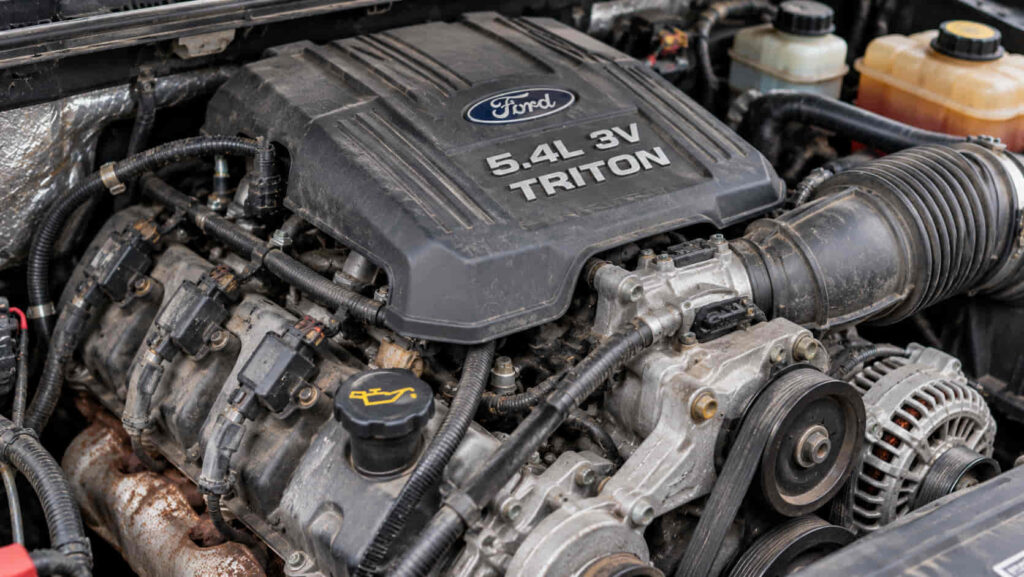
Ford 5.4 Triton engine problems commonly include cam phaser noise, timing chain tensioner failure, spark plug damage, low oil pressure, ignition coil misfires, and exhaust manifold leaks. However, the type of problem depends heavily on whether the engine is a 2-valve, 3-valve, or 4-valve version.
The Ford 5.4L Triton is a 330-cubic-inch V8 engine from Ford’s Modular engine family. It was used in vehicles such as the Ford F-150, F-250, F-350, Expedition, E-Series vans, and several Lincoln models.
Its long production history means that not every 5.4 Triton has the same design or reliability characteristics.
The earlier 2-valve engines are generally simpler. One of their best-known weaknesses involves spark plug threads in the aluminum cylinder heads, which can become damaged and allow a spark plug to be expelled.
The later 3-valve engines introduced variable camshaft timing and improved performance, but they became associated with cam phaser problems, timing chain noise, and difficult spark plug removal.
Ford documented these conditions through multiple Technical Service Bulletins.
For example, TSB 07-21-2 provides a repair procedure for damaged spark plug threads on certain 2-valve engines. TSB 08-7-6 addresses spark plugs breaking during removal on affected 3-valve engines built before October 9, 2007.
Ford also issued TSB 10-18-4 for certain cam phaser knocking complaints and TSB 14-0114 for specific variable cam timing problems involving intermittent rattling and rough idle.
The important distinction is that not every ticking 5.4 Triton needs new cam phasers, and not every misfire indicates internal engine damage.
Accurate diagnosis can prevent unnecessary repairs and help determine whether a used Ford 5.4 Triton is worth purchasing or keeping.
This guide explains the seven most important Ford 5.4 Triton engine problems, their symptoms, causes, repair options, estimated costs, affected years, and maintenance requirements.
What Are the Most Common Ford 5.4 Triton Engine Problems?
The most significant Ford 5.4 Triton problems involve the ignition system, spark plug design, variable cam timing components, timing chain assemblies, and lubrication system.
However, these problems are distributed differently across engine generations.
Early 2-valve engines do not have the same variable cam timing system found on the 3-valve version. Their mechanical design is comparatively straightforward, but certain cylinder heads have a history of damaged spark plug threads.
The 3-valve engine was introduced in the redesigned 2004 F-150. It uses three valves per cylinder and variable camshaft timing to improve performance.
This additional technology creates more components that depend on accurate engine oil pressure and proper timing system operation.
The 3-valve engine also introduced a distinctive spark plug design that caused removal problems in certain production periods.
Other problems, such as ignition coil failures, cooling system leaks, and exhaust manifold damage, can affect multiple versions.
The correct diagnostic approach begins by identifying the installed engine.
A 2004 F-150 Heritage with the older engine architecture should not automatically be treated like a redesigned 2004 F-150 equipped with the 3-valve engine.
The engine’s valve configuration, build date, and previous repair history are more useful than the general Triton name alone.
1. Ford 5.4 Triton Cam Phaser Problems
Cam phaser noise is one of the most recognizable Ford 5.4 Triton 3-valve engine problems, often producing a rattling or knocking sound when the engine is warm.
The 3-valve engine uses variable camshaft timing to adjust valve timing according to operating conditions.
A cam phaser changes the angular relationship between the camshaft and its drive sprocket.
This adjustment helps the engine balance torque, performance, fuel economy, and emissions.
However, proper operation depends on the cam phaser, its oil supply, the VCT control solenoid, and the engine’s electronic control system.
A problem in any of these areas can produce abnormal timing behavior.
Ford TSB 10-18-4 addresses a low-frequency knocking noise at hot idle in certain 2009–2010 vehicles equipped with the relevant 3-valve engines. The bulletin specifically identifies the right-hand cam phaser assembly as a possible source.
However, other Ford bulletins distinguish normal cam timing sounds from actual component failures.
A light ticking noise is not sufficient evidence that a cam phaser must be replaced.
The technician should determine when the sound occurs, where it originates, and whether it is accompanied by rough idle or diagnostic trouble codes.
If a cam phaser is mechanically damaged, replacement may be necessary.
However, replacing it without checking the lubrication and VCT control systems can result in an incomplete repair.
2. Ford 5.4 Triton Timing Chain and Tensioner Failure
Timing chain tensioner and guide problems can produce startup rattling, abnormal chain noise, incorrect camshaft timing, and reduced engine performance.
The Ford 5.4 Triton uses timing chains to synchronize the crankshaft and camshafts.
The timing system must maintain accurate mechanical relationships between the rotating components.
Hydraulic tensioners help keep the chains properly tensioned.
Guides control the movement of the timing chains.
Over time, tensioners may develop problems, and guide surfaces can wear.
If chain tension becomes insufficient, the chain can produce a slapping or rattling sound.
The noise may be most noticeable during engine startup, although it can also occur under other operating conditions.
However, startup rattling can have several causes.
A cam phaser, timing chain tensioner, hydraulic lash adjuster, or another component may produce a similar sound.
Ford’s technical documentation specifically warns against assuming that every engine tick or rattle represents a defect.
A timing chain that has excessive slack can affect valve timing.
In severe cases, timing-related mechanical damage may occur.
The proper repair involves inspecting the chains, guides, tensioners, and other relevant components.
A comprehensive timing system repair may be preferable to replacing one component when multiple parts are worn.
However, the extent of the repair should be determined through inspection rather than assumption.
3. Spark Plug Blowout on Ford 5.4 Triton 2-Valve Engines
Certain Ford 5.4 Triton 2-valve engines can experience damaged spark plug threads, allowing a spark plug to loosen or be expelled from the aluminum cylinder head.
This problem is particularly associated with earlier Ford Modular 2-valve cylinder head designs.
The spark plug must be secured by properly engaged threads.
When those threads become damaged or stripped, the plug may no longer remain securely seated.
Combustion pressure can then force the plug out of the cylinder head.
The result may be a loud popping sound, sudden misfire, and loss of engine power.
The ignition coil and nearby components may also be damaged.
Ford addressed this concern in Technical Service Bulletin 07-21-2.
The bulletin covers certain 2-valve 4.6L, 5.4L, and 6.8L engines with aluminum cylinder heads.
It identifies a spark plug port with stripped or missing threads as the relevant condition.
Ford authorized a specified Lock-N-Stitch aluminum insert repair procedure for eligible non-warranty repairs.
However, the bulletin does not mean that every engine within the covered vehicle range will experience spark plug ejection.
Likewise, an aftermarket thread insert should not automatically be assumed equivalent to the procedure Ford approved.
The correct repair must restore secure thread engagement while maintaining the spark plug’s proper position and heat transfer characteristics.
A truck with a previous plug blowout should have its repair history inspected carefully.
4. Broken Spark Plugs on Ford 5.4 Triton 3-Valve Engines
The Ford 5.4 Triton 3-valve engine is associated with spark plugs that can break during removal, leaving part of the original plug trapped inside the cylinder head.
This is a different problem from the spark plug blowout associated with certain 2-valve engines.
The affected 3-valve engines used an original spark plug design with a long lower electrode shield.
Carbon deposits could accumulate around the shield.
During removal, the deposits could cause the lower portion of the plug to remain stuck.
The spark plug might then separate into pieces.
Ford TSB 08-7-6 documents the problem.
The bulletin identifies affected 5.4L 3-valve engines built before October 9, 2007.
It covers relevant 2004–2008 F-150, Expedition, Super Duty, Navigator, and Mark LT applications.
Ford specifies that the engine must be at room temperature before the removal procedure begins.
The bulletin also describes a controlled technique involving the appropriate cleaner, limited initial plug rotation, and hand tools.
However, these instructions are intended for trained technicians.
Ford warns that improper use of the cleaner can introduce enough liquid to create a risk of engine hydrolock.
A broken plug may require specialized extraction tools.
In difficult situations, the repair can become expensive.
The engine’s exact build date and spark plug design should be checked before service.
5. Low Oil Pressure and Lubrication Problems
Low oil pressure can contribute to serious Ford 5.4 Triton problems because the 3-valve engine’s cam timing system and other components depend on a consistent supply of engine oil.
The lubrication system supplies oil to the crankshaft bearings, connecting rod bearings, camshaft journals, and valvetrain components.
It also provides the hydraulic pressure needed for certain timing system functions.
The variable cam timing system uses pressurized engine oil to control camshaft position.
If the oil supply becomes inadequate, cam timing operation may become unstable.
However, low oil pressure has several possible causes.
The engine may have insufficient oil.
The oil pump or pressure regulation components may be worn.
Bearing clearance can also affect pressure.
Ford’s 2010 F-150 service information identifies additional possible contributors, including loose oil gallery plugs, timing chain tensioner bolts, and certain VCT-related fasteners.
Therefore, low pressure should not automatically be attributed to a failed oil pump.
A dashboard warning may also result from a sensor or electrical problem.
The correct diagnosis should verify actual oil pressure with suitable equipment.
If the engine has genuine low oil pressure, continued operation can cause major damage.
The bearings, camshaft components, and timing system can all be affected.
A cam phaser replacement performed without correcting the underlying oil pressure problem may not provide a lasting solution.
6. Ignition Coil Failure and Engine Misfires
Ignition coil and spark plug problems can cause the Ford 5.4 Triton to misfire, idle roughly, accelerate poorly, or illuminate the check engine light.
The engine uses a coil-on-plug ignition system.
Each cylinder has an ignition coil positioned near its spark plug.
The coil generates the high voltage required for combustion.
A defective coil may fail to produce a consistent spark.
The result can be an intermittent or persistent misfire.
Symptoms may become more noticeable under acceleration or heavy load.
However, a misfire does not automatically indicate a bad ignition coil.
A worn spark plug can produce similar behavior.
Damaged coil boots, moisture intrusion, or wiring problems can also affect ignition.
The engine computer may store a cylinder-specific misfire code such as P0301 through P0308.
However, these codes identify the affected cylinder rather than the exact failed component.
The technician should evaluate the spark plug, coil, injector, wiring, and mechanical condition of the cylinder.
A compression problem can also cause a persistent misfire.
Repeatedly replacing ignition coils without diagnosing the underlying problem can be expensive.
A failed ignition component is often less serious than a damaged camshaft or low-compression cylinder, but the correct cause must be established before repair.
Read more: 602 Crate Engine Specs
7. Exhaust Manifold Leaks and Broken Studs
Exhaust manifold leaks are another common maintenance concern on aging Ford 5.4 Triton engines, often producing ticking noises that can be mistaken for cam phaser or valvetrain problems.
The exhaust manifolds connect the cylinder heads to the exhaust system.
They are exposed to repeated heating and cooling cycles.
These temperature changes create expansion and contraction.
Over time, the manifold hardware may deteriorate.
Broken studs or damaged sealing surfaces can allow exhaust gases to escape.
The resulting sound may resemble rapid ticking or tapping.
The noise is sometimes most noticeable after a cold start.
As the exhaust components warm and expand, the sound may change.
However, the pattern is not always identical.
A mechanic should inspect the exhaust manifolds before assuming that every engine tick comes from the camshaft timing system.
An exhaust leak can also produce an exhaust smell or visible soot around the affected area.
A broken stud may require specialized removal methods.
In difficult situations, accessing the fastener can account for much of the labor cost.
The correct repair may involve replacing studs, gaskets, or the exhaust manifold itself.
Tightening unrelated fasteners or replacing cam phasers will not correct an exhaust leak.
Ford 5.4 Triton 2-Valve vs 3-Valve Problems
The 2-valve and 3-valve Ford 5.4 Triton engines have different mechanical designs and should not be evaluated using the same list of likely failures.
The 2-valve engine uses two valves per cylinder and a simpler valve timing arrangement.
It does not have the 3-valve engine’s variable cam timing system.
Therefore, the common 3-valve cam phaser diagnosis does not apply to an ordinary 2-valve engine.
The most recognizable design-related concern on certain 2-valve versions is damaged spark plug threads.
Other problems include ignition faults, oil leaks, cooling system issues, and normal age-related wear.
The 3-valve engine uses three valves per cylinder and variable cam timing.
This improves the engine’s ability to adjust valve operation for different driving conditions.
However, it also adds cam phasers, VCT control solenoids, and additional oil-pressure-dependent functions.
The 3-valve engine’s original spark plug design created another well-documented maintenance challenge.
Therefore, the two versions should be compared according to their individual failure mechanisms.
A mechanically healthy 3-valve engine can provide dependable service.
Likewise, a neglected 2-valve engine may require expensive repairs despite its simpler design.
The vehicle’s actual condition remains more important than valve count alone.
Does the Ford 5.4 Triton 4-Valve Have the Same Problems?
The Ford 5.4L 4-valve engines use different cylinder heads and valvetrain designs from the ordinary truck-oriented 2-valve and 3-valve versions, so their common problems are not identical.
The 4-valve configuration appeared in selected performance and luxury vehicle applications.
Examples include certain Lincoln Navigator engines, the Ford GT, and Shelby GT500 models equipped with a 5.4L engine.
However, these engines were not all mechanically identical.
Some used naturally aspirated configurations.
Others incorporated superchargers and specialized performance components.
Their cylinder heads, intake systems, camshafts, and internal hardware differ according to application.
An important distinction is the Ford SVT Lightning.
Although it has a supercharged 5.4L V8, its familiar factory engine uses a 2-valve cylinder head arrangement rather than the 4-valve configuration found in certain other performance models.
Therefore, supercharging alone does not identify a 4-valve Triton engine.
Likewise, the 3-valve cam phaser problems should not automatically be applied to every 4-valve engine.
A buyer should identify the exact engine model before investigating its known service concerns.
The appropriate diagnosis and repair procedures depend on that configuration.
What Years Did Ford 5.4 Triton Engines Have Problems?
Ford 5.4 Triton problems occurred across multiple model years, but the most relevant concerns depend on engine generation and production date.
Earlier 2-valve engines are associated with spark plug thread damage.
However, this does not mean every early engine experiences plug ejection.
Ford’s TSB 07-21-2 covers relevant applications over a broad vehicle-year range.
The redesigned 2004 F-150 introduced the 5.4L 3-valve engine.
This created a different set of service concerns.
The original 3-valve spark plug arrangement is especially important for engines built before October 9, 2007.
Ford’s TSB 08-7-6 identifies that production cutoff for the specified removal problem.
However, this does not mean every engine built after that date is immune to all spark plug problems.
Cam timing complaints also extend beyond the earliest production years.
Ford TSB 14-0114 covers certain 2004–2010 F-150, 2005–2010 Super Duty, and 2005–2013 Expedition and Navigator applications.
Therefore, it would be inaccurate to claim that every 2009 or 2010 3-valve engine is completely free of VCT-related problems.
The model year should guide the initial inspection, but actual maintenance and mechanical condition remain essential.
Are 2004–2008 Ford 5.4 Triton Engines Bad?
The 2004–2008 5.4L 3-valve engines deserve careful inspection because they include many of the production configurations associated with difficult spark plug removal and variable cam timing complaints.
However, calling every engine from these years defective would be an overgeneralization.
The redesigned 2004 F-150 introduced the 3-valve engine.
Ford subsequently modified certain components.
TSB 04-24-24 documents changes to the camshaft and lash adjuster designs between the 2004 and 2005 model years.
Ford specifically warns technicians not to mix incompatible components from those versions.
The 2004 and 2005 engines therefore require correct parts identification during service.
Spark plug history is another major consideration.
Engines produced before the October 9, 2007 cutoff identified in TSB 08-7-6 may require the special removal procedure.
A truck that has already received appropriate spark plug service may be less concerning than one still equipped with original plugs of unknown condition.
Cam timing operation must also be evaluated.
A warm engine with severe rattling, rough idle, and timing-related trouble codes may require substantial work.
However, a properly maintained truck without these symptoms may still provide useful service.
The correct decision should be based on a professional inspection and documented maintenance history.
Are 2009–2010 Ford 5.4 Triton Engines More Reliable?
The 2009–2010 Ford F-150 5.4L engines avoided some of the earliest 3-valve spark plug production concerns, but they remained susceptible to certain cam phaser and VCT problems.
Ford had already revised the original spark plug arrangement during production.
This makes later engines different from the earlier units covered by the 2008 removal bulletin.
However, the cam timing system remained part of the 3-valve architecture.
Ford TSB 10-18-4 specifically addresses a low-frequency hot-idle knocking noise involving certain 2009–2010 trucks.
The bulletin identifies a possible right-hand VCT phaser concern.
Ford TSB 14-0114 also includes the 2009–2010 F-150 within its broader coverage.
Therefore, later model years should not automatically be described as problem-free.
However, the available service bulletins do not provide a controlled failure-rate comparison establishing that one year is universally the worst.
A 2009 truck with a documented timing system repair may be a better purchase than an earlier vehicle with unresolved mechanical problems.
Likewise, a neglected 2010 truck may be more expensive to maintain than a properly serviced 2006.
The individual vehicle should determine the purchase decision.
Why Does the Ford 5.4 Triton Rattle at Startup?
A Ford 5.4 Triton startup rattle may result from timing chain tensioner behavior, cam phaser operation, or another valvetrain component, but the sound alone does not identify the failed part.
Hydraulic timing system components depend on engine oil.
During startup, oil pressure must establish normal operating conditions.
A damaged tensioner or worn component may create abnormal noise.
However, Ford’s TSB 06-19-8 explains that certain ticking or knocking sounds can be normal characteristics of these engines.
The bulletin recommends determining whether the sound occurs when cold, hot, or both.
It also instructs technicians to distinguish fuel injector sounds from valvetrain and VCT-related noises.
This distinction is important because replacing expensive timing components may not correct a normal injector tick.
A brief startup noise also differs from a severe ongoing rattle accompanied by poor performance.
The technician should inspect oil level and condition.
Oil pressure may need to be measured.
If the engine produces a severe mechanical noise or has a genuine low-oil-pressure warning, operation should be stopped until the cause is evaluated.
A correct diagnosis protects against unnecessary repair expenses and possible additional engine damage.
Why Does the Ford 5.4 Triton Knock at Idle?
A hot-idle knock on a Ford 5.4L 3-valve engine may involve a VCT phaser, VCT solenoid, hydraulic lash adjuster, or another component.
The source depends on the exact sound and operating conditions.
Ford’s TSB 10-18-4 identifies a low-frequency knock that can be heard near the right front wheel well or right-hand cam cover in certain 2009–2010 applications.
That bulletin provides a diagnostic process for a possible right-hand cam phaser condition.
However, Ford’s later TSB 14-0114 addresses a different symptom group.
It identifies intermittent rattle and rough idle when the engine is at operating temperature.
The relevant codes can include P0021, P0022, P0340, and P0341.
For the vehicles and symptoms covered by that bulletin, Ford specifies replacing the left and right VCT solenoids.
This is an important distinction.
A vehicle with VCT-related noise does not automatically require complete cam phaser replacement.
The technician should use the appropriate Ford diagnostic procedure.
Oil pressure and electrical control problems must also be considered.
The correct repair should follow the confirmed root cause rather than a general assumption about the 5.4 Triton’s reputation.
Can Low Oil Pressure Cause Ford 5.4 Cam Phaser Problems?
Yes. Inadequate oil pressure can interfere with variable cam timing operation because the Ford 5.4L 3-valve engine relies on oil pressure to control camshaft timing.
The VCT system uses pressurized engine oil to change the camshaft position.
The control solenoids regulate the oil flow involved in this process.
When pressure or oil delivery is inadequate, cam timing may become unstable.
However, low oil pressure is not always caused by a failing oil pump.
The engine’s internal bearing clearances, oil passages, and timing system components can affect the lubrication system.
Ford’s low-oil-pressure diagnostic information for the 2010 F-150 identifies multiple mechanical conditions that may contribute.
A worn bearing or excessive clearance can reduce available pressure.
An oil restriction can also affect distribution.
The mechanic should therefore verify actual pressure before replacing the pump.
The correct oil filter and lubricant must also be used.
Ford’s engine noise bulletin specifically instructs technicians to check oil viscosity and filter condition.
If the engine has low oil pressure, installing new cam phasers without fixing the underlying problem may result in continuing symptoms or repeated failure.
What Oil Does a Ford 5.4 Triton Use?
Ford specifies SAE 5W-20 engine oil for the 2009 F-150 5.4L engine, provided the oil meets the applicable Ford performance requirements.
The 2009 owner’s manual identifies Ford specification WSS-M2C930-A and the API certification requirement.
However, the correct specification for another model year or engine configuration should be checked in its own manual.
This is especially important because the 5.4L engine was used across several vehicle platforms and production periods.
Oil viscosity matters to the 3-valve engine’s VCT system.
The engine uses hydraulic control to adjust camshaft timing.
Using an arbitrary thicker oil is not a reliable repair for worn cam phasers or low oil pressure.
Ford also warns against adding unnecessary supplemental oil treatments in the referenced owner’s manual.
The correct maintenance strategy is to use approved engine oil and replace it according to the applicable service schedule.
The oil level should also be checked regularly.
An engine can suffer lubrication problems even when its oil was recently changed if the crankcase contains insufficient oil.
The oil filter must be compatible with the engine’s requirements.
Clean oil and proper pressure help protect the timing system, bearings, and other internal components.
Ford 5.4 Triton Oil Capacity
The 2009 Ford F-150 equipped with the 5.4L Triton V8 has an engine oil refill capacity of 7.0 US quarts, approximately 6.6 liters.
This specification comes directly from Ford’s 2009 F-150 owner’s guide.
However, the 7-quart figure should not automatically be applied to every 5.4L engine used in another vehicle.
Oil pan configuration and application can affect refill capacity.
The exact engine and vehicle should be identified before service.
After draining the oil and replacing the filter, the specified quantity provides an initial reference.
The final level should be verified using the dipstick.
Ford instructs owners to park on level ground and allow oil to return to the sump before checking the level.
Overfilling is not beneficial.
Oil above the specified range can create additional problems.
Likewise, running below the minimum mark can compromise lubrication.
For a 3-valve engine with suspected VCT problems, the correct oil level is an important part of the initial diagnostic process.
However, restoring oil level will not repair mechanically worn timing components.
How Often Should You Change Ford 5.4 Triton Oil?
The correct Ford 5.4 Triton oil change interval depends on vehicle year and operating conditions, and earlier engines should follow their original Ford maintenance schedule rather than intervals published for newer trucks.
Oil changes protect the crankshaft bearings, camshaft components, timing system, and other internal surfaces.
The oil filter also removes contaminants.
However, the appropriate service interval varies by vehicle.
A truck used for short trips or frequent towing may require different maintenance from one used primarily for highway travel.
Extended idling can also influence engine operating conditions.
A driver should consult the specific scheduled maintenance guide for the vehicle.
Some owners choose more frequent oil service on aging 3-valve engines because of their oil-pressure-dependent cam timing system.
However, an arbitrary short interval does not guarantee that a worn cam phaser or damaged tensioner will never fail.
Maintenance also involves checking the oil level between changes.
An engine losing oil through a leak can develop lubrication problems before the next scheduled service.
The best approach is to use the approved oil, follow the correct maintenance schedule, maintain the proper level, and investigate unexplained changes in oil consumption or pressure.
How Much Does Ford 5.4 Triton Engine Repair Cost?
Ford 5.4 Triton repair costs vary widely because spark plug servicing, ignition repairs, VCT solenoid replacement, timing chain repairs, and complete engine replacement involve very different amounts of labor.
A simple ignition coil replacement is generally less expensive than major timing system work.
However, the cost increases when multiple coils or associated components require service.
Spark plug replacement on an affected early 3-valve engine can also become more expensive if a plug breaks.
Specialized extraction tools and additional labor may be needed.
Cam phaser and timing system repairs are substantially more involved.
The front of the engine may require extensive disassembly.
A 2026 repair-cost reference estimates approximately $2,000–$4,000 for a 5.4L 3-valve cam phaser job at an independent U.S. repair facility when the relevant timing components are included.
However, this is a budgeting estimate rather than a manufacturer quotation.
The final price depends on shop rates, actual damage, and parts selection.
For timing chain tensioner replacement, RepairPal’s 2026 estimates vary by F-150 model year and repair application.
A comprehensive engine repair can cost more if internal damage is discovered.
The most useful estimate is an itemized quotation based on the exact vehicle and confirmed problem.
Is Ford 5.4 Triton Cam Phaser Replacement Worth It?
Cam phaser replacement can be worthwhile when the engine is otherwise mechanically healthy and the repair addresses a confirmed phaser problem.
However, the engine should be evaluated before expensive work is authorized.
A cam phaser complaint may be related to low oil pressure.
A VCT solenoid can also cause timing-related symptoms.
The timing chain and tensioner system may be worn.
Replacing only the phaser without investigating these conditions may not restore dependable operation.
A repair facility should evaluate oil pressure, scan tool data, timing system condition, and related diagnostic codes.
The vehicle’s overall condition matters as well.
A truck with a healthy transmission and chassis may justify a substantial timing repair.
However, a truck with severe rust, transmission problems, and other major defects may not.
The owner should compare the repair cost with the value and expected service life of the complete vehicle.
If multiple timing components are worn, a comprehensive repair using compatible parts may provide better value than repeatedly replacing individual components.
However, the correct scope should be based on inspection.
How Long Does a Ford 5.4 Triton Engine Last?
A properly maintained Ford 5.4 Triton can provide substantial service life, with 200,000 miles or more possible in many cases, but no universal mileage figure guarantees engine durability.
The engine’s internal condition depends on maintenance, workload, and the presence of unresolved mechanical problems.
An early 2-valve engine can remain serviceable for many years when its spark plug threads, cooling system, and lubrication system are in good condition.
A 3-valve engine may also deliver substantial mileage.
However, its VCT and timing system components can require expensive repairs.
A timing-related failure does not necessarily mean the entire engine block is worn out.
Likewise, a spark plug repair does not automatically indicate that the crankshaft or pistons are near failure.
Mileage should therefore be considered alongside mechanical condition.
Oil consumption, oil pressure, compression, engine noise, coolant temperature, and maintenance records provide more useful information.
A high-mileage engine that has received correct repairs may be healthier than a lower-mileage engine with neglected timing system problems.
The vehicle’s actual operating history matters more than a fixed lifespan prediction.
Is the Ford 5.4 Triton a Reliable Engine?
The Ford 5.4 Triton can be reliable, but its reputation is strongly influenced by the specific version and the cost of repairing its known weaknesses.
The 2-valve engine has a relatively straightforward valvetrain.
However, certain cylinder heads have a history of spark plug thread damage.
The 3-valve engine provides improved performance and more advanced valve timing.
However, that technology introduces additional service requirements.
The spark plug design on earlier 3-valve engines also created well-documented maintenance difficulties.
These issues can make a 5.4L 3-valve truck expensive to own when major repairs are needed.
Nevertheless, the existence of technical service bulletins does not mean every engine will fail.
Ford’s bulletin covering engine ticking specifically explains that some noises are normal.
This reinforces the importance of proper diagnosis.
An owner should evaluate maintenance records, previous repairs, and current operating condition rather than assuming that every Triton engine is unreliable.
A healthy 5.4L can continue providing useful transportation and towing performance.
However, buyers should budget for the engine’s age and potential repair requirements.
Which Ford 5.4 Triton Engine Is the Most Reliable?
A well-maintained 2-valve Ford 5.4 Triton is often the more attractive choice for buyers who prioritize mechanical simplicity, provided its spark plug threads and other known concerns have been properly evaluated.
The 2-valve engine does not have the 3-valve version’s variable cam timing system.
This removes one category of potentially expensive repair.
However, earlier 2-valve heads still require attention to spark plug thread condition.
A truck with a properly repaired cylinder head and complete maintenance history can be attractive.
For buyers seeking a 3-valve truck, later production engines may have advantages involving revised spark plug hardware.
However, cam phaser and VCT problems remained relevant in later years.
Ford’s service bulletins demonstrate that these issues were not limited to the earliest vehicles.
Therefore, it would be misleading to identify one model year as universally trouble-free.
The best used 5.4 Triton is usually the one with the strongest maintenance history and verified mechanical condition.
A professional pre-purchase inspection is especially valuable.
The engine should be evaluated both cold and at normal operating temperature.
The technician should also check the specific problems associated with its valve configuration.
What Should You Check Before Buying a Used Ford 5.4 Triton?
A used Ford 5.4 Triton should be inspected for spark plug repair history, cold-start rattling, hot-idle knocking, oil pressure problems, misfires, and evidence of neglected maintenance.
The first step is identifying the engine version.
A 2-valve engine has different concerns from a 3-valve engine.
For older 2-valve applications, the buyer should investigate previous spark plug thread repairs.
Evidence of a properly completed repair may be important.
For the 3-valve engine, spark plug service history deserves attention.
The engine build date can help determine whether Ford’s original broken-plug service bulletin applies.
The engine should also be started cold.
Abnormal rattling should be documented.
After the engine reaches normal operating temperature, the technician should check for rough idle, timing-related noise, and diagnostic trouble codes.
Oil pressure should be evaluated when symptoms justify testing.
A persistent check engine light should not be dismissed.
The transmission and complete vehicle must also be inspected.
A mechanically healthy engine cannot compensate for severe frame corrosion or an expensive transmission fault.
The purchase decision should reflect both engine condition and total vehicle value.
How to Prevent Ford 5.4 Triton Engine Problems
The most effective way to reduce Ford 5.4 Triton problems is to use the correct oil and filter, maintain the proper oil level, service spark plugs correctly, monitor engine noise, and investigate symptoms before additional damage occurs.
Oil maintenance is especially important for the 3-valve engine.
Its variable cam timing system depends on proper lubrication and hydraulic control.
The engine should receive oil meeting the applicable Ford specification.
A compatible oil filter should also be installed.
Unexplained oil consumption or leakage should be repaired.
Spark plug service must match the engine design.
A 2-valve engine should be inspected for thread damage and correct plug seating.
An affected early 3-valve engine requires the special removal precautions described by Ford.
Ignition misfires should be diagnosed promptly.
The technician should also distinguish exhaust manifold leakage from internal engine noise.
Cooling system maintenance is another important consideration.
Repeated overheating can damage major engine components.
Finally, the vehicle should be operated within its towing and load ratings.
However, preventive maintenance cannot guarantee that every mechanical component will remain trouble-free.
It reduces avoidable stress and helps identify problems before they become more expensive.
Should You Rebuild or Replace a Ford 5.4 Triton?
Rebuilding or replacing a Ford 5.4 Triton depends on the extent of mechanical damage and the condition of the rest of the vehicle.
A spark plug thread problem does not automatically require a complete replacement engine.
Ford provides a specific repair procedure for certain damaged 2-valve cylinder heads.
A failed ignition coil is also usually a localized repair.
A confirmed cam phaser or timing system problem may require more extensive work.
However, the engine block and rotating assembly may remain healthy.
If the engine has severe bearing damage, widespread metal contamination, or other major internal defects, rebuilding or replacement may be more appropriate.
The technician should evaluate actual oil pressure, compression, internal wear, and the condition of the timing system.
Replacement engines may be available as used, rebuilt, or remanufactured assemblies.
However, the correct engine configuration must be selected.
A 2-valve engine is not automatically interchangeable with a 3-valve engine.
Electronic controls, intake components, emissions systems, and other equipment may differ.
The replacement engine should also address known application-specific weaknesses where appropriate.
The decision should compare the complete installed cost with the expected future value of the vehicle.
Final Verdict: Are Ford 5.4 Triton Engine Problems Serious?
Ford 5.4 Triton engine problems can be serious, particularly when they involve low oil pressure, camshaft timing, damaged spark plug threads, or extensive timing chain wear. However, not every problem requires replacing the engine.
The 2-valve and 3-valve versions have different mechanical weaknesses.
Certain 2-valve engines are associated with spark plug threads that can become damaged and allow plug ejection.
Ford TSB 07-21-2 provides a specific repair procedure for affected cylinder heads.
The early 3-valve engines have a separate spark plug problem.
Ford TSB 08-7-6 addresses plugs breaking during removal, particularly on engines built before October 9, 2007.
The 3-valve engine also uses variable cam timing.
Cam phaser, VCT solenoid, timing chain, and lubrication problems can produce rattling, knocking, rough idle, and diagnostic trouble codes.
However, the correct diagnosis must distinguish these conditions.
Ford’s technical information confirms that certain engine noises can be normal and that some timing-related complaints can be addressed through VCT solenoid replacement rather than complete cam phaser replacement.
For buyers, early 2-valve engines may offer greater mechanical simplicity, while later 3-valve models provide more modern performance but additional service complexity.
No production year should automatically be considered completely reliable or defective.
The best way to manage Ford 5.4 Triton engine problems is to identify the exact engine version, follow Ford’s technical service information, maintain correct oil pressure and lubrication, and repair confirmed faults before they damage additional components.
A properly maintained Ford 5.4 Triton can continue delivering useful service for many years, but its age, maintenance history, and current mechanical condition should always determine whether repair or replacement is worthwhile.