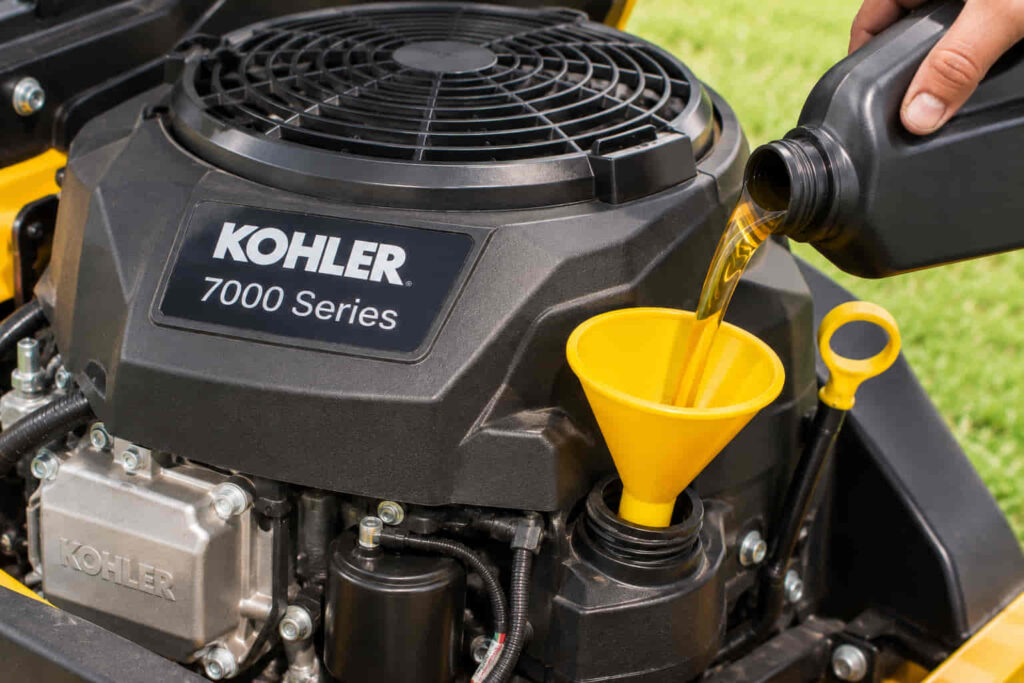
The Kohler 7000 Series oil capacity is 2.0 US quarts (approximately 1.9 liters) for the KT715, KT725, KT730, KT735, KT740, and KT745 engines. This is the manufacturer’s published oil refill specification for the popular air-cooled V-twin gasoline engines used in residential riding lawn mowers and lawn tractors.
Although these engines have different horsepower ratings and cylinder displacements, Kohler specifies the same 2.0-quart oil capacity across the covered models. The KT715 through most standard KT740 configurations use approximately 725cc of displacement, while the KT745 and certain PRO Performance configurations use 747cc.
The recommended engine oil depends on ambient temperature and the applicable Kohler manual. Kohler’s service documentation identifies SAE 10W-30, SAE 5W-30, SAE 30, and KOHLER PRO 10W-50 synthetic oil as options for specified temperature conditions. Engine oils outside the proprietary PRO program must meet API service class SJ or higher.
Oil change intervals also require attention. Kohler’s current 7000 Series service manual specifies oil and filter replacement every 100 operating hours for ordinary approved oil and filter combinations. A 300-hour interval is authorized only when the engine uses both KOHLER PRO 10W-50 synthetic oil and the specified KOHLER PRO Extended Life Oil Filter.
However, oil capacity and oil change interval should not be confused. Using a longer-life lubricant does not increase the engine’s oil capacity.
This guide explains the Kohler 7000 Series oil capacity by engine model, recommended oil grades, filter compatibility, correct oil change procedures, oil level checking, maintenance intervals, and common lubrication problems.
How Much Oil Does a Kohler 7000 Series Engine Take?
A Kohler 7000 Series engine takes approximately 2.0 US quarts, or 1.9 liters, of engine oil during a standard refill.
This specification applies to the major KT7000 engine configurations documented in Kohler’s service manual.
The 7000 Series is a family of air-cooled, four-stroke, V-twin engines designed for outdoor power equipment.
These engines feature cast-iron cylinder liners, overhead valves, and a pressure lubrication system.
Engine oil circulates through internal passages to protect the crankshaft, connecting rods, camshaft, and other moving components.
The lubrication system also helps carry heat away from critical engine surfaces.
Because the engine operates in a lawn mower, it may be exposed to dusty conditions, high ambient temperatures, and substantial mechanical loads.
Maintaining the correct oil level is therefore essential.
However, the published 2.0-quart capacity is a refill reference rather than permission to overfill the crankcase.
When performing an oil change, a small quantity of old oil may remain in internal passages or other areas.
The exact amount drained can vary depending on oil temperature, drain time, and how level the equipment is positioned.
The final oil level must therefore be verified using the dipstick.
Kohler specifically warns against operating the engine with oil below or above the marked operating range.
Kohler 7000 Series Oil Capacity in Quarts and Liters
Kohler specifies 2.0 US quarts, equivalent to approximately 1.9 liters, for the oil refill capacity of the KT715 through KT745 engine family.
The capacity may be displayed using different units depending on the manual or region.
In the United States, quarts are commonly used for engine oil quantities.
Other markets may use liters.
Two US quarts equal approximately 1.89 liters.
Kohler rounds this to 1.9 liters in the official specification.
Owners purchasing one-quart oil bottles generally need two bottles for a complete standard refill.
Owners purchasing metric containers should have approximately 1.9 liters available.
However, the actual quantity added should be controlled by the dipstick.
The oil should be introduced gradually near the end of filling rather than forcing the entire nominal capacity into an already full crankcase.
Oil capacity is also different from fuel tank capacity.
The gasoline tank belongs to the complete mower and varies by equipment manufacturer.
The 2.0-quart figure refers specifically to engine lubrication.
It should not be confused with the transmission or hydrostatic drive fluid capacity.
Riding mowers may have separate transmission systems requiring different fluids and maintenance procedures.
The engine oil and transmission fluid must not be treated as interchangeable.
Kohler KT715 Oil Capacity
The Kohler KT715 oil capacity is 2.0 US quarts (1.9 liters).
The KT715 is commonly identified as a 20-horsepower engine in the Kohler 7000 Series.
It uses a 725cc V-twin configuration.
Its bore measures approximately 83 mm, while its stroke measures 67 mm.
The engine uses a pressurized lubrication system and an external oil filter.
Despite being one of the lower-horsepower models in the family, the KT715 uses the same published oil refill capacity as larger 7000 Series engines.
This means owners should not assume that lower horsepower requires less engine oil.
The correct refill quantity is established by the engine’s crankcase and lubrication design rather than horsepower alone.
Kohler recommends checking the oil before operation.
The mower should be parked on a level surface, and the engine should be cool when checking the dipstick.
If the oil is below the correct operating level, approved oil should be added.
However, the crankcase must not be overfilled.
For an oil change, the filter should also be replaced according to the applicable maintenance schedule.
The correct filter part number should be verified using the full KT715 specification number.
Kohler KT725 Oil Capacity
The Kohler KT725 engine requires approximately 2.0 US quarts (1.9 liters) of oil during a refill.
The KT725 is commonly marketed as a 22-horsepower V-twin engine.
It uses the 725cc configuration shared with several other Kohler 7000 Series models.
The engine is found in various residential lawn tractors and riding mowers.
Its lubrication system is designed to deliver oil to internal engine components during normal operation.
Maintaining adequate oil is particularly important when the mower works in thick grass or during extended mowing sessions.
Heavy engine load increases the amount of work performed by the pistons, crankshaft, and valve train.
However, the recommended oil capacity remains unchanged.
Adding extra oil does not improve the engine’s protection under heavy load.
Instead, excessive oil can interfere with normal crankcase operation.
The correct maintenance procedure involves draining the old oil, replacing the filter, and refilling the crankcase to the indicated level.
The oil type should be selected from Kohler’s approved viscosity recommendations.
For many ordinary mowing temperatures, SAE 10W-30 is a commonly specified option.
Kohler also offers a proprietary PRO 10W-50 synthetic lubricant for the relevant engine family.
The correct lubricant and service interval depend on the specific product combination used.
Kohler KT730 Oil Capacity
The Kohler KT730 oil capacity is 2.0 US quarts, or approximately 1.9 liters.
The KT730 is commonly rated at 23 horsepower.
It belongs to the same air-cooled V-twin engine family as the KT715 and KT725.
Its displacement is approximately 725cc in the covered standard configuration.
The shared architecture explains why the published oil capacity remains consistent.
The engine uses an oil pump to circulate lubricant through internal passages.
The oil filter removes certain contaminants from the circulating oil.
A properly functioning lubrication system reduces friction and protects mechanical components.
However, oil condition can deteriorate during operation.
High temperatures, dust exposure, fuel contamination, and wear particles can affect lubricant quality.
Therefore, the oil must be changed at the appropriate interval.
Kohler’s current service manual identifies a 100-hour interval for ordinary approved oil and filter combinations.
The optional 300-hour program has stricter product requirements.
The KT730 should not receive additional oil simply because it has a different horsepower rating from the KT725.
The correct refill remains approximately two quarts.
The dipstick is the final reference for confirming the operating level.
Kohler KT735 Oil Capacity
The Kohler KT735 engine takes 2.0 US quarts (1.9 liters) of oil.
The KT735 is commonly rated at 24 horsepower.
It uses a 725cc V-twin layout in the standard configuration documented by Kohler.
The engine is often installed in residential lawn equipment designed for larger mowing areas.
Regular lubrication is essential because the engine may operate for extended periods at governed speed while driving the cutting blades.
However, the engine’s oil quantity does not need to increase with mowing duration.
The correct capacity remains two US quarts.
Owners should monitor the dipstick between oil changes.
A mower used frequently or on uneven terrain may require more attention to oil level and condition.
The engine should also be inspected for external leaks.
Oil around the crankcase, oil filter, or valve cover may indicate a sealing problem.
If the oil level repeatedly decreases, the source should be investigated.
Adding oil may temporarily restore the correct level, but it does not repair a leak or internal oil consumption problem.
The correct oil filter is also important.
For some KT735 specifications, Kohler parts catalogs identify the standard 12 050 01-S filter.
However, alternative filter configurations are available.
The correct component should always be confirmed against the engine’s specification number.
Kohler KT740 Oil Capacity
The Kohler KT740 oil capacity is 2.0 US quarts (1.9 liters), including versions with different air cleaner configurations.
The KT740 is commonly rated at 25 horsepower.
However, Kohler has produced different KT740 engine configurations.
Standard versions use approximately 725cc of displacement.
Certain versions equipped with the PRO Performance air cleaner have approximately 747cc of displacement.
This distinction is important because owners sometimes assume that a larger displacement requires a higher oil capacity.
Kohler’s specification table lists the same 2.0-quart refill for the covered KT740 configurations.
The engine’s external air cleaner arrangement does not automatically change the amount of oil required.
The PRO Performance air cleaner also should not be confused with Kohler’s PRO extended oil service program.
These are separate features.
An engine may have a PRO air cleaner while using a normal oil filter and standard oil change interval.
The 300-hour oil service option requires the designated KOHLER PRO 10W-50 synthetic oil and matching extended-life oil filter.
The air filter alone does not establish eligibility for that interval.
Owners should therefore identify both the air filtration equipment and the lubricant/filter combination before planning maintenance.
The dipstick remains the final check after refilling the engine.
Kohler KT745 Oil Capacity
The Kohler KT745 oil capacity is 2.0 US quarts (1.9 liters), even though the engine has a larger 747cc displacement.
The KT745 is commonly marketed as a 26-horsepower engine.
Its stroke measures approximately 69 mm, compared with the 67 mm stroke used by several smaller 725cc KT models.
The longer stroke contributes to its larger displacement.
However, the published oil refill capacity remains the same.
This demonstrates that engine displacement and oil sump capacity are different specifications.
A larger combustion displacement does not necessarily require a larger oil reservoir.
The engine’s lubrication system is designed around its internal oil passages, sump, filter, and operating requirements.
The KT745 uses pressure lubrication to protect internal moving components.
Maintaining the correct oil level helps support engine durability.
However, the engine should not be filled above the specified dipstick range.
Kohler’s oil recommendations also apply according to ambient temperature and manual revision.
Owners may use appropriate detergent engine oil meeting the manufacturer’s requirements.
The optional extended-life lubricant program requires the specified Kohler products.
For routine maintenance, the engine should be serviced according to the applicable schedule, and the filter should be replaced when required.
Does the Kohler 7000 Series PRO Have a Different Oil Capacity?
Kohler 7000 Series engines equipped with PRO-related features generally retain the 2.0-quart (1.9-liter) oil refill specification shown in the manufacturer’s manual.
However, the term PRO can describe different equipment or maintenance products.
Some 7000 Series engines are equipped with a PRO Performance air cleaner.
This air cleaner is intended to improve filtration capacity under relevant operating conditions.
Kohler also sells PRO 10W-50 synthetic engine oil.
That lubricant is associated with an extended oil change program when used with the specified KOHLER PRO Extended Life Oil Filter.
These features should not be confused.
Installing a PRO air cleaner does not increase oil capacity.
Using PRO synthetic oil also does not change the quantity required to reach the dipstick’s correct operating level.
The engine still uses the published refill capacity.
The main difference concerns maintenance intervals and the approved combination of oil and filter.
When the specified PRO products are used together, Kohler authorizes a longer service interval in the applicable service documentation.
If other approved oils or filters are used, the ordinary maintenance interval remains relevant.
Owners should verify the exact engine model and service manual before assuming that a PRO designation changes the lubrication requirements.
What Type of Oil Does the Kohler 7000 Series Use?
The Kohler 7000 Series uses detergent engine oil meeting API service class SJ or higher, with viscosity selected according to ambient temperature and the applicable manufacturer recommendations.
Kohler identifies several viscosity grades for the engine family.
SAE 10W-30 is a commonly recommended choice for a broad range of ordinary mowing temperatures.
SAE 5W-30 may be appropriate for cooler conditions, depending on the viscosity chart in the applicable manual.
SAE 30 is also listed for warmer operating environments.
Kohler’s current service manual recommends KOHLER PRO 10W-50 synthetic oil as its preferred all-season product.
However, the PRO lubricant is not the only acceptable oil.
Alternative high-quality detergent oils may be used when they satisfy the required API classification and viscosity guidance.
This distinction matters because a lawn mower may operate in different climates.
A machine used in a hot southern environment experiences different ambient conditions from one operated during cool spring mornings.
Oil viscosity affects how the lubricant flows at startup and behaves at operating temperature.
The correct grade should therefore match the engine’s published requirements.
Owners should not select oil solely by brand or price.
A lubricant marketed for lawn mowers is not necessarily suitable if it lacks the appropriate performance classification.
The safest approach is to use the engine’s current applicable manual and temperature chart.
Read more: 6.7 Powerstroke High Idle in Park
Is 10W-30 Good for Kohler 7000 Series Engines?
Yes. SAE 10W-30 is an approved viscosity option for the Kohler 7000 Series when operating temperatures fall within the range identified by Kohler.
SAE 10W-30 is a multigrade engine oil.
It is formulated to provide suitable viscosity characteristics during startup and at normal operating temperature.
Kohler’s service manual includes 10W-30 in its viscosity selection chart.
For many residential mowing applications, this makes it a practical choice.
However, the oil must still meet the minimum API performance requirements.
The manufacturer identifies API SJ or higher for alternative engine oils.
A suitable 10W-30 oil can support lubrication of the crankshaft bearings, connecting rods, camshaft, and other internal components.
However, the viscosity should not be selected independently of climate.
In extremely cold conditions, a different approved grade may provide more appropriate startup characteristics.
Likewise, Kohler’s PRO 10W-50 synthetic oil is another factory-recommended option with its own service interval requirements.
Using 10W-30 does not automatically authorize the 300-hour oil change interval.
The ordinary 100-hour interval remains applicable when using alternative oil and filter combinations.
Owners should also remember that oil capacity stays the same regardless of viscosity.
The engine still requires approximately two quarts during a normal refill.
Can You Use 5W-30 in a Kohler 7000 Series?
SAE 5W-30 can be suitable for the Kohler 7000 Series when the operating temperature falls within the range specified in the relevant Kohler oil chart.
The primary difference between 5W-30 and 10W-30 involves their cold-temperature viscosity classifications.
A 5W-rated lubricant is formulated to meet a different low-temperature performance requirement from a 10W-rated lubricant.
This can matter when starting an engine during cold weather.
However, a lower winter grade does not automatically make an oil superior for all conditions.
Kohler’s current service manual includes 5W-30 as an option primarily for cold-weather operation.
The older owner’s manual edition displays its temperature range somewhat differently.
Therefore, the applicable manual revision should be checked rather than assuming that one temperature chart covers every engine and production year.
The selected 5W-30 oil must also meet the manufacturer’s performance requirements.
For alternative oils, Kohler specifies API SJ or higher.
Oil capacity remains approximately 2.0 US quarts.
A 5W-30 oil does not require a different refill quantity from 10W-30.
Owners should evaluate the local operating temperature and the correct engine documentation before selecting the viscosity.
Can You Use SAE 30 in a Kohler 7000 Series?
SAE 30 is included in Kohler’s viscosity recommendations for specified warmer operating conditions, but it is not necessarily the best choice for cold-weather starting.
SAE 30 is a single-grade engine oil.
Unlike 10W-30 or 5W-30, it is not identified by a separate winter viscosity classification.
Kohler’s service documentation includes SAE 30 in its temperature chart.
However, its recommended operating range is associated with warmer temperatures.
Using an inappropriate oil during cold startup can affect how quickly lubrication reaches internal components.
This is particularly important because engine wear can occur when moving parts do not receive adequate lubrication.
A mower used primarily in warm weather may operate within the manufacturer’s suitable temperature range for SAE 30.
However, owners should not assume that the same grade is appropriate for freezing conditions.
The oil must meet the applicable performance standard.
Kohler also recommends multigrade alternatives, including 10W-30 and its proprietary PRO 10W-50 synthetic lubricant.
The choice should therefore be based on the current service documentation and actual climate.
Regardless of viscosity, the published refill capacity remains approximately two US quarts.
Is KOHLER PRO 10W-50 the Best Oil for the 7000 Series?
Kohler recommends its PRO 10W-50 synthetic oil as an all-season lubricant for the engine family and associates it with an extended service program when used with the required PRO oil filter.
The product is designed specifically for Kohler engine applications.
The manufacturer describes it as suitable across a broad range of operating temperatures.
Its synthetic formulation is intended to support protection during normal and demanding operating conditions.
However, the most important distinction is its maintenance program.
Kohler authorizes a 300-hour oil and filter service interval only when both the specified PRO 10W-50 oil and KOHLER PRO Extended Life Oil Filter are used.
Using the PRO oil with an ordinary filter does not automatically qualify.
Likewise, installing a PRO extended-life filter while using an unrelated lubricant does not satisfy the manufacturer’s published requirements.
The oil capacity remains unchanged.
Approximately 2.0 quarts are required for a standard refill.
Owners should also consider the age and condition of the engine.
An older mower with oil leaks, abnormal consumption, or unresolved mechanical problems still requires appropriate diagnosis.
Using premium synthetic oil does not correct a damaged gasket, worn piston rings, or a defective oil pump.
The correct lubricant supports normal maintenance but cannot reverse existing mechanical damage.
How Often Should You Change Kohler 7000 Series Oil?
Kohler’s current 7000 Series service manual specifies an oil and filter change every 100 operating hours for normal approved oil and filter combinations.
This is the standard interval identified in the manufacturer’s maintenance schedule.
The service interval is measured in engine operating hours rather than road mileage.
This is appropriate because lawn tractors may remain in one location while the engine is running.
A mower operating for two hours accumulates two engine hours even if it travels only a short distance across a property.
However, operating conditions affect maintenance needs.
Dusty environments, frequent heavy mowing, and other severe conditions can require more frequent attention.
Kohler’s maintenance schedule advises performing certain services more frequently under severe, dusty, or dirty conditions.
The engine’s air filter and cooling areas are particularly exposed to these environments.
Oil changes should therefore be planned using both the manufacturer’s schedule and the equipment’s actual operating conditions.
The oil filter should be changed at the specified interval.
Replacing the oil while retaining a heavily contaminated filter can reduce the benefit of the service.
Owners should maintain records of operating hours and oil changes.
A mower equipped with an hour meter makes this easier.
However, the equipment’s service history can also be recorded manually.
The manufacturer’s standard 100-hour interval should not be confused with the conditional 300-hour PRO program.
Can Kohler 7000 Series Oil Last 300 Hours?
Yes, but only under the conditions specified by Kohler for its extended-life oil and filter program.
Kohler’s current service manual authorizes an oil and filter change interval of up to 300 hours when the engine uses both KOHLER PRO 10W-50 synthetic oil and the specified KOHLER PRO Extended Life Oil Filter.
The combination requirement is explicit.
Alternative oils and filters are not automatically eligible.
This means owners should not extend the interval simply because a lubricant is fully synthetic.
A generic synthetic 10W-30 or 10W-50 product may not meet the conditions of Kohler’s extended-life program.
The same applies to aftermarket oil filters.
A filter advertised as premium or high capacity is not necessarily the approved PRO extended-life filter.
Owners should verify the exact part number and applicable engine documentation.
The extended interval also does not eliminate routine oil level checks.
An engine may develop a leak or consume oil between services.
If the level becomes low, internal engine damage can occur long before the next scheduled oil change.
The 300-hour interval also should not be used to ignore unusual engine noise, overheating, or evidence of oil contamination.
The appropriate service program depends on the specified products, engine condition, and current manufacturer recommendations.
What Oil Filter Does a Kohler 7000 Series Use?
Kohler 7000 Series engines use replaceable oil filters, but the correct filter should be selected using the engine model and specification number.
Kohler’s parts reference identifies the standard oil filter 12 050 01-S.
The company also lists premium oil filter 52 050 02-S for many engine applications.
These filters have different dimensions and intended uses.
For example, the standard filter is shorter than the premium version in Kohler’s published accessories information.
This matters because some mower installations provide limited clearance around the engine.
An oil filter may be mechanically compatible with the engine but interfere with another part of the equipment if its body is too long.
The owner’s manual and parts catalog should therefore be checked before selecting a replacement.
The extended-life PRO oil change program introduces another consideration.
Kohler requires the specified PRO Extended Life Oil Filter when using the 300-hour interval.
Owners should not assume that every filter labeled premium or PRO automatically qualifies.
The correct current part number should be confirmed through Kohler’s authorized parts information.
During installation, the old filter gasket must be removed from the engine’s mounting surface.
The replacement gasket should be prepared according to the manufacturer’s instructions.
An incorrectly installed filter can cause leakage or lubrication problems.
Does Kohler 7000 Series Oil Capacity Include the Filter?
Kohler publishes the 2.0-quart figure as an engine oil refill capacity and describes oil and filter replacement as the normal oil service procedure.
During an oil change, oil is drained from the crankcase and the old filter is removed.
A new filter is then installed.
Kohler’s owner’s manual includes a procedure for preparing the replacement filter with new engine oil before installation.
The manual instructs technicians to position the filter open-end upward and add oil until it reaches the bottom of the threads.
The filter is then allowed to absorb the oil for approximately two minutes.
The exact refill quantity should still be confirmed using the dipstick.
This is important because the oil added to the replacement filter forms part of the total oil introduced during the service.
The engine should not receive two quarts into the crankcase plus an additional unmeasured amount solely because the filter was prefilled.
Similarly, the oil filter should not be ignored when planning maintenance.
It helps remove certain particles from the circulating lubricant.
For normal service, both the oil and filter should be changed according to the applicable schedule.
Kohler does not provide a separate universal no-filter refill quantity for the engine family in the referenced specification table.
The published two-quart capacity remains the appropriate starting reference.
How to Change Oil in a Kohler 7000 Series Engine
Changing oil in a Kohler 7000 Series involves warming the engine, safely draining the old oil, replacing the oil filter, and refilling the crankcase to the correct dipstick level.
The mower should be placed on a level surface.
The parking brake must be applied, and the cutting blades should be disengaged.
The engine should be switched off before servicing.
Kohler recommends changing the oil while the engine is warm because warm oil drains more readily.
However, hot engine components and oil can cause burns.
The operator should allow sufficient cooling for safe handling.
The engine must also be protected against accidental starting.
Kohler’s service manual instructs technicians to disconnect and ground the spark plug leads before maintenance and disconnect the negative battery cable when required.
A suitable drain container should be positioned beneath the engine.
The area around the oil filler and dipstick is cleaned to prevent debris from entering the crankcase.
The oil drain plug and oil fill cap are removed.
Used oil is allowed to drain thoroughly.
The oil filter is then removed, and the mounting surface is cleaned.
The replacement filter is prepared according to Kohler’s instructions.
A thin film of clean oil should be applied to the new filter’s rubber gasket.
The filter is installed according to its specified procedure.
The drain plug is reinstalled correctly.
Fresh engine oil is then added gradually until the dipstick shows the correct level.
After reassembly, the engine is started and inspected for leaks.
The engine is shut off, and the oil level is checked again.
Used oil and the filter must be disposed of through an appropriate recycling or waste collection service.
What Is the Kohler 7000 Series Oil Drain Plug Torque?
Kohler’s owner’s manual for the covered 7000 Series engines specifies an oil drain plug tightening torque of 10 ft-lb, approximately 13.6 Nm, during the oil change procedure.
Correct tightening is important because the drain plug seals the engine’s oil sump.
A loose plug can allow oil to escape.
A plug tightened excessively can damage threads or sealing components.
Before reinstalling the plug, the threads and sealing area should be inspected.
The plug should thread into place smoothly.
If it does not, the technician should stop and inspect for thread damage.
The specified torque should be applied using an appropriate torque wrench.
However, the manufacturer’s procedure for the particular engine and drain hardware should always take precedence.
Some mower installations may use a drain extension, hose, or quick-drain accessory.
These components can have separate installation requirements.
The 10 ft-lb specification should not automatically be applied to every aftermarket drain valve.
Once the oil change is complete, the drain area should be inspected for leakage.
The engine should not continue operating if oil is escaping from the plug or another lubrication connection.
A properly sealed drain system helps preserve the correct oil level between services.
How to Check Kohler 7000 Series Oil Level
Kohler instructs owners to check the oil with the engine cool, the equipment level, and the dipstick fully seated in its tube.
The area around the oil filler and dipstick should first be cleaned.
This prevents dirt and debris from entering the crankcase.
The dipstick is removed and wiped clean.
It is then reinserted completely into the dipstick tube.
After removing it again, the oil level is checked against the indicator markings.
Kohler states that the level should be at the top of the specified indicator range.
If the oil is low, the correct lubricant should be added gradually.
The level should be checked again before operating the engine.
However, oil above the acceptable range is not desirable.
The manual specifically warns against running the engine with oil below or above the marked operating range.
These instructions are important because a dipstick reading can be misleading when the engine is tilted.
A riding mower parked on a slope may provide an inaccurate indication.
The mower should therefore be moved to a level surface before checking.
The dipstick should also be fully seated as described by Kohler.
Partially inserting the dipstick can produce a false reading.
Regular checks can help identify oil loss before insufficient lubrication causes serious damage.
What Happens if You Overfill a Kohler 7000 Series?
Overfilling a Kohler 7000 Series can interfere with normal crankcase operation and contribute to oil consumption, smoke, leakage, or other lubrication problems.
The engine is designed to operate with oil within a specified range.
Excessive oil can be disturbed by moving internal components.
This may increase oil aeration or abnormal movement of oil through the crankcase.
The breather system is designed to manage crankcase gases and oil separation.
When the oil level is too high, the system may carry excessive oil into the intake.
The engine can then produce exhaust smoke or consume more oil than expected.
However, blue smoke does not automatically prove overfilling.
Worn piston rings or valve-related problems can also allow oil to enter the combustion chamber.
The correct response is to check the oil level using the manufacturer’s procedure.
If the level is above the allowable range, excess oil should be removed.
The engine should not be operated simply because the oil appears clean or newly installed.
The correct quantity remains approximately 2.0 US quarts during a normal refill.
Adding extra oil for heavy mowing does not provide additional protection.
Maintaining the appropriate level is more important than maximizing the amount of lubricant in the crankcase.
What Happens if the Kohler 7000 Series Runs Low on Oil?
Low engine oil can cause excessive friction, overheating, abnormal mechanical noise, and internal component damage in a Kohler 7000 Series engine.
The lubrication system depends on an adequate supply of oil.
The pump distributes oil through internal passages to protect moving surfaces.
If the oil level becomes too low, lubrication may become inconsistent under certain conditions.
This risk can increase when the mower operates on uneven ground.
Kohler identifies a maximum operating angle of 25 degrees at the full oil level for the covered engines.
However, the mower manufacturer’s actual slope limit may be lower.
The equipment’s safety instructions must always take precedence.
Low oil can contribute to wear involving the crankshaft bearings, connecting rods, and other components.
The engine may become unusually noisy or lose power.
However, these symptoms can have other causes.
A damaged ignition system, fuel restriction, or excessive mower deck load may also affect performance.
The oil level should be checked before diagnosing a suspected lubrication-related failure.
Some applications have Kohler’s Oil Sentry system.
However, Kohler warns that Oil Sentry may not shut down a running engine before damage occurs.
Therefore, owners should not rely exclusively on a warning or shutdown system to protect the engine.
Regular dipstick checks remain essential.
Can the Kohler 7000 Series Burn Engine Oil?
A Kohler 7000 Series may consume engine oil because of overfilling, breather problems, piston ring wear, cylinder damage, or other internal mechanical conditions.
Some oil consumption can occur during normal engine operation.
However, a rapid or increasing loss of oil deserves investigation.
The first step is to check for external leaks.
Oil may escape from gaskets, seals, or filter connections.
A leaking oil filter gasket may create noticeable oil loss even when the engine’s internal components remain healthy.
If no external leak is found, internal consumption should be considered.
The crankcase breather helps control internal pressure and route gases through the intended system.
A damaged or restricted breather may interfere with oil separation.
Oil can then enter the intake system.
Worn piston rings provide another possible explanation.
The rings help seal combustion pressure and control oil on the cylinder walls.
If they become worn or damaged, additional oil may enter the combustion chamber.
Blue exhaust smoke is one possible symptom.
However, proper diagnosis may require checking the breather, measuring compression, or performing a cylinder leakage test.
The correct repair depends on the failed component.
Changing oil viscosity is not a substitute for repairing severe internal wear.
Why Is My Kohler 7000 Series Oil Turning Black?
Engine oil becomes darker as it accumulates combustion-related contaminants, wear particles, and oxidation products during normal operation.
The color change does not automatically indicate engine failure.
Detergent engine oils are designed to help keep certain contaminants suspended until the oil is changed.
However, excessive contamination or neglected maintenance can reduce lubrication quality.
Air-cooled lawn mower engines may operate at substantial temperatures.
Frequent heavy mowing can increase thermal demands.
Dusty environments also place greater importance on keeping the air cleaner properly sealed.
If dust enters the engine, abrasive particles can accelerate wear.
Fuel contamination is another possible concern.
If gasoline enters the crankcase, the oil may develop an unusual fuel smell and reduced viscosity.
A leaking carburetor inlet needle or another fuel system fault may contribute.
Milky or foamy oil can indicate contamination or aeration, but its cause must be evaluated carefully.
The Kohler 7000 Series is air-cooled and does not have the conventional liquid cooling system found in many automobiles.
Therefore, milky oil should not automatically be diagnosed as coolant entering the crankcase.
The engine’s maintenance history, oil level, smell, and operating condition provide more useful information than color alone.
When the oil is overdue for replacement or suspected of contamination, it should be changed and the underlying cause investigated.
Can You Use Automotive Oil in a Kohler 7000 Series?
Automotive engine oil can be suitable for a Kohler 7000 Series when it meets the manufacturer’s required API service classification and appropriate viscosity range.
Kohler does not require every owner to use only a lubricant marketed specifically for lawn mowers.
The current service manual permits alternative detergent engine oils meeting API class SJ or higher.
However, the viscosity must be selected according to operating temperature.
A high-quality automotive SAE 10W-30 may be appropriate when it meets those requirements.
The engine’s air-cooled design does not automatically prohibit suitable automotive oil.
Nevertheless, the owner should verify the product’s specifications rather than assume that every automotive lubricant is acceptable.
An oil with the wrong viscosity may not provide the intended performance under the relevant operating conditions.
The optional 300-hour service program also has stricter requirements.
Using a generic automotive synthetic oil does not qualify the engine for Kohler’s extended interval.
That program requires the specified KOHLER PRO 10W-50 oil and PRO Extended Life Oil Filter.
For ordinary approved alternative oils, the standard maintenance interval remains applicable.
The decision should therefore consider both oil compatibility and the required service schedule.
What Is the Difference Between Kohler 7000 Series and 7500 Series Oil Capacity?
The Kohler 7000 Series and 7500 Series EFI engines are distinct product families, although certain documented configurations share a 2.0-quart oil refill capacity.
The 7000 Series includes carbureted V-twin engines such as the KT715, KT725, KT730, KT735, KT740, and KT745.
The 7500 Series EFI uses electronic fuel injection and has different engine model identifiers.
Examples include EKT730, EKT740, EKT745, and EKT750.
Kohler’s published 7500 Series EFI service manual identifies an oil refill capacity of approximately 1.9 liters, or 2.0 US quarts, for those covered engines.
However, sharing an oil capacity does not mean every component is interchangeable.
Fuel injection equipment, electronic controls, filters, and other service parts may differ.
The correct maintenance schedule should also be confirmed using the applicable manual.
Owners should not select oil filters solely because two engines require the same amount of oil.
The engine identification label provides the model and specification numbers necessary for ordering the correct parts.
For a Kohler 7000 Series engine, the two-quart capacity remains the relevant specification.
For other Kohler families, the appropriate manual should be consulted independently.
Does Kohler 7000 Series Oil Capacity Change With Horsepower?
No. Kohler’s published specification identifies the same 2.0-quart refill across the covered 20–26 horsepower 7000 Series models.
Horsepower describes engine output.
Oil capacity describes the amount of lubricant required by the lubrication system.
The two specifications are related to different aspects of engine design.
A higher-horsepower engine may produce more mechanical output, but this does not automatically mean its oil sump is larger.
Kohler uses a shared engine architecture across several KT7000 models.
Different configurations may have different displacement, calibration, and airflow characteristics.
However, their published refill capacities remain consistent.
The KT715 and KT745 provide a useful comparison.
The KT715 is commonly rated at 20 horsepower with a 725cc displacement.
The KT745 is commonly rated at 26 horsepower with a 747cc displacement.
Both are listed with a 2.0-quart oil capacity.
This means owners should not add more oil simply because their mower has a 25- or 26-horsepower engine.
The correct refill amount should be verified using the engine model and Kohler’s specification table.
The dipstick provides the final confirmation after filling.
Does Mowing on Slopes Affect Kohler 7000 Series Lubrication?
Operating on slopes can affect oil distribution inside the engine, making correct oil level and compliance with the equipment’s slope restrictions especially important.
Engine oil normally collects in the sump.
The lubrication system draws oil from the designated pickup area.
When a mower tilts, the oil shifts within the crankcase.
If the angle becomes excessive, the oil pickup may not receive the intended supply.
This can interfere with lubrication.
Kohler identifies a maximum operating angle of 25 degrees at the full oil level in the covered service documentation.
However, this is an engine specification, not permission to operate every mower on a 25-degree slope.
The mower manufacturer’s slope limit may be considerably lower because of rollover and traction risks.
The equipment’s limit must take precedence.
Owners should also consider the direction of slope operation and the mower’s stability.
A low engine oil level may increase lubrication risk even before the maximum angle is reached.
Therefore, the oil should be checked regularly and kept within the correct range.
Overfilling is not an appropriate solution.
The engine should not be operated outside the manufacturer’s specified lubrication or equipment safety limits.
How Much Does a Kohler 7000 Series Oil Change Cost?
The cost of a Kohler 7000 Series oil change depends on the selected lubricant, oil filter, local pricing, and whether the owner performs the work or uses a service shop.
The required oil quantity is relatively modest.
A standard service uses approximately two US quarts.
This makes the lubricant quantity straightforward to plan.
However, different oil products have different prices.
A conventional approved SAE 10W-30 may cost less than a specialized synthetic lubricant.
KOHLER PRO 10W-50 is associated with an extended maintenance program, but it must be used with the specified extended-life filter to qualify for the 300-hour interval.
A standard oil filter may have a different price and replacement schedule.
The total cost should therefore consider the full oil and filter combination.
A DIY owner also needs a drain pan, suitable tools, and a safe method of disposing of used oil.
Professional service adds labor.
The mower’s engine installation can influence accessibility.
Some mower frames provide convenient access to the drain plug and oil filter.
Others require additional preparation.
An accurate service quote should identify the oil type, quantity, filter part number, and labor.
Using the cheapest oil without checking the required specification may not provide good long-term value.
How to Prevent Kohler 7000 Series Oil Problems
The most effective way to prevent oil-related problems is to maintain the correct oil level, use approved lubricant, replace the oil and filter on schedule, and address leaks or abnormal consumption promptly.
Regular dipstick checks are essential.
The engine should be cool and the mower positioned on level ground.
The oil must remain within Kohler’s specified operating range.
Overfilling and underfilling should both be avoided.
Oil changes should follow the correct service interval.
The standard 100-hour schedule applies to normal approved oil and filter combinations under Kohler’s current service documentation.
The conditional 300-hour program requires the specified PRO oil and filter.
Cooling system cleanliness is also important.
The Kohler 7000 Series is air-cooled.
Grass clippings and debris can accumulate around the fan screen and cooling fins.
Poor cooling increases operating temperature and can place additional demands on the lubricant.
The air cleaner should also be serviced regularly.
A damaged filter can allow abrasive dust to enter the engine.
Oil leaks should be investigated.
A leaking filter seal, damaged gasket, or crankcase breather problem can reduce the oil level between services.
Unusual smoke or rapid oil consumption also deserves attention.
Maintenance cannot prevent every mechanical failure, but it significantly reduces avoidable lubrication-related risks.
Final Verdict: What Is the Kohler 7000 Series Oil Capacity?
The Kohler 7000 Series oil capacity is 2.0 US quarts (1.9 liters) for the KT715, KT725, KT730, KT735, KT740, and KT745 engines. This is the official refill specification published in Kohler’s service and owner’s manuals.
The capacity remains the same across these covered models despite their different horsepower ratings and engine displacements.
The KT715 through standard KT740 configurations commonly use approximately 725cc of displacement.
The KT745 and certain PRO Performance configurations use approximately 747cc.
However, all retain the listed two-quart oil capacity.
The appropriate oil viscosity depends on ambient temperature and the applicable Kohler service manual.
SAE 10W-30 is a commonly approved choice.
Other options include SAE 5W-30, SAE 30, and KOHLER PRO 10W-50 synthetic oil within their specified operating conditions.
Alternative engine oils must meet API service class SJ or higher.
Kohler’s current service manual specifies an ordinary oil and filter change interval of 100 hours.
An extended interval of 300 hours is permitted only when using both KOHLER PRO 10W-50 synthetic oil and the specified KOHLER PRO Extended Life Oil Filter.
The correct filter part number should be verified using the engine’s model and specification numbers.
During an oil change, the engine should be warm enough for oil to drain properly but safe to service.
The drain plug is tightened according to the applicable procedure, and the new filter is installed correctly.
The final oil level must always be checked with the dipstick. The published two-quart capacity is the refill reference, but the engine must never be operated with oil outside the acceptable range.
For long-term reliability, owners should maintain the correct oil level, follow the applicable service interval, keep cooling fins clean, inspect for oil leaks, and avoid excessive slope operation.
These practices help protect the crankshaft, connecting rods, camshaft, and other internal engine components throughout the mower’s operating life.