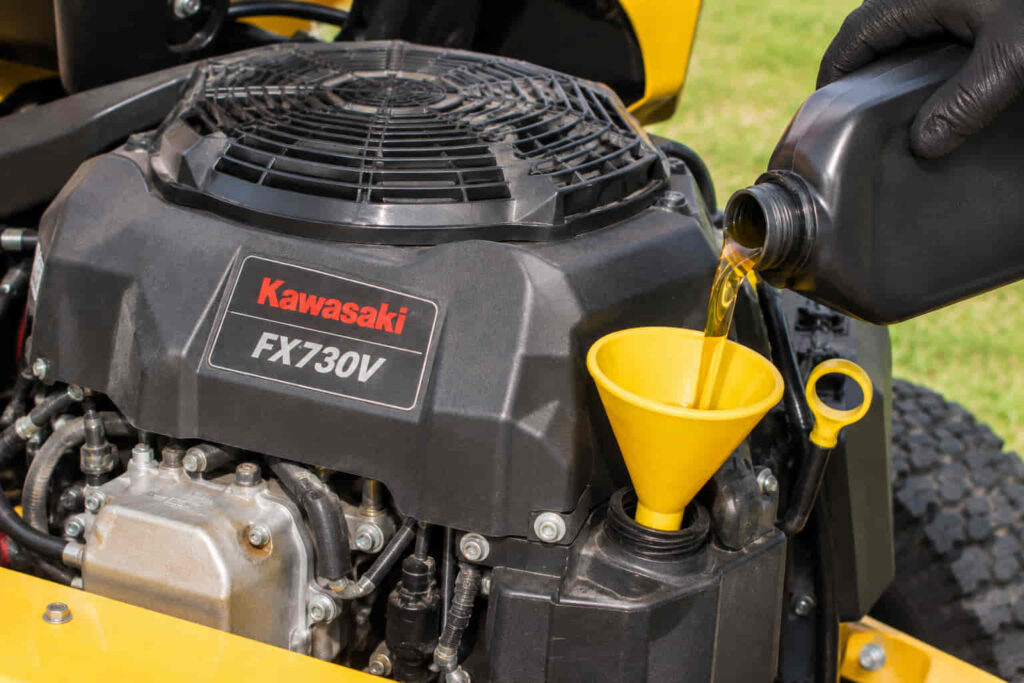
The Kawasaki FX730V oil capacity is 2.2 US quarts (2.1 liters) when replacing the engine oil and oil filter. Without replacing the oil filter, the published refill capacity is 1.9 US quarts (1.8 liters). These specifications are confirmed in Kawasaki’s official FX730V documentation and apply to commonly used versions of the 726cc V-twin commercial lawn mower engine.
Kawasaki recommends SAE 10W-40 engine oil for most operating conditions, although SAE 10W-30 and several other viscosity grades are permitted depending on ambient temperature. The engine oil must meet the applicable API service classification specified in the owner’s manual.
For routine maintenance, Kawasaki recommends changing the engine oil every 100 operating hours or once a year, whichever comes first, in its later FX730V documentation. The oil filter is scheduled for replacement every 200 hours. Certain older manuals also specify an initial oil change after the first eight operating hours.
However, not every FX730V manual lists exactly the same refill quantity. Some earlier documentation specifies 2.1 US quarts (2.0 liters) when replacing the oil filter, while Kawasaki’s current U.S. engine specifications identify 2.2 US quarts. Therefore, the correct approach is to verify the engine’s model and serial number, follow the appropriate service manual, and use the dipstick to establish the final oil level.
The FX730V powers commercial zero-turn mowers and other professional landscaping equipment. Its pressurized lubrication system protects the crankshaft, connecting rods, camshaft, and other internal components during demanding operation.
Using the correct oil quantity, viscosity, and replacement filter helps maintain lubrication, reduce wear, and protect engine reliability.
What Is the Kawasaki FX730V Oil Capacity?
The standard Kawasaki FX730V engine oil capacity is 2.2 US quarts, equivalent to approximately 2.1 liters, with a new oil filter installed.
Kawasaki lists this specification on its official U.S. FX730V engine product page.
The capacity represents the approximate amount of oil needed during a normal oil and filter replacement.
When the old oil is drained, lubricant remains in certain internal passages and on engine components.
Replacing the oil filter also removes the oil contained inside the original filter.
The new filter must receive oil after the engine starts and the lubrication system begins circulating.
This is why the published refill quantity is higher when the filter is replaced.
Kawasaki’s service documentation identifies 1.8 liters, approximately 1.9 US quarts, when the filter is not removed.
However, these quantities should be treated as service references rather than a substitute for checking the dipstick.
The exact amount needed to reach the correct operating level may vary slightly depending on how completely the oil drains and the engine’s configuration.
A mower parked on uneven ground may also produce an inaccurate dipstick reading.
The final oil level should be checked with the engine stopped and the equipment on a level surface.
Oil should remain within the designated ADD and FULL range.
The manufacturer’s published capacity and actual dipstick reading should always be considered together.
Read more: Ford 6.2 Oil Capacity
Kawasaki FX730V Oil Capacity With Filter
With a new oil filter, the Kawasaki FX730V requires approximately 2.2 US quarts (2.1 liters) of engine oil according to current U.S. manufacturer specifications.
The engine uses a replaceable oil filter to remove contaminants from the circulating lubricant.
When the filter is replaced, some additional oil is required to fill the new filter and maintain the correct level in the crankcase.
Kawasaki’s official owner documentation includes this additional quantity in its published oil capacity.
The specification is applicable to the conventional carbureted FX730V.
The manufacturer also lists the same 2.2-quart capacity for the FX730V EFI model.
However, the correct oil should be added gradually.
A technician does not need to pour the entire published amount into the crankcase without checking the level.
Instead, most of the specified quantity can be added first.
The remaining oil should be used as needed to bring the dipstick reading into the recommended range.
After installing the filter, the engine is operated briefly to circulate oil.
Kawasaki’s service procedure instructs technicians to run the engine for approximately three minutes and inspect for leakage.
The engine is then stopped so the oil level can be checked again.
The replacement filter may cause a small reduction in the dipstick reading as it fills.
Any additional oil should be added carefully.
Overfilling must be avoided.
Kawasaki FX730V Oil Capacity Without Filter
When the oil filter is not replaced, the Kawasaki FX730V oil refill capacity is approximately 1.9 US quarts (1.8 liters).
This value is lower than the full oil and filter service capacity.
The difference exists because the original oil filter remains installed and retains some lubricant.
Kawasaki’s official FX730V owner’s manual distinguishes between these two service conditions.
However, leaving the oil filter in place is not necessarily the best approach for every maintenance situation.
The filter traps contaminants produced during engine operation.
Over time, its ability to hold additional debris becomes limited.
Kawasaki provides a separate filter replacement schedule.
In the referenced manual, engine oil is changed every 100 hours or annually, while the filter is replaced every 200 hours.
This means an oil-only service may occur between scheduled filter changes.
However, owners operating in demanding conditions may choose to replace the filter more frequently when permitted by the maintenance instructions.
The correct refill quantity still depends on whether the filter was removed.
A service performed without changing the filter should begin with the lower published quantity.
The final level should then be verified using the dipstick.
Adding the full 2.2-quart quantity after leaving the old filter installed may result in overfilling.
Why Do Some Kawasaki FX730V Manuals Say 2.1 Quarts?
Some older Kawasaki FX730V owner manuals specify approximately 2.1 US quarts (2.0 liters) with the oil filter replaced, while newer official specifications commonly state 2.2 US quarts (2.1 liters).
This difference can create confusion when owners compare information from multiple websites.
The FX730V has been produced for many years.
During its production history, Kawasaki has issued different owner’s manual editions and product specifications.
Some early documentation identifies 1.9 quarts without the filter and 2.1 quarts with the filter.
More recent manuals and Kawasaki’s current U.S. product page identify 1.9 quarts without the filter and 2.2 quarts with the filter.
These values should not be combined into one assumed specification for every engine.
There are also regional differences in published product information.
For example, Kawasaki’s European FX730V product page lists an oil capacity of 2.2 liters.
That is a different measurement from 2.2 US quarts.
Because one US quart is approximately 0.946 liter, the units cannot be treated as interchangeable.
The safest approach is to identify the exact engine and consult the appropriate maintenance documentation.
The engine’s serial number helps an authorized dealer determine the applicable specification.
Regardless of which published capacity applies, the final oil level must remain within the dipstick’s approved range.
This is more reliable than attempting to reconcile different manual editions by adding extra oil.
Kawasaki FX730V EFI Oil Capacity
The Kawasaki FX730V EFI has a published oil capacity of 2.2 US quarts (2.1 liters) with a new oil filter installed, matching the current U.S. specification for the carbureted FX730V.
The EFI designation means the engine uses electronic fuel injection.
Unlike the conventional carbureted FX730V, the EFI version uses electronically controlled fuel delivery.
Kawasaki also equips the EFI engine with electronic throttle control and engine management components.
However, the basic engine configuration remains a 726cc air-cooled V-twin.
Both engines use a pressurized lubrication system.
The fuel delivery differences do not automatically require a different amount of oil.
Kawasaki’s current U.S. specifications list 2.2 quarts for both versions.
Nevertheless, the exact owner’s manual should be consulted before service.
Some equipment manufacturers may use different supporting components or installation arrangements.
The FX730V EFI also has electrical and fuel system maintenance requirements that differ from the carbureted engine.
However, these should not be confused with oil capacity.
An engine control module or electronic fuel injector does not determine how much oil should be added to the crankcase.
For normal oil and filter maintenance, the appropriate reference remains the published 2.2-quart capacity, followed by verification with the dipstick.
What Type of Engine Is the Kawasaki FX730V?
The Kawasaki FX730V is a 726cc, four-stroke, air-cooled V-twin gasoline engine with a vertical crankshaft and overhead valves.
It belongs to Kawasaki’s commercial FX engine family.
The engine uses two cylinders positioned at a 90-degree angle.
The published bore and stroke measure approximately 78 mm and 76 mm.
Its displacement is approximately 44.3 cubic inches.
The conventional FX730V produces 23.5 horsepower at 3,600 RPM under Kawasaki’s current U.S. published rating.
The manufacturer also lists a maximum torque output of approximately 39.7 lb-ft at 2,400 RPM.
However, actual output depends on engine installation, equipment configuration, environmental conditions, and operating speed.
The engine features cast-iron cylinder liners and a pressurized oil lubrication system.
These components are designed for the demanding operating conditions associated with commercial mowing.
Unlike liquid-cooled engines, the FX730V depends on airflow to control temperature.
Cooling fins and an engine-driven fan remove heat from the cylinders and surrounding components.
This design places additional importance on keeping the air intake screen and cooling passages clean.
Oil also plays an important role in internal heat transfer.
Maintaining the correct oil quantity is essential because the engine may operate for extended periods at relatively constant speed under changing cutting loads.
What Is the Best Oil for a Kawasaki FX730V?
Kawasaki recommends SAE 10W-40 engine oil for most FX730V operating conditions, provided the lubricant meets the appropriate API service classification.
The FX730V owner’s manual identifies several acceptable viscosity grades.
These include SAE 10W-40, SAE 10W-30, SAE 5W-20, SAE 20W-50, SAE 30, and SAE 40.
However, these grades are not intended to be used interchangeably in every climate.
Kawasaki provides an ambient-temperature chart to help owners select the correct viscosity.
The manual specifically identifies 10W-40 as the recommended oil for most conditions.
The oil should meet the applicable gasoline-engine API service requirements.
The documented owner’s manual identifies API SJ or SL.
Other manual editions also recognize earlier API classifications.
Modern replacement oils may use newer service classifications, but owners should confirm that the product is suitable for the engine and its specified requirements.
The lubricant should be formulated for four-stroke gasoline engines.
The FX730V does not require oil to be mixed into its gasoline.
A quality oil with the correct viscosity helps protect bearings, cylinder walls, piston rings, and valvetrain components.
However, choosing the correct oil does not eliminate the need for regular oil changes.
The oil must also be maintained at the appropriate level.
Can You Use SAE 10W-30 in a Kawasaki FX730V?
Yes. SAE 10W-30 is included among the acceptable viscosity grades in Kawasaki’s FX730V oil recommendations, provided it is suitable for the operating temperature.
SAE 10W-30 is a multigrade lubricant.
The 10W portion describes its low-temperature viscosity performance.
The second number identifies its high-temperature viscosity grade.
It is commonly used in four-stroke small engines.
However, Kawasaki’s FX730V manual identifies SAE 10W-40 as the preferred option for most operating conditions.
The two oils have different high-temperature viscosity characteristics.
A 10W-40 lubricant is in a higher high-temperature viscosity grade than 10W-30.
This can be relevant for air-cooled engines operating under sustained load.
However, thicker oil is not automatically better in every environment.
Cold-start requirements and ambient temperatures must also be considered.
Kawasaki’s manual includes a specific temperature chart for choosing among the approved options.
Owners should use that chart rather than selecting an oil based only on marketing claims.
The correct oil should also meet the required API classification.
For a normal FX730V, 10W-30 can be suitable within its approved temperature range.
However, 10W-40 remains the manufacturer-identified general recommendation in the referenced documentation.
Can You Use SAE 10W-40 in a Kawasaki FX730V?
Yes. SAE 10W-40 is the general-purpose oil viscosity recommended by Kawasaki for most FX730V operating conditions.
The manufacturer specifically identifies this viscosity in the owner’s manual.
The FX730V is an air-cooled commercial engine.
Its operating temperature depends on ambient conditions, cooling airflow, engine speed, and cutting load.
A multigrade 10W-40 oil provides a useful viscosity range for many mowing applications.
However, the correct lubricant must meet more than the viscosity specification.
It should also have a suitable gasoline-engine performance classification.
Kawasaki’s service documentation identifies API SJ or SL in the referenced owner manual.
Owners should follow the actual engine’s documentation when choosing a current replacement product.
The engine’s oil level should be checked daily.
This is particularly important because Kawasaki notes that certain multigrade lubricants may be associated with increased oil consumption under some operating conditions.
The manual recommends monitoring the oil level more frequently when necessary.
Low oil level can cause serious internal damage.
A quality 10W-40 lubricant supports normal operation, but it cannot correct a damaged oil pump, worn bearings, or defective piston rings.
Proper maintenance remains essential.
Can You Use SAE 20W-50 in a Kawasaki FX730V?
SAE 20W-50 is included in Kawasaki’s published viscosity recommendations for the FX730V under suitable higher-temperature operating conditions.
The manufacturer’s oil chart shows that different viscosities are appropriate across different ambient-temperature ranges.
SAE 20W-50 is a higher-viscosity multigrade lubricant than 10W-40 at normal high-temperature grading conditions.
Kawasaki’s manual notes that using 20W-50 at higher ambient temperatures may help reduce oil consumption.
However, this statement does not mean the oil should be used in every climate.
A relatively heavy oil may not provide the intended cold-temperature flow behavior in an environment where temperatures drop substantially.
Cold starting is particularly important because oil must reach engine components promptly after startup.
An engine that has already developed excessive internal wear should also be diagnosed rather than treated only with thicker oil.
Worn piston rings, damaged cylinder walls, or crankcase ventilation faults can contribute to oil consumption.
Changing viscosity may influence the amount of oil consumed but does not restore damaged components.
Owners operating commercial mowing equipment in hot climates should use the temperature chart and engine-specific service instructions.
For ordinary conditions, Kawasaki continues to identify 10W-40 as the general recommendation.
Is Synthetic Oil Good for the Kawasaki FX730V?
Synthetic oil can be suitable for the Kawasaki FX730V when it meets the required viscosity, performance classification, and operating conditions specified by Kawasaki.
Synthetic lubricants are formulated to provide controlled viscosity characteristics and resistance to degradation.
These properties can be valuable in engines exposed to sustained loads and high temperatures.
However, the word synthetic alone does not establish compatibility.
A synthetic oil with the wrong viscosity may be less appropriate than a conventional or synthetic-blend product that meets the engine’s requirements.
Kawasaki markets its KTECH line of four-cycle engine oils for use in compatible engines.
The company offers several formulations designed for outdoor power equipment.
However, owners are not required to assume that one product is suitable for every engine and climate.
The exact lubricant must match the specification.
Using synthetic oil also does not automatically justify extending the oil change interval.
Oil contamination depends on operating hours, dust exposure, fuel condition, and other factors.
Commercial lawn equipment may operate in especially dusty environments.
These conditions can accelerate contamination if the air filtration system is not properly maintained.
Owners should follow the applicable maintenance schedule even when using synthetic oil.
Correct filtration, oil level, and cooling system maintenance remain important.
What Oil Filter Does a Kawasaki FX730V Use?
Kawasaki currently lists genuine oil filter part number 49065-0736 for the FR, FS, FT, and FX 600 and 730 engine families, including compatible FX730V applications.
Older Kawasaki parts documentation identifies oil filter 49065-7007.
That part number was superseded by 49065-0721 in later manufacturer documentation.
Kawasaki’s current U.S. oil filter catalog lists 49065-0736 for the corresponding engine series.
However, parts should still be selected using the full engine model and specification information.
Oil filters must match the engine’s mounting dimensions, sealing requirements, and lubrication characteristics.
A filter that appears to fit physically is not necessarily correct.
The internal bypass valve and anti-drainback valve may have important functions.
Kawasaki describes its genuine filters as using a pressure-activated bypass valve to maintain oil flow under certain conditions.
The filter media is designed to capture contaminants while allowing appropriate oil circulation.
During replacement, the old filter gasket must be removed.
The new gasket should receive a thin coating of clean engine oil.
Kawasaki’s owner manual instructs technicians to turn the filter until its seal contacts the mounting surface, then tighten it approximately three-quarters of a turn further by hand for the applicable filter arrangement.
The exact part number and installation instructions should be verified before service.
How Often Should You Change Oil in a Kawasaki FX730V?
Kawasaki recommends changing FX730V engine oil every 100 operating hours or once per year, whichever comes first, in its later owner’s manual.
The engine is commonly used in commercial lawn mowers.
Operating hours are therefore a more useful maintenance measurement than vehicle mileage.
A commercial mower may spend long periods operating at nearly constant engine speed.
However, the actual load can vary considerably.
Cutting tall grass, operating on slopes, and working in hot conditions can increase mechanical and thermal demands.
The maintenance schedule accounts for normal operation, but Kawasaki also advises servicing the engine more frequently when conditions justify it.
Dusty or dirty operating environments may require additional attention.
The oil level should be checked daily before starting.
This is a separate requirement from the oil replacement interval.
An engine can develop an oil leak or consume oil between scheduled changes.
Some older FX730V manuals specify the first oil change after eight operating hours.
Later manuals do not always present the initial service requirement in the same way.
For a new mower, the correct break-in and maintenance instructions should therefore be confirmed using the actual engine and equipment documentation.
The oil change interval should not be extended simply because the oil appears clean.
Contamination and lubricant degradation cannot always be determined by appearance alone.
When Should You Change the Kawasaki FX730V Oil Filter?
Kawasaki’s referenced FX730V owner manual specifies oil filter replacement every 200 operating hours.
This differs from the published oil replacement interval.
The engine oil is changed every 100 hours or annually in the later manual.
The oil filter is scheduled at 200 hours.
This means the manufacturer permits certain oil services without replacing the filter.
However, replacing the filter during every oil change may be a reasonable maintenance choice when compatible with the manufacturer’s instructions.
The additional filter cost is usually modest compared with the value of a commercial engine.
Nevertheless, owners should not assume that every aftermarket filter has the same service life or performance.
The correct replacement part must be used.
Kawasaki’s current U.S. catalog identifies 49065-0736 for the relevant FX 600 and 730 engine family.
The filter should be checked for leakage after installation.
If oil escapes around the filter, the engine should be stopped and the cause corrected.
A loose filter, damaged gasket, or old gasket remaining on the mounting surface can create leakage.
After replacing the filter, the oil level must be checked again because the new filter receives oil when the engine starts.
Proper filtration helps protect the crankshaft, connecting rods, and other lubricated components.
How to Change Oil in a Kawasaki FX730V
Changing oil in a Kawasaki FX730V involves warming the lubricant, stopping the engine, safely draining the old oil, installing the appropriate filter when required, and refilling the crankcase to the correct dipstick level.
The mower should be parked on a level surface.
The parking brake should be applied and the cutting blades disengaged.
The engine is allowed to warm sufficiently to help the oil drain.
However, the engine should not be serviced while its oil and surrounding components are dangerously hot.
Kawasaki warns that hot engine oil can cause severe burns.
The engine should be stopped and allowed to cool to a safe working temperature.
Spark plug caps should be disconnected when required to prevent accidental starting during maintenance.
A suitable oil drain container is positioned beneath the engine.
The location of the drain plug depends partly on the engine installation and mower equipment.
The drain plug is removed and the used oil is allowed to flow into the container.
Once draining is complete, the plug is reinstalled according to the specified procedure.
If the filter is being replaced, it is removed and the mounting area is inspected.
The new filter is installed with a lightly lubricated gasket.
Fresh engine oil is then added gradually.
The published capacity is approximately 2.2 quarts with a new filter.
However, the dipstick should determine the final amount.
After running the engine briefly, it is stopped and inspected for leakage.
The level should be checked again before returning the mower to service.
How to Change the Kawasaki FX730V Oil Filter
The FX730V oil filter is replaced by draining the oil, removing the old filter, cleaning the mounting surface, installing a compatible new filter, and checking for leaks after refilling.
Kawasaki identifies the filter as a serviceable part of the pressurized lubrication system.
The filter should be replaced according to the scheduled interval or when the service condition requires it.
Before beginning, the engine must be switched off and allowed to cool.
A drain container should be positioned beneath the filter because oil can escape during removal.
The existing filter is rotated counterclockwise.
A suitable filter wrench may be required if the filter cannot be loosened by hand.
However, excessive force should not be applied to surrounding components.
Once the filter is removed, the mounting surface should be inspected.
The old sealing gasket must not remain attached.
A new filter is then prepared by applying a thin film of clean engine oil to its gasket.
For the applicable Kawasaki manual procedure, the filter is turned until the gasket contacts the mounting surface.
It is then tightened approximately three-quarters of a turn more by hand.
The engine is filled with the correct lubricant.
After startup, the filter area should be inspected for leakage.
The engine should be stopped if a leak is observed.
The oil level is checked again because the new filter contains some of the system’s total lubricant.
How to Check Kawasaki FX730V Oil Level Correctly
The FX730V oil level should be checked with the mower on a level surface and the engine stopped, using Kawasaki’s specified dipstick procedure.
Kawasaki recommends checking the oil level daily before operating the engine.
This is particularly important for commercial mowing equipment because it may accumulate many hours during a short period.
The area around the oil filler and dipstick should be cleaned before the dipstick is removed.
This helps prevent dirt from entering the engine.
The dipstick is removed and wiped with a clean cloth.
For the referenced Kawasaki owner’s manual, the dipstick is inserted into the filler tube without screwing it into place.
It is then removed to check the reading.
The oil level should remain between the ADD and FULL markings.
If the level is below the acceptable range, the appropriate oil should be added gradually.
However, oil should not be added above the FULL mark.
The dipstick should be reinstalled and secured after the measurement is complete.
Some engine and equipment combinations may have different filler arrangements.
The owner should therefore confirm the procedure for the actual engine.
A measurement obtained while the mower is parked on a steep slope may be inaccurate.
The correct reading is particularly important after changing the oil filter or adding oil to compensate for consumption.
What Happens If You Overfill a Kawasaki FX730V?
Overfilling a Kawasaki FX730V can cause abnormal oil movement, smoking, increased oil consumption, and potentially elevated operating temperature.
The engine’s crankcase is designed to contain a specific amount of lubricant.
The oil must remain at a level that allows the internal rotating components and oil pump to function normally.
If too much oil is added, the crankshaft and other moving parts may disturb the excess lubricant.
This can contribute to oil aeration.
Excessive crankcase oil may also enter the breather system.
The result can include oil reaching the intake system and producing exhaust smoke.
Kawasaki specifically warns against filling above the FULL mark.
The owner’s manual notes that excess oil can create smoking and may cause the engine to overheat.
However, overfilling does not always produce an immediate warning light or obvious mechanical symptom.
Therefore, a mower that appears to operate normally may still contain too much oil.
If the engine has been overfilled, the excess should be removed using an appropriate procedure.
The level should then be checked again on level ground.
Owners should not add the full 2.2-quart capacity when the old oil filter remains installed without checking the dipstick.
The amount added should match the actual service performed.
What Happens If a Kawasaki FX730V Runs Low on Oil?
Low oil level can cause serious Kawasaki FX730V engine damage because the pressurized lubrication system depends on a sufficient supply of lubricant.
Engine oil separates moving surfaces and helps reduce friction.
The crankshaft bearings, connecting rod bearings, camshaft components, piston assemblies, and valve train all depend on correct lubrication.
When the oil level becomes too low, the oil pump may not maintain the required flow under certain operating conditions.
Air may enter the system.
The lubricant may also overheat.
Insufficient lubrication can accelerate wear and eventually cause internal engine seizure.
Kawasaki’s owner manual explicitly warns that failing to check oil level can result in severe damage, including seizure.
Possible symptoms include abnormal mechanical noise, reduced performance, excessive temperature, or a low oil pressure warning if the mower is equipped with the relevant sensing system.
However, not every FX730V-powered mower has the same dashboard warning equipment.
The absence of a warning light should not be treated as proof that oil level is adequate.
If the engine produces severe knocking or displays a low oil pressure warning, it should be stopped as soon as safely possible.
Adding oil cannot reverse existing bearing damage.
The correct response is to restore the oil level and investigate whether any mechanical damage or lubrication fault has occurred.
Why Does a Kawasaki FX730V Burn Oil?
A Kawasaki FX730V may burn oil because of excessive crankcase level, breather system problems, piston ring wear, cylinder wear, or other internal sealing conditions.
The engine is designed to keep most of its lubricant inside the crankcase.
However, certain operating conditions or component faults can allow oil to enter the combustion chamber.
When oil burns with the gasoline-air mixture, blue or blue-gray exhaust smoke may become visible.
An overfilled crankcase is an important initial consideration.
Too much oil may increase movement through the breather system.
A damaged or incorrectly functioning breather can also affect oil transfer into the intake system.
Internal engine wear is another possibility.
Worn piston rings may allow oil to pass into the combustion chamber.
Cylinder wall damage can have a similar effect.
However, oil loss is not always caused by burning.
An external gasket or crankshaft seal leak can reduce the level without producing blue smoke.
The technician should distinguish external leakage from internal consumption before recommending repairs.
An engine with abnormal oil use may require compression testing, cylinder leakage testing, and inspection of the breather system.
Oil viscosity should also be reviewed.
Kawasaki notes that certain approved higher-viscosity oils may reduce consumption under hot operating conditions.
However, changing oil grade does not repair damaged piston rings or cylinders.
Kawasaki FX730V Oil Leak Problems
Oil leaks from a Kawasaki FX730V may originate around the oil filter, drain plug, crankcase seals, valve covers, or other engine sealing surfaces.
The engine operates under repeated heating and cooling cycles.
Gaskets and seals must maintain their sealing ability as components expand and contract.
Over time, sealing materials may deteriorate.
An oil filter installed incorrectly can also leak.
For example, an old filter gasket left on the mounting surface can prevent the new filter from seating properly.
A drain plug that has not been installed correctly may allow oil to escape.
However, the presence of oil near the bottom of the engine does not automatically identify the leak source.
Oil can travel along the engine case before dripping onto the mower frame.
The correct diagnosis involves cleaning the affected area and identifying where the oil first appears.
A persistent leak should be repaired because it can gradually reduce oil level.
Oil contacting hot engine or exhaust components also presents a safety concern.
If an oil leak begins immediately after an oil change, the filter and drain plug should be inspected first.
However, the engine should not continue operating when significant leakage is present.
The correct repair depends on the damaged seal, gasket, filter connection, or other identified component.
Why Does a Kawasaki FX730V Oil Light Come On?
An oil pressure warning on an FX730V-equipped mower may indicate inadequate lubrication pressure, low oil level, an electrical fault, or another problem with the lubrication monitoring system.
Not every FX730V has the same oil pressure warning configuration.
Kawasaki lists oil pressure switches among the optional equipment for certain FX730V versions.
The mower manufacturer determines how those signals are displayed and used.
A warning may appear as a dashboard light or another monitoring indicator.
However, the presence of a warning should not be ignored.
The engine should be stopped as soon as safely possible.
The oil level should then be checked according to the correct procedure.
If the level is low, the appropriate oil should be added.
However, restoring the oil level does not necessarily resolve a genuine pressure problem.
A damaged oil pump, blocked pickup passage, excessive internal bearing clearance, or another lubrication fault may prevent normal pressure.
A defective pressure switch or wiring problem can also cause an inaccurate warning.
The technician may need to verify actual pressure using suitable test equipment.
If pressure is genuinely low, continued operation can damage critical internal components.
The problem should be diagnosed and corrected before the mower returns to service.
Can the Wrong Oil Damage a Kawasaki FX730V?
Using oil that does not meet the Kawasaki FX730V’s viscosity or performance requirements can affect lubrication and engine protection, particularly under demanding operating conditions.
Engine oil must maintain an appropriate lubricating film over a range of temperatures.
Its viscosity influences how it flows during startup and normal operation.
An oil that is too thick for the ambient conditions may circulate differently during cold startup.
An oil that is unsuitable for high operating temperatures may not provide the intended protection.
However, oil selection depends on the manufacturer’s approved viscosity chart.
Kawasaki permits several viscosity grades rather than specifying one universal product for every climate.
The FX730V manual recommends 10W-40 for most conditions.
Other grades may be appropriate at different temperatures.
Oil quality is also important.
The lubricant should meet the applicable gasoline-engine API performance requirements.
Oil intended for a completely different application should not automatically be used simply because its viscosity appears similar.
Two-stroke oil should never be substituted for the engine’s normal four-stroke crankcase lubricant.
The FX730V also does not use gasoline mixed with oil.
If an unsuitable oil has been installed, the correct response is to replace it with a compatible lubricant.
If the engine has developed abnormal noise or pressure problems, further inspection may also be necessary.
Does Heavy Mowing Affect Kawasaki FX730V Oil Capacity?
Heavy mowing does not change the standard Kawasaki FX730V oil capacity, but it can increase operating demands and make proper lubrication maintenance more important.
The engine is designed for commercial equipment.
During mowing, the governor adjusts engine operation as the cutting load changes.
Tall grass, thick vegetation, wet conditions, and steep terrain can increase the workload.
The engine may operate under higher sustained load for extended periods.
This increases heat production and the importance of maintaining adequate lubrication.
However, additional engine load does not justify overfilling the crankcase.
The correct oil level remains within the ADD and FULL range.
The engine should also receive the viscosity recommended for the ambient temperature and applicable engine specification.
Cooling airflow is another important consideration.
Commercial mowers operate in dusty environments filled with grass debris.
The FX730V relies on forced-air cooling.
If the fan screen or cooling fins become restricted, engine temperature can increase.
The owner should therefore monitor both oil condition and cooling system cleanliness.
Kawasaki’s maintenance schedule recommends more frequent service when operating conditions require it.
The correct strategy is improved maintenance rather than adding extra oil beyond the published capacity.
Kawasaki FX730V Oil Capacity vs FR730V
The Kawasaki FX730V and FR730V are related 726cc V-twin engines, and current Kawasaki documentation identifies approximately 2.2 US quarts with an oil filter change for the relevant engine family.
However, the engines belong to different product series.
The FR730V is commonly used in residential and certain light-commercial lawn equipment.
The FX730V is positioned within Kawasaki’s commercial engine lineup.
The engines differ in equipment specifications and supporting features.
Air filtration is one important distinction.
The FX series commonly uses a heavy-duty multi-stage canister air cleaner.
Other design and equipment differences may also apply.
Nevertheless, the fundamental oil capacity is similar in current manufacturer documentation.
This does not mean that every service part is interchangeable.
The correct oil filter should be selected using the actual engine model and specification number.
Likewise, owner manuals should not be substituted indiscriminately.
Older engine generations may have different maintenance procedures or part numbers.
For a standard current FX730V, the published capacity is 2.2 quarts with the filter.
For an FR730V, the applicable Kawasaki documentation should be checked before service.
The two engines may share important dimensions while having different installed components.
Kawasaki FX730V Oil Capacity vs FS730V
The Kawasaki FX730V and FS730V share a similar 726cc displacement class, with current Kawasaki specifications commonly listing 2.2 US quarts for the relevant oil and filter service.
Both engines use a four-stroke, air-cooled V-twin arrangement.
They also use overhead valves and pressurized lubrication.
However, the engine families are positioned for different applications.
The FX series generally emphasizes commercial-duty features.
The FS series offers another combination of performance, filtration, and equipment compatibility.
The correct engine selection depends on the mower manufacturer and intended use.
Their similar oil capacities do not guarantee identical accessory configurations.
Oil filters, air cleaners, exhaust arrangements, and other parts may vary.
A filter that appears suitable for both engines should still be verified through the manufacturer’s parts information.
Maintenance instructions may also differ between manuals or production periods.
For service work, the complete engine identification is more reliable than assuming compatibility based only on displacement.
The FX730V’s current U.S. oil capacity is 2.2 quarts with the filter.
The corresponding FS730V manual should be used when servicing that engine.
Kawasaki FX730V Oil Capacity vs FX850V
The Kawasaki FX730V and FX850V have different engine displacements and oil capacities, so their refill specifications should not be interchanged.
The FX730V is a 726cc engine.
Its current U.S. oil capacity with the filter is 2.2 quarts.
The FX850V belongs to a larger displacement class.
Its published owner documentation identifies approximately 2.4 US quarts, or 2.3 liters, with the oil filter replaced.
The difference reflects changes in the engine’s size and lubrication system.
However, both engines use air-cooled V-twin designs intended for demanding mowing applications.
Owners should not assume that an oil specification suitable for the FX850V automatically applies to the FX730V.
The engine model must be verified before adding lubricant.
The oil filter must also match the engine’s service requirements.
A mower may display a horsepower rating that does not clearly identify which Kawasaki engine is installed.
The engine label provides more useful information.
If an engine has been replaced during the mower’s service life, the original mower owner’s manual may no longer describe the installed powerplant accurately.
The oil quantity must correspond to the engine currently installed.
How Much Does a Kawasaki FX730V Oil Change Cost?
A Kawasaki FX730V oil change is generally an affordable maintenance service compared with the cost of repairing a damaged commercial mower engine.
The engine requires approximately 2.2 US quarts of oil when the filter is replaced.
This means the owner should purchase enough oil to cover the refill quantity, allowing for the packaging sizes available.
The correct viscosity and performance classification are more important than simply buying the least expensive lubricant.
Oil filter cost also contributes to the service.
Kawasaki’s current catalog identifies filter part number 49065-0736 for the relevant engine family.
However, the correct part should be verified for the actual FX730V configuration.
Professional service adds labor charges.
The total price depends on local service rates, parts availability, and whether the mower requires additional access work.
A commercial mower dealer may also inspect the cooling system, air filter, fuel lines, and other maintenance items.
DIY maintenance can reduce labor expense.
However, used oil must be collected and disposed of appropriately.
The engine must also be refilled and checked correctly.
An inexpensive oil change performed with the wrong quantity or filter can create more damage than it prevents.
For commercial mowing equipment, timely maintenance is usually far less expensive than repairing lubrication-related internal engine failure.
How Can You Prevent Kawasaki FX730V Oil-Related Problems?
The best way to protect the Kawasaki FX730V lubrication system is to use the correct oil, maintain the recommended level, replace the oil and filter on schedule, and keep the engine’s cooling system clean.
Daily oil level inspection is particularly important.
A commercial mower may accumulate significant operating hours during a normal working week.
A small leak or gradual oil consumption can lower the level between scheduled services.
The engine should be parked on level ground for accurate measurement.
The dipstick should be used according to Kawasaki’s instructions.
Oil changes should follow the applicable maintenance schedule.
For the later FX730V manual, the published interval is every 100 hours or once per year.
The oil filter is scheduled for replacement every 200 hours.
However, dusty or demanding conditions may require closer attention.
Air filtration also contributes to engine durability.
A damaged or neglected air filter can allow abrasive particles into the engine.
Cooling maintenance is equally important because the FX730V is air-cooled.
The fan screen and cooling passages should remain free from grass, dust, and debris.
Oil leaks should be repaired promptly.
Unusual knocking, low oil pressure warnings, or excessive smoke deserve immediate investigation.
Maintenance cannot eliminate every mechanical failure, but it can substantially reduce avoidable lubrication-related damage.
Final Verdict: What Is the Correct Kawasaki FX730V Oil Capacity?
The Kawasaki FX730V oil capacity is 2.2 US quarts (2.1 liters) with a new oil filter and 1.9 US quarts (1.8 liters) when the oil filter remains installed, according to Kawasaki’s current U.S. documentation and the applicable owner’s manual.
The same 2.2-quart refill capacity is published for the FX730V EFI.
However, certain older manuals specify approximately 2.1 quarts with a filter change.
Regional Kawasaki product information may also display capacities in liters that differ from the U.S. service figures.
Therefore, the correct engine-specific manual should always be consulted.
The final oil level must be verified using the dipstick.
Kawasaki recommends SAE 10W-40 for most operating conditions.
SAE 10W-30 and other specified viscosity grades can also be suitable when selected according to the manufacturer’s ambient-temperature chart.
The lubricant must meet the required gasoline-engine API performance classification.
Kawasaki’s current genuine oil filter catalog lists part number 49065-0736 for the compatible FX 600 and 730 engine family.
The published maintenance schedule calls for an oil change every 100 hours or annually, with filter replacement every 200 hours in the referenced manual.
The oil level should be checked daily before operation.
Overfilling must be avoided because excessive oil can cause smoking and other operating problems.
Low oil level is equally serious because it can damage bearings and other internal components.
For most Kawasaki FX730V owners, the practical answer is to prepare approximately 2.2 quarts of approved engine oil for a complete oil and filter service, add the oil gradually, and verify the final level before operating the mower.
Correct lubrication, regular maintenance, proper filtration, and clean cooling passages provide the best foundation for long-term FX730V engine reliability.