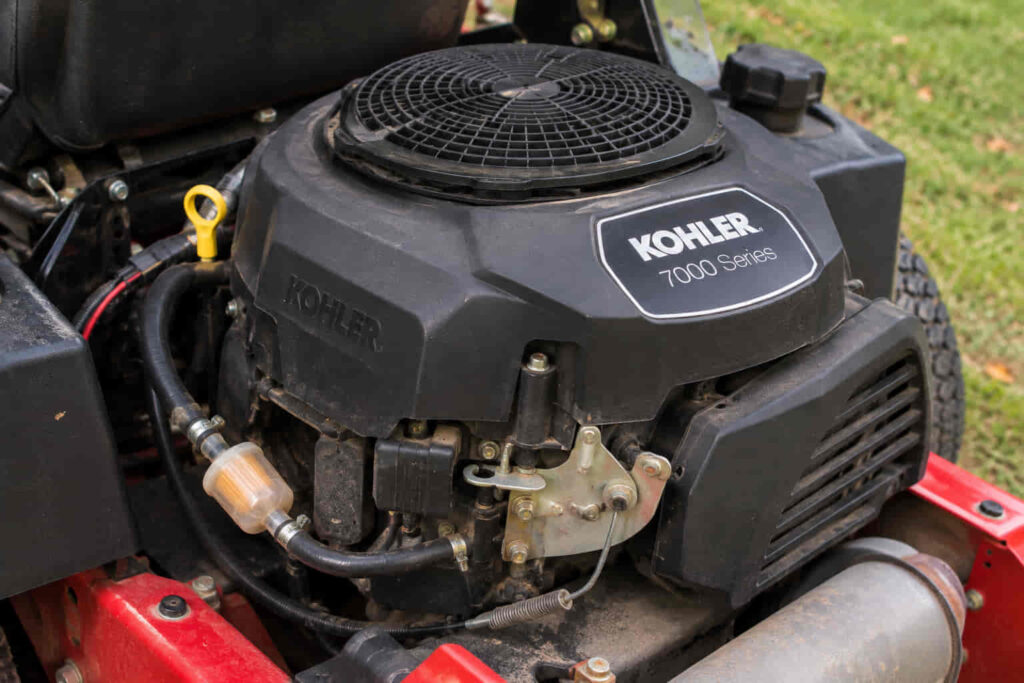
The most common Kohler 7000 Series problems to investigate include hard starting, unexpected stalling, carburetor and fuel pump faults, oil leaks, excessive oil consumption, overheating, ignition problems, and incorrect valve clearance. Some engines may also experience rough idle, backfiring, loss of power under load, or mechanical knocking when the lubrication or valvetrain system is not operating correctly.
The Kohler 7000 Series is a family of air-cooled, V-twin gasoline engines commonly installed in residential riding lawn mowers, lawn tractors, and other outdoor power equipment. Popular models include the KT715, KT725, KT730, KT735, KT740, and KT745, with advertised power ratings ranging from approximately 20 to 26 horsepower.
These engines use an overhead-valve design, cast-iron cylinder liners, pressure lubrication, electronic ignition, and carbureted fuel delivery. Their relatively simple construction can make many routine problems manageable, but accurate diagnosis remains important.
One documented issue involves unexplained engine stalling on certain Kohler 7000 Series engines. Kohler Service Bulletin 348 identifies a specific serial-number range in which an evaporative fuel line arrangement can contribute to stalling. However, the bulletin does not apply to every 7000 Series engine, and it states that not every engine within the affected range will exhibit the condition.
Other problems may develop because of stale gasoline, clogged cooling fins, deteriorated gaskets, incorrect oil levels, worn spark plugs, or neglected valve adjustments.
Understanding which symptoms are associated with routine maintenance and which indicate internal mechanical damage helps owners avoid unnecessary parts replacement and costly repairs.
What Is the Kohler 7000 Series Engine?
The Kohler 7000 Series is a line of four-stroke, air-cooled V-twin gasoline engines developed primarily for residential outdoor power equipment.
The family includes multiple horsepower ratings and engine configurations.
The KT715 is commonly rated at 20 horsepower, while the KT725 produces approximately 22 horsepower.
The KT730 and KT735 are rated at approximately 23 and 24 horsepower, respectively.
The KT740 is commonly rated at 25 horsepower, and the KT745 reaches approximately 26 horsepower.
These are published gross power ratings under the applicable SAE engine testing standards. Actual available power can vary with installation, operating conditions, accessories, and engine speed.
Most conventional KT715 through KT740 configurations have a displacement of approximately 725 cc.
The KT745 uses a displacement of approximately 747 cc. Certain KT740 engines equipped with the PRO Performance air cleaner also use the 747 cc configuration.
The engine family features two cylinders arranged in a V-shaped layout.
Each cylinder has intake and exhaust valves operated through a pushrod valvetrain.
The engines use cast-iron cylinder liners within aluminum engine blocks to provide durable cylinder running surfaces while controlling engine weight.
They also use a pressurized lubrication system.
Unlike liquid-cooled automotive engines, the Kohler 7000 Series depends on engine-driven airflow and external cooling fins to remove heat.
This characteristic makes cleaning grass clippings, dust, and debris particularly important.
The standard 7000 Series is predominantly carbureted. It should not be confused with Kohler’s separately marketed 7500 Series EFI engines.
Are Kohler 7000 Series Engines Reliable?
Kohler 7000 Series engines can provide dependable service in residential lawn equipment when maintained correctly, but their reliability depends on operating conditions, maintenance history, and individual component condition.
The engine family is based on established small-engine technology.
Its V-twin architecture provides relatively smooth operation and useful torque for mowing applications.
Cast-iron cylinder liners help provide wear-resistant surfaces for the pistons and piston rings.
The pressurized lubrication system supplies oil to critical internal components.
However, these design features do not eliminate the need for maintenance.
An air-cooled engine depends on unobstructed cooling airflow.
If grass clippings accumulate around the cooling fins, operating temperature may increase significantly.
The carburetor and fuel system also depend on clean gasoline.
Fuel that remains in the tank or carburetor for extended periods can deteriorate and leave deposits.
Oil maintenance is another important factor.
The engine’s bearings, camshaft components, valve train, and other moving parts rely on the correct lubricant.
An insufficient oil level or incorrect oil can accelerate wear.
Kohler’s service manual also identifies potential problems involving the crankcase breather, fuel pump, ignition system, valve clearance, and internal mechanical components.
However, a troubleshooting manual describes possible faults rather than their actual frequency among owners.
There is no reliable manufacturer-wide failure-rate figure establishing that every 7000 Series engine is likely to develop a specific problem.
The engine should therefore be judged through its service history, condition, and operating performance.
What Are the Most Common Kohler 7000 Series Problems?
The most frequently investigated Kohler 7000 Series complaints involve starting difficulties, intermittent stalling, fuel delivery problems, overheating, oil leakage, rough running, and loss of power.
These symptoms can have several underlying causes.
Hard starting may result from weak battery voltage, incorrect choke operation, dirty gasoline, defective spark plugs, or a problem with the automatic compression release mechanism.
A mower that starts but immediately shuts off may have a restricted fuel supply, faulty carburetor solenoid, ignition interruption, or evaporative fuel system issue.
Rough idle and surging can occur when the carburetor does not provide a stable air-fuel mixture.
A clogged main jet, intake leak, or incorrect governor operation may contribute.
Overheating is particularly relevant because the engine uses air cooling.
Debris around the flywheel fan screen and cylinder cooling fins can restrict heat removal.
Oil leakage may originate from gaskets, seals, or an incorrectly functioning crankcase breather.
Excessive oil consumption can involve improper oil level, worn piston rings, valve guide wear, or internal sealing problems.
Mechanical ticking and knocking require a separate diagnosis.
Incorrect valve clearance, low oil level, or internal engine wear may produce abnormal noises.
Kohler’s official service manual identifies these conditions as potential causes, but the exact repair depends on testing.
Replacing a carburetor, ignition coil, or other component without confirming the fault can waste money and leave the original problem unresolved.
Kohler 7000 Series Hard Starting Problems
Hard starting is a common symptom to diagnose on the Kohler 7000 Series, with possible causes including battery weakness, fuel restrictions, choke problems, defective spark plugs, and incorrect valve clearance.
The first distinction is whether the starter turns the engine normally.
A mower that cranks at a normal speed but does not start presents a different problem from one that barely rotates.
If the engine cranks normally, fuel and ignition operation should be evaluated.
Old gasoline may not ignite consistently.
A clogged fuel filter or restricted fuel line may prevent sufficient gasoline from reaching the carburetor.
The carburetor’s choke system must also function correctly.
During cold starting, the choke enriches the mixture to support combustion.
If it remains too open, starting may be difficult.
If it stays closed after the engine starts, the engine may run excessively rich.
Spark plugs are another potential cause.
Worn electrodes, incorrect gaps, carbon deposits, or a weak ignition system can interfere with combustion.
A vacuum-operated fuel pump may also fail to provide sufficient gasoline when its diaphragm or pulse hose is damaged.
If the engine cranks slowly, the battery, starter, cables, and automatic compression release system require investigation.
The safest repair begins by identifying which of these systems is not functioning.
Why Does a Kohler 7000 Series Crank but Not Start?
A Kohler 7000 Series engine that cranks but does not start may lack sufficient fuel, ignition spark, or proper mechanical conditions for combustion.
The engine requires gasoline to enter the carburetor and mix with air in the correct proportion.
It also requires a functioning ignition system.
The spark plugs must ignite the mixture at the intended moment.
If the fuel tank is empty or the fuel line is restricted, combustion cannot occur normally.
A clogged carburetor can also prevent gasoline from reaching the appropriate passages.
The fuel shutoff solenoid is another possible cause.
On certain carbureted engines, the solenoid controls fuel flow within the carburetor.
An electrical or mechanical fault may prevent the engine from receiving the necessary fuel.
However, the solenoid should not be replaced until its operation and electrical supply have been verified.
Ignition problems can produce identical no-start symptoms.
A defective ignition module, damaged spark plug, faulty kill-switch circuit, or poor electrical connection may prevent normal spark generation.
Safety interlock switches on the mower can also interrupt ignition or starting operation.
Finally, mechanical problems must be considered.
Incorrect valve clearance, low compression, or an automatic compression release fault may interfere with starting.
The correct diagnosis separates fuel delivery, ignition, electrical controls, and mechanical compression rather than assuming a new carburetor will solve every no-start complaint.
Kohler 7000 Series Starts Then Dies
A Kohler 7000 Series that starts and then dies may have a restricted fuel supply, clogged carburetor passage, blocked fuel tank vent, malfunctioning fuel pump, or intermittent ignition interruption.
The engine may initially start because the carburetor contains enough gasoline for a brief period of operation.
However, if the fuel supply cannot replenish the carburetor bowl, the engine may shut off.
A partially blocked fuel filter can contribute to this problem.
The engine may idle normally but stall when fuel demand increases.
A weak pulse fuel pump can produce similar symptoms.
Some fuel systems use a vacuum or pressure pulse generated by the crankcase to operate the pump diaphragm.
A cracked pulse hose, damaged connection, or failed diaphragm can reduce pumping performance.
Fuel tank venting is another consideration.
The fuel tank must allow air to enter as gasoline is consumed.
If the vent becomes restricted, vacuum can develop inside the tank and interfere with fuel delivery.
However, suspected vent problems should be checked using the equipment manufacturer’s safe diagnostic procedure.
Electrical faults can also cause sudden stalling.
A loose connection or safety interlock problem may interrupt the ignition system.
Kohler has also published a specific service bulletin concerning stalling caused by an evaporative line arrangement on certain 7000 Series engines.
Therefore, the engine’s serial number may be relevant when ordinary fuel and ignition checks do not identify the cause.
Kohler 7000 Series Engine Stall Service Bulletin 348
Kohler Service Bulletin 348 documents an unexplained stalling condition affecting some 7000 Series engines within a specific serial-number range.
The bulletin was issued in May 2016 and revised in June 2016.
It applies to the KT715 through KT745 engine family.
Kohler identifies the relevant serial-number range as 45327xxxxx through 4613302464.
However, the bulletin explicitly states that not every engine within that range will exhibit the condition.
The recommended diagnostic approach begins with ordinary checks.
The technician should verify that the fuel tank contains sufficient gasoline.
Fuel tank cap vent operation and fuel delivery to the carburetor should also be checked.
If these systems are functioning correctly but the engine continues to stall, the bulletin identifies a modification to the evaporative fuel line arrangement.
The repair involves an additional T-fitting and line routed to the appropriate air cleaner connection.
Kohler identifies the fitting as part number 25 155 56-S and the related hose as 25 326 28-S in its published instructions.
This is a highly specific service correction, not a general recommendation to modify the fuel system on every mower.
Owners should verify their engine serial number and have the applicable procedure reviewed by an authorized Kohler service provider.
Incorrect fuel or evaporative hose routing can create safety, drivability, and emissions problems.
Kohler 7000 Series Carburetor Problems
Carburetor problems can cause rough idle, surging, hard starting, stalling, and poor acceleration on the carbureted Kohler 7000 Series.
The carburetor combines gasoline and air to produce a combustible mixture.
It uses internal passages, jets, and fuel metering components to deliver the appropriate amount of gasoline under different operating conditions.
Over time, fuel deposits can interfere with these small passages.
Stale gasoline is a particularly important concern for seasonal mowing equipment.
When gasoline remains in the carburetor for extended periods, some of its volatile components can evaporate.
Residue may remain behind.
These deposits can restrict the carburetor’s fuel metering system.
A partially restricted passage may cause the engine to run lean or surge.
More severe restrictions may cause starting or stalling problems.
The float and needle valve can also develop faults.
If the inlet needle does not seal correctly, gasoline may continue entering the carburetor bowl.
This can cause flooding, fuel leakage, or abnormal fuel consumption.
A faulty fuel shutoff solenoid may also interfere with fuel delivery.
However, carburetor symptoms can be caused by related systems.
A leaking intake gasket, weak fuel pump, or restricted fuel filter may produce similar behavior.
The correct repair involves inspecting the complete fuel delivery system.
Cleaning or rebuilding the carburetor may be appropriate when internal contamination is confirmed.
A replacement carburetor should match the engine’s exact specification number.
Kohler 7000 Series Surging at Idle
Surging occurs when engine speed repeatedly increases and decreases instead of remaining stable, often because of fuel mixture problems or abnormal governor response.
The Kohler 7000 Series uses a mechanical governor to help maintain engine speed under changing loads.
The governor adjusts throttle opening as the engine encounters resistance.
When the fuel system operates correctly, engine speed should remain relatively stable.
However, a partially clogged carburetor can cause unstable combustion.
The engine may slow down because the mixture becomes too lean.
The governor responds by opening the throttle.
Engine speed then increases before dropping again.
This repeated cycle can create noticeable surging.
An intake air leak may contribute to the condition.
Incorrect choke operation can also affect the mixture.
However, the governor itself may require inspection when its linkage is damaged or its adjustment has been disturbed.
The correct response is not to randomly change governor settings.
An incorrect governor adjustment can allow the engine to exceed its intended operating speed.
Overspeeding can damage internal components and create a safety hazard.
The technician should first evaluate the fuel quality, carburetor condition, intake sealing, and linkage movement.
Governor adjustment should follow the correct Kohler service procedure.
Kohler 7000 Series Fuel Pump Failure
Fuel pump failure can cause hard starting, power loss, stalling, and poor performance under load when the carburetor does not receive enough gasoline.
Some Kohler 7000 Series arrangements use a pulse-type fuel pump.
This design operates through alternating pressure and vacuum signals from the engine crankcase.
A rubber hose carries these pulses to the pump.
Inside the pump, a diaphragm moves to draw gasoline from the tank and deliver it toward the carburetor.
Check valves help maintain the intended fuel flow direction.
If the diaphragm becomes damaged, pumping performance may decline.
A cracked pulse hose or loose fitting can prevent the pump from receiving the required pressure changes.
The engine may initially start but struggle when fuel demand increases.
However, low fuel delivery can also result from a clogged filter, restricted line, or blocked tank vent.
These components should be checked before replacing the pump.
Kohler’s service manual provides a fuel pump performance testing procedure.
The published requirements include a minimum delivery rate under specified testing conditions.
The exact diagnostic process should be followed rather than relying only on whether gasoline appears at the outlet.
A replacement fuel pump must be installed in the correct orientation.
Fuel lines and pulse hose connections must also be secured properly to prevent leakage and operating problems.
Kohler 7000 Series Smart-Choke Problems
Kohler 7000 Series engines equipped with Smart-Choke technology can develop starting or running problems when the choke linkage, air-vane mechanism, or associated components do not operate correctly.
The choke controls how much air enters the carburetor during starting.
A cold engine generally requires a richer fuel mixture than a fully warmed engine.
Smart-Choke is intended to manage this process with less manual operator adjustment.
However, the system still depends on moving mechanical components.
A linkage that binds or becomes disconnected may prevent proper choke movement.
The choke plate may remain too open during cold starting.
Alternatively, it may stay partly closed after the engine begins running.
The latter condition can produce an excessively rich fuel mixture, black exhaust smoke, poor performance, or increased gasoline consumption.
However, choke symptoms may also result from a dirty carburetor or poor fuel supply.
The technician should verify how the choke behaves throughout the starting and warm-up process.
The air-vane components, springs, and linkages should be inspected for damage or incorrect assembly.
The exact choke configuration varies by engine specification.
Some Kohler 7000 Series engines use different choke arrangements.
Therefore, parts and adjustments should be selected using the engine’s full model and specification number.
Kohler 7000 Series Vapor Lock and Hot Restart Problems
Hot restart problems on a Kohler 7000 Series may involve fuel delivery, heat-related ignition faults, carburetor flooding, or fuel vapor formation under certain operating conditions.
The engine operates at elevated temperatures during mowing.
When the engine is stopped, airflow from the cooling fan also stops.
Heat remaining in the engine and surrounding components can affect the fuel system.
Under certain conditions, fuel can vaporize within lines or other components and interrupt consistent delivery.
However, vapor lock should not be assumed to be the cause of every hot no-start complaint.
A defective ignition coil or electronic module may also fail intermittently when hot.
The engine may start normally after cooling.
Carburetor flooding is another possible explanation.
If the inlet needle fails to seal, excess gasoline may enter the intake.
This can make restarting difficult.
The fuel tank vent and pulse fuel pump should also be evaluated.
The best diagnostic approach compares spark and fuel availability during the actual hot no-start condition.
Allowing the engine to cool before testing may temporarily eliminate the symptom and make diagnosis more difficult.
The technician should follow the manufacturer’s safe procedures.
Fuel lines should not be rerouted or modified without ensuring proper heat clearance, compatibility, and compliance with the equipment’s fuel system design.
Kohler 7000 Series Overheating Problems
Overheating on a Kohler 7000 Series commonly requires inspection of cooling airflow, clogged fins, accumulated grass debris, engine load, oil level, and the surrounding mower configuration.
Unlike a liquid-cooled engine, the 7000 Series does not use a conventional radiator and coolant pump.
It relies on an engine-driven fan and air passages around the cylinder heads and block.
The fan draws or directs cooling air through the engine’s protective housing and cooling fins.
These fins increase the surface area available for heat dissipation.
However, lawn mowers operate in environments containing grass clippings, dust, and airborne debris.
Over time, this material can accumulate around the flywheel screen and cooling shrouds.
If airflow becomes restricted, engine temperature may rise.
A dirty air filter can also affect engine performance, while excessive engine load can increase heat production.
Incorrect oil level is another concern.
Engine oil helps lubricate and transfer heat away from internal components.
Low oil can increase wear and operating temperature.
Kohler’s maintenance schedule specifies periodic removal of the cooling shrouds and cleaning of the cooling areas.
The engine should be stopped and allowed to cool before servicing.
It must not be operated with required cooling covers or safety guards removed.
If overheating persists after airflow and oil conditions have been corrected, further mechanical inspection is necessary.
Why Does a Kohler 7000 Series Lose Power When Mowing?
Power loss under mowing load can result from a restricted air filter, inadequate fuel delivery, ignition faults, overheating, incorrect governor operation, or excessive mechanical load from the mower deck.
The engine must produce additional torque when the cutting blades encounter thick or wet grass.
The governor responds by adjusting the throttle to maintain the intended engine speed.
If the fuel system cannot supply enough gasoline, the engine may slow or stall.
A clogged fuel filter can restrict delivery.
A weak fuel pump may also become more noticeable under load.
A dirty air filter reduces airflow and may interfere with combustion.
Defective spark plugs or ignition modules can cause misfiring that becomes more obvious when the engine is working harder.
However, the mower deck itself may be responsible.
A seized blade spindle, damaged pulley bearing, excessive belt tension, or obstructed cutting deck can place additional load on the engine.
The engine may be mechanically healthy but unable to overcome the abnormal resistance.
The correct diagnosis should therefore include both the powerplant and the equipment it drives.
The mower deck must be inspected with the engine stopped, the key removed, and the spark plug leads disconnected.
If the engine runs normally without the cutting load but repeatedly loses power when the blades are engaged, the deck and PTO system deserve particular attention.
Kohler 7000 Series Oil Leak Problems
Kohler 7000 Series oil leaks can originate from aging gaskets, crankshaft seals, valve covers, loose fasteners, or excessive crankcase pressure caused by a defective breather system.
The engine contains several sealing surfaces.
These joints must retain oil while allowing internal components to move and expand with temperature.
Over time, seals and gaskets can deteriorate.
Heat, vibration, improper assembly, and normal aging may contribute.
Oil may leak from the valve cover area or other external joints.
Crankshaft seals can also develop leakage.
However, the location where oil accumulates is not always the original leak source.
Oil can travel along the exterior of the engine before dripping onto the mower frame.
The crankcase breather is another important component.
Kohler’s service manual explains that the engine should maintain partial crankcase vacuum during operation.
If the breather becomes restricted or defective, crankcase pressure may increase.
Excessive pressure can force oil past otherwise serviceable seals or gaskets.
Therefore, replacing a gasket without correcting abnormal crankcase pressure may not provide a permanent repair.
The technician should clean the engine exterior, identify the leak source, and inspect the breather system when necessary.
Oil leaks near hot exhaust components require particular attention because they can create a fire hazard.
Kohler 7000 Series Valve Cover Gasket Problems
Valve cover leakage can occur when the sealing material deteriorates, the cover becomes distorted, or abnormal crankcase pressure interferes with normal sealing.
The valve covers protect the rocker arms and other upper valvetrain components.
They also help retain engine oil.
Certain Kohler 7000 Series configurations use sealing material that must be applied according to the manufacturer’s service procedure.
Improper cleaning or incorrect sealant application can compromise the joint.
A warped cover or damaged sealing surface may also cause persistent leakage.
However, oil near a valve cover does not automatically mean the gasket is defective.
The crankcase breather may be integrated with the valve cover on some configurations.
Kohler’s service manual specifically instructs technicians to examine the breather when crankcase vacuum is insufficient.
If the breather is integral to the cover and cannot be serviced separately, replacement of the valve cover may be required.
This is an important distinction.
Repeatedly resealing a valve cover without checking crankcase ventilation may fail to correct the problem.
The appropriate repair should include inspection of the cover, sealing surfaces, breather operation, and fastener condition.
Fasteners must be tightened to the model-specific specification.
Excessive tightening can distort a cover or damage threads.
After repair, the engine should be inspected for leaks under normal operating conditions.
Read more: Chevrolet Engine Problems
Kohler 7000 Series Crankcase Breather Problems
A clogged or defective crankcase breather can contribute to oil leaks, abnormal oil consumption, and pressure buildup inside the Kohler 7000 Series engine.
During normal combustion, a small amount of gas can escape past the piston rings into the crankcase.
This is known as blow-by.
The breather system manages crankcase ventilation and pressure.
Kohler’s service manual specifies that the engine should maintain partial crankcase vacuum while operating.
The published minimum crankcase vacuum is approximately 4 inches of water under the specified test conditions.
This measurement is different from the inches-of-mercury values used for automotive intake vacuum testing.
If crankcase pressure becomes positive, oil may be forced through seals or gaskets.
A damaged breather reed, clogged passage, or improperly assembled component may contribute.
However, excessive crankcase pressure can also result from significant piston ring wear.
The breather should therefore not automatically be blamed without testing.
A qualified technician can use a suitable low-pressure gauge or water manometer to evaluate crankcase vacuum.
If the breather is defective, it should be serviced or replaced according to the engine configuration.
If the test indicates excessive internal blow-by, further mechanical inspection may be necessary.
The correct diagnosis distinguishes a ventilation fault from worn pistons or cylinders.
Why Does a Kohler 7000 Series Burn Oil?
Excessive oil consumption on a Kohler 7000 Series may result from overfilling, incorrect oil viscosity, defective crankcase ventilation, worn piston rings, cylinder wear, or valve guide problems.
Engine oil is necessary for lubrication.
However, it must remain in the appropriate parts of the engine.
Oil can enter the combustion chamber when piston rings or valve sealing components are worn.
The engine may then burn the oil during normal combustion.
This can produce blue exhaust smoke.
However, oil consumption does not always mean that the piston rings are defective.
An overfilled crankcase may cause oil to be drawn into the intake system.
A damaged breather reed can also allow abnormal oil movement.
External leaks may reduce the oil level without any oil being burned.
Kohler’s service manual identifies these conditions separately.
The technician should first verify the oil level using the correct dipstick procedure.
Oil viscosity and service history should also be reviewed.
The breather system and external sealing surfaces should be inspected.
If significant internal consumption remains suspected, a cylinder leakage test can help evaluate mechanical sealing.
Worn valve guides or damaged piston rings may require internal engine repair.
The correct diagnosis should be established before replacing the entire engine.
Kohler 7000 Series Blowing White or Blue Smoke
Smoke from a Kohler 7000 Series can result from oil entering the combustion process, an overly rich fuel mixture, or temporary conditions associated with storage, oil filling, or operation on a slope.
Blue smoke commonly suggests that engine oil is being burned.
Possible causes include excessive oil level, crankcase ventilation faults, worn piston rings, or valve-related sealing problems.
The engine’s operating angle is also important.
Kohler’s published specifications identify a maximum operating angle of 25 degrees at full oil level for the covered configurations.
Exceeding the permissible operating angle can interfere with lubrication and may contribute to abnormal oil movement.
However, the mower manufacturer’s actual slope limit may be lower than the engine’s maximum operating angle.
The equipment’s operating instructions must therefore take precedence.
Black smoke generally indicates a rich fuel mixture.
A choke that remains closed or a carburetor that delivers excessive fuel may contribute.
White-looking smoke during startup can have several explanations, including oil burning or fuel-related combustion behavior.
Because the engine is air-cooled, white smoke should not automatically be diagnosed as coolant entering the cylinders.
The 7000 Series does not use the conventional liquid cooling system found in many automotive engines.
Persistent smoke requires inspection of oil level, fuel delivery, choke operation, and engine mechanical condition.
Kohler 7000 Series Valve Clearance Problems
Incorrect valve clearance can cause difficult starting, abnormal valvetrain noise, reduced power, and poor engine operation on the Kohler 7000 Series.
The engine uses an overhead-valve arrangement.
A camshaft operates tappets and pushrods, which transfer motion to rocker arms.
The rocker arms open and close the intake and exhaust valves.
The valve clearance must remain within the specified range.
Kohler’s service manual identifies a valve clearance range of 0.004–0.006 inch, equivalent to approximately 0.101–0.152 mm, for the covered KT engine configurations.
The service procedure uses a 0.005-inch feeler gauge as a practical adjustment reference.
However, the exact procedure must match the engine’s specification and production configuration.
The engine must be positioned correctly before measurement.
Kohler’s published method establishes top dead center on the compression stroke for the relevant cylinder.
The technician then adjusts the rocker arm clearance and secures the adjuster.
The final clearance must be checked again after tightening.
An incorrect setting may leave excessive mechanical clearance or prevent the valve from seating properly.
Kohler’s maintenance schedule specifies a valve lash inspection and adjustment at 500 hours, with the procedure assigned to an authorized dealer.
The engine may require earlier inspection if a mechanical problem is suspected.
However, valve adjustment should not be performed randomly in an attempt to fix a fuel or ignition problem.
Kohler 7000 Series Automatic Compression Release Problems
An automatic compression release problem can contribute to difficult starting or slow cranking on certain Kohler 7000 Series configurations.
The automatic compression release mechanism, commonly abbreviated ACR, reduces the effort required for the starter to rotate the engine during cranking.
It temporarily changes valve operation at low engine speed.
This reduces effective compression during the starting process.
Once the engine reaches normal operating speed, the mechanism stops performing its starting function.
If the ACR mechanism fails to operate correctly, the starter may struggle to rotate the engine.
The engine may crank slowly or appear to stop against a compression stroke.
However, similar symptoms can result from weak batteries, poor battery cables, a defective starter, or incorrect valve clearance.
The starting system should therefore be checked before the engine is disassembled.
The battery should be tested under load.
The starter solenoid and electrical connections also require inspection.
If those components are functioning correctly, a technician may evaluate the valve adjustment and compression release system.
Kohler’s troubleshooting guide specifically identifies a faulty ACR mechanism as a possible cause of hard starting.
However, this does not prove that every slow-cranking 7000 Series engine has an internal ACR defect.
Major timing or compression release repairs should be performed using the correct service instructions.
Kohler 7000 Series Ignition Coil Problems
Ignition coil or ignition module faults can cause a Kohler 7000 Series engine to misfire, run unevenly, become difficult to start, or stall unexpectedly.
The ignition system generates the high voltage needed at the spark plugs.
Each cylinder requires a consistent spark to ignite the compressed gasoline-air mixture.
A weak ignition component may produce intermittent combustion.
The engine may run roughly or lose power.
Heat-related faults can sometimes become more noticeable after the engine has operated for an extended period.
The engine may restart after cooling.
However, this behavior is not proof that the ignition coil has failed.
Fuel delivery problems can cause similar symptoms.
A restricted fuel tank vent or weak fuel pump may also produce stalling that appears heat-related.
The spark plugs should be inspected first.
Damaged electrodes, incorrect gaps, or carbon deposits can interfere with ignition.
Wiring and the ignition kill circuit must also be checked.
Kohler’s service manual identifies ignition modules, spark plugs, electrical connections, and the kill circuit among the potential causes of starting and running problems.
The correct repair involves identifying whether spark is actually being lost.
Replacing ignition modules without testing may not resolve the underlying problem.
Kohler 7000 Series Spark Plug Problems
Worn, fouled, incorrectly gapped, or damaged spark plugs can cause hard starting, misfiring, rough idle, and loss of power on the Kohler 7000 Series.
Spark plugs ignite the compressed mixture inside the cylinders.
They operate under high temperature and electrical stress.
Over time, the electrodes wear and deposits may accumulate.
An incorrect spark plug gap can change the electrical requirements for ignition.
Kohler’s published specifications identify a spark plug gap of approximately 0.030 inch, equivalent to 0.76 mm, for the covered KT715 through KT745 engine models.
However, the correct plug type and replacement specification should be confirmed using the engine model and specification number.
The maintenance schedule identifies spark plug replacement and gap setting at 500 hours.
However, an engine experiencing ignition problems may require inspection sooner.
A spark plug covered in heavy carbon deposits can indicate an excessively rich fuel mixture or incomplete combustion.
Oil contamination may suggest oil entering the combustion chamber.
The spark plug’s condition therefore provides useful diagnostic information.
However, replacing the plugs does not correct a failing ignition coil, defective carburetor, or worn internal engine component.
The technician should investigate the cause when abnormal deposits repeatedly return.
Why Does a Kohler 7000 Series Backfire?
Backfiring or afterfiring can result from incorrect fuel mixture, ignition faults, engine operating conditions, or problems involving the valves and exhaust system.
The term backfire is often used broadly.
A true intake backfire involves combustion or pressure moving backward through the intake system.
An afterfire occurs when unburned fuel ignites within the exhaust system.
These conditions have different causes.
A lean fuel mixture or incorrect combustion timing may contribute to abnormal intake behavior.
A defective spark plug or ignition module can interfere with normal combustion.
Excess gasoline entering the exhaust may ignite when sufficient heat and oxygen are present.
Certain operating and shutdown conditions can also contribute to exhaust afterfire.
Some engines use a carburetor fuel shutoff solenoid to limit fuel delivery when the ignition is switched off.
If this system does not function correctly, afterfire may occur.
However, the cause should be confirmed before replacing the solenoid.
Valve clearance and valve sealing problems can also affect combustion behavior.
Kohler’s troubleshooting information includes fuel quality, incorrect controls, spark plug problems, and other operating conditions among the relevant diagnostic considerations.
Persistent or severe backfiring requires inspection because it can indicate an abnormal combustion or mechanical condition.
Kohler 7000 Series Knocking and Ticking Noise
Knocking or ticking from a Kohler 7000 Series may involve incorrect valve clearance, low engine oil, inadequate lubrication, excessive engine load, or internal mechanical wear.
Not every engine noise indicates major damage.
The valvetrain normally produces some mechanical sound.
However, persistent tapping or knocking that becomes louder should be investigated.
Excessive valve clearance can produce a repetitive ticking noise.
A loose or damaged rocker arm may create similar symptoms.
Low engine oil level can reduce lubrication and increase internal wear.
The engine’s connecting rods and crankshaft bearings depend on appropriate lubrication.
Damage to these components can produce a deeper knocking sound.
However, abnormal combustion may also create knocking or pinging.
Low-quality fuel, incorrect ignition conditions, or excessive engine loading can contribute.
Kohler’s troubleshooting guide identifies hydraulic tappet or lifter-related faults, lubrication problems, internal wear, and fuel quality among possible causes.
A noise that becomes severe under load or occurs with low oil pressure requires immediate attention.
The engine should be stopped as soon as it is safe to do so.
Continuing to operate a severely damaged engine can turn a repairable problem into a complete engine failure.
Kohler 7000 Series Battery and Starter Problems
A Kohler 7000 Series engine that will not crank may have a weak battery, defective starter, faulty solenoid, damaged electrical connections, or a mower safety interlock problem.
The starting circuit is partly controlled by the equipment manufacturer.
For this reason, not every starting problem originates within the Kohler engine.
A riding mower may require the parking brake to be engaged or certain controls to be in the correct position before starting.
A faulty seat switch, brake switch, or blade engagement interlock can prevent normal starter or ignition operation.
The battery must also provide sufficient current.
A battery can display a reasonable voltage without delivering enough power under load.
Corroded terminals and damaged cables may create additional resistance.
The starter solenoid connects battery power to the starter motor when the appropriate controls are activated.
A defective solenoid or starter can prevent cranking.
However, slow cranking can also involve engine mechanical resistance.
Incorrect valve clearance or an automatic compression release problem may increase the effort required to rotate the engine.
The correct diagnosis should test battery condition, electrical connections, solenoid operation, and starter performance before internal engine repairs are considered.
Safety switches should never be permanently bypassed to make the mower operate.
They are important protective components of the equipment.
Why Does a Kohler 7000 Series Stop When the Blades Engage?
An engine that stalls when the mower blades engage may be experiencing excessive cutting-deck load, insufficient engine power, or a problem with the mower’s electrical safety and PTO systems.
The power takeoff system transfers engine power to the cutting deck.
Engaging the blades creates additional load.
A healthy engine should respond by increasing fuel and air delivery through its governed throttle system.
However, abnormal mechanical resistance can overload the engine.
A seized blade spindle, damaged deck bearing, obstructed pulley, or incorrectly routed belt may cause excessive resistance.
Wet grass or an overly aggressive cutting height can also increase the required power.
Fuel delivery problems may become more noticeable during this additional load.
A restricted fuel filter or dirty carburetor may prevent the engine from responding correctly.
Ignition faults can also reduce available power.
However, if the engine stops immediately when the PTO switch is activated, an electrical safety interlock issue may be responsible.
The seat switch, PTO circuit, and related wiring should be inspected according to the mower manufacturer’s instructions.
The engine and deck must be completely stopped before inspecting the blades or belts.
A mower that stalls with the deck engaged should not automatically receive a new carburetor or ignition coil without checking the cutting equipment.
Kohler 7000 Series Oil Capacity and Oil Type
Most Kohler 7000 Series KT715 through KT745 configurations have a published engine oil refill capacity of approximately 2.0 US quarts, equivalent to 1.9 liters.
However, the correct oil level should be confirmed using the dipstick and the procedure specified for the engine.
The oil must not be filled above the maximum level.
Excess oil can contribute to abnormal crankcase pressure, aeration, and oil consumption.
The correct viscosity depends on operating temperature and the engine manufacturer’s guidance.
Kohler’s current service documentation recommends its PRO 10W-50 synthetic oil as an all-season option.
It also permits other suitable detergent engine oils meeting API service class SJ or higher when selected according to the ambient temperature chart.
SAE 10W-30 is another viscosity included in Kohler’s published recommendations for an appropriate temperature range.
However, oil selection should match the actual operating conditions.
A lubricant suitable for summer mowing may not be the best choice for starting equipment in very cold weather.
The oil filter must also be compatible with the engine.
Using an incorrect filter can affect installation, sealing, or oil system performance.
Owners should verify the full engine specification before ordering replacement parts.
Correct oil level and filtration are essential for protecting the crankshaft, connecting rods, camshaft, and valvetrain.
How Often Should You Change Kohler 7000 Series Oil?
Kohler’s current 7000 Series service manual generally specifies an oil and filter change every 100 operating hours when using approved conventional or alternative engine oils and filters.
However, the manual also identifies a special extended oil change program.
The interval may be extended to 300 hours when using both KOHLER PRO 10W-50 synthetic oil and the specified KOHLER PRO Extended Life Oil Filter.
The requirements are important.
Kohler states that the 300-hour interval is authorized only when both designated products are used together.
Using the PRO oil with an ordinary filter does not automatically qualify.
Likewise, using the extended-life filter with an unrelated oil does not establish eligibility.
The service manual also advises performing certain maintenance operations more frequently under severe, dusty, or dirty conditions.
Lawn mowing often exposes engines to substantial airborne contamination.
A heavily used mower may therefore require closer maintenance attention than one operated under clean conditions.
The manual’s maintenance schedule also specifies periodic inspection or replacement of air cleaner components according to their configuration.
Cooling areas must be cleaned regularly.
The fuel filter is normally scheduled for replacement at 100 hours in the referenced service documentation.
Valve lash inspection and spark plug replacement are identified at 500 hours.
However, the correct schedule may vary according to engine production revision and equipment application.
The actual manual for the engine serial number should take precedence.
What Gasoline Should You Use in a Kohler 7000 Series?
Kohler specifies clean, fresh, unleaded gasoline with a minimum octane rating of 87 AKI, or approximately 90 RON, for the covered 7000 Series engines.
The manual permits gasoline containing up to 10% ethanol.
This is commonly identified as E10.
However, Kohler explicitly states that E15, E20, and E85 are not approved for these engines.
These fuels contain higher percentages of ethanol than the allowed specification.
Using an unsuitable gasoline blend may affect fuel system materials, mixture operation, and engine performance.
Fuel freshness is another important concern.
Kohler advises against using gasoline older than 30 days in the referenced manual unless it has been appropriately managed according to the fuel storage guidance.
Seasonal lawn equipment may remain unused for several months.
During storage, gasoline can deteriorate and leave deposits in the carburetor.
This can contribute to hard starting and surging when mowing resumes.
For extended storage, Kohler recommends using an appropriate fuel stabilizer and following its engine storage procedure.
The manufacturer also advises against adding oil to the gasoline.
The 7000 Series is a four-stroke engine with a separate lubrication system.
It does not require the gasoline-oil mixture used by certain two-stroke engines.
Using fresh approved gasoline is one of the simplest ways to reduce avoidable fuel system problems.
Can Kohler 7000 Series Problems Be Caused by Old Gas?
Yes. Stale or contaminated gasoline can cause hard starting, rough idle, carburetor restrictions, fuel pump problems, and unexpected stalling.
Gasoline changes during storage.
Some volatile components evaporate, while other compounds can contribute to deposits.
A carburetor contains narrow internal passages that are particularly sensitive to contamination.
Even a small restriction may alter the amount of gasoline delivered.
The engine may then surge or run lean.
Old fuel can also contain moisture or debris.
Water contamination can interfere with combustion and promote corrosion in certain fuel system components.
However, a mower that has been stored for several months may have more than one problem.
A weak battery, damaged fuel hose, or fouled spark plug can contribute to starting difficulties.
The correct approach is to evaluate the fuel condition and related components.
Contaminated gasoline should be handled and disposed of safely.
The fuel system may require cleaning when deposits are present.
Kohler’s storage procedure recommends fuel treatment for extended inactivity.
It also describes running the engine briefly to distribute stabilized gasoline through the fuel system before storage.
However, an already clogged carburetor may require mechanical cleaning or repair.
Fuel stabilizer does not automatically remove heavy deposits from an obstructed jet.
Kohler 7000 Series Head Gasket Problems
Head gasket failure is a possible Kohler 7000 Series problem that can produce compression loss, oil leakage, overheating-related damage, or poor engine performance.
The head gasket seals the joint between the cylinder head and engine block.
It must contain combustion pressure and maintain the intended separation between internal engine passages.
Excessive engine temperature can damage the sealing joint.
Incorrect assembly, damaged sealing surfaces, or loose fasteners may also contribute.
However, a head gasket should not be blamed for every rough-running or smoking engine.
A defective carburetor can cause similar power problems.
Worn piston rings can reduce compression.
Oil leakage may originate from the valve cover or crankcase breather instead.
Kohler’s troubleshooting guide includes blown head gaskets and overheating among potential causes of excessive oil consumption.
The correct diagnosis may involve a cylinder leakage test.
This test introduces compressed air into the combustion chamber while the piston is positioned appropriately.
Escaping air can help identify whether the problem involves the valves, piston rings, or another sealing area.
If head gasket failure is confirmed, the cylinder head and block sealing surfaces must be inspected.
A replacement gasket installed without correcting overheating or distorted sealing surfaces may fail again.
Kohler 7000 Series Compression Problems
Low compression can make a Kohler 7000 Series engine difficult to start, reduce power, and cause rough running when the valves or piston rings do not seal correctly.
A gasoline engine requires sufficient compression for reliable combustion.
The pistons compress the air-fuel mixture before ignition.
If pressure escapes through worn piston rings or defective valves, the engine may produce less power.
Possible causes include damaged piston rings, cylinder wear, burned valves, incorrect valve clearance, and head gasket problems.
However, conventional compression testing has limitations on engines using automatic compression release mechanisms.
Kohler’s service documentation discusses compression testing and cylinder leakdown testing.
A leakdown test can provide more detailed information about where pressure is escaping.
Air heard entering the crankcase may suggest piston ring or cylinder sealing problems.
Air escaping through the intake may indicate an intake valve sealing issue.
Air escaping through the exhaust can point toward an exhaust valve problem.
The results must be interpreted according to the specific engine and test conditions.
A single low compression reading should not automatically lead to engine replacement.
The technician should verify the testing procedure and inspect the valve adjustment before concluding that the cylinder or piston assembly is damaged.
Kohler 7000 Series vs Kohler 7000 PRO Problems
Standard Kohler 7000 Series engines and configurations equipped with PRO Performance air filtration share much of the same basic engine architecture, although air filtration equipment and certain engine specifications differ.
The standard 7000 Series uses a residential-focused V-twin design.
Kohler offers several air cleaner configurations for these engines.
Certain versions use low-profile filters.
Others incorporate higher-capacity or PRO Performance air filtration.
The PRO-equipped configuration can provide additional filtration capacity for dusty operating environments.
However, an improved air cleaner does not eliminate every engine problem.
Fuel contamination, oil leakage, ignition faults, and incorrect valve clearance can still occur.
The PRO equipment also does not automatically make every internal component identical across all models.
For example, certain KT740 configurations equipped with the PRO Performance air cleaner use the 747 cc displacement.
Other KT740 arrangements use approximately 725 cc.
Therefore, engine specifications must be checked using the full model and specification number.
Kohler also markets separate engine families, including the 7500 Series EFI.
These should not be confused with a conventional 7000 Series engine merely fitted with a PRO air filter.
When researching repair parts, the actual engine identification label is more reliable than the horsepower badge printed on the mower.
How Much Does It Cost to Repair Kohler 7000 Series Problems?
Kohler 7000 Series repair costs vary according to the failed component, mower installation, labor requirements, and availability of compatible replacement parts.
Some faults require only routine maintenance.
Replacing a spark plug, changing the oil, or servicing the air cleaner is generally less expensive than repairing internal engine components.
Fuel system repairs vary in complexity.
A clogged fuel filter or damaged hose may be relatively straightforward to replace.
Cleaning a carburetor can require more labor.
A carburetor replacement may be appropriate when the original assembly is damaged or cannot be restored economically.
Fuel pumps and ignition modules also have different costs depending on the exact part number.
Oil leaks can range from simple gasket repairs to more involved work.
A crankcase breather problem may require replacing a valve cover assembly on certain configurations.
Valve clearance adjustment adds labor but does not necessarily require extensive replacement parts.
Major mechanical damage is more expensive.
A damaged crankshaft, worn cylinder assembly, or severe internal bearing failure may require rebuilding or replacing the engine.
The mower itself influences repair economics.
A relatively new lawn tractor may justify a substantial repair.
An older machine with a worn transmission, damaged deck, and other major defects may not.
A written diagnosis and itemized quotation provide a more dependable cost estimate than a generic repair price.
How Long Does a Kohler 7000 Series Engine Last?
A properly maintained Kohler 7000 Series engine can provide many years of residential mowing service, but the manufacturer does not guarantee that every engine will reach a specific number of operating hours.
Engine life depends on maintenance, workload, temperature, and operating conditions.
A mower used occasionally on a small residential lawn may accumulate hours slowly.
A mower used frequently on large properties may experience substantially greater annual operating time.
Dust and grass contamination also affect maintenance requirements.
An engine that operates with restricted cooling airflow may experience higher temperatures and accelerated wear.
Oil condition is particularly important.
Clean, correctly specified oil protects the moving internal components.
Fuel condition also influences reliability.
A mower stored with untreated stale fuel may develop carburetor problems even if the engine has relatively few operating hours.
Mechanical life should also be distinguished from accessory life.
A carburetor, ignition coil, fuel pump, or starter may require service while the main rotating assembly remains healthy.
Therefore, a repair does not automatically mean the entire engine is near the end of its lifespan.
Some owner reports describe engines accumulating hundreds or more than a thousand hours.
However, such reports cannot establish a controlled average lifespan for the complete engine family.
The best assessment uses operating hours together with oil consumption, compression, maintenance history, cooling condition, and overall engine performance.
How to Troubleshoot Kohler 7000 Series Problems
The most effective troubleshooting method is to identify the exact symptom, inspect the basic maintenance items, and test the relevant mechanical or electrical systems before replacing components.
The engine model and specification number should be identified first.
This helps determine the correct carburetor, ignition system, fuel pump, and other parts.
The serial number also matters when evaluating service bulletins.
A no-crank condition should be approached differently from an engine that cranks normally without starting.
For a no-crank complaint, the battery, starter, solenoid, wiring, and safety interlocks should be examined.
For a crank-no-start complaint, fuel delivery, choke operation, ignition spark, and mechanical conditions become more relevant.
An engine that starts but stalls may have a fuel supply restriction, tank vent problem, or intermittent ignition interruption.
An engine that surges may have carburetor contamination, intake leakage, or a governor-related problem.
Power loss under load requires checking both the engine and mower deck.
Overheating requires attention to cooling airflow, debris accumulation, and oil level.
Oil leakage should be traced to its source.
A mechanical knocking complaint requires evaluation of lubrication and internal components.
Kohler’s service manual provides diagnostic procedures for these systems.
However, certain operations require specialized equipment and experience.
Major internal repairs and procedures involving engine timing should be performed by qualified service personnel.
What Should You Check Before Buying a Used Kohler 7000 Series Mower?
Before purchasing a used mower equipped with a Kohler 7000 Series, inspect the engine’s maintenance records, starting behavior, oil condition, cooling system cleanliness, fuel delivery, and operation under mowing load.
The engine should be identified by its actual model and specification number.
The mower’s advertised horsepower does not provide enough information to select replacement parts.
A cold-start test can reveal starting problems that disappear after the engine warms.
The starter should rotate the engine normally.
The engine should start without excessive cranking or unusual smoke.
Once running, idle and operating speed should remain stable.
Repeated surging, hesitation, or unexpected stalling deserve investigation.
The mower should also be evaluated under its normal cutting load.
A healthy engine may still struggle if the cutting deck has damaged bearings or excessive resistance.
The oil level and condition should be checked.
Visible oil leaks around the valve covers, crankcase, or other sealing locations may indicate required repairs.
Cooling fins and the fan screen should be inspected for grass and debris accumulation.
An engine that has repeatedly overheated may have suffered internal damage.
The maintenance history is also valuable.
Regular oil changes, air filter replacement, fuel system service, and valve clearance inspection indicate more responsible ownership.
If the serial number falls within Kohler’s documented stalling bulletin range, the buyer may also wish to verify whether the engine experienced the condition and whether any relevant service work was completed.
Is the Kohler 7000 Series Worth Repairing?
Repairing a Kohler 7000 Series is often worthwhile when the problem is limited to the carburetor, fuel pump, ignition system, gaskets, or routine valvetrain service and the mower remains in good overall condition.
Many of the engine’s common symptoms do not require a complete replacement.
A mower that surges because of a dirty carburetor may return to normal operation after proper fuel system service.
A damaged ignition component can often be replaced without engine disassembly.
A leaking external gasket may also be repairable.
However, the economics change when major internal components are damaged.
Severe oil starvation can damage the crankshaft bearings and connecting rods.
Repeated overheating may affect cylinder heads, pistons, and sealing surfaces.
Extensive internal wear can require rebuilding or replacing the powerplant.
The complete mower condition should also be considered.
A machine with a healthy transmission, functional mower deck, and sound chassis may justify a substantial engine repair.
A mower with multiple expensive defects may not.
Replacement engines must match the original installation.
Crankshaft dimensions, mounting patterns, electrical connections, exhaust arrangements, and control configurations can differ.
The best decision compares the repair cost with the price and expected usefulness of a compatible replacement engine or mower.
How Can You Prevent Kohler 7000 Series Problems?
The best preventive maintenance for the Kohler 7000 Series involves proper oil service, clean gasoline, unobstructed cooling airflow, correct air filtration, and timely inspection of fuel, ignition, and valve components.
The oil level should be checked regularly.
The correct lubricant and filter should be used.
Oil changes should follow the applicable Kohler maintenance schedule.
Owners using the extended 300-hour oil program must follow Kohler’s specific requirements for both the oil and filter.
Cooling areas should remain clean.
Grass clippings and debris should not be allowed to accumulate around the fan screen or cylinder cooling fins.
The air cleaner must also be serviced at the appropriate interval.
A damaged filter can allow abrasive dust into the engine.
Clean gasoline helps prevent carburetor deposits and fuel system restrictions.
For extended storage, the manufacturer’s fuel stabilization procedure should be followed.
Fuel filters and spark plugs require periodic replacement.
Valve clearance should be inspected according to the service schedule.
Oil leaks and unusual engine noises should be investigated promptly.
A persistent leak can gradually reduce the lubricant supply.
An abnormal mechanical noise can indicate a developing valvetrain or internal engine problem.
The mower’s cutting deck should also be maintained.
Damaged bearings and obstructed blades can increase the load placed on the engine.
These practices reduce preventable operating problems and help extend the engine’s useful life.
Final Verdict: What Are the Biggest Kohler 7000 Series Problems?
The most important Kohler 7000 Series problems are hard starting, carburetor contamination, unexpected stalling, fuel pump faults, oil leaks, crankcase breather problems, overheating, ignition failures, and incorrect valve clearance.
The 7000 Series is a family of air-cooled V-twin gasoline engines with ratings ranging from approximately 20 to 26 horsepower.
Popular models include the KT715, KT725, KT730, KT735, KT740, and KT745.
The engines use conventional small-engine technology, but correct maintenance remains essential.
Stale gasoline can cause carburetor restrictions and starting problems.
A weak pulse fuel pump or damaged hose can contribute to fuel starvation.
Certain engines within Kohler’s specified serial-number range have a documented evaporative line-related stalling condition addressed by Service Bulletin 348.
Oil leaks may involve defective gaskets, crankshaft seals, or abnormal crankcase pressure caused by the breather system.
Excessive oil consumption can involve overfilling, incorrect oil, valve guide wear, or piston ring problems.
Overheating is particularly important because the engines depend on airflow through their cooling fins.
Grass and dirt buildup can interfere with heat removal.
Incorrect valve clearance can create starting and operating problems, while ignition faults may cause misfires or intermittent stalling.
However, none of these symptoms should be treated as proof that the entire Kohler 7000 Series engine family is unreliable.
Many complaints involve repairable maintenance items rather than major internal damage.
A proper diagnosis should distinguish carburetor problems from ignition faults, fuel pump failures from tank vent restrictions, and gasket leakage from excessive crankcase pressure.
For most owners, the best way to avoid expensive Kohler 7000 Series problems is to maintain the correct oil level, follow the specified service intervals, use clean approved gasoline, keep cooling passages free of debris, and repair abnormal symptoms before they cause additional damage.
Ultimately, a well-maintained Kohler 7000 Series can remain a practical engine for residential riding mowers, provided its fuel, lubrication, cooling, ignition, and valvetrain systems continue operating within the manufacturer’s specifications.