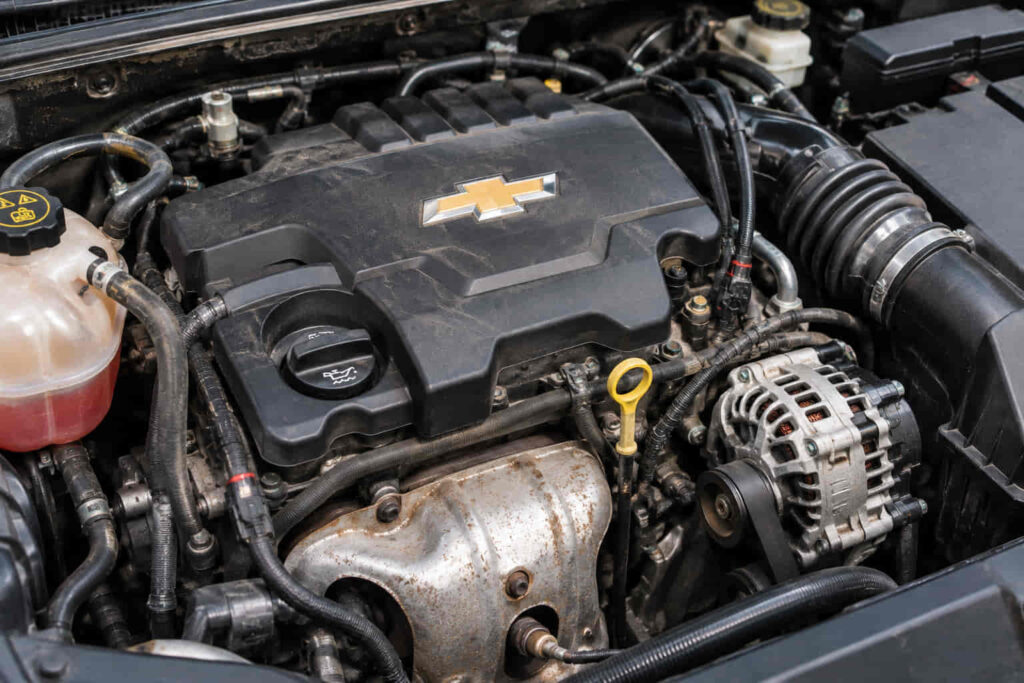
Chevrolet engine problems vary considerably by engine family, model year, and vehicle application. Some of the most important documented concerns include hydraulic lifter failure in certain 5.3L and 6.2L V8 engines, crankshaft and connecting rod defects in recalled 6.2L L87 engines, excessive oil consumption in older 2.4L Ecotec engines, PCV system problems in 1.4L turbocharged engines, and timing chain faults in certain 3.6L V6 applications.
Other Chevrolet engines have their own potential weaknesses. The 1.5L turbocharged Ecotec has been associated with cold-weather charge-air cooler icing in certain Equinox models, while GM has published service information concerning valvetrain noise and fuel injection control in the 2.7L TurboMax engine.
However, not every Chevrolet engine suffers from the same problems, and a documented technical service bulletin does not mean every vehicle equipped with that engine will fail. Chevrolet has used numerous gasoline and diesel engine designs across the Silverado, Tahoe, Suburban, Equinox, Traverse, Malibu, Cruze, Colorado, and other vehicles.
One particularly important development involves the 6.2L L87 V8. In April 2025, General Motors announced a safety recall covering certain 2021–2024 vehicles because manufacturing defects affecting connecting rod and crankshaft components could lead to engine failure and loss of propulsion. In August 2026, the National Highway Traffic Safety Administration expanded its investigation to include additional L87 applications through the 2026 model year. That expanded investigation is not itself a recall of every 2025 or 2026 vehicle.
Understanding the differences between these engine families, their common symptoms, diagnostic procedures, repair costs, and maintenance requirements is essential for determining whether a Chevrolet engine problem is minor, expensive, or potentially dangerous.
What Are the Most Common Chevrolet Engine Problems?
The most common Chevrolet engine problems depend on the specific engine, but frequently investigated conditions include excessive oil consumption, lifter ticking, cylinder misfires, timing chain wear, coolant leaks, turbocharger underboost, and fuel injection faults.
Chevrolet produces vehicles for several different purposes.
A Silverado 1500 equipped with a 5.3L V8 has a different engine architecture from an Equinox equipped with a 1.5L turbocharged four-cylinder.
The Chevrolet Cruze used several small gasoline engines, while heavy-duty Silverado trucks are available with Duramax diesel engines.
These powertrains differ in their internal components, operating characteristics, and maintenance requirements.
A problem that is well documented in one engine family may not apply to another.
For example, older Chevrolet Equinox models equipped with the 2.4L Ecotec have documented piston ring-related oil consumption concerns.
Certain Chevrolet Cruze 1.4L engines have known PCV system and cooling component issues.
Several GM V8 engines use hydraulic lifters associated with cylinder deactivation systems. When those components fail, ticking and misfires can develop.
The 6.2L L87 has also been the subject of a separate safety recall involving connecting rod and crankshaft manufacturing defects.
These conditions are not interchangeable.
A persistent engine tick may indicate a lifter problem, exhaust leak, damaged camshaft follower, or another mechanical condition.
Likewise, a check engine light can be caused by ignition, fuel injection, emissions control, or engine mechanical faults.
The correct diagnosis begins with identifying the engine code and the symptoms rather than assuming that every Chevrolet has the same mechanical weakness.
Are Chevrolet Engines Reliable?
Many Chevrolet engines can provide dependable long-term service when maintained correctly, but reliability varies significantly between engine generations and individual vehicles.
General Motors has produced several durable gasoline and diesel engine families.
The traditional Chevrolet small-block V8, including the 350 cubic-inch engine, developed a strong reputation for repairability and extensive parts availability.
Later LS-based V8 engines also became popular because of their performance, compact design, and broad aftermarket support.
However, modern engines introduce additional technologies.
Direct gasoline injection, turbocharging, variable valve timing, cylinder deactivation, and advanced electronic controls can improve power and efficiency.
These systems also create components that may require specialized diagnosis and expensive repairs.
A modern 5.3L V8 can experience problems involving its hydraulic lifters even when the engine block and crankshaft remain healthy.
A 1.5L turbocharged engine may develop a boost-related fault that does not involve internal engine damage.
Reliability also depends on how the vehicle is used.
A pickup truck frequently towing heavy trailers may experience different mechanical demands from a compact car used for commuting.
Oil change history, coolant maintenance, fuel quality, driving conditions, and previous repairs all influence long-term durability.
There is no reliable basis for claiming that every Chevrolet engine will last the same number of miles.
The best evaluation combines the engine’s known technical concerns with the actual vehicle’s service history and mechanical condition.
Chevrolet 5.3L V8 Lifter Problems
Hydraulic lifter failure is one of the most widely discussed Chevrolet 5.3L V8 engine problems, particularly in engines equipped with Active Fuel Management or Dynamic Fuel Management.
The 5.3L V8 has been used in numerous Chevrolet Silverado, Tahoe, Suburban, and other GM vehicles.
Its design has evolved through several generations.
Some versions use Active Fuel Management, commonly called AFM.
Other versions use Dynamic Fuel Management, known as DFM.
These systems improve fuel efficiency by reducing cylinder operation under selected driving conditions.
They depend on specialized hydraulic lifters and electronic oil control.
A mechanically damaged lifter may become stuck or fail to operate correctly.
When this happens, the corresponding valve may not open as intended.
The engine can develop a rhythmic ticking sound, rough idle, reduced power, and a cylinder misfire.
A check engine light may illuminate.
GM service bulletin 19-NA-219 discusses several possible valvetrain problems, including collapsed AFM lifters, damaged lifter rollers, worn camshaft lobes, and sticking valves.
However, lifter ticking does not automatically prove that the cylinder deactivation system has failed.
Low oil pressure, incorrect oil viscosity, damaged rocker arms, and other problems can produce similar symptoms.
The technician should identify the affected cylinder and inspect the relevant valvetrain components.
If a lifter has damaged its associated camshaft lobe, replacing the lifter alone may not provide a lasting repair.
The actual service procedure depends on the engine code and extent of damage.
Chevrolet 6.2L V8 Engine Failure and Recall
The Chevrolet 6.2L L87 V8 has been the subject of a major engine safety recall because manufacturing defects in certain crankshaft and connecting rod components can cause internal engine damage and a sudden loss of propulsion.
On April 24, 2025, General Motors submitted safety recall N252494000, also identified as NHTSA recall 25V-274.
The recall covers certain 2021–2024 Chevrolet Silverado 1500, Tahoe, and Suburban vehicles equipped with the 6.2L L87 gasoline engine.
Related GMC and Cadillac vehicles are also included.
GM’s initial report identified approximately 597,630 vehicles across the affected brands.
The company described two principal manufacturing-related causes.
The first involved sediment contamination on connecting rods and crankshaft oil galleries that could damage connecting rod bearings.
The second involved crankshaft dimensions and surface finishes that did not meet the required specifications.
These conditions can contribute to bearing damage and engine failure.
Possible warning signs include abnormal knocking, banging, a check engine light, hesitation, reduced power, or an inability to restart.
However, an engine failure may occur without a long period of obvious warning symptoms.
The recall remedy involves inspecting the engine according to GM’s specified procedure.
An engine that fails the inspection requires replacement.
For engines that pass, the remedy includes changing to the specified higher-viscosity oil and updating the oil fill cap and owner’s manual information.
The correct oil specification for a recalled engine after the remedy must be confirmed through the vehicle’s service documentation.
Owners should not independently change oil viscosity as a substitute for the required recall inspection.
What Is the Latest Chevrolet 6.2L L87 Engine Investigation?
As of November 2026, the 6.2L L87 engine remains under heightened regulatory scrutiny following an expanded NHTSA investigation announced on August 21, 2026.
The expanded investigation concerns reports of engine failures following the 2025 recall remedy and failures involving additional engine production periods.
The investigation encompasses approximately one million GM pickups and SUVs from the 2021–2026 model years.
Affected model families under examination include the Chevrolet Silverado 1500, Tahoe, and Suburban, along with related GMC and Cadillac vehicles.
NHTSA reported hundreds of alleged engine failures after the recall remedies had been performed.
The agency also examined failures involving vehicles outside the original recall production range.
However, an expanded investigation is not the same as a new recall covering all model years under investigation.
The original 2025 recall remains associated with its defined affected vehicles and manufacturing period.
Owners of 2025 and 2026 L87 vehicles should not assume that their vehicles are automatically subject to the same recall.
Likewise, owners of recalled 2021–2024 vehicles should not assume that completing the original remedy makes future symptoms irrelevant.
Persistent knocking, unusual engine vibration, low oil pressure, or sudden power loss requires prompt attention.
The most reliable way to identify an applicable recall is to check the individual vehicle identification number through Chevrolet or NHTSA.
Regulatory investigations and recall eligibility can change as additional information becomes available.
For this reason, Chevrolet 6.2L engine reliability should be evaluated using the latest vehicle-specific service and recall information.
What Causes Chevrolet V8 Lifter Ticking?
Chevrolet V8 lifter ticking can result from hydraulic lifter collapse, insufficient oil pressure, incorrect oil viscosity, a damaged lifter roller, or wear involving the camshaft and rocker arm components.
The valvetrain controls the opening and closing of the engine’s intake and exhaust valves.
In a conventional Chevrolet pushrod V8, the camshaft operates hydraulic lifters.
These lifters transfer motion through pushrods to the rocker arms.
Hydraulic lifters also use engine oil to maintain their intended operating position.
When a lifter loses its hydraulic function, excessive clearance or abnormal valve movement can develop.
This may produce a repetitive ticking or tapping sound.
In engines equipped with AFM or DFM, specialized lifters allow selected cylinders to be deactivated.
Certain failures involving these components can create additional problems.
A mechanically collapsed lifter may prevent a valve from moving correctly, causing a misfire.
A damaged lifter roller can also wear the camshaft lobe.
However, not every ticking noise is caused by a lifter.
An exhaust manifold leak can produce a similar rhythmic sound.
Fuel injectors may also make normal clicking noises.
GM’s service information emphasizes inspecting the actual components before replacement.
For persistent ticking accompanied by misfires, a technician may need to examine valve movement, camshaft condition, and hydraulic lifter operation.
A verified mechanical failure requires appropriate component replacement rather than attempting to hide the noise with thicker oil.
Chevrolet 2.4L Ecotec Oil Consumption Problems
Excessive oil consumption is one of the best-documented problems affecting certain older Chevrolet 2.4L Ecotec engines, particularly in Equinox applications.
The 2.4L Ecotec was used in Chevrolet vehicles such as the Equinox and Malibu.
Its direct-injection configuration and internal piston ring arrangement differ from Chevrolet’s larger V8 engines.
Certain production years experienced excessive engine oil consumption associated with piston ring wear.
GM issued special coverage programs addressing the condition.
For example, special coverage 16118 applied to qualifying 2012 Chevrolet Equinox and GMC Terrain vehicles equipped with the 2.4L engine.
GM also issued special coverage N192291100 for certain 2013 vehicles.
The documents describe excessive oil consumption associated with piston ring wear.
The condition could require adding approximately one quart of oil in less than 2,000 miles.
However, that threshold was part of the specific coverage criteria and should not be interpreted as a universal definition for every engine.
As oil level decreases, lubrication problems may develop.
The engine can produce unusual noise or illuminate a low oil pressure warning.
Repeated low-oil operation can damage bearings, timing components, and other internal parts.
The appropriate diagnosis involves measuring oil consumption under the manufacturer’s testing procedure.
External leaks must also be considered.
When excessive internal consumption is confirmed, piston and piston ring repairs may be required.
The specific repair and coverage depend on the vehicle’s model year, engine code, and eligibility.
Chevrolet Ecotec Timing Chain Problems
Timing chain problems have been reported in certain Chevrolet Ecotec engine generations, but the causes and repair requirements depend on the engine design.
A timing chain synchronizes crankshaft and camshaft rotation.
Correct timing ensures that the intake and exhaust valves open and close at the intended positions.
The chain must remain properly tensioned.
Its guides, sprockets, and hydraulic tensioner also play important roles.
Wear or inadequate tension can allow the chain to become loose.
Possible symptoms include rattling, poor engine performance, hard starting, and camshaft timing-related fault codes.
However, the appearance of a timing-related diagnostic code does not automatically confirm a stretched chain.
A faulty camshaft actuator, sensor problem, oil control fault, or incorrect electronic timing information can produce similar symptoms.
Oil maintenance is particularly important because many modern timing chain tensioners and variable valve timing systems depend on engine oil pressure.
Certain older Ecotec engines have also experienced oil consumption problems.
Operating with insufficient oil can create conditions that accelerate wear in the timing system.
When a timing chain fault is suspected, the technician should inspect the chain, guides, tensioner, sprockets, and related components according to the applicable service procedure.
Replacing a sensor without identifying mechanical timing wear may not solve the problem.
A correct repair should also address any lubrication problem that contributed to premature wear.
Chevrolet 3.6L V6 Timing Chain Problems
Timing chain wear and camshaft-to-crankshaft correlation problems are important diagnostic concerns on certain Chevrolet 3.6L V6 engines used in the Traverse, Camaro, Equinox, and other vehicles.
The 3.6L V6 belongs to GM’s High Feature V6 engine family.
It uses dual overhead camshafts and a timing chain system.
Several engine codes and generations have been produced.
The exact components differ according to production year.
GM technical information, including bulletin PIP3423N, identifies timing-related diagnostic codes such as P0008, P0009, P0016, P0017, P0018, and P0019 in certain High Feature V6 applications.
These codes indicate that the engine control system has detected a discrepancy involving camshaft and crankshaft timing.
A loose timing chain or defective tensioner is one possible cause.
However, GM’s bulletin also identifies another potential issue involving movement of the crankshaft sensor reluctor.
This distinction matters because replacing the timing chains will not correct a displaced reluctor.
Symptoms may include a check engine light, rough idle, reduced performance, or abnormal timing system noise.
Diagnosis should compare commanded and actual camshaft positions and inspect the relevant mechanical components.
Proper lubrication and timely oil changes are important for the timing system.
For used Chevrolet vehicles equipped with the 3.6L V6, maintenance records and unresolved timing-related codes deserve particular attention.
Chevrolet 1.4L Turbo PCV Valve Problems
PCV system failure is one of the most important Chevrolet 1.4L turbo engine concerns, particularly in certain Cruze, Sonic, and Trax applications.
The positive crankcase ventilation system controls gases and pressure inside the engine crankcase.
It allows gases that escape past the piston rings to be routed through the appropriate ventilation system.
The 1.4L turbocharged Ecotec uses a crankcase ventilation arrangement integrated with the intake system and engine covers.
In certain earlier engines, the intake manifold contains a non-return valve.
If this valve becomes damaged or dislodged, crankcase pressure control can be affected.
The engine may develop oil leaks, increased oil consumption, or abnormal air movement.
GM service bulletin 19-NA-101 provides a diagnostic procedure for inspecting the intake manifold non-return valve on certain 1.4L engines.
If the valve is missing, the bulletin directs replacement of the intake manifold.
Another concern involves the PCV pressure regulator diaphragm in the camshaft cover.
GM special coverage N192210230 addressed certain 2015–2016 Cruze and 2015 Sonic vehicles equipped with the 1.4L LUV engine.
The document describes a diaphragm that may crack and allow excess air into the intake.
This can cause rough idle and diagnostic code P0171, indicating a lean fuel mixture.
The proper repair depends on which PCV component has failed.
A damaged camshaft cover diaphragm and a missing intake manifold valve are different problems and may require different parts.
Chevrolet Cruze Coolant Leak and Overheating Problems
Cooling system leaks are a significant concern on certain Chevrolet Cruze 1.4L turbo applications, particularly when they involve the water pump, coolant connections, or aging plastic cooling components.
The turbocharged engine operates under substantial thermal demands.
Its cooling system must remove heat from the cylinder head, block, and related components.
Coolant circulation depends on a functioning water pump, thermostat, radiator, hoses, and other connections.
A leak can gradually reduce coolant level.
When coolant becomes insufficient, the engine may overheat.
GM preliminary information PI0762D addresses water pump coolant leakage on certain 2011–2012 Chevrolet Cruze vehicles equipped with the 1.4L LUJ turbo engine.
The document identifies possible symptoms including coolant loss, a hot-engine warning, and inadequate cabin heating.
However, a hot-engine warning does not prove that the water pump itself has failed.
Coolant hoses, connections, thermostat housing components, and other sealing areas must be inspected.
A cooling system pressure test can help identify the source.
Repeated overheating should not be ignored.
Excessive engine temperature can damage cylinder head gaskets, sealing components, and other internal parts.
Once the leak has been repaired, the system must be filled and bled according to the manufacturer’s procedure.
Trapped air can interfere with coolant circulation and temperature control.
Chevrolet 1.4L Turbo Cracked Piston Problems
Certain second-generation Chevrolet Cruze 1.4L turbo engines have a documented concern involving piston damage, which can cause misfires, rough running, and low cylinder compression.
The second-generation Cruze uses a different 1.4L engine configuration from many earlier Cruze models.
The LE2 engine incorporates direct injection and turbocharging.
GM service bulletin 18-NA-171, revised in December 2022, addresses certain 2016–2019 Chevrolet Cruze and related applications equipped with the 1.4L LE2.
The bulletin describes vehicles experiencing rough operation and diagnostic code P0300.
The underlying cause may involve a damaged piston.
When the engine has low compression, GM instructs technicians to perform a cylinder leakage test.
If leakage into the crankcase is excessive, the pistons and cylinder walls require further inspection.
For certain confirmed cases where the cylinder walls are not damaged, GM specifies replacing all four pistons.
The bulletin also identifies an updated engine control calibration for relevant Cruze applications.
However, a misfire code alone does not confirm a cracked piston.
Ignition coils, spark plugs, fuel injectors, air leaks, and other mechanical faults can produce similar symptoms.
Compression and leakage testing are important because they help distinguish internal cylinder damage from ordinary ignition problems.
A vehicle with a persistent misfire and low compression may require extensive engine repair.
The exact diagnosis should be confirmed before replacing internal components.
Read more: 3126 CAT Engine Problems
Chevrolet 1.5L Turbo Engine Problems
The Chevrolet 1.5L turbocharged Ecotec has been associated with certain boost-control and cold-weather charge-air cooler problems, particularly in Equinox applications.
The engine uses turbocharging to deliver practical low-speed torque.
Compressed air passes through a charge-air cooler before entering the engine.
The cooler reduces intake air temperature and supports combustion efficiency.
However, moisture can accumulate within the charge-air system under certain operating conditions.
In very cold weather, this moisture may freeze.
GM service bulletin 22-NA-002 addresses certain 2018–2022 Chevrolet Equinox and GMC Terrain vehicles equipped with the 1.5L LYX engine.
The bulletin discusses reduced power and diagnostic codes P0299 or P0234 during cold or freezing conditions.
The condition may involve moisture accumulation and icing within the charge-air cooler.
The turbocharger wastegate regulator solenoid can also be affected by freezing moisture.
GM’s service procedure includes diagnostic inspection and applicable calibration updates.
However, cold-weather charge-air icing is not the explanation for every underboost code.
A damaged hose, leaking intercooler, sensor fault, or turbocharger control problem may produce similar symptoms.
The engine’s exact configuration and environmental conditions must be considered.
The 1.5L designation has been used for different engine generations, so the specific RPO code matters when researching technical issues.
Chevrolet 2.7L TurboMax Engine Problems
The Chevrolet 2.7L TurboMax engine has several documented service concerns, including certain roller follower wear conditions, hydraulic lash adjuster ticking, electronic control issues, and fuel injection calibration updates.
The engine is identified by GM as the L3B.
It is used in vehicles such as the Chevrolet Silverado 1500 and Colorado.
The 2.7L turbocharged four-cylinder emphasizes strong low-speed torque.
However, its mechanical design differs substantially from Chevrolet’s traditional V8 engines.
GM bulletin PIP5847B addresses abnormal ticking or tapping from the cam carrier area in certain 2019–2024 Silverado vehicles equipped with the L3B.
The bulletin identifies excessive movement in the exhaust roller follower caused by axle pin wear.
In severe cases, the roller can become displaced and damage a valve or valve stem.
The procedure involves inspecting the exhaust roller followers and related components.
The engine’s camshaft must also be checked for damage.
A separate service update, N242450631, addresses fuel injector flow-rate control in certain earlier L3B applications.
The corrective action involves updating the engine control module calibration.
These issues are not the same as internal crankshaft failure.
Likewise, a tapping noise does not necessarily mean the turbocharger itself has failed.
The correct repair depends on identifying the specific mechanical or electronic condition.
Chevrolet TurboMax and Traverse Top-End Ticking Problems in 2025–2026
General Motors published service information in 2026 addressing top-end ticking on certain 2025–2026 Chevrolet vehicles equipped with the 2.7L L3B, 2.5L LK0, and 2.0L LSY engines.
The relevant applications include certain Silverado 1500, Colorado, Traverse, and Blazer models.
GM bulletin PIP6101 and its later revisions describe abnormal valvetrain noise involving hydraulic valve lash adjusters.
The technical information identifies debris that can interfere with the adjuster’s ability to maintain its normal hydraulic position.
Affected components may become soft or unable to maintain the required clearance.
The result can be a ticking sound from the upper engine.
The service procedure instructs technicians to confirm that the sound originates from the valvetrain before disassembly.
Depending on the bulletin revision and engine configuration, the repair may involve inspecting the hydraulic lash adjusters and rocker arms and replacing the specified components.
Later guidance expands the required replacement scope when the documented condition is confirmed.
However, this is a technical service bulletin, not proof that every 2025 or 2026 Chevrolet engine has a manufacturing defect.
It also should not be confused with the separate 6.2L L87 crankshaft recall.
An owner reporting top-end ticking on a new Chevrolet should request diagnosis using the applicable current service information.
The exact engine code and bulletin revision determine the appropriate repair.
Chevrolet Turbocharger Underboost Problems
Turbocharger underboost can affect several Chevrolet turbocharged gasoline engines, but a P0299 diagnostic code does not automatically mean the turbocharger assembly has failed.
A turbocharger compresses intake air to increase engine output.
The compressed air travels through intake hoses and a charge-air cooler before reaching the engine.
The engine control module monitors airflow and boost pressure.
When measured pressure is lower than expected, the module may store P0299.
Possible symptoms include slow acceleration, reduced power, hesitation, and a check engine light.
However, several components can contribute to the problem.
A leaking charge-air hose may allow boost pressure to escape.
A damaged intercooler connection may have a similar effect.
An improperly functioning wastegate can limit turbocharger output.
Faulty sensors or wiring can also affect control system operation.
Some Chevrolet applications have specific cold-weather concerns involving moisture accumulation in the charge-air cooler.
These conditions should be diagnosed according to the appropriate service bulletin.
A turbocharger that makes abnormal noise or shows evidence of mechanical damage requires closer inspection.
However, replacing the entire turbocharger without checking hoses, controls, and sensors can create unnecessary expense.
Accurate diagnosis is especially important because turbocharger replacement can be costly.
Chevrolet Duramax Diesel Engine Problems
Chevrolet Duramax diesel engine problems depend heavily on the engine generation, with fuel injection system reliability, turbocharger condition, emissions equipment, and cooling performance being major considerations.
Chevrolet Silverado HD trucks have used several generations of the 6.6L Duramax V8.
The engine family includes the LB7, LLY, LBZ, LMM, LML, and later L5P.
These engines do not share identical fuel injection equipment.
The early LB7 became known for injector-related concerns.
The LLY introduced different cooling and intake configurations and has been associated with certain overheating complaints under demanding conditions.
The LBZ has a strong reputation among diesel enthusiasts, although age-related wear and fuel system problems remain possible.
The 2011–2016 LML uses a Bosch CP4-family high-pressure fuel pump.
This pump is an important consideration because severe internal failure can introduce metal contamination into the fuel system.
A contaminated fuel system may require extensive repair involving injectors, fuel rails, lines, and other components.
The later L5P introduced a redesigned fuel injection system with a different high-pressure pump.
However, it is not immune to ordinary contamination, sensor, or mechanical faults.
Modern Duramax engines also contain emissions equipment such as diesel particulate filters and selective catalytic reduction systems.
These systems require proper maintenance and diagnosis.
When researching Duramax reliability, the exact engine code is more important than the general Chevrolet diesel designation.
What Are the Symptoms of Chevrolet Engine Failure?
Warning signs of Chevrolet engine problems include persistent knocking, ticking, excessive oil consumption, overheating, rough idle, cylinder misfires, reduced power, abnormal exhaust smoke, and difficulty starting.
However, not every symptom indicates that the engine is approaching complete mechanical failure.
A check engine light may be triggered by a relatively minor sensor or emissions-related issue.
A rough idle may result from ignition coils, spark plugs, or fuel delivery problems.
A ticking noise may come from a hydraulic lifter, fuel injector, or exhaust manifold leak.
More serious symptoms require immediate attention.
A deep metallic knocking sound can indicate bearing or rotating assembly damage.
Sudden loss of oil pressure can threaten the crankshaft bearings, camshafts, and other lubricated components.
Repeated overheating can cause severe engine damage.
A flashing check engine light may indicate a misfire serious enough to threaten the catalytic converter.
A vehicle that loses propulsion while driving also presents an obvious safety concern.
For owners of Chevrolet vehicles included in the L87 recall population, abnormal bottom-end engine noise deserves particular attention.
However, the correct response to any serious symptom is to stop driving as soon as it is safe and arrange professional evaluation.
Attempting to continue operating a severely damaged engine can increase repair costs.
Why Is a Chevrolet Engine Losing Oil?
Chevrolet engine oil loss can result from external leaks, internal oil consumption, crankcase ventilation problems, or mechanical wear, depending on the engine design.
External leakage may occur around the valve covers, timing cover, oil pan, crankshaft seals, or other sealing areas.
An aging gasket can allow oil to escape without affecting the engine’s internal combustion process.
Internal oil consumption is different.
Oil may pass the piston rings and enter the combustion chamber.
Worn valve guides or other sealing components can also contribute.
Certain Chevrolet 2.4L Ecotec engines have documented piston ring-related oil consumption.
A malfunctioning PCV system can also affect oil movement.
This is particularly relevant to certain 1.4L turbocharged Ecotec applications.
The engine may develop increased crankcase pressure or allow excessive oil vapor movement through the intake system.
However, a low dipstick reading does not identify which problem is present.
The engine should be inspected for external leaks.
If none are found, the technician may perform an oil consumption test according to the manufacturer’s procedure.
Compression or cylinder leakage testing may also be appropriate.
Operating with insufficient oil can cause more serious damage than the original source of consumption.
For this reason, owners should monitor the oil level and investigate unexplained losses promptly.
Why Does a Chevrolet Engine Overheat?
A Chevrolet engine can overheat because of coolant loss, radiator problems, water pump failure, thermostat faults, restricted cooling passages, or other conditions that prevent normal heat removal.
The engine cooling system maintains operating temperature within the intended range.
Coolant absorbs heat from the engine and transfers it through the radiator.
The water pump circulates coolant through the system.
The thermostat and electronically controlled components regulate coolant movement according to the engine design.
A coolant leak reduces the available fluid.
A damaged radiator or cooling fan can reduce heat dissipation.
A water pump with damaged internal components may fail to circulate sufficient coolant.
Some modern Chevrolet engines also use electronic coolant management systems.
Problems in these systems can create diagnostic trouble codes or temperature regulation issues.
However, overheating should not automatically be diagnosed as a failed water pump or head gasket.
A pressure test can help identify external leaks.
The cooling fan, thermostat, radiator, hoses, and coolant condition should also be checked.
If the engine is overheating, continued driving should be avoided.
Excessive temperature can distort cylinder heads, damage gaskets, and cause piston or bearing problems.
Correcting the underlying cooling problem is essential before the vehicle returns to normal operation.
What Do Common Chevrolet Engine Trouble Codes Mean?
Chevrolet engine trouble codes help identify abnormal operating conditions, but they do not automatically identify the exact defective part.
P0300 indicates a random or multiple-cylinder misfire.
The cause may involve ignition, fuel delivery, intake airflow, valve operation, or internal mechanical problems.
P0171 indicates that the engine control module has detected a lean fuel mixture condition on bank one.
This can occur with certain intake leaks or PCV system problems.
P0299 relates to lower-than-expected turbocharger boost pressure.
It may involve an air leak, turbocharger control problem, or another boost system component.
P0016 and P0017 are associated with camshaft and crankshaft position correlation.
These codes can indicate timing chain wear, camshaft actuator problems, sensor issues, or other mechanical conditions.
P0011 and P0014 are associated with camshaft timing performance.
P0521 and related oil pressure codes may indicate abnormal lubrication system conditions or sensor problems.
However, the precise interpretation depends on the vehicle’s diagnostic system and engine code.
The technician should inspect freeze-frame information, live engine data, and related operating conditions.
A fault code should guide testing rather than serve as a reason to replace the first component mentioned in its description.
How Do You Diagnose Chevrolet Engine Problems Correctly?
The correct diagnosis begins with identifying the engine code, documenting symptoms, scanning for diagnostic trouble codes, and testing the mechanical or electronic systems associated with the complaint.
A Chevrolet vehicle can have several engine options within the same model year.
The Silverado 1500, for example, may be equipped with different gasoline or diesel powertrains.
The relevant failure patterns differ substantially.
The vehicle identification number and engine RPO code help establish the installed configuration.
After identifying the engine, the technician should determine when the symptom occurs.
A problem during cold startup may have different causes from one appearing only under heavy acceleration.
Oil level, coolant condition, and visible leaks should be inspected.
A diagnostic scan can identify fault codes and relevant operating data.
Misfire data may indicate which cylinder requires further testing.
Compression testing can help identify mechanical cylinder sealing problems.
A cylinder leakage test can provide more information when compression is abnormal.
Oil pressure testing is important when lubrication problems are suspected.
Turbocharged engines may require boost pressure and intake leak testing.
For engines with documented lifter problems, valve movement and camshaft condition may need inspection.
Recall and service bulletin information should also be reviewed.
A structured diagnostic process is more economical than replacing components based solely on symptoms.
How Much Does It Cost to Fix Chevrolet Engine Problems?
Chevrolet engine repair costs range from relatively inexpensive maintenance to major repairs costing several thousand dollars, depending on the failed component and required labor.
A basic oil service, spark plug replacement, or minor sensor repair is usually much less expensive than internal engine work.
Cooling system repairs can vary considerably.
Replacing a leaking hose may be straightforward.
Replacing a water pump or other components in a difficult-to-access location may involve more labor.
Turbocharger problems also differ in cost.
A leaking boost hose may be relatively inexpensive to repair.
A failed turbocharger assembly requires substantially more parts and labor.
Lifter replacement can be costly on certain V8 engines because access may require extensive disassembly.
If the camshaft is also damaged, the repair becomes more expensive.
Timing chain replacement on certain overhead-camshaft V6 engines may involve substantial labor because multiple timing components must be accessed and correctly aligned.
A damaged piston or crankshaft can require internal engine rebuilding or complete replacement.
For general budgeting in the United States, major internal engine repairs can reach several thousand dollars, while full engine replacement may exceed $10,000 on some modern truck applications.
These are broad estimates rather than guaranteed repair prices.
Warranty coverage and applicable recalls can significantly affect the amount an owner must pay.
For a vehicle covered by an active safety recall, the specified recall repair is performed without charge under the applicable program.
The most reliable estimate is an itemized quotation based on confirmed diagnostic findings.
Is It Better to Rebuild or Replace a Chevrolet Engine?
Rebuilding a Chevrolet engine may be worthwhile when its block and major internal components remain serviceable, while replacement can be preferable when damage is extensive or a compatible remanufactured engine is readily available.
The decision depends on the engine family.
A traditional Chevrolet 350 small-block can often be rebuilt using widely available components and established machine shop procedures.
Many LS-based V8 engines also have extensive aftermarket support.
However, modern direct-injection and turbocharged engines may require specialized components and electronic procedures.
A rebuild involves disassembling the engine, inspecting internal parts, machining worn surfaces, and replacing defective components.
A remanufactured engine typically undergoes a standardized restoration process.
A complete replacement engine may reduce repair complexity when several major components are damaged.
However, replacement does not automatically correct the original failure cause.
For example, a cooling system defect that caused overheating must still be repaired.
Likewise, contaminated oil coolers or damaged fuel system components can threaten a replacement engine if reused improperly.
Warranty terms also matter.
Some remanufactured engines include parts-and-labor coverage.
Others provide limited protection or exclude certain installation expenses.
For older vehicles, the cost of major repairs should be compared with the vehicle’s remaining value.
A mechanically sound truck may justify substantial engine investment.
A vehicle with severe corrosion, transmission problems, and other expensive defects may not.
The correct decision should consider total installed cost, warranty coverage, and expected remaining service life.
Which Chevrolet Engines Have the Most Documented Problems?
Certain Chevrolet engine families have more clearly documented failure patterns than others, but the available technical records do not establish one universal ranking of the least reliable Chevrolet engines.
The older 2.4L Ecotec is notable because GM issued special coverage programs addressing excessive oil consumption associated with piston ring wear.
The 1.4L Ecotec Turbo has documented PCV system and cooling concerns in particular Cruze, Sonic, and Trax applications.
Certain 1.4L LE2 engines also have documented cracked piston-related diagnostic procedures.
The 3.6L High Feature V6 deserves attention because of timing chain and camshaft correlation concerns.
Among full-size truck engines, AFM and DFM lifter problems have generated extensive service information.
The 6.2L L87 is particularly important because its crankshaft and connecting rod concerns resulted in a major safety recall and subsequent expanded investigation.
The 2.7L L3B TurboMax also has service bulletins addressing certain roller follower and hydraulic lash adjuster conditions.
However, the existence of multiple bulletins does not establish that the entire engine family has an unusually high failure rate.
A technical bulletin may address a relatively narrow complaint affecting only certain vehicles.
A recall may involve a defined manufacturing period.
The correct purchasing decision therefore depends on the exact engine version, vehicle production date, maintenance history, and current mechanical condition.
Are Older Chevrolet Engines More Reliable Than Newer Ones?
Older Chevrolet engines can be mechanically simpler and easier to repair, but that does not automatically make them more reliable than modern engines.
Traditional Chevrolet small-block V8 engines use comparatively straightforward fuel, ignition, and valvetrain systems.
Their replacement parts are widely available.
Many mechanics are familiar with their construction.
This can make an older 350 or early LS-based V8 attractive for restoration and long-term ownership.
However, older engines may have accumulated substantial wear.
Age-related gasket deterioration, cooling system problems, corrosion, and previous repairs can affect reliability.
Modern engines offer different benefits.
Electronic fuel injection, variable valve timing, turbocharging, and cylinder deactivation can improve efficiency and performance.
These technologies also provide more precise control over combustion.
However, their additional components can increase repair complexity.
A modern engine may develop a sensor or electronic actuator problem without having significant internal wear.
An older engine may avoid certain electronic faults but require more frequent mechanical attention.
The correct comparison must account for the age and condition of the complete vehicle.
A well-maintained modern Chevrolet can be a more dependable daily driver than a neglected older truck.
Conversely, a properly rebuilt traditional small-block can be an economical choice for an owner who values mechanical simplicity.
What Chevrolet Engine Problems Should Used-Car Buyers Check?
Used Chevrolet buyers should identify the exact engine and evaluate its known mechanical concerns, maintenance history, diagnostic codes, and recall status before purchase.
For a Silverado or Tahoe with a 5.3L V8, abnormal valvetrain ticking and cylinder misfires deserve attention.
The buyer should also verify whether the engine has experienced previous lifter or camshaft repairs.
For a 6.2L L87, the recall and investigation history is especially important.
The vehicle identification number should be checked, and any documented engine inspection or replacement should be reviewed.
A used Equinox with an older 2.4L Ecotec should be evaluated for oil consumption.
Maintenance records and evidence of piston ring repairs can provide useful information.
A Cruze with a 1.4L turbo engine deserves inspection of the cooling and PCV systems.
A persistent lean-condition code or unexplained oil leak may indicate a relevant problem.
Vehicles with the 3.6L V6 should be checked for timing-related diagnostic codes.
For the 2.7L TurboMax, abnormal upper-engine ticking and prior valvetrain service records deserve attention.
Diesel Silverado buyers should identify the exact Duramax generation.
The fuel injection system and emissions equipment differ significantly between models.
A professional pre-purchase inspection can reduce the risk of purchasing a vehicle with an expensive unresolved mechanical problem.
How Long Do Chevrolet Engines Last?
A properly maintained Chevrolet engine can provide substantial service life, but no single mileage figure accurately represents every Chevrolet gasoline and diesel engine.
Engine longevity depends on design, maintenance, operating conditions, and mechanical condition.
A naturally aspirated V8 used primarily for highway driving may experience different wear from a small turbocharged engine frequently operated under high load.
Oil change history is important.
The crankshaft bearings, camshaft components, and turbocharger depend on suitable lubrication.
Cooling system condition also affects lifespan.
Repeated overheating can damage internal sealing surfaces and other components.
Fuel quality is another factor.
Direct-injection and diesel engines use precise fuel delivery systems that can be affected by contamination.
Owners sometimes use 150,000 or 200,000 miles as long-term planning milestones.
However, these are not manufacturer-guaranteed lifespans.
Some engines operate beyond those distances with appropriate maintenance.
Others require major repairs sooner because of defects, severe operating conditions, or neglect.
A vehicle’s odometer also does not reveal its complete operating history.
Engine hours, towing loads, idle time, and maintenance records can provide additional context.
The best evaluation considers compression, oil pressure, oil consumption, diagnostic information, and documented service rather than mileage alone.
How Can You Prevent Common Chevrolet Engine Problems?
The most effective preventive measures are using the correct engine oil, maintaining the cooling system, following factory service schedules, inspecting for leaks, and addressing abnormal symptoms promptly.
Engine lubrication deserves particular attention.
The oil must meet the manufacturer’s required viscosity and performance specification.
Modern Chevrolet engines may use different oil requirements according to engine code and production year.
For example, certain recalled 6.2L L87 vehicles received a revised oil specification as part of their recall remedy.
Owners should follow their vehicle-specific service documentation rather than assume that the original oil specification remains unchanged.
Cooling system maintenance is equally important.
Coolant leaks and abnormal temperature readings should be investigated before severe overheating occurs.
Fuel quality matters for direct-injection gasoline and diesel engines.
The correct fuel and filtration procedures should be used.
Turbocharged engines require a properly sealed intake system and reliable lubrication.
For engines with known valvetrain concerns, abnormal ticking or misfires should be diagnosed early.
A damaged lifter or follower can cause additional camshaft damage when the engine continues operating.
Owners should also check for open recalls.
A vehicle may qualify for a manufacturer repair even when it does not currently exhibit obvious symptoms.
Maintenance cannot prevent every manufacturing defect, but it can reduce avoidable wear and help identify developing problems.
How Do You Check Chevrolet Engine Recalls?
The most reliable way to check for Chevrolet engine recalls is to use the vehicle’s 17-character identification number through Chevrolet’s official owner resources or the National Highway Traffic Safety Administration recall lookup.
The VIN identifies the specific vehicle rather than only the model and year.
This distinction is important because a recall may affect only certain production dates, engine configurations, or manufacturing batches.
Two Chevrolet Silverado trucks from the same model year may have different recall eligibility.
The engine installed in each vehicle also matters.
A recall involving the L87 6.2L V8 does not automatically apply to a Silverado equipped with a 5.3L V8 or 2.7L TurboMax.
The official lookup can identify open safety recalls associated with the individual vehicle.
However, NHTSA’s public VIN lookup primarily displays unrepaired recalls.
It may not show all previously completed recall work or certain non-safety service campaigns.
A Chevrolet dealer can review relevant vehicle service information and confirm the status of manufacturer programs.
A technical service bulletin is also different from a recall.
A bulletin provides repair guidance but does not automatically guarantee a free repair.
Warranty or special coverage eligibility must be confirmed separately.
For a used Chevrolet, buyers should review recall completion records and ask whether major engine repairs have been performed.
A vehicle with a completed recall should still be evaluated for abnormal symptoms.
Final Verdict: What Are the Biggest Chevrolet Engine Problems?
The biggest Chevrolet engine problems depend on the exact powertrain, but the most significant documented concerns include V8 lifter failure, 6.2L L87 internal engine defects, 2.4L Ecotec oil consumption, 1.4L turbo PCV problems, 3.6L V6 timing issues, and selected turbocharged engine valvetrain faults.
The 5.3L V8 remains a popular Chevrolet truck engine, but certain AFM and DFM applications can experience hydraulic lifter problems.
These may cause ticking, misfires, and camshaft wear.
The 6.2L L87 is an especially important reliability consideration because manufacturing defects affecting crankshaft and connecting rod components led to a major safety recall in 2025.
NHTSA’s August 2026 investigation expansion also means owners should continue monitoring official information.
Older 2.4L Ecotec engines have documented piston ring-related oil consumption concerns.
Certain 1.4L turbocharged engines can experience PCV system problems, cooling leaks, and in some applications piston damage.
The 3.6L V6 has timing-related diagnostic concerns that must be distinguished from sensor and camshaft actuator problems.
Modern turbocharged engines such as the 2.7L TurboMax have their own documented service conditions involving roller followers and hydraulic lash adjusters.
However, none of these problems should be treated as a guarantee that every Chevrolet vehicle will experience engine failure.
A technical service bulletin identifies a diagnostic or repair condition, while a safety recall applies to a defined vehicle population.
A manufacturer investigation may involve a wider range of vehicles without automatically making every one of them subject to a recall.
For owners and used-car buyers, the strongest strategy is to identify the engine RPO code, verify recall eligibility, review maintenance records, and investigate warning signs before major damage occurs.
A Chevrolet engine with appropriate maintenance, completed applicable recalls, and no unresolved mechanical problems can still offer dependable long-term service. The key is understanding the specific engine family rather than judging every Chevrolet powertrain by the same reputation.