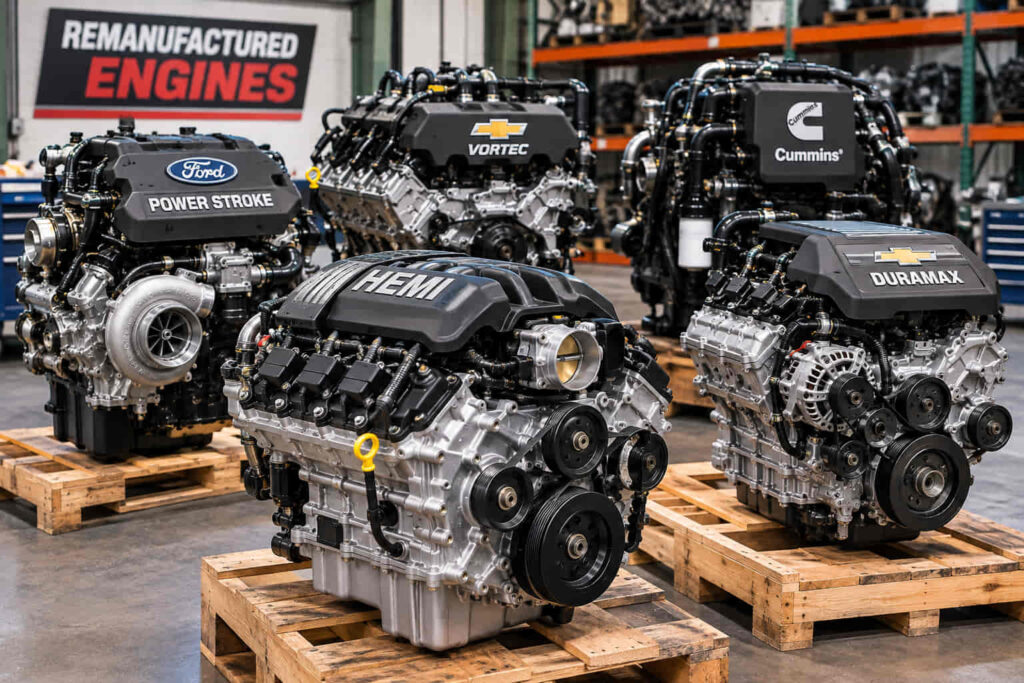
The best remanufactured engines come from manufacturers and suppliers that combine precision machining, comprehensive component inspection, updated replacement parts, consistent quality-control testing, and dependable warranty support. JASPER Engines & Transmissions, Ford and Motorcraft, GM Genuine Parts, Cummins ReCon, LKQ, ATK, Fraser Engines, and Powertrain Products are among the established options worth comparing when replacing a failed gasoline or diesel engine.
For most passenger cars and light-duty trucks, JASPER is a strong option because of its documented remanufacturing process, nationwide distribution network, and typical three-year/100,000-mile gasoline engine warranty. Ford and Motorcraft are particularly relevant for Ford vehicles, while GM Genuine Parts offers original-equipment-focused replacements for Chevrolet, GMC, Buick, and Cadillac applications. Cummins ReCon is an important choice for supported Cummins diesel engines.
However, there is no single remanufactured engine company that is automatically the best for every vehicle. Availability, engine design, manufacturing standards, warranty coverage, installer requirements, and total replacement costs vary significantly.
A remanufactured engine can restore reliable performance to a vehicle without the cost of purchasing a completely new engine or another vehicle. Choosing the right supplier requires understanding how engines are restored, what components are included, and which protections apply if the replacement develops a problem.
What Are the Best Remanufactured Engine Companies?
JASPER, Ford and Motorcraft, GM Genuine Parts, Cummins ReCon, LKQ, ATK, Fraser Engines, and Powertrain Products are established remanufactured engine suppliers worth evaluating. Each serves different vehicle applications and offers its own manufacturing standards, purchasing arrangements, and warranty terms.
JASPER specializes in remanufactured engines, transmissions, and other powertrain products for a broad range of vehicles. Its products are frequently installed through professional repair facilities.
Ford and Motorcraft provide remanufactured engines designed around Ford’s original engineering requirements. These products are particularly relevant when factory compatibility and Ford-backed support are priorities.
GM Genuine Parts offers remanufactured engine assemblies intended to meet the original specifications of supported General Motors vehicles.
Cummins ReCon focuses on genuine remanufactured Cummins engines and components, making it especially relevant to diesel trucks, commercial equipment, and other Cummins-powered applications.
LKQ provides remanufactured engines through its automotive parts distribution and manufacturing operations.
ATK offers remanufactured gasoline, diesel, and performance engine products for numerous domestic and imported vehicles.
Fraser Engines markets standard and upgraded remanufactured engines, including products sourced through its manufacturing operations and approved supplier network.
Powertrain Products offers online access to replacement engines and other powertrain assemblies with several available warranty programs.
These companies cannot be compared accurately using warranty duration or advertised price alone.
The correct supplier depends on whether it has a compatible engine, what restoration work was performed, and how its warranty addresses potential parts and labor expenses.
Are JASPER Remanufactured Engines the Best Overall Choice?
JASPER is a strong all-around choice for professionally installed remanufactured gasoline engines because of its established production system, broad application coverage, and nationwide warranty support.
JASPER Engines & Transmissions was founded in 1942 and operates remanufacturing facilities in the United States.
The company produces replacement gasoline engines, diesel engines, transmissions, differentials, and other powertrain components.
Its gasoline engine remanufacturing process includes disassembly, cleaning, component inspection, machining, and replacement of normal wear parts.
JASPER states that its remanufactured gasoline engines are built to meet or exceed original equipment manufacturer measured tolerances.
The company also describes live-run testing for popular gasoline engine applications.
Testing may include monitoring oil pressure, compression, vacuum, and certain variable valve timing functions.
Leak testing is performed to help identify sealing problems before the engine is delivered.
These procedures are relevant because a replacement engine can contain assembly defects that are not immediately apparent from visual inspection.
Most qualifying JASPER remanufactured gasoline engines include a three-year/100,000-mile nationwide, transferable parts-and-labor warranty.
However, commercial and specialized applications may receive different terms.
For example, certain qualifying commercial-use applications have an 18-month/100,000-mile warranty instead of the standard gasoline coverage.
JASPER also offers optional premium service protection for eligible products.
This can provide additional allowances for expenses such as towing, rental transportation, fluids, and labor.
The potential disadvantage is that JASPER may not be the least expensive supplier for a particular engine.
The final installed price depends on the engine, local installer, included components, and required supporting repairs.
For drivers who value established remanufacturing procedures and professional installation support, JASPER deserves consideration.
Are Ford and Motorcraft Remanufactured Engines Worth Buying?
Ford and Motorcraft remanufactured engines are especially attractive for Ford and Lincoln vehicles because they are designed around Ford’s original equipment engineering requirements and supported through the manufacturer’s service network.
Ford offers remanufactured gasoline and diesel engine assemblies for selected vehicle applications.
These products are designed to match the original vehicle configuration, including important engine components and emissions-related requirements.
Original equipment compatibility can reduce the risk of installing a mechanically similar but incorrectly configured engine.
Ford describes its remanufacturing process as involving precision machining, dimensional inspection, and component restoration to its engineering standards.
The company also incorporates relevant engineering updates where applicable.
Cylinder machining is important because piston ring sealing depends on correct bore dimensions and surface finish.
Ford’s remanufacturing documentation describes advanced honing procedures designed to support durability, oil consumption control, and proper break-in.
Warranty coverage is another important consideration.
Ford’s published remanufactured powertrain information identifies a three-year/unlimited-mile warranty for qualifying gasoline engine assemblies.
Complete remanufactured Power Stroke diesel engines and certain long-block assemblies have a two-year/unlimited-mile warranty.
Stripped long blocks and short blocks can have shorter coverage.
The exact terms depend on the product.
For example, Ford identifies a 12-month/unlimited-mile warranty for certain stripped diesel long blocks and short blocks.
The company also provides remanufactured versions of selected Power Stroke engines, including the 7.3L and 6.0L.
For Ford truck owners, choosing a Ford-authorized remanufactured engine may simplify parts identification and warranty administration.
However, a Ford-branded engine is not automatically the least expensive option.
The best comparison includes the assembly contents, complete installation cost, availability, and applicable warranty terms.
Are GM Genuine Parts Remanufactured Engines Reliable?
GM Genuine Parts remanufactured engines are a strong option for supported Chevrolet, GMC, Buick, and Cadillac vehicles because they are engineered and tested to meet General Motors’ original performance requirements.
General Motors offers remanufactured engines through its GM Genuine Parts powertrain program.
These products are intended to restore vehicles using compatible engine configurations rather than requiring extensive modifications.
GM states that its remanufactured engines undergo testing similar to the procedures used for new engines.
The objective is to restore the original performance characteristics while ensuring suitable reliability.
This is important for modern GM engines because compatibility involves more than displacement.
Two engines may have identical nominal displacement but use different fuel injection equipment, cylinder heads, camshafts, electronic controls, or emissions-related components.
A 5.3-liter V8 from one production generation may not be interchangeable with a 5.3-liter engine from another generation.
GM’s original equipment-focused program helps buyers identify assemblies designed for the vehicle’s specific configuration.
Warranty protection is also a major consideration.
GM Genuine Parts advertises a 36-month/100,000-mile limited warranty for qualifying remanufactured engine assemblies.
Coverage and claims procedures are subject to the official warranty terms.
The program is particularly relevant for common GM truck and SUV engines.
Examples include engines associated with Silverado, Sierra, Tahoe, Suburban, and other GM vehicles.
However, the exact replacement engine must be identified through the vehicle identification number and manufacturer parts catalog.
Not every remanufactured GM engine includes the same accessories.
Some assemblies require transferring the original intake system, fuel injectors, sensors, or other components.
For owners who prioritize original equipment fitment and manufacturer-backed parts support, GM Genuine Parts is an important option.
Are Cummins ReCon Engines the Best Choice for Diesel Trucks?
Cummins ReCon is one of the most relevant remanufactured engine programs for vehicles and equipment originally powered by Cummins diesel engines.
Unlike general automotive remanufacturers, Cummins develops and manufactures the original engine families covered by its ReCon program.
This allows the company to restore components using its own technical specifications and engineering information.
Cummins describes its ReCon process as involving complete disassembly, cleaning, inspection, restoration, and testing.
Components that cannot meet the required specifications are rejected or replaced.
The program also incorporates applicable engineering updates.
Cummins states that its remanufactured products are intended to provide performance and reliability comparable to new Cummins components.
This is particularly important for commercial diesel engines because their repair costs can be substantial.
High-pressure fuel systems, turbochargers, cylinder heads, and rotating assemblies require precise mechanical specifications.
Cummins offers ReCon engines and components for selected automotive, commercial, marine, and industrial applications.
For example, the company offers remanufactured 5.9L and 6.7L Cummins Turbo Diesel engines through the Mopar replacement engine program for certain Ram truck applications.
Cummins identifies a two-year/100,000-mile warranty for qualifying Mopar ReCon diesel engines.
Other Cummins ReCon programs have different warranty limits based on engine model and application.
A large commercial diesel engine may use operating-hour limits rather than the mileage limits common in pickup trucks.
The specific engine configuration must also be considered.
A remanufactured long block may exclude fuel injection components, turbochargers, or other accessories.
For a Cummins-powered vehicle, the ReCon program is worth investigating before selecting a general aftermarket remanufacturer.
The combination of manufacturer-specific engineering knowledge and dedicated diesel service support can be valuable when the engine is expected to operate under demanding conditions.
Are LKQ Remanufactured Engines Good Quality?
LKQ remanufactured engines are a competitive option for many gasoline-powered passenger cars and light-duty trucks, particularly when broad parts availability and established distribution channels are important.
LKQ operates a substantial automotive replacement parts business.
Its remanufactured engine program includes restoring major internal components and replacing critical wear parts.
The company describes using original equipment-grade replacement components during its engine remanufacturing process.
It also identifies testing procedures involving compression, oil pressure, and mechanical clearances.
These are important quality-control considerations.
An engine that does not produce suitable oil pressure may have problems involving bearing clearances, oil pump performance, or internal leakage.
Uneven compression can indicate cylinder sealing problems.
Dimensional inspection helps identify whether critical components are within the necessary limits.
LKQ’s published warranty information identifies four years of unlimited-mileage protection for many qualifying remanufactured gasoline and CNG engines installed in passenger cars and light trucks below 11,000 pounds gross vehicle weight.
The program also identifies labor reimbursement based on a specified hourly allowance.
However, the coverage does not apply universally to every LKQ product.
Diesel engines, certain other powertrain components, and specialized applications have separate conditions.
The company also advertises no-fault benefits for qualifying gasoline engine products.
These terms should be confirmed against the warranty document supplied with the specific engine.
LKQ is particularly relevant when local repair shops already work with its distribution network.
Parts availability and return logistics can influence the practical value of an engine replacement.
However, a broad distribution network does not automatically establish that every engine application has the same quality or warranty.
The specific product and its supporting documentation must be evaluated.
Are ATK Remanufactured Engines a Good Option?
ATK remanufactured engines are worth considering for owners seeking replacement gasoline, diesel, or performance engines through an established aftermarket supplier.
ATK supplies remanufactured engines for a range of domestic and imported vehicles.
Its product portfolio includes gasoline engines, diesel engines, cylinder heads, and selected high-performance applications.
ATK describes its products as restored to current original equipment specifications or better, where applicable.
The company also advertises engine testing and updated component procedures.
However, the most important consideration is the warranty attached to the particular product.
ATK’s published standard warranty provides four years of unlimited mileage for qualifying gasoline and CNG engines installed in passenger cars and light trucks with a gross vehicle weight below 11,000 pounds.
The warranty requires documented installation by a licensed automotive repair facility for the stated coverage.
Labor reimbursement on approved claims is subject to the published rate and conditions.
For heavier gasoline applications, warranty coverage may be shorter.
ATK’s published terms identify 12 months or 12,000 miles for certain medium- and heavy-duty truck applications.
Diesel engines also have different coverage, including a 12-month/12,000-mile standard warranty in the cited policy.
This distinction is critical.
An owner should not purchase a diesel engine expecting to receive the same four-year/unlimited-mile coverage advertised for qualifying gasoline passenger vehicle engines.
ATK also offers certain optional no-fault warranty protections.
The exact benefits depend on the product and plan selected.
Before purchasing, buyers should verify the engine’s manufacturing source, included components, and warranty policy.
For common gasoline engine applications, ATK can be a practical alternative to original equipment programs and other independent remanufacturers.
Read more: Powerstroke vs Duramax
Are Fraser Remanufactured Engines Reliable?
Fraser Engines offers standard and upgraded remanufactured engine programs, making it an option for buyers who want different levels of restoration and warranty protection.
Fraser describes its remanufacturing process as involving complete disassembly, cleaning, crack inspection, precision machining, and replacement of critical internal components.
The company also markets an upgraded product line called Fraser Advantage.
This program is intended to incorporate relevant engine design updates and additional component improvements.
Such upgrades can be valuable when the original engine family has known mechanical weaknesses.
However, the buyer should confirm exactly which modifications are included for the specific engine.
A product advertised with updated internal components does not necessarily include every modification available in the aftermarket.
Fraser’s published warranty information identifies three years of unlimited mileage for its standard qualifying remanufactured engine program.
Fraser Advantage engines can carry five years of unlimited-mileage coverage.
Other products supplied through Fraser’s vendor network may have different terms.
Certain imported, diesel, and performance engines are subject to separate warranty limits.
This distinction matters because Fraser states that it manufactures many products directly while also sourcing selected engines through approved outside suppliers.
Therefore, the Fraser name on an invoice does not automatically establish that every engine was assembled at one company-owned facility.
The actual product manufacturer and applicable warranty should be confirmed.
Fraser also offers optional protection programs for eligible products.
Labor reimbursement and no-fault benefits depend on the purchased coverage.
For consumers comparing several suppliers, Fraser is worth evaluating when a compatible engine is available and its particular restoration package addresses the vehicle’s known failure points.
Is Powertrain Products a Good Remanufactured Engine Supplier?
Powertrain Products is an established online supplier of remanufactured engines and other powertrain components, with several warranty programs and a broad catalog of replacement applications.
The company sells remanufactured engines, transmissions, transfer cases, and differentials.
Its website provides vehicle-based parts selection and published pricing for many products.
This can be useful when obtaining preliminary estimates.
For example, a buyer comparing replacement engines for a Chevrolet 5.3L V8 or Ford 5.4L V8 can review available configurations before discussing the installation with a repair shop.
Powertrain Products describes a remanufacturing process involving engine disassembly, cleaning, inspection, machining, and replacement of defective components.
Its technical information discusses CNC cylinder boring and crankshaft machining.
These procedures are important because modern engine tolerances require accurate measurements and consistent surface finishes.
The company also advertises several warranty durations.
Its published warranty information identifies standard coverage options of three, five, or seven years, with mileage limits extending up to one million miles on qualifying products.
However, this does not mean every engine automatically includes the maximum seven-year coverage.
Terms vary according to the product and selected warranty program.
Powertrain Products also offers an optional Pure Care protection plan that can add no-fault benefits, higher labor reimbursement allowances, and certain transportation-related coverage.
These options should be evaluated using the actual warranty policy rather than the headline mileage figure.
A long mileage limit does not automatically guarantee full reimbursement for an engine replacement.
The buyer should verify claim authorization requirements, exclusions, labor limits, and installation conditions.
For owners who prefer researching engine availability and pricing online, Powertrain Products can be a useful supplier to compare with other remanufacturing programs.
Are VEGE Remanufactured Engines Good for European Cars?
VEGE is an established remanufacturing company worth considering for supported European and international vehicle applications, particularly when local distributors can provide the correct engine and installation support.
VEGE has a long history in automotive engine remanufacturing, dating back to 1936.
The company supplies remanufactured gasoline and diesel engines, cylinder heads, and other automotive components.
Its product range includes applications for multiple manufacturers.
This can make VEGE relevant to owners of European vehicles where a compatible original equipment engine may be expensive or difficult to obtain.
VEGE describes a process involving complete disassembly of the original engine core, inspection, cleaning, machining, and reassembly using suitable new and restored components.
The finished engine passes through quality-control procedures during production.
One important distinction is how the products are sold.
VEGE states that its engines are supplied through selected distributors rather than through direct retail sales to end users.
Warranty arrangements are therefore handled through the relevant commercial distribution relationship.
The buyer should not assume that a warranty described by a distributor automatically represents the same coverage offered in every country.
The exact engine dress level also matters.
VEGE identifies different configurations for some diesel engines.
Certain assemblies include fuel injection equipment, while others require transferring these components from the original engine.
This can affect both purchase price and installation risk.
For European gasoline and diesel applications, a VEGE engine may provide an alternative to a factory-new replacement.
However, availability, warranty administration, and the local installer’s experience should be confirmed before ordering.
What Makes a Remanufactured Engine Better Than Another?
The quality of a remanufactured engine depends primarily on inspection standards, machining accuracy, replacement parts, engineering updates, assembly procedures, and testing rather than the number of years a company has been in business.
A remanufacturing program begins with used engine components.
The condition of these components varies according to the original engine’s service history and failure.
An engine that suffered severe overheating may have a distorted cylinder head or cracked block.
An engine damaged by oil starvation may contain worn crankshaft journals and bearing surfaces.
A reliable remanufacturer must identify these problems before reusing the components.
Inspection should cover structural integrity and dimensional accuracy.
Cylinder bores must be checked for wear, taper, and out-of-round conditions.
Crankshaft journals must be inspected for scoring and incorrect dimensions.
Connecting rods require inspection for distortion and other damage.
Cylinder heads must be evaluated for cracking, sealing surface condition, and valve guide wear.
Precision machining restores suitable components to the required specifications.
The use of appropriate replacement parts is equally important.
Piston rings, bearings, seals, and gaskets are common examples of components that require replacement during extensive engine remanufacturing.
However, the exact replacement policy varies by supplier.
A properly remanufactured engine also requires careful assembly.
Incorrect torque procedures, improper bearing clearances, or contaminated oil passages can compromise an otherwise well-machined engine.
Testing is the final element.
Oil pressure, compression, sealing, and running performance should be verified through procedures appropriate to the engine.
A high-quality remanufactured engine is therefore the result of a controlled process, not simply an old engine that has been cleaned and fitted with new gaskets.
What Is the Difference Between a Remanufactured, Rebuilt, and Used Engine?
A remanufactured engine is generally restored through a standardized industrial process, a rebuilt engine is restored through a repair or rebuilding process, and a used engine is normally removed from another vehicle without comprehensive internal restoration.
The distinction affects both price and risk.
A used engine may be sold after basic inspection or operational testing.
However, its internal bearings, cylinder walls, piston rings, and other components may still have significant wear.
The engine’s maintenance history may also be unknown.
A rebuilt engine has undergone more extensive work.
It is disassembled as necessary, and defective or excessively worn components are restored or replaced.
The work may be performed by an independent machine shop or engine specialist.
A remanufactured engine typically undergoes a factory-controlled process with standardized inspection, machining, assembly, and testing.
However, the terminology does not guarantee that a remanufactured engine contains a specific percentage of new parts.
The Federal Trade Commission’s automotive parts guides provide a more precise distinction.
Under 16 CFR Section 20.3, a rebuilt product must undergo the necessary restoration work to return it to sound operating condition.
A product described as remanufactured or factory rebuilt must meet the rebuilding requirements and be processed at a factory generally engaged in such rebuilding work.
These rules help prevent misleading descriptions of used automotive parts.
However, they do not independently guarantee a particular warranty duration or engine lifespan.
A professionally rebuilt engine can be highly reliable, while a poorly remanufactured engine can still fail.
The actual restoration procedure and quality control remain the most important factors.
Is an OEM Remanufactured Engine Better Than an Aftermarket Remanufactured Engine?
An original equipment remanufactured engine can offer advantages in factory compatibility and manufacturer-specific engineering information, while an aftermarket remanufactured engine may provide broader availability, competitive pricing, or application-specific improvements.
OEM remanufacturing programs are associated with the original vehicle or engine manufacturer.
Ford, GM, and Cummins are examples.
These manufacturers have direct knowledge of the engine’s original design specifications.
That information can be valuable for identifying correct component tolerances, model-year differences, and engineering revisions.
An OEM remanufactured engine is also intended to fit a defined vehicle or equipment application.
This can reduce compatibility concerns.
However, OEM status does not mean that every original engine design is free from weaknesses.
Certain engine families have known problems involving timing systems, cylinder heads, cooling components, or fuel delivery.
A qualified aftermarket remanufacturer may incorporate updated components intended to address these problems.
JASPER, Fraser, and other suppliers describe using selected engineering improvements in their remanufacturing programs.
Such changes can be valuable when they are properly engineered and tested.
However, not every aftermarket supplier includes the same updates.
A buyer should request documentation rather than assuming that the engine has been improved.
Price can also differ.
An OEM replacement may cost more for a particular application, while another engine family may have competitively priced factory-remanufactured options.
Warranty support also varies.
A manufacturer-backed warranty may be convenient when the vehicle is regularly serviced through a dealership.
An independent supplier may provide broader installer availability or a different claims process.
Neither OEM nor aftermarket remanufacturing is universally superior.
The better choice is the assembly that meets the correct specifications and offers the strongest combination of verified restoration quality, installation support, and overall value.
Which Remanufactured Engines Are Best for Ford Trucks?
For Ford trucks, Ford and Motorcraft remanufactured engines and established aftermarket programs such as JASPER, ATK, and LKQ are worth comparing according to the exact engine family.
Ford trucks have used a wide variety of gasoline and diesel engines.
Popular gasoline applications include the 4.6L and 5.4L Modular V8 families, 5.0L Coyote V8, 3.5L EcoBoost V6, and other engine configurations.
These engines have different mechanical characteristics and restoration requirements.
For example, certain Ford 5.4L three-valve engines have known timing system and camshaft phaser concerns.
A replacement engine should be evaluated for appropriate timing component restoration and relevant updates.
The 3.5L EcoBoost engine has a different design.
It uses turbocharging, direct injection in many versions, and engine-specific timing components.
Its replacement requirements depend on the production generation.
Diesel Ford trucks introduce further differences.
The 7.3L and 6.0L Power Stroke engines use hydraulically actuated electronic fuel injection systems.
The later 6.4L and 6.7L engines use common-rail diesel injection with different fuel system configurations.
These engines require different diagnostic and installation procedures.
Ford offers authorized remanufactured Power Stroke products for selected applications.
Other remanufacturers may offer long-block and more complete assemblies.
For a diesel replacement, the condition of transferred fuel injectors, turbocharger, oil cooler, and other supporting systems is particularly important.
An engine that is correctly remanufactured can still fail if contaminated components are transferred from the original engine.
The best Ford replacement therefore depends on its exact engine code, required assembly contents, and the original cause of failure.
Which Remanufactured Engines Are Best for Chevy and GMC Trucks?
GM Genuine Parts, JASPER, ATK, LKQ, and Powertrain Products are among the options worth evaluating for Chevrolet and GMC truck engines.
Common replacement applications include the GM 4.8L, 5.3L, 6.0L, and 6.2L V8 families.
However, these engines cover multiple generations.
The 5.3L V8 is a useful example.
Earlier engines such as the LM7 and L59 belong to a different generation from later direct-injection engines such as the L83.
Although both are commonly described as Chevrolet 5.3-liter V8 engines, their internal components and electronic systems differ.
Certain GM V8 engines also use active fuel management or dynamic fuel management technology.
These systems control cylinder operation under selected conditions and require engine-specific valvetrain components.
When replacing an engine with a known lifter or valvetrain problem, the buyer should confirm how the remanufacturer addresses the affected components.
However, performance modifications or removal of factory systems should not be assumed to be legal or compatible with every vehicle.
The replacement engine must match the vehicle’s electronic controls and emissions requirements.
A remanufactured engine intended for a particular generation may require specific sensors, camshaft components, cylinder heads, and fuel injection equipment.
GM Genuine Parts provides original equipment-focused replacement options.
Independent suppliers may offer alternative pricing or updated engine configurations.
For Duramax diesel trucks, the comparison is more specialized.
The 6.6L Duramax family includes different generations with distinct fuel injection and emissions systems.
A replacement long block does not necessarily include all the components needed to correct a previous high-pressure fuel system failure.
For both gasoline and diesel GM trucks, the correct engine code and complete installation requirements should be established before purchasing.
Which Remanufactured Engines Are Best for Ram and Jeep Vehicles?
For Ram and Jeep vehicles, suitable remanufactured engine options may come from Mopar-related programs, Cummins ReCon, JASPER, ATK, Fraser, and other suppliers with verified application coverage.
Ram and Jeep vehicles use several distinct engine families.
The 5.7L HEMI V8 is a common gasoline engine in Ram trucks and selected Jeep and Dodge vehicles.
It has a different architecture from the 3.6L Pentastar V6, another widely used Stellantis engine.
Older Jeep models may use the 4.0L inline-six, which has a strong reputation among enthusiasts and remains a common restoration application.
However, remanufactured engine availability can change.
An engine that was widely stocked several years ago may become harder to obtain because of changes in usable core supply or replacement component availability.
The supplier should confirm inventory and compatibility before the original engine is removed.
For Ram diesel trucks, the Cummins relationship is especially important.
Cummins ReCon offers remanufactured 5.9L and 6.7L engines through the relevant Mopar replacement program.
These products can provide a manufacturer-specific option for compatible Cummins-powered trucks.
However, a replacement must match the original engine configuration.
Electronic controls, emissions equipment, fuel injection hardware, and supporting components can differ by year.
The 5.7L HEMI and 3.6L Pentastar also require attention to their specific mechanical systems.
A buyer should ask whether the remanufacturing process addresses applicable valvetrain, lubrication, and cylinder head concerns.
For Jeep and Ram ownership, the best engine is not necessarily the least expensive listed online.
Correct fitment and a documented restoration process are more important than an attractive purchase price.
How Much Do the Best Remanufactured Engines Cost?
Remanufactured engine costs vary by engine size, complexity, supplier, included components, and installation requirements, with mainstream U.S. vehicle replacements often involving several thousand dollars.
Kelley Blue Book’s engine replacement guidance provides a useful reference.
Its published estimates place remanufactured engines for mainstream vehicles around $5,000 to $9,000, while a separate third-party installation may add approximately $1,200 to $1,500 or more.
These are broad estimates rather than guaranteed quotations.
Some common engines are available for less.
For example, Powertrain Products has advertised selected remanufactured GM and Ford V8 engine assemblies in the approximate $2,800 to $4,000 range.
These are individual product listings, not a universal market price.
The advertised amount may exclude installation, taxes, additional accessories, and certain other costs.
More complex engines can be substantially more expensive.
Turbocharged luxury engines, specialized performance engines, and heavy-duty diesel powerplants may require greater machining expense and more costly replacement parts.
A complete diesel engine with fuel injection equipment and a turbocharger can cost considerably more than a basic gasoline long block.
Labor is another major variable.
Some engines are relatively straightforward to remove and install.
Others require extensive disassembly of the surrounding vehicle components.
Modern vehicles may also require electronic programming or other installation procedures.
The vehicle’s condition affects the final bill.
A damaged radiator, contaminated oil cooler, defective fuel injector, or failing turbocharger may require replacement before the remanufactured engine can be installed safely.
The best price comparison is therefore the complete installed cost rather than the engine’s advertised purchase price.
What Is the Best Remanufactured Engine Warranty?
The best remanufactured engine warranty is one that covers qualifying defects, provides practical labor reimbursement, supports repairs through accessible service facilities, and clearly explains exclusions and claims procedures.
Warranty duration is important, but it is not the only consideration.
JASPER offers three years or 100,000 miles for most qualifying remanufactured gasoline engines.
Ford identifies three years of unlimited mileage for qualifying remanufactured gasoline engines and two years of unlimited mileage for certain remanufactured diesel assemblies.
GM Genuine Parts advertises three years or 100,000 miles for qualifying remanufactured engines.
ATK and LKQ identify four-year/unlimited-mileage programs for many qualifying gasoline engine applications.
Fraser advertises three-year/unlimited-mileage standard engine coverage and five-year/unlimited-mileage coverage for its qualifying upgraded products.
Powertrain Products offers warranty programs with several available durations and mileage limits extending up to one million miles for qualifying products.
Cummins ReCon warranty terms vary by engine and application.
These figures cannot be compared without reading the conditions.
Some warranties require installation by a licensed repair facility.
Others permit self-installation but may not reimburse the owner’s labor.
An engine may have an unlimited-mileage warranty while still being subject to a fixed time limit.
Labor reimbursement can also be lower than the rate charged by the installation shop.
For example, a supplier may reimburse labor according to a published flat-rate guide and a specified hourly allowance.
If the actual shop charges more, the owner may be responsible for the difference.
Warranty exclusions may involve overheating, oil starvation, improper installation, contamination, and unauthorized modifications.
The best protection is therefore the coverage that minimizes realistic financial risk while remaining practical to use if a failure occurs.
What Is a Remanufactured Engine Core Charge?
A core charge is a refundable deposit collected by many remanufactured engine suppliers to encourage customers to return their original engine for inspection and future remanufacturing.
The remanufacturing industry relies on used engine components.
Cylinder blocks, crankshafts, connecting rods, and cylinder heads may remain valuable even after the complete engine fails.
These components are recovered through core return programs.
When purchasing a replacement engine, the customer may pay a deposit in addition to the engine price.
After the original engine is removed, it is returned to the supplier.
The supplier examines the returned core to determine whether it meets the applicable return conditions.
If the core qualifies, the deposit is refunded according to the policy.
However, a core refund is not always automatic.
Certain suppliers reduce the credit when major components are missing or the core is not the correct model.
A badly damaged or cracked engine block may also affect the amount returned.
Shipping deadlines and packaging requirements can create additional costs.
Some manufacturers have more favorable return policies.
Ford, for example, advertises a no-risk core return policy for qualifying remanufactured powertrain products, subject to requirements involving completeness, correct application, fluid drainage, and packaging.
The buyer should review the terms before purchasing the engine.
A supplier with a low advertised engine price but an unfavorable core policy may not provide the lowest total cost.
Core return procedures are particularly important when the original engine has suffered catastrophic internal damage.
Understanding the deposit and refund conditions prevents unexpected expenses after the replacement has already been installed.
Should You Buy a Short Block, Long Block, or Complete Remanufactured Engine?
The correct engine assembly depends on which components failed and whether the original fuel, intake, exhaust, cooling, and electronic systems can be safely reused.
A short block generally includes the engine block and lower rotating assembly.
This commonly involves the crankshaft, connecting rods, pistons, and related internal components.
Cylinder heads are usually not included.
A short block may be suitable when the engine’s lower end is damaged but the cylinder heads and other components remain serviceable.
However, additional assembly work is required.
A long block typically includes the cylinder heads and related valvetrain components.
This makes it a common replacement choice when the original engine has significant internal damage.
Nevertheless, a long block often excludes the intake manifold, exhaust manifolds, fuel injection components, turbocharger, and other accessories.
The exact contents vary by supplier.
A more complete engine assembly includes additional components.
Some diesel engine suppliers offer running-complete configurations with fuel injection and turbocharger equipment.
However, the term complete is not universal.
Certain assemblies still require parts to be transferred from the original engine.
The engine package affects installation cost and risk.
Reusing a healthy alternator may be economical.
Reusing a damaged turbocharger or contaminated oil cooler can be much more dangerous.
The buyer should request a precise description of what is included.
Two remanufactured engines with substantially different prices may not represent the same product if one is a basic long block and the other contains major external components.
The most appropriate assembly restores all components affected by the original failure while avoiding unnecessary replacement of healthy parts.
How Can You Tell If a Remanufactured Engine Will Fit Your Vehicle?
The most reliable method is to confirm compatibility using the full vehicle identification number, original engine code, production details, and the supplier’s official application catalog.
Engine displacement alone is not enough.
A vehicle manufacturer may produce several engines with the same displacement but different internal components.
Changes can occur between production years or even during the same model year.
Fuel injection technology is one example.
An engine equipped with port fuel injection may not be interchangeable with a later direct-injection version.
Variable valve timing systems may also change.
Different camshaft phasers, timing covers, sensors, and control systems can affect installation compatibility.
Engine mounting arrangements are another consideration.
A replacement engine must match the vehicle’s transmission, accessory drive, exhaust system, and cooling connections.
Emissions-related equipment must remain compatible with the vehicle’s certified configuration.
The vehicle identification number helps the supplier determine the original factory engine.
However, the VIN may not identify a replacement engine installed during previous ownership.
The actual engine code and identification markings should therefore be checked when necessary.
The supplier should confirm the exact replacement part number before shipping.
For unusual or imported vehicles, additional verification may be required.
The installation shop should also confirm whether programming, component transfer, or other modifications are necessary.
Ordering the wrong engine can result in freight charges, return fees, delayed repairs, and extensive installation problems.
Written compatibility confirmation is especially valuable when purchasing a remanufactured engine online.
What Are the Most Common Problems With Cheap Remanufactured Engines?
Low-quality remanufactured engines may fail prematurely because of insufficient inspection, incorrect machining, defective replacement parts, inadequate cleaning, or poor assembly procedures.
One common problem is improper cylinder bore preparation.
A worn cylinder may have excessive taper or distortion.
Installing new piston rings without correcting the cylinder geometry can lead to poor sealing and increased oil consumption.
The cylinder surface finish also matters.
Incorrect honing can interfere with piston ring break-in and accelerate wear.
Bearing clearance is another critical factor.
Excessive clearance may contribute to low oil pressure.
Insufficient clearance can restrict the required lubricating oil film and increase mechanical heat.
Crankshaft journal condition must also be evaluated.
A damaged crankshaft can quickly destroy new bearings if it is reused without appropriate restoration.
Cylinder head problems are equally important.
Cracks, damaged valve seats, worn valve guides, and incorrect sealing surfaces can cause compression loss or fluid leakage.
An engine that has been cleaned externally may still contain hidden mechanical damage.
Contamination is another concern.
Metal particles left inside oil passages can damage new bearings or other components after startup.
Poor assembly can create immediate failures.
Incorrect fastener torque, improper timing, or damaged seals may compromise the engine before it accumulates significant mileage.
These risks demonstrate why a low purchase price is not sufficient evidence of value.
A supplier should be able to explain its machining specifications, component inspection methods, replacement parts, and quality-control testing.
If these details are unavailable, the advertised warranty should be examined especially carefully.
Can a Remanufactured Engine Last as Long as a New Engine?
A properly remanufactured engine can deliver performance and longevity comparable to a new engine when it is restored to the required specifications, installed correctly, and maintained according to the manufacturer’s recommendations.
Remanufacturing is intended to restore the mechanical condition of suitable engine components.
Cylinder blocks and crankshafts can remain usable after extensive service when they are structurally sound and can be restored within the required tolerances.
Precision machining corrects certain forms of wear.
New bearings, piston rings, seals, and other components restore essential operating clearances and sealing performance.
The completed engine may therefore function similarly to a new engine of the same design.
However, remanufactured does not mean entirely new.
Some major components have previously been used.
Their suitability depends on inspection and restoration.
A new engine may also benefit from design changes that are not incorporated into every remanufactured version.
Conversely, some remanufacturers include updated components intended to address known weaknesses in an older engine.
Long-term durability therefore depends on the exact product.
Installation quality is another major factor.
An incorrectly installed remanufactured engine can fail quickly even when it was manufactured properly.
A defective cooling system, contaminated oil cooler, or improperly functioning injector may damage the replacement.
Routine maintenance is equally important.
Approved oil, clean fuel, correct coolant, and appropriate service intervals help protect the restored engine.
No supplier can guarantee that every remanufactured engine will operate for a fixed number of miles.
The better question is whether the engine was restored correctly and whether the vehicle’s supporting systems can sustain reliable operation.
What Should Be Replaced When Installing a Remanufactured Engine?
A remanufactured engine installation should include inspection and replacement of any supporting components responsible for the original failure or likely to damage the replacement assembly.
The first step is identifying why the original engine failed.
If the failure resulted from overheating, the cooling system must be examined.
A leaking radiator, malfunctioning water pump, stuck thermostat, or defective cooling fan can damage the replacement engine.
If the original engine failed because of oil starvation, the lubrication system must be inspected.
Oil coolers and external oil lines may contain metal debris.
Some components cannot be cleaned reliably after severe internal engine failure and may require replacement.
The fuel system is another important area.
A defective fuel injector can cause abnormal combustion.
A failing high-pressure diesel pump may contaminate the fuel system with metal particles.
Installing a new engine without correcting these problems can produce another expensive failure.
Turbocharged engines require special attention.
The turbocharger should be inspected for bearing damage, contamination, and proper oil supply.
The intake system should be cleaned when necessary.
Damaged engine mounts, hoses, belts, and other accessories may also require replacement.
Modern engine control systems introduce additional considerations.
Certain components may need programming or relearning procedures after installation.
The correct engine oil and coolant must be used.
The replacement engine should be primed according to the manufacturer or remanufacturer’s instructions before normal operation.
A professional installation should include initial oil pressure verification, leak inspection, and appropriate post-installation testing.
The engine warranty may require documentation showing that these procedures were completed.
Do Remanufactured Engines Need a Break-In Period?
Many remanufactured engines require a break-in period, although the exact procedure depends on the engine design, machining process, replaced components, and supplier instructions.
Break-in is especially relevant to the interaction between piston rings and cylinder walls.
New piston rings must establish an effective seal against the restored cylinder surfaces.
The cylinder honing pattern influences this process.
Correct lubrication is essential from the first startup.
The oil pump must establish appropriate pressure before the engine is subjected to significant load.
The engine should also be checked for fluid leaks and unusual noises.
However, there is no single break-in procedure that applies to every remanufactured engine.
Some engines undergo live-run testing at the remanufacturing facility.
Others receive initial operation and testing after installation.
Different valvetrain systems can also require different procedures.
An older engine with a flat-tappet camshaft may have specific break-in requirements that differ from a modern roller-camshaft engine.
Diesel engines can have additional operating requirements associated with piston ring seating and combustion load.
Excessive idling may be undesirable for certain applications.
However, immediately exposing an unverified engine to severe operating loads can also be inappropriate.
The supplier’s documented procedure should determine the appropriate startup and driving conditions.
The first oil change may be required earlier than the vehicle’s ordinary maintenance schedule.
Owners should follow the written instructions rather than assume a remanufactured engine can always be operated exactly like a fully broken-in original engine from the first mile.
Is a Remanufactured Engine Better Than a Used Engine?
A quality remanufactured engine generally provides greater confidence in internal mechanical condition than an ordinary used engine because its critical components have been inspected and restored.
A used engine is typically removed from another vehicle and sold without a complete internal overhaul.
It may have undergone compression testing, visual inspection, or basic operational checks.
However, its bearing clearances, piston ring wear, cylinder surface condition, and internal contamination may not be fully known.
The engine’s maintenance history can also be incomplete.
A remanufactured engine undergoes a more extensive restoration process.
The objective is to correct internal wear and return the assembly to defined specifications.
This can reduce uncertainty about the engine’s condition.
Warranty protection is another difference.
Used engines frequently have shorter and more limited warranties, although the terms vary by seller.
Remanufactured engines from established suppliers may offer longer coverage and labor reimbursement.
However, the higher purchase price must be considered.
A low-mileage used engine from a known donor vehicle may be suitable for an older vehicle with limited remaining value.
For a daily-driven truck expected to remain in service for many years, the additional protection offered by a remanufactured engine may justify the cost.
The vehicle’s overall condition matters.
Replacing a failed engine does not restore a worn transmission, damaged suspension, or corroded frame.
The decision should therefore consider the complete vehicle rather than only the engine’s condition.
Is Buying a Remanufactured Engine Worth It?
Buying a remanufactured engine can be worthwhile when the vehicle is otherwise in good condition and the total replacement cost is reasonable compared with purchasing another vehicle.
An engine failure does not necessarily mean that a car or truck has reached the end of its useful life.
The transmission, frame, drivetrain, suspension, and other components may remain serviceable.
In this situation, replacing the failed engine can extend the vehicle’s usable life.
A remanufactured engine may also reduce the uncertainty associated with purchasing another used vehicle.
A replacement car can have unknown maintenance problems, even if its engine currently operates normally.
However, engine replacement is a major financial decision.
The total cost includes the engine, labor, transportation, fluids, supporting repairs, and possible core charges.
These expenses should be compared with the market value and expected remaining life of the vehicle.
A truck used for business may justify a significant engine investment when the repaired vehicle can continue generating income.
A passenger car with extensive corrosion and multiple expensive defects may not justify the same expense.
Warranty coverage can improve the value of a remanufactured engine, but it should not be confused with a guarantee that the entire vehicle will operate without repairs.
The best decision considers both immediate cost and future maintenance requirements.
For an otherwise reliable vehicle that the owner intends to keep for several more years, a properly selected remanufactured engine can be an economical alternative to complete vehicle replacement.
How Should You Choose the Best Remanufactured Engine for Your Vehicle?
The best remanufactured engine should be selected by matching the exact vehicle application with a supplier that offers documented restoration procedures, suitable warranty coverage, and a realistic total installed price.
The first consideration is compatibility.
The replacement must match the vehicle’s engine code, production year, electronic controls, and emissions configuration.
The second is restoration quality.
The supplier should explain its inspection and machining process.
Critical components must meet the appropriate specifications.
The third is the scope of the assembly.
A basic long block may require transferring numerous components from the original engine.
A more complete assembly may reduce installation work and the risk associated with reusing damaged accessories.
The fourth consideration is warranty value.
The buyer should compare time limits, mileage limits, labor reimbursement, exclusions, and service network coverage.
A warranty with a very high mileage limit may provide less practical protection than a shorter warranty with stronger labor coverage.
Price is also important, but the advertised engine price should not determine the decision alone.
Freight, core charges, installation labor, fluids, and required supporting repairs can change the total expense substantially.
Supplier reputation deserves attention, but individual customer reviews should be interpreted carefully.
A small collection of positive or negative experiences does not establish a statistically reliable failure rate.
Documentation of machining standards, testing, and warranty procedures is more useful than a simple review score.
Finally, the installation facility should be experienced with the specific engine family.
The best remanufactured engine can still fail when installed without correcting the original problem.
A reliable supplier and competent installer are equally important to successful engine replacement.
Final Verdict: What Are the Best Remanufactured Engines?
The best remanufactured engines are those supplied by companies with established restoration procedures, accurate original-equipment specifications, appropriate testing, and clear warranty support.
JASPER is a strong general option for professionally installed gasoline engines because of its broad product coverage, documented quality-control process, and typical three-year/100,000-mile warranty.
Ford and Motorcraft are particularly relevant for Ford and Lincoln applications, with manufacturer-specific engineering standards and warranty support.
GM Genuine Parts provides original equipment-focused replacements for supported Chevrolet, GMC, Buick, and Cadillac vehicles.
Cummins ReCon is an important option for compatible Cummins diesel engines because of its manufacturer-controlled restoration processes and access to genuine Cummins replacement components.
LKQ and ATK offer extensive replacement engine programs, with attractive warranty terms for qualifying gasoline vehicle applications.
Fraser Engines provides standard and upgraded remanufactured engine options, while Powertrain Products offers online engine availability and several warranty programs.
VEGE is another established option for supported European and international applications.
However, none of these companies should be selected solely because it advertises the longest warranty or lowest price.
A remanufactured engine must be compatible with the vehicle, correctly restored, and installed according to the required procedures.
The buyer should verify whether the assembly includes the necessary cylinder heads, timing components, fuel system equipment, and other accessories.
The warranty should also be evaluated for realistic labor reimbursement and claims support.
For most owners, a properly matched remanufactured engine from JASPER or an appropriate original equipment manufacturer program is a strong starting point. Independent suppliers such as ATK, LKQ, Fraser, and Powertrain Products deserve comparison when they offer better availability, suitable engineering updates, or more favorable overall pricing.
Ultimately, the best remanufactured engine is the one that restores reliable operation at a reasonable installed cost while providing meaningful support if a defect develops. Choosing the correct engine family, evaluating the actual remanufacturing process, and correcting the original cause of failure are more important than relying on a brand name alone.