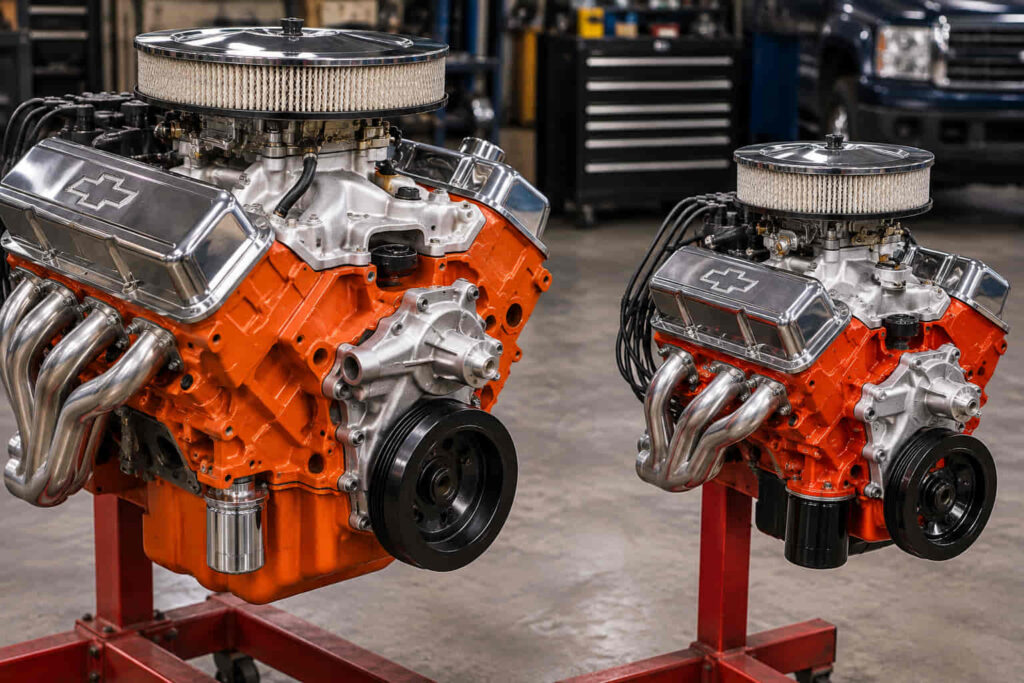
The main difference between a big block vs small block engine is the physical architecture of the engine block, including its dimensions, cylinder spacing, deck height, and capacity to accommodate larger displacement. Big block V8 engines generally have larger external dimensions and greater displacement potential, making them popular for high-torque applications. Small block V8 engines use a more compact architecture that typically reduces weight, improves engine bay packaging, and supports a wide range of performance applications.
However, a big block does not automatically produce more horsepower than a small block, and engine displacement alone does not determine whether an engine is a big block or small block. Modern small block engines can produce more power than many traditional big blocks through improved cylinder head design, higher operating speeds, forced induction, and electronic fuel management.
The Chevrolet 350 small block and 454 big block are classic examples of the difference. The 350 uses a compact engine architecture with a displacement of approximately 5.7 liters, while the 454 uses a larger engine block with a displacement of approximately 7.4 liters. Both engines are V8s, but they belong to different mechanical families.
Understanding the differences in block construction, horsepower, torque, engine weight, fuel economy, reliability, and installation costs helps determine which configuration is more suitable for muscle cars, trucks, street builds, towing, and motorsport.
What Is the Difference Between a Big Block and Small Block Engine?
A big block engine uses a larger engine block architecture designed to accommodate greater cylinder dimensions and displacement potential, while a small block engine is built around a more compact engine family.
The terms became especially popular in American V8 engine development during the 1950s and 1960s.
Automakers needed engines that could serve different vehicle categories.
Compact V8 engines were suitable for passenger cars, lighter vehicles, and applications where space and weight were important.
Larger V8 architectures allowed manufacturers to develop engines with greater displacement, larger cylinders, and the potential for substantial torque output.
The Chevrolet small block and big block families demonstrate this distinction.
The original Chevrolet small block V8 was introduced in 1955 with a displacement of 265 cubic inches.
Its compact architecture eventually supported popular engines such as the 283, 327, 350, and 400.
Chevrolet later developed larger engine families, including the 348 and 409 W-series engines and the Mark IV big block family that included the 396, 427, and 454.
These engines were not simply enlarged versions of the original small block.
They used different engine blocks, cylinder heads, internal dimensions, and supporting components.
The terms big block and small block therefore refer primarily to engine family and design rather than a universal displacement limit.
A modern 427-cubic-inch LS engine can be considered a small block, while a historical Chevrolet 396 is a big block despite having less displacement.
This distinction is essential when comparing performance, purchasing replacement parts, or planning an engine swap.
What Is a Small Block Engine?
A small block engine is a relatively compact V8 engine built around an architecture designed to provide useful horsepower and torque without the size and weight of a traditional big block.
Small block V8 engines became popular because they could fit into a wide variety of vehicles.
Their compact dimensions allowed manufacturers to install V8 power in cars that could not easily accommodate larger engine families.
Chevrolet’s small block V8 is one of the most recognizable examples.
The original 265-cubic-inch engine evolved into larger versions, including the 283, 327, 350, and 400.
The Chevrolet 350 became particularly popular because it offered a useful combination of displacement, performance potential, affordability, and parts availability.
Ford developed its own compact V8 families, including the Windsor engines associated with the 289, 302, and 351W.
Chrysler also produced small block V8 engines, including the 273, 318, 340, and 360 members of its LA family.
These engines have different designs, but they share the general purpose of providing V8 performance in a more compact package.
Modern small block engines are substantially more sophisticated than many of their historical predecessors.
Chevrolet’s LS and LT engine families retain the compact V8 concept while incorporating modern combustion technology, electronic controls, and improved internal components.
Small block architecture does not necessarily mean low displacement or limited power.
For example, the Chevrolet LS7 has a displacement of 427 cubic inches, equivalent to approximately 7.0 liters, while remaining part of the small block engine family.
The term describes its engineering lineage and external architecture rather than a specific engine size.
What Is a Big Block Engine?
A big block engine is a larger V8 engine architecture commonly developed to support greater displacement, substantial torque output, and demanding performance or heavy-load applications.
Traditional American big block engines became especially important during the muscle car era.
Manufacturers used them in high-performance coupes, full-size passenger cars, trucks, and specialized competition vehicles.
The Chevrolet Mark IV big block family is a classic example.
It included the 396, 427, and 454 engines, with later big block developments supporting additional displacements such as 502 cubic inches.
Chevrolet Performance continues offering big block crate engines with displacements ranging from 427 to 632 cubic inches.
The ZZ632/1000 is an extreme example of the architecture’s displacement and power potential.
It uses a 632-cubic-inch, 10.4-liter V8 configuration and is rated by Chevrolet Performance at 1,004 horsepower and 876 lb-ft of torque.
However, this specialized high-performance crate engine should not be considered representative of an ordinary production big block.
Ford developed several larger V8 engine families, including the FE series and the 429/460 family.
Chrysler produced its B and RB big block engines, including the 383, 400, 413, 426, and 440.
Although these engines were produced by different manufacturers, they were generally intended to accommodate larger displacement or substantial performance requirements.
Big block engines typically require more engine bay space and may weigh more than comparable small block engines.
However, modern materials and different engine configurations can change the weight comparison substantially.
A big block is therefore best understood as a larger engine architecture within a particular manufacturer’s engine family.
Does Big Block Mean the Engine Has More Displacement?
Big block engines generally have greater displacement potential, but displacement alone does not determine whether an engine is classified as a big block or small block.
Engine displacement measures the total volume swept by all pistons during one complete stroke.
It is determined by cylinder bore diameter, piston stroke, and the number of cylinders.
Manufacturers can increase displacement by enlarging the cylinder bores, increasing the crankshaft stroke, or combining both changes.
A larger engine block may provide greater space for large cylinder bores and longer crankshaft strokes.
However, modern engineering has allowed compact engine families to achieve displacements previously associated with traditional big blocks.
The Chevrolet LS7 demonstrates this principle.
Its 427-cubic-inch displacement makes it larger than the traditional Chevrolet 396 big block in terms of swept volume.
Nevertheless, the LS7 belongs to General Motors’ small block engine architecture.
Similarly, the Chevrolet LSX454 is built around an LS-based small block architecture despite having a displacement traditionally associated with the Chevrolet 454 big block.
The distinction also appears when comparing different manufacturers.
A Chevrolet 400 small block and a Chrysler 400 big block share the same nominal displacement but belong to completely different engine architectures.
Even within one manufacturer’s lineup, an engine’s nominal displacement cannot always establish its block family.
The most reliable identification method is to determine the engine family, block casting, dimensions, and production configuration.
Displacement is important for performance, but it is not a universal classification system for big block and small block engines.
Big Block vs Small Block Engine Size and Dimensions
Big block engines generally have larger physical dimensions than traditional small block engines, especially in block width, deck height, cylinder spacing, and cylinder head size.
The difference can be understood through Chevrolet V8 engine architecture.
The traditional Chevrolet small block uses approximately 4.40 inches of bore spacing, measured between the centers of adjacent cylinders.
The traditional Chevrolet big block uses approximately 4.84 inches of bore spacing.
This additional spacing provides room for larger cylinder bores and contributes to the big block’s larger overall dimensions.
Deck height is another important measurement.
It describes the distance from the crankshaft centerline to the block’s cylinder deck surface.
A conventional first-generation Chevrolet small block has a nominal deck height of approximately 9.025 inches.
A standard-deck Chevrolet Mark IV-style big block uses approximately 9.80 inches, while certain tall-deck big block configurations are taller.
These dimensions influence cylinder block height, connecting rod and piston geometry, intake manifold fitment, and overall engine packaging.
However, aftermarket racing blocks can use nonstandard dimensions, so these measurements should not be treated as universal limits.
The cylinder heads are also important.
Traditional Chevrolet big block cylinder heads have a larger overall architecture than small block heads.
Their port arrangements, valve sizes, and combustion chamber designs differ.
These characteristics influence airflow potential, but they also affect engine width and weight.
During an engine swap, these dimensional differences may require changes to mounts, exhaust routing, steering clearance, and other vehicle components.
A big block is therefore not merely a small block with larger pistons.
Its fundamental block architecture is different.
Big Block vs Small Block Weight: Which Is Lighter?
Small block engines are generally lighter than traditional big block engines when both use comparable construction materials and similar accessory configurations.
Engine weight influences more than transportation or installation.
It also affects vehicle balance, suspension loading, steering response, and total curb weight.
Traditional big block engines often used large cast-iron blocks and cylinder heads.
Their greater physical dimensions required additional material, increasing the weight of the complete assembly.
Small block engines used more compact castings and typically required less material for their block and head structures.
In a front-engine passenger car, the additional weight of a big block may increase the load over the front axle.
This can affect handling balance, particularly in vehicles originally designed around a lighter engine.
A small block swap may allow the vehicle to retain more favorable weight distribution.
However, engine material makes a substantial difference.
An aluminum big block may weigh less than expected when compared with an iron-block engine equipped with heavy accessories.
Modern aluminum LS engines can be considerably lighter than traditional cast-iron V8 assemblies.
Weight comparisons must also consider whether the engine includes its intake manifold, exhaust manifolds, starter, water pump, and other accessories.
A bare engine block cannot be compared directly with a complete assembled powertrain.
For racing applications, reducing engine weight may improve acceleration, braking, and handling.
For heavy trucks, the effect may be less important than torque delivery and overall load capacity.
The correct choice depends on whether the vehicle benefits more from reduced engine mass or from the characteristics of a larger engine configuration.
Big Block vs Small Block Horsepower: Which Makes More Power?
A big block does not automatically produce more horsepower than a small block. Horsepower depends on torque, engine speed, airflow, combustion efficiency, and the engine’s overall design.
Big block engines often have substantial displacement, allowing them to burn larger amounts of air and fuel during each operating cycle.
This can provide an advantage when developing high power through naturally aspirated configurations.
However, horsepower is not determined by displacement alone.
An engine’s cylinder head design, intake system, camshaft timing, compression ratio, fuel delivery, and operating speed all influence its maximum output.
A modern small block engine may have more efficient airflow and combustion characteristics than an older big block.
For example, Chevrolet’s traditional 350 HO crate engine is advertised at 333 horsepower, while its more advanced ZZ6 small block produces approximately 405 horsepower.
These engines share a nominal 350-cubic-inch displacement but use different performance-oriented components.
The Chevrolet ZZ427/480 big block produces 480 horsepower from 427 cubic inches.
However, Chevrolet’s LS7 427-cubic-inch small block was factory-rated at 505 horsepower in the Corvette Z06.
This comparison demonstrates that the smaller physical architecture can produce greater peak horsepower than a particular larger-block engine.
It does not establish that every LS7 is superior to every big block.
The engines have different design objectives, operating characteristics, and mechanical configurations.
Modern turbocharging and supercharging create an additional consideration.
Forced induction allows smaller engines to increase the amount of air entering their cylinders.
A turbocharged small block can therefore produce far more horsepower than a naturally aspirated big block.
The appropriate comparison is between complete engine specifications rather than between block labels alone.
Big Block vs Small Block Torque: Which Is Better?
Big block engines generally offer a natural advantage in torque production when their greater displacement is combined with suitable combustion, airflow, and camshaft characteristics.
Torque represents the rotational force produced at the crankshaft.
In a piston engine, combustion pressure acts on the piston and transfers force through the connecting rod to the crankshaft.
The total torque output depends on cylinder pressure, displacement, crankshaft geometry, and mechanical efficiency.
A larger-displacement engine can move more air per operating cycle.
When supplied with the appropriate amount of fuel, this provides the potential to generate greater combustion force.
Big block engines have historically been valued for producing substantial torque without requiring extremely high operating speeds.
This made them attractive for heavy cars, trucks, towing, and large-displacement muscle cars.
However, the torque curve is more important than the maximum number alone.
An engine that produces strong torque at relatively low RPM may feel more responsive during ordinary acceleration and heavy-load operation.
Another engine may develop its peak torque at a higher engine speed.
Camshaft selection, intake manifold design, compression ratio, and cylinder head airflow influence these characteristics.
The comparison also changes when forced induction is involved.
A turbocharged small block may produce more torque than a naturally aspirated big block of an older design.
For example, modern small block V8 engines with superchargers can exceed the torque output of many historical large-displacement big blocks.
Therefore, the traditional big block advantage is best described as greater naturally aspirated torque potential from displacement, not a universal rule that every big block produces more torque.
Do Small Block Engines Rev Higher Than Big Blocks?
Small block engines are often associated with higher-RPM performance, but maximum engine speed depends on rotating assembly design, piston speed, valvetrain stability, airflow, and mechanical strength rather than block size alone.
Traditional small block engines frequently appeared in lightweight performance cars and racing applications where higher engine speeds were desirable.
A compact engine with suitable internal components can produce substantial horsepower by operating efficiently at higher RPM.
Big block engines were often configured to produce greater torque at lower engine speeds.
However, this reflected their intended applications and component design rather than an unavoidable mechanical limitation.
The maximum safe RPM of an engine depends heavily on its crankshaft stroke.
Longer strokes increase average piston speed at a given engine RPM.
Higher piston speed increases mechanical demands on the connecting rods, pistons, wrist pins, and other components.
Valvetrain design also matters.
Valve springs, lifters, pushrods, rocker arms, and camshaft profiles must maintain proper valve motion as engine speed increases.
An engine may have sufficient bottom-end strength but become limited by valve float or inadequate airflow.
Modern performance big blocks can operate at engine speeds that would have been unusual for many historical truck-oriented designs.
Chevrolet’s ZZ632/1000, for example, has a published recommended maximum engine speed of 7,000 RPM.
This demonstrates that a large-displacement big block can be engineered for high-speed operation.
The appropriate conclusion is that small block engines can provide packaging and rotating-mass advantages in certain high-RPM applications, while both architectures can be designed for different operating speed ranges.
Big Block vs Small Block Fuel Economy
Small block engines generally have an advantage in fuel economy when compared with larger-displacement big blocks of similar technology and operating conditions, but the actual difference depends on the vehicle and engine design.
Engine displacement influences how much air and fuel the engine can process.
A larger engine can generate more torque, but it may also experience greater internal friction and other operating losses.
Traditional big block vehicles often combined large engines with heavy bodies and gearing intended for acceleration rather than maximum fuel efficiency.
These characteristics contributed to relatively high fuel consumption.
Small block engines were commonly used in lighter vehicles and could provide sufficient performance with less displacement.
However, the comparison is not always straightforward.
A smaller engine operating under heavy load may require greater throttle input or higher RPM to produce the required power.
A larger engine operating at a more favorable load and speed may perform differently than expected.
The vehicle’s transmission and axle ratio also influence fuel consumption.
An engine paired with suitable gearing may operate at a lower cruising speed while maintaining sufficient torque.
Modern engine technology introduces additional variables.
Electronic fuel injection, variable valve timing, direct injection, cylinder deactivation, and improved combustion control can significantly change fuel efficiency.
An older carbureted small block may consume more fuel than a modern larger-displacement engine operating under suitable conditions.
Similarly, two engines with the same displacement can have very different fuel economy ratings.
For daily driving, comparing complete vehicle fuel economy and driving conditions is more useful than selecting an engine based only on its big block or small block classification.
Big Block vs Small Block Reliability and Engine Lifespan
Neither big block nor small block engines are inherently more reliable. Long-term durability depends on the specific engine family, internal components, maintenance, operating temperature, lubrication, and mechanical loading.
Both engine categories have produced engines with strong reputations for durability.
The traditional Chevrolet 350 small block became widely used because it combined practical performance with straightforward maintenance and a large replacement parts market.
Several big block Chevrolet engines also gained reputations for durable service in trucks and heavy-duty applications.
However, the size of the engine block does not guarantee internal strength.
Cylinder wall thickness, main bearing support, crankshaft construction, connecting rod material, cooling system design, and manufacturing quality influence mechanical durability.
A larger block may provide additional material around critical components, but poor machining or inadequate lubrication can still cause failure.
An engine’s intended duty cycle also matters.
A big block designed for sustained heavy-load operation may use different internal components from a high-RPM competition engine.
Likewise, a small block designed for ordinary transportation may have different durability limits from a racing engine using forged components.
Maintenance remains essential.
Low engine oil levels can damage bearings and other moving parts.
Overheating can compromise head gasket sealing and cylinder head condition.
Improper fuel calibration can create abnormal combustion temperatures or detonation in gasoline engines.
Performance modifications can also affect longevity.
Increasing horsepower beyond the capacity of the original rotating assembly or cooling system may shorten service life.
For used-engine buyers, maintenance records and mechanical condition are generally more useful than assuming that a big block will last longer simply because its castings are larger.
Which Is Cheaper to Build: Big Block or Small Block?
Small block engines are often less expensive to build or replace because of their widespread availability, compact design, and established aftermarket parts supply. However, the total cost depends on the engine family and horsepower target.
The traditional Chevrolet 350 small block is a common example of an affordable performance platform.
Its long production history created a substantial supply of replacement parts, rebuilding components, and aftermarket upgrades.
Cylinder heads, camshafts, intake manifolds, pistons, crankshafts, and other components are available from numerous manufacturers.
This competition can help control costs.
Big block engines commonly use larger internal components and may require more expensive cylinder heads or rotating assemblies.
Their larger dimensions may also increase installation expenses when the vehicle was originally designed for a smaller engine.
However, the cost comparison changes at high horsepower levels.
A small block designed to produce substantial power may require an upgraded block, forged rotating assembly, specialized cylinder heads, and forced induction.
A larger-displacement big block may achieve a similar naturally aspirated output with a different combination of components.
The most economical option depends on how much power is required and how the engine will be used.
A basic street rebuild and a dedicated racing engine should not be compared only by displacement.
Installation costs are another important consideration.
A small block replacement may reuse existing engine mounts, transmission connections, and supporting components.
Installing a big block into the same vehicle may require modifications to the engine compartment, suspension, exhaust, cooling system, and transmission.
The complete installed cost is therefore more important than the engine’s advertised purchase price.
Chevy Big Block vs Small Block: What Are the Main Differences?
Chevrolet’s traditional small block and big block engines belong to distinct V8 families with different external dimensions, bore spacing, deck height, cylinder head design, and replacement part compatibility.
The Chevrolet small block was introduced in 1955.
Its original 265-cubic-inch displacement expanded into numerous configurations.
The 283, 327, 350, and 400 became important members of the family.
The 350 gained particularly widespread use in passenger cars, trucks, and performance applications.
Chevrolet’s larger engine development included the 348 and 409 W-series engines introduced before the Mark IV big block.
The Mark IV family appeared in the 1960s and became associated with the 396, 427, and 454.
Later big block developments included larger crate engine configurations such as the 502 and 572.
The 632-cubic-inch ZZ632 represents an extreme modern development of the big block architecture.
One of the most important technical distinctions is bore spacing.
A traditional Chevrolet small block uses 4.40 inches between adjacent cylinder centers.
The conventional Chevrolet big block uses 4.84 inches.
This difference influences the dimensions and displacement potential of the block.
The engine families also use different cylinder heads, intake manifolds, exhaust manifolds, and internal components.
A small block intake manifold generally cannot be installed on a traditional big block.
The same is true for most cylinder heads and rotating assembly components.
Although some Chevrolet transmissions can be adapted to different engines, compatibility should never be assumed for every installation.
Mounting hardware, flywheels, flexplates, starters, and cooling components must match the actual engine and vehicle.
For restoration projects, determining whether the vehicle originally used a small block or big block can significantly affect both parts selection and historical authenticity.
Read more: 7.3 Powerstroke Upgrades
Is the Chevy 350 a Small Block and the 454 a Big Block?
Yes. The Chevrolet 350 is a small block V8, while the Chevrolet 454 is a big block V8. These are two of the clearest examples of the traditional distinction.
The Chevrolet 350 has a displacement of approximately 5.7 liters.
It belongs to the first-generation small block engine family and has been used extensively in passenger cars, pickup trucks, performance cars, and marine applications.
Its popularity comes partly from its compact dimensions and broad aftermarket support.
A 350 can be configured for economical daily driving, classic car restoration, or high-performance use.
The Chevrolet 454 has a displacement of approximately 7.4 liters.
It belongs to the larger big block family and became associated with high-performance muscle cars and heavy-duty truck applications.
The engine’s greater displacement allows it to produce substantial torque when equipped with suitable cylinder heads, camshaft timing, and fuel delivery components.
However, the 454 is not automatically the better engine for every vehicle.
A 350 may provide sufficient power while reducing engine weight and installation complexity.
The 454 may offer greater naturally aspirated torque potential but require additional engine bay space and supporting drivetrain capacity.
The original vehicle configuration is important.
Installing a 454 in a car designed for a small block may require changes to engine mounts, exhaust routing, cooling, and suspension.
Conversely, replacing an original big block with a small block may reduce weight but change the vehicle’s performance characteristics.
The decision depends on whether the owner prioritizes torque, cost, handling, originality, or maximum performance.
Can a 427 Be a Small Block and a Big Block?
Yes. A 427-cubic-inch V8 can be either a small block or a big block because the classification depends on the engine’s mechanical architecture, not its displacement.
Chevrolet provides a particularly useful example.
The traditional Chevrolet 427 big block belongs to the Mark IV and related big block families.
It uses the larger Chevrolet big block architecture.
Chevrolet Performance’s ZZ427/480 is a modern crate engine based on this configuration.
It features a 427-cubic-inch displacement, a 4.250-inch bore, and a 3.750-inch stroke.
The engine is rated at 480 horsepower and 490 lb-ft of torque.
However, Chevrolet also produced the LS7.
The LS7 is a 427-cubic-inch, 7.0-liter V8 belonging to the LS small block family.
It uses a 4.125-inch bore and a 4.000-inch stroke.
Despite having the same nominal displacement as the big block 427, its engine block architecture is different.
The LS7 was used in performance vehicles such as the Corvette Z06.
Its factory output was rated at 505 horsepower in that application.
The two engines use different block dimensions, cylinder heads, internal components, and engine management systems.
They are not interchangeable simply because both are identified as 427 engines.
This is why displacement alone is an unreliable way to identify engine family.
The same principle applies to modern aftermarket stroker engines.
A manufacturer may develop a high-displacement small block without changing its fundamental family classification.
When comparing engines, the exact block architecture and engine code should take precedence over the cubic-inch number.
Ford Big Block vs Small Block Engines
Ford developed multiple small block and big block V8 families, and the correct classification depends on the specific engine architecture rather than displacement alone.
The Ford Windsor engine family is among the company’s best-known small block designs.
It includes the 221, 260, 289, 302, and 351 Windsor engines.
The 289 and 302 became particularly associated with the Ford Mustang and other performance-oriented vehicles.
The 351 Windsor offered greater displacement while retaining its place within Ford’s small block family.
Ford also developed the 351 Cleveland, which uses a different architecture from the Windsor engine.
Although the two engines share nominal displacement, their cylinder heads, block designs, and components differ.
The Cleveland is generally grouped with Ford’s small block engine families.
Ford’s FE engine family is a recognized big block design.
It includes engines such as the 332, 352, 390, 427, and 428.
The 427 FE became closely associated with high-performance Ford vehicles and motorsport.
The separate 385-series big block family included the 429 and 460 engines.
These engines were used in passenger cars, trucks, and other applications requiring substantial displacement and torque.
The 429 and 460 are not the same engine family as the FE-series 427 and 428.
This distinction is important when ordering cylinder heads, intake components, and other parts.
Ford engine classification is sometimes more complicated than a simple small block versus big block description.
For example, the 351 Modified and 400 belong to an architecture related to the Cleveland family but use taller block dimensions than a conventional 351 Cleveland.
Modern Ford engines introduce additional design families that do not always fit neatly into historical terminology.
For a Ford engine swap or rebuild, identifying the exact engine family is more reliable than relying only on displacement.
Mopar Big Block vs Small Block Engines
Chrysler’s traditional small block engines include the 318, 340, and 360, while its big block families include the B-series 383 and 400 and the RB-series 413, 426 wedge, and 440.
Mopar is a common name associated with Chrysler, Dodge, and Plymouth performance vehicles.
Its traditional V8 engines have distinct family classifications.
The LA small block family became widely used in passenger cars, trucks, and performance applications.
The 318 provided a practical V8 option for many vehicles.
The 340 became popular in performance-oriented applications, while the 360 offered greater displacement within the same broad small block family.
Chrysler’s big block architecture developed differently.
The B-series engines included configurations such as the 361, 383, and 400.
The RB designation refers to the raised-block architecture, which uses a taller deck height.
The RB family includes engines such as the 413, 426 wedge, and 440.
This explains why the Chrysler 383 is a big block while the Chevrolet 383 stroker is commonly considered a small block.
The two engines share a displacement number but belong to different manufacturers and architectures.
Chrysler’s famous 426 Hemi adds another important distinction.
It uses a specialized hemispherical combustion chamber cylinder head design and belongs to the historical big block performance tradition.
However, the modern 5.7-liter and 6.4-liter HEMI engines are separate engine families and should not automatically be classified using the same assumptions applied to the original 426 Hemi.
For Mopar restoration and performance projects, engine family identification is essential because the B, RB, LA, and HEMI architectures use different components.
Are Modern LS and LT Engines Small Blocks?
Yes. Chevrolet’s modern LS and LT V8 engine families are classified as small block engines, even though certain versions have substantial displacement and produce very high horsepower.
The LS engine family introduced major changes to General Motors’ small block V8 design.
Its architecture combines compact external dimensions with modern materials, electronic fuel injection, and advanced engine management.
The LS1 became well known through the Chevrolet Corvette and Camaro.
Later versions included engines such as the LS2, LS3, LS7, and supercharged LS9.
The LS7 is especially important because it demonstrates that a 427-cubic-inch engine can remain a small block.
Modern LT engines continue the small block concept with updated combustion and fuel delivery technology.
Some LT engines use direct injection and forced induction to produce significant power without requiring a traditional big block architecture.
The compact dimensions of the LS and LT families have also made them popular for engine swaps.
A modern small block may fit into vehicles originally designed for older small block engines, although installation still requires compatible mounts, electronics, transmission components, and other supporting systems.
However, LS engines are not completely interchangeable with first-generation Chevrolet small blocks.
Their internal architecture, cylinder heads, intake systems, and electronic controls differ significantly.
The term small block therefore covers different generations of Chevrolet engine engineering.
It should not be interpreted as meaning every small block shares the same mechanical components.
Modern LS and LT engines illustrate how improved engineering can provide substantial horsepower and torque within a relatively compact engine package.
Big Block vs Small Block for Towing and Trucks
Big block engines have historically been favored for heavy towing because their larger displacement can provide substantial low- and mid-range torque, but the best towing engine depends on its actual torque curve, transmission, gearing, and vehicle capacity.
Towing requires sustained power under load.
A truck pulling a heavy trailer may need significant torque during acceleration, hill climbing, and highway cruising.
Traditional gasoline big block engines were popular in heavy-duty truck applications because their displacement allowed them to produce strong torque without operating at extremely high engine speeds.
The Chevrolet 454 and Ford 460 are recognizable examples of large-displacement gasoline V8 engines used in heavy-duty vehicles.
However, greater engine displacement also increases potential fuel consumption and may add weight.
Modern small block engines can deliver strong towing performance through improved combustion efficiency and transmission integration.
Some modern engines also use turbocharging to produce substantial torque at relatively low RPM.
The correct engine should therefore be evaluated through its actual manufacturer performance ratings.
Peak horsepower is not the only relevant figure.
The torque available throughout the operating range determines how effectively the engine can maintain speed under load.
The transmission and axle ratio must also be considered.
An engine with substantial torque may not perform optimally if its gearing is poorly matched to the trailer and operating conditions.
Cooling system capacity is equally important.
Sustained towing increases engine and transmission heat.
A vehicle’s official towing capacity is determined by the complete vehicle configuration, not simply by installing a larger engine.
For older truck builds, a big block may be an effective choice when torque is the priority.
For modern towing, the complete powertrain and rated vehicle capacity are more important than the traditional engine block classification.
Big Block vs Small Block for Drag Racing and Performance Builds
Both big block and small block engines can be highly effective in drag racing, but the best choice depends on required horsepower, vehicle weight, traction, budget, and the racing class.
Big block engines offer substantial displacement potential.
This can be advantageous for naturally aspirated competition applications where increasing cylinder volume helps produce additional torque and horsepower.
Large displacement may also reduce the engine speed required to achieve a particular power target.
However, a big block often adds weight to the vehicle.
Additional weight can affect acceleration and front-to-rear balance.
In a lightweight racing car, a smaller engine package may provide advantages in packaging and weight distribution.
Small block engines are also capable of producing substantial racing output.
Modern high-performance small blocks can use forged rotating assemblies, specialized cylinder heads, high engine speeds, and forced induction.
Turbochargers and superchargers can dramatically increase airflow and horsepower potential.
Therefore, maximum displacement is not the only route to strong performance.
The racing rules may also influence engine choice.
Some classes restrict engine displacement, cylinder head design, induction systems, or vehicle weight.
A well-designed small block may be more competitive in a class where lower mass or specific engine restrictions matter.
In an unrestricted high-displacement naturally aspirated class, a big block may provide advantages.
Reliability and maintenance cost must also be considered.
An engine producing extreme horsepower may require specialized parts and frequent inspection regardless of block classification.
For competitive racing, the ideal engine is the one that delivers the required power within the vehicle’s weight, traction, rules, and budget constraints.
Which Is Better for a Street Car: Big Block or Small Block?
A small block is generally the more practical choice for a street car that prioritizes manageable weight, engine bay space, everyday drivability, and lower operating costs. A big block can be attractive when the owner wants traditional large-displacement torque and muscle car character.
Street driving places different demands on an engine than racing.
The engine must operate smoothly during traffic, start reliably, maintain acceptable temperatures, and provide predictable throttle response.
A compact small block can simplify installation in many older vehicles.
Its lower weight may also reduce the need for suspension changes.
The broad aftermarket for popular small block families can make routine maintenance and upgrades more affordable.
Modern LS-based small blocks are especially popular because they combine relatively compact dimensions with electronic fuel injection and strong performance potential.
A big block street build offers a different experience.
Its greater displacement can provide substantial torque and acceleration without requiring an extremely aggressive high-RPM configuration.
For classic muscle cars, an original or period-correct big block may also have historical appeal.
However, engine bay clearance, fuel consumption, cooling requirements, and total vehicle weight deserve attention.
A large engine with an aggressive camshaft may produce poor idle quality or reduced low-speed drivability.
Likewise, a poorly calibrated small block can be unpleasant for everyday use.
The camshaft, intake system, fuel delivery, transmission, and axle gearing influence street behavior as much as the block family.
For most practical performance builds, choosing a balanced engine combination is more important than selecting the largest displacement available.
Is a Big Block Engine Swap Harder Than a Small Block Swap?
Installing a big block into a vehicle originally designed for a small block often requires additional modifications because the engine may be wider, taller, heavier, and more demanding of the vehicle’s cooling and drivetrain systems.
Engine swaps require careful planning.
The engine must fit within the compartment without interfering with the hood, steering system, suspension, firewall, or other components.
A traditional big block may require different engine mounts or mounting brackets.
Exhaust manifold clearance can become a problem because the cylinder heads and exhaust ports occupy different positions.
A larger radiator or upgraded cooling system may be necessary depending on the engine and intended use.
The transmission must also be compatible.
Different engine families may use different bellhousing patterns, flywheels, flexplates, or torque converter arrangements.
Even when a transmission can be mounted, it may not have sufficient torque capacity for the new engine.
Suspension requirements should also be considered.
Additional engine weight can affect front springs, ride height, and handling balance.
Brake system condition and overall vehicle safety are important, especially when the engine substantially increases performance.
A small block swap may simplify some of these challenges.
Its compact architecture can make it easier to install in smaller engine compartments.
However, modern small blocks introduce additional requirements.
Electronic fuel injection, engine control modules, wiring harnesses, fuel pumps, and sensors may require extensive integration.
A carbureted big block can sometimes be simpler electronically than a modern fuel-injected small block, even though it is physically larger.
The easiest swap therefore depends on the original vehicle and the exact replacement engine.
Compatibility should be confirmed before purchasing the engine or supporting parts.
How Can You Tell If an Engine Is Big Block or Small Block?
The most reliable way to identify a big block or small block is to determine the engine family through casting numbers, manufacturer specifications, and distinctive block features rather than relying only on displacement or visual size.
The engine’s identification markings are often the best starting point.
Traditional Chevrolet engines have casting numbers and production codes located on specific areas of the engine block.
These markings can help identify the engine family and manufacturing period.
The physical proportions may provide additional clues.
A traditional Chevrolet big block is generally wider and taller than a conventional first-generation Chevrolet small block.
Its cylinder heads and valve covers also have different shapes.
However, visual identification can be misleading when aftermarket components are installed.
A modified small block may have tall valve covers, a large intake manifold, or other components that make it appear larger.
The distributor location and accessory arrangement can help identify certain engine families.
However, these features vary across manufacturers.
For example, Chrysler small block and big block engines use different distributor mounting locations.
Ford engine families also have distinctive timing covers, intake manifold designs, and block configurations.
A Chevrolet LS engine differs substantially in appearance from a first-generation small block despite sharing the small block classification.
Engine displacement should be treated as supporting information rather than conclusive proof.
A 400 may be a Chevrolet small block or Chrysler big block.
A 427 may belong to a Chevrolet big block, Ford FE big block, or Chevrolet LS small block family.
Accurate identification is especially important when ordering cylinder heads, intake manifolds, gaskets, pistons, and other components.
The manufacturer’s engine code and technical documentation provide the most dependable reference.
Which Engine Has Better Aftermarket Parts Availability?
Traditional Chevrolet small block engines have exceptionally broad aftermarket support, while popular Chevrolet big block, Ford, Mopar, and modern LS engine families also have substantial performance parts availability.
Aftermarket support affects the cost and complexity of maintaining or modifying an engine.
The Chevrolet 350 small block has been used for decades across numerous applications.
This created a large market for replacement components and performance upgrades.
Cylinder heads, intake manifolds, camshafts, crankshafts, pistons, and other parts are available in many configurations.
Modern LS engines also have extensive aftermarket support.
Their popularity in engine swaps and performance builds has encouraged manufacturers to develop compatible mounts, wiring systems, fuel injection components, exhaust systems, and other installation products.
Big block Chevrolet engines remain well supported in the muscle car and racing markets.
The 454 and 502 families are especially relevant to high-displacement performance builds.
However, parts availability is not equally strong for every big block engine.
Certain historical Ford FE or specialized Mopar applications may require more careful component sourcing.
Rare cylinder heads, original intake manifolds, and model-specific accessories can be expensive.
The availability of reproduction parts may also vary.
Some performance components are intended primarily for racing and may not be appropriate for ordinary road use.
The best engine family for a budget-oriented project is often one with readily available parts and qualified local service support.
An uncommon big block may offer distinctive performance or historical value, but the cost of maintaining originality can be substantial.
For practical ownership, parts availability should be considered alongside horsepower and torque.
Big Block vs Small Block: Which Engine Should You Choose?
Choose a small block engine when compact dimensions, reduced weight, affordability, and flexible performance options are the priorities. Choose a big block when the project benefits from greater displacement potential, substantial naturally aspirated torque, or a period-correct large-displacement V8.
The decision should begin with the intended vehicle application.
A lightweight street car may benefit from the more compact package of a small block.
The engine can provide sufficient horsepower without adding unnecessary weight over the front axle.
A classic muscle car restoration may require a particular big block to preserve its original mechanical configuration and historical identity.
For an older heavy-duty truck, a large-displacement gasoline big block may provide the torque characteristics desired for towing.
However, a modern smaller engine with suitable gearing and electronic controls can also deliver strong towing performance.
Horsepower targets matter as well.
A moderate street performance goal may be achieved economically using a traditional 350 or modern LS-based engine.
A naturally aspirated build targeting very high torque may benefit from the greater displacement potential of a big block.
Forced induction changes the calculation.
A turbocharged small block can produce substantial power while occupying less space than a traditional big block.
Cost should be evaluated through the complete engine and vehicle combination.
The initial engine price is only one part of the expense.
Transmission compatibility, cooling system upgrades, mounts, exhaust, electronics, and installation labor can substantially affect the final cost.
Reliability should also influence the decision.
An engine built and calibrated correctly for its intended use is generally a better investment than an oversized or poorly matched powertrain.
The best choice is not simply the bigger engine, but the one whose performance characteristics and installation requirements match the vehicle.
Final Verdict: Big Block vs Small Block — Which Is Better?
The fundamental difference between a big block and small block engine is the engine’s physical architecture, not simply its displacement or horsepower. Big block engines generally use larger blocks with greater cylinder spacing and displacement potential, while small block engines use more compact designs suited to a broad range of vehicles.
Traditional big blocks became popular for their substantial torque and large-displacement performance.
The Chevrolet 454, Ford 460, and Chrysler 440 are recognizable examples.
Traditional small blocks such as the Chevrolet 350, Ford 302, and Chrysler 360 gained popularity because they offered strong performance in lighter and more compact packages.
However, modern engineering has reduced the performance gap between the two categories.
Chevrolet’s LS7 demonstrates that a 427-cubic-inch engine can be a small block, while the traditional Chevrolet 427 remains a big block.
Advanced cylinder heads, electronic fuel injection, improved internal components, and forced induction allow modern small blocks to deliver horsepower that exceeds many older big block engines.
Big blocks still offer important advantages in applications requiring substantial naturally aspirated displacement and torque.
Small blocks often provide benefits in engine weight, packaging, aftermarket affordability, and engine swap flexibility.
Neither architecture automatically guarantees better fuel economy, reliability, or maximum horsepower.
For most street cars and cost-conscious performance builds, a small block is usually the more practical option. For classic muscle cars, heavy-load applications, and large-displacement naturally aspirated performance, a big block can be the better fit.
Ultimately, the best engine depends on its specific design, horsepower and torque curve, weight, supporting drivetrain, budget, and intended operating conditions rather than the big block or small block label alone.