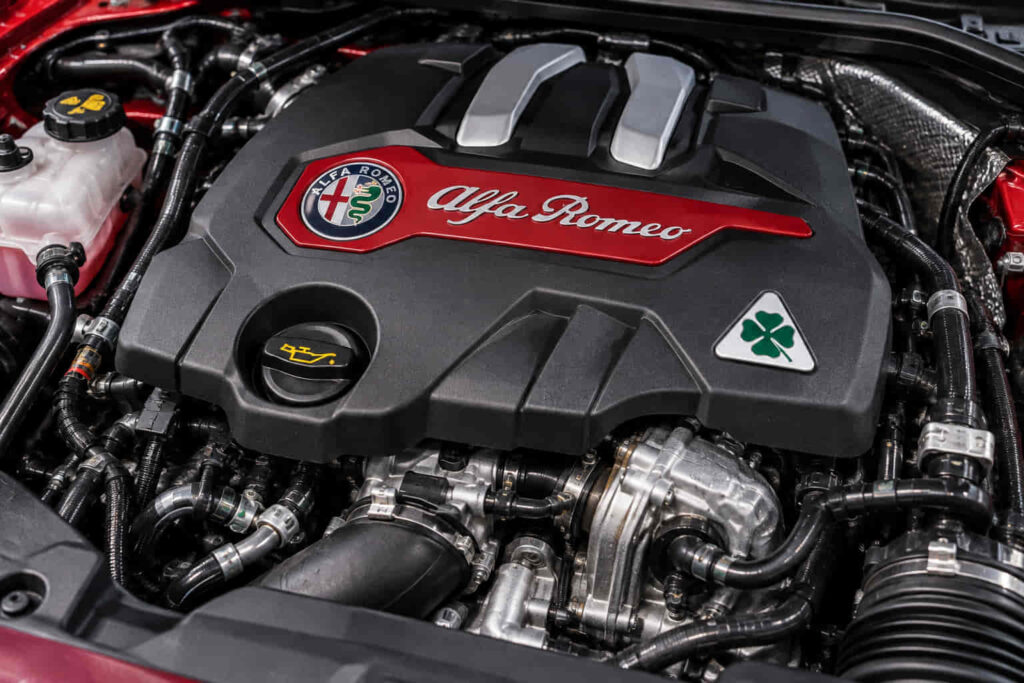
Who makes Alfa Romeo engines? Alfa Romeo engines are developed and manufactured through Stellantis, the automotive group that owns Alfa Romeo, Fiat, Jeep, Maserati, and several other brands. Many of Alfa Romeo’s modern gasoline engines have been produced at the Termoli engine plant in Italy, while its 2.2-liter diesel engines have been manufactured at Pratola Serra. However, the exact manufacturer and production location depend on the engine family and model year.
One of the most frequently misunderstood Alfa Romeo engines is the 2.9-liter twin-turbocharged V6 used in the Giulia Quadrifoglio and Stelvio Quadrifoglio. Although this engine incorporates Ferrari-derived engineering, it was developed specifically for Alfa Romeo and manufactured within the Fiat Chrysler Automobiles engine production network rather than being a standard Ferrari engine.
Other Alfa Romeo models use powertrains based on technology shared across Stellantis. The Giulia and Stelvio feature the 2.0-liter turbocharged gasoline engine, while the Tonale and Junior use different gasoline, hybrid, or electric configurations depending on the market. Historical Alfa Romeo vehicles also used engines developed in-house, including the famous Busso V6, as well as engines associated with Fiat, General Motors, and Maserati.
Understanding these relationships helps explain where Alfa Romeo engines are made, whether Ferrari actually manufactures them, and how their engineering compares with other Italian and European automotive brands.
Who Actually Manufactures Alfa Romeo Engines?
Stellantis is the automotive group responsible for manufacturing most modern Alfa Romeo engines, with engine development and production carried out through its Italian powertrain operations and associated engineering facilities.
Alfa Romeo is an Italian automotive brand founded in 1910 and headquartered in the Milan area. Throughout its history, the company has developed numerous engines that contributed to its reputation for performance-oriented vehicles.
However, Alfa Romeo’s corporate structure has changed considerably over time.
Fiat acquired Alfa Romeo in 1986, bringing the brand into a larger automotive manufacturing group. Alfa Romeo subsequently became part of Fiat Chrysler Automobiles, commonly known as FCA.
In January 2021, Fiat Chrysler Automobiles merged with PSA Group to create Stellantis.
As a result, Alfa Romeo now operates within a multinational automotive company that coordinates engineering, manufacturing, technology development, and component purchasing across multiple brands.
This shared structure explains why some Alfa Romeo engines have engineering relationships with powerplants used in Fiat, Jeep, Dodge, or other Stellantis vehicles.
However, a shared engine family does not necessarily mean that the powerplants are mechanically identical.
Alfa Romeo may use different turbochargers, fuel injection calibration, intake components, cooling arrangements, and engine management software to meet its own performance requirements.
The Giulia and Stelvio are particularly important examples of Alfa Romeo-specific engine development.
When these vehicles were introduced, their gasoline and diesel engines were manufactured in Italy at dedicated production areas within the FCA engine manufacturing network.
For the gasoline engines, Termoli was the principal production location. The 2.2-liter diesel engine was produced at Pratola Serra.
The manufacturer is therefore best identified as Alfa Romeo and Stellantis through their integrated powertrain operations, rather than Ferrari or Fiat acting as an unrelated external supplier.
However, different engine families have different origins, making individual engine identification essential.
Does Ferrari Make Alfa Romeo Engines?
Ferrari has contributed engineering technology and expertise to certain Alfa Romeo engines, but Ferrari does not manufacture every Alfa Romeo engine, and the Giulia Quadrifoglio V6 should not be described as an ordinary Ferrari production engine.
The connection between Ferrari and Alfa Romeo is especially strong in the high-performance Quadrifoglio models.
The 2.9-liter twin-turbocharged V6 used in the Giulia Quadrifoglio was developed with engineering technology originating from Ferrari.
In 2015, Fiat Chrysler Automobiles officially announced that its Termoli engine plant had been selected to manufacture two new engines for Alfa Romeo.
One was an advanced four-cylinder gasoline engine.
The other was described as a Ferrari-derived six-cylinder engine developed specifically for Alfa Romeo.
This announcement establishes an important distinction between the origin of the engineering and the location of manufacturing.
Ferrari-derived does not necessarily mean Ferrari-built.
The V6 was designed to meet Alfa Romeo’s own vehicle architecture, performance requirements, emissions standards, and production objectives.
Manufacturing was assigned to the Termoli plant within FCA’s Italian engine production operations.
The engine later became one of Alfa Romeo’s most recognizable modern powerplants.
Its twin-turbocharged configuration provides strong acceleration and high power output while maintaining the characteristics required for road-going performance sedans and SUVs.
Ferrari technology also influenced certain historical Alfa Romeo projects.
The 8C Competizione, for example, used a V8 closely associated with the Ferrari-manufactured Maserati engine family.
However, it would be incorrect to assume that every Alfa Romeo equipped with a V6 or V8 contains a Ferrari-manufactured engine.
The answer depends on the particular powerplant and its engineering history.
Who Makes the Alfa Romeo Giulia Engine?
The Alfa Romeo Giulia’s gasoline and diesel engines were developed within the Fiat Chrysler Automobiles powertrain program, with original production assigned to Termoli for gasoline engines and Pratola Serra for diesel engines.
The modern Giulia was introduced in 2015 as an important part of Alfa Romeo’s return to the premium sports sedan market.
It uses a longitudinal engine layout and rear-wheel-drive-based architecture, with all-wheel drive available in selected configurations.
The standard gasoline engine is a turbocharged 2.0-liter inline-four.
This all-aluminum engine uses direct gasoline injection and advanced valve control technology to produce substantial torque from a relatively compact displacement.
In the United States, the 2026 Giulia is equipped with a 2.0-liter turbocharged four-cylinder engine producing 280 horsepower and 306 lb-ft of torque.
Power is delivered through an eight-speed automatic transmission.
The engine was developed to support both everyday driving and the responsive performance expected from Alfa Romeo.
Earlier European Giulia models were offered with several gasoline and diesel configurations.
The 2.2-liter turbo-diesel was manufactured at Pratola Serra and used MultiJet II fuel injection technology.
Its power output varied according to the engine configuration and market.
The Giulia Quadrifoglio uses a completely different engine.
Its 2.9-liter twin-turbocharged V6 was developed specifically for Alfa Romeo with Ferrari-derived technology.
The V6 is not simply a larger version of the Giulia’s standard four-cylinder engine.
Its internal architecture, cylinder arrangement, turbocharging system, and performance characteristics differ substantially.
Therefore, identifying who makes a Giulia engine requires knowing whether the vehicle uses the 2.0-liter gasoline engine, 2.2-liter diesel, or 2.9-liter Quadrifoglio V6.
Who Makes the Alfa Romeo Stelvio Engine?
The Alfa Romeo Stelvio uses engines developed through Alfa Romeo’s Stellantis powertrain operations, including the 2.0-liter turbocharged gasoline engine and the Ferrari-derived 2.9-liter twin-turbocharged V6 found in the Quadrifoglio.
The Stelvio is Alfa Romeo’s performance-oriented luxury SUV.
Although it shares important engineering features with the Giulia, its engine calibration and drivetrain configuration are adapted to the requirements of an SUV.
The standard 2026 U.S.-market Stelvio uses a turbocharged 2.0-liter inline-four engine.
It produces approximately 280 horsepower and 306 lb-ft of torque and is paired with an eight-speed automatic transmission and Q4 all-wheel drive.
Alfa Romeo’s original technical documentation identifies Termoli as the manufacturing location for the Stelvio’s gasoline engine.
Selected earlier European Stelvio versions also used a 2.2-liter diesel engine manufactured at Pratola Serra.
The Stelvio Quadrifoglio is powered by the 2.9-liter twin-turbocharged V6.
This engine uses Ferrari-derived technology and is designed to provide substantially greater horsepower and torque than the standard four-cylinder version.
The Quadrifoglio also incorporates upgraded vehicle systems to support its higher performance.
These include specialized suspension, braking, drivetrain, and engine management configurations.
However, the engine remains part of Alfa Romeo’s own performance vehicle program rather than being supplied as a conventional Ferrari production-car engine.
The standard Stelvio and Stelvio Quadrifoglio should therefore be evaluated as different powertrain configurations.
Their maintenance requirements, component prices, diagnostic procedures, and operating characteristics are not identical.
Who Makes the Alfa Romeo Quadrifoglio V6 Engine?
The Alfa Romeo Quadrifoglio 2.9-liter twin-turbocharged V6 was developed specifically for Alfa Romeo using Ferrari-derived engineering and manufactured at the Termoli engine plant in Italy.
This engine is one of the most important powerplants in Alfa Romeo’s modern history.
It was introduced with the Giulia Quadrifoglio and later adapted for the Stelvio Quadrifoglio.
The engine features six cylinders arranged in a 90-degree V configuration.
Its aluminum construction helps reduce engine weight, while two turbochargers increase the amount of air entering the cylinders.
The original European specification produced approximately 510 metric horsepower and 600 Nm of torque.
Later versions received different performance ratings depending on the vehicle, market, and model year.
The engine’s high power output is achieved through a combination of forced induction, precise fuel delivery, combustion management, and carefully engineered internal components.
Ferrari’s influence is relevant to the engine’s development.
Alfa Romeo has explicitly described the powerplant as Ferrari-inspired or Ferrari-derived in its official communications.
However, the company also identifies the engine as a product developed specifically for Alfa Romeo.
The manufacturing distinction is supported by FCA’s 2015 announcement naming Termoli as the production location.
This means the Quadrifoglio V6 should not be confused with a Ferrari engine that was simply removed from another sports car and installed in an Alfa Romeo.
It is an Alfa Romeo-specific engine with engineering links to Ferrari technology.
For owners and technicians, this distinction matters when purchasing replacement parts.
Components designed for a Ferrari engine should not automatically be considered compatible with the Alfa Romeo V6.
The correct engine code and Alfa Romeo service specifications must be used.
Is the Alfa Romeo 2.9 V6 the Same as a Ferrari V8?
The Alfa Romeo 2.9-liter V6 shares engineering heritage with Ferrari performance engine technology, but it is not mechanically identical to a Ferrari V8.
The most frequently discussed comparison involves Ferrari’s F154 twin-turbocharged V8 family.
Both designs use high-performance turbocharged gasoline engine technology and a 90-degree cylinder-bank arrangement.
The Ferrari relationship helped influence the development of Alfa Romeo’s six-cylinder engine.
However, describing the Alfa Romeo V6 as merely a Ferrari V8 with two cylinders removed oversimplifies the engineering process.
A production engine requires much more than a cylinder count and displacement.
The crankshaft, engine block, cylinder heads, combustion system, lubrication passages, engine mounts, and electronic control system must function together as a complete design.
Changing the number of cylinders also affects crankshaft geometry, engine balance, firing intervals, and vibration characteristics.
The Alfa Romeo V6 was engineered to operate within the Giulia and Stelvio vehicle platforms.
Its dimensions, power delivery, emissions systems, and supporting components were developed around those applications.
A Ferrari V8 may share certain engineering principles, but that does not make the major assemblies interchangeable.
Likewise, the maintenance requirements of the two engines can differ.
Oil specifications, cooling components, turbocharger arrangements, sensors, and internal engine parts should be selected according to the exact manufacturer service information.
For automotive enthusiasts, the Ferrari connection is an important part of the Quadrifoglio’s engineering history.
For mechanical servicing, however, the Alfa Romeo 2.9-liter V6 must be treated as a distinct engine family.
Where Are Alfa Romeo Engines Manufactured?
Many modern Alfa Romeo engines have been manufactured in Italy, particularly at Termoli and Pratola Serra, while historical Alfa Romeo engines were also produced at Arese and other Fiat-group manufacturing facilities.
The production location depends on the engine generation.
For the modern Giulia and Stelvio programs, Alfa Romeo officially identified two principal Italian engine manufacturing sites.
The Termoli factory was responsible for gasoline engine production.
The Pratola Serra factory manufactured the 2.2-liter turbo-diesel.
Both facilities formed part of Fiat Chrysler Automobiles’ powertrain operations before the creation of Stellantis.
The Termoli plant was selected to manufacture the turbocharged four-cylinder gasoline engine and Ferrari-derived six-cylinder engine developed for Alfa Romeo.
The Pratola Serra factory has a long history of producing gasoline and diesel engines for Fiat-group brands.
Earlier Alfa Romeo vehicles also used engines manufactured at Arese, near Milan.
Arese became especially important because it was the production home of the famous Alfa Romeo Busso V6.
The original Busso engine family remained closely associated with Alfa Romeo’s independent engine engineering identity.
Certain Twin Spark engines were manufactured at Pratola Serra as Alfa Romeo’s production operations became increasingly integrated with Fiat.
More recent Alfa Romeo models use additional shared Stellantis powertrain technologies.
For these engines, the precise assembly plant can vary according to the powertrain family and production arrangement.
It is therefore incorrect to assume that every Alfa Romeo engine has always been manufactured at one factory.
The more accurate explanation is that Alfa Romeo has a long history of Italian engine manufacturing, with production increasingly coordinated through the wider Fiat, FCA, and Stellantis groups.
Does Fiat Make Alfa Romeo Engines?
Fiat and its successor automotive groups have played a major role in Alfa Romeo engine development and manufacturing since Fiat acquired Alfa Romeo in 1986.
The relationship changed how Alfa Romeo engines were engineered and produced.
Before becoming part of Fiat, Alfa Romeo had a substantial history of independent engine design.
Its engineers developed distinctive four-cylinder and V6 engines used in both passenger cars and competition vehicles.
Following the acquisition, Alfa Romeo gained access to Fiat’s powertrain development resources, manufacturing facilities, and component technologies.
This led to increased sharing of engine architectures across the group.
Fiat Powertrain Technologies became an important part of the manufacturing and engineering structure supporting both Fiat and Alfa Romeo vehicles.
However, sharing an engine architecture does not mean every Alfa Romeo engine was identical to the engine installed in a Fiat passenger car.
Alfa Romeo often used its own cylinder head designs, intake systems, calibration strategies, and performance-oriented modifications.
The Twin Spark and JTS engine families provide examples of Alfa Romeo’s distinctive approach to gasoline engine technology.
Later engines incorporated MultiAir valve control, direct injection, turbocharging, and other developments created through group-wide engineering programs.
The modern Giulia and Stelvio engines emerged during the FCA period.
Their development was supported by the wider company’s technical resources while maintaining configurations specific to Alfa Romeo.
Today, the relationship continues under Stellantis.
Fiat and Alfa Romeo are separate vehicle brands within the same automotive group, not unrelated companies operating through a conventional supplier arrangement.
The answer to whether Fiat makes Alfa Romeo engines is therefore historical and organizational.
Fiat-group engineering and production facilities have manufactured many Alfa Romeo engines, while modern production is coordinated through Stellantis.
Who Makes the Alfa Romeo Tonale Engine?
The Alfa Romeo Tonale uses engines developed within Stellantis powertrain programs, with gasoline, hybrid, plug-in hybrid, and diesel options varying by market and model year.
The Tonale is a compact luxury SUV designed to combine Alfa Romeo’s performance-oriented identity with more efficient powertrain technology.
Its engine lineup differs significantly between Europe and North America.
For the 2026 U.S. market, the Tonale uses a 2.0-liter turbocharged four-cylinder gasoline engine.
This engine produces 268 horsepower and 295 lb-ft of torque.
It is paired with a nine-speed automatic transmission and Q4 all-wheel drive.
The engine belongs to Stellantis’ Global Medium Engine technology family, which is used in different configurations across multiple vehicle brands.
However, the Tonale receives Alfa Romeo-specific vehicle calibration and powertrain integration.
European versions use different configurations.
The updated Tonale lineup includes a 1.5-liter hybrid producing 175 metric horsepower in combined system output.
A 1.3-liter plug-in hybrid version delivers 270 metric horsepower and uses electric propulsion to support all-wheel drive.
A 1.6-liter turbo-diesel remains available in selected European markets.
These powertrains draw from different Stellantis engine development programs.
The four-cylinder hybrid engines are not simply smaller versions of the Giulia Quadrifoglio V6.
Their architecture, fuel delivery, electrification systems, and intended performance characteristics differ.
For this reason, identifying the manufacturer of a Tonale engine requires checking the market and model year.
A 2026 U.S.-market Tonale and a 2026 European Tonale Hybrid do not necessarily use the same gasoline engine.
Who Makes the Alfa Romeo Junior Engine?
The Alfa Romeo Junior uses a Stellantis-developed 1.2-liter turbocharged three-cylinder engine in its hybrid configurations, while fully electric Junior models use electric propulsion instead of a gasoline engine.
The Junior represents Alfa Romeo’s entry into the premium compact SUV market.
Unlike the Giulia and Stelvio, which use a rear-wheel-drive-based architecture, the Junior is developed around a compact platform shared within Stellantis.
Its powertrain reflects this different vehicle design.
The Junior Ibrida combines a 1.2-liter turbocharged three-cylinder gasoline engine with a 48-volt hybrid system.
The electric motor is integrated with a six-speed dual-clutch transmission.
This configuration allows the hybrid system to provide electrical assistance during suitable operating conditions.
A Junior Ibrida Q4 version adds an electrified rear axle to provide all-wheel-drive capability without using the same conventional mechanical arrangement found in larger Alfa Romeo models.
The vehicle’s gasoline engine architecture is related to the wider Stellantis three-cylinder powertrain family.
It should not be confused with Alfa Romeo’s larger 2.0-liter turbocharged four-cylinder or 2.9-liter V6 engines.
The Junior is also available as a fully electric vehicle.
In that configuration, propulsion comes from an electric motor powered by a high-voltage battery.
There is no conventional gasoline engine to identify.
The Junior demonstrates how Alfa Romeo increasingly uses shared Stellantis architectures for compact vehicles while developing its own suspension tuning, steering characteristics, exterior design, and driving experience.
The precise engine manufacturing origin should be confirmed through the powertrain identification and production documentation for the particular vehicle.
Who Makes Alfa Romeo Diesel Engines?
Alfa Romeo diesel engines have largely been developed and manufactured through Fiat-group and Stellantis powertrain operations, including the Pratola Serra factory in Italy.
Diesel engines have played an important role in Alfa Romeo’s European vehicle lineup.
The company became associated with advanced common-rail diesel fuel injection through its work with Fiat-group engineering resources and technology partners.
The JTD and JTDm diesel engine families were used across multiple Alfa Romeo models.
These included the 147, 156, 159, Giulietta, Giulia, Stelvio, and other vehicles, depending on the production period.
The modern Giulia and Stelvio used a 2.2-liter turbo-diesel engine with an aluminum construction.
This engine was manufactured at Pratola Serra.
It incorporated MultiJet II fuel injection technology and a variable-geometry turbocharger.
The system was designed to provide substantial torque at relatively low engine speeds while meeting the applicable emissions requirements.
Earlier Alfa Romeo diesel engines were associated with different generations of Fiat’s JTD and MultiJet technology.
Although various engines shared architectures with Fiat and other group brands, Alfa Romeo applications could use different power ratings and calibrations.
The Tonale also offers a 1.6-liter turbo-diesel in selected markets.
For the updated European lineup, Alfa Romeo identifies a 130-horsepower diesel configuration.
These engines belong to Stellantis’ broader diesel powertrain portfolio rather than being produced by Ferrari.
Diesel Alfa Romeo models are not available in every country.
The United States, for example, has historically received a more limited selection of Alfa Romeo engine options.
Buyers should therefore identify the engine by its market, model year, and engine code rather than assuming every Alfa Romeo model was offered with the same diesel powertrain.
Who Manufactured the Famous Alfa Romeo Busso V6?
The Alfa Romeo Busso V6 was developed and manufactured by Alfa Romeo, with production associated primarily with its historic Arese engine plant near Milan, Italy.
The Busso V6 is one of the most celebrated engines in Alfa Romeo’s history.
Its name comes from Giuseppe Busso, an Italian engineer closely associated with the development of the engine.
The V6 entered production in 1979 and became a defining feature of several Alfa Romeo performance and luxury models.
Unlike the modern Ferrari-derived Quadrifoglio V6, the Busso engine originated from Alfa Romeo’s own engineering program.
Early versions used a 2.5-liter displacement, while later developments expanded the family to include 3.0-liter and 3.2-liter configurations.
The engine was used in vehicles such as the Alfa Romeo 6, GTV6, 75, 164, 156, 166, and selected GTA models.
Its design evolved considerably during its production life.
Later versions incorporated more advanced cylinder heads and four valves per cylinder.
The Busso V6 became especially recognizable for its intake arrangement, smooth power delivery, and distinctive mechanical sound.
Production continued until 2005.
The University of Palermo’s engine museum identifies Alfa Romeo’s Arese facility as the manufacturer of later Busso V6 variants.
This is a significant part of Alfa Romeo’s engine manufacturing heritage because the powerplant was developed during an earlier period of greater in-house technical independence.
The Busso V6 should not be confused with the later GM-derived V6 engines used in certain Alfa Romeo models.
Nor should it be confused with the modern 2.9-liter twin-turbocharged Quadrifoglio engine.
All three are six-cylinder Alfa Romeo powerplants, but their engineering histories and manufacturing origins are different.
Read more: Who Makes Subaru Engines
Did General Motors Make Alfa Romeo Engines?
General Motors supplied important engine architecture and components for certain Alfa Romeo models, particularly the 3.2-liter V6 JTS used in the Alfa Romeo 159, Brera, and Spider.
This relationship developed during the period when Fiat and General Motors had a strategic automotive partnership.
The cooperation influenced several powertrain development programs.
One notable example was the replacement of the historic Busso V6 in certain Alfa Romeo vehicles.
The Alfa Romeo 159 and Brera introduced a new 3.2-liter V6 JTS engine.
This powerplant used an engine architecture associated with General Motors’ High Feature V6 family.
However, Alfa Romeo incorporated its own engineering features, including cylinder head and fuel delivery technology suited to its vehicles.
The resulting engine should not be considered completely identical to every GM V6 from the same architecture.
The 159 also offered a 2.2-liter JTS gasoline engine associated with an engine family developed through the Fiat-GM collaboration.
These engines demonstrate how Alfa Romeo’s manufacturing strategy evolved after joining a larger automotive group.
The company increasingly used shared engine platforms while adapting them for its own vehicle requirements.
This approach allowed Alfa Romeo to access modern engine technology without independently developing every major engine component.
However, it also created substantial differences between older and newer engine families.
A Busso 3.2-liter V6 and a 159 3.2-liter JTS are not the same engine simply because they share similar displacement figures.
Their engine blocks, cylinder heads, fuel injection systems, and service procedures differ.
For used-car buyers, identifying which 3.2-liter V6 is installed is important for reliability research and replacement part selection.
Did Maserati or Ferrari Make the Alfa Romeo 8C Engine?
The Alfa Romeo 8C Competizione uses a 4.7-liter naturally aspirated V8 associated with the Ferrari-manufactured Maserati F136 engine family, making it an important example of engineering shared between Italian performance brands.
The 8C Competizione was introduced as a limited-production Alfa Romeo sports car.
Its design and construction involved extensive collaboration within the Fiat automotive group.
The car was assembled through Maserati’s manufacturing operations in Modena.
Its V8 engine had a displacement of approximately 4.7 liters and produced 450 horsepower.
The engine was related to the Ferrari-manufactured V8 family used in Maserati performance vehicles.
This explains why the 8C is often associated with both Ferrari and Maserati.
However, these names describe different aspects of the vehicle’s engineering and production.
Ferrari was associated with the engine manufacturing technology.
Maserati contributed vehicle production facilities and related engineering resources.
Alfa Romeo was responsible for the vehicle’s identity, design direction, and brand-specific performance characteristics.
The finished 8C Competizione was therefore an Alfa Romeo product developed through cooperation between companies within the Italian automotive industry.
Its engine should not be confused with the later 2.9-liter Quadrifoglio V6.
The 8C uses a naturally aspirated eight-cylinder configuration, while the Quadrifoglio uses a twin-turbocharged six-cylinder engine.
The two also belong to different periods of Alfa Romeo performance engineering.
The 8C demonstrates that Alfa Romeo has sometimes used closely related Ferrari and Maserati engine technology rather than producing every special-performance engine through one independent manufacturing program.
Who Makes the Alfa Romeo 4C Engine?
The Alfa Romeo 4C uses a 1.75-liter turbocharged four-cylinder engine developed through Fiat-group and Alfa Romeo powertrain engineering rather than a Ferrari V6 or Maserati V8.
The 4C was designed as a lightweight mid-engine sports car.
Its performance strategy differed from that of larger luxury sports cars.
Instead of using a large-displacement engine, Alfa Romeo focused on reducing vehicle weight and using a responsive turbocharged powerplant.
The production 4C uses a 1,742 cc turbocharged inline-four engine with an aluminum block.
It produces approximately 240 metric horsepower and 350 Nm of torque.
The engine incorporates direct fuel injection and advanced turbocharging technology.
Its output is delivered through a six-speed dual-clutch transmission.
The complete car was built in Modena through a manufacturing arrangement involving Maserati.
However, this does not mean the 4C engine was a conventional Maserati-produced powerplant.
The engine was part of Alfa Romeo and Fiat-group engineering efforts aimed at producing a compact, lightweight, high-output four-cylinder.
A 2011 Alfa Romeo announcement described plans for an advanced all-aluminum turbocharged gasoline engine to be developed in Italy for production at the Pratola Serra facility.
This broader engine development program illustrates the company’s emphasis on performance-oriented four-cylinder technology during that period.
For owners, the 4C engine is mechanically distinct from the engines found in the Giulia and Stelvio.
Its transverse mid-engine installation, smaller displacement, engine management, and cooling requirements create different maintenance and repair considerations.
The fact that the 4C was assembled at a Maserati facility should not be used to identify its engine manufacturer without considering the powertrain’s actual origin.
Who Makes the Alfa Romeo 33 Stradale Engine?
The modern Alfa Romeo 33 Stradale uses a specially developed 3.0-liter twin-turbocharged V6 that evolved from the high-performance V6 technology associated with Alfa Romeo’s Quadrifoglio models.
The 33 Stradale was introduced as a limited-production supercar inspired by Alfa Romeo’s historic 1960s sports racing heritage.
Its development involved collaboration within the Stellantis luxury and performance vehicle operations.
The car’s gasoline powertrain produces more than 620 horsepower, with later communications describing an output of approximately 630 horsepower.
The engine is installed behind the passenger compartment in a mid-engine configuration.
It is paired with an eight-speed dual-clutch transmission and rear-wheel drive.
Although the vehicle has a technical relationship with the Maserati MC20 platform, the exact origin of its combustion engine requires more careful interpretation.
Alfa Romeo’s official announcement described the 33 Stradale engine as an evolution of the V6 already used in the brand’s highest-performance vehicles.
This description links the engine to Alfa Romeo’s performance engine lineage.
The Maserati MC20, by contrast, uses the Nettuno V6 developed and manufactured by Maserati.
The two powertrains share several broad characteristics, including twin turbocharging, six cylinders, and approximately 3.0 liters of displacement.
However, similar specifications do not prove that they are identical engines.
The 33 Stradale should therefore not automatically be described as having an unchanged Maserati Nettuno engine.
The engine’s specific hardware and development history should be evaluated using Alfa Romeo’s official technical documentation.
This distinction illustrates why engine identification becomes especially important for limited-production supercars that share platforms and engineering resources with other brands.
Are Alfa Romeo Engines Reliable?
Alfa Romeo engine reliability depends on the engine family, model year, maintenance history, operating conditions, and supporting vehicle systems rather than the Alfa Romeo name alone.
Different Alfa Romeo engines have different mechanical designs.
A naturally aspirated Busso V6 is substantially different from a turbocharged Giulia four-cylinder or a modern hybrid powertrain.
These engines therefore have different maintenance requirements and potential failure points.
Turbocharged engines depend on reliable lubrication and cooling.
The turbocharger operates at high rotational speeds and is exposed to substantial exhaust heat.
Contaminated oil, inadequate oil supply, or excessive operating temperatures can damage its internal bearings.
Direct-injection gasoline engines also depend on precise fuel pressure and injection control.
Problems involving fuel injectors, sensors, or engine management can affect combustion performance.
The 2.9-liter Quadrifoglio V6 introduces additional complexity because of its high power output and specialized performance components.
However, complexity alone does not establish that an engine is unreliable.
The quality of engineering, manufacturing, maintenance, and repairs all influence actual service life.
Older engines can present different concerns.
A Busso V6 requires attention to its timing belt service schedule and other age-related maintenance.
Certain GM-derived JTS engines may have different timing, fuel injection, or mechanical concerns.
Hybrid systems add electrical propulsion components and power electronics alongside the gasoline engine.
The condition of these systems can affect overall vehicle reliability without necessarily indicating an internal engine defect.
For used Alfa Romeo buyers, a complete service history is especially important.
A properly maintained engine with documented oil changes and prompt repairs may be a better purchase than a lower-mileage engine with an uncertain maintenance record.
Are Ferrari-Derived Alfa Romeo Engines Expensive to Maintain?
Ferrari-derived Alfa Romeo engines can involve higher maintenance and repair expenses because of their specialized components, performance-oriented construction, and more demanding service procedures.
The Giulia Quadrifoglio and Stelvio Quadrifoglio are designed to deliver substantially more power than their standard four-cylinder counterparts.
This performance requires different internal engine components and supporting systems.
Twin turbochargers, specialized cooling arrangements, and advanced electronic control systems add complexity.
High-performance engines can also generate substantial heat during demanding operation.
The cooling and lubrication systems must maintain appropriate conditions to protect engine components.
Replacement parts may be more expensive than those used in mass-market vehicles.
Labor costs can also increase when specialized diagnostic equipment or additional disassembly is required.
However, the Ferrari relationship does not mean that the engine must be serviced using Ferrari passenger-car procedures.
The Quadrifoglio V6 is an Alfa Romeo-specific engine.
Its replacement parts, approved fluids, repair procedures, and electronic diagnostics should correspond to Alfa Romeo service documentation.
Using an unrelated Ferrari component merely because the engines share technical heritage can create compatibility problems.
For long-term ownership, maintenance expenses should be considered alongside the vehicle’s purchase price.
A used high-performance Alfa Romeo may be relatively affordable to purchase compared with its original price, but its repair requirements remain those of a sophisticated performance vehicle.
Owners should therefore budget for correct preventive maintenance and qualified servicing rather than assuming that a Ferrari-derived engine will have the same operating costs as a conventional four-cylinder sedan.
How Long Do Alfa Romeo Engines Last?
Alfa Romeo engine life expectancy varies significantly by engine family, and no single mileage figure accurately represents every Alfa Romeo powertrain.
Engine longevity depends on lubrication, combustion quality, operating temperature, mechanical loading, and maintenance history.
A standard 2.0-liter turbocharged Giulia engine may experience different operating conditions from a 2.9-liter Quadrifoglio V6.
A diesel engine may also accumulate mileage under very different load and temperature conditions.
Owners sometimes use 150,000 or 200,000 miles as long-term durability targets for modern gasoline vehicles.
However, these are general ownership benchmarks rather than official Alfa Romeo engine life guarantees.
A properly maintained engine can remain serviceable beyond these figures.
Another engine may require major repairs earlier because of overheating, low oil pressure, improper servicing, or individual mechanical problems.
The quality of maintenance is therefore essential.
Engine oil must meet the manufacturer’s specification.
Coolant should be maintained at the correct level and composition.
Fuel system components must operate correctly to support stable combustion.
Turbocharged engines also require attention to oil supply and operating temperatures.
When evaluating a high-mileage Alfa Romeo, the engine’s condition should be assessed through available diagnostic information and mechanical inspection.
Excessive oil consumption, persistent misfires, abnormal noises, low compression, or repeated overheating require investigation.
However, a minor sensor problem or external fluid leak does not automatically mean the engine is approaching the end of its life.
A useful evaluation distinguishes internal engine condition from the condition of supporting components.
The expected lifespan of an Alfa Romeo therefore depends more on the specific engine and its maintenance history than on whether its original engineering was associated with Fiat, Ferrari, or Stellantis.
What Maintenance Do Alfa Romeo Engines Require?
Alfa Romeo engines require maintenance according to the exact engine family, including appropriate oil and filter changes, cooling system service, ignition system maintenance, and inspections of turbocharging or hybrid components where fitted.
Maintenance schedules vary between naturally aspirated, turbocharged, diesel, and hybrid powertrains.
For modern gasoline engines, approved engine oil is especially important.
The lubricant reduces friction between internal components, supports turbocharger lubrication, and helps control operating temperatures.
Using an oil with the incorrect viscosity or performance approval can affect engine protection.
The oil filter should be replaced according to the applicable maintenance schedule.
Engine oil levels should also be checked between services, particularly when the vehicle has accumulated substantial mileage.
Cooling system condition is another important consideration.
A damaged thermostat, water pump, hose, or radiator component can lead to overheating.
High temperatures can degrade engine oil and damage internal sealing surfaces.
Spark plugs and ignition coils are relevant to gasoline engines.
Worn spark plugs may cause misfires, hesitation, or reduced performance.
Diesel engines have different ignition and fuel delivery requirements.
Their maintenance may involve high-pressure diesel fuel injection components, fuel filtration, and emissions aftertreatment systems.
Turbocharged engines require suitable oil supply and correctly functioning boost control equipment.
Hybrid vehicles incorporate electric motors, batteries, and control electronics that require vehicle-specific procedures.
Older Alfa Romeo engines may have additional scheduled maintenance requirements.
For example, certain Busso V6 applications use timing belts that must be replaced according to the manufacturer’s service schedule.
The exact maintenance instructions should be obtained from the manual corresponding to the model year and engine code.
Regular servicing helps protect engine reliability regardless of who originally designed or manufactured the powerplant.
How Can You Identify Who Manufactured Your Alfa Romeo Engine?
The most reliable way to identify an Alfa Romeo engine manufacturer is to determine the engine code, vehicle model year, market specification, and original engine configuration.
The vehicle model name alone may not provide enough information.
A Giulia can be equipped with a 2.0-liter gasoline engine, a 2.2-liter diesel in selected markets, or the 2.9-liter Quadrifoglio V6.
These engines have different development histories and manufacturing arrangements.
The Stelvio follows a similar pattern.
The Tonale uses different gasoline, hybrid, plug-in hybrid, and diesel powertrains depending on the market.
The Junior uses a shared Stellantis three-cylinder hybrid powertrain or fully electric propulsion.
Historical Alfa Romeo models add further complexity.
A 156 with a Busso V6 has a different engine origin from a 159 equipped with a GM-derived V6 JTS.
An Alfa Romeo 8C Competizione has a V8 associated with Ferrari and Maserati engineering.
The engine code is therefore one of the most important identification references.
It can help establish displacement, engine family, mechanical configuration, and replacement part compatibility.
The vehicle identification number can also help identify the engine originally installed at the factory.
However, the original specification may not describe the current engine if a replacement has been fitted during previous ownership.
Service documentation and engine identification markings should be used to confirm the actual powerplant.
This information is valuable when purchasing parts, scheduling maintenance, evaluating reliability, or comparing engines from different production generations.
The distinction between design origin and assembly location should also be considered.
An engine can use Ferrari-derived engineering while being manufactured at a Stellantis factory.
Likewise, an engine can share architecture with a Fiat or Jeep product without being identical in its Alfa Romeo configuration.
Alfa Romeo shares selected engine technologies with other Stellantis brands because common powertrain architectures can reduce development costs while allowing vehicle-specific engineering and performance calibration.
Modern engine development requires substantial investment.
Automakers must satisfy emissions regulations, fuel economy requirements, durability standards, and customer performance expectations.
Designing every engine independently for a relatively low-volume brand would be extremely expensive.
Shared engineering allows manufacturers to distribute development costs across several vehicle programs.
For example, a turbocharged four-cylinder engine architecture may be adapted for different vehicles using different electronic calibrations, turbocharging systems, and supporting components.
A compact SUV may prioritize fuel efficiency and everyday drivability.
A performance-oriented sedan may use the same general engine architecture with different output characteristics and thermal management.
Stellantis uses this approach across its global brand portfolio.
However, sharing an engine platform does not mean every vehicle drives identically.
Alfa Romeo can differentiate its models through engine tuning, transmission calibration, suspension geometry, steering response, and drivetrain engineering.
The Giulia demonstrates this approach through its longitudinal powertrain layout and rear-wheel-drive-based architecture.
The Tonale and Junior use different shared platforms suited to compact SUV applications.
This allows Alfa Romeo to offer multiple vehicle categories while accessing the wider group’s manufacturing resources.
The limitation is that component commonality should not be assumed without verification.
Even closely related engines can use different sensors, emissions equipment, mounting arrangements, and internal parts.
For repair purposes, the Alfa Romeo-specific engine code and production specification remain essential.
What Is the Future of Alfa Romeo Engine Manufacturing?
Alfa Romeo continues to develop gasoline, hybrid, and electric powertrains within Stellantis, with its future engine strategy shaped by changing emissions requirements, customer demand, and shared technology development.
Electrification has become an important part of the company’s product range.
The Junior offers both hybrid and fully electric configurations.
The Tonale combines different combustion and electrified powertrains depending on the market.
At the same time, Alfa Romeo continues offering traditional turbocharged gasoline engines in models such as the Giulia and Stelvio.
In February 2026, Alfa Romeo confirmed that European orders for the Giulia and Stelvio Quadrifoglio would reopen.
The company subsequently clarified that the Giulia and Stelvio, including Quadrifoglio versions, would remain in production until 2027.
This announcement is significant because it demonstrates that Alfa Romeo’s performance combustion engines continue to have a place in the company’s near-term product strategy.
The brand is therefore not replacing every gasoline engine with an electric motor at the same time.
Instead, it is maintaining different propulsion technologies for different markets and vehicle categories.
The development of shared Stellantis platforms may also influence future Alfa Romeo engines.
New powertrains can incorporate hybrid assistance, improved combustion efficiency, and updated emissions technology.
However, the exact manufacturing arrangements for future engines should not be assumed before the company officially announces them.
Stellantis operates a large international manufacturing network, and individual engines may be assigned to different production facilities according to future investment and product decisions.
For the current Alfa Romeo lineup, the most accurate approach remains identifying each engine family separately.
The historical connection with Ferrari is important, but the company’s broader engine strategy is now part of Stellantis’ global powertrain development operations.
Final Verdict: Who Makes Alfa Romeo Engines?
Most modern Alfa Romeo engines are developed and manufactured through Stellantis powertrain operations, with important production facilities in Italy, including Termoli and Pratola Serra. However, the precise manufacturer depends on the engine family and production period.
The standard Giulia and Stelvio 2.0-liter turbocharged gasoline engines were developed through Fiat Chrysler Automobiles and manufactured in Termoli.
Their 2.2-liter diesel engines were manufactured at Pratola Serra.
The high-performance 2.9-liter twin-turbocharged V6 used in the Giulia Quadrifoglio and Stelvio Quadrifoglio incorporates Ferrari-derived technology but was developed specifically for Alfa Romeo and manufactured at Termoli.
Historical Alfa Romeo vehicles had different engine origins.
The famous Busso V6 was developed and manufactured by Alfa Romeo at Arese.
Certain Alfa Romeo 159 and Brera engines incorporated General Motors-derived architecture.
The 8C Competizione used a V8 associated with Ferrari-manufactured Maserati engine technology.
Newer vehicles such as the Tonale and Junior increasingly use gasoline and hybrid powertrain architectures shared within Stellantis.
These relationships reflect Alfa Romeo’s evolution from an independent Italian engine manufacturer to a performance-oriented brand operating within a larger global automotive group.
The simplest answer is that Stellantis manufactures most modern Alfa Romeo engines, Ferrari contributed important engineering to the Quadrifoglio V6, and Fiat-group technology forms the foundation of several other Alfa Romeo powertrains.
For a specific vehicle, confirming the engine code, model year, and factory specifications is the most accurate way to identify its engineering origin, manufacturing background, and maintenance requirements.