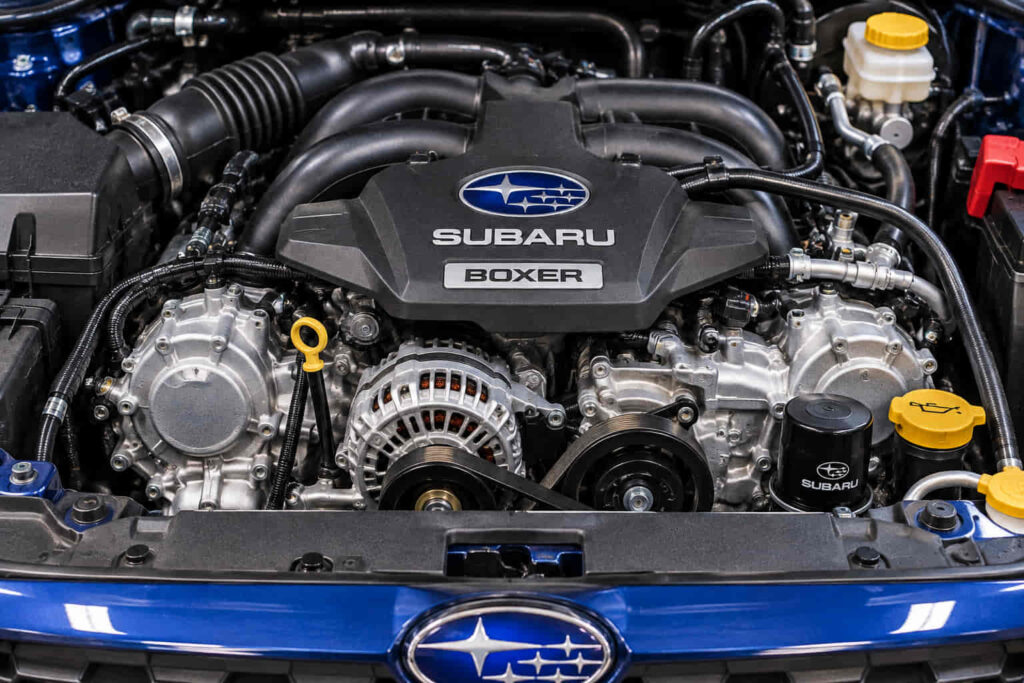
Who makes Subaru engines? Subaru Corporation, the Japanese automaker formerly known as Fuji Heavy Industries, designs and manufactures the Boxer engines used in most Subaru gasoline-powered vehicles. Its primary engine manufacturing facility is the Oizumi Plant in Gunma Prefecture, Japan, where Subaru produces horizontally opposed engines and automotive transmissions.
Subaru engines are not generally manufactured by Toyota, Honda, or another independent automaker. Although Toyota maintains a significant ownership interest in Subaru and collaborates with the company on hybrid systems, electric vehicles, and sports cars, Subaru remains responsible for developing and producing its signature Boxer engines.
Modern Subaru vehicles use several engine families, including the FB-series naturally aspirated four-cylinder engines and the FA-series performance-oriented Boxer engines. Older models commonly feature EJ-series engines, while certain historical Subaru vehicles used flat-six, diesel, or other specialized powerplants.
The engine manufacturer, production location, and design vary according to the vehicle’s model year and configuration. Understanding these differences helps explain how Subaru engines are built, why the Boxer layout is important, and how Subaru’s partnership with Toyota affects its current powertrains.
Who Manufactures Subaru Engines?
Subaru Corporation manufactures its own gasoline Boxer engines through its automotive production operations in Japan. The company is responsible for the design, engineering, production, and quality control of its core internal combustion engine families.
Subaru is an independent publicly traded Japanese manufacturer headquartered in Tokyo. Its automotive business produces vehicles sold internationally under the Subaru brand.
The company is best known for combining horizontally opposed engines with its Symmetrical All-Wheel Drive technology.
Unlike automakers that primarily use conventional inline-four engines, Subaru has maintained a long-term commitment to the Boxer engine configuration.
The main manufacturing location for these engines is the Oizumi Plant, part of Subaru’s Gunma manufacturing complex.
Subaru officially identifies this factory as a production site for automotive engines and transmissions.
The company has manufactured Boxer engines for decades, developing different designs to meet evolving requirements for performance, fuel economy, emissions, and reliability.
Subaru’s engine manufacturing history dates to the period when the company operated under the Fuji Heavy Industries name.
The corporate name changed to Subaru Corporation in 2017, but the company’s engine engineering heritage remained central to its automotive identity.
Modern Subaru engine production includes naturally aspirated and turbocharged configurations.
Naturally aspirated engines are commonly used in mainstream passenger cars and SUVs, while turbocharged variants provide additional power for performance-oriented models and certain larger vehicles.
Subaru also develops Boxer engines specifically adapted for hybrid powertrains.
Although individual components may come from outside suppliers, the finished Boxer engine is a Subaru-engineered product manufactured within the company’s production system.
This distinction is important because purchasing components from suppliers does not make those suppliers the manufacturer of the complete engine.
Where Are Subaru Engines Made?
Subaru engines are primarily manufactured at the Oizumi Plant in Oizumi, Gunma Prefecture, Japan. The facility is part of Subaru’s Gunma manufacturing operations and serves as a major production center for Boxer engines and transmissions.
The Oizumi Plant began engine and transmission production in 1982.
Before that, Subaru manufactured powertrain components at its Mitaka facility in Tokyo.
As the company expanded its vehicle production, engine manufacturing operations were gradually transferred to Oizumi.
Subaru completed the consolidation of engine and transmission production at Oizumi in 1999.
The factory became an important part of the company’s vertically integrated manufacturing strategy.
By producing engines and transmissions within its own manufacturing network, Subaru can coordinate powertrain engineering and vehicle development more closely.
The Oizumi facility also supports production of components designed to work with Subaru’s distinctive drivetrain configurations.
In 2010, the company expanded its production capabilities to support a new generation of Boxer engines.
These engines incorporated changes intended to improve fuel economy while maintaining the low-profile configuration associated with Subaru vehicles.
Subaru’s official facilities information, updated in August 2026, continues to identify Oizumi as a manufacturing site for automotive engines and transmissions.
The company’s nearby Main Plant and Yajima Plant are primarily associated with vehicle manufacturing.
This distinction matters because the factory where a Subaru vehicle is assembled is not necessarily the factory where its engine is manufactured.
A finished vehicle may be assembled at one plant using an engine produced at another facility.
For an individual Subaru engine, the engine identification number, production records, and manufacturer documentation provide the most reliable information about its exact configuration and origin.
Are Subaru Engines Made in Japan or the United States?
Subaru’s core Boxer engines are manufactured in Japan, while the company also assembles complete vehicles in the United States at Subaru of Indiana Automotive in Lafayette, Indiana.
Subaru operates major vehicle production facilities in both countries.
Its Japanese manufacturing network includes the Gunma operations, where engines, transmissions, and complete vehicles are produced at different plants.
In the United States, Subaru of Indiana Automotive, commonly called SIA, is responsible for assembling selected Subaru models.
The Indiana facility began production in 1989 and has assembled several Subaru vehicles, including the Legacy, Outback, Ascent, Crosstrek, and Forester, depending on the production period.
However, vehicle assembly and engine manufacturing are not the same process.
Subaru’s official manufacturing information identifies the Oizumi facility in Japan as its engine production site.
The Indiana operation is primarily documented as a complete vehicle manufacturing facility rather than the company’s principal Boxer engine manufacturing location.
Therefore, a Subaru with a vehicle identification number indicating U.S. assembly should not automatically be described as having an American-manufactured engine.
Its Boxer powertrain may originate from Subaru’s Japanese manufacturing network.
The distinction also applies in the opposite direction.
A Subaru assembled in Japan may use components produced by suppliers in several different countries.
Modern automobile manufacturing depends on international supply chains, even when the engine itself is manufactured by the vehicle company.
The most accurate description is that Subaru manufactures its signature Boxer engines in Japan while assembling different vehicles in Japan and the United States.
Does Toyota Make Subaru Engines?
Toyota does not generally manufacture Subaru’s Boxer engines. Subaru develops and produces these engines itself, although Toyota collaborates with Subaru on certain vehicles, hybrid technologies, and electric powertrains.
The relationship between the two companies began in 2005 through a business collaboration agreement.
Their cooperation expanded over time to include vehicle production, joint development, technology sharing, and investment.
In 2019, Toyota and Subaru announced a stronger business and capital alliance.
Toyota subsequently increased its voting interest in Subaru to more than 20% in February 2020.
However, that investment did not make Subaru a wholly owned Toyota subsidiary.
Subaru remains a separate corporate entity with its own engineering teams, manufacturing operations, and vehicle technologies.
One of the partnership’s best-known achievements is the Subaru BRZ and Toyota 86 sports car project.
These vehicles were jointly developed and use Subaru’s horizontally opposed engine architecture.
The companies also collaborate on hybrid propulsion systems.
Toyota contributes expertise in hybrid-electric technology, while Subaru contributes its Boxer engine architecture and all-wheel-drive engineering.
This arrangement allows the companies to combine technologies without requiring Toyota to manufacture every engine installed in a Subaru vehicle.
The partnership also extends to battery-electric vehicles.
Subaru and Toyota jointly developed electric vehicle platforms and models that incorporate technologies from both manufacturers.
However, an electric vehicle does not use a conventional gasoline Boxer engine.
The important distinction is between corporate ownership, shared vehicle development, and actual engine manufacturing.
Toyota is a major Subaru partner and shareholder, but Subaru remains the manufacturer of its core gasoline Boxer engines.
Does Toyota Own Subaru?
Toyota is a major shareholder in Subaru Corporation, but Subaru is not a wholly owned subsidiary of Toyota. The two companies operate through a business and capital alliance while retaining separate corporate identities.
The partnership has expanded significantly since 2005.
Toyota and Subaru initially collaborated on selected manufacturing projects and vehicle technologies.
Subaru later produced Toyota vehicles under contract, including the Toyota Camry at its Indiana manufacturing facility during an earlier production period.
The companies also jointly developed the rear-wheel-drive Subaru BRZ and Toyota 86.
Their cooperation subsequently expanded into electrification, connected vehicle technologies, and future vehicle platforms.
As part of the 2019 alliance agreement, Toyota increased its ownership position in Subaru.
Subaru confirmed in February 2020 that Toyota held more than 20% of its voting rights.
This made Toyota an important shareholder with a meaningful strategic relationship.
However, the arrangement is different from complete corporate ownership.
Subaru continues to develop its own core vehicle technologies, including Boxer engines and Symmetrical All-Wheel Drive systems.
The company also maintains independent manufacturing and research operations.
Its engine facilities, engineering programs, and vehicle products remain part of Subaru Corporation.
For consumers, Toyota’s investment does not mean that a Subaru Outback or Forester uses a Toyota engine.
The vehicle’s engine family must be identified separately from the ownership relationship between the companies.
What Is a Subaru Boxer Engine?
A Subaru Boxer engine is a horizontally opposed internal combustion engine in which the cylinders are arranged in two banks on opposite sides of the crankshaft. Its pistons move horizontally rather than vertically like those in a conventional inline engine.
This configuration is one of Subaru’s defining engineering characteristics.
In a typical inline-four engine, the cylinders are arranged vertically or at an angle along a single row.
In a Boxer engine, the cylinders extend outward from opposite sides of the crankcase.
The opposing piston movement creates an arrangement that can provide favorable primary balance characteristics.
The wide, relatively flat engine layout also allows the engine to be mounted lower in the vehicle.
A lower engine position can contribute to a lower overall center of gravity, depending on vehicle packaging.
Center-of-gravity height influences vehicle body motion during braking, acceleration, and cornering.
Subaru uses this engine arrangement as part of its broader vehicle dynamics strategy.
The company combines the Boxer layout with a longitudinally oriented powertrain in many of its all-wheel-drive vehicles.
This arrangement allows the engine, transmission, and major drivetrain components to be positioned around the vehicle’s longitudinal centerline.
However, the Boxer design also creates engineering challenges.
The engine is wider than many comparable inline-four engines.
This can make certain components more difficult to access during maintenance.
Spark plugs and cylinder head components may be positioned close to the engine compartment’s sides.
The engine also uses two cylinder heads rather than the single cylinder head found on a conventional inline-four.
Despite these differences, Subaru has continued developing Boxer engines because the configuration supports its preferred balance of vehicle packaging, drivetrain layout, and driving characteristics.
Why Does Subaru Use Boxer Engines Instead of Inline Engines?
Subaru uses Boxer engines because their low-profile design, opposing piston arrangement, and compatibility with longitudinal drivetrain layouts support the company’s vehicle engineering philosophy.
The Boxer engine first appeared in a Subaru production vehicle in 1966.
Its introduction represented a major departure from the engine configurations used by many competing passenger car manufacturers.
The horizontally opposed layout allows a relatively low engine installation position.
This can help lower the vehicle’s center of gravity compared with a taller powertrain arrangement, although the overall result depends on the complete vehicle design.
Subaru also emphasizes the inherent balance characteristics of opposing pistons.
Certain inertia forces can counteract one another, reducing the need for some balancing arrangements used in other engine configurations.
However, a Boxer engine is not completely free from vibration.
Its actual refinement depends on crankshaft design, engine mounts, combustion consistency, and the specific mechanical configuration.
The engine’s relationship with the drivetrain is another major factor.
In many Subaru models, the engine and transmission are arranged along the vehicle’s longitudinal axis.
This supports Subaru’s Symmetrical All-Wheel Drive packaging approach.
The resulting system provides a distinctive engineering solution for distributing engine torque to the front and rear axles.
However, the advantages are not universal.
Inline engines can be more compact in width and may be easier to package in certain front-wheel-drive vehicles.
They can also offer manufacturing and maintenance advantages.
Subaru’s continued use of Boxer engines reflects its long-term investment in a specific technical architecture rather than proof that every Boxer engine is inherently better than every inline engine.
Who Makes Subaru EJ Engines?
Subaru Corporation manufactured the EJ-series Boxer engines used in many older Subaru vehicles, including the Impreza, Legacy, Forester, Outback, and WRX STI.
The EJ engine family became one of Subaru’s most recognizable powertrain designs.
It was introduced around the launch of the first-generation Legacy in 1989 and remained in production through multiple vehicle generations.
The family includes naturally aspirated and turbocharged configurations with different displacements.
The EJ20 is a 2.0-liter flat-four engine strongly associated with Japanese-market performance models and several international Subaru applications.
The EJ25 is a 2.5-liter flat-four used extensively in North American Subaru vehicles.
Naturally aspirated EJ25 engines powered many mainstream models, while turbocharged variants appeared in performance-oriented vehicles.
The EJ257 became particularly well known through the WRX STI.
These engines belong to Subaru’s own manufacturing history.
They were not produced by Toyota simply because the companies later became business partners.
The EJ family’s long production period also means that individual versions have different components and reliability characteristics.
Some older naturally aspirated EJ25 engines became associated with head gasket problems.
Certain turbocharged EJ engines have different maintenance requirements because of their higher operating loads and temperatures.
The EJ engine family should therefore not be treated as one mechanically identical engine across every vehicle.
Engine codes, cylinder head designs, lubrication systems, and turbocharger configurations can vary.
For used-car buyers, identifying the exact EJ engine is more valuable than relying solely on the broader engine family name.
Who Makes Subaru FB Engines?
Subaru manufactures the FB-series Boxer engines, including the FB20 and FB25, which are widely used in modern naturally aspirated Subaru passenger cars and SUVs.
The FB engine family represented a substantial redesign of Subaru’s mainstream four-cylinder powertrain.
Subaru introduced its new-generation Boxer engine in 2010, describing it as a major engineering renewal intended to improve efficiency and maintain the benefits of the horizontally opposed layout.
The FB20 is a 2.0-liter four-cylinder engine used in selected Impreza and Crosstrek configurations, depending on the market and model year.
The FB25 is a 2.5-liter four-cylinder used in vehicles such as the Forester, Outback, Legacy, and certain Crosstrek models.
These engines were designed primarily for everyday transportation rather than maximum performance output.
Different versions use different fuel injection arrangements and internal components.
Earlier FB engines generally used port fuel injection, while later applications introduced direct injection and other technical updates.
As a result, replacement parts and service requirements can differ substantially between model years.
The FB family is also important to Subaru’s hybrid development.
The company’s newer hybrid systems incorporate a specially developed 2.5-liter Boxer engine designed to operate efficiently alongside an electric propulsion system.
This demonstrates how Subaru continues adapting its own engine architecture rather than replacing all Boxer engines with Toyota-manufactured gasoline engines.
For owners evaluating modern Subaru reliability, the FB engine family is especially relevant because it powers many of the brand’s mainstream models.
The correct maintenance information should correspond to the specific engine code, production year, and vehicle configuration.
Who Makes Subaru FA Engines?
Subaru Corporation develops and manufactures the FA-series Boxer engines, including the FA20 and FA24 families used in performance-oriented and turbocharged Subaru vehicles.
The FA series is closely associated with Subaru’s modern sports car and turbocharged engine programs.
The FA20 appeared in the first-generation Subaru BRZ and Toyota 86 sports cars.
This naturally aspirated 2.0-liter Boxer engine combined Subaru’s underlying engine architecture with fuel injection technology developed through the Toyota partnership.
Turbocharged FA20 variants were also used in selected Subaru models, including earlier WRX configurations.
The newer FA24 family expanded displacement to approximately 2.4 liters.
The naturally aspirated FA24 powers the second-generation Subaru BRZ and Toyota GR86.
Turbocharged FA24 engines are used in performance-oriented Subaru models such as the WRX and certain versions of the Outback and Ascent.
Although these engines share a family designation, they do not all have identical components or operating characteristics.
A naturally aspirated BRZ engine is designed around a different power delivery objective from a turbocharged WRX engine.
Compression ratios, fuel delivery arrangements, turbocharging hardware, and calibration strategies vary by application.
Subaru’s 2026 Outback, for example, offers a naturally aspirated 2.5-liter Boxer rated at approximately 180 horsepower and a turbocharged 2.4-liter Boxer rated at approximately 260 horsepower, depending on the trim.
These engines illustrate the company’s use of different Boxer powertrain families to satisfy distinct vehicle requirements.
The FA-series engines are Subaru-developed powerplants, even when installed in a vehicle produced through cooperation with Toyota.
Read more: Who Makes PACCAR Engines
Who Makes the Engines in the Subaru BRZ and Toyota GR86?
Subaru manufactures the Boxer engines used in the Subaru BRZ and Toyota GR86, although both sports cars were jointly developed by Subaru and Toyota.
The collaboration is one of the most visible examples of the companies’ shared vehicle engineering programs.
The original Subaru BRZ and Toyota 86 were developed to offer a lightweight rear-wheel-drive sports car with a low center of gravity.
The engine was a key part of achieving that design objective.
A horizontally opposed four-cylinder can be installed relatively low in the engine compartment, supporting the vehicle’s intended handling characteristics.
The first-generation BRZ and Toyota 86 used a 2.0-liter Boxer engine associated with the FA20 family.
Subaru provided the Boxer engine architecture, while Toyota contributed direct fuel injection technology.
The combination demonstrated how the companies could combine engineering resources within a single powertrain.
The second-generation BRZ and GR86 introduced a larger naturally aspirated 2.4-liter Boxer engine.
This engine belongs to the FA24 family and provides greater displacement and improved torque compared with the earlier 2.0-liter design.
Subaru also manufactures the BRZ and its Toyota counterpart at its Japanese production operations.
The fact that the Toyota GR86 carries a Toyota badge does not mean that its gasoline engine is manufactured through Toyota’s conventional inline-engine manufacturing program.
Its Boxer engine has Subaru engineering and manufacturing origins.
However, the vehicle itself remains a jointly developed product.
The two companies contributed to the development process, and the cars may have differences in suspension tuning, design, and other characteristics.
For engine repairs and replacement parts, technicians should still verify the model year and engine specifications.
A shared Boxer architecture does not mean that every component from both generations is interchangeable.
Who Makes Subaru Forester Engines?
Subaru manufactures the Boxer engines used in gasoline-powered Forester models, including the naturally aspirated 2.5-liter engine and selected turbocharged engines offered in different markets.
The Forester has used several Subaru Boxer engine families throughout its production history.
Earlier models included EJ-series engines, while later generations transitioned toward FB-series naturally aspirated powertrains.
For the 2026 U.S.-market Forester, Subaru identifies a 2.5-liter four-cylinder Boxer engine across the gasoline and hybrid trim ranges.
However, the powertrain configuration differs between the conventional gasoline Forester and the Forester Hybrid.
The conventional gasoline engine drives the vehicle through its transmission and all-wheel-drive system.
The hybrid powertrain combines a specially developed Subaru Boxer engine with electric propulsion components.
This allows the hybrid system to manage engine and electric motor operation according to vehicle conditions.
Toyota’s hybrid technology contributes to the electrification system, but the gasoline engine remains a Subaru Boxer design.
In certain international markets, Forester models have also used different turbocharged powertrains, including Subaru’s newer 1.8-liter direct-injection turbocharged Boxer engine.
This illustrates why the Forester model name alone does not identify one universal engine.
Engine specifications depend on the market, model year, and trim.
Nevertheless, Subaru remains the manufacturer of the Forester’s signature Boxer combustion engine rather than relying on a conventional Toyota gasoline engine.
Who Makes Subaru Outback, Crosstrek, and WRX Engines?
The engines used in Subaru Outback, Crosstrek, and WRX models are manufactured by Subaru Corporation, although each model can use a different Boxer engine family depending on its year and specification.
The Outback is one of Subaru’s main crossover vehicles.
Modern versions offer naturally aspirated 2.5-liter Boxer engines, while certain trims use more powerful turbocharged 2.4-liter engines.
The 2026 U.S.-market Outback continues this distinction, with approximately 180 horsepower from its naturally aspirated engine and 260 horsepower from its turbocharged version.
The Crosstrek generally uses smaller naturally aspirated Boxer powertrains, including 2.0-liter and 2.5-liter configurations across different production years and markets.
The introduction of hybrid versions added electric propulsion technology alongside a Subaru gasoline engine.
The WRX uses a different performance-oriented approach.
Modern versions employ a turbocharged 2.4-liter Boxer engine developed to provide greater output and responsiveness.
The WRX has historically been associated with Subaru’s EJ and FA turbocharged engine families.
Although these vehicles differ in intended use, they share Subaru’s underlying commitment to horizontally opposed engine design.
The Outback emphasizes practical transportation and all-weather capability.
The Crosstrek is designed around a smaller crossover platform, while the WRX prioritizes sporty handling and turbocharged performance.
These different objectives influence engine calibration, displacement, and supporting systems.
However, the primary manufacturer of their gasoline Boxer engines remains Subaru.
For repairs and maintenance, owners should identify the exact engine code rather than assume that all Subaru 2.5-liter engines share identical components.
Are Subaru Hybrid Engines Made by Toyota?
Subaru hybrid vehicles combine Subaru-developed Boxer engines with electrification technology incorporating elements of Toyota’s hybrid system. Toyota’s involvement does not mean that the gasoline engine is simply a Toyota-built powerplant.
Subaru and Toyota have collaborated on hybrid technology for several years.
An earlier example is the Crosstrek Hybrid plug-in hybrid introduced for the 2019 model year in the United States.
That vehicle combined Subaru’s Boxer engine architecture and all-wheel-drive technology with hybrid components developed through the Toyota partnership.
More recently, Subaru introduced a next-generation strong hybrid system.
The system was officially presented in October 2024 and uses a newly developed 2.5-liter horizontally opposed gasoline engine.
Subaru designed the engine specifically for the hybrid powertrain rather than relying exclusively on an unchanged conventional gasoline configuration.
The system incorporates series-parallel hybrid technology based on Toyota Hybrid System principles.
This allows the vehicle to use gasoline engine power, electric motor power, or combinations of both according to operating conditions.
Subaru also developed a hybrid transaxle designed to integrate with its Boxer engine arrangement and Symmetrical All-Wheel Drive layout.
This is important because Toyota’s mainstream front-wheel-drive hybrid architecture is not automatically suitable for Subaru’s longitudinal engine configuration.
The powertrain must be adapted to maintain the characteristics of Subaru’s AWD system.
The next-generation hybrid technology is used in selected Crosstrek and Forester models.
Subaru’s official technical announcements identify the gasoline engine as a newly developed Subaru Boxer unit.
Therefore, the most accurate description is that Subaru manufactures the Boxer engine while collaborating with Toyota on the broader hybrid propulsion system.
Who Makes Subaru Electric Vehicle Motors?
Subaru develops its battery-electric vehicles in cooperation with Toyota and other technology partners, but an electric motor is fundamentally different from the Boxer gasoline engines manufactured at Subaru’s Oizumi plant.
Electric vehicles do not use conventional gasoline combustion engines.
Instead, they produce propulsion through electric traction motors powered by a high-voltage battery system.
These motors operate using electromagnetic forces rather than pistons, valves, crankshafts, and fuel injection.
The Subaru Solterra was developed through a partnership with Toyota.
The project combined Subaru’s vehicle dynamics and all-wheel-drive experience with Toyota’s electrification and electric vehicle platform expertise.
Subsequent Subaru electric vehicle programs have expanded this cooperation.
Subaru has also announced plans to manufacture certain jointly developed electric vehicles at its Japanese facilities.
The company continues to develop electric propulsion, battery management, thermal control, and vehicle integration technologies as part of its transition toward electrification.
However, the company does not publicly establish that every electric motor component is manufactured entirely within its own factories.
Electric vehicles depend on specialized supplier networks for batteries, electric motors, semiconductors, and related equipment.
For this reason, identifying the manufacturer of an electric Subaru’s traction motor requires information specific to that vehicle and component.
The traditional answer that Subaru makes its own Boxer engines applies to its gasoline and Boxer-based hybrid vehicles.
It does not automatically describe the production origin of every component used in a Subaru electric vehicle.
Did Subaru Ever Use Engines Made by Other Companies?
Yes, some Subaru-branded vehicles have used engines or complete vehicle platforms supplied by other manufacturers, particularly certain small Japanese-market models. However, Subaru’s mainstream Boxer-powered passenger cars are developed and manufactured through Subaru’s own engine operations.
Subaru has a long history of producing distinctively engineered vehicles, but not every product carrying its badge has used an internally developed Boxer engine.
In Japan, certain compact and mini-vehicle products have been supplied through original equipment manufacturing arrangements with other automakers.
Subaru’s cooperation with Toyota and Daihatsu has included the supply of selected vehicles sold under the Subaru brand.
These vehicles may use engines developed and manufactured by the original supplying company.
This is different from the Subaru Outback, Forester, Impreza, or WRX, whose principal gasoline engine families are associated with Subaru’s own Boxer engineering programs.
Subaru has also manufactured vehicles for other brands.
The BRZ and Toyota 86 relationship demonstrates that an engine built by Subaru can be installed in a vehicle wearing another manufacturer’s badge.
Therefore, engine branding and vehicle branding should not automatically be treated as identical.
The correct manufacturer depends on the original engineering and production arrangement.
For unusual imported models or Japanese-market Subaru vehicles, the engine code and original manufacturer specifications should be checked.
The broad statement that Subaru manufactures its own Boxer engines remains accurate, but it should not be extended to every historical Subaru-badged vehicle without considering OEM supply arrangements.
Are Subaru Engines Reliable?
Subaru engines can provide dependable long-term service when properly maintained, but reliability varies between engine families, production years, and operating conditions.
The Boxer engine layout itself does not guarantee reliability.
Internal component quality, lubrication, cooling, fuel delivery, and maintenance practices all influence engine life.
Older Subaru EJ engines developed reputations for certain maintenance concerns, particularly head gasket problems on some naturally aspirated EJ25 applications.
These problems should not automatically be attributed to every Subaru engine.
Different EJ versions used different head gaskets, cylinder heads, and internal designs.
Turbocharged EJ engines also have different operating demands compared with naturally aspirated versions.
Modern FB and FA engines incorporate substantial design changes.
They use updated internal components, improved combustion strategies, and different fuel management technologies.
However, newer engines can still develop problems involving oil consumption, cooling system components, sensors, turbochargers, or other parts.
Reliability depends on identifying issues early and correcting them before secondary damage occurs.
Engine oil is especially important.
Boxer engines contain moving components distributed across two opposing cylinder banks, and all critical surfaces require consistent lubrication.
Turbocharged FA engines also depend on clean oil for the turbocharger’s bearings and other components.
Cooling system condition influences cylinder head and head gasket durability.
Overheating can damage an otherwise healthy engine, regardless of its manufacturer.
Owners should follow Subaru’s maintenance recommendations for the particular engine rather than assuming that every Boxer engine uses the same fluids and service intervals.
A properly maintained Subaru engine may provide many years of service, but the manufacturer’s reputation alone cannot establish a guaranteed mileage lifespan.
Why Do Some Subaru Engines Have Head Gasket Problems?
Head gasket problems have been associated with certain older Subaru engines, especially some naturally aspirated EJ25 configurations, but this history does not mean that every Subaru Boxer engine has the same defect.
The head gasket seals the connection between the engine block and cylinder head.
It must contain combustion pressure while separating engine oil and coolant passages.
Subaru’s horizontally opposed four-cylinder engines use two cylinder heads, one on each side of the engine.
This arrangement differs from a conventional inline-four engine, which typically uses a single cylinder head.
However, having two cylinder heads does not automatically cause head gasket failure.
Gasket design, clamping force, surface condition, operating temperature, and material characteristics all influence sealing reliability.
Certain older EJ25 engines became known for head gasket leakage.
Some problems involved external coolant or oil leakage, while others affected internal sealing.
The severity depended on the engine version and failure condition.
Subaru subsequently introduced different engine designs and sealing improvements across later generations.
Modern FB and FA engines should not automatically be assigned the same head gasket failure expectations as older EJ25 variants.
Nevertheless, proper cooling system maintenance remains important for every engine.
Low coolant levels, overheating, and neglected cooling system problems can increase stress on cylinder head sealing surfaces.
Owners should investigate unexplained coolant loss, unusual engine temperatures, or evidence of fluid contamination.
A professional diagnosis can determine whether the problem involves a gasket, hose, water pump, thermostat, or another component.
Accurate identification prevents unnecessary engine repairs and supports long-term reliability.
How Long Do Subaru Engines Last?
Many properly maintained Subaru engines can reach 200,000 miles or more, but actual life expectancy depends on the engine family, maintenance history, operating conditions, and whether significant mechanical problems have occurred.
The manufacturer’s identity does not establish a fixed engine lifespan.
A naturally aspirated FB25 in a daily-driven Forester may experience different mechanical stresses from a turbocharged FA24 used in a WRX.
Likewise, an older EJ25 engine that has experienced repeated overheating may have a different remaining service life from a well-maintained example with similar mileage.
Engine oil maintenance is a major factor.
The correct lubricant must maintain a protective film between bearings, crankshaft journals, piston rings, and other moving surfaces.
Allowing the oil level to fall too low can accelerate wear and cause serious internal damage.
Cooling system reliability is equally important.
A failing water pump, damaged hose, or malfunctioning thermostat can cause overheating and compromise cylinder head sealing.
Turbocharged engines require additional attention to lubrication and operating temperature.
Fuel quality, ignition system condition, and air filtration also influence combustion efficiency and long-term operation.
The best way to evaluate a high-mileage Subaru engine is to examine its actual condition.
Compression, oil consumption, oil pressure, engine noise, and maintenance records provide more useful evidence than mileage alone.
An engine with consistent servicing and no significant symptoms may retain substantial useful life after 150,000 miles.
Conversely, a lower-mileage engine may require major repairs if it has been operated with inadequate lubrication or excessive temperature.
Engine life expectancy should therefore be considered an outcome of design, use, and maintenance rather than a number guaranteed by Subaru.
Are Subaru Engines Expensive to Maintain?
Subaru engine maintenance costs vary by model and engine configuration, with naturally aspirated engines generally having fewer turbocharger-related components than performance-oriented turbocharged versions.
Routine maintenance includes engine oil and filter replacement, spark plug service, cooling system inspection, and other procedures identified in the vehicle’s maintenance schedule.
The Boxer layout can affect access to certain components.
Because the cylinders extend horizontally toward the sides of the engine compartment, spark plugs are positioned differently from those in a typical inline-four engine.
This may increase service complexity on certain vehicles.
Some repairs involving cylinder heads or internal components can also require additional labor because of engine packaging.
However, not every service is more expensive simply because the engine is horizontally opposed.
Many common maintenance operations are straightforward when technicians use the correct procedures and equipment.
The engine family also matters.
A naturally aspirated FB engine does not have the same turbocharger components as a turbocharged FA engine.
Turbocharged models may require attention to boost control systems, intercooler connections, and turbocharger lubrication.
Older EJ engines can have different maintenance concerns from newer FB and FA engines.
For example, repairing a head gasket problem on an older EJ25 can involve substantial labor, while an ignition coil replacement may be much simpler.
The correct comparison is therefore between specific engines and their maintenance requirements rather than treating every Subaru as mechanically identical.
Using quality replacement parts, approved fluids, and an appropriate service schedule helps reduce the risk of avoidable repairs.
For long-term ownership, preventive maintenance is usually more economical than allowing minor problems to develop into major engine damage.
How Can You Identify Which Subaru Engine You Have?
The most reliable way to identify a Subaru engine is to check its engine code, model year, displacement, and vehicle identification information.
Subaru uses several engine family designations.
Older vehicles may contain EJ-series engines, including EJ20 and EJ25 variants.
Modern mainstream models commonly use FB-series engines, such as the FB20 and FB25.
Performance-oriented vehicles may use FA-series engines, including the FA20 and FA24.
Some Japanese-market vehicles use the newer CB18 turbocharged Boxer engine.
Historical models may also contain other engine families.
For example, Subaru produced flat-six engines such as the EZ30 and EZ36 for selected Legacy, Outback, and Tribeca applications.
Because engine variants can share the same displacement, engine size alone may not provide enough information.
A 2.5-liter Subaru engine could belong to different generations and use different fuel injection or timing components.
The vehicle’s production year and original factory specification can help narrow the identification.
However, a replacement engine may differ from the original unit.
The engine code and available identification marks should therefore be checked directly whenever possible.
Official Subaru service documentation can provide the corresponding specifications and parts information.
For used-car buyers, an engine identification check is useful when evaluating reliability and maintenance history.
It also prevents incorrect parts ordering.
A component designed for an EJ25 should not automatically be installed on an FB25 merely because both engines have approximately 2.5 liters of displacement.
Correct identification is essential for maintenance, repairs, engine replacement, and performance upgrades.
What Is the Future of Subaru Engine Manufacturing?
Subaru continues developing horizontally opposed gasoline engines while adapting its powertrain technology for hybrid vehicles and expanding its battery-electric vehicle programs.
The company has maintained its commitment to Boxer engines for decades.
However, changing emissions requirements and increasing demand for electrified vehicles are influencing its future engineering strategy.
Subaru introduced a next-generation hybrid system in 2024, incorporating a newly developed 2.5-liter Boxer engine.
The system combines Subaru’s engine architecture with electric propulsion technology based partly on Toyota’s hybrid expertise.
This demonstrates how Subaru can continue manufacturing its own gasoline engines while changing the way those engines contribute power to the vehicle.
The company has also expanded its electric vehicle collaboration with Toyota.
Future vehicle programs involve jointly developed electric platforms, new battery technologies, and manufacturing arrangements designed to support changing market requirements.
In 2024, Subaru, Toyota, and Mazda announced a shared commitment to developing new engine technologies suited to the electrification era.
Each company emphasized the continued development of its own distinctive engine architecture.
Subaru identified the horizontally opposed engine as a central part of its engineering approach.
This indicates that Subaru’s transition toward electrification does not necessarily require abandoning Boxer engines immediately.
Instead, the company is pursuing multiple powertrain technologies.
These include conventional gasoline engines, hybrids combining Boxer engines with electric motors, and fully electric vehicles.
Subaru has also announced work on engines compatible with different future fuel technologies.
The exact production lifespan of individual engine families remains subject to future product decisions and market conditions.
For now, Subaru’s engine manufacturing strategy continues to combine in-house Boxer engine development with selected technology partnerships.
Final Verdict: Who Makes Subaru Engines?
Subaru Corporation makes its own Boxer engines, primarily at the Oizumi Plant in Gunma Prefecture, Japan. The company develops and manufactures the EJ, FB, FA, and other major Boxer engine families used throughout its passenger car and SUV lineup.
Subaru’s engine manufacturing history dates back decades, with the Boxer layout first appearing in the Subaru 1000 in 1966.
The company previously operated as Fuji Heavy Industries before adopting the Subaru Corporation name in 2017.
Although Toyota is a major shareholder and technology partner, it does not generally manufacture Subaru’s Boxer gasoline engines.
The two companies collaborate on vehicles such as the Subaru BRZ and Toyota GR86, along with hybrid and electric vehicle technologies.
The BRZ and GR86 use Subaru-developed Boxer engines, while newer Subaru hybrids combine a Subaru gasoline engine with electrification technology incorporating Toyota Hybrid System principles.
The manufacturing distinction is also important geographically.
Subaru assembles vehicles in Japan and the United States, but its primary documented Boxer engine production facility is located in Japan.
Modern Subaru models use different engine families according to their performance requirements.
The FB series supports many mainstream naturally aspirated models, while the FA series is associated with several performance-oriented and turbocharged applications.
Older EJ engines remain important to Subaru’s history, particularly in the Impreza, WRX STI, Legacy, Forester, and Outback.
The simplest answer is that Subaru manufactures Subaru Boxer engines, Toyota collaborates on selected technologies, and Subaru’s Oizumi Plant in Japan is the principal manufacturing center for those engines.
For an individual vehicle, checking the engine code and factory specifications is the best way to confirm the exact engine family, manufacturing background, and correct maintenance requirements.