Active Fuel Management (AFM) and Dynamic Fuel Management (DFM) are two cylinder deactivation technologies developed by General Motors (GM) to improve fuel efficiency in V8 engines. The main difference between AFM and DFM is how they control the number of active cylinders. AFM switches between eight-cylinder and four-cylinder operation, while DFM uses 17 cylinder activation patterns to adjust engine output more precisely based on driving conditions.
AFM reduces fuel consumption by deactivating four cylinders during light-load driving, such as steady highway cruising. DFM expands this approach by allowing different combinations of cylinders to operate as engine load changes. This flexibility gives DFM greater control over cylinder deactivation, although actual fuel savings depend on engine configuration, vehicle weight, and driving conditions.
Both systems rely on specialized valve lifters and oil-pressure-controlled mechanisms, making valvetrain reliability an important consideration. AFM and DFM engines have experienced lifter-related problems, including misfires, ticking noises, and potential camshaft damage. However, the frequency and severity of these issues vary by engine generation and application.
This comparison examines how AFM and DFM work, their fuel economy differences, common reliability problems, engine performance, and long-term ownership costs to help GM truck owners and buyers evaluate both technologies.
What Is the Difference Between AFM and DFM?
The main difference between AFM and DFM is the number of cylinder activation patterns each system supports. General Motors’ Active Fuel Management (AFM) switches between eight-cylinder and four-cylinder operation in applicable V8 engines, while Dynamic Fuel Management (DFM) uses 17 cylinder activation patterns to match engine output with changing power demands. Both technologies reduce pumping losses and fuel consumption by deactivating cylinders when full engine power is unnecessary.
AFM follows a fixed cylinder deactivation strategy, shutting down the same four cylinders during suitable light-load conditions. DFM uses a more flexible approach, selecting different combinations of active cylinders based on engine speed, load, and torque requirements. This allows DFM to adjust cylinder operation across a wider range of driving conditions instead of relying on a single four-cylinder mode.
The following table compares the main technical and operational differences between AFM and DFM in GM V8 engines.
| Feature | Active Fuel Management (AFM) | Dynamic Fuel Management (DFM) |
|---|---|---|
| Manufacturer | General Motors | General Motors |
| Cylinder deactivation | Fixed cylinder group | Variable cylinder combinations |
| Operating patterns | 2 (V8 and V4) | 17 |
| Active cylinders | 8 or 4 | 2–8, depending on the operating pattern |
| Engine control | Load-based switching | Dynamic torque-demand-based control |
| Fuel efficiency | Reduces fuel consumption during light loads | Enables more flexible fuel-saving operation |
| Mechanical complexity | Less complex deactivation system | More complex valve control system |
| Reliability concerns | Lifter failure, misfires, camshaft wear | Lifter failure, misfires, valvetrain damage |
DFM offers greater flexibility in cylinder deactivation, but this does not establish that it delivers better fuel economy or reliability in every vehicle. Actual results depend on engine design, transmission, vehicle configuration, and maintenance history.
How Does GM Active Fuel Management Work?
GM Active Fuel Management works by temporarily deactivating four cylinders in a compatible V8 engine when full engine power is unnecessary. The system uses an engine control module (ECM), specialized hydraulic valve lifters, and an oil-pressure-controlled mechanism to switch between V8 and V4 operation. This reduces engine pumping losses while maintaining sufficient power for light-load driving.
The ECM monitors operating parameters, including engine speed, throttle position, engine load, and temperature, to determine when cylinder deactivation is appropriate. During steady highway cruising or gentle acceleration, the ECM can command the system to deactivate four cylinders. The engine continues running on the remaining four cylinders while the inactive cylinders stop contributing combustion power.
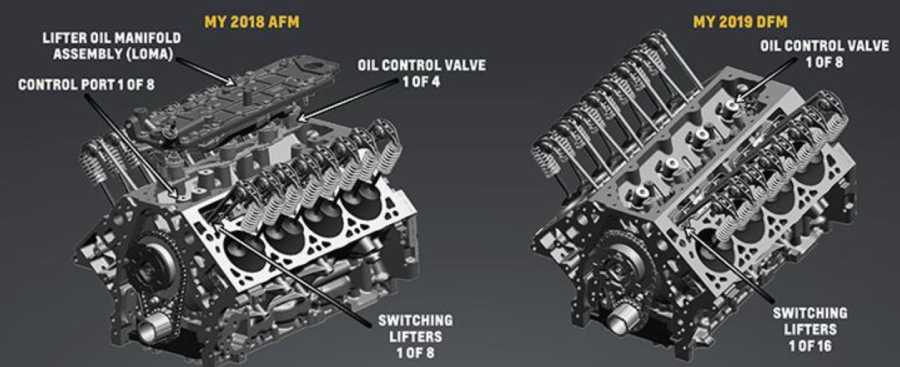
AFM uses collapsible hydraulic lifters to prevent the intake and exhaust valves of selected cylinders from opening. When the ECM requests cylinder deactivation, the valve lifter oil manifold directs pressurized engine oil to the appropriate lifters, disengaging their locking mechanisms. The lifters then absorb camshaft movement without transferring it to the pushrods and valves. Fuel injection is also suspended in the deactivated cylinders, reducing unnecessary fuel consumption.
When the driver requests additional power, such as during hard acceleration, towing, or climbing a steep hill, the ECM restores eight-cylinder operation. Oil-pressure control allows the lifters to lock again, restoring normal valve movement and combustion in the previously inactive cylinders. This transition is designed to occur automatically without driver intervention.
AFM operation depends on proper engine oil pressure, hydraulic lifter function, and electronic control. Contaminated oil, inadequate lubrication, or malfunctioning lifters can interfere with cylinder activation and deactivation. For example, a lifter that remains collapsed may prevent a valve from operating correctly, causing engine misfires, ticking noises, and potentially camshaft damage. These mechanical dependencies explain why oil maintenance and valvetrain condition are important for AFM engine reliability.
How Does GM Dynamic Fuel Management Work?
GM Dynamic Fuel Management (DFM) works by continuously adjusting which cylinders fire to match engine torque demand, using 17 cylinder activation patterns instead of AFM’s fixed V8 and V4 modes. The system uses electronically controlled oil-pressure mechanisms, specialized hydraulic lifters, and the engine control module (ECM) to deactivate selected cylinders when full engine power is unnecessary.
DFM builds on the cylinder deactivation principle used by AFM but provides more flexible control over the valvetrain. In applicable GM V8 engines, the system can operate with different combinations of two to eight active cylinders. The ECM selects an appropriate firing pattern based on engine speed, load, throttle input, and required torque. Rather than consistently deactivating the same four cylinders, DFM distributes cylinder deactivation across different combinations to balance fuel efficiency, engine output, and vibration.
The system uses electronically controlled oil control valves to regulate hydraulic pressure supplied to the deactivating lifters. When a cylinder is selected for deactivation, its intake and exhaust valve lifters disengage, preventing the valves from opening. Fuel injection is suspended for that cylinder, while the remaining active cylinders continue producing the required torque. When additional power is needed, hydraulic pressure control restores normal lifter operation and the cylinder resumes combustion.
During steady highway cruising, DFM can deactivate more cylinders when engine load is low. As driving conditions change, such as during moderate acceleration or climbing a gradual incline, the system selects another cylinder activation pattern to maintain the requested torque. Under high engine loads, including heavy acceleration and towing, all eight cylinders can remain active.
DFM’s main technical advantage over AFM is its ability to match cylinder activation more closely to changing engine demand. However, the additional control mechanisms and specialized lifters also introduce mechanical and hydraulic components that require proper lubrication and operation. DFM therefore provides more advanced cylinder management without eliminating the possibility of lifter-related failures.
Is DFM More Fuel-Efficient Than AFM?
DFM has greater fuel-saving potential than AFM because it can deactivate cylinders across a wider range of engine loads, but it does not guarantee higher MPG in every GM vehicle. AFM primarily reduces fuel consumption during conditions suitable for four-cylinder operation, whereas DFM can select intermediate cylinder activation patterns when operating on four cylinders would not provide the required torque efficiently.
Both systems improve fuel efficiency by reducing engine pumping losses. When fewer cylinders remain active, those cylinders operate at a higher relative load to produce the requested engine output. This reduces the throttling losses associated with operating all eight cylinders at light loads. DFM extends this principle by providing additional cylinder combinations, allowing the engine to maintain efficient operation under more varied driving conditions.
Actual fuel economy depends on several factors beyond cylinder deactivation, including engine displacement, transmission gearing, vehicle weight, axle ratio, aerodynamic drag, and driving speed. For example, comparing a 5.3L V8 equipped with AFM against a newer 5.3L V8 equipped with DFM does not isolate the fuel-saving effect of DFM if the vehicles also have different transmissions or other powertrain improvements.
How Much Fuel Does AFM Save?
GM has reported fuel economy improvements of approximately 5–7% from AFM in certain applications, although actual savings vary by engine and driving conditions. AFM achieves these reductions primarily by operating on four cylinders during suitable light-load conditions, reducing pumping losses without requiring the driver to change driving behavior.
AFM delivers its greatest benefits when the engine operates under relatively stable, low-load conditions. Highway cruising on level roads provides opportunities for sustained V4 operation because maintaining speed requires less engine power than accelerating or climbing hills. In contrast, frequent acceleration, heavy towing, and steep terrain increase torque demand and limit the time the engine can remain in four-cylinder mode.
For example, a vehicle consuming 20 gallons of fuel over a given driving cycle would consume approximately 19 gallons if AFM reduced fuel use by 5% under otherwise identical conditions. This represents a theoretical saving of one gallon for that cycle, not a guaranteed reduction for every AFM-equipped vehicle. The actual benefit depends on how frequently cylinder deactivation occurs and the operating conditions under which it remains active.
How Much Fuel Does DFM Save Compared With AFM?
GM has described DFM as providing an additional fuel-efficiency improvement of approximately 2% over AFM in relevant development comparisons. This incremental benefit comes from the ability to select cylinder activation patterns beyond the fixed four-cylinder mode used by AFM. The reported improvement is a system-level comparison rather than a guaranteed increase in a vehicle’s EPA-rated fuel economy.
DFM can improve efficiency when engine torque requirements fall between the operating conditions best suited to AFM’s V8 and V4 modes. For example, when four active cylinders cannot efficiently satisfy the requested torque, DFM can select a pattern with additional active cylinders instead of returning directly to full eight-cylinder operation. This flexibility reduces the need to operate more cylinders than necessary.
A hypothetical vehicle averaging 20 MPG with AFM would achieve approximately 20.4 MPG if DFM produced a 2% improvement under otherwise identical test conditions. However, this calculation illustrates the reported percentage rather than predicting the fuel economy of a specific Silverado or Sierra. EPA ratings must be compared using matching engine displacement, drivetrain, transmission, model year, and vehicle configuration wherever possible.
DFM therefore offers a technical efficiency advantage through more precise cylinder management, while the measurable difference in everyday fuel consumption may be relatively small. For GM truck owners, driving conditions, vehicle configuration, and maintenance can have a greater influence on actual MPG than the difference between AFM and DFM alone.
Is AFM or DFM More Reliable?
Neither AFM nor DFM has been conclusively proven more reliable across all GM V8 engines. Both systems use specialized hydraulic lifters to deactivate cylinders, and both have experienced lifter-related failures that can cause engine misfires, ticking noises, and camshaft damage. AFM uses a simpler cylinder deactivation strategy, while DFM relies on more sophisticated hydraulic and electronic controls. However, greater mechanical complexity does not automatically mean a higher failure rate.
AFM has a longer service history, with documented lifter problems across multiple generations of GM V8 engines. DFM was introduced more recently and has also been associated with valvetrain failures in certain GM truck and SUV applications. General Motors has issued service bulletins addressing lifter-related concerns in affected engines, including some 5.3L and 6.2L V8 applications. These bulletins identify specific symptoms, diagnostic procedures, and production-related conditions rather than establishing that every AFM or DFM engine is defective.
A meaningful reliability comparison must account for engine generation, production date, mileage, maintenance history, and documented failure rates. Reports of individual failures establish that a problem exists, but they do not demonstrate which system fails more frequently. Without comparable population-level failure data, neither technology can be identified as the more reliable option solely on the basis of its cylinder deactivation design.
What Are the Most Common AFM Problems?
The most commonly documented AFM problems involve collapsed hydraulic lifters, engine misfires, valvetrain ticking, and camshaft damage. These issues are closely related because AFM depends on hydraulic lifters that must repeatedly lock and unlock to activate or deactivate selected cylinders. A malfunction in this mechanism can interrupt normal valve movement and combustion.
Collapsed AFM lifters are a significant mechanical concern. When an AFM lifter fails to return to its locked position, the corresponding valve may not open as intended. This disrupts airflow through the affected cylinder and can produce a persistent misfire, rough idle, reduced engine power, or an illuminated check engine light. Depending on the affected cylinder and operating conditions, diagnostic trouble codes such as P0300 or cylinder-specific misfire codes may be stored.
Valvetrain ticking is another symptom associated with AFM lifter problems. A failed lifter can create abnormal clearance or movement between valvetrain components, producing a repetitive metallic tapping sound that follows engine speed. However, ticking alone does not confirm an AFM lifter failure because exhaust leaks, lubrication problems, and other mechanical faults can produce similar noises.
Camshaft damage can occur when a malfunctioning lifter no longer follows the camshaft lobe correctly. Continued operation under these conditions can damage the contact surfaces and increase repair complexity. A repair that initially involves replacing failed lifters may also require camshaft replacement if the affected lobes are worn or damaged.
Oil condition and hydraulic pressure are important to AFM operation because the system relies on controlled oil flow to operate its deactivating lifters. Incorrect oil viscosity, inadequate oil pressure, or contamination can interfere with hydraulic components. However, not every AFM lifter failure is caused by poor maintenance; component defects and mechanical wear must also be considered during diagnosis.
What Are the Most Common DFM Problems?
The most commonly reported DFM problems include hydraulic lifter failure, engine misfires, abnormal valvetrain noise, and associated camshaft damage. Although DFM uses more flexible cylinder activation patterns than AFM, it still depends on hydraulic lifters that must operate correctly as cylinders are activated and deactivated.
Lifter failure has been documented in certain GM engines equipped with DFM, including affected 5.3L and 6.2L V8 applications. General Motors service guidance has addressed collapsed or broken valve lifters in specific vehicle populations. Some documented cases involve component-related manufacturing concerns, meaning the failure cannot automatically be attributed to the frequency of DFM cylinder switching.
A malfunctioning DFM lifter can prevent the affected intake or exhaust valve from operating normally. This can produce rough running, reduced power, engine vibration, and diagnostic misfire codes. In severe cases, the engine may exhibit persistent mechanical noise or require substantial valvetrain repairs. These symptoms overlap with AFM-related failures because both technologies depend on similar principles of hydraulic valve deactivation.
DFM also uses a more complex control arrangement to manage multiple cylinder activation patterns. Its electronically controlled oil valves and hydraulic circuits must coordinate with the engine control module to operate the lifters. Faults in these components can affect cylinder deactivation, but a diagnostic scan and mechanical inspection are necessary to distinguish control-system problems from damaged lifters.
The presence of DFM does not establish that an engine will develop lifter problems. Reliability varies between engine applications and production periods, and service bulletins generally apply to defined vehicle populations. Owners experiencing persistent ticking, misfires, or reduced engine performance should have the engine diagnosed using the applicable GM service procedures rather than assuming that DFM itself is the cause.
Does AFM or DFM Affect Engine Performance?
AFM and DFM affect engine operation by changing the number of active cylinders, but neither system is designed to reduce the engine’s maximum rated horsepower or torque. Both technologies deactivate cylinders when full engine output is unnecessary and reactivate them when the driver requests additional power. The primary differences involve how precisely each system adjusts cylinder operation and how smoothly those transitions occur.
AFM switches between V8 and V4 operation, making cylinder deactivation most suitable for relatively stable, low-load driving conditions. During acceleration, towing, or climbing steep grades, the engine control module restores eight-cylinder operation to meet increased torque demand. For example, a Chevrolet Silverado equipped with AFM can operate on four cylinders during light highway cruising and return to all eight cylinders when the driver presses the accelerator. The engine’s rated output remains unchanged because cylinder deactivation is temporary.
DFM provides more flexible engine operation by selecting from 17 cylinder activation patterns. Instead of switching directly between four and eight active cylinders, DFM can adjust the number and combination of firing cylinders according to changing torque requirements. This allows the system to manage intermediate engine loads without activating more cylinders than necessary. However, the additional operating patterns do not inherently increase peak horsepower or torque compared with an otherwise equivalent engine.
Cylinder deactivation can also influence noise, vibration, and harshness (NVH). Operating with fewer firing cylinders changes combustion frequency and the distribution of torque pulses through the crankshaft. GM uses engine calibration and vehicle-specific vibration management to reduce the perceptibility of these transitions. DFM’s wider selection of firing patterns provides additional flexibility for managing combustion events, although perceived smoothness depends on the engine, transmission, mounts, and vehicle configuration.
Neither AFM nor DFM should produce persistent hesitation, severe vibration, or repeated misfires during normal operation. Noticeable performance problems may indicate malfunctioning lifters, ignition faults, fuel delivery problems, or other engine issues rather than normal cylinder deactivation. Diagnostic testing is necessary to identify the cause before attributing reduced performance to either system.
Is AFM or DFM Better for Long-Term Ownership?
Neither AFM nor DFM is universally better for long-term ownership because maintenance history, engine condition, production year, and repair exposure matter more than the cylinder deactivation strategy alone. AFM has a longer service history and a simpler operating design, while DFM offers more flexible fuel management. Both systems contain specialized hydraulic lifters that can require expensive repairs when mechanical failures occur.
Long-term ownership costs depend partly on the condition of the valvetrain. When a deactivating lifter fails, repairs may involve removing cylinder heads, replacing affected lifters, inspecting the camshaft, and installing new gaskets and related components. If a damaged lifter has also worn a camshaft lobe, the repair can become substantially more expensive because additional engine disassembly and component replacement are required. The final cost depends on the engine application, extent of damage, labor rates, and replacement parts.
AFM’s simpler cylinder activation strategy does not guarantee lower maintenance or repair expenses. Although AFM operates with fewer deactivation patterns, its hydraulic lifters remain vulnerable to mechanical failure. DFM introduces more sophisticated control of cylinder activation, but additional system complexity alone does not establish that its components fail more frequently. Comparing ownership costs therefore requires vehicle-specific repair histories rather than assuming one technology is inherently more durable.
For used GM trucks, engine condition and documented service history are especially important. Buyers should check for abnormal valvetrain ticking, rough idle, stored misfire codes, and evidence of previous lifter or camshaft repairs. A pre-purchase inspection should also verify engine oil condition, maintenance records, and any outstanding recalls or applicable service campaigns. For example, a well-maintained Silverado with DFM and a documented repair history may present less ownership risk than an older AFM-equipped truck with persistent engine noise and incomplete maintenance records.
Fuel economy also contributes to long-term ownership costs, although the financial difference between AFM and DFM depends on actual consumption and annual mileage. For example, at 15,000 miles per year and a fuel price of $3.50 per gallon, a truck averaging 20 MPG would spend approximately $2,625 annually on fuel. Improving fuel economy to 20.4 MPG would reduce that expense to approximately $2,574, saving about $51 per year. This hypothetical comparison demonstrates that a modest efficiency improvement may have a relatively small financial effect compared with a major valvetrain repair.
Warranty coverage and repair eligibility should also influence ownership decisions. Depending on the vehicle’s model year, mileage, original warranty terms, and applicable manufacturer programs, certain engine repairs may qualify for coverage. Owners should verify eligibility using the vehicle identification number (VIN) and current GM warranty information rather than assuming all AFM or DFM lifter repairs are covered.
For buyers choosing between AFM- and DFM-equipped vehicles, the better long-term ownership choice is the truck with the stronger maintenance history, healthier engine, and lower documented repair risk. DFM provides more advanced cylinder management, while AFM offers a longer-established design. Neither advantage replaces the need to evaluate the specific engine and vehicle before purchase.
Which GM Engines and Vehicles Use AFM or DFM?
GM uses AFM and DFM in selected V8 engines found in Chevrolet and GMC trucks and SUVs, including the Silverado 1500, Sierra 1500, Tahoe, Yukon, and Suburban. AFM appeared in earlier generations of GM small-block engines, while DFM was introduced on redesigned 2019 Silverado 1500 and Sierra 1500 models equipped with certain EcoTec3 V8 engines. The system installed depends on the engine code, model year, and vehicle configuration.
AFM was introduced in GM production V8 applications during the mid-2000s and subsequently appeared in engines such as the 5.3L V8 used in Chevrolet Silverado and GMC Sierra trucks. Later EcoTec3 engines, including certain 5.3L L83 and 6.2L L86 applications, also used AFM. These engines switch between eight-cylinder and four-cylinder operation when driving conditions permit.
DFM became available with the newer generation of GM V8 engines, including the 5.3L L84 and 6.2L L87. These engines use more flexible cylinder activation patterns and appear in various Silverado, Sierra, Tahoe, Yukon, and Suburban configurations. However, not every vehicle with a 5.3L or 6.2L engine uses the same cylinder deactivation technology.
The following table identifies representative GM engine applications.
| GM Engine | Cylinder Deactivation System | Representative Vehicles |
|---|---|---|
| 5.3L V8 LC9 | AFM | Earlier Silverado 1500, Sierra 1500, Tahoe |
| 5.3L V8 L83 | AFM | 2014–2018 Silverado 1500 and Sierra 1500 |
| 6.2L V8 L86 | AFM | Selected Silverado, Sierra, Yukon, and Escalade models |
| 5.3L V8 L84 | DFM | 2019+ Silverado 1500, Sierra 1500, and newer full-size SUVs |
| 6.2L V8 L87 | DFM | 2019+ Silverado 1500, Sierra 1500, and newer full-size SUVs |
Note: Model-year ranges and vehicle applications are representative, not exhaustive. Certain production configurations have different cylinder deactivation hardware or operating capabilities.
Some GM vehicles were also produced with cylinder deactivation features restricted or unavailable because of component supply constraints. For example, certain 2021 and 2022 GM trucks were manufactured without functional AFM or DFM, depending on their engine and production configuration. Therefore, the presence of an L84 or L87 engine does not always confirm that DFM is operational.
Owners can identify their engine through the vehicle identification number (VIN), engine identification information, or GM service documentation. Checking the specific engine code and factory equipment is more reliable than determining AFM or DFM availability from vehicle model or engine displacement alone.
Read more: How to Disable AFM on Chevy 5.3: Methods & Costs
Can You Disable AFM or DFM on a GM Engine?
AFM and DFM can be disabled on certain GM engines using compatible electronic devices or mechanical modifications, but the available methods depend on the engine and vehicle configuration. Electronic disablers prevent cylinder deactivation during normal operation, while mechanical delete kits replace or modify the components responsible for cylinder deactivation. These approaches differ in installation complexity, cost, and their effects on the original engine hardware.
An electronic AFM or DFM disabler typically connects through the vehicle’s onboard diagnostic (OBD-II) port or uses another compatible control interface. The device changes how the cylinder deactivation system operates, allowing the engine to remain in full-cylinder mode during supported driving conditions. Installation generally requires less mechanical work than a delete kit, although compatibility varies by model year, engine control system, and device manufacturer.
A mechanical delete kit involves replacing cylinder deactivation components with conventional valvetrain hardware. Depending on the engine, this may require non-deactivating lifters, a compatible camshaft, replacement gaskets, and engine control calibration changes. The work can involve substantial engine disassembly, making it significantly more labor-intensive than installing an electronic disabler.
Disabling cylinder deactivation also changes the engine’s intended fuel management strategy. Continuous eight-cylinder operation removes the fuel-saving opportunities associated with AFM or DFM, potentially increasing fuel consumption during light-load driving. The actual difference depends on the vehicle, driving conditions, and whether the original system would otherwise have been active.
Owners must also consider warranty and regulatory implications. Modifying engine control software or emissions-related systems may affect warranty coverage for related failures and may violate applicable emissions requirements. A modification is not automatically legal simply because a compatible aftermarket device is available. Owners should verify local regulations and manufacturer requirements before changing the original engine configuration.
Does Disabling AFM or DFM Prevent Lifter Failure?
Disabling AFM or DFM electronically does not guarantee prevention of lifter failure because the original hydraulic lifters remain installed inside the engine. An electronic disabler changes cylinder deactivation behavior but does not remove worn, defective, or mechanically vulnerable valvetrain components.
AFM and DFM lifters contain internal mechanisms that allow valve operation to be interrupted during cylinder deactivation. Preventing the system from commanding these transitions may reduce the number of activation and deactivation cycles, but this does not establish that the lifters will remain mechanically sound. Failures related to manufacturing defects, internal wear, lubrication problems, or damaged components can still occur.
Mechanical deletion addresses the cylinder deactivation hardware more directly by replacing specialized lifters with compatible non-deactivating components. This removes the original lifter deactivation mechanism when the conversion is performed correctly. However, it does not eliminate every possible valvetrain problem, including failures involving conventional lifters, camshaft wear, or inadequate lubrication.
For example, installing an electronic AFM disabler on an engine with an already damaged lifter will not restore the failed component. The engine may continue experiencing misfires, ticking noises, or reduced performance until the mechanical problem is repaired. Similarly, a mechanical delete requires correct component selection and installation to avoid introducing additional engine problems.
The most reliable approach to an existing lifter problem is proper diagnosis and repair, not disabling the system without identifying the cause. Owners considering an AFM or DFM delete should evaluate engine condition, repair requirements, warranty implications, and applicable emissions regulations before proceeding.
How Can You Maintain an AFM or DFM Engine?
Maintaining an AFM or DFM engine requires using the correct engine oil, following GM’s recommended service intervals, monitoring valvetrain operation, and addressing mechanical symptoms promptly. Both cylinder deactivation systems depend on hydraulic lifters and precisely controlled oil pressure, making lubrication quality and proper engine operation essential for long-term reliability.
Engine oil maintenance is particularly important because AFM and DFM use pressurized oil to control cylinder deactivation. GM specifies engine oil viscosity and performance standards according to the engine and model year. For example, many GM EcoTec3 V8 applications require SAE 0W-20 oil meeting the appropriate dexos specification, while certain earlier AFM engines have different viscosity requirements. Owners should follow the specifications in their vehicle’s owner’s manual rather than assuming all AFM and DFM engines use identical oil.
Oil changes should follow the manufacturer’s recommended maintenance schedule and the vehicle’s oil life monitoring system. Frequent short trips, extended idling, towing, and operation in dusty environments can affect oil condition and maintenance requirements. Using an oil filter that meets GM specifications is also important because proper filtration helps protect hydraulic lifters and oil control components from contamination. Regular oil maintenance supports system operation but cannot prevent failures caused by defective or worn mechanical components.
Owners should also monitor engine behavior for signs of valvetrain problems. Persistent ticking noises, rough idling, hesitation, reduced power, and an illuminated check engine light warrant inspection. A diagnostic scan may identify misfire codes such as P0300 or cylinder-specific codes, but these codes do not independently confirm lifter failure. Ignition components, fuel injectors, compression, and mechanical valve operation may require additional testing to determine the underlying cause.
Engine oil pressure should be evaluated when symptoms suggest a lubrication or hydraulic control problem. Insufficient pressure can interfere with lifter operation, while damaged lifters may require mechanical inspection even when oil pressure is within specification. Continuing to operate an engine with a confirmed valvetrain malfunction can increase the risk of additional damage, including camshaft wear.
GM owners should check for applicable technical service bulletins, recalls, and warranty coverage using their vehicle identification number (VIN). Service bulletins provide diagnostic and repair guidance for identified vehicle populations, while recalls and warranty programs have separate eligibility requirements. Reviewing current manufacturer information helps owners and technicians determine whether a documented issue applies to a particular engine.
The most effective maintenance strategy is to follow GM’s engine-specific service requirements and investigate abnormal symptoms before mechanical damage progresses. Proper lubrication, timely diagnosis, and documented maintenance help protect AFM and DFM engines, although neither system can be made completely immune to lifter or valvetrain failures.