DEXRON-VI and DEXRON-III are automatic transmission fluid (ATF) specifications developed by General Motors (GM), but they differ in viscosity, shear stability, oxidation resistance, and friction performance. DEXRON-VI is a newer specification designed to provide more consistent transmission performance and improved fluid durability compared with DEXRON-III. DEXRON-VI generally has a lower initial viscosity while meeting stricter requirements for maintaining its properties under operating conditions.
The main difference between Dexron 6 and Dexron 3 is their compatibility with automatic transmissions. DEXRON-VI can replace DEXRON-III in many older GM automatic transmissions because it is backward compatible with applicable GM specifications. However, DEXRON-III cannot replace DEXRON-VI in transmissions specifically requiring the newer fluid. Using an ATF that does not meet the manufacturer’s specifications can affect shift quality, clutch engagement, and transmission durability.
Choosing between Dexron 3 and Dexron 6 depends on the transmission model, manufacturer requirements, and approved fluid specifications rather than vehicle age alone. This guide compares their technical specifications, viscosity, durability, and compatibility. It also explains whether the two fluids can be mixed, what happens when the wrong ATF is used, and how to identify the correct transmission fluid for your vehicle.
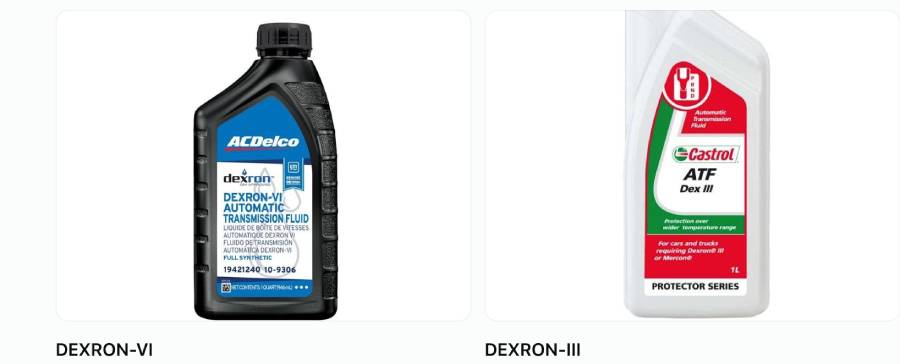
What Is the Difference Between Dexron 3 and Dexron 6?
The main differences between DEXRON-III and DEXRON-VI are viscosity, shear stability, oxidation resistance, friction durability, and backward compatibility. DEXRON-III is an older General Motors automatic transmission fluid specification, while DEXRON-VI was introduced in 2005 to meet more demanding transmission performance requirements. DEXRON-VI generally has lower initial viscosity and stricter durability requirements, allowing it to maintain more consistent performance throughout its service life.
The two specifications also differ in their approval status. GM discontinued its DEXRON-III licensing program at the end of 2006, while DEXRON-VI remains a licensed specification. Products labeled “DEXRON-III compatible” or “DEX/MERC” are typically marketed based on manufacturer claims rather than current GM DEXRON-III licensing.
How Do Dexron 3 and Dexron 6 Specifications Compare?
The following table summarizes the main technical and application differences between DEXRON-III and DEXRON-VI.
| Specification | DEXRON-III | DEXRON-VI |
|---|---|---|
| Introduction | 1993 | 2005 |
| GM licensing status | Discontinued | Active |
| Typical viscosity at 100°C | Approximately 7–8 cSt | Approximately 5.8–6.4 cSt |
| Shear stability | Older performance requirements | Stricter viscosity retention requirements |
| Oxidation resistance | Older durability requirements | Improved oxidation resistance requirements |
| Friction durability | Earlier friction performance standards | More demanding friction durability standards |
| Backward compatibility | Not approved as a DEXRON-VI replacement | Approved for many earlier GM DEXRON applications |
| Primary applications | Older automatic transmissions | Newer and compatible older GM automatic transmissions |
Viscosity values are representative of conventional products and vary by formulation. They are not universal limits for every fluid marketed under these specifications.
GM developed DEXRON-VI to address the changing lubrication requirements of automatic transmissions, particularly the need for consistent hydraulic operation, clutch friction characteristics, and fluid durability. Its stricter performance requirements help reduce changes in fluid properties caused by heat, oxidation, and mechanical shearing.
DEXRON-VI is the more advanced specification, but that does not make it universally interchangeable with DEXRON-III. Its backward compatibility applies to supported GM transmission applications, while other manufacturers and specialized transmission systems may require different fluid characteristics. The correct choice depends on the transmission manufacturer’s approved ATF specification.
Is Dexron 6 Thinner Than Dexron 3?
Yes, DEXRON-VI is generally thinner than DEXRON-III when both fluids are new. Conventional DEXRON-III automatic transmission fluids typically have a kinematic viscosity of approximately 7–8 centistokes (cSt) at 100°C, while DEXRON-VI fluids commonly measure around 5.8–6.4 cSt at the same temperature. This difference reflects the newer specification’s lower initial viscosity requirements and improved resistance to viscosity loss during operation.
The lower viscosity of DEXRON-VI allows transmission fluid to flow more readily through hydraulic passages under comparable operating conditions. Automatic transmissions rely on hydraulic pressure to operate clutch packs, control valves, and torque converters. Fluid viscosity influences flow resistance, pressure regulation, and the timing of clutch engagement. However, lower viscosity does not automatically improve shifting in every transmission because hydraulic systems are designed around specific fluid performance requirements.
DEXRON-VI also has stricter shear stability requirements than DEXRON-III. Mechanical shearing occurs as transmission fluid passes through pumps, gears, and narrow hydraulic passages under repeated stress. Over time, this process can reduce the viscosity of fluids containing viscosity-index improvers. DEXRON-VI is formulated to resist excessive viscosity loss, helping maintain more consistent hydraulic behavior throughout its service life.
Although DEXRON-VI starts with a lower viscosity, its improved viscosity retention means the difference between the two fluids can narrow as conventional DEXRON-III fluid ages. Actual viscosity changes depend on formulation, transmission design, operating temperature, and service conditions. For this reason, fresh-fluid viscosity alone is not sufficient to determine whether DEXRON-VI can replace DEXRON-III in a particular transmission.
Does Dexron 6 Last Longer Than Dexron 3?
Yes, DEXRON-VI is designed to maintain its performance longer than DEXRON-III because it has stricter requirements for oxidation resistance, shear stability, and friction durability. These improvements help the fluid retain its lubricating and hydraulic properties under prolonged exposure to heat, mechanical stress, and repeated transmission operation. However, the actual service life depends on driving conditions, transmission design, and manufacturer maintenance requirements.
Oxidation resistance is a major factor affecting automatic transmission fluid durability. Transmission fluid is exposed to elevated temperatures during driving, particularly when towing, carrying heavy loads, or operating in stop-and-go traffic. Prolonged heat exposure accelerates oxidation, which can increase fluid acidity, contribute to deposit formation, and degrade lubrication performance. DEXRON-VI has more demanding oxidation performance requirements, helping limit these changes compared with fluids meeting older DEXRON-III requirements.
Shear stability also contributes to longer-lasting fluid performance. Automatic transmissions subject ATF to mechanical stress as it circulates through hydraulic pumps, control valves, and other components. DEXRON-VI must demonstrate improved resistance to permanent viscosity loss, helping preserve the fluid characteristics required for consistent hydraulic operation. Its friction durability requirements also support more stable clutch engagement and shift quality as the fluid ages.
DEXRON-VI’s improved durability does not establish a universal transmission fluid replacement interval. A transmission operating under severe conditions may require more frequent servicing than one used primarily for normal highway driving. Vehicle owners should follow the applicable OEM maintenance schedule rather than extending fluid changes solely because DEXRON-VI has stricter performance requirements.
Can You Use Dexron 6 Instead of Dexron 3?
Yes, DEXRON-VI can replace DEXRON-III in many older General Motors automatic transmissions because GM approved DEXRON-VI for backward-compatible applications. This allows owners of compatible GM vehicles originally requiring DEXRON-III to use licensed DEXRON-VI fluid without modifying the transmission. However, this approval does not automatically extend to every transmission that specifies DEXRON-III, particularly units manufactured by other automakers.
DEXRON-VI meets more demanding requirements for oxidation resistance, shear stability, and friction durability than DEXRON-III. Although its initial viscosity is lower, its improved viscosity retention helps maintain consistent hydraulic performance during service. These characteristics support its use in older GM transmissions covered by the manufacturer’s backward-compatibility guidance.
Is Dexron 6 Backward Compatible With Dexron 3?
DEXRON-VI is backward compatible with DEXRON-III in applicable GM automatic transmissions, but the compatibility is not reciprocal. GM introduced DEXRON-VI for its newer automatic transmissions and authorized its use as a service replacement for earlier DEXRON fluids in supported applications. This includes many older GM automatic transmissions originally designed for DEXRON-III.
For example, GM’s 4L60-E and 4L80-E automatic transmissions were used in numerous vehicles before DEXRON-VI was introduced. Many applications of these transmissions originally specified DEXRON-III and are covered by GM’s subsequent DEXRON-VI service recommendations. Owners should still verify the applicable service information for their specific vehicle and transmission configuration.
Backward compatibility also has important limitations. Some manual transmissions, transfer cases, and non-GM automatic transmissions specify DEXRON-III-type fluids but have different lubrication or friction requirements. A DEXRON-III recommendation in these applications does not independently establish DEXRON-VI compatibility.
The safest replacement is a licensed DEXRON-VI fluid used in a transmission for which the manufacturer approves that specification. Check the owner’s manual, transmission identification, and current OEM service guidance before switching fluids, especially when servicing older vehicles or transmission systems outside GM’s automatic transmission applications.
Can You Use Dexron 3 Instead of Dexron 6?
No, DEXRON-III should not replace DEXRON-VI in automatic transmissions that specifically require DEXRON-VI. DEXRON-III does not meet the newer specification’s requirements for viscosity, shear stability, oxidation resistance, and friction durability. Although both fluids are designed for automatic transmissions, they are not interchangeable in both directions.
DEXRON-VI typically has a lower initial viscosity than conventional DEXRON-III fluid. Transmissions designed for DEXRON-VI use hydraulic control systems calibrated for its specified fluid characteristics. Substituting DEXRON-III can change fluid flow resistance and hydraulic response, potentially affecting clutch engagement, shift timing, and transmission operation. The difference in friction performance can also contribute to inconsistent shifting or torque converter clutch shudder.
Using DEXRON-III in a transmission requiring DEXRON-VI can increase the risk of poor shift quality and premature transmission wear. Possible symptoms include delayed gear engagement, harsh shifts, slipping, or torque converter shudder. However, these symptoms are not guaranteed to occur immediately, and their presence does not prove that incorrect transmission fluid is the cause. Actual consequences depend on the fluid formulation, transmission condition, operating temperature, and duration of use.
If DEXRON-III has been added to a transmission requiring DEXRON-VI, verify the fluid used and consult the manufacturer’s service procedure. Corrective service may involve draining the incorrect fluid and refilling with approved DEXRON-VI. Because a conventional drain-and-fill does not remove all fluid retained in the torque converter and hydraulic circuits, additional fluid replacement may be necessary depending on the amount of incorrect ATF introduced.
The correct transmission fluid must meet the manufacturer’s required specification, not merely belong to the same DEXRON family. DEXRON-VI’s backward compatibility with older GM applications does not mean DEXRON-III is suitable for transmissions designed around DEXRON-VI.
Can You Mix Dexron 3 and Dexron 6?
Yes, DEXRON-III and DEXRON-VI can generally be physically mixed, but the mixture is suitable only when it meets the transmission manufacturer’s fluid requirements. In older GM automatic transmissions where DEXRON-VI is approved as a replacement for DEXRON-III, adding DEXRON-VI to existing DEXRON-III fluid is generally acceptable. However, mixing the fluids does not guarantee that the resulting blend meets the complete DEXRON-VI specification.
DEXRON-III and DEXRON-VI have different viscosity and performance requirements. Mixing them changes the proportions of their base oils and additive packages, including friction modifiers, antioxidants, and antiwear additives. The resulting fluid properties depend on the formulations and mixing ratio. In a transmission originally requiring DEXRON-VI, adding DEXRON-III introduces fluid that does not meet the required specification and should be avoided.
Should You Flush the Transmission When Switching to Dexron 6?
A complete transmission flush is not automatically necessary when switching from DEXRON-III to DEXRON-VI in a compatible GM automatic transmission. A conventional drain-and-fill removes part of the existing fluid, while the remaining ATF stays in components such as the torque converter, valve body, and internal hydraulic passages. The new DEXRON-VI mixes with this residual fluid during normal transmission operation.
A fluid exchange replaces a greater proportion of the existing ATF but must follow the manufacturer’s approved service procedure. The appropriate method depends on transmission condition, service history, and whether the existing fluid is contaminated or incorrect. For example, a routine fluid change in a compatible older GM transmission may require only a drain-and-fill, while significant contamination or an incorrect fluid application may require additional service.
Follow the OEM maintenance procedure rather than performing a flush solely because the fluid specification is changing. Use approved DEXRON-VI, maintain the correct fluid level, and follow the specified temperature-checking procedure to avoid overfilling or underfilling the transmission.
Read more: Best 6L80 Transmission Upgrades for Reliability
How Do You Know if Your Car Needs Dexron 3 or Dexron 6?
You can determine whether your car needs DEXRON-III or DEXRON-VI by checking the manufacturer’s transmission fluid specifications, identifying the transmission model, and reviewing current OEM service recommendations. The correct fluid depends on the transmission’s design and approved lubrication requirements rather than the vehicle’s age alone. Many older GM automatic transmissions originally specified DEXRON-III but can use DEXRON-VI under GM’s backward-compatibility guidance.
General Motors introduced DEXRON-VI for newer automatic transmissions beginning with the 2006 model year and approved it for many earlier GM automatic transmission applications. However, some vehicles use manual transmissions, transfer cases, or specialized transmission systems with different fluid requirements. These components should not automatically receive DEXRON-VI simply because their original specifications mention DEXRON-III.
Where Can You Find Your Vehicle’s Transmission Fluid Specification?
The owner’s manual, OEM service documentation, and transmission identification information are the most reliable sources for determining the required ATF specification. These resources identify the fluid requirements established by the manufacturer and help distinguish between transmission models that may be installed in vehicles of the same model year.
The owner’s manual typically lists the required automatic transmission fluid under maintenance specifications or recommended fluids. For older GM vehicles, updated technical service information may identify DEXRON-VI as an approved replacement for the originally specified DEXRON-III. The transmission model or identification code can provide additional confirmation when different transmission options were available for the same vehicle.
For example, a GM vehicle equipped with a 4L60-E automatic transmission may have originally specified DEXRON-III, while later GM service guidance permits DEXRON-VI in compatible applications. In contrast, a non-GM vehicle specifying DEXRON-III may require a different fluid formulation or manufacturer-specific approval.
Always verify the exact transmission specification before purchasing or adding ATF. If the owner’s manual and current service information appear inconsistent, follow the manufacturer’s applicable updated guidance or consult a qualified transmission specialist. This prevents selecting fluid based solely on the DEXRON name, vehicle model year, or claims printed on a product label.
Which Is Better for Your Transmission, Dexron 3 or Dexron 6?
DEXRON-VI is generally the better choice for compatible GM automatic transmissions because it meets stricter requirements for viscosity stability, oxidation resistance, and friction durability than DEXRON-III. However, the best transmission fluid is the one approved by the vehicle manufacturer. A newer ATF specification does not automatically make it suitable for every transmission originally designed to use DEXRON-III.
For GM automatic transmissions requiring DEXRON-VI, only fluid meeting that specification should be used. Many older GM automatic transmissions originally requiring DEXRON-III can also use DEXRON-VI under GM’s backward-compatibility guidance. However, non-GM transmissions and specialized driveline components may have different fluid requirements that must be verified separately.
The following table summarizes how to choose between the two specifications.
| Transmission Requirement | Recommended Fluid |
|---|---|
| GM automatic transmission requiring DEXRON-VI | Licensed DEXRON-VI |
| Older GM automatic transmission originally requiring DEXRON-III | DEXRON-VI where GM approves backward compatibility |
| Non-GM transmission requiring DEXRON-III | Fluid meeting the manufacturer’s specific requirements |
| Manual transmission or transfer case specifying DEXRON-III | OEM-approved fluid for that component |
| Unknown transmission specification | Verify OEM requirements before adding ATF |
Choose transmission fluid based on OEM approval rather than viscosity, price, or specification age alone. Using the correct ATF helps maintain the hydraulic and friction characteristics required for proper shifting, clutch operation, and transmission durability.