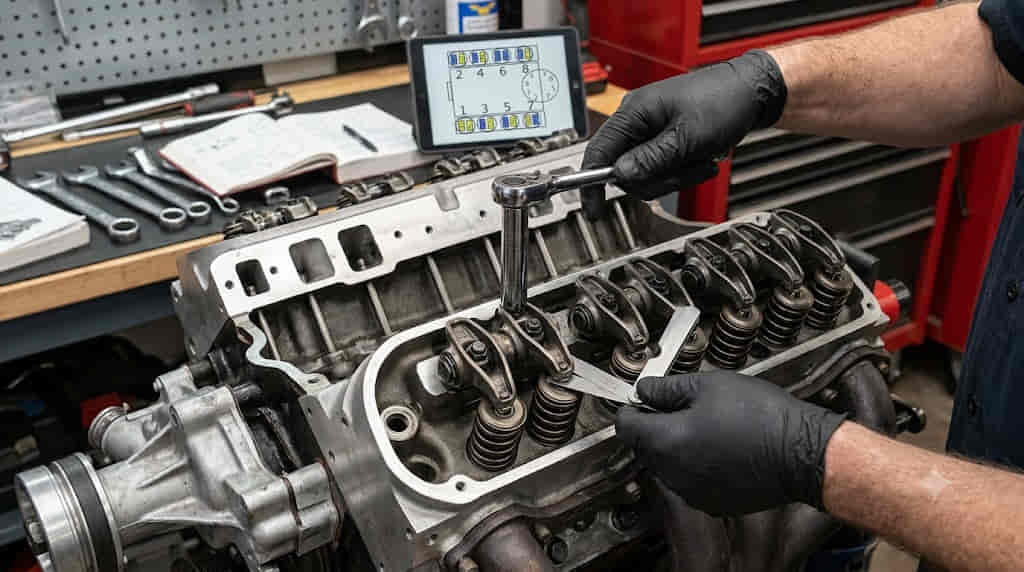
SBC valve adjustment is the process of setting the correct clearance or preload in the valvetrain of a Chevrolet Small Block V8 engine. The correct procedure depends primarily on whether the engine uses hydraulic lifters or solid lifters, along with the camshaft specifications and valvetrain components installed. Hydraulic lifters require a specific lifter preload after zero lash is established, while solid lifters require a measured valve lash setting according to the camshaft manufacturer’s specifications.
Correct valve adjustment helps the valvetrain operate as designed, supports consistent engine performance, and reduces the risk of excessive mechanical noise or component damage. An adjustment that is too loose can create excessive clearance and impact valvetrain operation. An adjustment that is too tight can prevent a valve from seating correctly, potentially causing compression loss and valve damage. These risks make it important to identify the engine configuration before turning any rocker arm nuts.
This guide explains how to identify the lifter type, prepare a Small Block Chevy engine, select the appropriate adjustment method, and verify the final settings. It also covers valve adjustment sequence, common mistakes, and situations that require a recheck. Because SBC engines can use different factory and aftermarket valvetrain combinations, always confirm the exact specifications for the installed camshaft and lifters rather than relying on a universal adjustment setting.
What Is SBC Valve Adjustment?
SBC valve adjustment is the process of setting the correct relationship between the valvetrain components so that the intake and exhaust valves open and close according to the camshaft’s design. In a Chevrolet Small Block V8, the rocker arm transfers motion from the pushrod to the valve, while the lifter follows the camshaft lobe to control that movement. The adjustment determines how much clearance or preload exists within this mechanical assembly. The required setting depends on whether the engine uses hydraulic lifters or solid lifters and on the specifications of the installed camshaft.
The two main adjustment concepts are valve lash and hydraulic lifter preload. Valve lash is the specified clearance in a solid-lifter valvetrain, measured at the designated position and temperature. Hydraulic lifter preload is the amount the lifter’s internal plunger is compressed after the clearance has been removed and zero lash has been established. These settings serve different purposes, so a solid-lifter lash specification must not be used as a hydraulic-lifter preload specification. For example, an SBC fitted with a solid roller camshaft requires the lash specified by its camshaft manufacturer, whereas an engine with hydraulic roller lifters requires the appropriate preload setting.
Correct SBC valve adjustment supports consistent valve operation, engine performance, and valvetrain reliability. Excessive lash can increase mechanical noise and alter the effective valve motion, while excessive hydraulic lifter preload can prevent a valve from seating correctly under certain conditions. A valve that cannot fully close may cause compression loss, rough running, or valve damage. These symptoms are not exclusive to incorrect adjustment, however; worn lifters, damaged rocker arms, incorrect pushrod length, and other mechanical problems can produce similar results.
The correct adjustment procedure therefore begins with identifying the installed valvetrain components rather than simply loosening or tightening the rocker arm nuts. Engine displacement and the Small Block Chevy designation alone do not establish the correct setting because original and aftermarket combinations can use different camshafts, lifters, rocker arms, and locking hardware. The camshaft manufacturer’s instructions and the specifications for the actual components provide the reliable basis for determining whether to measure valve lash or set hydraulic lifter preload.
Read more: What Cars Have LS3 Engines
Which Type of Lifters Does Your Small Block Chevy Use?
Identifying the lifter type is the first step in choosing the correct SBC valve adjustment procedure. Chevrolet Small Block V8 engines can use hydraulic flat-tappet lifters, hydraulic roller lifters, solid flat-tappet lifters, or solid roller lifters, depending on the original engine configuration and any aftermarket modifications. These lifters follow the camshaft lobes to control valve movement, but they do not all use the same adjustment method. Before changing rocker arm settings, identify the installed lifters and confirm the camshaft manufacturer’s requirements.
Hydraulic flat-tappet lifters use a flat contact surface against the camshaft lobe and an internal hydraulic mechanism that uses engine oil to compensate for normal valvetrain clearance. During adjustment, the goal is to establish zero lash and then set the specified lifter preload. Hydraulic roller lifters also use an internal hydraulic mechanism, but they incorporate a roller wheel that follows the camshaft lobe. Although both types require preload rather than a conventional solid-lifter lash setting, their required adjustment depends on the lifter design, camshaft combination, and manufacturer specifications.
Solid flat-tappet lifters and solid roller lifters do not use the same hydraulic plunger mechanism to compensate for clearance. Instead, their valvetrains require a specified valve lash, which is measured with a feeler gauge under the conditions prescribed by the camshaft manufacturer. Solid roller lifters use a roller wheel at the camshaft contact point, while solid flat-tappet lifters use a flat contact surface. A performance SBC with a solid-lifter camshaft may require different intake and exhaust lash settings, so applying a generic hydraulic-lifter preload procedure would be incorrect.
The engine’s original model designation is not always enough to identify the lifters currently installed. An older Small Block Chevy may have been rebuilt with an aftermarket camshaft, roller conversion, different rocker arms, or replacement lifters. Check the engine build records, camshaft part number, lifter markings, and installation documentation wherever possible. If the components cannot be identified visually, obtain the relevant specifications before proceeding. Establishing whether the engine uses hydraulic or solid lifters prevents the most fundamental adjustment error: confusing hydraulic lifter preload with solid-lifter valve lash.
What Tools Do You Need for SBC Valve Adjustment?
Adjusting SBC valves requires tools that allow you to access the valvetrain, rotate the engine safely, and establish the correct clearance or lifter preload. The essential equipment typically includes the appropriate socket and ratchet for the crankshaft bolt, a wrench or socket for the rocker arm nuts, and tools for removing the valve covers. A feeler gauge is also necessary when the installed valvetrain requires a measured solid-lifter valve lash. The exact tools depend on the engine configuration and the adjustment method specified by the camshaft or lifter manufacturer.
A feeler gauge measures the clearance between specified valvetrain surfaces when a solid-lifter adjustment calls for a particular lash setting. The correct blade thickness must match the camshaft manufacturer’s specification, and the gauge should move through the gap with the resistance described by the manufacturer’s procedure. Hydraulic lifter adjustment is different because the objective is to establish zero lash and then set the required preload. A feeler gauge is not a substitute for the correct hydraulic-lifter adjustment procedure.
A suitable crankshaft-turning tool helps rotate the engine by hand so each lifter can be positioned on the camshaft’s base circle before its corresponding valve is adjusted. This position matters because measuring or adjusting a valve while its lifter is riding on the opening or closing ramp can produce an incorrect setting. Use the correct tool for the engine’s crankshaft bolt and follow the service procedure for rotating the engine. Never use the starter motor as a substitute for controlled positioning during manual adjustment.
The camshaft and lifter documentation is just as important as the physical tools. It provides the required valve lash or lifter preload, the specified adjustment conditions, and any special instructions for the installed components. An SBC fitted with aftermarket rocker arms, polylock adjusters, or a nonstandard camshaft may require a different procedure from a stock engine. Before beginning, verify the component specifications and ensure that the tools fit the installed hardware correctly; forcing an incorrect wrench or applying an assumed adjustment value can damage components or leave the valvetrain improperly set.
How Should You Prepare a Small Block Chevy for Valve Adjustment?
Preparing a Small Block Chevy for valve adjustment begins with identifying the exact valvetrain configuration and determining whether the adjustment must be performed with the engine cold or at a specified operating temperature. The required conditions depend on the camshaft, lifters, and manufacturer’s instructions. A stock SBC and a modified engine with an aftermarket camshaft may require different procedures, even when both use the same basic small-block architecture. Confirm the specified valve lash or lifter preload before loosening any rocker arm nuts.
Before accessing the valvetrain, park the vehicle on a stable, level surface, place the transmission in the appropriate position, apply the parking brake, and prevent accidental engine starting. Allow the engine to cool if the procedure requires a cold adjustment. If the manufacturer specifies a hot adjustment, follow the relevant service instructions and take precautions against hot engine surfaces and moving components. Disconnecting the ignition system or disabling fuel delivery as directed by the vehicle’s service manual helps prevent an unintended start during manual engine positioning.
Next, remove the valve covers to expose the rocker arms, rocker studs, pushrods, and valve springs. Inspect the visible components for obvious damage, looseness, abnormal wear, or signs of inadequate lubrication. A bent pushrod, damaged rocker arm, or worn component should not be treated simply as an adjustment problem. If the valvetrain shows signs of mechanical damage, investigate the cause before proceeding because adjusting damaged components may not restore proper operation.
The final preparation step is to establish a reliable method for rotating the crankshaft by hand and identifying the camshaft’s base circle for each lifter being adjusted. The lifter must be on the base circle—not on the opening or closing ramp—so the valve is in the correct position for the specified measurement or preload procedure. Use the appropriate crankshaft-turning tool and follow the engine or camshaft manufacturer’s positioning instructions. Once the engine configuration, adjustment conditions, tools, and component condition have been verified, the correct hydraulic-lifter or solid-lifter procedure can be performed.
How Do You Adjust Hydraulic Lifters on a Small Block Chevy?
Adjusting hydraulic lifters on a Small Block Chevy requires establishing zero lash and then setting the lifter preload specified for the installed valvetrain. Zero lash is the point at which the clearance between the rocker arm, pushrod, and lifter has been removed without deliberately compressing the lifter’s internal plunger. Preload is the additional amount the plunger is compressed after that point. The correct preload depends on the lifter design, rocker arm arrangement, and camshaft manufacturer’s instructions, so there is no single adjustment value that applies to every SBC.
Begin by positioning the lifter being adjusted on the camshaft’s base circle, where the cam lobe is not lifting the lifter. Follow the camshaft manufacturer’s recommended valve-positioning procedure to confirm that the corresponding valve is closed and the valvetrain is not on the opening or closing ramp. With the engine secured against accidental starting, gently take up the clearance in the rocker arm and pushrod assembly according to the specified method. The goal is to identify zero lash accurately, not to tighten the rocker arm until the valve begins to open or the lifter plunger is compressed excessively.
Once zero lash has been established, adjust the rocker arm to achieve the specified hydraulic lifter preload. Some SBC valvetrains use conventional rocker arm nuts, while others use adjustable hardware such as polylocks. The correct procedure and adjustment amount depend on the installed components; the number of additional turns must not be assumed to be universal. For example, an aftermarket camshaft and lifter combination may specify a different preload from another hydraulic setup installed in an otherwise similar Small Block Chevy. Use the lifter manufacturer’s instructions and verify that the rocker arm hardware is compatible with the required setting.
After adjusting the rocker arm, verify that the hardware is secured according to the manufacturer’s procedure and repeat the process for the remaining valves, positioning each lifter correctly before adjustment. Check that the pushrods and rocker arms remain properly seated and that no component binds during the engine’s manual rotation. If the engine has adjustable rocker arms, nonstandard pushrod lengths, or aftermarket valvetrain parts, confirm that the geometry and adjustment method are suitable for the complete assembly. Correct hydraulic lifter preload depends on accurate zero-lash identification and the specified final setting, not simply on eliminating valvetrain noise.
How Do You Adjust Solid Lifters on a Small Block Chevy?
Adjusting solid lifters on a Small Block Chevy requires setting the specified valve lash rather than hydraulic lifter preload. Solid lifters do not contain the hydraulic plunger mechanism used to compensate for normal valvetrain clearance, so the gap between the specified contact surfaces must be measured and adjusted according to the camshaft manufacturer’s requirements. The correct setting depends on the camshaft profile, lifter type, valvetrain configuration, and whether the manufacturer specifies a cold or hot adjustment. Some camshafts also require different lash values for intake and exhaust valves.
Begin by identifying the camshaft and obtaining its recommended valve lash specifications. Position the lifter on the camshaft’s base circle so the valve is fully closed and the lifter is not riding on the opening or closing ramp. This position is essential because measuring lash while the camshaft is lifting the valve produces an incorrect result. Follow the camshaft manufacturer’s specified positioning procedure rather than assuming that every valve can be adjusted at the same crankshaft position.
Use a feeler gauge of the specified thickness to measure the clearance at the designated point in the valvetrain. The gauge should fit the gap with the resistance described by the manufacturer’s procedure. If the measured clearance differs from the required setting, adjust the rocker arm hardware according to the installed system and recheck the measurement. For example, a solid-lifter camshaft may specify different intake and exhaust lash values, so using one measurement for every valve could leave the engine incorrectly adjusted. Always use the exact specifications for the installed camshaft rather than a generic Small Block Chevy value.
After adjusting each valve, secure the locking hardware as specified and remeasure the lash to confirm that tightening has not changed the setting. Repeat the process with each lifter correctly positioned on its base circle. Once the adjustments are complete, rotate the engine manually through the appropriate inspection procedure and recheck any measurements required by the manufacturer. If the engine uses aftermarket rocker arms, different pushrod lengths, or a modified camshaft, confirm that these components are compatible and correctly installed before operation. Accurate solid-lifter valve lash depends on both the specified measurement and the correct adjustment conditions.
What Is the Correct SBC Valve Adjustment Sequence?
The correct SBC valve adjustment sequence depends on the camshaft position, the lifter type, and the method specified by the manufacturer. The goal is to adjust each valve when its lifter is on the camshaft’s base circle, where the cam lobe is not applying lift. This position allows hydraulic lifter preload or solid-lifter valve lash to be established accurately. Simply following the engine’s firing order without confirming the position of each lifter can result in an incorrect adjustment.
One approach is to position the engine so that a particular cylinder is at top dead center (TDC) on its compression stroke. At this point, both intake and exhaust valves for that cylinder should be closed, provided the camshaft timing and valvetrain are functioning correctly. This position can provide a suitable reference for adjusting the corresponding valves, but the exact sequence must follow the procedure appropriate for the engine and camshaft. TDC alone does not guarantee that every other valve is ready for adjustment.
Another approach is the EO/IC method, which stands for Exhaust Opening/Intake Closing. This method uses the movement of the opposite valve to help identify when a lifter is on the base circle. When the exhaust valve begins to open, the intake valve can be positioned for adjustment; when the intake valve is nearing full closure, the exhaust valve can be positioned for adjustment. The method helps establish the correct relationship between valve movement and camshaft position, but it must be applied carefully and in accordance with the camshaft manufacturer’s instructions.
For an accurate adjustment, use a verified procedure for the specific SBC configuration rather than assuming one universal sequence applies to every engine. Hydraulic lifters require the specified preload after zero lash is established, while solid lifters require the specified valve lash under the prescribed conditions. If the engine has an aftermarket camshaft, modified firing order, or nonstandard valvetrain components, confirm the correct sequence in the relevant documentation before proceeding. Correct positioning is essential because even a precisely measured setting will be wrong if the lifter is on a camshaft ramp rather than the base circle.
How Can You Check Whether SBC Valve Adjustment Is Correct?
Correct SBC valve adjustment should match the specifications for the installed camshaft and lifters, and the valvetrain should operate without abnormal mechanical interference. After completing the adjustment, verify each valve’s setting using the appropriate method. For solid lifters, this means remeasuring the specified valve lash with a feeler gauge under the required temperature conditions. For hydraulic lifters, verify that zero lash was identified correctly and that the specified preload was established. A rocker arm that feels tight does not automatically indicate a correct adjustment because excessive preload can also cause problems.
The next step is to inspect the rocker arms, pushrods, and locking hardware. Each pushrod should remain properly seated, the rocker arms should align with the valve stems, and the adjusters should be secured according to the component manufacturer’s instructions. Rotate the engine manually through the required inspection procedure and observe the valvetrain for binding, abnormal contact, or unexpected movement. If a rocker arm moves inconsistently or a pushrod appears misaligned, investigate the cause before starting the engine.
After the mechanical checks are complete, reinstall the valve covers and any components removed during the procedure. Start the engine only after confirming that the adjustment hardware is secure and the lubrication and reassembly requirements have been met. Listen for abnormal valvetrain noise and observe engine operation for signs such as rough running or misfires. However, a quiet engine does not prove that the adjustment is correct, and noise alone does not establish that valve lash or preload is the cause.
If abnormal noise or poor engine operation continues, recheck the adjustment using the correct specifications and inspect related components. Worn lifters, damaged rocker arms, incorrect pushrod length, poor rocker geometry, and camshaft wear can create symptoms similar to an adjustment problem. For example, persistent ticking after a careful adjustment may indicate a worn component rather than a need to tighten the rocker arm further. Confirming the actual cause prevents unnecessary adjustments that could introduce excessive lash or preload and damage the valvetrain.
What Are the Most Common SBC Valve Adjustment Mistakes?
The most common SBC valve adjustment mistakes involve using the wrong specifications, positioning the lifter incorrectly, and confusing hydraulic lifter preload with solid-lifter valve lash. These errors can leave the valvetrain operating outside its intended settings, even when the rocker arm nuts appear secure. The first step in preventing incorrect adjustment is to identify the installed camshaft and lifters, then follow the corresponding manufacturer’s procedure. A factory Small Block Chevy specification should not automatically be applied to an engine that has been rebuilt or modified with aftermarket components.
Another frequent mistake is adjusting a valve while its lifter is on the camshaft’s opening or closing ramp rather than the base circle. When the lifter is not on the base circle, the measured clearance or apparent zero-lash position does not represent the correct adjustment point. This can result in incorrect valve lash or excessive hydraulic lifter preload. To avoid this problem, rotate the engine using the specified procedure and confirm that the valve is in the appropriate position before making the adjustment.
Overtightening rocker arms is another important source of valvetrain problems. On a hydraulic-lifter engine, excessive preload can prevent a valve from seating fully under certain operating conditions, potentially causing compression loss, rough running, or valve damage. On a solid-lifter engine, setting the lash tighter than specified changes the intended clearance and may affect valve operation as the engine reaches its operating temperature. Conversely, excessive lash can increase mechanical noise and alter the effective valve motion. Neither tightening nor loosening the rocker arm based only on sound is a reliable adjustment method.
Ignoring the condition and compatibility of the valvetrain components can also undermine an otherwise careful adjustment. Worn lifters, bent pushrods, damaged rocker arms, incorrect pushrod length, and unsuitable rocker geometry may produce symptoms that resemble incorrect valve adjustment. For example, persistent ticking after the specified settings have been established may indicate component wear rather than insufficient tightening. Inspect the complete valvetrain, verify that the parts are compatible, and correct any mechanical defects before repeating the adjustment. This approach addresses the underlying cause instead of risking further damage through unnecessary changes to lash or preload.
When Should You Recheck SBC Valve Adjustment?
You should recheck SBC valve adjustment whenever the valvetrain has been assembled, modified, or shows symptoms that suggest the settings may be incorrect. A recheck is particularly important after installing a new camshaft, replacing lifters, changing rocker arms, or altering pushrod length. These changes can affect valve lash, hydraulic lifter preload, or valvetrain geometry. Following the component manufacturer’s inspection and adjustment schedule helps establish whether the settings remain within the intended specifications.
A newly assembled or rebuilt Small Block Chevy may require additional checks according to the camshaft and lifter manufacturers’ instructions. The requirements depend on the installed components and the break-in procedure, especially when a new flat-tappet camshaft is involved. Do not assume that every SBC needs the same recheck interval. For example, a solid-lifter performance camshaft may have a specified lash inspection schedule, while a hydraulic-lifter setup follows its own adjustment and maintenance requirements.
You should also investigate the valvetrain if the engine develops persistent ticking, unusual mechanical noise, rough running, misfires, or an unexplained change in performance. These symptoms can indicate incorrect adjustment, but they may also result from worn lifters, damaged pushrods, loose rocker hardware, camshaft wear, or other mechanical faults. Repeating the adjustment without identifying the underlying cause may fail to solve the problem and could make it worse. Check the actual lash or preload against the correct specifications and inspect the associated components when necessary.
The most reliable approach is to keep a record of the installed camshaft and lifter specifications, the adjustment method used, and any subsequent valvetrain work. Recheck the settings at the intervals or milestones required by the component manufacturers, and investigate abnormal symptoms promptly. Hydraulic lifter preload and solid-lifter valve lash follow different procedures, so the recheck must use the method appropriate to the installed system. This ensures that maintenance decisions are based on the engine’s actual configuration rather than a generic schedule for all Chevrolet Small Block V8 engines.