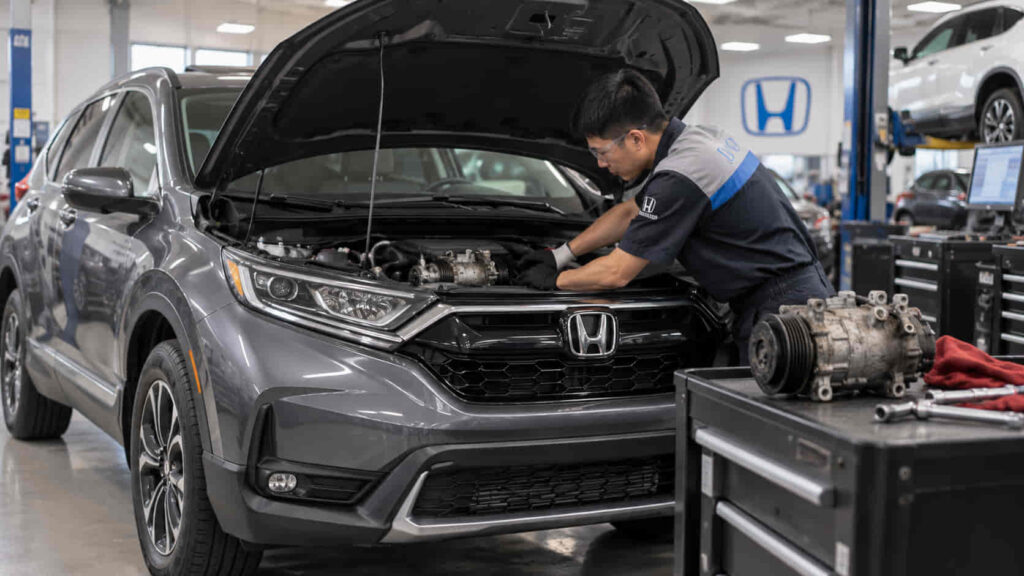
If you are searching for a Honda CR-V AC compressor recall, the key issue is whether your vehicle is covered by Honda’s A/C compressor shaft seal warranty extension rather than assuming every compressor problem is part of a safety recall. Honda Service Bulletin 23-040 covers eligible 2017–2022 Honda CR-V models equipped with the 1.5L turbocharged engine and extends coverage for the A/C compressor shaft seal to 10 years from the vehicle’s original purchase date with no mileage limitation.
The covered condition involves refrigerant leakage from the compressor shaft seal. Honda states that the seal can develop abnormal wear, increasing clearance around the compressor shaft and allowing refrigerant to leak. Loss of refrigerant can eventually reduce A/C cooling performance, but an air conditioner that stops blowing cold does not by itself confirm that the shaft seal is responsible.
Coverage is also vehicle-specific. A CR-V being from the 2017–2022 model-year range does not automatically establish eligibility, and the actual A/C problem must match the covered condition. VIN verification and proper diagnosis are therefore important before assuming the repair will be covered.
This guide explains which Honda CR-V years are included, what the compressor warranty extension covers, how long the coverage lasts, how eligibility is verified, what repair Honda provides, and what owners should do if they have already paid for a related A/C repair.
Is There a Honda CR-V AC Compressor Recall?
If you are looking for a Honda CR-V AC compressor recall related to the compressor shaft seal leak, Honda identifies the program as a warranty extension rather than a safety recall. Honda Service Bulletin 23-040 is titled “Warranty Extension: 2017-22 CR-V A/C Compressor Shaft Seal Leak” and extends coverage for the specified compressor shaft seal condition on eligible vehicles.
This distinction matters because a recall and a warranty extension are not interchangeable terms. A safety recall addresses a safety-related defect or regulatory noncompliance through a formal recall campaign, while this Honda program extends the warranty period for a specific A/C component and failure condition. Searching for a “Honda CR-V AC compressor recall” can therefore lead owners to the correct issue, but the relevant Honda documentation describes the remedy as extended warranty coverage.
The warranty extension specifically concerns refrigerant leakage from the A/C compressor shaft seal. Honda states that changes associated with refrigerant and oil requirements can cause the compressor shaft seal to swell. The swelling can lead to abnormal seal wear, which can increase the gap around the compressor shaft and allow refrigerant to escape.
Honda did not use this warranty extension to declare that every A/C compressor problem on an affected CR-V has the same cause. The covered condition is the compressor shaft seal leak described in the bulletin. A compressor can develop other faults, and an A/C system can stop cooling for reasons elsewhere in the system. The existence of the warranty extension therefore does not establish that every loss of air-conditioning performance qualifies for the covered repair.
The remedy also demonstrates the limited scope of the program. Honda instructs technicians to perform an inspection procedure and, when directed by that procedure, replace the compressor shaft seal. The bulletin does not instruct dealers to automatically replace the complete A/C compressor on every vehicle included in the affected model range.
Vehicle eligibility must also be verified. Honda instructs dealers to perform an iN VIN status inquiry to determine whether the vehicle is shown as eligible for the campaign. This means model year and engine configuration identify the relevant vehicle population, while the individual VIN establishes whether a specific CR-V is included.
For owners, the practical distinction is straightforward: the documented Honda CR-V A/C compressor shaft seal program is a 10-year warranty extension for an identified leak condition, not a blanket recall covering every compressor failure. The next step is to determine whether the CR-V falls within the affected vehicle population and whether its VIN and diagnosed A/C condition qualify for coverage.
Which Honda CR-V Years Are Covered by the AC Compressor Warranty Extension?
Honda’s A/C compressor shaft seal warranty extension identifies 2017 through 2022 Honda CR-V models equipped with the 1.5T engine as affected vehicles, subject to VIN eligibility. Honda Service Bulletin 23-040 lists the model years as 2017–22, the model as CR-V, and the trim or powertrain designation as 1.5T.
The model-year range is important because it establishes the vehicle population addressed by this specific bulletin. A 2017, 2018, 2019, 2020, 2021, or 2022 CR-V with the applicable 1.5T configuration can fall within the program, but the year alone is not sufficient to confirm coverage. Honda explicitly instructs dealers to check the iN VIN status for eligibility.
This prevents a common misunderstanding when owners search for recall information by year. A statement such as “2017–2022 CR-Vs are covered” can be too broad if it implies that every CR-V produced during those model years automatically receives the repair. The bulletin defines an affected vehicle group but still requires vehicle-specific eligibility verification.
The same limitation applies when evaluating CR-Vs outside the listed years. This particular warranty extension should not be generalized to an earlier or later CR-V simply because that vehicle has an A/C compressor problem. An A/C system that stops cooling can have a refrigerant leak or compressor-related fault without being part of Service Bulletin 23-040.
Honda’s owner notification provides additional context for eligible vehicles. The company states that the warranty extension covers the original owner and subsequent owners, meaning the vehicle does not lose the applicable extension merely because it was sold to another owner. The warranty period, however, remains tied to the vehicle’s original date of purchase rather than restarting when a used CR-V changes ownership.
There are also exclusions. Honda states that this warranty extension does not apply to a vehicle that has been declared a total loss, sold for salvage by a financial institution or insurer, or has a branded or similar title under applicable state law. This is another reason an owner should not determine coverage solely from the model year.
The most reliable interpretation is therefore that 2017–2022 CR-V 1.5T models define the affected population for Honda Service Bulletin 23-040, while the VIN determines whether an individual vehicle is eligible for the warranty extension. Owners experiencing A/C problems within this model range should verify the VIN and have the actual refrigerant leak diagnosed before assuming the repair is covered.
Read more: Honda CRV Cabin Noise Reduction
What AC Compressor Problem Is Covered by Honda?
Honda’s warranty extension covers refrigerant leakage from the A/C compressor shaft seal on eligible 2017–2022 Honda CR-V 1.5T models. The coverage is specific to this shaft-seal condition and should not be interpreted as a 10-year warranty for every possible A/C compressor failure.
Honda Service Bulletin 23-040 explains that refrigerant and oil requirements can affect the compressor shaft seal. According to Honda, the seal can swell, and this swelling can lead to abnormal wear. As the seal wears, the clearance around the compressor shaft can increase enough to allow refrigerant to leak from the compressor.
This failure mechanism matters because an automotive A/C system depends on maintaining the correct refrigerant charge in a closed circuit. When refrigerant escapes through the compressor shaft seal, the system can gradually lose its ability to provide the expected cooling performance. The resulting customer complaint can therefore appear as an air-conditioning problem even though the specific covered defect is a leak at the compressor shaft seal.
The warranty extension does not establish that the complete compressor assembly is defective. Honda’s corrective action instructs technicians to perform an inspection and, when directed by the procedure, replace the compressor shaft seal. This distinction prevents the term “AC compressor recall” from being interpreted as automatic authorization for complete compressor replacement.
Other A/C failures also remain possible. Refrigerant can be lost from other parts of the system, and reduced cooling performance can result from conditions unrelated to the covered shaft seal. An eligible CR-V with an A/C complaint therefore still requires diagnosis to determine whether the problem matches the condition described by Honda.
This is also why model year and VIN eligibility alone do not prove that a particular A/C failure will be repaired under the extension. Those factors determine whether the vehicle can fall within the program, while inspection establishes whether the actual condition corresponds to the covered compressor shaft-seal leak.
The covered Honda CR-V A/C compressor problem is therefore a specific compressor shaft-seal refrigerant leak, not every compressor malfunction or every cause of weak air conditioning. Keeping that distinction clear is essential when determining whether Honda will cover the repair.
What Are the Symptoms of the Honda CR-V AC Compressor Shaft Seal Leak?
The primary symptom associated with the Honda CR-V A/C compressor shaft seal leak is an air-conditioning system that does not blow cold air as expected. Honda identified “A/C not blowing cold air” as the customer complaint in its earlier service bulletin addressing this shaft-seal condition, while the later warranty-extension bulletin explains the refrigerant-leak mechanism behind the problem.
The loss of cooling occurs because the shaft seal can allow refrigerant to escape from the A/C system. As refrigerant charge is lost, the system may no longer operate under the conditions required to deliver normal cabin cooling. The owner experiences the result as reduced or absent cold air, while the underlying covered condition is the refrigerant leak at the compressor shaft.
The symptom does not establish the diagnosis by itself. A Honda CR-V can have poor A/C performance for reasons other than a compressor shaft-seal leak. Treating “not blowing cold” as proof of the warranty-covered defect can therefore lead to an incorrect conclusion about both the required repair and warranty eligibility.
The relationship between symptom and cause should instead be treated as a diagnostic path. Loss of cooling creates a reason to inspect the A/C system; evidence of refrigerant leakage then helps locate the fault; and Honda’s specified inspection procedure determines whether the compressor shaft seal is the condition addressed by the warranty extension.
This distinction becomes particularly important when an owner expects complete compressor replacement. A CR-V can exhibit the same cabin symptom whether the problem is a covered shaft-seal leak or another A/C fault, but those conditions do not necessarily receive the same repair or warranty coverage. The symptom identifies the system requiring diagnosis rather than the component that must automatically be replaced.
Owners of potentially affected vehicles should therefore connect cooling symptoms with vehicle eligibility instead of assuming either one proves the other. A 2017–2022 CR-V 1.5T that stops blowing cold air fits the general vehicle and symptom context of the Honda program, but the VIN and actual leak condition still need to be verified.
A Honda CR-V that is not blowing cold air may have the covered compressor shaft-seal leak, but the symptom alone cannot confirm it. The correct path is to verify campaign eligibility and have the A/C system inspected so the refrigerant leak can be identified before determining whether the warranty extension applies.
How Long Is the Honda CR-V AC Compressor Warranty Extension?
Honda extended the warranty for the A/C compressor shaft seal on eligible 2017–2022 Honda CR-V 1.5T models to 10 years from the vehicle’s original date of purchase, with no mileage limitation. This extension applies specifically to the compressor shaft seal condition covered by Honda’s program rather than creating a 10-year warranty for every component in the A/C system.
The original warranty period for the affected component was 3 years or 36,000 miles. Honda extended the compressor shaft-seal coverage to 10 years with unlimited mileage because of the refrigerant-leak condition described in Service Bulletin 23-040. Mileage therefore does not end this particular extended coverage as long as the other eligibility requirements are satisfied and the vehicle remains within the applicable 10-year period.
The starting date is important when determining whether an older CR-V remains covered. The 10-year period is measured from the vehicle’s original date of purchase, not from the date the current owner purchased the vehicle used. A second or third owner does not receive a new 10-year period when ownership changes.
Honda’s customer notification states that the warranty extension applies to both original and subsequent owners. This means a used CR-V can still qualify if the vehicle itself remains within the applicable warranty period and meets the other conditions of the program. Coverage follows the eligible vehicle and its original purchase timeline rather than being restricted to the person who originally bought it new.
For example, model year alone cannot determine the exact expiration date. Two CR-Vs from the same model year can have different original purchase dates, which means their 10-year coverage periods can end at different times. This is another reason owners should verify the individual vehicle rather than calculating eligibility solely from the year printed on the registration or title.
The extension also remains limited to the condition Honda identified. An eligible vehicle being less than 10 years from its original purchase date does not mean Honda must pay for every compressor, refrigerant, or HVAC repair. Diagnosis must still establish that the repair falls within the compressor shaft-seal coverage.
The applicable coverage period is therefore 10 years from the original purchase date with no mileage limit, but the extension is component- and condition-specific. Ownership changes do not restart the period, and VIN eligibility plus diagnosis remain necessary before coverage for a particular repair is established.
How Can You Check If Your Honda CR-V Is Covered?
The most reliable way to determine whether a Honda CR-V is covered by the A/C compressor shaft-seal warranty extension is to verify the vehicle’s VIN eligibility and then confirm that the diagnosed A/C problem matches the covered condition. Model year and engine configuration identify potentially affected vehicles, but they do not replace vehicle-specific verification.
Honda Service Bulletin 23-040 instructs dealers to perform an iN VIN status inquiry and states that the inquiry must show the vehicle as eligible before the warranty-extension procedure is applied. The VIN therefore connects the general affected population of 2017–2022 CR-V 1.5T models to the individual vehicle being presented for repair.
This distinction prevents model-year information from being interpreted too broadly. An owner can first determine whether the CR-V falls within the relevant 2017–2022 1.5T population, but that is only the initial filter. The individual vehicle still needs to appear as eligible for the program.
An authorized Honda dealer can verify this status using the vehicle identification number. This is particularly important for used vehicles because the current owner may not have received the original warranty-extension notification. Honda’s owner notice states that the extension applies to subsequent owners as well, so the absence of a mailed notice does not by itself establish that a used CR-V is excluded.
VIN eligibility is only one part of the coverage determination. The A/C system must also have the condition addressed by the program. If a potentially eligible CR-V is not blowing cold air, diagnosis is needed to determine whether refrigerant is leaking from the compressor shaft seal or whether another component is responsible for the cooling problem.
The vehicle’s history can also affect eligibility. Honda’s customer notice describes exclusions involving vehicles declared a total loss, sold for salvage by a financial institution or insurer, or carrying certain branded or similar titles under applicable law. Vehicle-specific verification is therefore more reliable than assuming coverage from year, mileage, or ownership status alone.
Owners should also distinguish this warranty check from a general safety-recall search. The compressor shaft-seal program is documented as a warranty extension. Checking for open safety recalls remains useful for the vehicle generally, but it is not a substitute for verifying eligibility for this specific A/C warranty program.
A potentially affected owner should therefore use the VIN to verify program eligibility and have the A/C condition diagnosed before assuming Honda will cover the repair. A matching model year identifies the possibility of coverage; VIN status identifies the eligible vehicle; and diagnosis identifies whether the actual failure matches the compressor shaft-seal condition covered by the extension.
Will Honda Repair the AC Compressor for Free?
Honda can repair the covered A/C compressor shaft-seal condition at no cost when the CR-V is eligible for the warranty extension and diagnosis confirms that the repair falls within the covered condition. The free repair is therefore conditional on both vehicle eligibility and the actual source of the refrigerant leak.
Honda’s warranty extension was created specifically for the A/C compressor shaft seal on eligible 2017–2022 CR-V 1.5T models. When the applicable inspection procedure identifies the covered shaft-seal condition, Honda directs the dealer to replace the shaft seal. The warranty claim procedure also accounts for the inspection and the A/C system work required to perform the covered repair.
This distinction is important for owners whose CR-V is no longer blowing cold air. Reduced cooling performance can be consistent with refrigerant loss, but it does not establish that the compressor shaft seal is leaking. Other A/C components and leak locations can produce a similar customer complaint. A repair associated with a different failure is not automatically covered simply because the vehicle falls within the relevant model-year range.
The same principle applies when a dealer identifies a compressor-related problem. The word “compressor” by itself does not establish warranty coverage. The extended warranty described in Service Bulletin 23-040 is tied to the compressor shaft seal and the refrigerant-leak condition addressed by Honda. Another internal or external compressor failure requires its own warranty determination.
An eligible vehicle also needs to remain within the extended warranty period. Honda extended coverage to 10 years from the original purchase date without a mileage limitation. A high-mileage CR-V can therefore remain eligible if it is still within that time period and meets the program requirements, while exceeding the normal original warranty mileage does not by itself eliminate this specific coverage.
Owners should consequently have eligibility established before authorizing an assumption-based repair. VIN verification identifies whether the vehicle is included in the program, while dealer diagnosis determines whether the actual A/C condition matches the warranty extension. These two checks establish a stronger basis for coverage than model year, mileage, or cooling symptoms considered separately.
Honda will cover the applicable shaft-seal repair when the vehicle and diagnosed condition qualify under the warranty extension, but the program should not be interpreted as free repair for every Honda CR-V A/C problem. The covered defect, rather than the general symptom of poor cooling, determines whether the extension applies.
Does the Honda CR-V AC Compressor Warranty Cover the Entire Compressor?
Honda’s 10-year warranty extension described in Service Bulletin 23-040 is specifically for the A/C compressor shaft seal and does not establish 10-year coverage for every failure of the complete compressor assembly. This component-level distinction is one of the most important points for owners researching a Honda CR-V AC compressor recall.
The compressor contains more than the shaft seal addressed by the program. The warranty extension exists because Honda identified a specific mechanism that can cause abnormal shaft-seal wear and refrigerant leakage. Extending coverage for that identified condition does not automatically extend the same warranty period to unrelated compressor failure modes.
Honda’s prescribed repair reinforces this distinction. The bulletin directs technicians to inspect the system and replace the A/C compressor shaft seal when the procedure calls for it. If the program were intended to provide automatic complete-compressor replacement for every affected vehicle, a shaft-seal-specific inspection and replacement procedure would not define the corrective action in this way.
A complete compressor replacement can therefore represent a different repair decision from the warranty-extension remedy. If diagnosis identifies another compressor fault, the dealer must determine coverage according to the applicable warranty and vehicle circumstances rather than assuming Service Bulletin 23-040 covers it. The presence of an A/C complaint does not expand the shaft-seal warranty into blanket compressor coverage.
This distinction also matters when owners compare previous repair invoices with the current warranty extension. An invoice showing an A/C compressor-related repair does not by itself prove that the expense resulted from the covered shaft-seal condition. The reason for the repair, diagnosis, replaced components, vehicle eligibility, and applicable program requirements all affect whether the work relates to the extension.
The term “Honda CR-V AC compressor recall” can obscure this component-level scope because it suggests that the compressor assembly itself was recalled as one unit. Honda’s documentation is more specific: the program is a warranty extension for an A/C compressor shaft-seal leak. Using the manufacturer’s terminology provides a more accurate understanding of both the defect and the remedy.
Owners should therefore separate compressor shaft-seal coverage from complete compressor coverage. If the diagnosed problem is the eligible shaft-seal leak, the warranty extension can provide the specified repair. If another compressor component has failed, that condition requires a separate coverage determination rather than being automatically included in the 10-year shaft-seal extension.
What Will a Honda Dealer Do If Your CR-V Has the Covered AC Leak?
If an eligible Honda CR-V has the covered A/C compressor shaft-seal leak, an authorized Honda dealer will inspect the vehicle and replace the compressor shaft seal when Honda’s diagnostic procedure directs that repair. The warranty-extension procedure does not call for automatic replacement of the complete compressor simply because the vehicle has poor A/C performance.
The process begins with vehicle eligibility and diagnosis. Honda instructs dealers to perform an iN VIN status inquiry to confirm that the CR-V is eligible for the warranty extension. The technician then follows the inspection procedure in Service Bulletin 23-040 to determine whether the A/C condition matches the compressor shaft-seal problem addressed by the campaign.
This diagnostic step is necessary because a loss of cooling does not identify the leak location by itself. Refrigerant can escape from different parts of an A/C system, and poor cooling can have causes unrelated to the compressor shaft seal. The dealer therefore needs to establish that the diagnosed condition corresponds to Honda’s covered failure before applying the warranty-extension repair.
When the inspection directs shaft-seal replacement, the repair involves more than simply installing a new external seal. The A/C system must be serviced as part of the procedure so the technician can access and repair the compressor correctly. Honda’s bulletin includes A/C evacuation and recharge within the applicable shaft-seal replacement operation, along with the inspection and related repair steps.
Honda provides a dedicated seal-set assembly for this procedure. The repair addresses the compressor shaft-seal area and associated service components rather than treating the complete compressor assembly as a routine replacement item. This reinforces the distinction between a shaft-seal warranty extension and a blanket compressor-replacement campaign.
Honda’s owner notification states that the total repair process may take approximately two to three hours when the problem is related to the covered condition. Actual time at the dealership can be longer because scheduling, diagnosis, vehicle intake, technician availability, or other service requirements can affect how long the CR-V remains at the facility.
The procedure is intended for trained technicians with the proper tools and equipment. Honda specifically states that the service-bulletin procedures should not be attempted by do-it-yourselfers. This is relevant because the work involves refrigerant-system servicing as well as specialized compressor shaft-seal procedures.
The dealer process therefore follows a defined sequence: vehicle eligibility is confirmed, the A/C problem is inspected, and the compressor shaft seal is replaced when Honda’s procedure identifies the covered condition. This process prevents an A/C symptom alone from being treated as automatic proof that the complete compressor requires warranty replacement.
Can You Get Reimbursed If You Already Paid for the AC Repair?
You may be eligible for reimbursement if you previously paid to replace the A/C compressor and/or compressor shaft seal because of the condition covered by Honda’s warranty extension. Honda’s customer notification specifically addresses owners who paid for qualifying repairs before receiving the benefit of the extended coverage.
Reimbursement is not automatically available for every previous Honda CR-V A/C expense. The earlier repair needs to relate to the condition addressed by the warranty extension, and Honda states that eligibility requirements and a reimbursement procedure apply. A receipt for an unrelated refrigerant leak, electrical repair, condenser problem, or another A/C fault does not by itself establish that the expense falls under the compressor shaft-seal program.
Repair documentation therefore becomes important when determining whether a previous expense corresponds to the covered condition. An invoice describing the diagnosed problem, parts replaced, repair performed, vehicle identification, and amount paid provides more useful evidence than a record showing only a generic A/C service. The purpose of the reimbursement review is to connect the previous repair to the condition Honda subsequently placed under extended warranty.
Honda’s owner notification also states that a person may be eligible for reimbursement even if they no longer own the vehicle. This is significant for former owners who paid for a qualifying compressor or shaft-seal repair before selling or trading the CR-V. Current ownership is therefore not necessarily required for a reimbursement request involving a previously paid covered repair.
The same coverage boundaries discussed throughout the warranty extension still matter. Honda’s program concerns the compressor shaft-seal leak, so the fact that a previous invoice contains the words “A/C compressor” does not automatically establish reimbursement eligibility. The underlying repair and condition must satisfy Honda’s requirements.
Owners who believe a previous repair qualifies should use Honda’s reimbursement instructions associated with the warranty-extension notice and retain the relevant repair and payment records. If the relationship between an earlier repair and the covered condition is unclear, Honda or an authorized dealer can provide additional information about the campaign, while the reimbursement review determines whether the submitted expense meets the applicable requirements.
Previous payment for a qualifying compressor or shaft-seal repair does not necessarily mean the owner must absorb the cost permanently. Honda created a reimbursement path for eligible repairs related to this condition, including potential claims from former owners, but approval depends on the repair meeting the warranty-extension requirements rather than simply being an A/C expense.
What If Your Honda CR-V Is Not Covered by the Warranty Extension?
If your Honda CR-V is not covered by the A/C compressor shaft-seal warranty extension, the A/C problem should still be diagnosed based on its actual cause rather than assuming the compressor must be replaced. Lack of eligibility means this specific Honda warranty program does not provide coverage for the repair; it does not establish what has failed in the air-conditioning system.
A CR-V can lose cooling performance because of conditions outside the compressor shaft-seal warranty extension. Refrigerant loss can originate elsewhere in the A/C system, while compressor operation and other system components can also affect cooling. The symptom of warm air therefore remains a starting point for diagnosis even when Service Bulletin 23-040 does not apply to the vehicle.
This distinction is particularly important for CR-V model years outside the 2017–2022 1.5T population identified by Honda. A similar A/C symptom on another model year should not be attributed to the same shaft-seal condition without supporting diagnosis or manufacturer documentation. Similar symptoms can result from different failures, so the existence of a warranty extension for one vehicle population should not be generalized to every Honda CR-V.
A vehicle within the 2017–2022 range can also fail to qualify for this specific program. Honda requires VIN eligibility, and the diagnosed condition must correspond to the covered compressor shaft-seal leak. If the VIN is not eligible or the refrigerant leak comes from another location, the repair falls outside the scope of this warranty extension even though the vehicle may appear to match the general model-year range.
Being outside the extension does not automatically mean the owner must pay for every repair without checking other applicable coverage. Warranty status depends on the individual vehicle, repair, and any other applicable Honda coverage. The shaft-seal extension should therefore be treated as one specific coverage program rather than the only possible warranty context for an A/C repair.
Diagnosis also prevents unnecessary compressor replacement. If the A/C stops cooling, identifying the actual leak or failed component provides a basis for selecting the repair. Replacing a compressor based only on the assumption that a compressor-related campaign exists can add cost without addressing the real source of the problem.
The appropriate next step for a non-covered vehicle is therefore the same source-first approach used for an eligible one: determine why the A/C is not cooling, identify the failed component or leak location, and then determine what warranty or repair options apply to that diagnosed condition.
A Honda CR-V that is not covered by the compressor shaft-seal warranty extension can still have a repairable A/C problem, but Service Bulletin 23-040 should not be used to determine the cause or coverage of an unrelated failure. Eligibility answers the warranty question; diagnosis answers the mechanical question.
What Should You Do If Your Honda CR-V AC Is Not Blowing Cold?
If your Honda CR-V A/C is not blowing cold, first determine whether the vehicle falls within the 2017–2022 CR-V 1.5T population associated with Honda’s compressor shaft-seal warranty extension, then verify VIN eligibility and have the actual A/C fault diagnosed. This sequence establishes whether the problem and the vehicle qualify for Honda’s extended coverage before a repair decision is made.
Model year and engine configuration provide the first connection to the warranty program. Honda Service Bulletin 23-040 identifies 2017–2022 CR-V 1.5T vehicles as the affected population. If the vehicle falls within that group, its VIN should be checked because Honda requires vehicle-specific eligibility rather than treating every CR-V from those years as automatically covered.
Cooling performance then needs to be connected to an actual failure. A CR-V that stops blowing cold air may have lost refrigerant, but the symptom alone does not establish where the refrigerant escaped. The compressor shaft seal is one possible source on an eligible vehicle, while other A/C conditions can produce a similar result.
If inspection confirms the covered compressor shaft-seal leak on an eligible vehicle, the warranty extension provides the relevant repair path. Honda’s procedure directs technicians to replace the shaft seal when the inspection calls for it, and the extended coverage lasts 10 years from the vehicle’s original purchase date with no mileage limitation. The program should therefore be evaluated before an eligible owner assumes that a high-mileage vehicle is automatically outside coverage.
If diagnosis identifies another A/C problem, that condition should be evaluated separately. The compressor shaft-seal extension does not convert every refrigerant leak, cooling complaint, or compressor failure into a covered repair. Keeping the diagnosis tied to the specific component prevents the broad search term “AC compressor recall” from creating an incorrect expectation about warranty coverage.
Owners who have already paid for a repair should also determine whether the previous work involved the condition covered by Honda. A qualifying compressor or shaft-seal repair may be eligible for reimbursement under Honda’s program, subject to its requirements. Previous payment should therefore be reviewed against the warranty-extension documentation rather than assumed to be either automatically reimbursable or automatically excluded.
The same process applies to a used CR-V. Honda’s customer notification states that the extension applies to original and subsequent owners, while the 10-year period remains tied to the vehicle’s original purchase date. Buying the CR-V used does not by itself eliminate applicable coverage, but it also does not restart the warranty period.
The correct response to a Honda CR-V that is not blowing cold is therefore to verify the vehicle before assuming there is a recall, diagnose the A/C system before assuming the compressor is defective, and confirm the covered condition before paying for a repair that may qualify under Honda’s warranty extension. This keeps the decision tied to the vehicle’s VIN, the actual failure, and the scope of Honda’s documented coverage.