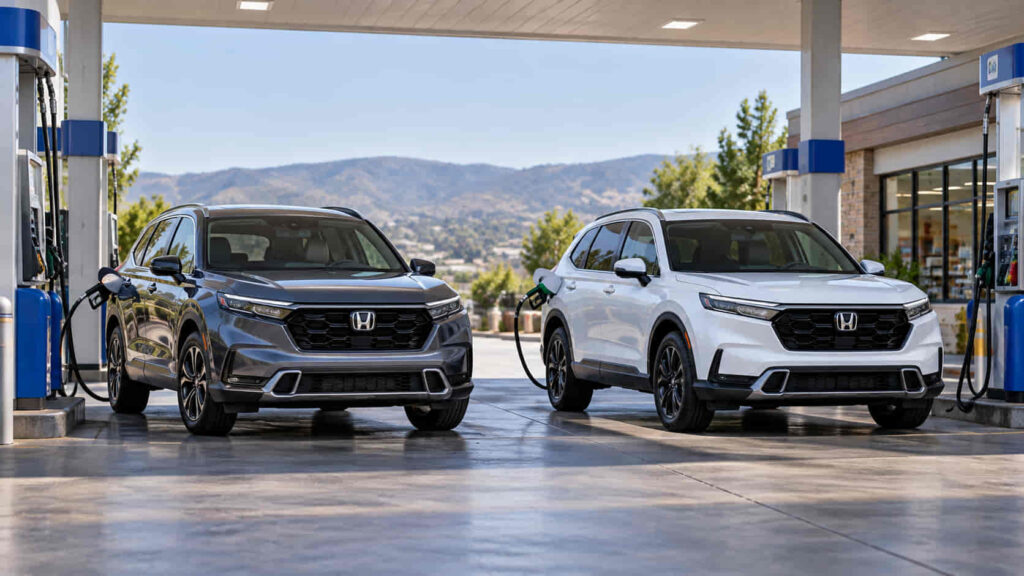
Honda CR-V fuel economy varies significantly between gasoline and hybrid models, with the largest difference appearing in city driving. The CR-V is available with a 1.5-liter turbocharged gasoline engine and a two-motor hybrid powertrain, and each configuration uses fuel differently according to driving speed, traffic conditions, drivetrain, and vehicle specification. Comparing only one MPG figure can therefore give an incomplete picture of how efficiently each CR-V uses fuel.
The Honda CR-V Hybrid generally delivers its strongest fuel-economy advantage in urban and stop-and-go driving, where the hybrid system can use electric-motor assistance and recover energy during deceleration. The gasoline CR-V follows a different efficiency pattern and can narrow the MPG difference during sustained highway driving. Front-wheel-drive and all-wheel-drive configurations can also receive different fuel-economy ratings, making drivetrain an important part of an accurate comparison.
A useful Honda CR-V fuel economy comparison should therefore examine city, highway, and combined MPG alongside powertrain and drivetrain configuration. EPA ratings provide a standardized basis for comparing models, while actual fuel consumption can change with driving behavior, temperature, traffic, tire condition, vehicle load, and other operating conditions. Comparing these factors together shows where the gasoline and hybrid CR-V differ and how those differences can affect annual fuel use.
How Does Honda CR-V Gas vs Hybrid Fuel Economy Compare?
The Honda CR-V Hybrid is more fuel-efficient than the gasoline CR-V in configurations where their EPA ratings are directly comparable, with the largest advantage occurring in city driving. For the 2026 model year, Honda lists the front-wheel-drive gasoline CR-V at 28 MPG city, 33 MPG highway, and 30 MPG combined. The front-wheel-drive CR-V Hybrid is rated at 43 MPG city, 36 MPG highway, and 40 MPG combined. This creates a 15 MPG city difference, a 3 MPG highway difference, and a 10 MPG combined difference between these two configurations.
The size of that difference changes with the driving environment because the gasoline and hybrid powertrains manage energy differently. The gasoline CR-V uses a turbocharged 1.5-liter four-cylinder engine, while the CR-V Hybrid combines a 2.0-liter four-cylinder engine with a two-motor hybrid system. The hybrid system can use electric propulsion and motor assistance under suitable operating conditions instead of depending on the gasoline engine for every propulsion demand. This operating strategy is particularly effective when vehicle speed and power demand change repeatedly.
City driving therefore produces the clearest fuel-economy separation. Based on the 2026 front-wheel-drive EPA figures, the hybrid’s 43 MPG city rating is approximately 54% higher than the gasoline model’s 28 MPG city rating. Stop-and-go operation gives the hybrid system repeated opportunities to manage propulsion electrically and recover part of the vehicle’s kinetic energy during deceleration through regenerative braking. A conventional gasoline powertrain cannot recover braking energy in the same way, so repeated acceleration and deceleration impose a larger fuel-consumption penalty.
The difference becomes considerably smaller on the highway. The same 2026 front-wheel-drive comparison shows 36 MPG highway for the hybrid and 33 MPG for the gasoline CR-V, a difference of 3 MPG. Sustained higher-speed driving reduces some of the operating conditions that create the hybrid’s large city advantage. Aerodynamic resistance also becomes increasingly important as road speed rises, requiring continuous energy regardless of whether the vehicle uses a gasoline or hybrid powertrain.
Combined MPG provides a more useful general comparison when a vehicle is driven in both city and highway conditions. The 2026 front-wheel-drive CR-V Hybrid is rated at 40 MPG combined compared with 30 MPG for the front-wheel-drive gasoline CR-V. Expressed as fuel consumption rather than MPG, a vehicle averaging 30 MPG requires approximately 33.3 gallons to travel 1,000 miles, while one averaging 40 MPG requires 25 gallons over the same distance. Under those rating-based conditions, the difference is approximately 8.3 gallons per 1,000 miles.
Drivetrain must remain constant when comparing Honda CR-V fuel economy because adding all-wheel drive can change the applicable EPA rating. A comparison between a front-wheel-drive hybrid and an all-wheel-drive gasoline model combines both a powertrain difference and a drivetrain difference, making it harder to isolate the effect of the hybrid system itself. Accurate comparisons should therefore match model year and drivetrain wherever possible before comparing city, highway, or combined MPG.
The central difference is consequently not simply that the Honda CR-V Hybrid uses less fuel. Its fuel-economy advantage changes according to where and how the vehicle is driven. The 2026 EPA figures show a substantial advantage for the front-wheel-drive hybrid in city and combined driving but a much narrower difference on the highway. This relationship between powertrain, driving environment, and MPG is more useful for comparing CR-V configurations than treating one fuel-economy number as representative of every driving condition.
How Does Honda CR-V City and Highway MPG Compare?
Honda CR-V fuel economy changes between city and highway driving, and the direction of that change depends strongly on whether the vehicle uses the gasoline or hybrid powertrain. Using the 2026 front-wheel-drive models as a direct comparison, the gasoline CR-V is rated at 28 MPG city and 33 MPG highway, while the CR-V Hybrid is rated at 43 MPG city and 36 MPG highway. The gasoline model therefore performs better on the highway than in the city, while the hybrid produces its highest EPA fuel-economy rating in city driving.
The gasoline CR-V loses efficiency in urban driving because repeated acceleration, deceleration, idling, and low-speed operation create conditions in which a conventional internal-combustion powertrain uses fuel without maintaining a steady, efficient cruising load. The 2026 front-wheel-drive gasoline model improves from 28 MPG city to 33 MPG highway, an increase of 5 MPG. Sustained highway driving reduces the frequency of stops and repeated acceleration, allowing the powertrain to operate under more consistent conditions.
The CR-V Hybrid follows a different pattern because its two-motor hybrid system can use electric-motor assistance and recover energy during deceleration. Regenerative braking converts part of the vehicle’s kinetic energy into electrical energy that can be stored and reused rather than dissipating all of that energy through conventional friction braking. This mechanism is particularly useful in stop-and-go traffic, where acceleration and deceleration occur repeatedly. The result is reflected in the 2026 front-wheel-drive hybrid rating of 43 MPG city compared with 36 MPG highway.
Higher highway speed changes the efficiency relationship because aerodynamic drag becomes a larger part of the energy required to move the vehicle. The hybrid system can still manage gasoline and electric power efficiently, but highway driving provides fewer repeated deceleration events for regenerative energy recovery than urban traffic. This helps explain why the front-wheel-drive hybrid’s advantage over the gasoline model is 15 MPG in the city but only 3 MPG on the highway.
City and highway MPG should therefore be compared separately before using combined MPG to estimate overall fuel use. A driver who spends a large share of annual mileage in urban traffic encounters a different fuel-economy pattern from someone who primarily travels at sustained highway speeds. The Honda CR-V Hybrid’s strongest numerical advantage appears in city driving, while the fuel-economy gap between the gasoline and hybrid models becomes substantially smaller on the highway.
How Does Honda CR-V FWD vs AWD Fuel Economy Compare?
Front-wheel-drive Honda CR-V models generally receive higher EPA fuel-economy ratings than comparable all-wheel-drive configurations, although the exact difference depends on the powertrain and trim. Honda’s current CR-V specifications illustrate this relationship clearly. The 2WD gasoline configuration is rated at 28 MPG city, 33 MPG highway, and 30 MPG combined, while the corresponding AWD gasoline figures are 27 MPG city, 31 MPG highway, and 29 MPG combined.
The difference is connected to the drivetrain configuration rather than a change in the basic purpose of the engine. An all-wheel-drive system adds components that allow engine or powertrain output to be distributed to additional wheels when required. The resulting vehicle configuration changes mechanical and operating demands compared with a front-wheel-drive version. For the gasoline CR-V figures above, adding AWD corresponds to a reduction of 1 MPG city, 2 MPG highway, and 1 MPG combined.
The hybrid CR-V shows the same broader relationship, but its AWD fuel-economy rating can also vary by configuration. Honda lists a 2WD hybrid rating of 43 MPG city, 36 MPG highway, and 40 MPG combined. Current AWD hybrid configurations include ratings of 40 MPG city, 34 MPG highway, and 37 MPG combined, while another AWD configuration is rated at 38 MPG city, 33 MPG highway, and 35 MPG combined. The existence of more than one AWD hybrid rating demonstrates why drivetrain alone is not sufficient to identify the MPG of every CR-V.
Tires, wheels, trim-specific equipment, and the complete vehicle configuration can contribute to differences between versions that share a general powertrain and drivetrain category. For this reason, a statement such as “all AWD CR-V Hybrids get the same MPG” would remove information necessary for an accurate comparison. Fuel-economy figures should be attached to the applicable model year and configuration rather than generalized across every vehicle carrying the CR-V Hybrid name.
The most accurate Honda CR-V fuel economy comparison therefore holds as many variables constant as possible. Comparing a gasoline 2WD model with its gasoline AWD counterpart isolates the drivetrain difference more effectively, while comparing 2WD gasoline and 2WD hybrid models makes the powertrain difference clearer. Changing powertrain, drivetrain, and trim simultaneously can produce a valid vehicle-to-vehicle comparison, but it cannot show which individual variable caused the MPG difference.
For buyers comparing fuel consumption, FWD or 2WD provides the higher EPA rating in the directly comparable current configurations, while AWD trades part of that fuel-economy advantage for additional driven-wheel capability. The numerical difference is relatively small for the current gasoline configuration but can be larger between specific hybrid configurations. Model year, powertrain, drivetrain, and trim should therefore be identified before an MPG figure is used to estimate fuel consumption.
Read more: Honda CRV Suspension Replacement
How Has Honda CR-V Fuel Economy Changed by Model Year?
Honda CR-V fuel economy has changed across model years as Honda has updated engines, transmissions, hybrid systems, drivetrains, vehicle specifications, and available configurations. This means an MPG figure from one CR-V model year should not automatically be applied to another. The model year establishes the vehicle configuration being measured, while powertrain and drivetrain determine which fuel-economy rating within that model year applies.
Recent CR-V models demonstrate why model year and configuration need to remain connected. The current generation offers both a turbocharged gasoline powertrain and a two-motor hybrid system, creating separate fuel-economy paths within the same CR-V nameplate. A buyer comparing two used CR-Vs can therefore encounter a larger MPG difference between two configurations from the same model year than between similar configurations from adjacent model years.
Powertrain changes are one mechanism behind longer-term fuel-economy differences. A gasoline CR-V relies on its internal-combustion engine for propulsion, while a CR-V Hybrid can combine engine operation with electric-motor assistance and regenerative energy recovery. When Honda changes the available powertrain, transmission strategy, hybrid system, or related vehicle specifications between generations, the conditions under which the vehicle consumes fuel also change. Fuel economy by model year is therefore a comparison of complete vehicle configurations rather than a simple progression in which every newer CR-V must achieve a higher MPG rating.
Drivetrain availability creates another variable within a model-year comparison. A front-wheel-drive or 2WD CR-V and an AWD CR-V from the same year can carry different EPA ratings even when they use the same general gasoline or hybrid powertrain. Trim-specific equipment can introduce additional differences. Comparing only the year while ignoring drivetrain and configuration can therefore attribute an MPG change to vehicle age or generation when part of the difference actually comes from the specification being compared.
The correct way to compare Honda CR-V MPG by year is to match equivalent configurations whenever possible. A gasoline FWD model should first be compared with gasoline FWD models from other years, while hybrid AWD models should be compared with equivalent hybrid AWD configurations. Once those relationships are established, differences between powertrains can be examined separately. This approach keeps model year, powertrain, and drivetrain from becoming mixed variables in the same comparison.
Model-year MPG should also be treated as a standardized rating rather than a guarantee that one individual CR-V will reproduce the same fuel consumption. Two vehicles carrying the same EPA rating can return different real-world results because of speed, traffic, temperature, tire condition, vehicle load, maintenance condition, and driving behavior. Model-year comparison is most useful for identifying differences in rated efficiency; actual fuel use requires operating conditions to be considered as a separate variable.
Does the Honda CR-V Hybrid Always Get Better MPG Than the Gas Model?
The Honda CR-V Hybrid can have a higher EPA fuel-economy rating than a comparable gasoline CR-V, but the size of its advantage is not constant across city, highway, drivetrain, and trim configurations. The strongest difference appears in driving conditions that allow the hybrid system to use electric assistance and regenerative braking frequently. Highway operation reduces that relative advantage because sustained higher-speed driving creates a different energy-demand pattern.
The current front-wheel-drive comparison demonstrates this difference. The CR-V Hybrid is rated at 43 MPG city compared with 28 MPG city for the gasoline CR-V, producing a 15 MPG advantage. On the highway, the corresponding figures are 36 MPG for the hybrid and 33 MPG for the gasoline model, reducing the difference to 3 MPG. The hybrid remains more fuel-efficient in this direct comparison, but the magnitude of the advantage changes substantially with the driving environment.
This difference occurs because hybrid efficiency is closely connected to how energy moves through the powertrain. During suitable low-speed and changing-load conditions, the electric motor can contribute to propulsion while the gasoline engine does not need to supply every unit of driving demand directly. During deceleration, regenerative braking can recover part of the vehicle’s kinetic energy and convert it into electrical energy for later use. Repeated urban acceleration and deceleration creates more opportunities for these processes than sustained highway cruising.
Highway driving changes the mechanism. At continuous road speeds, the vehicle must keep supplying energy to overcome rolling resistance and aerodynamic drag, with aerodynamic demand becoming increasingly significant as speed rises. There are also fewer braking events from which the hybrid system can recover energy. The hybrid system continues managing engine and electric-motor operation, but the operating environment no longer produces the same advantage shown by its city MPG rating.
AWD and trim configuration add another layer to the comparison. A hybrid AWD model should not automatically be assigned the MPG of a front-wheel-drive hybrid, just as an AWD gasoline CR-V should not be assigned the rating of its FWD counterpart. Comparing a high-efficiency hybrid configuration against a different gasoline drivetrain can exaggerate the apparent effect of the powertrain because the comparison is simultaneously measuring more than one vehicle variable.
The practical conclusion is that Honda CR-V Hybrid fuel economy should be evaluated by model year, drivetrain, and driving environment rather than by the hybrid label alone. The hybrid’s strongest MPG advantage is associated with conditions where its electric assistance and energy-recovery capabilities provide the greatest benefit. Highway-heavy driving can produce a narrower rated advantage, while city-heavy use makes the difference between comparable gasoline and hybrid configurations substantially more visible.
How Does Real-World Honda CR-V MPG Compare With EPA Ratings?
Real-world Honda CR-V MPG can be higher or lower than its EPA fuel-economy rating because EPA figures are standardized estimates, while actual fuel consumption reflects the conditions in which an individual vehicle is driven. EPA ratings are useful for comparing gasoline, hybrid, FWD, and AWD configurations on a consistent basis, but they should not be interpreted as a fixed MPG result that every CR-V will reproduce on every trip.
This distinction is important because standardized fuel-economy testing controls variables that change continuously in normal driving. Traffic density, road speed, trip length, ambient temperature, acceleration, braking, vehicle load, climate-control demand, and tire condition can all change the amount of energy required to move the vehicle. Two Honda CR-Vs with the same EPA rating can therefore produce different measured MPG when their operating conditions are different.
Driving pattern is particularly important when comparing the gasoline CR-V with the CR-V Hybrid. The hybrid system can recover part of the vehicle’s kinetic energy during deceleration and reuse stored electrical energy to assist propulsion. Frequent changes in vehicle speed can create more opportunities for this energy-management strategy. A driver completing repeated urban trips can therefore experience a different hybrid fuel-economy pattern from a driver covering most annual mileage at sustained highway speeds.
Temperature can also change real-world fuel consumption. Cold operating conditions affect engine warm-up and can change how frequently a hybrid vehicle can rely on its most efficient operating strategies. Heating, air conditioning, and other accessory demands also require energy. The resulting MPG difference is not evidence that the EPA comparison has become invalid; it shows that standardized ratings and individual operating results answer different questions.
Trip-level MPG can be misleading when it is used to represent long-term fuel economy. A short journey affected by cold start, congestion, elevation change, or unusual speed may produce a result that differs substantially from the vehicle’s longer-term average. Measuring fuel consumption across multiple refueling cycles and a larger mileage sample reduces the influence of one unusual trip and provides a more useful picture of actual ownership fuel economy.
EPA and real-world MPG should therefore be used together rather than treated as competing measurements. EPA ratings provide the standardized baseline for comparing Honda CR-V configurations, while real-world MPG shows how a specific vehicle performs under its actual operating conditions. A valid fuel-economy comparison identifies which type of measurement is being used before drawing conclusions from the MPG number.
What Affects Honda CR-V Fuel Economy?
Honda CR-V fuel economy is affected by the amount of energy required to move the vehicle and by how efficiently the gasoline or hybrid powertrain supplies that energy. Driving speed, acceleration, traffic conditions, temperature, tire pressure, vehicle load, drivetrain, climate-control demand, and mechanical condition can change fuel consumption because each variable changes either propulsion demand or powertrain operation.
Driving speed has a direct relationship with energy demand, particularly as aerodynamic resistance becomes more important at higher speeds. Maintaining a substantially higher highway speed requires the powertrain to overcome greater aerodynamic drag continuously. This helps explain why highway MPG should not be interpreted as a single result that remains unchanged at every cruising speed. Two otherwise similar highway trips can produce different fuel consumption when average speeds differ.
Acceleration pattern changes fuel demand for a different reason. Rapid acceleration requires the powertrain to deliver more power over a shorter period, while repeated acceleration followed by unnecessary braking repeatedly adds and removes kinetic energy. Smoother speed control reduces avoidable changes in energy demand. The CR-V Hybrid can recover part of the energy during regenerative braking, but energy conversion and storage are not lossless, so avoiding unnecessary acceleration still remains more efficient than repeatedly accelerating and recovering only part of that energy.
Tire pressure and tire condition affect the resistance between the vehicle and road. When tire pressure is below the specification applicable to the vehicle, tire deformation can increase rolling resistance and raise the energy required to maintain movement. Tire-related MPG effects should therefore be addressed by maintaining the specified pressure and correcting tire problems rather than increasing pressure beyond the vehicle manufacturer’s recommendation in an attempt to reduce fuel consumption.
Vehicle load also changes propulsion demand because additional mass requires additional energy during acceleration and influences the work required under changing road conditions. Carrying necessary passengers or cargo is part of normal vehicle use, but repeatedly transporting unnecessary weight adds demand without providing a transportation benefit. The effect becomes especially relevant in driving patterns with frequent acceleration because the vehicle must repeatedly accelerate the additional mass.
Drivetrain configuration creates a measurable difference before driving behavior is considered. As shown in the direct current-model comparison, the gasoline 2WD CR-V is rated at 30 MPG combined, while the gasoline AWD version is rated at 29 MPG combined. Hybrid ratings also differ according to drivetrain and configuration. AWD capability should therefore be treated as part of the vehicle specification when comparing MPG rather than as an external factor applied after the fuel-economy rating.
Mechanical condition can influence fuel consumption when a fault increases resistance or prevents the vehicle from operating as intended. Tire problems, alignment conditions, brake drag, or powertrain-related faults can increase energy demand or alter normal operation. A sudden, persistent MPG decrease is therefore more informative when it is evaluated alongside changes in driving conditions and vehicle condition rather than attributed automatically to the engine or hybrid system.
Honda CR-V fuel economy is ultimately the result of vehicle configuration interacting with operating conditions. Powertrain and drivetrain establish the vehicle’s fuel-economy characteristics, while speed, traffic, temperature, tires, load, accessory demand, and mechanical condition influence the result achieved in use. Keeping these variables separate makes it possible to compare CR-V MPG without treating every difference in fuel consumption as a difference between gasoline and hybrid technology.
How Much Fuel Can a Honda CR-V Hybrid Save Compared With a Gas Model?
A Honda CR-V Hybrid can use substantially less fuel than a comparable gasoline CR-V, but the amount saved depends on annual mileage, the MPG of the configurations being compared, and the driver’s mix of city and highway driving. MPG alone does not show the number of gallons saved because fuel use is determined by both efficiency and distance. The practical comparison therefore requires converting MPG into fuel consumed over the same mileage.
Using the 2026 front-wheel-drive combined EPA ratings provides a consistent example. The gasoline CR-V is rated at 30 MPG combined, while the front-wheel-drive CR-V Hybrid is rated at 40 MPG combined. At 12,000 miles per year, a vehicle averaging 30 MPG would consume approximately 400 gallons, while a vehicle averaging 40 MPG would consume approximately 300 gallons. Under this rating-based scenario, the hybrid would use about 100 fewer gallons over 12,000 miles.
The difference increases as annual mileage rises because the fuel-economy advantage applies across more miles. At 15,000 miles, 30 MPG corresponds to approximately 500 gallons of fuel, while 40 MPG corresponds to approximately 375 gallons. The difference becomes about 125 gallons. These calculations do not predict the exact consumption of an individual CR-V; they demonstrate how a 10 MPG difference in combined ratings translates into fuel use when both vehicles cover the same distance.
Driving environment can change the result because the hybrid’s MPG advantage is not equal in city and highway operation. The current front-wheel-drive ratings show a 15 MPG difference in the city but only a 3 MPG difference on the highway. A driver whose mileage is concentrated in urban traffic can therefore have a different fuel-saving potential from a driver whose annual mileage consists primarily of sustained highway travel, even when both cover the same total distance.
Fuel savings should also be separated from financial savings. Gallons saved are determined by distance and fuel economy, while money saved adds fuel price as another variable. If two drivers save the same 100 gallons annually but purchase fuel at different prices, their reduction in fuel expense will differ. This is why a fixed statement about how many dollars a CR-V Hybrid saves each year cannot apply equally to every owner.
The useful calculation is based on the relationship between annual mileage, actual or applicable MPG, and fuel price. For example, once the annual fuel difference has been calculated as 100 gallons, multiplying those 100 gallons by the applicable price per gallon converts the efficiency advantage into estimated annual fuel-cost savings. This method can be updated whenever mileage, fuel prices, or the vehicle’s measured MPG changes.
The Honda CR-V Hybrid’s fuel-saving potential should therefore be expressed as a measurable consumption difference rather than a general claim that the hybrid “saves more gas.” With comparable 30 MPG and 40 MPG combined ratings, the difference is approximately 100 gallons over 12,000 miles or 125 gallons over 15,000 miles. Actual savings will change when the configuration, driving environment, annual mileage, or real-world MPG changes.
Is Better Honda CR-V MPG Enough to Justify Choosing the Hybrid?
Better MPG alone does not determine whether the Honda CR-V Hybrid produces lower total ownership cost because fuel economy measures fuel consumption rather than the complete financial difference between two vehicles. The hybrid’s lower fuel use creates a measurable operating-cost advantage, but evaluating that advantage financially requires comparing fuel savings with the price difference between the specific gasoline and hybrid configurations being considered.
The first step is converting the MPG difference into annual fuel consumption. In the 12,000-mile example, a 30 MPG gasoline CR-V uses approximately 400 gallons and a 40 MPG hybrid uses approximately 300 gallons, creating a 100-gallon annual difference. If fuel costs $3.50 per gallon, that difference represents about $350 in annual fuel expense. The $3.50 figure is an illustrative assumption rather than a current national fuel price, allowing the calculation to show the mechanism without treating a changing fuel price as a fixed fact.
Ownership period then determines how the annual saving accumulates. If the same 100-gallon annual difference continued for five years and the illustrative fuel price remained $3.50 per gallon, the calculated fuel saving would be about $1,750 over that period. If annual mileage doubled while the same MPG relationship remained valid, the fuel-saving opportunity would also increase because twice as many miles would be exposed to the efficiency difference.
Fuel price has the same directional effect. Higher fuel prices increase the monetary value of each gallon avoided, while lower prices reduce it. This means two owners driving identical CR-V configurations for the same mileage can reach different financial results if their fuel prices differ. A financial comparison should therefore use the driver’s expected mileage and a fuel-price assumption appropriate to the market being evaluated rather than relying on a universal savings figure.
The vehicle-price comparison must also use equivalent configurations. Comparing the purchase price of one hybrid trim with an unrelated gasoline trim can include differences in equipment as well as powertrain. Any resulting price gap would not represent the cost of hybrid technology alone. A more useful ownership analysis identifies the actual gasoline and hybrid vehicles being considered and then compares their purchase cost with the expected reduction in fuel expense over the intended ownership period.
Fuel economy also represents only one part of a broader vehicle decision. The MPG comparison can quantify fuel use, but it does not by itself determine the value a buyer assigns to drivetrain capability, equipment, performance characteristics, purchase price, or other ownership requirements. Those attributes should not be converted into an MPG conclusion because they answer different questions.
The appropriate fuel-economy question is therefore not simply whether the hybrid has a higher MPG rating. It is how much fuel the hybrid is expected to save over the owner’s mileage and whether the monetary value of that fuel reduction is meaningful relative to the cost difference between the vehicles being compared. This keeps the comparison measurable and prevents a higher MPG figure from being treated automatically as proof of lower total ownership cost.
How Can You Improve Honda CR-V Fuel Economy?
Honda CR-V fuel economy can be improved by reducing unnecessary energy demand and keeping the vehicle operating within its intended mechanical conditions. The most relevant variables include driving speed, acceleration and braking behavior, tire pressure, unnecessary vehicle load, maintenance condition, and trip characteristics. These factors do not change the CR-V’s underlying EPA rating, but they can change the amount of fuel the vehicle consumes in actual use.
Smoother acceleration and more consistent speed reduce repeated changes in vehicle energy. Every acceleration event requires the powertrain to add kinetic energy to the vehicle, and braking removes that energy when the vehicle slows. The CR-V Hybrid can recover part of this energy through regenerative braking, but the conversion from vehicle motion to stored electrical energy and back to propulsion is not perfectly efficient. Avoiding unnecessary acceleration followed by braking therefore reduces energy demand even in a hybrid.
Highway speed also affects fuel consumption because aerodynamic drag increases as vehicle speed rises. Maintaining a higher speed requires the powertrain to continuously supply additional energy to overcome that resistance. This relationship applies to both gasoline and hybrid CR-V models. A hybrid powertrain can manage energy efficiently, but it cannot eliminate the aerodynamic demand created by sustained higher-speed travel.
Correct tire pressure supports fuel economy by keeping rolling resistance within the conditions intended for the vehicle. Underinflated tires deform more as they roll, which can increase resistance and require additional propulsion energy. Tire pressure should be maintained according to the specification for the specific Honda CR-V rather than increased beyond the recommended value in an attempt to gain MPG. Tire condition should also be considered because abnormal wear can indicate another problem, such as incorrect alignment, that needs separate correction.
Unnecessary vehicle load increases the energy required to accelerate the CR-V. The effect is especially relevant during driving that involves repeated changes in speed because the powertrain must repeatedly accelerate the additional mass. Passengers and necessary cargo are normal vehicle loads, but routinely carrying items that are not needed adds propulsion demand without contributing to the trip’s purpose. External accessories that substantially alter aerodynamic resistance can create an additional efficiency penalty at road speed.
Mechanical condition should be evaluated when fuel economy decreases persistently without a corresponding change in driving pattern. Brake drag, tire problems, incorrect wheel alignment, or powertrain faults can increase resistance or prevent the vehicle from operating normally. The appropriate response is to identify and correct the underlying condition rather than attempting to compensate for the MPG decrease through driving behavior alone.
Trip length and temperature also influence the fuel economy an owner observes. Short trips can devote a larger proportion of total operating time to engine and powertrain warm-up, while cold conditions can alter engine operation, hybrid-system behavior, and cabin-heating demand. Combining trips when practical can reduce the number of separate cold operating periods, although the effect depends on actual driving conditions and trip requirements.
The most useful way to improve Honda CR-V fuel economy is therefore to reduce avoidable energy demand while maintaining the vehicle in its intended operating condition. Smooth speed control, appropriate highway speeds, correct tire pressure, reasonable vehicle loading, and condition-based maintenance address specific mechanisms that affect fuel consumption. These practices can improve real-world efficiency, but they should not be used to predict a fixed MPG increase because the result still depends on powertrain, drivetrain, weather, traffic, route, and driving environment.
This distinction completes the Honda CR-V fuel economy comparison: EPA MPG establishes a standardized basis for comparing gasoline and hybrid configurations, while real-world fuel use reflects how the selected configuration interacts with actual operating conditions. Fuel economy is therefore most accurately evaluated through the combination of powertrain, drivetrain, city or highway use, annual mileage, and measured fuel consumption rather than through a single MPG figure viewed in isolation.