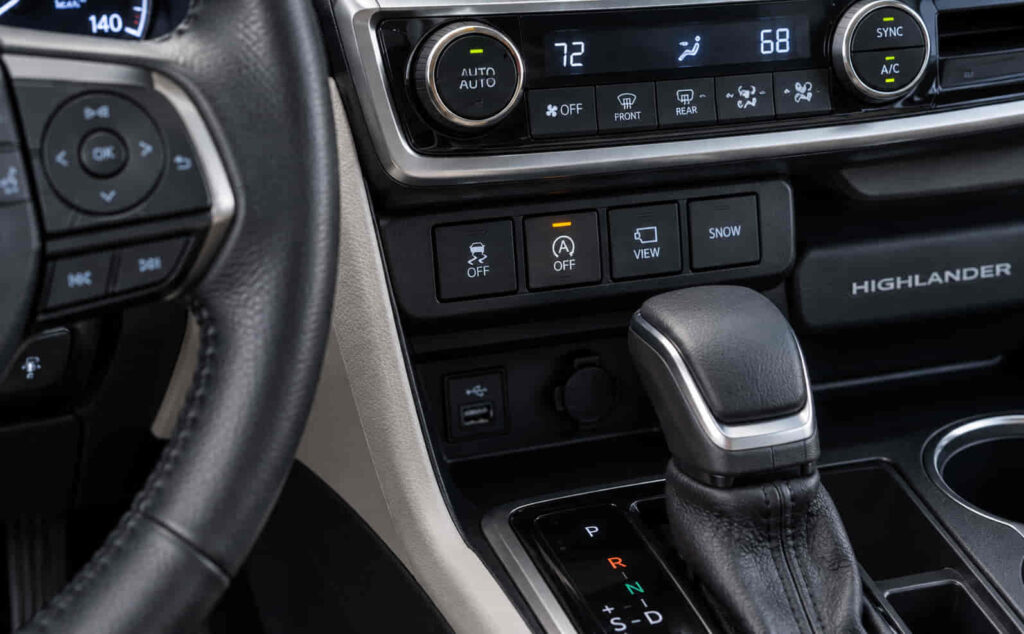
You can disable Toyota Highlander Auto Start/Stop when you do not want the engine to shut off automatically at stops, but using the factory Stop & Start cancel control is not always the same as permanently disabling the system. On Highlander models equipped with conventional Stop & Start, the factory control allows the driver to cancel automatic engine stopping. Depending on the model year and system configuration, however, that cancellation may not remain active after the vehicle is turned off and restarted.
This distinction explains why drivers searching for a permanent solution often find that pressing the Auto Start/Stop off button does not fully solve the problem. If the vehicle returns to its normal enabled state during a new ignition cycle, the driver must cancel the function again or use a compatible method that restores or maintains the preferred cancel state automatically. An aftermarket Auto Start/Stop eliminator is one approach used for this purpose, but compatibility and operation depend on the exact Highlander configuration.
A permanent solution should not rely on creating a battery problem, disconnecting sensors, or modifying wiring simply to force the Stop & Start system into an unavailable state. This guide explains the difference between temporary and permanent disabling, how the factory control works, how Auto Start/Stop eliminators operate, and how to verify that the system is actually disabled rather than merely prevented from operating by current vehicle conditions.
Can You Permanently Disable Toyota Highlander Auto Start/Stop?
You can keep Toyota Highlander Auto Start/Stop from operating persistently, but the factory Stop & Start cancel function should not automatically be treated as a permanent-disable setting. On Highlander models equipped with the conventional Stop & Start system, Toyota provides a way to cancel automatic engine stopping. The important distinction is whether that cancel state remains active through later ignition cycles or whether the system returns to its normal enabled state after the vehicle is restarted.
A permanent solution therefore depends on what “permanently disable” means in practice. If the goal is simply to prevent the engine from automatically stopping during the current drive, the factory cancel control is sufficient. If the goal is to start the Highlander on a later trip and have Stop & Start remain canceled without pressing the button again, a temporary factory cancellation does not satisfy that requirement when the vehicle does not retain the previous cancel state.
This is also different from making the Stop & Start system unavailable. The engine may remain running at a stop because operating conditions required for automatic shutdown are not satisfied. Battery condition, cabin climate demand, engine operating conditions, and other control requirements can influence whether an enabled system actually stops the engine. An engine that does not shut off at one particular stop therefore does not prove that Auto Start/Stop has been permanently disabled.
The exact Highlander configuration matters before choosing a persistent solution. Toyota has sold the Highlander across different model years, markets, trims, and powertrain configurations, so a method designed around one Stop & Start implementation should not be assumed to apply to every Highlander. Conventional Stop & Start behavior also should not be confused with engine cycling that occurs as part of a hybrid powertrain’s normal operation.
For owners whose Highlander returns Stop & Start to an enabled state after restarting, a compatible persistent-cancel solution can address the repeated-button-press problem. An aftermarket Auto Start/Stop eliminator is one approach because certain devices are designed to reproduce or retain the desired cancel behavior automatically. This does not necessarily mean that the Stop & Start programming has been removed from the engine ECU; the system can remain present while its automatic stopping function is consistently canceled.
Permanent disabling should therefore be understood as maintaining the desired Stop & Start cancellation across normal vehicle use, not deliberately creating a fault that prevents the system from functioning. Disconnecting sensors, creating a battery-related problem, or altering unrelated wiring can make the system unavailable for reasons that are fundamentally different from a controlled persistent-disable method.
How Do You Turn Off Auto Start/Stop on a Toyota Highlander?
On a Toyota Highlander equipped with the conventional Stop & Start system, Auto Start/Stop is turned off for the applicable drive by using the factory Stop & Start cancel control. The control tells the vehicle that the driver does not want the automatic engine-stop function to operate under otherwise eligible stopping conditions. The vehicle’s indicator or system-status display should then provide confirmation that the cancellation has been recognized.
The cancel control changes the operating state of the Stop & Start function rather than shutting down the engine-management system. The engine continues operating normally while the automatic stop event is suppressed. When the Highlander comes to a stop under conditions in which Stop & Start would otherwise shut the engine off, the canceled state allows the engine to remain running instead.
This factory method is useful for drivers who only want the feature disabled temporarily. For example, a driver may prefer continuous engine operation during a particular trip because of traffic conditions, frequent short stops, or personal driving preference. The cancel control provides a direct way to request that behavior without intentionally creating an electrical or diagnostic fault.
The limitation appears when the driver expects the selection to remain permanent. If the applicable Highlander restores the normal Stop & Start state after the vehicle is shut down and started again, pressing the cancel control during today’s drive does not establish a permanent preference for tomorrow’s drive. The driver must either cancel it again after startup or use a compatible persistent solution if repeated manual cancellation is the problem being addressed.
It is equally important not to judge the system state only by watching whether the engine shuts off. An enabled Stop & Start system does not stop the engine every time the vehicle becomes stationary. The control logic must first determine that the conditions required for an automatic stop are satisfied. Consequently, “the engine stayed running” and “Auto Start/Stop is disabled” are not interchangeable observations.
Owners should also confirm that their specific Highlander is equipped with the conventional system being discussed before following Stop & Start cancellation instructions. Powertrain configuration changes the context, particularly on hybrid models where normal engine shutdown and restart can be part of hybrid-system operation rather than the same conventional Stop & Start function controlled by a cancel switch.
The factory cancel control is therefore the correct starting point for turning off conventional Toyota Highlander Auto Start/Stop, but it should be treated as a temporary cancellation unless the specific vehicle configuration demonstrably retains that setting after restart. Drivers seeking true persistent behavior need to distinguish this factory function from the permanent-disable methods discussed in the following sections.
Read more: toyota 5.7 engine life expectancy
Where Is the Auto Start/Stop Off Button on a Toyota Highlander?
On a Toyota Highlander equipped with conventional Stop & Start, the Auto Start/Stop off control is the factory Stop & Start cancel switch, but its exact physical location should be confirmed for the specific model year and vehicle configuration rather than assumed to be identical on every Highlander. Toyota has changed interior controls and equipment configurations across Highlander generations, so identifying the function of the switch is more reliable than applying one universal location to every vehicle.
The cancel switch is associated specifically with the Stop & Start function and is used to prevent the system from automatically stopping the engine when its normal operating conditions are satisfied. When the driver activates the cancel function, the vehicle should provide an indicator or other status confirmation showing that the request has been recognized. That confirmation is more important than simply observing that the engine remains running at the next stop.
Owners who cannot immediately find the control should first confirm that their Highlander actually has the conventional Stop & Start system. Equipment varies by model year, market, trim, and powertrain. A control shown in instructions for another Highlander configuration may therefore be absent or positioned differently in the vehicle being inspected.
Powertrain identification is particularly important with a Highlander Hybrid. The gasoline engine in a hybrid can shut down and restart as part of normal hybrid-system operation. That behavior should not automatically be interpreted as the same conventional Auto Start/Stop function controlled by a Stop & Start cancel switch. Attempting to find a conventional cancel button for normal hybrid engine cycling starts from the wrong system definition.
The vehicle-specific owner’s information provides the appropriate reference when the switch location is uncertain. This also helps distinguish the Stop & Start control from nearby controls that manage unrelated functions. Pressing or modifying an unrelated switch because it appears similar does not provide a valid method of disabling Auto Start/Stop.
Once the correct cancel control is identified, the driver can use the vehicle’s status indication to confirm the requested state. If the system reports cancellation but the preference disappears after the vehicle is shut down and restarted, the issue is not necessarily the location or operation of the button. It reflects the difference between a current-cycle cancel command and a persistent preference.
The correct Toyota Highlander Auto Start/Stop off button is therefore the Stop & Start cancel control provided on equipped vehicles, while its exact location should be verified against the specific Highlander model year and configuration. Finding the correct control solves temporary cancellation; it does not by itself establish that Auto Start/Stop will remain disabled permanently.
Does Toyota Highlander Auto Start/Stop Stay Off After Restarting?
Toyota Highlander Auto Start/Stop should not be assumed to remain canceled after the vehicle is shut down and restarted, because the factory cancel function can operate as a temporary selection rather than a permanently stored off setting. If the applicable Highlander returns Stop & Start to its normal enabled state during a new ignition cycle, the driver must use the cancel control again when another trip begins.
This behavior explains a common source of confusion around permanent disabling. The driver can press the cancel switch, confirm that Stop & Start has been canceled, drive normally, and then discover that the system is available again after the next startup. The original cancellation worked correctly; it simply did not function as a permanent configuration change.
An ignition cycle creates a useful boundary between temporary and persistent behavior. A temporary cancel command controls Stop & Start for the relevant period of vehicle operation. A persistent solution, by contrast, must continue producing the desired canceled state after subsequent startups without requiring the driver to repeat the same manual action every time.
The system returning to enabled operation should not automatically be diagnosed as a defective cancel switch. If the button successfully changes the system state when pressed and the vehicle provides the expected cancellation indication, the control has performed its immediate function. The fact that the preference is not retained after restart concerns how the system manages that selection, not necessarily a failure of the switch.
The opposite situation also requires careful interpretation. If the engine does not automatically stop after restarting the Highlander, that does not prove the previous cancel state was retained. Stop & Start can remain enabled while an operating requirement prevents an automatic engine stop. Battery condition, temperature, climate-control demand, and other vehicle conditions can affect whether the system actually activates.
For this reason, persistent disabling should be verified through system status rather than inferred from one stop in traffic. If the Highlander starts a new trip with Stop & Start enabled and requires the driver to press the cancel switch again, the factory method is functioning as temporary cancellation for that configuration. If a compatible solution automatically restores the canceled state after startup, it addresses the persistent-disable intent in a different way.
This distinction also prevents owners from using system faults as substitutes for a permanent setting. A weak battery or another condition that prevents Stop & Start from operating may make the engine remain running, but the system has not necessarily been intentionally disabled. Removing the underlying condition can allow normal Auto Start/Stop operation to return.
If your Toyota Highlander requires the Stop & Start cancel switch to be pressed again after restarting, the factory control is not providing the permanent-off behavior you are looking for. A true persistent solution must address what happens during subsequent startups rather than merely canceling Auto Start/Stop during the current drive.
How Can You Permanently Disable Toyota Highlander Auto Start/Stop?
If your Toyota Highlander does not retain the factory Stop & Start cancel setting after restart, permanently disabling Auto Start/Stop generally requires a compatible method that restores or maintains the canceled state each time the vehicle starts. The objective is persistent cancellation across ignition cycles, not deliberately creating a malfunction that prevents the Stop & Start system from operating.
The factory cancel switch remains the simplest method when permanent behavior is unnecessary. Pressing it tells the vehicle not to perform automatic engine stops during the applicable drive. The limitation is that if the Highlander returns to its default enabled state after the next startup, the driver must repeat the action. In that configuration, the factory switch provides manual cancellation rather than a stored permanent-off preference.
A compatible Auto Start/Stop eliminator addresses this limitation differently. Instead of requiring the driver to press the cancel control after every startup, the device is designed to produce the required cancel behavior automatically. From the driver’s perspective, Auto Start/Stop remains consistently canceled without the same manual input at the beginning of each trip.
This distinction matters because persistent cancellation does not necessarily mean removing the Stop & Start function from the engine ECU. The underlying system can remain installed and capable of operation while an added device manages the cancel-state behavior. This can also make the modification conceptually different from ECU software changes that alter the vehicle’s programmed control strategy.
Compatibility is critical. A device intended for one Highlander model year, powertrain, connector arrangement, or Stop & Start implementation should not be assumed to work on another configuration. Before using an eliminator, the owner needs to verify that the specific product supports the exact vehicle rather than relying only on the general Toyota Highlander name.
Permanent-disable intent should also be separated from methods that merely make Stop & Start unavailable. Disconnecting a battery-monitoring component, interfering with sensors, or altering unrelated wiring may prevent automatic stops because the control system no longer sees acceptable operating conditions. That outcome is not equivalent to a controlled cancel command and can introduce diagnostic faults or interfere with functions beyond Stop & Start.
The same principle applies to maintaining a weak battery intentionally. Stop & Start operation can depend on battery condition, but degrading or manipulating battery status is not a valid persistent-disable strategy. The 12V electrical system serves numerous vehicle functions, so creating an electrical weakness to suppress one convenience feature introduces a broader problem rather than solving the feature preference correctly.
A permanent solution should therefore preserve normal vehicle operation while addressing the repeated cancellation requirement. If the owner later wants factory Stop & Start behavior again, the ability to return the vehicle to its intended configuration is also valuable. This is one reason a compatible, reversible persistent-cancel method is fundamentally different from uncontrolled wiring modifications.
For a Highlander that re-enables Stop & Start after every restart, the practical permanent solution is a compatible persistent-cancel method rather than a fault-based workaround. The correct method depends on the exact model year and system configuration, and the resulting state should be verified after subsequent vehicle startups.
How Does a Toyota Highlander Auto Start/Stop Eliminator Work?
A Toyota Highlander Auto Start/Stop eliminator is generally designed to automate the cancellation behavior that the driver would otherwise have to request manually after startup. Rather than assuming that the Stop & Start system has been deleted from the vehicle, it is more accurate to view a compatible eliminator as a device that manages the desired cancel state according to its specific design.
The practical problem being solved is simple. Without persistent cancellation, the driver starts the Highlander, finds Stop & Start available again, and presses the factory cancel control. This sequence can repeat on every trip. An eliminator removes or reduces that repeated manual step by causing the desired canceled state to be established automatically.
This mechanism is different from intentionally making the vehicle believe that Stop & Start cannot operate. A battery problem, sensor fault, or another unmet operating condition can prevent an automatic engine stop, but the control system may still be enabled. An eliminator designed around cancellation behavior instead targets the driver’s preference for the system state without depending on an unrelated fault.
It is also different from assuming that the engine ECU has been reprogrammed. A device can produce persistent user-facing behavior without permanently deleting the original Stop & Start control logic. The exact implementation varies by product, which is why claims about how one eliminator communicates or connects should not automatically be generalized to every device sold for the Highlander.
Some persistent solutions may be designed to recreate the cancel command after startup, while other products may manage or remember the preferred state differently. The important SEO and diagnostic distinction is the outcome: after a new ignition cycle, the Highlander reaches the intended canceled state without the driver repeating the normal manual cancellation process.
Because the device interacts with vehicle controls or electrical connections, exact compatibility matters more than the generic product category. Model year, trim, powertrain, connector configuration, and the presence of the conventional Stop & Start system can determine whether a particular eliminator is appropriate. A product described broadly as a Toyota Auto Start/Stop eliminator is not automatically compatible with every Highlander.
A properly selected solution should also allow its behavior to be verified. After installation, the vehicle can be shut down and restarted to determine whether the desired Stop & Start cancel state returns as intended. The vehicle’s relevant system indication provides stronger evidence than waiting for the engine to remain running at one traffic light, because operating conditions can prevent an enabled Stop & Start system from activating.
An Auto Start/Stop eliminator therefore solves the permanent-disable problem by automating or retaining the desired cancellation behavior across startups, depending on the device design. It should not be confused with deliberately causing a system fault, and its exact operation should be determined from the instructions and compatibility information for the specific device being installed.
How Do You Install an Auto Start/Stop Eliminator on a Toyota Highlander?
To install an Auto Start/Stop eliminator on a Toyota Highlander, first verify that the device is specifically compatible with the vehicle’s model year, powertrain, Stop & Start system, and connector configuration, then follow the installation procedure supplied for that exact device. There is no single installation sequence that should be applied to every Highlander because eliminators can differ in connection point, wiring design, and method of controlling the cancel state.
Compatibility should be confirmed before any interior trim or electrical connector is disturbed. A device advertised for a Toyota vehicle or even for a different Highlander generation is not automatically suitable for another configuration. The presence of the conventional Stop & Start system is especially important because an eliminator designed to automate its cancel function does not provide the same purpose for normal gasoline-engine cycling within a hybrid powertrain.
The installation method depends on how the specific eliminator interfaces with the vehicle. A plug-in design may connect through an existing factory connection associated with the relevant control circuit, while another design may use a different interface. For this reason, the manufacturer’s instructions for the exact product should determine which panels are accessed, which connectors are used, and how the device is positioned after installation.
Electrical connections should not be identified by guesswork. Similar-looking connectors can serve unrelated vehicle functions, and altering wiring simply because it is located near the Stop & Start control creates unnecessary diagnostic risk. A compatible installation should preserve the original electrical connections according to the device design rather than rely on cutting, shorting, or disconnecting unrelated circuits to force Stop & Start into an unavailable state.
After the physical installation is complete, the Highlander should be started and the relevant Stop & Start status checked. The objective is to determine whether the eliminator produces the expected cancel behavior while the rest of the vehicle continues operating normally. Warning indicators or unexpected electrical behavior after installation should be treated as reasons to recheck compatibility and installation rather than as evidence that the permanent-disable method is working.
The next verification should occur after a complete shutdown and subsequent restart. Persistent behavior is the reason for installing an eliminator in the first place, so a device that cancels Stop & Start only during the initial test but fails to reproduce or retain that state during later startups has not satisfied the intended function.
Reversibility is also useful when evaluating an installation method. If the owner later wants to restore normal factory Stop & Start behavior, a solution that can be removed or returned to its original configuration provides a clearer path than permanent wiring alterations. This becomes particularly relevant when diagnosing future electrical problems or returning the vehicle to factory condition.
The correct installation procedure is therefore the one specified for an eliminator confirmed to match the exact Toyota Highlander configuration. The goal is not merely to keep the engine running at stops, but to establish persistent cancellation without creating unrelated electrical faults or compromising normal vehicle operation.
How Do You Know Toyota Highlander Auto Start/Stop Is Disabled?
The most reliable way to confirm that Toyota Highlander Auto Start/Stop is disabled is to check the vehicle’s Stop & Start cancellation status or indicator rather than judging the system only by whether the engine remains running at a stop. Engine behavior alone can be misleading because an enabled system may temporarily decline to stop the engine when its operating requirements are not satisfied.
Verification should begin immediately after the cancel command or persistent-disable solution becomes active. If the vehicle provides the expected indication that Stop & Start has been canceled, that status confirms that the control system has recognized the cancellation request. The exact indicator presentation can depend on the Highlander configuration, so vehicle-specific owner information should be used when identifying the relevant display or warning.
A single traffic stop is not an adequate test. The engine may remain running because cabin climate demand, battery condition, engine temperature, or another operating requirement prevents an automatic stop. In that situation, Auto Start/Stop can still be enabled even though no engine shutdown occurs. This is why “the engine did not stop” and “the system is disabled” should not be treated as equivalent diagnostic statements.
Permanent-disable verification requires an additional step because persistence must survive a new vehicle startup. After confirming the canceled state, the Highlander can be shut down normally and restarted. If the desired cancellation state is automatically restored or retained according to the eliminator’s intended design, the solution is performing the persistent function that distinguishes it from pressing the factory cancel button manually on every trip.
Repeated startups provide stronger evidence than one successful cycle. If the system consistently reaches the intended canceled state without repeated driver input, the modification is addressing the permanent-disable intent. If the driver must press the factory button again after each restart, the vehicle is still relying on manual temporary cancellation.
Warning lights should not be interpreted as confirmation of success. A fault that makes Stop & Start unavailable can also prevent the engine from automatically shutting down, but this represents a different system state from intentional cancellation. If an installation produces new warning indicators, diagnostic trouble codes, or unexpected vehicle behavior, those symptoms should be investigated rather than accepted as part of normal permanent disabling.
The same distinction applies when Auto Start/Stop stops functioning because of battery condition. A weak or unsuitable 12V battery state can affect whether the system is permitted to operate, but restoring normal battery condition may allow Stop & Start to function again. That behavior demonstrates system unavailability, not a stored permanent-off preference.
A Toyota Highlander Auto Start/Stop solution is successfully providing persistent cancellation when the correct canceled status is established after startup, remains consistent across subsequent ignition cycles, and does not depend on a vehicle fault to prevent automatic engine stopping. Verification through system status separates a true disable solution from temporary operating conditions that merely make the engine stay running.
Can You Disable Toyota Highlander Auto Start/Stop Without an Aftermarket Device?
You can disable Toyota Highlander Auto Start/Stop without an aftermarket device by using the factory Stop & Start cancel control, but this method should not be considered permanently disabled if the vehicle returns the system to its enabled state after restart. For drivers who do not mind pressing the cancel control at the beginning of each trip, the factory method provides the most direct way to prevent conventional Stop & Start from automatically shutting down the engine.
The difference is persistence. The factory control can satisfy the immediate goal of keeping the engine running during eligible stops, but it does not necessarily satisfy the separate goal of preserving that preference across ignition cycles. If the Highlander requires another cancel input after the next startup, the owner has disabled the function for the current drive rather than permanently changed its default behavior.
This means an aftermarket device is not required simply to avoid Auto Start/Stop operation. A driver can continue using the factory control whenever the feature is unwanted. An additional solution becomes relevant when the repeated manual action itself is the problem and the owner wants the canceled state to be restored automatically during future startups.
A no-device permanent method should not be assumed to exist merely because another Toyota model, model year, or online procedure appears to provide one. Stop & Start implementation can vary by vehicle configuration. A software setting, control sequence, or diagnostic procedure described for another platform should not be treated as a supported Highlander permanent-off function without vehicle-specific confirmation.
Fault-based workarounds also do not provide an equivalent alternative. Disconnecting a battery-monitoring component, interfering with a sensor, or manipulating wiring may cause Stop & Start to become unavailable because the control system no longer sees acceptable operating conditions. The engine may stay running, but the vehicle has reached that result through an abnormal system condition rather than an intentional cancel state.
The same reasoning applies to attempts to influence the feature through battery condition. If the control logic determines that battery state does not support an automatic stop, the engine may remain running. That does not create a legitimate permanent-off preference, and deliberately maintaining an electrical problem to suppress Stop & Start can affect systems that depend on a healthy 12V supply.
For owners who want to avoid aftermarket hardware entirely, repeated use of the factory cancel control is therefore the cleaner option when the vehicle does not provide a confirmed persistent factory setting. It preserves the intended vehicle configuration and allows Stop & Start to remain available whenever the driver chooses not to cancel it.
You can turn off Toyota Highlander Auto Start/Stop without an aftermarket device, but factory cancellation and permanent cancellation are not interchangeable. If the specific Highlander does not remember the canceled state after restart, achieving persistent hands-off behavior requires a different solution rather than simply finding another way to make the system unavailable.
Is It Safe to Permanently Disable Toyota Highlander Auto Start/Stop?
Permanently keeping Toyota Highlander Auto Start/Stop canceled is fundamentally different from disabling it by creating an electrical or sensor fault, so the safety and reliability implications depend heavily on the method used. Using the factory cancel function keeps the vehicle within an intended operating mode, while an aftermarket persistent-cancel solution must be evaluated according to its compatibility, installation method, and effect on normal vehicle systems.
When the factory cancel control is used, the primary behavioral change is that the engine continues running during stops where the Stop & Start system might otherwise shut it down. The vehicle still relies on its normal engine-management, charging, cooling, and other control systems. Canceling the automatic stop function does not mean disabling the engine ECU or preventing the vehicle from controlling normal engine operation.
A compatible eliminator aims to produce similar user-facing behavior without requiring the driver to press the cancel control after every startup. The relevant question is therefore whether the device performs that limited function correctly on the exact Highlander configuration. Proper compatibility matters because a device interacting with the wrong connector, signal, or vehicle configuration introduces a different risk from simply requesting the normal cancel state.
Methods that intentionally create a fault require a different assessment. Disconnecting sensors or electrical components can affect information used by more than one vehicle function. Even if the immediate result is that Stop & Start no longer operates, additional warning indicators, diagnostic trouble codes, charging-system behavior, or unrelated control functions can be affected depending on what has been altered.
For the same reason, cutting or modifying wiring without a vehicle-specific design should not be treated as equivalent to installing a compatible plug-in cancellation device. The absence of automatic engine stops does not prove that the modification is electrically appropriate. A successful method should preserve normal vehicle operation rather than trade an unwanted convenience feature for a new diagnostic problem.
The ability to return the Highlander to its original configuration also has practical value. A reversible installation makes future diagnosis easier because the vehicle can be restored to factory behavior if an electrical or Stop & Start-related problem develops. This helps separate a vehicle fault from the behavior of the added device instead of leaving permanent wiring changes as another diagnostic variable.
Safety assessment should therefore focus on how the system is being kept canceled, not simply on the fact that the engine continues idling at stops. Factory cancellation provides the clearest reference because the vehicle already supports that operating state. An aftermarket method should seek to reproduce persistent cancellation without interfering with unrelated vehicle functions.
Permanently canceling Toyota Highlander Auto Start/Stop can be approached without deliberately creating a system fault, but a permanent modification should only be considered appropriate when it is compatible with the exact vehicle and preserves normal electrical and diagnostic operation. Sensor disconnection, intentional battery problems, and uncontrolled wiring modifications should not be treated as equivalent alternatives simply because they also prevent automatic engine stopping.
Will Disabling Toyota Highlander Auto Start/Stop Damage the Engine?
Disabling Toyota Highlander Auto Start/Stop through the factory cancel function does not inherently damage the engine, because the result is simply that the engine continues running during stops where the system might otherwise shut it down automatically. The engine remains under normal engine-management control, and canceling Stop & Start does not remove lubrication, cooling, fuel, ignition, or other functions required for normal operation.
The mechanical difference occurs during eligible stops. With Stop & Start enabled and operating, the engine can shut down while the vehicle is stationary and restart when driving conditions require propulsion again. When the function is canceled, the engine continues idling instead. This changes the number of automatic stop-and-restart events and the amount of time the engine spends idling, but it does not by itself create an abnormal engine operating state.
This distinction is important when evaluating claims that disabling Auto Start/Stop will substantially extend engine life. Fewer automatic restart events do not establish that the engine will last a specific number of additional miles. Engine longevity depends on broader factors such as lubrication, temperature control, maintenance, operating conditions, and whether mechanical problems are corrected before they cause secondary damage.
The same caution applies to starter-system life. Auto Start/Stop operation creates repeated restart events by design, but disabling the feature does not provide enough information to predict how much longer a starter-related component will last. Component condition, vehicle design, driving pattern, total operating cycles, electrical condition, and other factors influence service life.
Battery life should not be treated as a guaranteed benefit either. The Stop & Start system depends on the vehicle’s electrical system and considers battery-related conditions when determining whether automatic stopping is appropriate. Canceling the feature changes how frequently Stop & Start events occur, but it does not eliminate the battery’s other starting, charging, and electrical loads.
The method used to disable the system remains critical. Factory cancellation keeps the Highlander in an operating state that the vehicle already provides. A compatible persistent-cancel device attempts to automate that preference. In contrast, deliberately creating a sensor, wiring, or battery fault can introduce problems unrelated to the engine continuing to idle, so the consequences of those methods should not be attributed to Stop & Start cancellation itself.
Additional idling also creates a tradeoff rather than direct engine damage. When the engine remains on during a stop, it continues accumulating operating time and consuming fuel. This does not mean that every period of idling causes significant mechanical damage, but permanent cancellation replaces some automatic engine-off periods with engine-running periods.
Disabling Toyota Highlander Auto Start/Stop through an appropriate cancellation method should therefore be evaluated as a change in stop-and-idle behavior, not as an engine-damaging action or a guaranteed engine-life extension. The reliability implications of an aftermarket solution depend more on correct compatibility and installation than on the fact that the engine remains running at eligible stops.
Does Disabling Toyota Highlander Auto Start/Stop Reduce Fuel Economy?
Disabling Toyota Highlander Auto Start/Stop can increase fuel consumption in driving conditions where the system would otherwise shut the engine off, because the engine continues using fuel while the vehicle is stationary. The size of the difference is not fixed, however, because it depends on how frequently the vehicle stops, how long those stops last, and how often the Stop & Start system would actually have been permitted to operate.
The mechanism is straightforward. An idling gasoline engine requires fuel to remain running. When Stop & Start shuts the engine down during an eligible stationary period, fuel is not being used for normal engine idling during that portion of the stop. Canceling the feature removes that particular opportunity to reduce idle fuel consumption.
Urban driving therefore creates a different effect from uninterrupted highway driving. A Highlander encountering frequent traffic lights and extended stationary periods provides more opportunities for automatic engine stops than a vehicle traveling long distances without stopping. Permanently canceling the system can consequently have a greater fuel-consumption effect in stop-and-go use than on a trip where Stop & Start would rarely have activated anyway.
The number of stops alone does not determine the result. The vehicle’s control system also considers whether conditions permit an automatic stop. If climate-control demand, battery condition, engine requirements, or another operating factor keeps the engine running even while Stop & Start is enabled, disabling the feature during that same period does not remove an engine-off event that would otherwise have occurred.
This is why a universal MPG penalty should not be assigned to permanently disabling the feature. Two Highlanders driven for the same mileage can spend very different amounts of time stationary with Stop & Start conditions satisfied. Their actual fuel-consumption difference can therefore vary even if both drivers use the same cancellation method.
Climate preferences can further affect the real-world comparison. Cabin heating, cooling, defogging, and other operating demands can influence whether automatic stopping is available or how the vehicle manages engine operation. Fuel-economy expectations should consequently reflect actual driving conditions rather than assume that every stop produces the same amount of engine-off time.
The economic effect also depends on scale. Eliminating a fuel-saving opportunity does not mean fuel economy suddenly becomes poor, and the decision to disable Stop & Start may still reflect the driver’s preference for continuous engine operation at stops. The relevant tradeoff is between that preference and the fuel that could have been saved during eligible engine-off periods.
Permanently disabling Toyota Highlander Auto Start/Stop can therefore reduce the fuel-saving benefit available during eligible stops, but there is no single MPG loss that applies to every driver. The effect is greatest when driving produces frequent, sufficiently long stops under conditions where the system would normally shut the engine down, and smaller when automatic stops would rarely occur.
Will an Auto Start/Stop Eliminator Affect the Toyota Highlander Warranty?
Installing an aftermarket Auto Start/Stop eliminator should not be treated as automatically canceling the entire Toyota Highlander warranty, but warranty coverage for a specific repair can become more complicated if the modification causes or contributes to the problem being claimed. The relevant issue is therefore the relationship between the aftermarket device and the affected vehicle system rather than the simple fact that an eliminator has been installed.
An eliminator changes how the driver’s Stop & Start cancellation preference is handled. Depending on its design, the device may interact with the factory control or an associated electrical connection so that the desired cancel state is restored or retained after startup. Because the modification interfaces with vehicle electronics, correct compatibility and installation become important when a future electrical or control-system problem is diagnosed.
A properly functioning device and an unrelated mechanical failure should not automatically be treated as the same issue. For example, the presence of an Auto Start/Stop eliminator does not by itself establish that the device caused an unrelated suspension or mechanical problem. When a warranty question involves the Stop & Start system, related controls, wiring, or electrical behavior, however, the connection between the modification and the reported failure can receive greater scrutiny.
This is one reason reversible installation has practical value. If a plug-in solution can be returned to factory configuration without permanent wiring changes, the owner can restore the original Stop & Start behavior when troubleshooting a future problem. Returning the vehicle to stock condition does not determine warranty coverage by itself, but it can reduce uncertainty when technicians need to distinguish a vehicle fault from aftermarket-device behavior.
Permanent wiring alterations create a different diagnostic situation. Cutting factory wiring, modifying connectors, or making undocumented electrical changes can make it more difficult to determine whether a later fault originates from the vehicle or the modification. This is another reason a persistent-disable method should not be selected solely because it prevents the engine from stopping.
Warranty terms can also vary according to market, vehicle age, coverage type, and the specific repair being requested. An owner considering an eliminator should therefore review the warranty applicable to the exact Highlander and, when warranty coverage is a significant concern, confirm how the proposed modification may be treated before installation.
The device manufacturer’s own warranty is a separate issue from Toyota vehicle warranty coverage. A seller may provide coverage for the eliminator itself without providing coverage for vehicle repairs. These two forms of protection should not be assumed to be interchangeable.
An Auto Start/Stop eliminator should therefore be evaluated as an aftermarket modification whose warranty implications depend on the device, installation, applicable warranty terms, and whether the modification is connected to the failure being repaired. Choosing a compatible, reversible solution reduces unnecessary modification of the factory electrical system but does not justify a universal promise that every warranty claim will remain unaffected.
Why Is Toyota Highlander Auto Start/Stop Not Working Even When It Is Enabled?
Toyota Highlander Auto Start/Stop can remain enabled without shutting the engine off because the system only performs an automatic stop when its required operating conditions are satisfied. This means an engine that continues idling at a traffic light is not sufficient evidence that Stop & Start has been disabled, permanently canceled, or malfunctioning.
The control system must determine that an automatic engine stop is appropriate before it allows the engine to shut down. Vehicle operating state, battery condition, engine requirements, climate-control demand, and other control conditions can affect that decision. If one required condition is not satisfied, the engine can continue running while the Stop & Start function itself remains available.
Battery condition is particularly relevant because the vehicle must retain sufficient electrical capability to support the stop-and-restart process and vehicle loads while the engine is off. If the system determines that battery-related conditions are unsuitable, it can avoid an automatic stop. This behavior protects normal vehicle operation rather than functioning as a driver-selected permanent disable setting.
Climate-control demand can produce a similar result. Maintaining the requested cabin environment, windshield clearing, or other operating requirements can influence whether shutting down the engine is appropriate. A driver may therefore notice that Stop & Start operates during one trip but remains inactive during another even though the feature has not been manually canceled.
Engine and vehicle operating conditions also matter. Auto Start/Stop is a controlled function rather than a command that forces the engine off every time vehicle speed reaches zero. The system evaluates whether an automatic stop can occur under the current circumstances, which is why identical-looking stops from the driver’s perspective do not necessarily produce identical engine behavior.
This conditional operation becomes especially important after installing an eliminator. The owner should not test the device simply by observing that the engine remains running once. If Stop & Start would have remained inactive because an operating requirement was not satisfied anyway, that observation does not prove the eliminator established the cancel state.
The correct diagnostic question is whether the system reports or behaves according to the intended cancellation status. If Stop & Start is shown as canceled after startup and the persistent solution repeatedly establishes that state across ignition cycles, there is evidence of intentional cancellation. If the system remains enabled but simply does not perform an automatic stop, the cause should be evaluated separately.
A change in previous behavior can still justify inspection. If Stop & Start previously operated regularly under similar conditions and then stops functioning altogether, battery condition, system status, warning information, diagnostic faults, and other relevant vehicle conditions should be checked. The absence of automatic stops should not automatically be solved by replacing components until the reason for system inhibition has been identified.
Toyota Highlander Auto Start/Stop can therefore be enabled and functioning correctly even when the engine does not shut down at a particular stop. Intentional disabling is confirmed through the cancellation state, while an enabled system that does not activate should be understood through its operating conditions or diagnosed if the change becomes persistent and unexplained.
Can a Weak Battery Disable Toyota Highlander Auto Start/Stop?
A weak or insufficiently charged 12V battery can prevent Toyota Highlander Auto Start/Stop from operating under conditions where the system would otherwise be available, but this should not be treated as a permanent-disable method. The Stop & Start system depends on adequate electrical conditions because the vehicle must continue supporting electrical loads while the engine is stopped and must be capable of restarting the engine when required.
This creates an important distinction between system cancellation and system inhibition. When the driver uses the factory cancel control, the vehicle receives an intentional request not to perform automatic engine stops. When battery condition prevents operation, Stop & Start may remain enabled but the control system declines to shut down the engine because the required conditions are not satisfied.
The driver can observe the same immediate result in both situations: the Highlander stops in traffic and the engine remains running. The underlying system states, however, are different. A canceled system remains inactive because of a driver-selected state, while a battery-related inhibition occurs because the vehicle determines that an automatic stop is not appropriate under the current electrical conditions.
Battery state can also explain why Stop & Start behavior changes over time. A Highlander that previously performed automatic stops regularly may begin doing so less frequently when battery-related conditions change. That pattern should not automatically lead to the conclusion that the Auto Start/Stop system has somehow permanently disabled itself.
If Stop & Start stops operating unexpectedly, battery condition is one factor worth evaluating alongside other operating requirements and diagnostic information. The correct response is to determine why the system is being inhibited rather than replace the battery solely because Auto Start/Stop did not activate at one traffic light. An enabled system can skip individual stop events for several legitimate operating reasons.
Deliberately maintaining a weak battery is also an unsuitable way to achieve permanent cancellation. The 12V battery supports far more than the Stop & Start function, and inadequate electrical condition can affect starting reliability and other vehicle systems. Creating a broader electrical weakness to suppress one feature does not provide the controlled result of a factory cancellation or compatible persistent-cancel solution.
The same principle applies to disconnecting battery-monitoring or related electrical components in an attempt to force Stop & Start into an unavailable state. Even if automatic engine stopping no longer occurs, the result depends on abnormal system information or a fault rather than a legitimate stored preference. It can also complicate later electrical diagnosis.
If normal battery condition is restored, an Auto Start/Stop system that was merely inhibited may become available again. This demonstrates why battery-related inactivity is not permanent disabling. The underlying Stop & Start functionality remains present and can resume when its operating requirements are satisfied.
A weak battery can therefore keep Toyota Highlander Auto Start/Stop from activating, but it does not provide the same result as intentionally and persistently canceling the feature. Battery problems should be diagnosed and corrected as electrical-system conditions, while permanent-disable preferences should be handled through an appropriate cancellation method.
Should You Permanently Disable Toyota Highlander Auto Start/Stop?
You should permanently cancel Toyota Highlander Auto Start/Stop only if you consistently prefer the engine to remain running at eligible stops and you are comfortable giving up the feature’s automatic idle fuel-saving function. For owners who only dislike Stop & Start occasionally, using the factory cancel control when needed preserves the original operation without adding a persistent modification.
The strongest reason for permanent cancellation is convenience. If a Highlander restores Stop & Start to its enabled state after every restart and the driver cancels it manually on virtually every trip, a compatible persistent solution removes that repeated action. In this situation, the modification addresses a consistent user preference rather than attempting to repair a malfunction.
Drivers who only want the feature off under particular conditions have less reason to make the preference persistent. The factory control already allows Stop & Start to be canceled for the applicable drive. Keeping factory behavior also means the feature remains available on trips where reducing unnecessary engine idling is desirable.
Fuel consumption is part of this tradeoff. When Stop & Start is canceled, the engine continues using fuel during eligible stationary periods that could otherwise include an automatic engine shutdown. The real-world difference depends on driving conditions, so permanent cancellation has greater relevance to fuel use in frequent stop-and-go traffic than during driving where automatic stops rarely occur.
Engine durability should not be the sole justification for the decision. Preventing automatic stop-and-restart events does not establish that the Highlander engine, starter-related components, or 12V battery will last a specific amount longer. Their service lives depend on multiple operating, electrical, maintenance, and mechanical factors that cannot be reduced to whether Stop & Start is enabled.
The method becomes especially important when permanent cancellation is chosen. A compatible solution that establishes the intended cancel state while preserving normal vehicle operation is fundamentally different from disconnecting sensors, weakening the battery, or modifying unrelated wiring until the system refuses to operate. The second approach replaces a convenience preference with a potential diagnostic or electrical problem.
Reversibility also improves the ownership decision. A solution that allows the Highlander to return to normal factory Stop & Start behavior gives the owner flexibility if driving preferences change, the vehicle is sold, or future diagnosis requires the original configuration. Permanent physical alteration provides less flexibility without necessarily delivering a better cancellation result.
Owners should finally confirm that they are addressing the correct system. Conventional Toyota Highlander Stop & Start and normal gasoline-engine cycling within a hybrid powertrain should not be treated as interchangeable functions. The vehicle’s model year, powertrain, equipment, and actual Stop & Start implementation need to match the disable method being considered.
For a Toyota Highlander that repeatedly re-enables conventional Stop & Start after startup, a compatible and reversible persistent-cancel solution is the most logical choice when the driver wants the feature off on every trip. If occasional cancellation is sufficient, the factory control remains the simpler option. A weak battery, disconnected sensor, or intentionally created system fault should not be used as a substitute for either method.