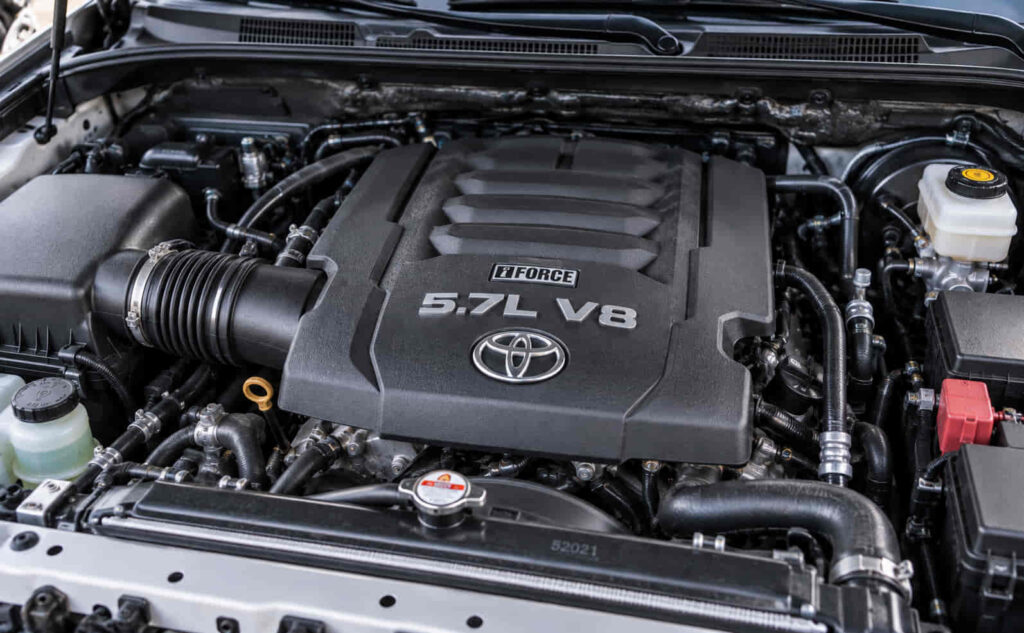
A well-maintained Toyota 5.7L 3UR-FE can remain serviceable well into high mileage, but there is no single mileage at which every Toyota 5.7 engine reaches the end of its life. Reaching 200,000 miles does not automatically make the engine worn out, and 300,000 miles is possible when the engine has accumulated mileage without major lubrication, cooling, or internal mechanical damage. These mileage figures should be treated as longevity benchmarks rather than guaranteed service-life limits.
Toyota used the 5.7L 3UR-FE V8 in vehicles designed for demanding applications, including the Tundra and Sequoia. Actual engine life depends heavily on how each vehicle has been maintained and operated. Regular oil service, a healthy cooling system, prompt repair of fluid leaks, and avoiding repeated overheating help preserve internal components as mileage increases. Heavy towing, neglected maintenance, low oil levels, overheating, and unresolved mechanical problems can shorten usable engine life even when the odometer is relatively low.
For this reason, Toyota 5.7 engine life expectancy is better evaluated through mileage, maintenance history, operating conditions, and current mechanical condition together. This guide explains what 200,000 and 300,000 miles mean for the 3UR-FE, which problems can shorten its lifespan, and how to judge whether a high-mileage Toyota 5.7 still has substantial engine life remaining.
How Long Does a Toyota 5.7 Engine Last?
A Toyota 5.7L 3UR-FE can remain serviceable beyond 200,000 miles and can reach 300,000 miles in favorable conditions, but 300,000 miles should be treated as a high-mileage possibility rather than a guaranteed engine lifespan. The useful life of an individual engine depends on maintenance history, lubrication, cooling-system performance, operating load, previous repairs, and its current mechanical condition.
Mileage matters because wear accumulates as engine components complete more operating cycles. Bearings, piston rings, cylinder surfaces, valve-train components, seals, gaskets, timing components, and cooling-system parts all experience age, heat, friction, and material degradation. However, mileage alone does not show how severe that wear has become. Two 3UR-FE engines with identical odometer readings can have substantially different remaining service lives.
Maintenance history creates much of this difference. Engine oil provides lubrication and carries heat and contaminants away from internal surfaces. When oil level is maintained and oil service is performed appropriately, the lubrication system can continue protecting components as mileage rises. Repeated operation with insufficient, badly degraded, or contaminated oil increases the risk of wear that cannot be reversed simply by improving maintenance later.
Cooling-system condition is similarly important because excessive temperature can cause far more consequential damage than normal mileage accumulation. An engine that reaches high mileage without repeated overheating can remain mechanically sound, while a lower-mileage engine that has suffered severe thermal stress may require major repairs much earlier. This is why overheating history deserves significant weight when estimating Toyota 5.7 engine life expectancy.
Operating conditions also change the meaning of mileage. A 3UR-FE used for frequent towing, heavy loads, extended idling, or demanding operation experiences a different thermal and mechanical duty cycle from an engine used primarily for moderate unloaded driving. Heavy use does not establish a fixed shorter lifespan, but it increases the importance of correct maintenance and early response to developing problems.
Age must also be considered separately from mileage. A lower-mileage engine can still develop deteriorated seals, hoses, cooling-system components, or other age-related problems. Conversely, a vehicle that accumulated substantial highway mileage under stable operating conditions can sometimes show less severe wear in certain areas than its odometer number might suggest.
For these reasons, a useful life-expectancy assessment should move beyond asking whether the engine has crossed a specific mileage threshold. Oil consumption trends, compression, abnormal internal noise, cooling-system history, fluid leaks, exhaust smoke, diagnostic information, and maintenance records provide evidence about actual condition. A high odometer reading establishes accumulated use; it does not independently establish that the engine is near failure.
The practical Toyota 5.7 engine lifespan is therefore determined by how well the 3UR-FE survives accumulated mileage, not by a predetermined odometer limit. An engine that has passed 200,000 miles with good maintenance and sound mechanical condition can still have useful life remaining, while an abused or overheated engine can require major repair considerably earlier.
Can a Toyota 5.7 Engine Last 200,000 Miles?
Yes, a Toyota 5.7L 3UR-FE can reach 200,000 miles, and crossing that mileage does not by itself mean the engine needs to be rebuilt or replaced. At 200,000 miles, the more useful question is whether the engine has reached that point with stable lubrication, effective cooling, acceptable mechanical condition, and a documented history of maintenance.
The 200,000-mile mark should therefore be treated as a condition-assessment point rather than an expiration date. By this mileage, the engine and its supporting systems have accumulated substantial operating time, so age-related and wear-related issues deserve closer attention. The significance of those issues depends on their severity and whether they have been corrected before causing secondary damage.
Oil condition is one of the strongest examples. A 200,000-mile engine that maintains its oil level, operates without abnormal internal noise, and has received consistent oil service presents a different longevity profile from an engine with a history of low-oil operation or prolonged neglected service. Lubrication-related damage accumulates internally, which means an odometer cannot reveal the entire maintenance history.
The same logic applies to cooling. A high-mileage 3UR-FE that has maintained normal operating temperature has avoided one of the major pathways to serious engine damage. In contrast, repeated or severe overheating can compromise sealing surfaces and internal components regardless of whether the engine has accumulated 100,000, 150,000, or 200,000 miles.
A 200,000-mile Toyota 5.7 should also be evaluated for changes rather than mileage alone. Increasing oil consumption, persistent smoke, abnormal knocking or mechanical noise, recurring coolant loss, reduced compression, or repeated overheating carries more diagnostic value than the odometer reaching an even number. These conditions can indicate deterioration that directly affects remaining engine life.
Service history becomes particularly valuable when evaluating a used 5.7L vehicle at this mileage. Records can show whether oil service was consistent, cooling-system problems were addressed promptly, and significant repairs were performed correctly. Missing records do not prove neglect, but they increase uncertainty because the buyer has less evidence about how the engine accumulated its mileage.
The condition of supporting components should not automatically be confused with the condition of the engine’s internal assembly. A high-mileage vehicle can require repairs to cooling, charging, starting, sealing, or accessory systems while the basic engine remains mechanically usable. Conversely, a vehicle that looks well maintained externally can still have internal wear that requires mechanical testing to identify.
A compression or other appropriate mechanical evaluation becomes valuable when symptoms or purchase risk justify it because testing provides evidence that mileage alone cannot. The goal is not to prove that every 200,000-mile engine is healthy, but to determine whether the individual engine still produces evidence of sound internal operation.
A Toyota 5.7 with 200,000 miles can therefore still have substantial usable life when its maintenance history and current condition support that conclusion. The mileage should trigger a more careful assessment of lubrication, cooling, engine wear, and service history rather than an automatic assumption that the 3UR-FE has reached the end of its life.
Read more: rav4 auto start stop disable
Can a Toyota 5.7 Engine Last 300,000 Miles?
A Toyota 5.7L 3UR-FE can reach 300,000 miles, but 300,000 miles should be viewed as an achievable high-mileage outcome rather than a guaranteed service life for every engine. Reaching this point depends less on a single durability claim and more on whether the engine has accumulated its mileage without severe lubrication failure, repeated overheating, major internal damage, or prolonged operation with unresolved problems.
The distinction between 200,000 and 300,000 miles is important because another 100,000 miles represents a substantial amount of additional operating time. An engine that is mechanically healthy at 200,000 miles still has to maintain adequate lubrication, cooling, compression, sealing, and oil control as components continue aging. Its condition at 200,000 miles therefore influences whether 300,000 miles is a realistic target.
Maintenance becomes increasingly important as mileage rises because small problems can create larger consequences when ignored. A developing oil leak, for example, is not necessarily an internal engine failure. If the leak causes the oil level to remain low and the engine continues operating with insufficient lubrication, however, a relatively manageable external problem can contribute to accelerated internal wear.
Cooling-system problems create a similar progression. A leaking component or loss of coolant does not automatically mean that the 3UR-FE is worn out, but continuing to drive while the engine overheats can turn a supporting-system failure into major engine damage. At high mileage, preserving the engine often depends on correcting these problems before secondary damage occurs.
The engine’s behavior at 300,000 miles matters more than the number itself. Stable oil pressure, acceptable oil consumption, normal operating temperature, consistent cylinder performance, absence of serious internal noise, and reliable operation provide more useful information about remaining life than simply knowing that the odometer has crossed 300,000 miles.
A high-mileage engine can also require substantial peripheral maintenance while its core internal assembly remains serviceable. Cooling-system parts, seals, hoses, mounts, sensors, accessories, and other components can age or fail during the same ownership period. Repairing these items should not automatically be described as rebuilding the engine, although neglected supporting-system failures can eventually damage the engine itself.
Conversely, reaching 300,000 miles does not prove that another 100,000 miles is available. Remaining life becomes progressively more dependent on current mechanical condition. An engine can operate normally at one inspection and later develop a significant failure, which is why high-mileage examples should not be converted into a universal prediction for another Toyota 5.7.
This is particularly relevant when evaluating online reports of exceptionally high-mileage Tundra or Sequoia vehicles. Such examples demonstrate that the 3UR-FE can remain operational at substantial mileage under certain conditions. They do not establish a fixed minimum lifespan because maintenance quality, driving conditions, repairs, operating hours, and previous engine work can differ substantially between vehicles.
A Toyota 5.7 can therefore make it to 300,000 miles when its mechanical condition and maintenance history support continued operation, but the mileage should be treated as a high-mileage achievement rather than an automatic expectation. Once a 3UR-FE reaches this range, condition-based evaluation becomes more useful than predicting its remaining life from the odometer alone.
What Determines the Life Expectancy of a Toyota 5.7 Engine?
Toyota 5.7 engine life expectancy is primarily determined by lubrication quality, temperature control, operating load, maintenance history, and how quickly developing problems are corrected. These factors influence the rate at which internal components wear and whether a relatively minor service problem progresses into damage that shortens the usable life of the 3UR-FE.
Lubrication is fundamental because moving internal components depend on an adequate oil supply to reduce friction, control heat, and protect loaded surfaces. Correct oil level matters alongside oil-service history. An engine can receive scheduled oil changes and still experience damage if a leak or consumption problem allows the oil level to fall excessively between services.
Oil condition also reflects how the engine has been operated. Heat, contaminants, combustion by-products, and extended service progressively affect the lubricant. Appropriate oil and filter service removes contaminated oil before deterioration becomes excessive and provides the engine with a renewed lubrication environment. Repeated neglect increases the opportunity for deposits and wear to accumulate over time.
Temperature control is another major longevity factor. The cooling system must transfer engine heat effectively and maintain the operating temperature within the intended range. Coolant loss, circulation problems, radiator-related issues, or other cooling faults can reduce that capability. The greatest longevity concern is not simply replacing an aging cooling component; it is continuing to operate the engine while excessive temperature is damaging internal parts.
Operating load determines how much thermal and mechanical demand the engine experiences. Towing, carrying heavy loads, extended operation under demanding conditions, and repeated high-load use can increase heat generation and component stress. These applications do not establish that a Toyota 5.7 will fail prematurely, but they make correct fluid condition, cooling performance, and maintenance discipline more important.
Driving pattern adds another layer that mileage does not capture. Highway mileage accumulated at stable operating temperature is not mechanically identical to the same mileage accumulated through repeated short trips, extensive idling, frequent cold starts, or heavy-duty operation. This is why two engines displaying 200,000 miles can have different operating histories and different remaining life.
Maintenance history combines these factors into a record of how the engine was treated. Consistent service does not guarantee that a mechanical failure will never occur, but it reduces preventable sources of accelerated wear. More importantly, records can reveal whether previous problems such as coolant loss, oil leaks, overheating, or abnormal engine operation were corrected promptly or allowed to continue.
Repair quality also affects future lifespan. Correcting the original cause of a problem protects the engine more effectively than repeatedly treating its symptom. For example, continually adding coolant without identifying a recurring loss does not address why the cooling system is losing fluid. If the underlying problem eventually causes overheating, the consequences can extend far beyond the original leak.
The response to warning signs is therefore one of the most controllable longevity factors. Persistent mechanical noise, falling oil level, coolant loss, abnormal exhaust smoke, overheating, misfires, or significant changes in performance should not be ignored simply because the engine still runs. Continued operation can transform a detectable problem into more extensive damage.
Previous engine damage must also be included when estimating lifespan. A 3UR-FE that has experienced severe overheating, prolonged low-oil operation, or internal mechanical failure does not have the same condition profile as an engine with identical mileage and no comparable history. An odometer records distance traveled, not the severity of the events that occurred during that distance.
The life expectancy of a Toyota 5.7 is therefore the result of accumulated operating history rather than mileage alone. Good lubrication, effective cooling, appropriate maintenance, controlled operating stress, and early repair of developing faults give the 3UR-FE the strongest conditions for remaining serviceable as it moves beyond 200,000 miles and potentially toward 300,000 miles.
How Does Maintenance Affect Toyota 5.7 Engine Life?
Maintenance has a direct effect on Toyota 5.7 engine life because lubrication, cooling, fluid levels, and early fault detection determine how much preventable wear the 3UR-FE accumulates over time. Maintenance cannot eliminate normal mechanical aging, but it can prevent serviceable components and minor problems from developing into conditions that cause permanent internal engine damage.
Engine oil is one of the most important longevity factors because the 3UR-FE depends on continuous lubrication whenever it is running. Oil forms a protective film between moving surfaces, carries heat away from loaded components, suspends contaminants, and supports the operation of oil-dependent engine systems. As oil remains in service, heat and contamination progressively affect its condition, which is why appropriate oil and filter service matters throughout the engine’s life rather than only after high mileage is reached.
Oil level is just as important as the oil-change schedule. A 5.7L engine can develop a leak or begin consuming more oil as mileage accumulates, and a scheduled service interval does not protect the engine if the oil level becomes excessively low between changes. Operating with insufficient oil can reduce lubrication where it is needed most and accelerate wear. Checking for changes in oil level and correcting the reason for significant loss therefore becomes increasingly important on a high-mileage 3UR-FE.
Cooling-system maintenance protects the engine through a different mechanism. Combustion generates substantial heat, and the cooling system must continuously remove enough of that heat to keep engine temperature controlled. Coolant loss or a failing cooling-system component can reduce this capability. If the problem is corrected before overheating occurs, the repair may have little effect on the engine’s remaining life. If the engine continues operating at excessive temperature, the same initial problem can become a major longevity event.
This is why fluid leaks should be treated according to consequence rather than appearance alone. A small visible leak may initially seem less important than an internal engine problem, but its effect changes if it allows the oil or coolant level to become unsafe. Correcting the leak protects the system that depends on that fluid and reduces the chance that a relatively limited repair will lead to internal damage.
Maintenance also includes responding to changes in engine behavior. New mechanical noise, persistent misfires, abnormal smoke, rising oil consumption, coolant loss, or unusual temperature behavior provides information that routine fluid replacement alone cannot address. Continuing to operate the engine while a damaging condition develops can shorten its remaining life even when previous scheduled maintenance was performed consistently.
Service records become valuable for the same reason. They establish more than whether an oil change occurred at a particular mileage. A useful history can show whether leaks were repaired, cooling-system problems were addressed, overheating occurred, and abnormal engine symptoms received proper diagnosis. For a Toyota 5.7 with 200,000 miles or more, this history helps explain how the engine reached its current condition.
Maintenance requirements should also be tied to the exact vehicle and operating conditions rather than replaced with one universal interval taken from another Toyota application. The 3UR-FE was installed in different vehicles and markets, and maintenance requirements can vary with vehicle configuration and use. The appropriate schedule for the exact model provides a better baseline than an arbitrary interval presented as universal for every Toyota 5.7.
More frequent service is not automatically a substitute for correct diagnosis either. Changing oil repeatedly cannot repair an active coolant leak, restore damaged compression, or reverse wear caused by previous overheating. Maintenance preserves a functioning engine; repairs correct faults that maintenance alone cannot remove.
Good maintenance extends the usable life of a Toyota 5.7 by controlling preventable wear and correcting conditions that can lead to internal damage. The most valuable maintenance history is therefore not simply a record of routine service, but evidence that the engine remained properly lubricated, properly cooled, and free from unresolved problems as mileage accumulated.
Does Towing Reduce Toyota 5.7 Engine Life?
Towing does not automatically shorten a Toyota 5.7 engine to a predetermined lifespan, but frequent heavy towing can increase engine load, heat generation, and operating stress, making correct maintenance and temperature control more important. A 3UR-FE that tows within the vehicle’s applicable limits and remains properly maintained should not be evaluated the same way as an engine repeatedly overloaded, overheated, or operated with inadequate fluid condition.
The mechanical relationship begins with load. Moving a heavier combined vehicle and trailer mass requires the powertrain to produce more work during acceleration, climbing, and other demanding conditions. The engine can therefore spend more time operating under substantial load than it would during lightly loaded cruising. Higher sustained output increases fuel burned and heat produced, which places greater demand on the lubrication and cooling systems.
Heat is particularly important to engine longevity because towing often combines increased engine output with conditions such as low-speed climbing, high ambient temperature, or extended operation under load. The cooling system must remove this additional heat while maintaining acceptable engine temperature. A healthy system can manage the operating demands it was designed for, but reduced cooling capacity becomes more consequential when the engine is working hard.
This is why towing history should not be interpreted as a simple yes-or-no durability indicator when evaluating a used Toyota 5.7. A vehicle that has regularly towed appropriate loads while receiving maintenance suited to its use can present a better engine condition than a vehicle that rarely towed but experienced neglected oil service or overheating. How the engine was operated and maintained matters more than the presence of a trailer hitch.
Repeated overloading creates a different condition. Exceeding applicable vehicle limits increases demand beyond the intended operating context and can affect more than the engine. Cooling, transmission, braking, suspension, and driveline systems all participate in moving and controlling the load. For engine-life assessment, the key concern is whether excessive demand contributed to abnormal heat, lubrication stress, detonation-related conditions, or other damaging operation.
Towing also makes existing weaknesses more visible. A marginal cooling system may appear adequate during unloaded driving but struggle when engine output and heat production increase. A fluid leak that seems minor during short local trips can become more consequential during a long tow. Heavy operation therefore does not necessarily create the original fault, but it can expose reduced system capacity sooner.
The same principle applies to a high-mileage 3UR-FE. Mileage alone does not prohibit towing, but current condition becomes increasingly important. An engine with stable oil level, controlled temperature, normal performance, and no significant mechanical symptoms presents a different risk profile from one already experiencing coolant loss, abnormal oil consumption, overheating, or internal noise.
Drivers who tow frequently should therefore base maintenance on the exact Toyota model, service guidance, operating severity, and observed engine condition. Simply shortening every maintenance interval without reference to the vehicle’s requirements is less useful than ensuring the engine has the correct fluids, adequate levels, effective cooling, and prompt repair when abnormalities appear.
A history of towing should also be evaluated alongside the rest of the vehicle when purchasing a high-mileage Tundra or Sequoia. The engine may remain mechanically sound while other powertrain or chassis components show the effects of heavy-duty use. Toyota 5.7 engine life expectancy should not be used as a proxy for the remaining life of the transmission, differential, cooling components, suspension, or the vehicle as a whole.
Towing affects Toyota 5.7 engine longevity primarily through increased load and thermal demand, not through a fixed mileage penalty. When the engine operates within the vehicle’s intended limits, receives appropriate maintenance, and avoids overheating or lubrication problems, towing history alone does not establish that the 3UR-FE is near the end of its usable life.
What Problems Can Shorten Toyota 5.7 Engine Life?
The problems most likely to shorten Toyota 5.7 engine life are those that interfere with lubrication, cooling, combustion, or internal mechanical operation and then remain unresolved long enough to cause secondary damage. A high-mileage 3UR-FE does not reach the end of its useful life simply because an accessory, sensor, seal, or other serviceable component fails. The longevity risk increases when a problem allows the engine to operate with insufficient oil, excessive temperature, abnormal combustion, or progressive internal wear.
Oil loss becomes a major concern when the engine can no longer maintain an adequate lubricant level between inspections or services. The initial cause can be an external leak or oil consumption rather than a failed internal engine assembly, but the consequence changes if the driver continues operating with insufficient oil. Bearings, cylinder surfaces, valve-train components, timing components, and other lubricated parts depend on a stable oil supply, so prolonged low-oil operation can convert a manageable oil-loss problem into permanent mechanical wear.
Abnormal oil consumption requires the same condition-based approach. The fact that an older engine uses some oil does not establish that it is finished, but increasing consumption changes the risk because the oil level can fall more quickly and the consumption itself can indicate a developing sealing or internal-wear issue. The important questions are how much oil is being lost, how rapidly the rate is changing, whether external leaks are present, and whether smoke or other evidence indicates that oil is entering the combustion process.
Cooling-system faults can shorten engine life more abruptly because they can lead to overheating. Coolant loss, inadequate circulation, or another condition that prevents the cooling system from controlling temperature can expose the engine to thermal stress. Repairing the original cooling problem before the engine overheats is fundamentally different from repeatedly adding coolant while continuing to operate a vehicle with an unresolved loss.
Persistent combustion problems can also matter when they are severe enough to affect engine operation over time. A recurring misfire, for example, is not automatically evidence that the 3UR-FE needs replacement because ignition, fuel, air, electrical, and mechanical causes can produce similar symptoms. The longevity concern arises when the underlying fault remains unresolved and contributes to abnormal cylinder operation or secondary damage.
Internal mechanical noise deserves attention for the same reason. Not every tick or sound indicates catastrophic wear, and diagnosis is required before assigning a cause. However, a new knock, persistent abnormal timing-related noise, or another mechanical sound should not be ignored solely because the engine continues to run. The sound can provide an early indication of a condition that becomes more expensive if operation continues.
Fluid contamination can provide another warning that requires diagnosis rather than assumption. Changes in oil or coolant condition can indicate problems ranging from normal service deterioration to more serious internal communication between systems. The significance depends on the actual cause, so replacing contaminated fluid without determining why it became abnormal may leave the engine exposed to the same problem.
Previous repair history is also relevant when estimating remaining life. An engine that has already experienced a serious low-oil event, severe overheating, or internal mechanical damage carries a different risk profile from an engine at the same mileage that has avoided those events. A successful repair can restore operation, but the history still matters because some damaging events can affect components beyond the part that originally failed.
The duration of a problem often determines whether it becomes a lifespan issue. A leak identified and repaired before the fluid level becomes unsafe may have little effect on engine life. The same leak ignored for thousands of miles can produce a completely different outcome if it causes chronic low fluid level, overheating, or inadequate lubrication.
This distinction prevents routine high-mileage repairs from being mistaken for engine failure. Seals, cooling-system parts, sensors, accessories, and other components can require replacement during a long vehicle life without establishing that the 3UR-FE itself is worn out. The engine’s remaining life should be judged from the effect of those failures on internal mechanical condition.
Problems shorten Toyota 5.7 engine life when they create damaging operating conditions and are allowed to continue, not merely because a high-mileage component requires repair. Protecting the 3UR-FE therefore depends on recognizing oil loss, cooling problems, abnormal combustion, and mechanical symptoms early enough to prevent a serviceable fault from becoming internal engine damage.
How Does Overheating Affect a Toyota 5.7 Engine?
Overheating can significantly shorten Toyota 5.7 engine life because excessive temperature can damage sealing surfaces, gaskets, cylinder-head components, lubricated parts, and other engine materials that depend on controlled operating temperature. The severity of the effect depends on how hot the 3UR-FE became, how long it remained overheated, why the overheating occurred, and whether the engine developed mechanical damage afterward.
The cooling system normally removes excess heat produced during combustion and maintains the engine within its intended temperature range. When coolant is lost or heat transfer becomes inadequate, engine temperature can rise beyond the range the system is designed to control. At that point, the concern is no longer simply the failed cooling component; it is the effect of excessive heat on the engine itself.
Thermal expansion explains part of this risk. Engine components are designed to expand as they warm, but excessive temperature can create conditions outside normal operating tolerances. Sealing surfaces and gaskets must continue containing combustion pressure, oil, and coolant while components are exposed to this heat. Severe thermal stress can compromise that sealing relationship and create problems that remain after the original cooling-system fault is repaired.
Engine oil is also affected by excessive heat. Lubricant must maintain an effective protective film across moving surfaces, and abnormal temperature increases the thermal stress placed on the oil and lubricated components. An overheating event combined with low oil level or another lubrication problem therefore presents a more serious condition than normal high-mileage operation.
The duration of overheating matters because a brief temperature increase identified immediately is not automatically equivalent to driving an engine for an extended period while severely overheated. Continuing to operate the vehicle after an overheating warning gives excessive temperature more time to affect components and can turn a cooling-system repair into a major engine repair.
The cause must be identified before determining the engine’s future risk. Replacing coolant after an overheating event does not explain why the coolant was lost or why temperature control failed. If a leak, circulation problem, or other cooling fault remains present, the 3UR-FE can overheat again and accumulate additional thermal damage.
Post-overheating behavior provides important evidence. Recurring coolant loss, abnormal exhaust smoke, rough running, contamination between fluids, persistent overheating, loss of compression, or other mechanical changes can justify deeper diagnosis. The absence of an immediate symptom is reassuring but does not make the original cause irrelevant; the cooling system still needs to operate correctly before continued high-mileage use can be considered dependable.
A single overheating history also should not automatically condemn every Toyota 5.7 engine. The correct assessment depends on severity and resulting condition. An engine whose temperature began rising, was shut down promptly, and received the required repair can have a very different outcome from one driven until severe overheating caused internal damage.
This is why overheating history is particularly important when purchasing a high-mileage Toyota 5.7. A 3UR-FE with 250,000 miles and no evidence of serious thermal damage can present a stronger longevity case than a substantially lower-mileage engine with repeated coolant loss and severe overheating. Odometer mileage cannot represent the mechanical consequences of those events.
Mechanical testing becomes appropriate when symptoms or the severity of an overheating event creates reason to suspect internal damage. Compression-related testing, cooling-system evaluation, fluid inspection, diagnostic information, and other vehicle-specific checks can provide evidence about whether the engine still maintains normal mechanical integrity.
Overheating can therefore reduce Toyota 5.7 engine life far more significantly than ordinary mileage accumulation when excessive temperature causes internal damage. Preventing repeated overheating, repairing coolant loss promptly, and evaluating the engine after a serious thermal event are more useful for preserving 3UR-FE longevity than relying on an odometer target alone.
Does the Toyota 5.7 Engine Have a Timing Belt or Timing Chain?
The Toyota 5.7L 3UR-FE uses a timing chain rather than a timing belt, so engine-life assessment does not depend on replacing a conventional timing belt at a fixed mileage interval. The timing system remains an important part of long-term engine reliability, however, because the chain, guides, tensioning components, lubrication, and related parts must continue maintaining correct mechanical timing as mileage accumulates.
A timing chain operates inside the engine and depends on engine oil for lubrication. This creates a direct relationship between oil maintenance and timing-system longevity. Consistent lubrication helps protect moving timing components, while prolonged operation with inadequate or severely degraded oil can increase wear throughout oil-dependent parts of the engine. The presence of a chain therefore removes the routine timing-belt replacement question but does not make the timing system maintenance-independent.
This distinction becomes increasingly relevant above 200,000 miles. A high-mileage 3UR-FE should not automatically receive a timing-chain replacement simply because the odometer crosses a specific threshold. Actual condition provides more useful evidence. Abnormal timing-related noise, diagnostic faults associated with camshaft and crankshaft synchronization, or evidence of excessive mechanical wear requires investigation, while a normally operating timing system should not be declared worn out from mileage alone.
Cold-start noise deserves the same diagnostic discipline. A brief or persistent abnormal sound can have several possible sources, so hearing a noise does not establish that the timing chain itself has stretched or failed. The location, duration, operating conditions, diagnostic information, and mechanical inspection are needed to identify the cause before a major timing repair is justified.
The consequences of a genuine timing problem can be more important to engine life than the maintenance label attached to the component. Accurate valve timing is required for normal engine operation. If timing-system wear becomes severe enough to affect synchronization, continued operation can create drivability problems and potentially greater mechanical risk. Detecting an abnormal condition before it progresses is therefore more valuable than replacing parts solely because the engine has reached high mileage.
Oil level again matters because a perfectly reasonable oil-change history does not protect the timing system if the engine repeatedly operates below an adequate lubricant level. A high-mileage Toyota 5.7 that develops an oil leak or increasing consumption needs level monitoring between services so that oil-dependent components continue receiving the lubrication they require.
For used-vehicle evaluation, the timing chain should consequently be considered within the broader condition of the engine. A 3UR-FE with 250,000 miles, stable oil level, normal operation, and no evidence of timing-system problems presents a different case from a lower-mileage engine with poor oil history and persistent timing-related symptoms. The odometer alone cannot establish the remaining life of the chain or the engine.
The Toyota 5.7 uses a timing chain, but the chain should still be evaluated through lubrication history, symptoms, diagnostic evidence, and mechanical condition rather than assumed to last forever. Its design eliminates a conventional timing-belt replacement interval, not the need to maintain and monitor the engine as mileage increases.
Does Oil Consumption Mean a Toyota 5.7 Engine Is Worn Out?
Oil consumption does not automatically mean a Toyota 5.7 engine is worn out, but increasing or excessive oil use can indicate a condition that needs diagnosis and can shorten engine life if the oil level is allowed to become too low. The significance depends on how much oil is being lost, how quickly the rate changes, whether the oil is leaking externally or being consumed internally, and whether other mechanical symptoms are present.
The first distinction is between oil loss and internal engine wear. Oil can leave the lubrication system through an external leak without being burned inside the cylinders. In that situation, the engine can consume oil from the owner’s perspective because the dipstick level falls, but the underlying mechanism is different from oil entering the combustion chambers. Identifying the path of the oil loss is therefore necessary before using consumption as evidence of internal wear.
Internal oil consumption can have several mechanical pathways, and the severity matters more than the mere presence of consumption. An engine that requires progressively more oil between services deserves closer evaluation because a rising trend can indicate deterioration in oil control or another internal condition. Exhaust smoke, spark-plug condition, cylinder performance, deposits, and mechanical testing can provide additional evidence when internal consumption is suspected.
The direct longevity risk appears when consumption causes the engine to operate with insufficient oil. A 3UR-FE can continue running while the oil level declines, but continued operation below an adequate level reduces the lubrication margin available to bearings, timing components, cylinder surfaces, and other moving parts. An unresolved consumption problem can therefore create secondary wear even when the original cause was not immediately catastrophic.
Adding oil can protect the engine from becoming dangerously low while diagnosis is pending, but topping up should not be confused with repairing abnormal consumption. If the rate continues increasing, the underlying cause remains present. Tracking how much oil is added over a known mileage interval provides more useful information than describing an engine vaguely as “using some oil.”
Oil consumption should also be interpreted alongside other evidence of engine condition. Stable compression, normal performance, controlled operating temperature, absence of abnormal internal noise, and no significant smoke can produce a different assessment from an engine that combines high oil consumption with low compression, persistent smoke, fouled plugs, or mechanical noise.
Mileage provides context but not a diagnosis. A 250,000-mile Toyota 5.7 may consume oil without being at the immediate end of its service life, while a much lower-mileage engine with rapidly increasing consumption can have a problem requiring attention. Assuming that oil use is simply normal because an engine is old risks overlooking a developing condition that could still be corrected or managed.
The economic significance also depends on severity. A small, stable loss that can be monitored safely presents a different ownership decision from consumption severe enough to require frequent additions or accompanied by evidence of internal mechanical deterioration. At high mileage, the cost and invasiveness of the required repair must be weighed against the engine’s overall condition and expected remaining service life.
Oil consumption should therefore be treated as evidence to evaluate, not automatic proof that a Toyota 5.7 has reached the end of its life. The critical factors are the consumption rate, its cause, whether the oil level remains adequately maintained, and whether other tests or symptoms show that internal engine wear has become significant.
What Are the Signs of a Worn-Out Toyota 5.7 Engine?
A worn Toyota 5.7 engine is better identified by persistent evidence of declining internal mechanical condition than by mileage alone. Significant oil consumption, low or uneven compression, persistent exhaust smoke, abnormal internal noise, recurring overheating, loss of power, and continuing cylinder-performance problems become more meaningful when several symptoms point toward the same underlying deterioration. A 3UR-FE should not be declared worn out from one symptom without determining its cause.
Oil consumption becomes stronger evidence when the rate is substantial or progressively increasing. An external leak can lower the oil level without proving that cylinders, piston rings, or other internal components are worn. When oil consumption is accompanied by persistent exhaust smoke, plug contamination, compression problems, or other evidence of oil entering the combustion process, the case for internal deterioration becomes stronger.
Compression provides another useful view of mechanical condition because the cylinders must seal adequately for the engine to produce consistent combustion pressure. Low or uneven results can indicate a sealing problem, but the measurement still requires diagnosis. Piston rings, valves, cylinder sealing, and other mechanical conditions can affect the result, so a compression problem identifies a need for further evaluation rather than automatically establishing the complete repair.
Persistent internal noise can indicate wear when the sound is traced to a mechanical source. Knocking, abnormal timing-related noise, or other sounds that change with engine speed or operating condition deserve investigation, especially when they appear together with oil-pressure, performance, or lubrication concerns. A noise should not be assigned to a bearing, timing chain, or valve-train component solely from a general description because several systems can produce similar sounds.
Exhaust smoke also needs to be interpreted according to its behavior. Persistent smoke after the engine reaches normal operating condition can provide evidence of oil or coolant entering the combustion process depending on the symptom and diagnosis. A brief visible exhaust plume under certain environmental conditions does not provide the same evidence. Duration, color, fluid loss, engine temperature, and accompanying symptoms determine its diagnostic value.
Recurring overheating is particularly important because it can both indicate an unresolved problem and create additional engine damage. A 3UR-FE that repeatedly loses coolant or exceeds normal operating temperature should not be evaluated as healthy simply because it continues to start and drive. Thermal damage can affect sealing and internal mechanical integrity, making overheating history a major part of high-mileage condition assessment.
Loss of power or rough running can contribute to the diagnosis but is not specific enough to establish a worn-out engine by itself. Ignition components, fuel delivery, air-metering problems, sensors, electrical faults, and other repairable conditions can cause similar symptoms. Mechanical wear becomes more likely when testing shows that the problem originates inside the engine rather than from a serviceable external system.
Oil and coolant condition can add supporting evidence. Abnormal contamination, unexplained fluid loss, or repeated mixing-related symptoms require investigation because they can indicate a sealing problem. Simply changing the affected fluid without identifying the cause does not establish that the problem has been corrected.
The strongest assessment therefore comes from multiple pieces of evidence that agree with one another. A 300,000-mile 3UR-FE with stable fluid levels, acceptable cylinder condition, normal temperature, no serious internal noise, and consistent performance can present a better mechanical picture than a 150,000-mile engine with severe oil consumption, low compression, and a history of overheating.
The signs that a Toyota 5.7 is approaching the end of its usable engine life are persistent mechanical problems supported by diagnosis, not a particular odometer reading. Mileage establishes how much use the engine has accumulated, while symptoms and testing establish how well its internal components have survived that use.
How Can You Tell How Much Life Is Left in a Toyota 5.7 Engine?
You cannot determine the exact remaining life of a Toyota 5.7 engine, but you can estimate its condition by combining maintenance history, current symptoms, fluid behavior, cooling-system history, diagnostic information, and mechanical testing. This approach is more useful than subtracting the current mileage from an assumed 200,000- or 300,000-mile lifespan because the 3UR-FE does not have a fixed mileage expiration point.
Maintenance records provide the historical layer of the assessment. Consistent oil service is valuable, but records showing how previous problems were handled can be even more informative. Evidence that coolant leaks, oil loss, overheating, misfires, or abnormal noises were addressed promptly reduces uncertainty about whether the engine accumulated hidden damage while those conditions were present.
Cold-start behavior provides another useful observation because some mechanical and lubrication-related symptoms are easier to notice before the engine reaches normal operating temperature. The engine should be evaluated for abnormal noise, smoke, unstable operation, warning indicators, and unusual starting behavior rather than judged only after it has been warmed up before inspection.
Fluid behavior reveals what happens between services. An engine that maintains predictable oil and coolant levels presents a different condition profile from one that requires frequent additions with no documented explanation. The direction of change matters as well. Rapidly increasing oil consumption or recurring coolant loss deserves more attention than a stable condition that has been properly diagnosed and monitored.
Cooling-system history should receive substantial weight because serious overheating can affect remaining engine life independently of mileage. When evaluating a used Toyota 5.7, evidence of repeated coolant loss or previous severe overheating can be more significant than a moderate difference in odometer mileage. A mechanically sound cooling system today does not automatically reveal whether damaging thermal events occurred in the past, which makes service history valuable.
Diagnostic information can identify active or recurring faults that are not obvious during a short inspection. A vehicle that currently has no warning light can still require evaluation if codes were recently cleared or if a problem only appears under particular operating conditions. Diagnostic data should therefore complement physical inspection rather than replace it.
Mechanical testing becomes especially valuable when the engine has symptoms, very high mileage, an uncertain history, or is being evaluated for a significant purchase. Compression-related testing can provide evidence about cylinder sealing, while additional testing can help narrow the cause when results are abnormal. The purpose is to establish internal condition rather than predict an exact number of miles the engine has left.
Oil pressure, when there is a reason to evaluate it, can also provide information about the lubrication system and internal condition. The measurement must be interpreted according to the appropriate specification and operating conditions. A warning light or suspected pressure problem should be diagnosed rather than dismissed as a normal consequence of high mileage.
A proper estimate should also separate engine condition from overall vehicle condition. A healthy 3UR-FE does not mean the transmission, cooling system, drivetrain, suspension, electrical system, or chassis has the same remaining service life. This distinction becomes increasingly important when deciding whether a high-mileage Tundra or Sequoia is economically worth keeping or purchasing.
No inspection can guarantee another 50,000 or 100,000 miles because future failures cannot be predicted with that precision. What inspection can establish is whether the engine currently shows evidence of healthy operation or significant deterioration. That information provides a much stronger basis for an ownership decision than applying a universal lifespan number.
The best way to estimate how much life remains in a Toyota 5.7 is therefore to evaluate the individual engine’s history and mechanical condition rather than calculate remaining mileage from an assumed maximum lifespan. A well-documented high-mileage 3UR-FE with stable fluids, controlled temperature, normal operation, and satisfactory mechanical test results can have a stronger remaining-life profile than a lower-mileage engine with neglect or previous internal damage.
Is a Toyota 5.7 Engine With 200,000 Miles Worth Buying?
A Toyota 5.7 engine with 200,000 miles can still be worth buying when the 3UR-FE has a strong maintenance history, no evidence of serious overheating or lubrication damage, and current mechanical condition supports continued service. The odometer should increase the level of inspection required, but 200,000 miles alone is not sufficient evidence that the engine is near the end of its usable life.
Maintenance history should carry substantial weight because it explains how the engine accumulated those miles. A documented 3UR-FE that received consistent oil service and prompt repairs for leaks, cooling problems, or other faults provides more useful evidence than a lower-mileage engine with an unknown history. The goal is not simply to find records showing routine service, but to determine whether damaging conditions were allowed to continue.
Overheating history deserves particular attention. A 200,000-mile engine that has maintained normal operating temperature can present a stronger longevity profile than an engine with significantly fewer miles that experienced severe or repeated overheating. Evidence of recurring coolant loss, previous thermal damage, or unresolved cooling problems should therefore influence the purchase decision more heavily than mileage alone.
Oil behavior provides another condition indicator. The engine should be evaluated for external leaks, unexplained oil loss, abnormal consumption, smoke, and evidence that it has been operated with insufficient oil. A high-mileage engine that maintains a stable oil level between services presents a different risk from one that requires frequent additions without a clear diagnosis.
The engine should also be observed during a cold start when practical. Abnormal mechanical noise, persistent smoke, unstable running, warning indicators, or unusual starting behavior can reveal conditions that may be less obvious after the engine has already reached operating temperature. A seller presenting an engine fully warmed before every inspection does not automatically indicate a problem, but a true cold-start assessment can provide additional information.
Diagnostic and mechanical testing becomes more valuable as purchase price and mileage increase. Trouble-code information can identify active or recurring control-system problems, while compression-related testing can provide evidence about internal cylinder condition when the vehicle’s history or symptoms justify it. No single test guarantees future mileage, but several consistent results can substantially reduce uncertainty.
The asking price must also reflect the condition of the complete vehicle. A sound 3UR-FE does not make a worn transmission, failing cooling system, damaged drivetrain, deteriorated suspension, or heavily corroded chassis irrelevant. Conversely, the need for several age-related peripheral repairs does not automatically establish that the engine itself is worn out. Engine life and total vehicle life should be evaluated separately before the purchase economics are combined.
A lower-mileage Toyota 5.7 is therefore not automatically the better purchase. If the lower-mileage engine has poor service history, repeated overheating, significant oil loss, or evidence of internal wear, its remaining life can be less favorable than a properly maintained 200,000-mile example. Mileage is valuable context, but condition determines how that mileage should affect the decision.
Purchase expectations should also be realistic. Buying any vehicle at 200,000 miles means accepting a greater probability of age- and mileage-related repairs than buying the same vehicle much earlier in its service life. The fact that a 3UR-FE can continue beyond 200,000 miles does not make every supporting component equally durable or eliminate the possibility of an expensive engine failure.
A 200,000-mile Toyota 5.7 can be worth buying when inspection, maintenance records, and mechanical condition show that the engine has reached high mileage without major accumulated damage. The purchase should be rejected or repriced based on evidence of condition and repair risk rather than because the odometer has crossed 200,000 miles by itself.
Is a Toyota 5.7 Engine Expensive to Rebuild or Replace?
Rebuilding or replacing a Toyota 5.7L 3UR-FE can become a major repair expense because the total cost includes more than the engine assembly itself, and the economically correct choice depends on the type of damage, labor required, replacement-engine condition, and value of the vehicle. There is no single rebuild or replacement price that accurately applies across every Toyota model, repair facility, engine source, and market.
A rebuild becomes relevant when internal wear or damage is extensive enough that repairing one external component will not restore acceptable engine condition. Low compression caused by internal mechanical deterioration, serious bearing damage, cylinder-related wear, or major heat damage can move the repair beyond normal high-mileage maintenance. The engine must then be evaluated to determine whether rebuilding the existing assembly is technically and economically reasonable.
Rebuilding has the advantage of addressing the condition of the existing engine directly, but the scope matters. A limited repair and a comprehensive engine rebuild are not equivalent. Parts replacement, machining requirements, measurement of internal components, cylinder-head work, gasket replacement, and labor can change substantially according to what inspection reveals after disassembly.
Engine replacement provides a different path. A used 3UR-FE may reduce the initial component cost compared with some rebuilding options, but its mileage and history introduce uncertainty. Installing another high-mileage engine with incomplete maintenance records can exchange a known damaged engine for an engine whose remaining life is difficult to establish.
A remanufactured or otherwise comprehensively prepared replacement can reduce some of that uncertainty, but the purchase price can be higher. Warranty terms, included components, installation requirements, and the quality of the engine source affect the value of the replacement. The word “remanufactured” should not be treated as sufficient evidence of quality without understanding what work was actually performed and what coverage is provided.
Labor is a major part of the economic calculation because replacing or rebuilding an engine requires substantial disassembly and installation work. Related items discovered during the repair can further increase the final cost. Cooling-system problems that caused the original failure, damaged mounts, hoses, seals, or other components should not be ignored merely because another engine is being installed.
Correcting the original cause is particularly important after an engine failure. If severe overheating damaged the 3UR-FE because the cooling system had an unresolved problem, installing another engine without repairing that cause exposes the replacement to the same risk. The same principle applies to lubrication failures and other external conditions capable of damaging an otherwise serviceable engine.
Vehicle value determines whether a technically possible repair makes financial sense. A well-maintained Tundra or Sequoia with a solid transmission, drivetrain, chassis, and body can justify a different repair decision from a vehicle that simultaneously needs several other expensive systems restored. Engine replacement should therefore be considered within the remaining value and condition of the entire vehicle.
This economic boundary also helps define the true end of engine life. An engine does not always stop running completely before replacement becomes rational. It can reach a condition where restoring reliable mechanical operation costs more than the owner is prepared to invest relative to the vehicle’s value. In that case, economic service life and absolute mechanical failure are not the same point.
A Toyota 5.7 rebuild or replacement becomes most relevant when diagnosis confirms major internal damage and normal repairs can no longer restore dependable operation economically. The decision should compare the existing engine’s damage, rebuild scope, replacement-engine quality, labor, cause of the original failure, and overall vehicle condition rather than using mileage alone to decide that the 3UR-FE needs replacement.
How Can You Make a Toyota 5.7 Engine Last Longer?
The most effective way to extend Toyota 5.7 engine life is to prevent lubrication failure, overheating, prolonged fluid loss, and continued operation with unresolved mechanical symptoms. A 3UR-FE does not need unusual maintenance simply because the owner wants it to reach high mileage. Longevity depends more on consistently maintaining the systems that protect the engine and correcting problems before they produce secondary internal damage.
Oil maintenance provides the first layer of protection because internal engine components depend on a continuous supply of suitable lubricant. Oil and filter service should follow the requirements applicable to the specific Toyota model and operating conditions, but changing the oil is only part of the process. The oil level also needs attention between services, particularly as the engine accumulates mileage and the possibility of leaks or consumption increases.
Monitoring the oil level becomes more important when the engine begins losing oil. Waiting until the next scheduled service can allow a developing leak or consumption problem to reduce the available lubricant significantly. If the level repeatedly falls, the cause should be identified rather than relying indefinitely on topping up. Maintaining the correct level protects the engine in the short term; diagnosing the loss protects it over the longer term.
Cooling-system condition has similarly direct consequences for longevity. Coolant loss, abnormal temperature behavior, or evidence of a cooling problem should be addressed before the engine experiences severe overheating. Repeatedly adding coolant without finding the source of the loss leaves the 3UR-FE exposed to another overheating event, while continuing to drive an overheating engine can turn a repairable cooling fault into internal engine damage.
The response to warning signs matters because engine damage often develops through a sequence rather than one isolated event. An oil leak can lead to a low oil level, a cooling leak can lead to overheating, and a persistent misfire or mechanical noise can indicate a problem that becomes more serious with continued operation. Interrupting that sequence early is one of the most practical ways to preserve remaining engine life.
High-mileage owners should also pay attention to changes from the engine’s established behavior. A sudden increase in oil consumption, new internal noise, recurring coolant loss, persistent smoke, unusual temperature changes, or deteriorating performance provides more actionable information than the odometer reaching another round number. A 250,000-mile engine operating consistently does not require the same response as one developing a new mechanical symptom at the same mileage.
Operating load should be matched with vehicle condition. Towing and heavy-duty use increase thermal and mechanical demand, so a 3UR-FE used regularly under load needs a healthy lubrication and cooling environment. An existing cooling weakness or fluid-loss problem becomes more consequential when the engine is required to produce substantial power for extended periods.
Avoiding unnecessary neglect is more valuable than attempting to compensate for previous neglect with unusually aggressive maintenance later. Fresh oil cannot reverse bearing damage caused by prolonged low-oil operation, and new coolant cannot undo severe thermal damage that has already occurred. Preventive maintenance works best before internal surfaces or sealing systems have been permanently compromised.
Service records also contribute indirectly to longevity by making trends easier to recognize. Tracking repairs, fluid loss, oil consumption, and previous cooling-system work helps establish whether a condition is stable or deteriorating. This information becomes increasingly valuable when a Toyota 5.7 passes 200,000 miles and future maintenance decisions depend more heavily on the engine’s individual history.
Making a Toyota 5.7 last longer therefore requires preserving lubrication, controlling temperature, maintaining adequate fluid levels, and responding quickly to abnormal engine behavior. These practices cannot guarantee a specific mileage, but they reduce preventable damage and give a mechanically healthy 3UR-FE the best opportunity to remain serviceable at high mileage.
Is the Toyota 5.7 a Good High-Mileage Engine?
The Toyota 5.7L 3UR-FE can be a strong high-mileage engine when it has accumulated its mileage with consistent maintenance, effective cooling, adequate lubrication, and no major unresolved internal damage. Its suitability at 200,000 or 300,000 miles should still be judged from the individual engine’s condition rather than from the reputation of the engine family alone.
A useful high-mileage engine must do more than continue starting. It should maintain stable operation without evidence of serious internal deterioration. Oil consumption, compression, mechanical noise, exhaust behavior, coolant stability, operating temperature, and cylinder performance provide a more complete picture of engine health than the odometer by itself.
This is why 200,000 miles should not function as an automatic replacement threshold for the 3UR-FE. An engine that reaches this mileage with a documented maintenance history, controlled temperature, stable oil level, and normal mechanical operation can still provide useful service. The mileage establishes that wear has accumulated, but it does not establish that the wear has reached a failure limit.
The same reasoning applies at 300,000 miles, although uncertainty naturally becomes greater as operating time accumulates. Reaching 300,000 miles demonstrates that an individual engine has survived substantial use; it does not guarantee another fixed mileage interval. At this stage, remaining life depends heavily on what inspection and testing reveal about the engine’s present condition.
High-mileage reliability should also be separated from whole-vehicle reliability. A mechanically healthy Toyota 5.7 can remain serviceable while the vehicle requires repairs to its cooling system, transmission, drivetrain, suspension, electrical components, or other aging systems. An owner deciding whether to keep a high-mileage Tundra or Sequoia must therefore consider total vehicle condition in addition to engine life expectancy.
Engine reputation is most useful as context, not as a substitute for inspection. A durable engine design cannot protect an individual 3UR-FE from severe overheating, prolonged low-oil operation, neglected maintenance, or previous mechanical damage. Likewise, a high odometer reading should not outweigh evidence that a particular engine remains mechanically healthy.
For a used-vehicle buyer, this means a well-maintained high-mileage Toyota 5.7 can represent a more defensible purchase than a lower-mileage example with an uncertain or damaging history. Service records, cold-start behavior, fluid stability, diagnostic information, and mechanical testing provide evidence about the actual engine being purchased rather than relying on general expectations for the engine family.
There is also no mileage at which every Toyota 5.7 suddenly changes from reliable to unreliable. Wear progresses according to operating history and component condition. Major repair becomes appropriate when diagnosis identifies significant deterioration or failure, not simply when the odometer reaches 200,000, 250,000, or 300,000 miles.
The Toyota 5.7 can therefore be considered a capable high-mileage engine, but its real life expectancy is determined by condition and history rather than a guaranteed mileage figure. A properly maintained 3UR-FE can remain serviceable beyond 200,000 miles and may reach 300,000 miles or more, while overheating, lubrication failure, neglect, or major internal wear can end the useful life of another engine much earlier.