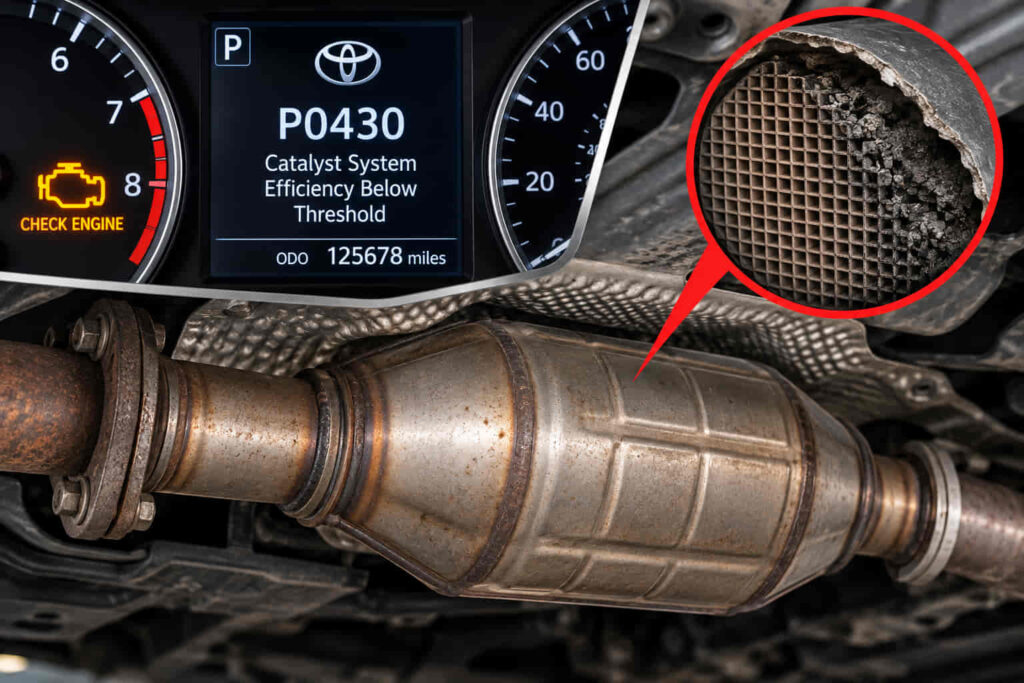
Toyota P0430 means the vehicle’s onboard diagnostic system has detected catalyst system efficiency below the expected threshold on Bank 2. The code identifies a catalyst-efficiency monitoring problem, but it does not by itself prove that the Bank 2 catalytic converter has failed. An exhaust leak, inaccurate oxygen or air-fuel sensor readings, engine misfire, incorrect fuel mixture, or another engine condition can also contribute to the code.
The catalytic converter is monitored through the exhaust sensors positioned before and after the catalyst. The engine control system evaluates the sensor signals to determine whether the catalyst is performing its expected emissions-control function. When the monitored behavior falls outside the calibrated threshold, the system can store P0430 and illuminate the Check Engine Light.
Correct diagnosis therefore requires more than reading the code and replacing a catalytic converter. The technician must first identify the correct Bank 2 for the Toyota engine, check for related diagnostic trouble codes, inspect the exhaust system, evaluate sensor operation, and determine whether an engine condition is affecting catalyst performance.
This guide explains what Toyota P0430 means, what causes it, which symptoms can appear, how Bank 2 catalyst efficiency is diagnosed, when a catalytic converter actually needs replacement, and how to verify that the underlying problem has been fixed.
What Does Toyota Code P0430 Mean?
Toyota code P0430 means the engine control system has detected that the catalyst system efficiency for Bank 2 is below the expected threshold. The code is an emissions-related diagnostic trouble code stored by the vehicle’s onboard diagnostic system when the catalyst-monitoring strategy determines that the applicable catalytic system is not performing within its calibrated efficiency range.
P0430 does not identify a specific failed component. The code describes the condition detected by the diagnostic system, while the underlying cause still needs to be established. A deteriorated catalytic converter can produce this condition, but an exhaust leak, sensor problem, engine misfire, incorrect air-fuel conditions, or another issue affecting exhaust-gas composition can also interfere with the catalyst monitoring process.
The catalyst monitor evaluates information from exhaust sensors positioned before and after the applicable catalytic converter. The upstream sensor provides information about exhaust-gas conditions entering the catalyst, while the downstream sensor provides information about the exhaust after it has passed through the catalyst. The engine control system uses the behavior of these signals to determine whether the catalyst is storing and processing oxygen as expected.
A properly functioning catalytic converter changes the composition of the exhaust gas passing through it. This changes the characteristics of the exhaust signal observed downstream compared with the signal entering the catalyst. When the downstream behavior becomes too similar to the upstream behavior under the conditions used by the monitoring strategy, the system can determine that catalyst efficiency has fallen below the expected threshold.
The word “efficiency” in P0430 therefore refers to the catalyst’s emissions-control performance as evaluated by the engine control system. It does not simply mean that the vehicle has poor fuel economy or that the engine has lost mechanical efficiency. The code belongs specifically to the emissions-monitoring system.
Bank 2 is equally important because P0430 does not apply generically to the entire exhaust system. It identifies the catalyst system associated with Bank 2 on an engine configuration that has more than one cylinder bank. The correct physical location depends on the Toyota engine design, so Bank 2 should be identified from the applicable engine rather than from a universal left-side or right-side rule.
A P0430 diagnosis should also consider whether other diagnostic trouble codes are stored. An engine misfire, fuel-control problem, or sensor fault can affect exhaust conditions and potentially create a catalyst-efficiency problem. If another code identifies an active engine-management problem, that condition may need to be addressed before the catalyst itself can be accurately evaluated.
The Check Engine Light commonly accompanies P0430 because the code represents a condition detected by the vehicle’s emissions-monitoring system. However, a Toyota can store P0430 while continuing to drive relatively normally because catalyst-efficiency problems do not necessarily produce an immediate and obvious drivability symptom.
The correct interpretation is therefore straightforward: Toyota P0430 means Bank 2 catalyst-system efficiency has been detected below the expected threshold; it does not mean that the catalytic converter has automatically been proven defective. Diagnosis must determine why the catalyst monitor detected that condition before a repair is selected.
What Is Bank 2 on a Toyota?
Bank 2 is the cylinder bank that contains cylinder number 2 on a Toyota engine with multiple cylinder banks. It identifies one side of the engine’s cylinder arrangement and allows the diagnostic system to distinguish the catalyst and sensor system associated with that bank from Bank 1.
The distinction matters because P0430 specifically targets Bank 2 catalyst efficiency. A technician diagnosing the code must therefore identify the correct cylinder bank before inspecting the corresponding catalytic converter and exhaust sensors. Testing the components associated with Bank 1 would not directly address the system identified by P0430.
Bank numbering is determined by engine design rather than by a universal position relative to the driver or passenger side of the vehicle. This is why statements such as “Bank 2 is always the driver’s side” should not be applied to every Toyota. Engine configuration, cylinder arrangement, and model generation determine the actual location.
The cylinder-numbering relationship provides the reliable reference. Bank 1 is the bank containing cylinder number 1, while Bank 2 is the other cylinder bank on an applicable multi-bank engine. Once cylinder number 2 is identified, the corresponding bank can be established without relying on vehicle orientation.
This distinction is especially important when Toyota P0430 is being diagnosed on different model families. Toyota vehicles use multiple engine configurations across different generations, and the physical location of Bank 2 can therefore differ between vehicles. The model year and engine should be identified before a sensor or catalytic converter is ordered.
The Bank 2 designation also helps connect the diagnostic code with the exhaust components being tested. The relevant upstream air-fuel or oxygen sensor, downstream oxygen sensor, exhaust piping, and catalytic converter belong to the exhaust path associated with that cylinder bank. A problem anywhere along that monitored path can potentially influence the catalyst-efficiency evaluation.
Bank 2 should not be confused with the downstream sensor itself. The bank identifies the cylinder group and associated exhaust path, while upstream and downstream describe sensor position relative to the catalytic converter. A Toyota can therefore have a Bank 2 upstream sensor and a Bank 2 downstream sensor, with each providing different information to the catalyst-monitoring system.
Correctly identifying Bank 2 is consequently one of the first steps in a P0430 diagnosis. Once the engine configuration establishes the bank, the technician can follow the applicable exhaust path and evaluate the components that influence catalyst-efficiency monitoring.
The practical rule is simple: Bank 2 is determined by the Toyota engine’s cylinder numbering, not by a fixed left/right position. Identifying it correctly prevents the diagnostic process from being directed toward the wrong catalytic converter or oxygen/air-fuel sensor.
Read more: Toyota Tacoma Transfer Case Fluid Change
How Does a Toyota Detect P0430 Catalyst Efficiency?
A Toyota detects P0430 when its engine control system determines that the catalyst system efficiency on Bank 2 is below the calibrated threshold. The system makes this determination by evaluating exhaust-gas information from sensors positioned around the catalytic converter and comparing the observed sensor behavior with the expected behavior of a functioning catalyst.
The catalytic converter changes the composition of exhaust gases as they pass through the catalyst. Oxygen and other exhaust-gas characteristics change as the catalyst performs its emissions-control function, and the sensors before and after the converter provide the engine control system with information about those conditions. The monitoring strategy uses this information to determine whether the catalyst is operating efficiently enough under the conditions required for the diagnostic monitor.
The upstream sensor measures exhaust conditions before the catalyst, while the downstream sensor measures conditions after the catalyst. A functioning catalyst causes the downstream signal to behave differently from the upstream signal because the catalyst is processing the exhaust gases between the two measurement points. When the downstream behavior indicates insufficient catalyst activity, the engine control system can eventually store P0430.
The monitoring process does not simply measure whether the catalytic converter exists or whether it is physically intact. It evaluates whether the catalyst is producing the expected effect on the monitored exhaust-gas behavior. This distinction explains why a P0430 diagnosis can involve several components even though the code description refers specifically to catalyst-system efficiency.
An exhaust leak can interfere with this process because outside air entering the exhaust system can alter the gas conditions reaching a sensor. A sensor that is inaccurate or responding incorrectly can also provide information that does not accurately represent the exhaust condition. Engine problems that change the composition of the exhaust can create another pathway toward an abnormal catalyst-monitoring result.
The engine control system also does not necessarily set P0430 immediately after detecting one abnormal reading. Emissions monitors operate under specific enabling conditions and use calibrated diagnostic logic to determine whether a fault condition is sufficiently consistent to store the code. This means that clearing the code without correcting the underlying condition does not prevent it from returning when the catalyst monitor runs again.
P0430 therefore represents the outcome of a monitoring strategy rather than a direct physical inspection of the catalytic converter. The code tells the technician that Bank 2 catalyst efficiency has fallen below the expected threshold, while additional testing must determine whether the catalyst itself, an exhaust component, a sensor, or an engine condition caused that result.
Understanding this monitoring relationship is important because it changes the diagnostic approach. Instead of asking only “Which catalytic converter do I replace?”, the correct question is “Why is the Bank 2 catalyst monitor detecting insufficient efficiency?” That question leads to a broader but more accurate inspection of the exhaust, sensors, engine operation, and catalyst performance.
What Causes Toyota P0430?
There are five major cause groups to consider when diagnosing Toyota P0430: a degraded catalytic converter, an exhaust leak, a faulty oxygen or air-fuel sensor, an engine condition that changes exhaust composition, and contamination or damage affecting catalyst performance. The actual cause must be confirmed through diagnosis because P0430 itself identifies the detected efficiency condition rather than naming the failed component.
A degraded Bank 2 catalytic converter is one direct cause of P0430. A catalyst can lose its ability to process exhaust gases effectively after prolonged exposure to heat, contaminants, or damaging engine conditions. When the catalyst no longer produces the expected change in exhaust-gas behavior, the downstream sensor information can cause the catalyst monitor to determine that efficiency is below its threshold.
An exhaust leak can create a different pathway to the same diagnostic result. A leak in a relevant portion of the exhaust system can allow outside air to enter the exhaust stream and alter the conditions observed by the oxygen or air-fuel sensors. The engine control system can then receive sensor information that does not accurately represent the catalyst’s actual performance.
A faulty oxygen or air-fuel sensor can also interfere with catalyst monitoring. These sensors provide the data used by the engine control system to evaluate exhaust conditions, so an inaccurate, slow, biased, or otherwise abnormal signal can affect the diagnostic calculation. A sensor-related P0430 should therefore be distinguished from genuine catalyst degradation before a converter is replaced.
Engine misfire is another important cause group because incomplete combustion changes the composition and temperature of the exhaust entering the catalyst. Repeated misfire can also expose the catalytic converter to abnormal thermal conditions, potentially causing catalyst damage. When P0430 appears together with a misfire-related diagnostic code, the engine fault should receive appropriate attention before the catalyst is condemned.
Fuel-control problems can create a similar relationship. An excessively rich or lean combustion condition changes exhaust-gas composition and can interfere with the conditions under which the catalyst is expected to operate. Problems involving fuel delivery, air measurement, fuel control, or other engine-management systems can therefore become relevant when diagnosing a catalyst-efficiency code.
Ignition-system problems can also contribute when they cause incomplete combustion or misfire. A failing ignition component may not initially appear to be related to the catalytic converter, but the resulting combustion condition can affect both catalyst operation and the exhaust information used by the monitoring system. This is why related engine-management codes should be considered before replacing an expensive emissions component.
Oil or coolant contamination can damage catalyst performance when an engine condition allows these substances to enter the exhaust stream in abnormal quantities. The catalyst is designed to process normal exhaust gases, not continuous contamination caused by an underlying engine problem. If the catalyst has been damaged by such a condition, replacing the converter without correcting the source of the contamination can result in another failure.
Physical damage or deterioration within the catalytic converter can also produce the code. The catalyst may lose effectiveness even when there is no obvious external damage to the exhaust housing. Internal substrate deterioration can reduce the catalyst’s ability to perform the chemical reactions required for emissions control, allowing the monitoring system to detect insufficient efficiency.
The cause can therefore exist before the catalytic converter itself. A Toyota with P0430 may have a catalyst problem, but it may instead have an exhaust leak, sensor fault, misfire, fuel-control problem, or another engine condition that changes the monitored exhaust environment. The diagnostic process must establish which causal path applies to the individual vehicle.
The most important repair principle is to correct the root cause rather than the code description. Replacing the Bank 2 catalytic converter solely because P0430 is stored can produce an unnecessary repair if an exhaust leak or engine-management problem is actually responsible. Conversely, continuing to operate an engine that is damaging the catalyst can cause a replacement converter to fail again.
P0430 should therefore be treated as an emissions-system diagnostic starting point. The code identifies a specific monitored condition on Bank 2, while the underlying cause can involve the catalyst, exhaust, sensors, combustion system, or another condition affecting catalyst efficiency.
What Symptoms Can Toyota P0430 Cause?
The most direct symptom of Toyota P0430 is an illuminated Check Engine Light because the code is generated by the vehicle’s emissions-monitoring system. A Toyota can store P0430 while continuing to drive normally because a catalyst-efficiency problem does not necessarily change the engine’s basic ability to produce power or maintain normal drivability.
Some vehicles with P0430 show no obvious symptom beyond the warning light. This happens because the catalyst can still allow exhaust gases to pass through the engine’s exhaust system while its emissions-control efficiency has fallen below the threshold used by the diagnostic monitor. The driver may therefore notice the warning light before noticing any change in acceleration, idle quality, or fuel economy.
Other symptoms depend on the condition that caused the code. If an exhaust leak is responsible, the vehicle may produce an unusual exhaust sound or odor. If an engine misfire or fuel-control problem is responsible, the RAV4, Tacoma, or other Toyota application may experience rough running, hesitation, reduced performance, or additional diagnostic trouble codes. Those symptoms originate from the underlying condition rather than from the P0430 code itself.
A degraded catalytic converter can also produce symptoms when the physical condition of the catalyst becomes severe. Internal damage can create exhaust-flow restrictions or unusual noises, while a catalyst that has lost efficiency without becoming physically restricted may produce little noticeable change in vehicle operation. The severity and type of symptom therefore depend on how the catalyst has failed.
Multiple diagnostic trouble codes are particularly important. P0430 appearing alongside misfire, fuel-control, oxygen-sensor, or other engine-management codes provides a different diagnostic context from an isolated P0430. The additional codes can identify an upstream condition that affects the exhaust and catalyst, so they should be evaluated before treating the catalyst itself as the failed component.
Fuel economy changes should also be interpreted carefully. P0430 does not directly mean that the vehicle will consume more fuel. If a faulty sensor, rich fuel mixture, misfire, or another engine-management problem caused the catalyst-efficiency code, that underlying condition may affect fuel economy. A vehicle with an isolated catalyst-efficiency problem can therefore have normal fuel consumption.
Performance loss should likewise not be assumed to come from P0430 itself. A severely restricted catalytic converter can reduce engine performance because exhaust gases cannot leave the engine efficiently, but ordinary catalyst-efficiency degradation does not necessarily create an immediate restriction. A technician should establish whether the exhaust is actually restricted rather than using poor acceleration alone as proof of converter failure.
The timing of the Check Engine Light can also provide useful information. If the light appeared after another engine problem, such as persistent misfire or an abnormal fuel-control condition, the catalyst code may be a consequence of that earlier fault. If P0430 appears by itself after the engine has otherwise operated normally, catalyst and exhaust-system diagnosis becomes more relevant.
The key distinction is between symptoms caused by the catalyst-efficiency condition and symptoms caused by the underlying fault that produced P0430. The warning light is the most direct indication of the stored code, while drivability symptoms, exhaust noise, fuel-economy changes, and additional DTCs provide evidence about the condition behind it.
Can an Exhaust Leak Cause Toyota P0430?
Yes. An exhaust leak can contribute to Toyota P0430 when it allows outside air to enter the exhaust stream in a location that affects the sensor readings used by the catalyst-monitoring system. Additional oxygen in the exhaust can alter the signal observed by an oxygen or air-fuel sensor and cause the engine control system to interpret the catalyst system as less efficient than expected.
The location of the leak is critical. A leak near the relevant sensor or in the exhaust section where outside air can influence the monitored gas stream has greater diagnostic significance than a leak far downstream from the sensors used for catalyst evaluation. This is why simply finding an exhaust leak somewhere underneath the vehicle does not automatically establish that it caused P0430.
Exhaust leaks can also change the sound of the vehicle. A ticking, hissing, or louder-than-normal exhaust noise may accompany a leak, particularly during acceleration when exhaust flow increases. The relationship between engine load and the sound can provide useful evidence, but sound alone cannot determine whether the leak is responsible for the catalyst-efficiency code.
The leak can affect sensor interpretation because the catalyst monitor depends on accurate information about exhaust conditions. When outside air enters the exhaust before or near the relevant sensor, the measured oxygen concentration may no longer represent the exhaust produced by the engine. The control system can then receive data that does not correspond to the actual catalyst performance.
A leak can also exist without an obvious exhaust sound. Small leaks may be difficult to hear, particularly when the engine is operating at idle. The leak can become more significant under acceleration because exhaust flow and pressure change with engine load. A proper inspection should therefore consider the operating conditions under which the leak is most likely to affect the monitored system.
The relationship between P0430 and an exhaust leak should also be considered alongside other codes. If the vehicle has sensor-related codes or evidence of abnormal fuel control, the diagnostic path may involve more than one issue. The technician needs to establish whether the leak is sufficient to influence the catalyst monitor and whether repairing it resolves the condition.
Repairing a confirmed relevant exhaust leak can correct the conditions that caused the catalyst monitor to fail. However, the code should not be considered permanently resolved merely because a leak was repaired. The vehicle’s diagnostic system must be allowed to reevaluate the catalyst under the required operating conditions, and the code should be checked for recurrence.
An exhaust leak is therefore an important P0430 cause because it can alter the very sensor information used to evaluate catalyst efficiency. Confirming the leak’s location and its relationship to the Bank 2 monitoring system is essential before deciding that the catalytic converter itself has failed.
Can a Bad Oxygen Sensor Cause Toyota P0430?
Yes. A faulty oxygen sensor or air-fuel ratio sensor can contribute to Toyota P0430 when its output does not accurately represent the exhaust conditions used by the catalyst-monitoring system. Because the engine control system relies on sensor information to evaluate catalyst behavior, an inaccurate or abnormal sensor signal can lead to a catalyst-efficiency diagnosis that does not necessarily mean the catalytic converter itself is defective.
The sensor position matters because upstream and downstream sensors perform different diagnostic roles. The upstream sensor monitors exhaust conditions before the catalytic converter, while the downstream sensor monitors the exhaust after it passes through the catalyst. The control system uses the relationship between these signals to evaluate catalyst performance.
A sensor that responds incorrectly can distort this relationship. A sensor may become slow, biased, contaminated, electrically faulty, or otherwise unable to provide the expected signal. If the sensor data does not accurately represent actual exhaust conditions, the catalyst monitor can reach an incorrect or misleading efficiency conclusion.
This does not mean that every P0430 should be repaired by replacing a sensor. Sensor replacement without confirming abnormal sensor operation can result in unnecessary parts replacement, especially because a degraded catalytic converter can produce sensor behavior that appears abnormal when the sensor itself is functioning correctly.
The diagnostic process should therefore evaluate sensor behavior rather than simply checking whether a sensor is old. Relevant diagnostic data, additional sensor-related trouble codes, wiring condition, connector condition, and the relationship between upstream and downstream sensor signals can help establish whether the sensor is contributing to the problem.
An engine-management problem can further complicate the diagnosis. If the engine is operating with an incorrect air-fuel mixture or experiencing misfire, the resulting exhaust conditions can affect both the sensors and the catalytic converter. Replacing a sensor without correcting the engine condition can therefore leave the underlying problem unresolved.
The downstream sensor is especially relevant to catalyst-efficiency monitoring because it observes the exhaust after the catalyst. If its signal indicates that the exhaust characteristics are changing in a way that resembles the upstream signal too closely, the system may determine that catalyst efficiency is below its expected threshold. However, the sensor must first be shown to be operating correctly before that behavior can be used as evidence against the catalytic converter.
A confirmed sensor fault should be repaired according to the specific sensor and Toyota configuration involved. After repair, the P0430 condition must be reevaluated under the operating conditions required for the catalyst monitor. Simply clearing the stored code does not demonstrate that the sensor problem or catalyst-efficiency condition has been resolved.
The correct diagnostic principle is therefore to treat the oxygen or air-fuel sensor as a possible source of misleading catalyst-monitoring data, not as an automatic replacement part. Sensor operation, exhaust integrity, engine condition, and catalyst performance must be considered together to determine why Toyota P0430 was stored.
Does Toyota P0430 Always Mean a Bad Catalytic Converter?
No. Toyota P0430 does not automatically mean that the Bank 2 catalytic converter has failed. The code means that the engine control system detected catalyst efficiency below its expected threshold on Bank 2, while the condition responsible for that result can originate from the catalytic converter, exhaust system, sensors, or an engine problem that changes the exhaust entering the catalyst.
A catalytic converter becomes the primary suspect when the exhaust system is intact, the relevant sensors are operating correctly, and engine combustion conditions are normal, but the catalyst monitor continues to detect insufficient efficiency. A catalyst can gradually lose its ability to process exhaust gases because of thermal damage, contamination, age-related deterioration, or previous engine problems. When its oxygen-storage and emissions-conversion performance falls below the calibrated threshold, the downstream sensor behavior can lead to P0430.
An exhaust leak must be considered before condemning the converter because outside air can change the exhaust-gas conditions detected by the sensors. A small leak in a relevant section of the Bank 2 exhaust can produce misleading sensor information, particularly when exhaust flow and pressure change during engine operation. Repairing the leak can therefore resolve the condition without replacing the catalytic converter.
Sensor accuracy is another important distinction. The catalyst-monitoring strategy depends on information from the applicable oxygen or air-fuel sensors. If a sensor is slow, biased, contaminated, electrically faulty, or otherwise inaccurate, the engine control system may receive data that does not correctly represent the actual exhaust conditions. P0430 can then be stored even though the catalytic converter is still capable of functioning properly.
Engine operation must also be evaluated because the catalyst processes the exhaust produced by the engine. A persistent misfire can send unburned fuel into the exhaust, while an abnormal fuel mixture can change exhaust-gas composition. These conditions can interfere with catalyst operation and, when severe or prolonged, can physically damage the catalytic converter.
This is why additional diagnostic trouble codes matter. P0430 appearing together with a misfire code, fuel-control code, sensor code, or another engine-management code creates a different diagnostic picture from an isolated P0430. The related engine condition may be the upstream cause of the catalyst-efficiency problem and should be addressed before the catalyst is judged defective.
Catalytic-converter replacement should therefore be based on evidence that the catalyst itself is no longer meeting its required performance. The technician needs to establish that the exhaust system is not introducing misleading air, the sensors are providing reliable information, and the engine is operating under appropriate combustion conditions. Only then does the evidence strongly support the catalyst as the root cause.
A replacement converter also cannot correct an unresolved engine problem that caused the original failure. If excessive fuel, repeated misfire, oil consumption, coolant contamination, or another condition damaged the original catalyst, installing another converter without repairing the underlying condition can expose the replacement to the same damaging environment.
The distinction between P0430 and catalytic-converter failure is therefore essential. P0430 is the diagnostic result; catalytic-converter failure is one possible explanation for that result. Treating the code as a direct instruction to replace the converter skips the causal diagnosis and can lead to an unnecessary or short-lived repair.
The most reliable approach is to progress from the code to the evidence. Confirm the P0430 condition, identify the correct Bank 2 exhaust path, inspect for leaks, evaluate sensor operation, check engine-management conditions, and then assess catalyst performance. This sequence determines whether the catalyst is actually responsible for the code.
How Do You Diagnose Toyota P0430?
Diagnosing Toyota P0430 starts by confirming the stored code and identifying the exact Toyota engine and Bank 2 exhaust configuration. The technician then evaluates related diagnostic codes, exhaust integrity, sensor operation, engine combustion conditions, and catalyst performance. The purpose is to establish the causal chain behind the low catalyst-efficiency result rather than replacing components based only on the code description.
The first step is to scan the vehicle and confirm that P0430 is actually stored. The scan should also identify whether other diagnostic trouble codes are present. A P0430 accompanied by misfire, fuel-control, oxygen-sensor, air-fuel sensor, or other engine-management codes should not be treated as an isolated catalyst problem because those faults can directly influence the exhaust conditions being monitored.
The next step is to identify Bank 2 correctly for the specific Toyota engine. Bank 2 is the cylinder bank containing cylinder number 2 on an applicable multi-bank engine, but its physical location varies with engine design. Correct bank identification determines which catalytic converter and sensor circuit belong to the P0430 monitoring system.
The exhaust system should then be inspected for leaks, damage, loose connections, and other conditions that can affect sensor readings. The most important leaks are those located in portions of the exhaust that can allow outside air to influence the monitored sensor signals. A leak farther downstream may have a different diagnostic significance, so the location must be considered rather than treating every exhaust leak as equally relevant.
The applicable oxygen and air-fuel sensors should then be evaluated. The objective is to determine whether the sensor signals respond as expected and whether the wiring, connectors, and sensor circuits are intact. A sensor should not be replaced simply because P0430 is stored. There needs to be evidence that its output or operation is inconsistent with the expected behavior.
Engine operating conditions must also be checked. Misfire, abnormal fuel mixture, ignition problems, excessive oil consumption, coolant entering the combustion process, or other engine conditions can alter the exhaust entering the catalyst. If the engine is not producing normal exhaust conditions, catalyst-efficiency testing can be misleading because the catalyst is being evaluated under an abnormal operating environment.
The relationship between the upstream and downstream sensor signals provides important information about catalyst performance. The upstream sensor reflects exhaust conditions before the catalyst, while the downstream sensor reflects conditions after the catalyst. A functioning catalyst changes the exhaust characteristics between these points, so the downstream behavior should show the effect of catalyst activity rather than simply reproducing the upstream pattern.
If the sensor system and engine operation are verified as normal, the catalytic converter becomes a stronger suspect. At this stage, the technician can evaluate whether Bank 2 catalyst performance is consistent with a degraded or damaged converter. The exact testing method depends on the Toyota engine and available diagnostic equipment, but the principle remains the same: catalyst failure should be demonstrated after alternative causes have been addressed.
The condition of the catalyst may also require physical inspection when other evidence points toward internal damage. A converter can deteriorate internally even when its exterior housing appears normal. Loose or damaged internal substrate can create noise, while a chemically degraded catalyst can lose efficiency without producing an obvious external defect.
Live diagnostic data can strengthen the diagnosis because it shows how the engine and emissions system behave rather than relying only on stored codes. Sensor response, fuel-control information, engine operating conditions, and other available data can be compared against the conditions under which P0430 was detected. The more closely the observed data supports one causal explanation, the less need there is to replace parts speculatively.
After the identified cause has been repaired, the diagnostic code should be cleared when appropriate and the vehicle operated under the conditions required for the catalyst monitor to run again. The important verification is not simply that the Check Engine Light turns off immediately. The vehicle’s emissions monitor needs an opportunity to evaluate the repaired system and confirm that the P0430 condition does not return.
If P0430 returns after an apparently correct repair, the diagnosis should continue rather than repeatedly replacing components. A returning code can indicate that the original cause was not corrected, that another condition is affecting catalyst monitoring, or that the catalytic converter itself has a problem that was not fully established during the first inspection.
The complete diagnostic logic is therefore code confirmation → Bank 2 identification → related-code review → exhaust inspection → sensor evaluation → engine-condition verification → catalyst assessment → root-cause repair → monitor verification. This sequence provides a more reliable diagnosis than treating P0430 as an automatic catalytic-converter replacement code.
How Do You Fix Toyota P0430?
The correct way to fix Toyota P0430 is to repair the condition that caused the Bank 2 catalyst-efficiency monitor to fail. Because P0430 identifies a catalyst-efficiency condition rather than a specific failed part, the appropriate repair can range from an exhaust repair or sensor replacement to an engine-management repair or catalytic-converter replacement.
If an exhaust leak is confirmed as the cause, the leak should be repaired at the affected section of the exhaust system. The repair must restore the integrity of the exhaust path so outside air can no longer influence the sensor readings used by the catalyst monitor. Simply clearing P0430 without repairing the leak allows the same exhaust condition to remain and can cause the code to return.
If an oxygen or air-fuel sensor is confirmed to be faulty, the affected sensor or its associated circuit should be repaired according to the applicable Toyota configuration. Wiring, connectors, and sensor operation should be considered because replacing a sensor does not correct an electrical or wiring problem that is actually responsible for the abnormal signal.
Engine-related faults require correction before the catalyst can be judged properly. A misfire, abnormal fuel mixture, ignition problem, or another combustion fault changes the exhaust entering the catalytic converter. If that condition remains active, it can continue to interfere with catalyst monitoring and may also damage the catalyst through prolonged abnormal exhaust conditions.
If the catalytic converter itself is confirmed to have insufficient performance, the applicable Bank 2 converter must be replaced with a component appropriate for the Toyota’s exact emissions and engine configuration. The correct replacement is important because emissions-system components are designed for specific vehicle applications, and an unsuitable converter may not satisfy the vehicle’s catalyst-monitoring requirements.
A catalyst should not be replaced simply because P0430 is stored. The diagnosis should establish that the exhaust system is intact, the relevant sensors are operating correctly, and the engine is producing normal combustion conditions. Once those potential causes have been excluded, evidence of inadequate catalyst performance provides a much stronger basis for converter replacement.
The cause of catalyst failure should also be investigated when converter replacement is required. Excessive fuel, repeated misfire, oil contamination, coolant contamination, or another abnormal engine condition can damage a catalytic converter. Installing a replacement converter without correcting the condition that damaged the original can expose the new component to the same failure mechanism.
After the repair, the stored code can be cleared using appropriate diagnostic equipment when necessary. Clearing the code is only a reset of the diagnostic memory; it does not prove that the catalyst system is functioning correctly. The vehicle must subsequently operate under the conditions required for the emissions monitor to evaluate Bank 2 catalyst efficiency again.
The repair should therefore be verified through a combination of inspection, diagnostic data, and monitor status. If P0430 remains absent after the relevant catalyst monitor completes, the repair has stronger evidence of success. If the code returns, the diagnostic process should continue rather than replacing another component without establishing why the monitor failed again.
The most important repair principle is fix the cause, not the code. Toyota P0430 can originate from several points in the emissions and engine system, so the correct repair depends on which condition caused the catalyst monitor to detect insufficient Bank 2 efficiency.
Can You Drive a Toyota With Code P0430?
A Toyota with P0430 may remain drivable when the Check Engine Light is on but the engine operates normally, although the vehicle should still be diagnosed because the code indicates an emissions-system condition that requires attention. The urgency becomes greater when P0430 appears together with misfire, severe loss of power, overheating, unusual engine operation, or other warning conditions.
An isolated P0430 does not necessarily produce an immediate drivability failure. The catalytic converter can lose emissions efficiency while the engine continues to start, idle, accelerate, and cruise normally. This explains why some drivers discover P0430 through an OBD-II scan or Check Engine Light without noticing any mechanical difference in the vehicle.
The situation changes when P0430 is accompanied by an active engine problem. A persistent misfire can send abnormal combustion products into the exhaust and expose the catalytic converter to excessive heat. Continuing to operate the vehicle with an unresolved engine-management fault can therefore turn a diagnostic issue into a more serious catalyst or engine problem.
A flashing Check Engine Light requires greater caution than a steady warning light because it can indicate an active misfire or another condition requiring prompt attention. If the vehicle is running roughly, losing substantial power, overheating, producing severe abnormal noises, or showing another serious symptom, continued driving should not be used as a substitute for diagnosis.
Exhaust-related symptoms also deserve attention. A strong exhaust odor, unusual exhaust noise, visible exhaust damage, or evidence of an exhaust leak can indicate that P0430 is connected to a broader exhaust-system condition. An exhaust leak can also affect the sensor signals used by the catalyst monitor, so the underlying problem should be corrected rather than ignored.
A Toyota that has only an isolated P0430 and otherwise operates normally may not require the same immediate response as a vehicle with severe drivability symptoms. However, delaying diagnosis indefinitely is not a good maintenance strategy because the code can represent a developing catalyst problem or an engine condition that is affecting the emissions system.
The appropriate response is therefore based on the complete symptom pattern rather than P0430 alone. A steady Check Engine Light with normal operation generally calls for timely diagnosis, while severe drivability problems, a flashing warning light, overheating, or evidence of active misfire warrant more urgent attention.
The important point is that drivability does not determine catalyst health. A Toyota can drive normally while failing its catalyst-efficiency monitor. Diagnosis remains necessary even when the vehicle feels unchanged because the purpose of the catalyst-monitoring system is to detect emissions performance that the driver cannot necessarily observe.
If P0430 is repaired, the vehicle should also be monitored afterward rather than assuming that the problem is permanently resolved as soon as the warning light goes out. Successful repair requires the catalyst monitor to operate again without reproducing the condition that originally caused the code.
How Much Does It Cost to Fix Toyota P0430?
The cost to fix Toyota P0430 depends primarily on the root cause rather than the diagnostic code itself. An exhaust leak or sensor-related problem can require a substantially different repair from a failed catalytic converter, so there is no single repair price that accurately represents every Toyota with P0430.
An exhaust leak is generally a different repair category from catalytic-converter replacement because the technician may only need to restore the affected exhaust connection, pipe, gasket, or other component. The final cost depends on where the leak is located, whether the affected component can be repaired, and how accessible the area is.
A confirmed oxygen or air-fuel sensor problem also follows a different cost path. The repair may involve replacing the applicable sensor, repairing wiring, or correcting a connector or circuit problem. Diagnostic labor still matters because P0430 alone does not establish that the sensor is defective.
Catalytic-converter replacement can represent a significantly larger repair because the converter is an emissions-control component designed for a specific engine and vehicle configuration. Parts cost varies according to the Toyota model, engine, emissions configuration, and whether an original-equipment or appropriate aftermarket component is used. Labor also varies according to converter location and accessibility.
Engine-related problems can increase the total repair cost when P0430 is a consequence rather than the primary fault. A misfire, fuel-control problem, oil consumption, coolant contamination, or another engine condition may require its own diagnosis and repair. If that condition has already damaged the catalytic converter, both the underlying engine fault and the catalyst may need attention.
Diagnostic cost should also be considered separately from repair cost. Determining why P0430 was stored may require code scanning, exhaust inspection, sensor evaluation, engine-condition testing, and catalyst assessment. Spending money on diagnosis before replacing an expensive emissions component can prevent a much larger cost caused by replacing the wrong part.
The model year and engine configuration are especially important when estimating a Toyota P0430 repair. Different Toyota applications use different emissions systems and catalyst configurations, so a price quoted for one vehicle should not be treated as a universal Toyota P0430 price.
The most useful way to approach P0430 cost is therefore to identify the confirmed cause first. A low-cost repair can resolve the code when an exhaust leak or sensor fault is responsible, while a confirmed catalytic-converter failure can require a substantially more expensive repair. The diagnostic result should determine the repair budget rather than the P0430 code alone.
How Do You Clear Toyota P0430?
Toyota P0430 can be cleared with an appropriate diagnostic scan tool after the underlying problem has been repaired, but clearing the code does not repair the catalyst-efficiency condition. The diagnostic memory is being reset; the vehicle’s emissions system still needs to demonstrate that Bank 2 catalyst efficiency meets the required criteria.
A scan tool can erase stored diagnostic trouble codes from the engine control system when the applicable procedure allows it. However, removing P0430 immediately after a repair does not prove that the repair was successful. If the condition that caused the code remains, the catalyst monitor can detect it again after the required operating conditions are met.
The vehicle’s emissions monitors operate through defined diagnostic conditions rather than simply running continuously in the background. After a code is cleared, the catalyst monitor may initially show an incomplete or not-ready status because the system has not yet completed its evaluation. The vehicle may therefore need an appropriate drive cycle or normal operating conditions before the monitor can run again.
Disconnecting the battery should not be treated as the preferred repair method for P0430. Doing so can reset diagnostic information and monitor readiness without correcting the cause of the code. It can also remove useful diagnostic information that a technician could have used to understand the original fault.
A better approach is to diagnose and repair the underlying condition first, then clear the code when appropriate and allow the Toyota’s diagnostic system to reevaluate the repaired emissions system. This preserves the distinction between resetting a code and repairing a fault.
If P0430 returns after the catalyst monitor has completed, the repair should be reconsidered. A returning code indicates that the vehicle has again detected the catalyst-efficiency condition or that the original diagnosis did not fully resolve the cause. Repeatedly clearing the code without additional diagnosis does not address that evidence.
The final objective is therefore not simply to make the Check Engine Light disappear. The objective is for the Bank 2 catalyst system to operate correctly and for the vehicle’s monitoring system to complete its evaluation without reproducing the P0430 condition.
How Do You Know Toyota P0430 Is Fixed?
Toyota P0430 is more convincingly considered fixed when the confirmed root cause has been repaired, the vehicle’s catalyst monitor completes successfully, and P0430 does not return. A Check Engine Light that turns off immediately after clearing the code is not sufficient evidence because the catalyst monitor may not have completed its evaluation yet.
The first verification point is the repair itself. If an exhaust leak was identified, the repaired section should remain sealed. If a sensor was replaced, the sensor circuit and signal should operate correctly. If an engine-management problem caused the catalyst condition, the underlying engine fault must also be resolved. If the catalytic converter was replaced, the reason for its failure should have been addressed as well.
The diagnostic system then needs an opportunity to reevaluate the catalyst. After the code is cleared, the relevant monitor may remain incomplete until the Toyota is driven under the conditions required for that test. The exact conditions depend on the vehicle and diagnostic strategy, so monitor status should be checked rather than assuming that a short drive has completed the evaluation.
A scan tool can provide useful verification by showing whether P0430 has returned and whether the applicable emissions monitor has completed. This is more reliable than judging success from the dashboard warning light alone because the warning light can remain off before the catalyst monitor has fully tested the system.
The vehicle should also be evaluated for related symptoms. If the Toyota continues to run roughly, lose power, produce abnormal exhaust noise, or display another warning condition after the repair, the original problem may not have been fully resolved. A successful P0430 repair should be consistent with the complete condition of the vehicle rather than only the absence of one stored code.
A returning P0430 should trigger additional diagnosis rather than another automatic parts replacement. The returning code may indicate an unresolved exhaust leak, inaccurate sensor information, continuing engine-management problem, or genuine catalyst deterioration. The new diagnostic evidence should determine the next repair decision.
Verification is therefore a separate stage from repair. The repair addresses the identified cause, while the catalyst monitor provides evidence that the emissions system now behaves as expected. Completing both stages gives substantially stronger evidence that the Toyota P0430 problem has actually been resolved.
What Is the Difference Between Toyota P0430 and P0420?
Toyota P0430 and P0420 are both catalyst-efficiency diagnostic trouble codes, but they identify different engine banks. P0420 refers to catalyst system efficiency below threshold on Bank 1, while P0430 refers to catalyst system efficiency below threshold on Bank 2 on applicable multi-bank engines.
The diagnostic logic behind the two codes is similar. The engine control system evaluates information from sensors positioned before and after the catalytic system and determines whether the observed catalyst behavior meets its expected efficiency threshold. The difference is the bank of the engine and exhaust system being monitored.
This distinction matters during diagnosis because Bank 1 and Bank 2 have different cylinder groups and corresponding exhaust paths. A technician who receives P0430 needs to identify Bank 2 correctly for the specific Toyota engine before inspecting the applicable catalyst and sensors. The physical location of Bank 2 cannot be determined from a universal left-side or right-side rule.
The two codes can also appear together on a vehicle with a multi-bank engine. When both P0420 and P0430 are present, the diagnostic context changes because the catalyst-efficiency monitor has identified conditions affecting both banks. This can point toward a broader engine, fuel, exhaust, or emissions-system condition rather than an isolated problem on one side.
P0420 and P0430 should therefore not be treated as interchangeable codes. Their troubleshooting principles overlap, but the relevant bank, sensors, catalytic converter, and exhaust path must be identified separately. A repair confirmed for Bank 1 does not automatically repair a Bank 2 catalyst-efficiency condition.
The same root-cause principle applies to both codes. Neither code by itself proves that its corresponding catalytic converter has failed. Exhaust leaks, sensor problems, engine combustion conditions, and other factors can affect catalyst monitoring. Diagnosis must establish the cause associated with the specific bank before an expensive emissions component is replaced.
The practical distinction is simple: P0420 identifies Bank 1 catalyst efficiency below threshold, while P0430 identifies Bank 2 catalyst efficiency below threshold. Correct bank identification determines where the diagnostic process should begin and prevents the wrong catalyst or sensor system from being inspected.