A Mercon LV equivalent is an automatic transmission fluid that meets the requirements for a transmission that calls for MERCON LV. Choosing the right fluid requires more than checking its viscosity. The fluid also needs suitable friction characteristics, lubrication, and transmission compatibility.
MERCON LV is a low viscosity automatic transmission fluid specification associated with Ford applications. Drivers often compare it with DEXRON VI, MERCON V, MERCON ULV, and multi vehicle ATFs when they need a replacement. These fluids do not automatically work as substitutes. Each specification has different requirements, and some aftermarket fluids support more than one specification.
The safest approach starts with the transmission specification. Check the vehicle owner’s manual or service information first. Then check the fluid manufacturer’s technical data. Look for an explicit statement that the product supports MERCON LV applications.
This guide explains what makes a fluid a Mercon LV equivalent. It also compares MERCON LV with other commonly considered ATFs. You will learn how to check compatibility, what happens when you use the wrong fluid, and how to choose the right replacement for your vehicle.
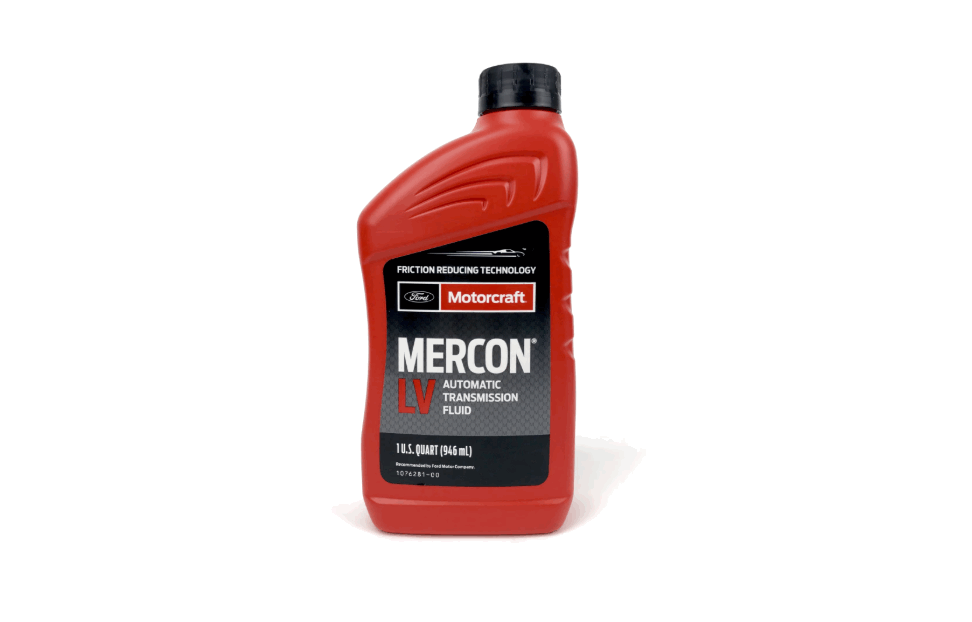
What Is Equivalent to MERCON LV Transmission Fluid?
A Mercon LV equivalent is an automatic transmission fluid that the manufacturer states as suitable for applications requiring MERCON LV. The key point is the specification, not the product name or viscosity alone. A fluid with similar viscosity does not automatically provide the friction control and operating characteristics that a transmission needs.
When you compare replacement fluids, check the product label and technical data first. Look for a clear statement about MERCON LV compatibility. A multi vehicle ATF can work when its manufacturer specifically lists MERCON LV among its supported applications. This gives you a stronger basis for substitution than a general claim such as “suitable for modern transmissions.”
Viscosity also matters because MERCON LV belongs to the low viscosity ATF category. However, viscosity only describes one part of the fluid’s behavior. Automatic transmissions rely on specific friction properties to control clutch engagement and shifting. The fluid also needs to maintain suitable performance across changing temperatures and operating conditions.
You should also separate the terms equivalent, compatible, and identical. An aftermarket ATF can support MERCON LV applications without being the same product as Motorcraft MERCON LV. Likewise, a fluid that works in one transmission does not automatically work in every transmission that uses a similar ATF. Always match the replacement fluid to the specification required by the specific vehicle or transmission.
What Specifications Should a MERCON LV Equivalent Meet?
A MERCON LV replacement should match the specification required by the transmission. Viscosity matters, but it does not define compatibility on its own. Automatic transmissions depend on the fluid’s overall performance to control shifting, lubricate components, and operate across different temperatures.
Start with viscosity because MERCON LV belongs to the low viscosity ATF category. A lower viscosity fluid can reduce resistance inside the transmission and support the operating characteristics of transmissions designed for that fluid. However, two ATFs with similar viscosity can still have different friction and performance characteristics. For this reason, you should not choose a replacement based on viscosity alone.
Friction characteristics also matter because automatic transmissions use fluid pressure and controlled friction during gear changes. The transmission relies on the fluid to support consistent clutch engagement and smooth shifting. A fluid with different friction behavior can change how the transmission responds, even when its viscosity appears similar.
The most reliable check comes from the fluid specification and product documentation. Check the vehicle owner’s manual first. Then review the manufacturer’s technical information for the replacement ATF. Look for an explicit reference to MERCON LV compatibility or the required application. This approach gives you a stronger compatibility check than comparing product names, colors, or viscosity alone.
Is DEXRON VI Equivalent to MERCON LV?
DEXRON VI is not automatically equivalent to MERCON LV. The two names identify different transmission fluid specifications, so you should not assume that a DEXRON VI fluid can replace MERCON LV in every transmission.
The confusion comes from the fact that some aftermarket ATFs support multiple specifications. A product may list both DEXRON VI and MERCON LV compatibility. In that situation, the specific product documentation provides the basis for using that ATF in a MERCON LV application. The DEXRON VI designation alone does not provide the same assurance.
Ford’s own product information identifies MERCON LV as a specific Ford transmission fluid requirement. For example, Ford lists MERCON LV for certain applications and identifies its specification as WSS M2C938 A. General Motors, meanwhile, specifies DEXRON VI for certain GM automatic transmissions. This shows why you should treat the two specifications separately rather than assuming that one replaces the other.
If you want to use a DEXRON VI product in a transmission that requires MERCON LV, check the product’s technical data first. The important question is whether that specific ATF explicitly supports MERCON LV applications. Similar viscosity, fluid appearance, or the presence of a DEXRON VI claim does not establish universal compatibility.
Is MERCON V the Same as MERCON LV?
MERCON V and MERCON LV are different transmission fluid specifications. You should not treat them as the same fluid simply because both carry the MERCON name. The specification required by the transmission determines which fluid you should use.
The main source of confusion comes from the similar naming. MERCON V and MERCON LV both belong to the MERCON family, but they serve different transmission applications. MERCON LV also belongs to the low viscosity ATF category, while MERCON V represents a different fluid specification. These differences affect how the fluid behaves inside the transmission.
Viscosity provides one useful distinction, but it does not tell the entire story. Automatic transmissions depend on specific friction characteristics for clutch operation and gear shifting. A fluid that works correctly in a transmission designed for MERCON V does not automatically meet the requirements of a transmission designed for MERCON LV.
You should therefore avoid choosing MERCON V as a MERCON LV replacement based only on the product name. Check the vehicle’s required specification and the ATF manufacturer’s compatibility statement before making a substitution. If a specific aftermarket product lists both MERCON V and MERCON LV applications, evaluate that product based on its own technical documentation rather than assuming that all MERCON V fluids have the same compatibility.
The practical rule is simple: MERCON V is not automatically a MERCON LV equivalent. Use a product that explicitly supports the specification required by your transmission.
Can You Use MERCON ULV Instead of MERCON LV?
MERCON ULV and MERCON LV are different transmission fluid specifications. The similar names do not mean that one specification automatically replaces the other. You should check the transmission requirement before using MERCON ULV in an application that calls for MERCON LV.
The terms “LV” and “ULV” also indicate different viscosity categories. MERCON LV belongs to the low viscosity category, while ULV refers to an ultra low viscosity formulation. This difference matters because transmission manufacturers design their transmissions around specific fluid characteristics. A newer or thinner fluid does not automatically provide the performance required by an older transmission.
Viscosity alone also cannot establish interchangeability. The transmission depends on the fluid’s friction behavior, lubrication, and operating characteristics. These properties influence clutch engagement and shifting. Two fluids can therefore have different specifications even when both target modern automatic transmissions.
Do not assume that MERCON ULV can replace MERCON LV unless the specific fluid product and transmission application support that substitution. Check the vehicle owner’s manual and the fluid manufacturer’s technical documentation before making the change. If the documentation does not confirm compatibility, choose a fluid that explicitly supports the MERCON LV requirement.
The practical distinction is straightforward: MERCON ULV is not automatically a MERCON LV equivalent. Treat each specification separately and verify compatibility at the product and transmission level.
How Can You Choose the Correct MERCON LV Replacement?
Choose a MERCON LV replacement by matching the transmission’s required specification with the fluid manufacturer’s compatibility information. The safest process starts with the vehicle, not with a transmission fluid brand or viscosity number.
First, check the vehicle owner’s manual or service information to identify the required ATF specification. The model year and transmission can affect the required fluid, so do not assume that every vehicle from the same manufacturer uses the same ATF. If the documentation specifies MERCON LV, use that specification as the primary reference.
Next, check the technical information for the replacement fluid. Look for an explicit statement that the product supports MERCON LV applications. This check matters when you consider a multi vehicle ATF because the term “multi vehicle” describes the product’s range of applications rather than a specific transmission fluid specification.
You should also compare the product’s stated applications with the transmission requirement. A compatible replacement should have clear documentation that connects the ATF to the required MERCON LV application. Do not rely on fluid color, viscosity alone, or a similar product name as proof of compatibility.
If the available information does not confirm compatibility, choose a fluid that clearly lists MERCON LV support instead. This approach reduces the risk of using an ATF that does not match the transmission’s intended operating characteristics. The source material also emphasizes checking the required specification rather than assuming that different ATF types are interchangeable.
Can You Use Multi Vehicle ATF Instead of MERCON LV?
You can use a multi vehicle ATF for a MERCON LV application when the specific product documentation confirms MERCON LV compatibility. “Multi vehicle” alone does not establish that the fluid works with every transmission.
Check the product label and technical data before installation. If the manufacturer lists MERCON LV among the supported applications, the product has a specific basis for use in that application. If it does not list MERCON LV, choose another ATF with clearer compatibility information.
What Happens If You Use the Wrong Fluid Instead of MERCON LV?
Using the wrong transmission fluid can change shifting behavior and affect transmission operation. Automatic transmissions rely on specific fluid properties to control hydraulic pressure, lubrication, and clutch engagement. When the fluid does not match the transmission’s requirements, its operating characteristics may change.
One potential issue involves shift quality. The transmission uses controlled friction during gear changes. A fluid with different friction characteristics can affect clutch engagement and produce changes such as harsh or inconsistent shifting. The exact symptoms depend on the transmission design and the properties of the fluid used.
Incorrect fluid selection can also affect lubrication and thermal performance. Automatic transmission fluid works across a range of temperatures and operating conditions. A fluid with unsuitable characteristics may not provide the performance that the transmission manufacturer intended. Continued use can increase the risk of transmission performance problems and component wear.
The risk does not come simply from using a different brand. The important factor is whether the replacement fluid matches the specification required by the transmission. An aftermarket ATF can work correctly when its manufacturer explicitly supports the required MERCON LV application. Conversely, a fluid with a similar name, viscosity, or appearance does not automatically provide the same compatibility.
If you discover that you used an incorrect ATF, avoid assuming that the transmission will remain unaffected. Check the vehicle’s required specification and consult the relevant service information to determine the appropriate corrective action. The source material similarly identifies incorrect fluid selection as a concern because different ATF characteristics can affect transmission operation.
Can You Mix MERCON LV With Other Transmission Fluids?
You should only mix MERCON LV with another transmission fluid when the fluid manufacturer confirms compatibility with the same transmission application. The fact that two ATFs have similar viscosity or appearance does not prove that you can safely mix them.
Mixing two products that both support MERCON LV applications presents a different situation from mixing different ATF specifications. If both products meet the requirements for the same application, the compatibility basis is stronger. However, you should still check the product documentation before combining them.
The situation becomes less certain when the second fluid uses a different specification. DEXRON VI, MERCON V, and MERCON ULV have different specification identities. A product that carries one of these labels does not automatically qualify as a suitable fluid for mixing with MERCON LV. Check the specific product rather than judging compatibility from the specification name alone.
Top off the transmission with the correct fluid whenever possible. If you do not know which fluid the transmission currently contains, identify the required specification before adding another ATF. This approach avoids introducing an incompatible fluid based on assumptions about viscosity, color, or brand.
For a complete fluid service, follow the vehicle manufacturer’s service procedure and use the specified ATF. For a simple top off, verify the required specification and the replacement product’s application information first. The source material emphasizes the same principle throughout its discussion of ATF selection: fluid temperature, viscosity, and application all matter, and users should not assume that different transmission fluids provide identical performance.
Which Vehicles and Transmissions Use MERCON LV?
MERCON LV applies to specific vehicles and automatic transmissions that require the specification. You should not assume that every Ford or Lincoln vehicle uses MERCON LV. The required fluid can vary by vehicle, model year, and transmission.
Ford and Lincoln applications provide the main automotive context for MERCON LV. However, the vehicle brand alone does not provide enough information to select the fluid. A vehicle can use a different ATF specification depending on its transmission design and application. This makes the transmission requirement more important than the brand name.
The transmission also determines the fluid characteristics needed for proper operation. MERCON LV belongs to the low viscosity ATF category, and transmissions that require it rely on the fluid’s specific operating properties. These properties include viscosity, friction behavior, lubrication, and performance across different temperatures.
Check the vehicle owner’s manual or service information to confirm whether your transmission requires MERCON LV. Do not select the fluid based only on the vehicle manufacturer, model name, or the appearance of the existing ATF. The source material identifies Ford and Lincoln applications as the main context for MERCON LV and emphasizes checking the specific vehicle requirements before selecting a transmission fluid.
A correct fluid selection starts with the transmission specification. Once you confirm that the vehicle requires MERCON LV, you can compare replacement ATFs by checking whether their manufacturers explicitly support that specification.
What Should You Use as a MERCON LV Equivalent?
The best MERCON LV equivalent is an ATF that explicitly supports the MERCON LV specification required by your transmission. Do not choose a replacement based only on viscosity, fluid color, brand, or a similar specification name.
MERCON V, MERCON ULV, and DEXRON VI are separate specifications. Some aftermarket ATFs may support more than one specification, but that does not make every fluid under those names interchangeable. Check the specific product documentation before using one as a replacement.
The safest selection process starts with your vehicle’s required transmission fluid specification. Check the owner’s manual or service information first. Then review the replacement ATF’s technical data and confirm that it supports the required MERCON LV application.
If you need a replacement, focus on documented compatibility rather than assumed equivalence. This approach gives you a clearer basis for choosing an ATF that matches your transmission’s intended operating requirements.