Finding a Mobil Vactra Oil No. 2 equivalent requires more than a similar product name. The right alternative must meet the relevant lubricant requirements. It must also suit the intended application and equipment.
Viscosity provides an important starting point for comparison. However, viscosity alone does not prove equivalence. You should also compare the lubricant type, technical specifications, application, and compatibility. These factors determine whether another lubricant can perform the same function.
This guide explains how to find a Mobil Vactra Oil No. 2 equivalent. It covers the key specifications you should compare. It also explains why viscosity matters during lubricant selection. You will learn how to evaluate alternative lubricants before making a replacement.
The goal is simple. You should choose an alternative based on technical and application requirements. You should not choose a product based only on its name or viscosity.
What Is Mobil Vactra Oil No. 2?
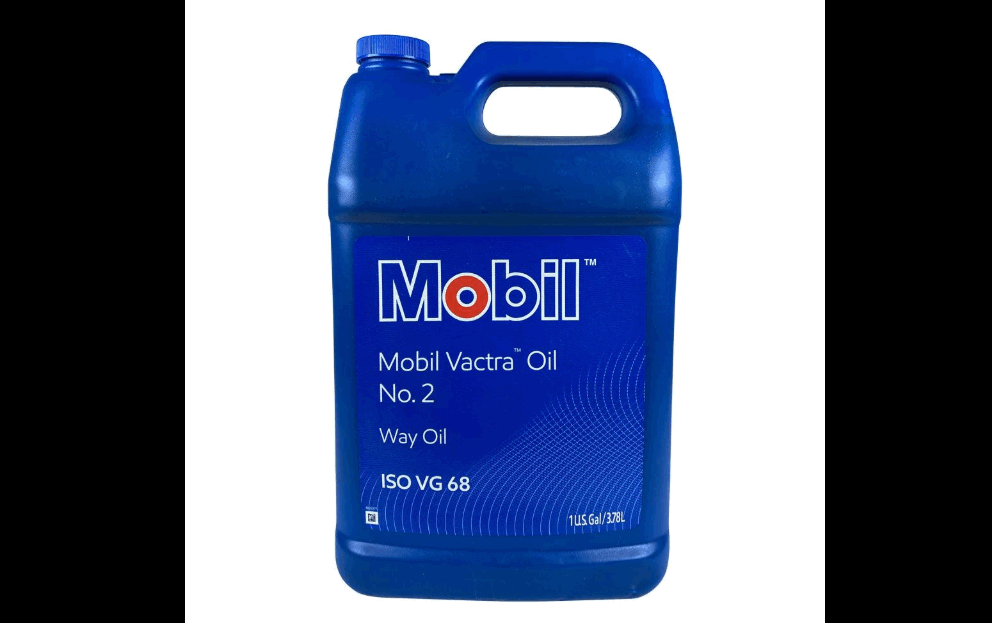
Mobil Vactra Oil No. 2 is a way and slide lubricant designed for precision machine tools. ExxonMobil places it within the Mobil Vactra Oil Numbered Series. The series targets slideway lubrication where controlled friction, equipment protection, and coolant separation matter.
Mobil Vactra Oil No. 2 has an ISO viscosity grade of 68. ExxonMobil reports a kinematic viscosity of 68 mm²/s at 40°C under ASTM D445. The product also meets the requirements of DIN 51502 CGLP and ISO L GA and ISO L GB for the applications listed by the manufacturer.
The product supports horizontal slideways on small to medium sized machine tools. ExxonMobil also lists applications in circulating systems for larger machines. The numbered series can also serve ball screws, linear guides, headstocks, and translating screws. These applications show why an equivalent must match the required function, not just the oil grade.
Mobil Vactra Oil No. 2 also provides controlled friction characteristics and protection against rust and corrosion. Its formulation supports compatibility with many aqueous metalworking coolants. These properties help reduce stick slip and chatter while supporting smooth machine movement.
For this reason, a suitable Mobil Vactra Oil No. 2 equivalent should match the requirements of the specific lubrication system. A matching ISO 68 viscosity provides an important starting point. However, you should also compare the lubricant’s application, performance requirements, relevant standards, and compatibility before choosing a replacement.
What Specifications Should a Mobil Vactra Oil No. 2 Equivalent Match?
A suitable Mobil Vactra Oil No. 2 equivalent should match the key technical requirements of the original lubricant. Mobil lists Vactra Oil No. 2 as an ISO VG 68 way lubricant. Its kinematic viscosity measures 68 mm²/s at 40°C under ASTM D445. Mobil also lists Fives Cincinnati P 47 approval and compliance with DIN 51502 CGLP, ISO L GA, and ISO L GB.
Viscosity provides the first comparison point. However, the same ISO VG grade does not make two lubricants equivalent. ISO VG 68 defines viscosity, but it does not define the complete formulation or application. A suitable alternative should also serve the same type of lubrication system. This distinction helps prevent incorrect substitutions between way oils and other ISO VG 68 fluids.
The lubricant’s performance requirements also matter. Mobil states that Vactra Oil No. 2 supports horizontal slideways on small and medium machine tools. The product can also serve circulating applications in larger machines. Mobil lists ball screws, linear guides, headstocks, and translating screws among the applications for its numbered series.
An equivalent should therefore match the relevant viscosity, lubricant category, application, and required specifications. It should also provide suitable friction control, corrosion protection, and coolant compatibility for the intended system. Mobil highlights these functions as important performance characteristics of the Vactra series.
Before choosing a replacement, compare the current technical data sheets. Check the viscosity, standards, approvals, application, and compatibility requirements. This approach gives you a stronger basis for identifying a genuine alternative than comparing product names alone.
Which Lubricants Can Be Used as a Mobil Vactra Oil No. 2 Alternative?
Several way oils appear in cross reference databases as alternatives to Mobil Vactra Oil No. 2. These include Shell Tonna S2 MX 68, TotalEnergies Drosera MS 68, Fuchs Renolin Unisyn OL 68, Klüber Lamora D 68, and Castrol Magna BD 68. Cross reference data classifies these products as ISO VG 68 slideway oils.
Shell Tonna S2 MX 68 provides one of the clearest cross reference examples. Materialref lists it alongside Mobil Vactra Oil No. 2 in the same ISO VG 68 slideway oil category. The same source also lists TotalEnergies Drosera MS 68, Fuchs Renolin Unisyn OL 68, Klüber Lamora D 68, and Castrol Magna BD 68 in the same cross reference group.
Another industrial lubricant cross reference lists Chevron Way Oil Vistac ISO 68, FUCHS RENEP KN 68 NA, Phillips 66 Multi-Way Oil HD 68, Shell Tonna S2 MX 68, and Sunoco Waylube 1180 as comparable products. These references show that several manufacturers offer ISO VG 68 way lubricants that users may consider when Vactra Oil No. 2 is unavailable.
However, a cross reference does not automatically prove that every listed product is an identical replacement for every machine. Mobil specifies Vactra Oil No. 2 as an ISO 68 lubricant with Fives Cincinnati P-47 approval and compliance with DIN 51502 CGLP, ISO L-GA, and ISO L-GB. You should therefore compare the alternative’s current technical data with your equipment requirements before changing products.
The safest approach is to treat these products as potential alternatives, then verify viscosity, application, specifications, approvals, and compatibility for the specific lubrication system. This distinction helps prevent an incorrect substitution based on ISO VG 68 alone.
Can You Replace Mobil Vactra Oil No. 2 With Another Lubricant?
Yes, you can replace Mobil Vactra Oil No. 2 with another lubricant when the replacement meets the requirements of the lubrication system. The replacement should match the required viscosity, lubricant type, application, and relevant technical specifications. You should also confirm compatibility before changing the product.
Viscosity provides an important starting point for the replacement decision. Mobil identifies Vactra Oil No. 2 as an ISO VG 68 way lubricant. However, another ISO VG 68 oil does not automatically provide the same performance. ISO VG identifies viscosity, while other specifications describe the lubricant’s intended use and performance.
Application provides another important check. Mobil lists Vactra Oil No. 2 for machine tool slideways and related applications. A replacement should therefore support the same lubrication function. An oil designed for a different system may have the same viscosity but still fail to meet the equipment’s requirements.
Compatibility also requires attention during a lubricant change. Mixing two lubricants without confirmation can create an unsuitable lubricant mixture. The existing oil, replacement product, and equipment requirements should therefore guide the changeover process. The equipment manufacturer or lubricant supplier can provide specific guidance when compatibility remains unclear.
You should also check the latest technical data sheets before making the replacement. Compare the viscosity, specifications, approvals, intended applications, and compatibility information. This process gives you a stronger basis for selecting an alternative than relying on a cross reference alone.
The key principle is simple: choose the replacement that matches the lubrication requirements, not merely the product name or viscosity grade.
Why Does Viscosity Matter When Choosing a Mobil Vactra Oil No. 2 Equivalent?
Viscosity matters because it affects how a lubricant flows and forms a protective film. Mobil Vactra Oil No. 2 has an ISO VG 68 viscosity grade. Mobil reports a kinematic viscosity of 68 mm²/s at 40°C under ASTM D445. An equivalent should therefore meet the viscosity requirement of the equipment and lubrication system.
A lubricant with the correct viscosity can support the required movement and lubrication conditions. The viscosity determines how easily the oil moves through the lubrication system. It also affects the thickness of the lubricant film between moving surfaces. These factors influence friction, wear, and lubrication performance.
A lubricant with a higher viscosity does not automatically provide better protection. Higher viscosity can change oil flow and increase resistance within the lubrication system. A lower viscosity can also create problems when the system requires a thicker lubricant film. The correct viscosity therefore depends on the equipment design and operating requirements.
Temperature also affects viscosity. Oil becomes less viscous as temperature increases and more viscous as temperature decreases. This relationship makes the test temperature important when comparing technical data. You should compare viscosity values under the same measurement conditions to avoid misleading conclusions.
However, viscosity alone cannot establish that two lubricants are equivalent. ISO VG 68 describes a viscosity grade, not a complete lubricant formulation. A proper comparison should also consider the lubricant type, intended application, technical specifications, approvals, and compatibility.
For this reason, viscosity should serve as a key screening criterion, not the final replacement decision. Start with the required viscosity, then verify the other technical requirements before selecting a Mobil Vactra Oil No. 2 alternative.
How Should You Verify a Mobil Vactra Oil No. 2 Equivalent Before Using It?
You should verify a Mobil Vactra Oil No. 2 equivalent against the equipment requirements before using it. Start with the manufacturer’s technical data. Mobil identifies Vactra Oil No. 2 as an ISO VG 68 way lubricant. It also lists Fives Cincinnati P-47 and several ISO and DIN requirements.
Next, compare the alternative’s technical data sheet with the original product. Check the viscosity grade, kinematic viscosity, lubricant category, applications, specifications, and approvals. Shell Tonna S2 M 68, for example, has an ISO VG 68 grade and 68 mm²/s viscosity at 40°C. Shell also lists machine tool slideways as a main application.
You should then confirm the lubrication point and operating conditions. Mobil recommends Vactra Oil No. 2 for horizontal slideways on small and medium machine tools. The product also supports circulating applications in larger machines. These details matter because an equivalent must serve the same lubrication function.
Finally, check compatibility before changing products. Mobil designed the Vactra series to work with many aqueous coolants and other machine tool lubricants. However, this information does not prove compatibility between every alternative and every existing lubricant. The equipment manufacturer or lubricant supplier should confirm the changeover procedure when the compatibility data remains unclear.
A reliable verification process therefore uses four checks: technical specifications, viscosity, application, and compatibility. These checks help separate a genuine replacement candidate from a product that only appears similar.
What Should You Consider Before Choosing a Mobil Vactra Oil No. 2 Equivalent?
Choosing a Mobil Vactra Oil No. 2 equivalent starts with the equipment and its lubrication requirements. Do not select an alternative based only on the product name. The lubricant must suit the application and meet the required technical specifications.
Viscosity provides an important first check. Mobil Vactra Oil No. 2 uses an ISO VG 68 grade, so a potential alternative should meet the required viscosity for the equipment. However, the same viscosity grade does not make two lubricants identical. You should also compare the lubricant type, intended application, specifications, and approvals.
Compatibility provides another essential check. Confirm that the replacement works with the existing lubricant, lubrication system, and equipment. When the available technical information does not provide a clear answer, consult the equipment manufacturer or lubricant supplier before changing products.
A suitable Mobil Vactra Oil No. 2 alternative should therefore satisfy four key requirements: viscosity, application, technical specifications, and compatibility. You should verify each requirement using current technical documentation before making the change.
The right equivalent is not simply the oil that looks most similar. It is the product that meets the technical and application requirements of the specific lubrication system.