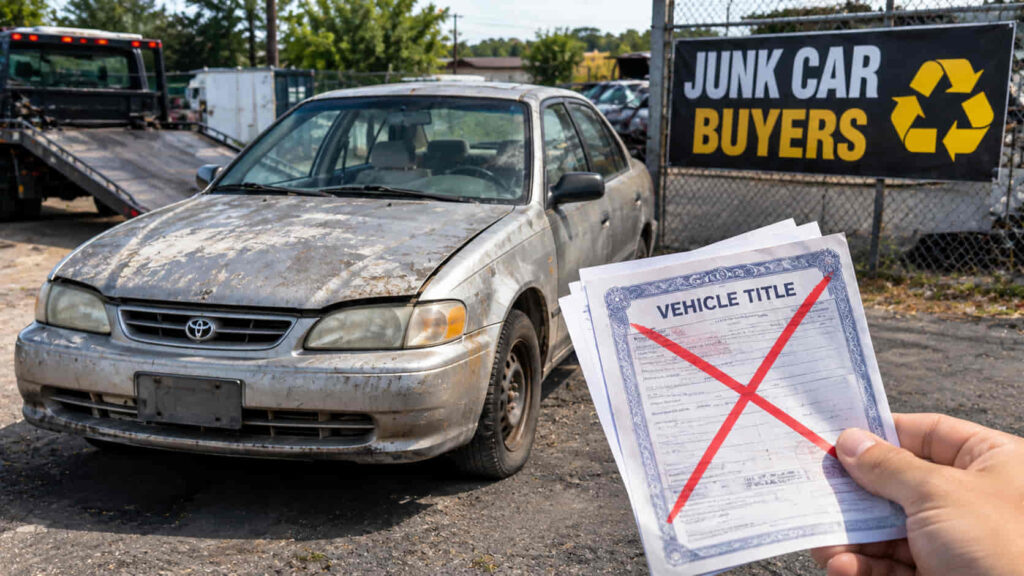
Yes, you can junk a car without a title in certain U.S. states, provided you can prove legal ownership and meet the state’s vehicle disposal requirements. Some states allow licensed junkyards and vehicle dismantlers to accept alternative ownership documents, while others require a duplicate title before transferring the vehicle. For example, Wisconsin permits owners to junk vehicles without replacing lost titles, while New York allows eligible vehicles at least eight model years old and worth $1,250 or less to be transferred using Form MV-35.
The requirements depend on why the title is missing, whether the vehicle is registered in your name, and whether an outstanding lien exists. A bill of sale, vehicle registration, or government-issued identification may help verify ownership, but these documents do not automatically replace a certificate of title. Junkyards must follow applicable state regulations when accepting vehicles for dismantling or scrap processing.
Before arranging vehicle pickup, owners should verify their state’s DMV requirements, identify acceptable ownership documents, and confirm that the receiving junkyard can legally process the vehicle. This guide explains how to junk a car without a title, which documents you need, how state laws differ, and what options are available when a replacement title is required.
Can You Legally Junk a Car Without a Title?
You can legally junk a car without a title if your state permits an alternative ownership verification process and you have the legal authority to dispose of the vehicle. Some states allow licensed salvage dealers and vehicle dismantlers to accept specific ownership declarations instead of the original certificate of title. However, the absence of a physical title does not eliminate the legal requirement to establish ownership before transferring a vehicle for dismantling or scrap processing.
The legal requirements depend on whether the title was lost, never transferred into the current owner’s name, or remains subject to an outstanding lien. A registered owner who loses a title may qualify for a simplified disposal procedure, while someone who purchased a vehicle without completing the title transfer may need additional documentation. Vehicle possession alone does not establish the right to sell or scrap a car, even when the vehicle is damaged, inoperable, or stored on private property.
Wisconsin provides a specific exception for owners who want to permanently junk vehicles with missing titles. The Wisconsin Department of Transportation states that an owner does not need to obtain a replacement title solely to junk a vehicle. The state’s Junked Vehicle Bill of Sale, Form MV2459, supports qualifying transfers to licensed salvage dealers and requires the owner to confirm legal ownership and the absence of outstanding liens. This exception does not apply to ordinary vehicle sales, which generally require a valid title.
New York also provides a restricted alternative through Form MV-35. Eligible owners can transfer vehicles that are at least eight model years old and worth $1,250 or less to registered vehicle dismantlers, itinerant vehicle collectors, or certified scrap processors without presenting a valid title. The form cannot be used for ordinary private-party sales. Vehicles transferred under this procedure must be dismantled or scrapped and cannot be titled again. Owners whose vehicles do not qualify for an applicable exception must obtain the ownership documents required by their state before completing the disposal.
What Documents Do You Need to Junk a Car Without a Title?
The documents needed to junk a car without a title generally include government-issued identification, vehicle identification information, proof of ownership, and any state-approved declaration required for the transfer. Vehicle registration records, previous bills of sale, and lien-release documents may also be necessary, depending on the vehicle’s ownership history and state regulations. These supporting records help establish the seller’s identity and legal authority but do not automatically replace the certificate of title.
A government-issued photo ID allows the receiving salvage business to verify the identity of the person transferring the vehicle. The Vehicle Identification Number (VIN) connects the physical car to its ownership records and helps identify inconsistencies between the vehicle and the submitted paperwork. Registration documents can support an ownership claim, while a bill of sale can establish details of a previous purchase. However, registration or a bill of sale alone may be insufficient when the state requires a title or an approved substitute. An outstanding lien must also be addressed before the vehicle can be transferred in a manner that conflicts with the lienholder’s rights.
Wisconsin’s Form MV2459 illustrates how a state-approved document can support a title-free junk vehicle transaction. The form records the seller’s and purchaser’s information, the vehicle’s year, make, and VIN, and identification details. The registered owner must certify that no liens remain outstanding, confirm the legal right to sell the vehicle, and declare that the original title was lost, destroyed, or previously surrendered with a junk designation. Both parties sign the document to establish a record of the qualifying transfer to a licensed salvage dealer.
New York requires different documentation under its MV-35 procedure. The owner must provide vehicle identification details, sign the ownership declaration, and attach a copy of government-issued identification. If another person delivers the vehicle, the form also requires delivery-agent identification. The receiving licensed business must complete its certification and submit the required paperwork to the DMV. In California, a dismantler handling a vehicle with a lost California title may use a properly completed Application for Duplicate Title, Form REG 227, along with the required dismantler reporting documents and any applicable ownership-chain or lien-release records.
Before scheduling vehicle pickup, owners should contact the receiving junkyard to confirm which documents are accepted under their state’s requirements. Preparing the correct ownership evidence prevents rejected transactions and helps ensure that the vehicle is transferred to an authorized dismantler or scrap processor.
Can You Junk a Car With a Bill of Sale but No Title?
You can junk a car with a bill of sale but no title when state law recognizes the document as sufficient evidence of ownership or permits an approved alternative transfer procedure. A standard bill of sale does not automatically replace a certificate of title because it records a transaction rather than independently establishing that the seller has the legal authority to transfer the vehicle. Whether a junkyard can accept the document depends on the state’s ownership requirements, the vehicle’s title history, and the receiving business’s licensing status.
A vehicle bill of sale generally identifies the buyer, seller, transaction date, purchase price, and vehicle identification number (VIN). These details establish a record of the transaction and help connect the vehicle to its previous owner. However, a bill of sale cannot resolve an outstanding lien, establish ownership of a stolen vehicle, or automatically correct an incomplete title transfer. For example, someone who purchased a damaged vehicle with only a handwritten receipt may still need the previous owner’s title or an approved ownership declaration before selling it to a salvage yard.
Wisconsin provides an example of a state that recognizes a specialized bill of sale for qualifying junk vehicle transfers. Form MV2459, the Junked Vehicle Bill of Sale, allows a registered owner to transfer a vehicle to a licensed salvage dealer when the original title has been lost or destroyed. The seller must certify that no outstanding liens exist and that they have the legal right to transfer the vehicle. This state-issued form serves a specific legal purpose and should not be confused with an ordinary sales receipt.
California applies a different procedure. When a California-titled vehicle is transferred to a dismantler and its title is missing, the dismantler’s documentation generally includes Application for Duplicate Title (REG 227). Additional bills of sale are required when necessary to establish the chain of ownership between the registered owner and the dismantler. Therefore, a bill of sale can support the transaction without replacing every other ownership requirement. Vehicle owners should confirm the documents accepted by their state DMV and receiving junkyard before arranging the transfer.
Which States Allow You to Junk a Car Without a Title?
Wisconsin and New York provide specific procedures for junking eligible vehicles without an original certificate of title, while California allows certain dismantler transactions to proceed using replacement-title documentation. These states illustrate three approaches to missing-title vehicle disposal, but they do not represent a complete nationwide list. Eligibility depends on the vehicle’s ownership record, condition, age, value, and the documentation required by the state where the transaction occurs.
Wisconsin allows registered owners to junk vehicles without obtaining replacement titles when the original documents have been lost. The Wisconsin Department of Transportation confirms that replacing a missing title is unnecessary when an owner intends to permanently junk the vehicle. For a qualifying transfer to a licensed salvage dealer, Form MV2459 documents the seller’s ownership declaration and confirms that the vehicle has no outstanding liens. Once the vehicle receives a junk designation, Wisconsin prohibits it from being titled or registered for road use again, even if it is subsequently repaired.
New York permits eligible owners to transfer vehicles without valid titles through Form MV-35, the Statement of Vehicle Owner Who Does Not Have a Valid Title. The vehicle must be at least eight model years old and worth $1,250 or less. This procedure applies when an owner lost a title issued in their name or purchased the vehicle from the titled owner without subsequently obtaining a title in their own name. The completed declaration authorizes transfer only to a registered vehicle dismantler, itinerant vehicle collector, or certified scrap processor. It cannot be used for an ordinary private-party sale, and the vehicle must be permanently dismantled or scrapped rather than returned to road use.
California does not provide the same general missing-title exemption for California-titled vehicles entering the dismantling process. Instead, the Department of Motor Vehicles allows a properly completed Application for Duplicate Title (REG 227) to serve as the required title-related documentation when the original certificate is lost. Licensed dismantlers must also submit the Report of Vehicle To Be Dismantled (REG 42), establish the ownership chain, and address any applicable lienholder release requirements. This procedure allows an eligible vehicle to enter the dismantling process without the original paper title while preserving the state’s ownership verification requirements.
These differences demonstrate why vehicle owners must check the rules of their specific state before selling a car for scrap. An older, low-value vehicle may qualify for an alternative ownership declaration in New York, while a vehicle with a lost title may qualify for Wisconsin’s junking procedure without meeting the same age or value thresholds. California instead relies on designated replacement-title documentation for the relevant transactions. Owners in other states should verify whether their DMV offers a comparable exception or requires a duplicate certificate of title before transferring the vehicle to a licensed junkyard.
Read more: how much is whistle express car wash
How Do You Get a Replacement Title for a Junk Car?
You can get a replacement title for a junk car by applying for a duplicate certificate of title through the state motor vehicle agency that issued the original document. The application generally requires the vehicle identification number (VIN), registered owner’s information, proof of identity, and the state’s designated replacement-title form. A duplicate title establishes the documentation needed to transfer a vehicle when its original title has been lost, stolen, or damaged and no applicable title-free disposal procedure is available.
The registered owner should first verify that the vehicle’s ownership records are accurate and identify the state responsible for issuing the replacement. In New York, the Department of Motor Vehicles uses Form MV-902, Application for Duplicate Certificate of Title, and charges a $20 replacement fee. Eligible owners can apply online, by mail, or at a DMV office. In-person applications require proof of identity and current address, while mailed applications require photocopies of the appropriate identification documents. New York DMV processes accepted duplicate-title applications within 72 hours, although mailing and delivery take additional time.
An outstanding lien can complicate the replacement process because the lender may retain a legal interest in the vehicle even when it is no longer operational. The owner may need to obtain a lien release or have the lienholder participate in the title transaction before transferring the car to a junkyard. California, for example, uses Form REG 227 for replacement-title and certain ownership-transfer procedures, with additional lienholder signature requirements depending on the vehicle’s records.
Once the replacement title becomes available, the owner can complete the transfer documentation required by the receiving salvage business. However, obtaining a duplicate title is unnecessary when the vehicle qualifies for a state-approved alternative junking procedure. Checking eligibility before submitting an application prevents unnecessary replacement-title fees and paperwork.
How Do You Junk a Car Without a Title Step by Step?
To junk a car without a title, verify your legal ownership, confirm your state’s alternative documentation requirements, contact a licensed junkyard, and complete the authorized vehicle transfer. The process depends on whether the title was lost, the vehicle was purchased without a completed title transfer, or the state permits a specific junk-vehicle ownership declaration. A vehicle cannot be legally transferred for scrap merely because it is damaged or no longer running.
Begin by identifying the vehicle’s registered owner and checking whether any outstanding liens or ownership disputes exist. Locate the VIN, which is commonly displayed near the driver’s side dashboard or on the driver’s door jamb, and compare it with available registration or purchase documents. Contact the relevant state DMV to determine whether the vehicle qualifies for an alternative disposal form or requires a duplicate title. For example, Wisconsin permits qualifying junk vehicle transfers using Form MV2459, while New York provides Form MV-35 for eligible older, low-value vehicles transferred to authorized disposal businesses.
After confirming the documentation requirements, contact a licensed vehicle dismantler, salvage yard, or scrap processor. Provide the vehicle’s year, make, model, VIN, location, mechanical condition, and available ownership records. Ask whether the business accepts the applicable state-approved documents and request a purchase quote that identifies any towing or pickup charges. Confirm the payment method and required signatures before scheduling collection. A buyer’s willingness to accept a title-free vehicle does not eliminate the obligation to comply with state ownership laws.
Before pickup, remove personal belongings and determine whether the license plates must be removed or surrendered under state requirements. During the transfer, present the accepted ownership documents, verify the vehicle’s identification details, and sign the required sale or disposal paperwork. In California, licensed dismantlers must complete the applicable REG 42 acquisition and dismantling documentation, while the owner must supply the required evidence of ownership.
After transferring the vehicle, obtain a dated receipt identifying the receiving business, vehicle, and transaction. Retain copies of the ownership documents and complete any required DMV transfer notification, registration cancellation, or license plate surrender. These records help establish when the vehicle left your possession and support the completion of the legal disposal process.
Will a Junkyard Accept a Car Without a Title?
A junkyard may accept a car without a title if state law permits an alternative ownership transfer procedure and the seller can establish the legal right to dispose of the vehicle. Licensed vehicle dismantlers, salvage yards, and scrap processors must comply with state ownership verification and vehicle reporting requirements. Some states recognize specific declarations for qualifying junk vehicles, while others require the original certificate of title or an approved replacement document before the transfer can proceed.
Junkyards verify ownership to prevent the unauthorized sale of stolen vehicles, financed cars, and vehicles with incomplete ownership records. The verification process generally involves checking the vehicle identification number (VIN), reviewing the seller’s government-issued identification, and examining available ownership documents. A vehicle registration or bill of sale may support the transaction, but neither document automatically satisfies every state’s title requirements. A junkyard must also determine whether outstanding liens or conflicting ownership claims prevent the vehicle from being legally transferred.
New York provides a specific example of title-free vehicle acceptance through Form MV-35. Registered vehicle dismantlers, itinerant vehicle collectors, and certified scrap processors can acquire qualifying vehicles that are at least eight model years old and worth $1,250 or less. The seller must satisfy the form’s ownership declaration requirements, and the receiving business must complete the required certification and reporting. This procedure does not authorize transfers to unlicensed buyers or ordinary towing companies acting as vehicle purchasers. California follows a different system, requiring licensed dismantlers to obtain acceptable ownership evidence, such as a properly completed REG 227 when the original California title is missing.
Before arranging pickup, vehicle owners should confirm that the junkyard is properly licensed and accepts the ownership documents available for their vehicle. Providing the VIN, registration history, lien status, and reason for the missing title allows the business to identify potential documentation problems before scheduling collection. A junkyard’s willingness to purchase a vehicle does not override state law, so the transaction should proceed only after the required ownership evidence has been established.
What Should You Do if You Bought a Car Without a Title?
If you bought a car without a title, contact the previous owner to obtain the missing ownership documents or determine whether your state offers an alternative title application or junk vehicle transfer procedure. Purchasing a vehicle and physically possessing it does not automatically establish a complete ownership record with the DMV. The appropriate solution depends on whether the seller lost the original title, failed to transfer ownership, or lacked the legal authority to sell the vehicle.
The first step is to identify the last titled owner and determine why the certificate of title was not provided during the purchase. If the seller is the registered owner but lost the document, that person may need to request a duplicate title and properly assign it to the buyer. If the vehicle passed through multiple owners without completed title transfers, additional bills of sale or ownership records may be necessary to establish the transaction history. The VIN should match all available documents, and any outstanding lien must be resolved before completing a transfer that requires the lienholder’s release.
Some states provide procedures for resolving incomplete ownership documentation. Wisconsin allows qualifying applicants who purchased or received vehicles without sufficient ownership evidence to apply for a bonded certificate of title. The Wisconsin Department of Transportation reviews the vehicle’s ownership records, evaluates the submitted documents, and determines the required surety bond before issuing an eligible bonded title. However, the bonded-title process has eligibility requirements and should not be treated as an automatic solution for every untitled or permanently junked vehicle.
New York offers a different option for certain vehicles intended exclusively for dismantling. Form MV-35 allows an eligible owner who purchased a vehicle directly from its titled owner but never obtained a title in their own name to transfer the vehicle to an authorized dismantler or scrap processor. The vehicle must be at least eight model years old and worth no more than $1,250, and the owner must complete the required declaration. Vehicles transferred under this procedure cannot be titled again. Owners whose vehicles do not meet an applicable exception should resolve the ownership documentation through their state DMV before attempting to sell the car for scrap.
Can You Junk a Car That Still Has a Lien?
You generally cannot junk a car with an outstanding lien without resolving the lienholder’s legal interest or obtaining the authorization required under state law. A lien gives a lender or another secured party a legal claim against the vehicle, even when the car is damaged, inoperable, or worth less than the remaining loan balance. The registered owner’s possession of the vehicle does not automatically provide unrestricted authority to transfer it to a junkyard.
An outstanding auto loan is a common reason a vehicle remains subject to a lien. When a car is financed, the lender’s interest is recorded in the vehicle’s title records and generally remains until the debt is satisfied or the lien is otherwise released. Scrapping the vehicle does not cancel the loan or remove the lender’s financial claim. For example, a car worth $500 in scrap metal may still secure a $3,000 outstanding loan. Selling the vehicle for scrap without addressing the lien would not eliminate the remaining debt.
State disposal procedures demonstrate how lienholder rights affect junk vehicle transfers. Wisconsin’s Junked Vehicle Bill of Sale, Form MV2459, requires the seller to certify that no liens remain outstanding before transferring a qualifying vehicle to a licensed salvage dealer. California requires appropriate lienholder release documentation when a California-titled vehicle is transferred for dismantling. When Form REG 227 is used because the original title is missing, a releasing lienholder’s signature generally must be notarized. These requirements prevent a missing title from being used to bypass an existing security interest.
Vehicle owners should contact the lienholder before arranging disposal and request the current payoff amount and instructions for releasing or otherwise resolving the lender’s interest. If the loan balance exceeds the vehicle’s scrap value, the lender must be consulted about an acceptable resolution. After obtaining the required release or authorization, the owner can provide the applicable ownership documents to a licensed junkyard. The vehicle’s low value does not independently remove a lien or authorize its destruction.
Can You Junk an Inherited Car Without a Title?
You can junk an inherited car without its original title after establishing your legal authority to transfer the vehicle and satisfying the applicable state’s ownership documentation requirements. Inheriting or possessing a deceased relative’s vehicle does not always make someone its legally recognized owner. The right to dispose of the vehicle depends on state inheritance laws, the deceased owner’s title records, and whether the vehicle belongs to an estate administered through probate.
The documents required depend on the relationship between the deceased owner and the person arranging the disposal. A death certificate establishes the owner’s death, while an inheritance affidavit, executor appointment, or court-issued estate document may establish the authority to transfer the vehicle. When the original title is missing, additional replacement-title paperwork may also be required. A relative who possesses the vehicle’s keys and registration documents cannot assume those items independently authorize a sale to a scrap yard.
New York provides different ownership-transfer procedures depending on the deceased owner’s family circumstances and the value of the vehicle. For example, ownership of one vehicle valued at $25,000 or less may pass to a surviving spouse under the state’s inheritance rules. Vehicles belonging to an estate may instead require Letters Testamentary, Letters of Administration, or other qualifying court documentation establishing the representative’s authority. The New York DMV requires the applicable transfer documents and does not treat a death certificate alone as sufficient proof of a person’s right to sell the vehicle.
California also provides an inheritance procedure through Form REG 5, the Affidavit for Transfer Without Probate, for qualifying California-titled vehicles. The form requires supporting documentation, including a copy of the death certificate, and generally cannot be used until at least 40 days after the registered owner’s death. Eligibility depends on the circumstances of the estate and the state’s applicable requirements. If the original California title is missing, Form REG 227 may also be necessary to complete the ownership documentation.
Before contacting a junkyard, the heir or estate representative should verify the vehicle’s ownership record, establish the legal authority to transfer it, and determine whether a replacement title is required. The receiving dismantler must receive the documentation needed for a lawful acquisition, even when the vehicle has little monetary value. Resolving inheritance-related ownership requirements before pickup prevents an unauthorized transfer and helps ensure the vehicle can be legally dismantled.
How Much Can You Get for a Junk Car Without a Title?
The amount you can get for a junk car without a title depends on its scrap metal value, reusable parts, vehicle condition, location, and whether the buyer can legally accept it without the original ownership document. There is no fixed nationwide payment or standard price reduction for vehicles with missing titles. A junkyard must first establish that the vehicle qualifies for a lawful transfer before determining how much it is willing to pay.
Vehicle weight provides a foundation for scrap valuation because heavier vehicles generally contain more recoverable metal. However, junkyards also evaluate components that can be removed and resold, including engines, transmissions, catalytic converters, wheels, and electronic modules. A complete vehicle with reusable mechanical components may receive a higher offer than a similar vehicle with its engine, transmission, or catalytic converter missing. Local demand for replacement parts and fluctuations in scrap metal prices also influence the amount a dismantler can recover from the vehicle.
Transportation costs further affect the final payment. A junkyard may account for towing distance, vehicle accessibility, and the equipment required to remove a nonrunning car when preparing its offer. For example, collecting an inoperable SUV from a remote property can involve different transportation expenses than collecting the same vehicle from an accessible location near the salvage facility. Owners should confirm whether towing is included in the quoted payment or deducted from the final amount.
A missing title primarily affects the transaction’s legal eligibility rather than the physical value of the vehicle’s metal and components. Some licensed dismantlers accept approved alternative ownership documents, while others require a duplicate title before making a purchase. There is no established rule that every untitled vehicle loses a specific percentage of its scrap value. Owners should resolve the applicable documentation requirements and compare written offers from eligible buyers, including any towing charges, before accepting payment.
Do You Need to Notify the DMV After Junking a Car?
You may need to notify the DMV after junking a car, depending on your state’s vehicle transfer, registration, and disposal reporting requirements. Transferring a vehicle to a junkyard does not automatically eliminate every administrative responsibility associated with its ownership. Vehicle owners should confirm whether they must report the transfer, surrender license plates, cancel registration, or retain specific disposal records.
California requires a vehicle owner who sells or transfers a vehicle to submit a Notice of Transfer and Release of Liability (NRL) within five calendar days. The notice identifies the vehicle, transfer date, and receiving party, allowing the DMV to record the reported transaction. Owners can submit the notification online or use Form REG 138 and should retain the submission confirmation. Filing an NRL helps protect the former owner from liability associated with certain violations after the transfer, but it does not independently complete the vehicle’s ownership transfer. Licensed dismantlers have separate reporting obligations involving Form REG 42 when acquiring vehicles for dismantling.
Wisconsin applies different notification requirements. An individual who transfers a vehicle to another individual, including a junk vehicle transferred by bill of sale, must report the transaction to the Wisconsin Department of Transportation within 30 days. The notification includes the vehicle identification number, buyer’s identity, sale price, and transaction date. This individual-to-individual reporting requirement should not be confused with the documentation used for transfers to licensed salvage dealers. Wisconsin also instructs owners to remove license plates when selling or junking passenger vehicles rather than leaving them attached to the transferred vehicle.
New York requires particular attention to license plates and insurance when disposing of a registered vehicle. Owners should remove their license plates and registration sticker before transferring the car and surrender the plates to the DMV unless they are being transferred to another eligible vehicle. Active New York plates generally must be surrendered before the vehicle’s liability insurance is canceled to avoid insurance-lapse penalties and registration suspension. The DMV provides a plate-surrender receipt that owners should retain as evidence of compliance.
After a vehicle is accepted by a licensed junkyard, the former owner should keep a dated receipt identifying the vehicle, its VIN, the receiving business, and the transaction. Copies of ownership declarations, DMV notifications, and plate-surrender confirmations provide additional evidence that the disposal was completed. These records are especially important when the original title was unavailable because they document the vehicle’s transfer and help resolve later questions about registration, ownership, or liability.
Can a Junked Car Be Registered Again?
A car officially designated as junk generally cannot be registered for road use again, while a vehicle classified as salvage may qualify for registration after being rebuilt and passing the required inspections. The distinction depends on the vehicle’s legal title status rather than whether its mechanical condition can be restored. State motor vehicle agencies maintain records of junk and salvage classifications, and repairing a permanently junked vehicle does not automatically restore its eligibility for registration.
Wisconsin prohibits issuing a certificate of title or registration for vehicles designated as junk, junked, or an equivalent classification. Under Wisconsin Statute 342.34(3), a vehicle that has been junked or destroyed cannot receive another certificate of title. New York imposes a similar restriction on vehicles transferred using Form MV-35, which explicitly states that the vehicle may never be titled again and must be dismantled or scrapped. These restrictions prevent vehicles transferred for permanent disposal from returning to public roads through ordinary registration procedures.
Salvage vehicles follow a different legal process. Wisconsin allows a repaired salvage vehicle to receive registration after passing an inspection conducted by an authorized salvage inspector, with its title subsequently branded as rebuilt salvage. New York also requires qualifying rebuilt salvage vehicles to undergo a DMV salvage examination before issuing a new title and registration. Vehicle owners should therefore verify whether their car has a salvage classification or a permanent junk designation before authorizing dismantling, because choosing permanent disposal can eliminate the possibility of legally returning the vehicle to road use.