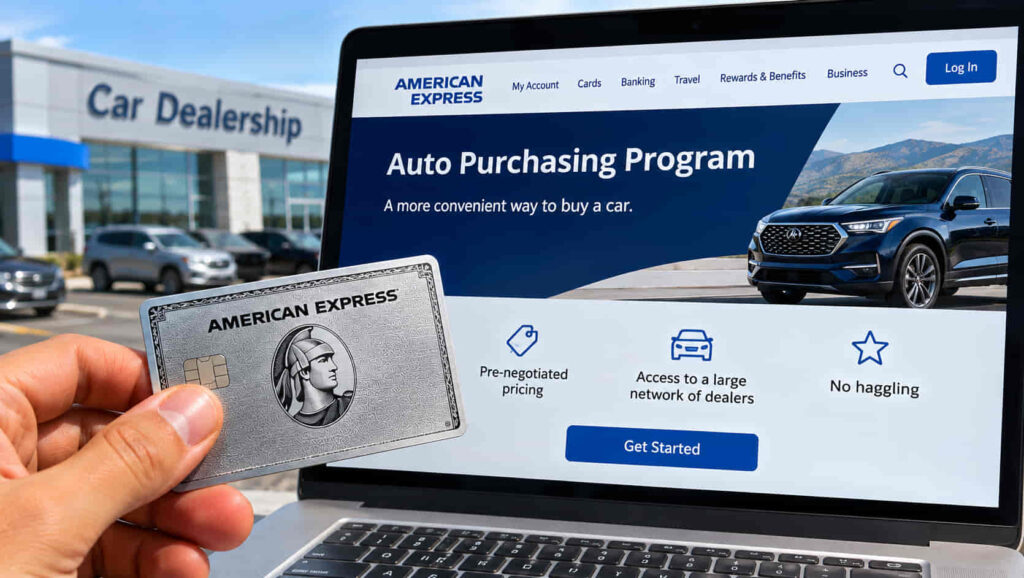
The American Express Auto Purchasing Program was worth considering for car buyers who wanted competitive dealer offers, credit card rewards, and additional post-purchase benefits. However, it never guaranteed the lowest vehicle price, and it is no longer available. American Express officially discontinued its TrueCar-powered Auto Purchasing Program on April 28, 2025, meaning cardholders cannot use this benefit in 2026.
Before its termination, the program connected American Express cardholders with participating TrueCar dealerships offering upfront pricing on new and used vehicles. Participating dealers agreed to accept at least $2,000 of a vehicle purchase on an eligible Amex card, allowing buyers to earn Membership Rewards points or cash back. The program also offered up to $2,000 in conditional post-purchase benefits, including eligible repair and insurance deductible reimbursements. These advantages provided potential financial value but did not guarantee equivalent savings for every buyer.
The program’s actual value depended on dealer pricing, credit card payment limits, transaction fees, and eligibility for additional benefits. Comparing the final vehicle price against competing dealership offers remained essential. This guide examines whether the Amex Auto Purchasing Program delivered meaningful savings, explains its limitations and discontinuation, and identifies alternative car-buying options available in 2026.
Was the Amex Auto Purchasing Program Worth It?
The American Express Auto Purchasing Program was worth using for buyers who wanted competitive dealership pricing, credit card rewards, and additional vehicle ownership benefits, but its overall value depended on the final purchase price and individual dealer terms. Powered by TrueCar, the program helped American Express cardholders compare new and used vehicle offers from participating dealerships while providing opportunities to pay part of the purchase price with an eligible Amex card. Although these features made the buying process more convenient, the program did not guarantee greater savings than negotiating directly with dealerships.
One of the program’s strongest advantages was access to upfront vehicle pricing through TrueCar’s network of Certified Dealers. Buyers could review local inventory, compare advertised offers, and examine pricing information before visiting a dealership. This reduced the uncertainty associated with traditional vehicle negotiations and provided a reference point for determining whether a dealer’s offer was competitive. However, the advertised price was not necessarily the lowest available price, particularly when other dealerships offered additional manufacturer incentives, lower documentation fees, or more favorable financing arrangements. The program’s pricing information was therefore most valuable as a comparison tool rather than a guarantee of the best possible deal.
The ability to earn American Express rewards provided another financial incentive. Participating dealerships agreed to accept at least $2,000 of the vehicle purchase price on an eligible Amex card, with some allowing larger payments. This arrangement gave cardholders an opportunity to earn Membership Rewards points or cash back on a transaction that many dealerships would otherwise require customers to complete through financing, a bank transfer, or another payment method. For example, charging $5,000 to a card earning 1% cash back would generate $50 in rewards, assuming the transaction qualified for rewards and no additional processing fee applied. However, a dealership charging a 3% card processing fee would add $150 to the same transaction, exceeding the rewards earned by $100.
The program also offered access to post-purchase benefits through the TrueCar Buyer’s Bonus, with eligible reimbursement benefits worth up to $2,000. These benefits included certain vehicle repair expenses and insurance deductible reimbursements, subject to registration requirements, coverage limits, and exclusions. The advertised amount represented the maximum combined potential value rather than a guaranteed payment to every buyer. A cardholder who never incurred an eligible repair or insurance claim would not necessarily receive any reimbursement, making the bonus more accurately described as conditional financial protection than immediate purchase savings.
The Amex Auto Purchasing Program was particularly valuable for cardholders who preferred a simplified vehicle search, found a competitively priced vehicle through a participating dealership, and could pay their credit card balance without incurring interest. Its benefits became less compelling when dealer fees reduced rewards, better prices were available elsewhere, or the buyer could not qualify for post-purchase reimbursements. The program was a useful car-buying tool, but the strongest financial outcome still depended on comparing out-the-door prices, calculating net credit card rewards, and evaluating the actual value of conditional benefits.
Is the Amex Auto Purchasing Program Still Available in 2026?
No, the American Express Auto Purchasing Program is no longer available in 2026 because American Express ended its partnership with TrueCar on April 28, 2025. The termination eliminated the dedicated car-buying program that previously connected Amex cardholders with participating dealerships and provided specific card payment arrangements and promotional benefits. Although historical descriptions of the program remain available online, cardholders can no longer enroll in or initiate a vehicle purchase through the discontinued Amex-specific platform.
The termination followed a formal decision made in October 2024, when American Express notified TrueCar that it intended to end their longstanding affinity marketing partnership. According to TrueCar’s filings with the U.S. Securities and Exchange Commission, the termination became effective on April 28, 2025. The partnership had previously supported vehicle purchases through a dedicated TrueCar-powered platform and included promotional arrangements with certain automobile manufacturers. TrueCar reported that approximately 5% of its vehicle sales volume during the 12 months preceding the termination notice came through the American Express Auto Purchasing Program, demonstrating that the partnership represented a measurable part of its car-buying business.
The closure means American Express cardholders no longer receive the program’s specific dealer payment commitment, dedicated vehicle pricing experience, or historical promotional benefits simply by holding an eligible Amex card. In particular, the former requirement for participating dealers to accept at least $2,000 of a vehicle purchase on an Amex card no longer applies through this program. Buyers should therefore not assume that a dealership previously participating in the program must continue accepting the same payment amount or offering the same incentives. Current payment acceptance depends on individual dealership policies rather than the discontinued American Express arrangement.
However, the end of the partnership did not eliminate TrueCar’s broader vehicle shopping services. TrueCar continues to provide access to new and used vehicle listings, dealer pricing information, and car-buying tools independently of the former Amex program. American Express cardholders can still use these services as ordinary consumers, although access to a general TrueCar listing does not automatically provide the specialized benefits previously associated with the partnership. Buyers who want to use an Amex card toward a vehicle purchase must contact dealerships directly to confirm card acceptance, transaction limits, and potential processing fees.
For car buyers researching the program in 2026, the important distinction is between its historical value and its current availability. The former Amex Auto Purchasing Program may still serve as a useful example of how dealer pricing networks and credit card rewards can complement each other, but it is no longer a purchasing option. Drivers looking for similar benefits today should compare available TrueCar dealer offers, evaluate current financing terms, and confirm credit card payment policies before committing to a vehicle purchase.
How Did the Amex Auto Purchasing Program Work?
The American Express Auto Purchasing Program worked by connecting eligible Amex cardholders with TrueCar Certified Dealers that provided upfront vehicle pricing and accepted at least $2,000 of the purchase price on an American Express card. Buyers used a dedicated TrueCar-powered platform to research new and used vehicles, compare local dealer offers, and arrange purchases directly with participating dealerships. American Express did not sell or finance the vehicles through this program; the actual transaction took place between the buyer and the dealership.
The purchasing process began on the former Amex Auto Purchasing Program website, where cardholders selected a vehicle manufacturer, entered their ZIP code, and specified the model they wanted to purchase. The search tool allowed buyers to refine their preferences by vehicle style, exterior color, and available equipment. TrueCar then displayed relevant local inventory and pricing information, including comparisons with prices paid by other consumers for similar vehicles. This information gave buyers a reference point for evaluating dealer offers before visiting a showroom.
After identifying a suitable vehicle, buyers submitted their contact information to receive offers from participating TrueCar Certified Dealers. Dealership representatives could contact customers by phone or email to discuss inventory, confirm vehicle specifications, and provide pricing details. The program also offered special savings opportunities on selected vehicles, including manufacturer-supported incentives when available. These offers helped buyers understand potential discounts, although eligibility requirements, dealer participation, and vehicle availability determined which promotions applied to an individual transaction.
Once a buyer selected a dealership and agreed on the purchase terms, the transaction proceeded through the dealer’s normal sales process. The dealership determined the final vehicle price, trade-in allowance, financing arrangements, and applicable taxes and fees. Participating dealers were required to accept at least $2,000 toward the purchase using an eligible American Express card, but the amount above that minimum depended on the dealership. For example, a buyer purchasing a $40,000 vehicle could charge $2,000 to an Amex card under the program’s minimum payment arrangement, while charging $10,000 or the entire vehicle price required additional dealer approval and sufficient card purchasing capacity.
Following an eligible purchase, buyers could register the completed transaction with TrueCar to access applicable post-purchase benefits. Registration generally had to occur within 45 days of the vehicle purchase, and eligibility depended on completing the transaction through a participating Certified Dealer. This requirement connected the original vehicle search and dealer selection to the benefits available after ownership began. However, submitting a vehicle inquiry or receiving a dealer offer did not independently qualify a customer for reimbursement benefits without completing the required purchase and registration process.
The program therefore combined online vehicle research with dealership-based purchasing rather than replacing the traditional sales transaction. TrueCar supplied pricing information and dealer connections, American Express provided the cardmember relationship, and participating dealerships handled vehicle sales and card acceptance. Because the American Express partnership ended on April 28, 2025, this historical purchasing process is no longer available through the former Amex-specific program.
What Benefits Did the Amex Auto Purchasing Program Offer?
The Amex Auto Purchasing Program offered three main benefits: access to competitive vehicle pricing, opportunities to earn American Express credit card rewards, and up to $2,000 in conditional post-purchase reimbursement benefits. Each benefit addressed a different part of the car-buying process, from identifying a suitable vehicle to completing payment and managing certain ownership expenses. The actual value depended on the dealership’s offer, the cardholder’s rewards structure, and whether the buyer qualified for specific reimbursements.
Vehicle pricing transparency was a central feature of the program. TrueCar provided information about prices other consumers had paid for comparable vehicles, allowing buyers to evaluate whether a dealership’s offer was competitive. The program also connected cardholders with Certified Dealers that supplied upfront pricing and, on selected vehicles, special savings offers. For example, a buyer considering a vehicle with a $42,000 manufacturer’s suggested retail price could compare a participating dealer’s discounted offer against other available quotes. However, a discount from MSRP was not necessarily the same as the lowest out-the-door price because taxes, documentation fees, optional accessories, and financing conditions could change the final cost.
The second benefit was the opportunity to earn rewards on a substantial vehicle-related transaction. Participating dealers accepted at least $2,000 of the purchase price on an eligible American Express card, allowing cardholders to earn Membership Rewards points or cash back according to their card’s terms. For example, an eligible $5,000 payment on a card earning one Membership Rewards point per dollar would generate 5,000 points. Cards with higher eligible earning rates could generate additional rewards, while a qualifying purchase could also contribute toward an introductory spending requirement. These benefits were determined by the specific card rather than a universal rewards rate established by the Auto Purchasing Program.
Post-purchase protection represented the third benefit. Through the TrueCar Buyer’s Bonus, eligible customers could access reimbursement benefits with a combined potential value of up to $2,000. The historical program included reimbursement of 20% of eligible vehicle repair costs, subject to a maximum of $500 per claim and two claims per year. It also offered reimbursement of eligible automobile insurance deductibles, with a limit of $500 per claim and two claims per year. These benefits were subject to program terms, exclusions, and geographic restrictions, including exclusions affecting New York and New Hampshire.
The reimbursement structure matters because the advertised $2,000 represented a maximum potential benefit rather than an automatic payment after purchasing a vehicle. For example, an eligible $1,000 repair expense could generate a $200 reimbursement under the 20% repair benefit, assuming all claim requirements were satisfied. A buyer who did not experience qualifying repair expenses or insurance claims would receive no reimbursement from those benefits. The Buyer’s Bonus also provided access to automotive experts who could offer guidance about maintenance questions and potential vehicle problems, adding a service component beyond direct financial reimbursement.
The program’s benefits were most useful when they complemented a competitively priced vehicle purchase. Upfront pricing helped buyers evaluate dealership offers, credit card acceptance created opportunities to earn rewards, and conditional reimbursements provided financial support for certain ownership expenses. However, none of these features independently guaranteed a lower total purchase price. The program delivered its strongest practical value when buyers secured favorable dealer terms, avoided credit card interest and excessive processing fees, and satisfied the eligibility requirements for any additional benefits.
Read more: where to buy good to go pass
How Much of a Car Purchase Could You Pay With an Amex Card?
The American Express Auto Purchasing Program allowed cardholders to pay at least $2,000 of a vehicle’s purchase price with an eligible Amex card, while the maximum amount depended on the participating dealership. Some TrueCar Certified Dealers accepted payments exceeding $2,000, including the entire vehicle price, but full credit card payment was never guaranteed. The program’s minimum acceptance requirement applied only to participating dealers before the partnership ended on April 28, 2025. Buyers using American Express cards today must negotiate payment limits directly with dealerships because the former program’s $2,000 commitment no longer applies.
The amount a dealership accepted depended on its payment policies, processing costs, and willingness to negotiate. For example, a customer purchasing a $40,000 vehicle could previously charge at least $2,000 through a participating dealer, representing 5% of the vehicle’s purchase price. Charging $10,000 would cover 25% of the same purchase, while paying the entire $40,000 by credit card required the dealership to approve the full transaction. Buyers also needed sufficient purchasing capacity on their Amex cards, which depended on the specific card product, account standing, and issuer approval. A card without a preset spending limit did not provide unlimited purchasing power.
Credit card rewards were a primary reason to maximize the amount charged. A card earning one Membership Rewards point per eligible dollar would generate 2,000 points on a $2,000 payment or 10,000 points on a $10,000 payment. Assuming a hypothetical redemption value of one cent per point, those transactions would provide $20 and $100 in rewards, respectively. Actual redemption values depend on the card and redemption method, and some American Express products earn different rewards rates. Cardholders pursuing a welcome bonus could also benefit from qualifying vehicle-related spending, provided the transaction met the applicable offer terms.
However, dealership processing fees could eliminate the financial advantage of earning rewards. For example, a $10,000 payment on a card earning 1% cash back would generate $100 in rewards. If the dealership imposed a 3% credit card processing fee, the transaction would incur an additional $300, creating a net loss of $200 compared with a fee-free payment method. These percentages are illustrative rather than universal dealership charges. Buyers needed to confirm whether card payments involved additional fees and whether those fees were permitted under applicable rules before deciding how much to charge.
Credit card interest represented another potential expense. Paying $10,000 toward a vehicle purchase with an Amex card could generate rewards, but carrying that balance beyond the payment deadline could create interest charges that exceeded their value. For example, a $10,000 balance subject to a hypothetical 24% annual interest rate would accrue approximately $200 in interest over one month under a simplified calculation, substantially exceeding the $100 earned at a 1% cash-back rate. Actual interest depends on the card agreement, balance calculation method, and payment timing. The most favorable arrangement was therefore one in which the buyer secured a competitive vehicle price, avoided excessive payment fees, and paid the eligible card balance in full.
Did the Amex Auto Purchasing Program Actually Save Buyers Money?
The Amex Auto Purchasing Program could save buyers money through competitive dealer offers, eligible manufacturer incentives, and credit card rewards, but it did not guarantee a lower total vehicle purchase price. TrueCar’s pricing information helped cardholders evaluate offers from participating dealerships and compare them with market transaction data. However, the program’s actual financial value depended on the vehicle’s negotiated selling price, additional dealership charges, available incentives, and the costs associated with credit card payments. Buyers who compared several offers were better positioned to identify genuine savings than those who accepted the first quoted discount.
A discounted vehicle price did not necessarily translate into the lowest out-the-door cost. Consider a hypothetical vehicle with a manufacturer’s suggested retail price of $36,000. A participating dealer might advertise a selling price of $33,800, representing a $2,200 discount from MSRP, but add $800 in dealer-installed accessories and a $500 documentation fee. The resulting subtotal would be $35,100 before government taxes and registration charges. Another dealership might offer the same vehicle for $34,400 with a $200 documentation fee and no mandatory accessories, producing a $34,600 subtotal. Despite advertising a smaller MSRP discount, the second dealer would cost $500 less before taxes and other applicable government charges.
Credit card rewards could improve a competitive purchase offer, provided the dealership did not impose charges exceeding their value. For example, suppose a buyer obtained a $1,000 lower vehicle price than an equivalent competing offer and charged $5,000 to an eligible Amex card earning 1% cash back. The transaction would produce $50 in rewards, bringing the combined benefit to $1,050 if no card processing fees applied and the compared offers had equivalent taxes and other charges. If the dealer instead charged a 3% processing fee on the card payment, the buyer would incur $150 in additional costs, reducing the combined financial advantage to $900. This example demonstrates why card rewards should be evaluated alongside the entire purchase transaction rather than treated as automatic savings.
Manufacturer incentives also influenced the program’s financial value. Selected vehicles previously qualified for special savings offers through the Amex and TrueCar partnership, although eligibility depended on the manufacturer, model, participating dealership, and promotion terms. These incentives could improve the purchase price when they were available and compatible with other discounts. However, buyers needed to determine whether an advertised offer could be combined with manufacturer rebates, financing promotions, or loyalty incentives. A discounted price that required giving up a more valuable financing offer could result in a higher total ownership cost, particularly when the replacement loan carried a substantially higher interest rate.
The TrueCar Buyer’s Bonus provided another source of potential value, but its maximum $2,000 reimbursement limit was not equivalent to immediate purchase savings. Eligible repair and insurance deductible reimbursements became valuable only when qualifying expenses occurred and the buyer satisfied the program’s registration and claim conditions. For example, a customer receiving a $200 reimbursement on an eligible vehicle repair would realize $200 in additional financial support, not the entire advertised $2,000 maximum. Buyers who never submitted qualifying claims would receive no direct reimbursement from those benefits.
The most reliable way to evaluate the Amex Auto Purchasing Program was to compare complete vehicle purchase offers rather than focus exclusively on rewards or advertised discounts. A meaningful comparison accounted for the negotiated vehicle price, mandatory dealer charges, manufacturer incentives, financing costs, and net rewards after any processing fees. Post-purchase benefits could provide additional value but should not have been treated as guaranteed reductions in the purchase price. The program was financially worthwhile when its combined benefits exceeded the costs of using it and the buyer could not obtain a better overall deal through another dealership.
Was the TrueCar Buyer’s Bonus Really Worth $2,000?
The TrueCar Buyer’s Bonus could provide up to $2,000 in post-purchase benefits, but it was not an automatic $2,000 discount, cash payment, or guaranteed reimbursement for every vehicle buyer. The benefit combined eligible automobile repair reimbursements and insurance deductible reimbursements, each with a maximum potential value of $1,000. Its actual financial value depended on whether the buyer registered the vehicle, incurred qualifying expenses, and submitted claims that satisfied the program’s conditions. Buyers without eligible repair costs or insurance claims could receive no reimbursement despite qualifying for the program.
The auto repair benefit reimbursed 20% of eligible repair expenses, up to $500 per repair and a maximum of two reimbursements during the applicable one-year benefit period. For example, a qualifying $1,500 repair bill could produce a $300 reimbursement, reducing the owner’s net expense to $1,200. A $3,000 eligible repair would generate a calculated reimbursement of $600 at the 20% rate, but the $500 per-claim limit would reduce the actual payment to $500. Reaching the full $1,000 annual repair benefit required two separate qualifying claims that each satisfied the maximum reimbursement conditions.
The insurance deductible benefit covered eligible comprehensive or collision insurance deductibles up to $500 per claim, with a maximum of two claims during the applicable one-year coverage period. For example, a driver paying a $750 deductible after a covered collision could qualify for a $500 reimbursement, leaving $250 of the deductible as an out-of-pocket expense. Two qualifying claims with deductibles of at least $500 could provide the maximum $1,000 benefit. However, the underlying insurance claim needed to satisfy the program’s requirements, and reimbursement was unavailable when the insurer waived the deductible or the loss did not qualify under the applicable policy.
Accessing these benefits required completing the registration process within 45 days of purchasing an eligible vehicle through the relevant TrueCar Certified Dealer channel. Coverage generally lasted 365 days after the applicable activation or registration milestone, depending on the benefit. Repair reimbursement claims required documentation, including an itemized paid repair invoice, proof of payment, and vehicle ownership information. Claims also had submission deadlines, including a 90-day filing period for eligible repairs. Benefits were unavailable to residents of New York and New Hampshire under the published reimbursement terms.
Several exclusions further restricted the amount buyers could recover. The repair benefit did not cover routine maintenance such as oil changes, tire rotations, brake pad replacement, or other scheduled services. Windshield damage, tire and wheel repairs, batteries, cosmetic modifications, and certain pre-existing mechanical problems were also excluded. These restrictions meant the benefit could not be treated as general maintenance coverage or a substitute for a comprehensive vehicle warranty. Buyers needed qualifying mechanical repair expenses rather than ordinary ownership costs to obtain reimbursement.
The Buyer’s Bonus also included access to automotive experts who could review repair estimates, explain mechanical problems, and provide second opinions about recommended repairs. This service offered practical value for drivers who lacked automotive expertise or wanted help evaluating repair recommendations. However, expert assistance did not increase the $2,000 reimbursement ceiling or guarantee that a repair would qualify for payment.
The TrueCar Buyer’s Bonus was most valuable for buyers who completed the required registration and subsequently experienced eligible repair or insurance expenses during the coverage period. Its advertised $2,000 maximum represented a combination of conditional benefits rather than money automatically returned after purchasing a vehicle. Because the Amex Auto Purchasing Program ended on April 28, 2025, buyers in 2026 should not assume that the former Amex-specific benefits remain available. Other TrueCar-affiliated buying programs may advertise similar coverage, but their eligibility requirements and terms must be evaluated separately.
What Were the Main Disadvantages of the Amex Auto Purchasing Program?
The Amex Auto Purchasing Program had five major limitations: restricted dealership participation, uncertain final vehicle pricing, variable credit card payment limits, frequent dealer contact, and conditional post-purchase benefits. These restrictions reduced the program’s overall value for buyers who expected a guaranteed discount or the ability to charge an entire vehicle purchase to an American Express card. Although the platform simplified vehicle research and connected cardholders with participating dealers, it did not eliminate the need to compare offers, negotiate payment arrangements, or evaluate additional purchase costs.
The first limitation was the program’s dependence on participating TrueCar Certified Dealers. Buyers could compare offers from thousands of dealerships, but access was limited to sellers within the network. A dealership outside the program could offer a lower price, a better trade-in valuation, or more favorable financing terms. For example, a participating dealer might quote $38,000 for a new vehicle while an independent dealership offers an equivalent configuration for $37,300. The $700 difference would outweigh a modest credit card rewards benefit if the other purchase terms were comparable. Restricting a vehicle search to program participants could therefore prevent buyers from identifying the lowest available price.
The second disadvantage was the absence of a guaranteed lowest out-the-door price. TrueCar’s pricing tools provided market comparisons and upfront offers, but the final transaction could include dealer documentation fees, optional accessories, taxes, and financing-related charges. Manufacturer incentives also depended on eligibility and could differ between dealerships. Buyers who focused only on the advertised discount from MSRP risked overlooking charges that increased the total purchase price. Obtaining written quotes from multiple dealerships remained necessary to determine whether a program offer represented genuine savings.
The third limitation involved American Express payment acceptance. Participating dealers were required to accept at least $2,000 of the vehicle purchase price on an eligible Amex card, but they were not universally required to accept the full amount. Buyers interested in earning rewards on a $30,000 or $50,000 vehicle purchase needed to negotiate the permitted card payment with individual dealers. Some dealerships imposed additional restrictions or processing charges, potentially reducing the financial benefit. A buyer paying a hypothetical 3% processing fee on a $5,000 card transaction would incur $150 in additional costs, which could exceed the rewards earned on that payment.
The fourth disadvantage was the potential for frequent sales communications after submitting an inquiry. The program required buyers to provide contact details before receiving certain local dealer offers, allowing participating dealerships to initiate follow-up calls and emails. In a published review of the program, The Points Guy reported receiving dealer communications shortly after submitting contact information. The reviewer also described vehicle search results that did not consistently reflect previously selected preferences for style, color, and equipment. This could create additional work for buyers attempting to compare specific vehicle configurations without repeated dealership interactions.
The fifth limitation concerned the conditions attached to post-purchase benefits. The TrueCar Buyer’s Bonus advertised reimbursement benefits worth up to $2,000, but eligibility depended on timely vehicle registration, qualifying claims, documentation, and coverage restrictions. Buyers who missed registration deadlines or incurred excluded expenses could receive no reimbursement. The benefits also had limited coverage periods and did not function as unrestricted vehicle repair insurance. Their value was therefore uncertain at the time of purchase, making them less reliable than an immediate reduction in the vehicle’s selling price.
The program also introduced potential financial risks for cardholders who treated vehicle purchases primarily as opportunities to earn rewards. Charging a large amount to an Amex card could generate valuable points, but interest charges or additional payment fees could exceed their redemption value. A buyer carrying a significant card balance might incur higher financing costs than someone using a competitively priced auto loan. Maximizing credit card rewards was financially beneficial only when the transaction qualified for rewards, associated fees remained sufficiently low, and the buyer could manage the balance without excessive interest.
These limitations did not make the Amex Auto Purchasing Program universally unattractive. It offered useful pricing information, access to participating dealerships, and opportunities to earn rewards on vehicle purchases. However, buyers who negotiated effectively, compared competing dealership quotes, or prioritized the lowest total acquisition cost could obtain better results outside the program. Its strongest value was convenience combined with conditional financial benefits, rather than a guaranteed advantage over independent vehicle shopping.
Who Would Have Benefited Most From the Amex Auto Purchasing Program?
The Amex Auto Purchasing Program was most beneficial for first-time car buyers, American Express rewards enthusiasts, and consumers who preferred comparing dealership offers before negotiating a vehicle purchase. These buyers gained the greatest value when they found a competitively priced vehicle through a participating TrueCar Certified Dealer, used an eligible Amex card without incurring excessive fees, and qualified for additional purchase benefits. The program was particularly attractive to customers who prioritized price transparency and purchasing convenience rather than relying exclusively on direct dealership negotiations.
First-time car buyers benefited from TrueCar’s vehicle pricing information because it provided a reference point for evaluating dealership offers. Traditional car purchases require buyers to compare vehicle configurations, manufacturer incentives, documentation fees, and financing arrangements, which can make negotiations difficult without reliable market data. The program helped simplify this process by connecting customers with participating dealers and displaying pricing information for comparable vehicles. For example, a buyer unfamiliar with negotiating the price of a $35,000 SUV could use available market comparisons to assess whether a dealer’s offer was competitive before requesting a final out-the-door quote.
American Express cardholders who earned valuable Membership Rewards points or cash back also had reasons to use the program. Participating dealerships accepted at least $2,000 of an eligible vehicle purchase on an Amex card, creating an opportunity to earn rewards on a substantial transaction. This arrangement was especially useful for cardholders working toward an eligible introductory spending requirement or using a rewards card with favorable earning terms. However, the financial advantage depended on avoiding processing fees that exceeded the rewards earned and paying the card balance in full to prevent interest charges.
Buyers who valued additional ownership protection could also benefit from the TrueCar Buyer’s Bonus. The program offered reimbursement for eligible vehicle repairs and insurance deductibles, subject to claim limits and registration requirements. This coverage was particularly relevant to used-car buyers concerned about unexpected repair expenses, although reimbursement was not guaranteed and qualifying claims remained necessary. Customers who completed the required registration within 45 days of purchase and retained appropriate documentation were better positioned to access these benefits when eligible expenses occurred.
The program was less suitable for experienced buyers who could negotiate substantially better prices outside the TrueCar dealer network or customers who intended to finance a large credit card balance. A dealership offering a lower out-the-door price without program participation could provide greater financial value than modest credit card rewards or conditional reimbursements. Similarly, buyers seeking to charge an entire vehicle purchase to an Amex card could not rely on the program’s $2,000 minimum acceptance requirement to guarantee approval for a larger transaction.
Ultimately, the Amex Auto Purchasing Program delivered its strongest value when competitive dealership pricing, eligible card rewards, and post-purchase benefits worked together without introducing significant additional costs. Buyers who prioritized convenience and transparent price comparisons were more likely to appreciate the program, while those focused exclusively on obtaining the lowest final purchase price needed to evaluate competing dealership offers. Since the program ended on April 28, 2025, these advantages remain relevant only when assessing its historical value rather than as benefits available to American Express cardholders in 2026.
Can You Still Buy a Car With an American Express Card in 2026?
Yes, you can still buy a car with an American Express card in 2026, provided the dealership accepts Amex payments and agrees to the transaction amount. The discontinuation of the American Express Auto Purchasing Program did not prevent cardholders from using their cards at participating automobile dealerships. However, the former program’s requirement for dealers to accept at least $2,000 toward a vehicle purchase no longer applies. Buyers must now confirm payment acceptance, transaction limits, and additional charges directly with individual dealerships before completing a purchase.
Dealerships establish their own policies for accepting credit cards on vehicle transactions, and the permitted payment amount varies between sellers. Some dealerships allow customers to charge a portion of their down payment, while others may accept several thousand dollars or, in certain circumstances, the entire vehicle purchase price. For example, a dealership selling a $35,000 vehicle might agree to accept $5,000 through an American Express card and require the remaining $30,000 through financing, a bank transfer, or another approved payment method. Another dealership could impose a lower card payment limit because processing large credit card transactions creates additional costs for the business. Buyers should request written confirmation of the accepted amount and any applicable fees before finalizing their payment arrangements.
American Express cardholders can earn Membership Rewards points or cash back on eligible vehicle-related purchases according to their specific card agreements. A $5,000 payment on a card earning one point per eligible dollar would generate 5,000 Membership Rewards points, while a card offering 1.5% cash back would generate $75 on the same transaction. These examples assume the purchase qualifies for rewards under the card’s terms. However, the rewards should be compared against any additional processing charges imposed by the dealership. A hypothetical 2.5% fee on a $5,000 payment would cost $125, exceeding the $75 earned at a 1.5% cash-back rate and producing a $50 net disadvantage.
The cardholder’s available purchasing capacity also determines whether a large vehicle payment can be completed. Traditional credit cards have defined credit limits, while certain American Express cards operate without a preset spending limit. A card without a preset spending limit does not provide unlimited purchasing power because transaction approval still depends on factors such as account history, payment patterns, and the issuer’s assessment of the purchase. Customers planning to charge a substantial amount should confirm their available spending capacity before visiting the dealership. They should also consider the effect of a large outstanding balance on credit utilization when using a card with a reported credit limit.
Car buyers should distinguish paying for a vehicle at a dealership from making monthly payments on an existing auto loan. A dealership may accept an American Express card for part of the initial vehicle transaction, but auto lenders generally do not accept credit cards as a direct method for making scheduled loan payments. Third-party payment services may offer alternative arrangements, although their transaction fees can make this approach expensive. Buyers who intend to use a credit card primarily for rewards should avoid carrying balances that generate interest, since financing charges can quickly exceed the value of the points or cash back earned.
The most effective approach in 2026 is to negotiate the vehicle’s out-the-door price before discussing credit card payment arrangements. After agreeing on a competitive price, buyers can ask whether the dealership accepts American Express, how much of the transaction can be charged, and whether using the card changes the quoted terms. Using an Amex card for a vehicle purchase remains worthwhile when the dealer permits the transaction, the rewards exceed any additional costs, and the buyer can pay the card balance without expensive interest charges.
Can You Still Use TrueCar Without the Amex Auto Purchasing Program?
Yes, TrueCar continues to operate as an independent automotive shopping platform in 2026, allowing consumers to research new and used vehicles, compare pricing information, and connect with participating dealerships without the discontinued American Express program. The company remains active after completing a $227 million take-private acquisition led by Fair Holdings in January 2026. Although its former Amex partnership ended in April 2025, consumers can still access TrueCar’s general vehicle marketplace and use its pricing tools when evaluating potential purchases.
TrueCar allows buyers to search for vehicles by manufacturer, model, location, and other specifications while reviewing available dealership inventory. Its pricing information helps shoppers evaluate how advertised offers compare with recent market transactions for similar vehicles. For example, a buyer researching a new Toyota RAV4 can compare local listings, evaluate vehicle configurations, and identify dealerships offering suitable inventory. This provides some of the price-comparison functionality that previously made the American Express Auto Purchasing Program attractive, although the former Amex-specific card payment commitment and promotional benefits are no longer included.
The platform also connects buyers with TrueCar Certified Dealers that provide vehicle availability and purchase information. Customers can use these connections to request additional details, arrange test drives, and discuss final purchase terms. However, TrueCar does not directly sell vehicles or determine the final transaction price. Participating dealerships establish their own selling prices, and availability, incentives, financing terms, and additional charges can affect the final agreement. Buyers should therefore request complete out-the-door quotes and compare them with offers from other dealerships before committing to a purchase.
TrueCar continues to support vehicle shopping programs operated through other membership organizations and financial institutions. These partnerships may provide participating members with additional pricing opportunities or post-purchase benefits, depending on the specific program. For example, TrueCar-powered buying services associated with qualifying organizations can advertise additional discounts on selected vehicles or reimbursement benefits for eligible ownership expenses. However, these benefits are not automatically available through every TrueCar purchase, and they should not be confused with the historical American Express Auto Purchasing Program’s Buyer’s Bonus. Eligibility, registration requirements, participating dealers, and coverage terms must be verified for each current offer.
TrueCar also provides tools for estimating vehicle trade-in values and exploring options for selling an existing car. These features can help buyers evaluate the financial effect of replacing their current vehicle before negotiating with a dealership. For example, comparing an independent trade-in estimate with a dealer’s proposed allowance can reveal whether an apparently attractive new-car discount is being offset by a lower valuation of the existing vehicle. Separating the vehicle purchase price, trade-in value, and financing costs provides a clearer assessment of the overall transaction.
TrueCar’s continued operation gives former Amex program users a way to research vehicle prices and connect with participating dealerships, but it does not restore the discontinued American Express-specific benefits. Buyers can still use TrueCar as a pricing and vehicle comparison resource while arranging credit card payments independently with dealerships that accept American Express. Combining market research with direct price negotiations and careful evaluation of payment costs provides a practical alternative to relying on the former Amex Auto Purchasing Program.
What Are the Best Alternatives to the Amex Auto Purchasing Program in 2026?
The best alternatives to the discontinued Amex Auto Purchasing Program in 2026 include TrueCar, Costco Auto Program, eligible AAA car-buying services, direct dealership price comparisons, and preapproved auto financing from banks or credit unions. These options help buyers research vehicle prices, access participating dealerships, and compare purchase terms without relying on the former American Express partnership. However, no single program guarantees the lowest vehicle price, so the most effective approach combines competitive dealer quotes with financing comparisons and careful evaluation of the total purchase cost.
TrueCar is the closest alternative for buyers who previously valued the Amex program’s pricing transparency and dealership connections. The platform continues to provide new and used vehicle listings, market pricing information, and access to participating Certified Dealers. Buyers can research specific models, compare available inventory, and request offers from dealerships before visiting a showroom. For example, a shopper interested in a new Honda CR-V can use TrueCar to evaluate local vehicle listings and identify potential price differences between similar configurations. Although the platform retains much of the former program’s vehicle research functionality, it does not automatically include the discontinued Amex-specific payment commitment or historical post-purchase benefits.
Costco Auto Program offers another alternative for eligible Costco members seeking a more structured purchasing experience. The program connects members with approved dealerships that provide prearranged vehicle pricing, reducing the need for traditional price negotiations. Members can request a personalized price breakdown and evaluate applicable manufacturer incentives when purchasing qualifying new or pre-owned vehicles. Costco also periodically offers additional member-only incentives on selected models, although eligibility depends on the vehicle, promotion period, and membership requirements. Its prearranged pricing can simplify the buying process, but buyers should still compare the final offer with independent dealership quotes because actual savings vary by vehicle and location.
Eligible AAA members can also consider regional AAA Auto Buying Programs powered by TrueCar. Participating services allow customers to research vehicles, review pricing information, and connect with Certified Dealers offering member-oriented purchasing assistance. The available benefits and geographic coverage depend on the participating AAA organization, so membership alone does not guarantee access to identical offers nationwide. This option is particularly relevant for buyers who want a familiar membership-based purchasing service without negotiating every aspect of a vehicle transaction independently. However, the program does not guarantee the lowest possible vehicle price, making comparison shopping essential.
Requesting written out-the-door prices directly from multiple dealerships remains one of the most reliable alternatives to using a dedicated car-buying program. The Federal Trade Commission recommends obtaining the complete vehicle price, including applicable taxes and fees, before discussing financing. This allows buyers to compare equivalent vehicles without being distracted by advertised MSRP discounts or monthly payment estimates. For example, one dealership might advertise a vehicle for $32,000 but add $1,000 in mandatory accessories and a $699 documentation fee, creating a $33,699 subtotal before government charges. Another dealer offering the same vehicle for $32,900 with a $399 documentation fee and no mandatory accessories would have a $33,299 subtotal, making the second offer $400 less expensive despite its higher advertised selling price.
Auto financing also deserves separate consideration because interest costs can exceed the value of credit card rewards or dealership discounts. The Consumer Financial Protection Bureau recommends comparing financing offers from banks, credit unions, and dealerships before purchasing a vehicle. Obtaining preapproval gives buyers an estimated borrowing limit, annual percentage rate, and repayment term that can be compared with dealer-arranged financing. A lower vehicle price paired with a substantially higher loan APR may ultimately cost more than a slightly higher purchase price financed at a better rate. Buyers should therefore evaluate the total amount payable over the loan term rather than selecting financing based exclusively on the monthly payment.
American Express cardholders can still incorporate rewards into their purchasing strategy without using a dedicated Amex car-buying program. After negotiating the vehicle price, buyers can ask whether the dealership accepts American Express for a deposit or part of the purchase. The value of this arrangement depends on the amount accepted, the card’s eligible rewards rate, and any transaction fees. For example, charging $4,000 to a card earning 1.5% cash back would generate $60 in rewards, while a 3% processing fee would cost $120. In that situation, paying by another accepted method would be financially preferable unless other qualifying card benefits outweighed the additional $60 expense.
For buyers who previously used the Amex Auto Purchasing Program, the strongest replacement strategy is to combine TrueCar or a qualifying membership-based buying service with competing dealership quotes and independent financing offers. TrueCar provides a familiar vehicle research experience, Costco and AAA programs offer additional structured purchasing options for eligible members, and direct negotiations allow buyers to compare offers outside those networks. Credit card rewards can provide incremental value when payment fees remain low, but the final out-the-door price and total financing cost should determine which purchase option delivers the best financial result.