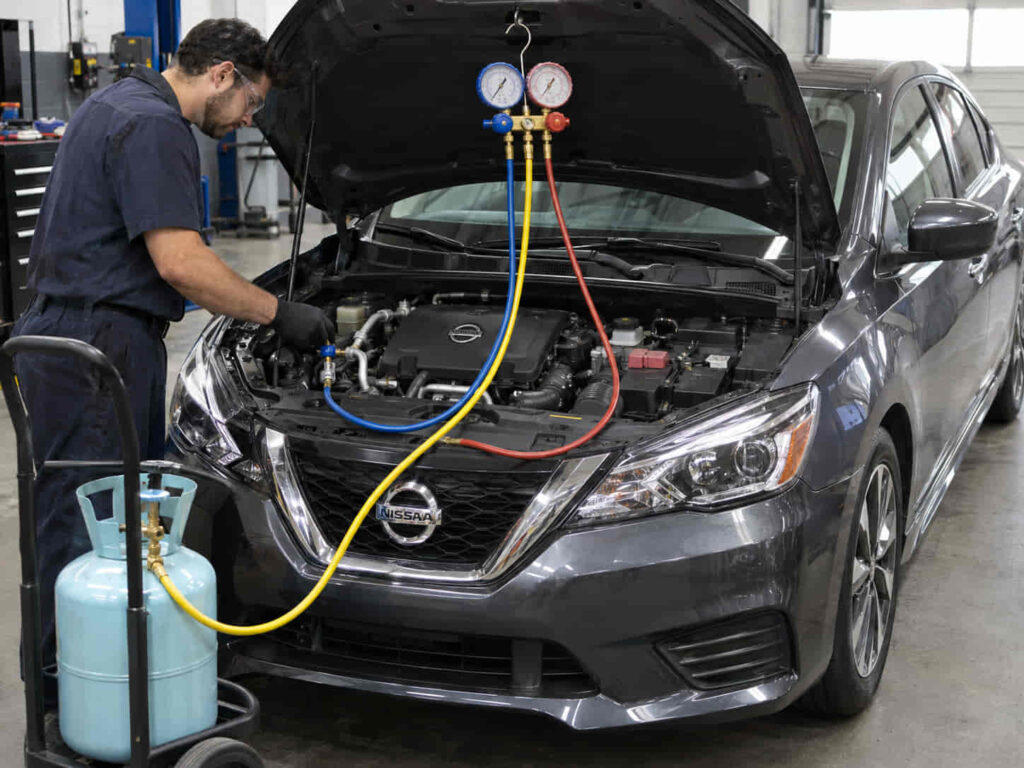
A Nissan Sentra AC recharge requires the correct refrigerant type, a manufacturer-specified charge quantity, and an inspection of the air conditioning system before refrigerant is added. Nissan Sentra models use different refrigerants depending on the model year, including R134a and R1234yf. Using the wrong refrigerant or charging an incorrect amount can reduce cooling performance and damage AC components. The vehicle’s refrigerant identification label and applicable Nissan service manual provide the specifications needed for accurate servicing.
If your Nissan Sentra blows warm air or its cooling performance has gradually declined, low refrigerant may be responsible, but a recharge is not always the correct repair. A refrigerant leak, faulty compressor, restricted condenser airflow, or electrical malfunction can produce similar symptoms. Because automotive AC systems are sealed, recurring refrigerant loss requires leak diagnosis rather than repeated top-offs. Proper servicing involves checking system condition, recovering refrigerant with compatible equipment, and charging the specified amount by weight.
This guide explains how Nissan Sentra AC recharging works, which refrigerant different model years require, and how to determine the correct refrigerant capacity. It also covers service equipment, AC recharge port identification, cooling performance checks, common refrigerant leaks, and when professional AC repair is necessary.
How Do You Recharge the AC in a Nissan Sentra?
Recharging the AC in a Nissan Sentra involves identifying the correct refrigerant, checking the system for leaks, recovering the existing refrigerant, evacuating the system, and adding the manufacturer-specified charge by weight. The procedure requires refrigerant-compatible service equipment because an automotive air conditioning system operates under pressure and contains refrigerant that must be recovered properly. Simply connecting a recharge can and adding refrigerant until the air feels cold does not establish the correct charge quantity.
The first part of the service is determining whether refrigerant loss is responsible for the cooling problem. A technician examines compressor operation, condenser airflow, refrigerant pressures, and signs of leakage before deciding whether a recharge is necessary. Low refrigerant reduces the amount of refrigerant circulating through the evaporator, limiting its ability to absorb heat from cabin air. However, a compressor fault or inadequate condenser cooling can produce similar symptoms. For example, a Nissan Sentra that blows warm air at idle but cools while driving may have an airflow-related problem rather than an insufficient refrigerant charge.
Once the system has been evaluated, compatible recovery equipment removes and measures the remaining refrigerant. If a leak is found, the affected component or connection must be repaired before charging. The service procedure then includes evacuation to remove air and moisture, along with the required checks for system integrity. Moisture inside the refrigerant circuit can contribute to corrosion and freezing at refrigerant metering components, while noncondensable gases interfere with normal operating pressures.
The correct refrigerant is then introduced using equipment that measures the charge by weight. This is essential because Nissan specifies refrigerant quantity as a mass, not as a target reading on a low-pressure gauge. Adding too little refrigerant can reduce evaporator performance, while overcharging can increase operating pressures and interfere with heat rejection at the condenser. The required amount must match the vehicle’s refrigerant identification label and applicable Nissan service information.
After charging, the technician checks vent temperature, compressor behavior, condenser fan operation, and high-side and low-side pressures under specified operating conditions. These measurements help confirm that the refrigeration system is functioning correctly. Nissan recommends experienced technicians with appropriate equipment for AC servicing, and US regulations prohibit intentional refrigerant venting. A proper recharge therefore restores the specified refrigerant quantity while addressing any underlying fault responsible for refrigerant loss.
What Type of Refrigerant Does a Nissan Sentra Use?
The refrigerant used in a Nissan Sentra depends on its model year and factory air conditioning specifications. Nissan Sentra vehicles have used both R134a, also identified as HFC-134a, and R1234yf, also identified as HFO-1234yf. These refrigerants are not interchangeable, so the correct type must be verified before any refrigerant is recovered or added. The refrigerant identification label in the engine compartment and the applicable Nissan owner’s or service manual provide the vehicle-specific requirements.
The 2016 Nissan Sentra owner’s manual specifies R134a refrigerant and Nissan A/C System Oil Type S (DH-PS), or exact equivalents. In contrast, the 2022 Nissan Sentra owner’s manual specifies R1234yf refrigerant and Nissan A/C System Oil Type PAG, or exact equivalents. These manufacturer specifications demonstrate why an AC recharge guide cannot recommend one refrigerant for every Nissan Sentra. The vehicle’s model year and original AC configuration determine which refrigerant and lubricant are appropriate.
R134a and R1234yf have different service requirements, including refrigerant-specific recovery equipment and service connections. R1234yf is classified as a mildly flammable refrigerant, making correct identification and compatible handling equipment particularly important. Mixing refrigerants can contaminate the system and cause improper compressor operation or lubrication problems. Nissan warns that using an incorrect refrigerant or oil can severely damage AC components.
For example, servicing a 2016 Sentra with equipment and refrigerant intended for a 2022 Sentra would disregard the older vehicle’s R134a specification. Likewise, adding R134a to an R1234yf-equipped Sentra would introduce an incompatible refrigerant. Before beginning service, technicians should confirm the model-specific refrigerant label, identify the refrigerant already present when necessary, and use equipment approved for that refrigerant. The exact charge quantity must then be verified separately because refrigerant type alone does not establish how much refrigerant the system requires.
Read more: 6 7 powerstroke ac recharge port location
How Much Refrigerant Does a Nissan Sentra AC System Hold?
A Nissan Sentra AC system holds a specific refrigerant charge measured by weight, and the required amount depends on the vehicle’s model year and air conditioning configuration. Verified service information for the 2015 and 2016 Sentra specifies 450 ± 50 grams (15.9 ± 1.8 ounces) of R134a. The 2020 Sentra service information lists approximately 450 grams (15.9 ounces) of R1234yf. Because Nissan Sentra refrigerant specifications have changed between generations, the correct charge must be confirmed using the vehicle’s under-hood air conditioning label and applicable service manual.
The following Nissan Sentra AC refrigerant capacity chart summarizes specifications found in model-year service documentation and published service lookups.
| Nissan Sentra Model Year | Refrigerant Type | Capacity (Grams) | Capacity (Ounces) |
|---|---|---|---|
| 2015 | R134a | 450 ± 50 g | 15.9 ± 1.8 oz |
| 2016 | R134a | 450 ± 50 g | 15.9 ± 1.8 oz |
| 2019 | R134a | 450 ± 50 g | 15.9 ± 1.8 oz |
| 2020 | R1234yf | 450 g | 15.9 oz |
| 2021 | R1234yf | Approximately 470 g | Approximately 16.6 oz |
The 2015 and 2016 specifications come from Nissan service manual refrigerant data, while the 2019 and 2020 figures appear in the corresponding service fluid specifications. The 2021 value is an approximate figure reported in a service lookup, not an independently confirmed factory charging tolerance. Some quick-reference databases also report approximately 470 grams for the 2020 Sentra, whereas its detailed fluids and lubricants specification lists 450 grams. This difference reinforces the need to use the identification label on the specific vehicle rather than treating a general capacity chart as a final charging instruction.
Refrigerant capacity describes the total specified charge in the system, not the amount that should automatically be added when cooling becomes weak. If a Nissan Sentra still contains refrigerant, adding the full listed capacity would overcharge the system. A technician instead recovers the existing refrigerant, evaluates system condition, repairs identified leaks, and restores the specified charge using accurate weighing equipment. Pressure readings cannot establish the exact refrigerant mass because compressor operation, ambient temperature, and condenser airflow also affect system pressure.
The refrigerant type must also match the vehicle’s original specifications. For example, the verified 2016 Sentra uses R134a, while the 2020 Sentra uses R1234yf. These refrigerants require compatible service equipment and must not be mixed. Owners of other model years, including vehicles whose charge quantity is not listed in this chart, should verify both the refrigerant type and the exact charge weight before servicing.
What Equipment Is Required for a Nissan Sentra AC Recharge?
A Nissan Sentra AC recharge requires refrigerant-compatible recovery and charging equipment, accurate refrigerant measurement, appropriate service connections, and tools for evaluating leaks and system operation. The equipment must match the refrigerant specified for the vehicle because R134a and R1234yf systems have different service requirements. Nissan service documentation identifies recovery/recycling/recharging equipment, a vacuum pump, a manifold gauge set, a refrigerant weight scale, and refrigerant leak detection tools as essential parts of AC servicing.
A recovery and recharge machine removes refrigerant from the vehicle without intentionally releasing it into the atmosphere. It also allows technicians to measure the recovered quantity and charge the system with the specified refrigerant mass. This is important because a low-pressure gauge cannot accurately determine how much refrigerant remains inside the AC circuit. For R1234yf-equipped Sentra models, the recovery equipment must be suitable for that refrigerant and meet the applicable service equipment requirements.
A vacuum pump is used during the service process to evacuate air and moisture from the refrigerant circuit. Air can interfere with condensation and increase operating pressures, while moisture can contribute to corrosion and ice formation at refrigerant metering components. A properly performed evacuation is followed by the required system integrity checks before refrigerant charging. A calibrated electronic scale or a charging machine with accurate mass measurement then establishes the specified charge quantity.
A manifold gauge set helps technicians monitor high-side and low-side refrigerant pressures during diagnosis and performance testing. The gauges must be compatible with the refrigerant being serviced, and their readings must be interpreted alongside ambient temperature, compressor behavior, and condenser airflow. A refrigerant identifier is useful for detecting an incorrect or contaminated refrigerant before recovery, while an electronic leak detector or approved fluorescent dye system helps locate escaping refrigerant.
For example, a 2020 Nissan Sentra using R1234yf should be serviced with R1234yf-compatible couplers, hoses, gauges, and recovery equipment rather than an R134a charging setup. Nissan specifically warns against using adapters to connect incompatible refrigerant service fittings because contamination and compressor damage can result. Correct equipment selection, protective eyewear, gloves, and adequate ventilation are therefore essential to safe and accurate Nissan Sentra AC servicing.
Where Is the AC Recharge Port on a Nissan Sentra?
The Nissan Sentra AC recharge port is located on the low-pressure side of the air conditioning system, along the refrigerant line that returns vapor from the evaporator to the compressor. Its exact position depends on the model year and engine compartment layout. On 2013–2019 Sentra models, Nissan service diagrams identify the low-pressure service port on the low-pressure flexible hose and the high-pressure service port on a separate high-pressure pipe. Owners should consult the service diagram for their specific model year rather than assume every Sentra uses the same port location.
The low-pressure line connects the evaporator outlet to the compressor suction side. Because refrigerant absorbs heat inside the evaporator before returning to the compressor, this line carries relatively cool, low-pressure vapor during normal AC operation. The high-pressure line carries compressed refrigerant toward the condenser, where heat is transferred to outside air. These different functions explain why the two service ports are positioned on separate sections of the refrigerant circuit.
To identify the correct port, locate the air conditioning refrigerant lines in the engine compartment and compare their routing with the vehicle-specific Nissan service diagram. The service fittings are normally protected by removable caps, and their dimensions are designed for the refrigerant and pressure side being serviced. Cap color, hose appearance, or an assumed passenger-side location should not be used as the only method of identification. A capped fitting must be confirmed as an AC service port rather than another connection or sensor.
Refrigerant compatibility is particularly important when identifying service connections. Earlier R134a-equipped Sentra models and newer R1234yf-equipped models require different refrigerant-specific servicing equipment. The US Environmental Protection Agency explains that automotive refrigerants use unique service fittings to help prevent incompatible connections. Forcing an adapter onto an incorrect port or connecting a charging container to the high-pressure side creates serious safety risks.
The correct low-pressure service port provides access for approved diagnostic and servicing equipment, but finding it does not establish whether the system needs refrigerant. A technician must still verify the refrigerant type, evaluate system condition, and determine the required charge quantity. If the service port cannot be identified from the appropriate Nissan documentation, professional inspection is safer than connecting a recharge hose to an uncertain fitting.
How Do You Know Whether a Nissan Sentra AC Recharge Was Successful?
A Nissan Sentra AC recharge is successful when the system contains the manufacturer-specified refrigerant charge, operates within the applicable pressure and temperature specifications, and delivers stable cabin cooling without evidence of refrigerant leakage. Cold air immediately after charging is not sufficient proof of a successful repair because an incorrectly charged system or an unresolved leak may temporarily produce acceptable cooling.
Nissan’s service procedure evaluates AC performance under controlled operating conditions. For the 2020–2025 Sentra, the performance test specifies a shaded or indoor, well-ventilated location, the hood open, the engine idling, the AC switched on, the temperature set to maximum cooling, the airflow directed through the dashboard vents, recirculation selected, and the blower at maximum speed. The doors remain closed while the door windows are fully open. The system is allowed to stabilize for approximately 10 minutes before temperature and pressure measurements are evaluated.
The Nissan Sentra B18 service manual provides operating pressure ranges based on ambient temperature. At an outside temperature of 86°F (30°C) and relative humidity between 50% and 70%, the specified high-side pressure is approximately 155.6–190.2 psi, while low-side pressure is approximately 30.6–37.6 psi under the prescribed test conditions. These values demonstrate how a vehicle-specific service manual can support diagnosis more accurately than a universal AC pressure chart. They must not be used as target pressures for adding refrigerant because matching a gauge reading does not verify the actual refrigerant charge.
Vent temperature provides a second measurement of cooling performance. Nissan compares the temperature of recirculated air entering the blower assembly with the discharge temperature at the center dashboard vent. For example, the B18 performance table specifies a center-vent temperature of approximately 47–52°F (8.6–11.1°C) when recirculated inlet air is 77°F (25°C) at 50%–60% relative humidity. Different inlet temperatures and humidity levels produce different acceptable vent temperatures, so an isolated vent reading does not establish whether the system is operating correctly.
A complete post-recharge inspection also checks compressor operation, condenser fan performance, abnormal refrigerant pressures, and evidence of leakage. If the air conditioner cools initially but loses performance again, refrigerant may be escaping through a damaged component or connection. The EPA explains that adding refrigerant does not permanently repair a leak. A lasting repair requires identifying the fault, restoring the correct refrigerant charge, and confirming stable cooling performance under the manufacturer’s test conditions.
Why Is My Nissan Sentra AC Blowing Warm Air After a Recharge?
A Nissan Sentra AC may continue blowing warm air after a recharge because the system has an incorrect refrigerant charge, an unresolved leak, a malfunctioning compressor, inadequate condenser cooling, or an electrical control problem. Adding refrigerant only addresses insufficient refrigerant quantity. It does not restore cooling when another component prevents the air conditioning system from absorbing heat inside the cabin or releasing it outside the vehicle. A proper diagnosis must therefore establish whether the refrigerant circuit is operating correctly before another recharge is considered.
An incorrect refrigerant charge is one possible cause of poor cooling after servicing. Undercharging limits refrigerant circulation through the evaporator, while overcharging can interfere with condenser heat rejection and increase discharge pressure. If a leak was not repaired, the system may also lose cooling performance again as refrigerant escapes. For example, a Sentra that produces cold air immediately after servicing but gradually returns to warm air may have a leaking refrigerant connection or condenser. The correct response is to inspect for leaks and verify the charge by weight rather than repeatedly adding refrigerant.
Compressor and condenser problems can produce similar symptoms even when the refrigerant quantity is correct. The compressor must maintain sufficient pressure difference for refrigerant to circulate through the system, while the condenser must release heat to outside air. A defective compressor control valve, clutch-related fault, or condenser cooling fan can interrupt these processes. A Sentra that cools while moving but blows warmer air during traffic stops may have inadequate condenser airflow at idle. This symptom provides a diagnostic clue, but fan operation and system pressures must be checked before identifying the failed component.
The cabin climate-control system must also be considered. A malfunctioning temperature blend door, control module, or related electrical component can allow heated air to enter the ventilation stream despite normal refrigerant operation. Nissan’s Sentra diagnostic procedures distinguish insufficient cooling from blower, compressor, and HVAC control faults. Technicians use vent temperature, refrigerant pressures, compressor operation, electrical diagnostics, and condenser fan performance to identify the cause. Recharging the system again without confirming the fault can waste refrigerant and leave the original cooling problem unresolved.
What Causes a Nissan Sentra AC System to Lose Refrigerant?
A Nissan Sentra AC system loses refrigerant when a leak develops in a refrigerant line, component connection, condenser, compressor seal, service valve, or evaporator. Automotive air conditioning uses a closed refrigerant circuit, so refrigerant is not consumed during normal cooling. A system that repeatedly requires recharging should be inspected for leakage rather than treated as needing routine refrigerant replacement. Even a small leak can eventually reduce the refrigerant charge enough to affect evaporator performance and cabin cooling.
Refrigerant pipe and hose connections are important inspection points because their O-ring seals must remain airtight under changing temperature and pressure conditions. Over time, seal deterioration, vibration, or damage to the mating surfaces can allow refrigerant to escape. Nissan’s technical bulletin NTB09-099a identifies O-ring seals as a common cause of leaks at AC pipe and hose joints. The bulletin instructs technicians to inspect the joint surfaces and replace a defective seal rather than automatically replacing an otherwise serviceable refrigerant line.
The condenser is another potential leak location because it sits near the front of the vehicle and is exposed to road debris, moisture, and corrosion. Damage to the condenser tubing can allow pressurized refrigerant to escape. Leaks may also develop around compressor seals, service valves, or the evaporator inside the HVAC housing. For example, a leaking evaporator may not produce an obvious external stain because the component is concealed inside the dashboard. This makes systematic leak detection more reliable than visual inspection alone.
Nissan service procedures describe electronic refrigerant leak detection and fluorescent dye inspection for identifying the source of refrigerant loss. Technicians examine refrigerant line connections, accessible AC components, and the evaporator drain area when an internal leak is suspected. Fluorescent residue can help locate a suspected leak, but Nissan cautions that unrelated materials may also fluoresce and that apparent compressor seal seepage should be confirmed before repair. Once the leaking component or connection has been repaired, the system must be checked again for leakage and recharged with the correct refrigerant quantity. This approach addresses the cause of refrigerant loss instead of providing only temporary cooling improvement.
How Much Does a Nissan Sentra AC Recharge Cost?
A Nissan Sentra AC recharge typically costs between $247 and $331 in the United States, according to RepairPal estimates updated September 3, 2026. The estimated labor cost ranges from $179 to $263, with approximately $68 attributed to parts and materials. These figures exclude taxes, additional fees, location-specific pricing, and repairs that may be necessary before the system can be recharged. The actual cost depends on the Sentra’s model year, refrigerant type, and condition of its air conditioning system.
Recharge estimates also vary between Nissan Sentra model years. RepairPal lists approximately $219–$299 for a 2016 Sentra and $307–$404 for a 2022 Sentra. One factor affecting service pricing is the refrigerant specification: older Sentra models use R134a, while newer models use R1234yf, which requires compatible recovery and charging equipment. However, refrigerant type does not explain every price difference. Shop labor rates, equipment charges, service procedures, and regional pricing also influence the final bill.
A professional recharge may involve refrigerant identification, performance testing, recovery, evacuation, and charging the specified refrigerant mass. Some repair shops include basic system checks in a flat service fee, while others bill separately for diagnostic labor and refrigerant. The US Environmental Protection Agency notes that shops may also charge fees related to refrigerant recycling equipment. Owners should therefore confirm whether a quoted recharge price includes leak testing and the full manufacturer-specified charge.
If the Nissan Sentra has a leaking condenser, damaged refrigerant hose, or defective compressor, the repair cost will exceed a recharge-only estimate. For example, replacing a leaking condenser involves component replacement and subsequent refrigerant servicing. Recharging without repairing the leak may temporarily restore cooling but will not prevent further refrigerant loss. A written estimate that separates diagnosis, component repair, and refrigerant service helps owners understand the work required.
How Can You Prevent Nissan Sentra AC Refrigerant Problems?
Nissan Sentra owners can reduce recurring AC problems by maintaining unobstructed condenser airflow, monitoring cooling performance, and addressing refrigerant leaks before they cause repeated charge loss. The air conditioning system is sealed, so it should not require refrigerant replacement as routine maintenance when operating correctly. A gradual decline in cooling performance warrants inspection because adding refrigerant without identifying the cause can conceal an unresolved leak or create an incorrect charge.
Condenser airflow is important for reliable AC operation. The condenser releases heat from compressed refrigerant to outside air, and restricted airflow increases the temperature and pressure required for heat rejection. Leaves, dirt, insects, and road debris can obstruct the front cooling surfaces, while a malfunctioning cooling fan can reduce airflow when the vehicle is stationary. Nissan maintenance guidance recommends checking the front cooling area for accumulated debris. For example, a Sentra that cools normally at highway speeds but struggles during traffic stops may need its condenser airflow and cooling fan inspected rather than another recharge.
Cabin air filter maintenance also supports consistent ventilation performance, although it does not prevent refrigerant leaks. A clogged filter restricts air entering the passenger compartment and can make cooling feel weak even when the refrigerant circuit operates correctly. Nissan specifies an in-cabin microfilter replacement interval of 15,000 miles or 18 months for the 2022 Sentra under its published maintenance schedule. Owners should follow the schedule applicable to their model year and driving conditions.
Early diagnosis helps prevent repeated servicing and unnecessary component replacement. Refrigerant stains or suspected leakage near AC connections, declining vent cooling, abnormal compressor noise, and inconsistent cooling at idle are reasons to have the system inspected. Qualified technicians can evaluate system pressures, condenser operation, refrigerant quantity, and potential leaks using appropriate equipment. Repairing identified faults and restoring the specified refrigerant charge provides a more reliable long-term result than repeatedly adding refrigerant whenever cooling performance decreases.