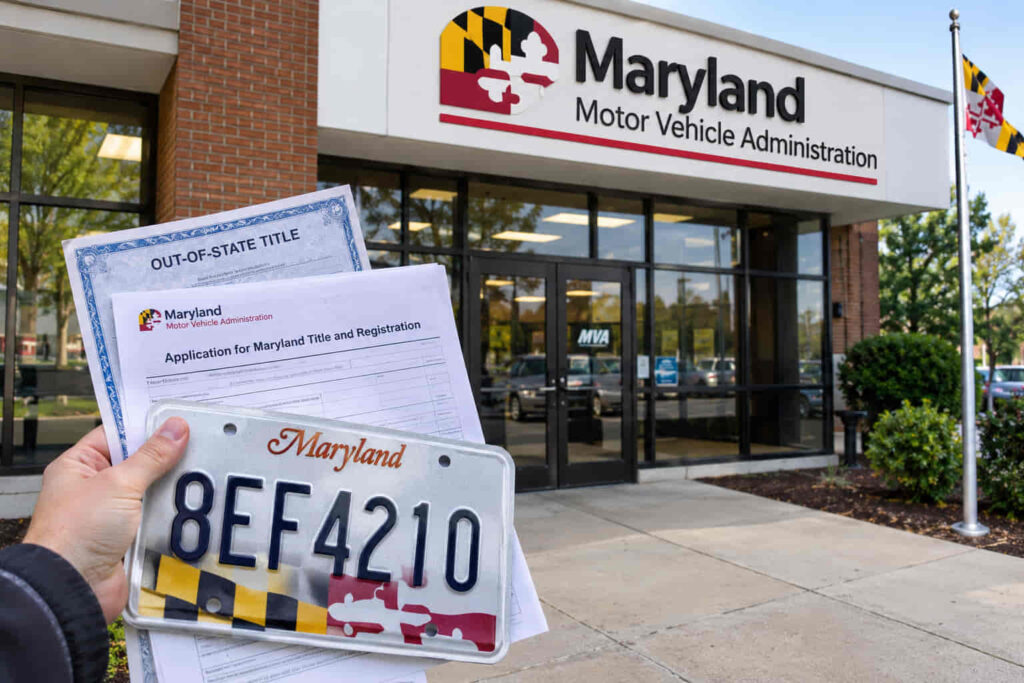
To register a car in Maryland from out of state, you must apply for a Maryland title and registration through the Maryland Motor Vehicle Administration (MVA), provide proof of ownership and Maryland-compliant insurance, and obtain a Maryland Safety Inspection Certificate when required. New Maryland residents must title and register their vehicles within 60 days of moving to the state. Missing this deadline can also affect eligibility for a credit toward Maryland’s vehicle excise tax.
The registration process begins with an MVA appointment and pre-application. Vehicle owners generally need their out-of-state title, a valid Maryland driver’s license or proof of Maryland residency, insurance information, and payment for applicable taxes and fees. Most vehicles must pass a safety inspection at an authorized Maryland inspection station before registration. Additional documentation may be necessary if a lender holds the vehicle’s original title.
Registration requirements also depend on whether you are moving to Maryland with a vehicle you already own or purchasing a vehicle from another state. These situations can involve different ownership documents and excise tax calculations. This guide explains the registration process, required paperwork, vehicle inspections, insurance requirements, registration fees, deadlines, and special circumstances to help you complete your Maryland MVA registration correctly.
Does an Out-of-State Car Need a Maryland Safety Inspection?
Most out-of-state cars must pass a Maryland Safety Inspection before they can be titled and registered with the Maryland Motor Vehicle Administration (MVA). The inspection verifies that essential vehicle components meet Maryland’s safety standards, regardless of whether the vehicle was previously registered in another state. However, certain vehicles qualify for exemptions based on their Maryland title history. For example, a person returning to Maryland with a vehicle previously titled in Maryland under the same owner’s name does not need another safety inspection solely because the vehicle was registered elsewhere.
A Maryland Safety Inspection must be performed at an inspection station licensed by the Maryland State Police. The inspection evaluates components that directly affect vehicle safety, including brakes, steering, suspension, tires, lighting, and other required equipment. These checks identify mechanical defects that could compromise vehicle control or roadworthiness. For example, a vehicle registered in Virginia may require repairs to worn brake components or damaged suspension parts before it meets Maryland inspection standards. An inspection certificate from another state does not automatically replace the required Maryland certification.
A Maryland Safety Inspection Certificate is valid for 90 days from its issue date and is transmitted electronically to the MVA after the vehicle passes. Vehicle owners must complete the applicable titling and registration process before the certificate expires. Inspection fees are determined by individual licensed inspection stations rather than a single statewide price. If a vehicle fails, the inspection report identifies the defects requiring correction. The owner must complete the necessary repairs and return for reinspection within 30 days. According to Maryland MVA, exceeding the 30-day reinspection period or driving more than 1,000 miles before reinspection requires a new full inspection.
Vehicles without valid registration may qualify for a 30-day temporary Maryland registration to obtain the required safety inspection. This option allows eligible owners to legally transport their vehicles to an authorized inspection station before completing permanent registration. However, the vehicle must still satisfy applicable insurance and operating requirements. Owners should confirm their eligibility before requesting temporary registration because Maryland generally issues only one temporary registration for this purpose.
Maryland Safety Inspection and Vehicle Emissions Inspection Program (VEIP) testing are separate requirements. Safety inspections evaluate vehicle equipment and roadworthiness before initial titling and registration when required, while emissions inspections measure pollution-related performance according to the applicable VEIP schedule. Eligible vehicles generally receive an emissions testing notice after registration rather than completing VEIP testing as part of the initial safety inspection. Understanding this distinction prevents unnecessary inspections and helps vehicle owners complete Maryland’s registration requirements in the correct order.
Do You Need Maryland Car Insurance Before Registering an Out-of-State Vehicle?
Yes, you need active automobile insurance from a Maryland-approved insurance company before registering an out-of-state vehicle in Maryland. Maryland law requires registered vehicles to maintain continuous insurance coverage that meets the state’s minimum liability requirements. An existing out-of-state policy should not be assumed to satisfy Maryland registration rules without verification from the insurer. Before submitting a registration application, vehicle owners should confirm that their coverage is issued by an insurer authorized to operate in Maryland and that the policy reflects the correct vehicle information.
Maryland requires minimum liability coverage of $30,000 for bodily injury per person, $60,000 for bodily injury per accident, and $15,000 for property damage. These limits establish the minimum financial protection required for liability claims involving injuries or property damage caused to others. For example, the $60,000 bodily injury limit represents the minimum total coverage available for covered bodily injury claims arising from a single accident, subject to the $30,000 per-person limit. Vehicle owners may purchase higher limits to provide additional financial protection beyond the state’s legal minimum.
Maryland MVA requires insurance information when processing an out-of-state vehicle registration application. Applicants must provide the insurance company’s name, policy or binder number, and insurance agent’s name when applicable. These details allow the MVA to associate the vehicle with its insurance coverage and verify compliance. For example, a driver moving from Pennsylvania to Maryland should contact their insurance provider before the registration appointment to arrange Maryland-compliant coverage and confirm that the vehicle identification number and policy information are accurate. Errors in insurance records can delay registration or create compliance problems after the vehicle is registered.
Insurance coverage must remain active throughout the entire period that the vehicle is registered in Maryland, even when the vehicle is not being driven. Insurance companies report policy information electronically to the MVA, allowing the agency to identify cancellations, coverage lapses, or discrepancies. A lapse can result in financial penalties, registration suspension, or administrative restrictions. If an owner intends to cancel insurance without replacing it, Maryland requires the registration plates to be returned before coverage ends. Maintaining uninterrupted insurance and accurate policy information helps vehicle owners avoid these consequences.
Obtaining compliant insurance before the MVA appointment is an essential part of registering a car in Maryland from out of state. Vehicle owners should verify their insurer’s Maryland authorization, confirm that their policy meets the required coverage limits, and ensure that the policy information matches their registration documents. Completing these checks in advance reduces administrative delays and establishes the insurance coverage required for lawful Maryland vehicle registration.
Read more: car smells like burning rubber
How Do You Transfer an Out-of-State Car Title to Maryland?
To transfer an out-of-state car title to Maryland, submit your existing vehicle title, complete the Maryland Certificate of Title Application (VR-005) or online pre-application, provide the required insurance and inspection information, and pay the applicable fees through the Maryland Motor Vehicle Administration (MVA). New Maryland residents must complete the title and registration transfer within 60 days of establishing residency. The procedure establishes a Maryland title record for a vehicle previously titled in another state while preserving the owner’s legal interest and any existing liens.
The out-of-state certificate of title is the primary ownership document required for the transfer. It identifies the vehicle through its Vehicle Identification Number (VIN), records the registered owner, and shows any outstanding security interests. Maryland MVA uses this information to verify ownership before issuing a new certificate of title. For example, a vehicle owner relocating from Pennsylvania to Maryland can apply for a Maryland title using the existing Pennsylvania title, provided the ownership information is accurate and the required documents are available. A routine relocation does not constitute a vehicle sale, so an owner transferring a vehicle already titled in their name should not complete the paperwork as though ownership were changing.
Vehicles with an outstanding loan require additional lienholder documentation because the lender may possess the original title. Maryland MVA instructs owners of financed or leased vehicles to provide their current registration card, lienholder account number, mailing information, and fax number. These details allow the agency to coordinate the transfer of title information with the financial institution. For example, a driver who financed a vehicle through an out-of-state bank may be unable to obtain the original title directly because the lender retains it until the loan is satisfied. The MVA can use the lienholder information to request the documentation needed to establish the Maryland title record.
Maryland records an existing lien as a security interest in the vehicle. When a lien is active, the MVA may issue a Security Interest Filing (SIF) rather than providing the owner with a paper title. The security interest filing identifies the lender’s legal claim while the vehicle remains financed. A $40 security interest filing fee applies when a lien is recorded, in addition to the standard title fee and other applicable registration charges. Paying off the loan does not automatically eliminate every administrative requirement; the lienholder must properly release its security interest so the vehicle’s title record can be updated.
The title transfer is finalized after the MVA verifies ownership, processes the application, records any liens, and collects the required taxes and fees. Once the registration application is approved, the owner receives the applicable Maryland registration credentials, while title issuance follows the MVA’s processing procedures. Completing the pre-application through myMVA and confirming the lienholder’s information before the appointment helps prevent delays caused by incomplete ownership records. Vehicle owners should also distinguish transferring an existing title from registering a recently purchased vehicle, which may require additional purchase documents and a different excise tax calculation.
How Much Does It Cost to Register an Out-of-State Car in Maryland?
Registering an out-of-state car in Maryland generally involves a $200 title fee, an annual registration fee based on the vehicle’s classification and shipping weight, applicable vehicle excise tax, and the cost of a Maryland Safety Inspection when required. Additional charges apply when the vehicle has an outstanding lien, qualifies for special registration, or is subject to electric vehicle surcharges. The total cost depends on the vehicle’s characteristics, ownership history, and whether the owner qualifies for the excise tax treatment available to new Maryland residents.
Maryland MVA charges $200 for a standard new or used vehicle title certificate. Annual registration fees for Class A passenger cars are $120.50 for vehicles with a shipping weight of 3,500 pounds or less, $125.50 for vehicles in the 3,500–3,700-pound category, and $191.50 for vehicles weighing more than 3,700 pounds. These published registration amounts include Maryland’s applicable $40 annual Emergency Medical Services surcharge. Registration can cover multiple years, depending on the permitted registration term, so the total registration payment may exceed the listed annual rate. Vehicles with recorded liens also incur a $40 security interest filing fee, while battery electric vehicles and plug-in hybrids are subject to additional annual surcharges.
Maryland’s standard vehicle excise tax rate is 6.5%, but new residents transferring vehicles they already own may qualify for a reduced amount. For vehicles that are six model years old or newer, residents completing the transfer within 60 days of moving to Maryland receive tax treatment based on the tax rate applicable in their previous state. If that state’s tax rate is 6.5% or higher, the Maryland excise tax is $100. If the previous state’s rate is lower than 6.5%, Maryland generally charges the difference between the two rates using the vehicle’s clean retail value determined under MVA valuation rules. Vehicles coming from states with a 0% tax rate are subject to the full 6.5% calculation.
For example, consider an eligible new Maryland resident who transfers a vehicle valued by the MVA at $20,000 from a state with a recognized 5% vehicle tax rate. The difference between Maryland’s 6.5% rate and the previous state’s 5% rate is 1.5%. Applying that difference to the vehicle’s $20,000 value results in an estimated Maryland excise tax of $300. This calculation applies to the qualifying new-resident transfer scenario, not automatically to every out-of-state vehicle purchase. The MVA determines the actual amount based on the vehicle’s age, accepted valuation, previous state tax treatment, and application circumstances.
Vehicles seven model years old or older generally receive a different excise tax calculation when transferred by new Maryland residents. Maryland MVA lists an excise tax of $41.60 for qualifying vehicles in this age category. For vehicles six model years old or newer transferred more than 60 days after moving, the MVA generally applies the full 6.5% rate to the vehicle’s retail value rather than the reduced new-resident calculation. This makes completing the registration process within the required deadline particularly important for owners of newer vehicles. Recently purchased vehicles, leased vehicles, and qualifying military vehicles have separate tax rules that should be evaluated according to their specific circumstances.
Safety inspection charges represent another registration expense but are not established as a single statewide price. Authorized inspection stations set their own inspection fees, and vehicles that fail inspection may require repairs before registration can proceed. The final registration cost should therefore account for the title fee, registration term, applicable excise tax, inspection charges, and any lien or vehicle-specific surcharges. Completing the myMVA pre-application provides an estimated amount before the appointment, helping vehicle owners prepare payment and identify potential tax savings before transferring their out-of-state registration to Maryland.
How Long Do You Have to Register an Out-of-State Car in Maryland?
New Maryland residents must title and register their out-of-state vehicles within 60 days of establishing residency in Maryland. This deadline applies to individuals relocating to Maryland with vehicles previously titled or registered in another state. The Maryland Motor Vehicle Administration (MVA) requires new residents to complete the title transfer, provide valid insurance information, satisfy applicable vehicle inspection requirements, and pay the necessary taxes and registration fees. Missing the 60-day deadline can result in registration enforcement actions and the loss of eligibility for certain excise tax credits.
The 60-day registration period begins when the vehicle owner becomes a Maryland resident, not when the owner schedules an MVA appointment or completes a safety inspection. For example, a driver who moves from Virginia to Maryland on November 1 must generally complete the Maryland title and registration transfer within 60 days of that date. Scheduling an appointment early provides time to obtain a Maryland Safety Inspection Certificate, coordinate with a lienholder, and resolve incomplete ownership documents. Waiting until the deadline approaches can create difficulties if the vehicle fails inspection or the original title is held by an out-of-state financial institution.
Registering an out-of-state vehicle after the 60-day deadline can affect how Maryland calculates vehicle excise tax. Maryland provides special tax treatment for qualifying new residents who transfer previously owned vehicles within the required period. For vehicles six model years old or newer, the amount depends on the tax rate associated with the previous state. Eligible owners coming from states with tax rates of 6.5% or higher generally pay $100 in Maryland excise tax, while qualifying vehicles from states with lower rates are subject to a difference-based calculation. After the 60-day period, Maryland generally applies the full 6.5% excise tax to the MVA-determined retail value of vehicles in this age category. Older vehicles follow different fixed-amount rules.
Maryland introduced additional enforcement measures on October 1, 2026, for residents who continue using improperly registered out-of-state vehicles. Under the state’s Plate Where You Live enforcement program, the MVA can issue an official written warning requiring the owner to register the vehicle in Maryland or provide documentation establishing an applicable exemption. The notice starts a separate 60-day compliance period during which no fines are assessed under this new process. If the owner remains noncompliant after that period, a penalty of $7 per day can apply for up to 60 additional days, reaching a maximum of $420 per vehicle.
If the vehicle remains improperly registered 120 days after the official warning, the MVA may refer the case to the appropriate local jurisdiction for further enforcement. Depending on the circumstances, additional action can include civil proceedings, vehicle booting, towing, or impoundment. The warning period does not replace the existing requirement for new residents to register within 60 days of moving to Maryland. Vehicle owners should therefore complete registration promptly rather than treating an enforcement notice as an extension of the original deadline.
The safest way to avoid registration penalties and unnecessary tax costs is to begin the Maryland MVA process as soon as residency is established. Vehicle owners should confirm their inspection requirements, arrange Maryland-compliant insurance, and prepare the necessary title documents before scheduling their appointment. Individuals who believe they qualify for an exemption, including certain military personnel and nonresidents, should verify their eligibility directly with the MVA rather than continuing to use out-of-state plates without appropriate documentation.
How Do You Register an Out-of-State Car Purchased in Another State?
To register a car purchased in another state, a Maryland resident must obtain valid proof of ownership, complete the Maryland title application, arrange Maryland-compliant insurance, satisfy applicable safety inspection requirements, and pay the required title, registration, and excise tax charges. The process depends on whether the vehicle was purchased from an out-of-state dealership or a private seller. Unlike transferring a vehicle already owned before moving to Maryland, registering a recently purchased car involves documenting a new ownership transaction and determining the tax based on the purchase.
When purchasing a vehicle from an out-of-state dealership, the buyer should first confirm whether the dealer will submit the Maryland title and registration paperwork. Many licensed dealerships handle title applications for customers, but an out-of-state dealer may not provide this service. If the dealer does not complete the Maryland process, the buyer must submit the required documents to the MVA. For a new vehicle, these documents generally include the Manufacturer’s Certificate of Origin and the original dealer’s bill of sale. Used vehicles typically require a properly assigned certificate of title, purchase documentation, and any applicable odometer or lien information.
A vehicle purchased from a private seller outside Maryland requires a properly assigned title establishing the transfer of ownership to the buyer. The seller must complete the applicable title assignment information, including the buyer’s details, sale date, signatures, purchase price, and odometer disclosure when required. A bill of sale is recommended and may be necessary to substantiate the transaction under Maryland’s valuation rules. For example, a Maryland resident purchasing a used vehicle from a private seller in Pennsylvania should verify that the Pennsylvania title is valid, that the seller is authorized to transfer ownership, and that any recorded lien has been released before submitting the vehicle for Maryland titling.
Most used vehicles purchased outside Maryland must pass a Maryland Safety Inspection before permanent registration. The inspection must be performed at an authorized Maryland inspection station, and any defects identified during the inspection must be corrected before the vehicle qualifies for certification. Owners who need registration plates solely to obtain an inspection may qualify for a 30-day temporary registration through the MVA. However, temporary registration does not eliminate the requirement to maintain valid insurance or complete the inspections necessary for permanent registration.
Maryland generally applies a 6.5% vehicle excise tax to recently purchased vehicles, using the purchase price or the valuation recognized under MVA rules. If the reported price is significantly below the MVA’s accepted valuation, supporting purchase documentation may be required. For vehicles seven years old or older, the taxable value is generally the greater of the purchase price or the $640 minimum established by Maryland. For example, a recently purchased vehicle with an accepted taxable value of $20,000 would generally generate $1,300 in Maryland excise tax before considering any transaction-specific adjustments or exemptions. This purchase-based calculation must not be confused with the special excise tax treatment available to qualifying new residents transferring vehicles they already owned.
After the ownership documents, insurance information, and inspection requirements are complete, the buyer can submit the Maryland title and registration application through the appropriate MVA process. The MVA reviews the paperwork, calculates the applicable charges, and issues registration credentials when the application is approved. Buyers should not assume that temporary plates issued by an out-of-state dealer automatically satisfy Maryland’s permanent registration requirements. Confirming who handles the title application and obtaining complete purchase documents before taking delivery are essential steps for registering an out-of-state vehicle in Maryland without unnecessary delays.
Do You Need an Emissions Test to Register an Out-of-State Car in Maryland?
Most eligible out-of-state cars must complete Maryland emissions testing after registration, but a Vehicle Emissions Inspection Program (VEIP) test is generally not required before the initial Maryland title and registration transfer. Maryland MVA separates emissions testing from the Maryland Safety Inspection, which is required before registering most out-of-state vehicles. New Maryland residents typically receive a VEIP notification approximately three months after registration, allowing them to complete the emissions inspection according to the assigned testing deadline.
Maryland’s Vehicle Emissions Inspection Program evaluates whether vehicles meet applicable emissions standards and helps identify problems involving the engine or emissions control system. Most eligible vehicles must undergo testing every two years after their initial inspection. The requirement applies to vehicles registered in designated jurisdictions, including Baltimore City and counties such as Montgomery, Prince George’s, Howard, Anne Arundel, and Frederick. Vehicles registered outside the designated testing areas may not be subject to the same requirements. For example, an eligible gasoline-powered vehicle registered in Montgomery County generally must follow the VEIP schedule, while a qualifying exempt vehicle does not require routine emissions testing.
Maryland provides emissions testing exemptions based on vehicle age, fuel type, and registration classification. Vehicles powered exclusively by electricity or diesel, qualifying historic vehicles, and certain older vehicles are exempt under the state’s VEIP rules. Qualifying new vehicles also receive an initial 72-month testing exemption, but this exemption has specific ownership and titling conditions. Maryland MVA identifies eligible new vehicles as model year 2019 or newer, originally owned and titled in Maryland without having been previously titled in another jurisdiction. Consequently, drivers transferring vehicles from another state should not assume their vehicles automatically qualify for the new-vehicle exemption.
Vehicle owners subject to VEIP testing must complete the inspection by the deadline stated in their MVA notification. The standard attended emissions test costs $30, while eligible vehicles can use a self-service VEIP kiosk for $26. Failure to complete the required inspection can result in late fees and registration renewal restrictions. Drivers registering an out-of-state vehicle should therefore complete the Maryland Safety Inspection first when required, finalize their registration, and follow the separate VEIP notice issued by the MVA.
Can You Get Temporary Registration in Maryland Before a Safety Inspection?
Yes, Maryland allows eligible vehicle owners to obtain a 30-day temporary registration before completing the required Maryland Safety Inspection. This temporary registration provides a limited period during which the vehicle can be legally transported for inspection and necessary repairs, provided all applicable operating and insurance requirements are satisfied. Maryland MVA generally permits only one 30-day temporary registration for this purpose, making it important to apply when the vehicle is ready for inspection.
To obtain temporary registration, the applicant must complete the Maryland Temporary Inspection Waiver, Form VR-129, and provide the required vehicle ownership and insurance information. The form identifies the vehicle through details such as its make, model, model year, and Vehicle Identification Number (VIN). It also requires certification that the vehicle has liability insurance meeting Maryland’s minimum coverage requirements. The temporary registration fee is $50, according to the current Maryland MVA fee schedule. This charge is separate from applicable title taxes, title fees, and permanent registration charges.
Temporary registration is particularly useful when an out-of-state vehicle cannot receive permanent Maryland registration because it has not yet passed its safety inspection. For example, a Maryland resident purchasing a used car from Virginia may need temporary registration plates to transport the vehicle to an authorized Maryland inspection station. If the vehicle requires repairs before it can pass inspection, the owner may complete the title transaction first and apply for temporary registration when the vehicle is ready to be inspected. This approach avoids using the limited 30-day registration period while waiting for extensive repairs.
A 30-day temporary registration does not replace a Maryland Safety Inspection Certificate or authorize unrestricted vehicle operation after the temporary period expires. The owner must complete the inspection and satisfy the remaining permanent registration requirements. Once the vehicle passes inspection, the authorized station electronically submits the certificate to Maryland MVA. Eligible owners with temporary registration can then complete their registration through myMVA Online Services, generally beginning the next business day after the inspection record is transmitted.
Vehicle owners should apply for temporary registration only when they can reasonably complete the necessary inspection within the permitted period. Because Maryland generally issues only one temporary registration for this purpose, failing to complete the inspection before expiration can create additional transportation and registration difficulties. Completing the inspection promptly and converting the temporary registration into permanent Maryland registration ensures the vehicle meets the state’s applicable registration requirements.
Can Nonresidents Keep Out-of-State License Plates in Maryland?
Nonresidents can keep their out-of-state license plates in Maryland if their vehicles remain legally registered in their home states and they meet Maryland’s applicable nonresident vehicle requirements. Individuals temporarily staying in Maryland for employment, education, military service, or extended visits may qualify for a Maryland Nonresident Vehicle Permit instead of transferring their vehicle titles and registrations. However, people who establish Maryland residency generally must title and register their vehicles in Maryland within 60 days of moving to the state.
Maryland MVA advises that individuals keeping an out-of-state vehicle in Maryland for 30 consecutive days or longer may need a nonresident permit. The agency specifically identifies extended stays of more than 60 days as situations in which eligible nonresidents can use a permit to maintain their existing registration. For example, a college student attending a Maryland university while maintaining legal residency in Virginia may qualify to keep a Virginia-registered vehicle in Maryland. The permit allows eligible individuals to operate their vehicles without obtaining Maryland registration, provided their original registration remains valid.
A Maryland Nonresident Vehicle Permit costs $27 and is valid for one year or until the vehicle’s existing registration expires, whichever occurs first. Eligible active-duty military personnel, their spouses, and dependents can obtain the permit without paying this fee. Applicants generally must complete the Nonresident Permit Application (VR-111), provide a valid out-of-state driver’s license, current vehicle registration, and proof of insurance meeting Maryland requirements. Supporting documentation depends on the applicant’s circumstances. Students may submit enrollment records, while temporary workers may provide an employer’s letter explaining the expected length of their assignment.
Applicants can submit the required documents through an MVA branch office or by mail, subject to the agency’s processing instructions. Once approved, the permit must be displayed on the vehicle as directed by Maryland MVA. The permit applies to the specified vehicle and applicant rather than automatically covering other vehicles in the household. It also does not replace the vehicle’s home-state registration or eliminate the obligation to maintain appropriate insurance coverage.
Maryland residents cannot use out-of-state registration as a substitute for completing Maryland’s registration requirements. Under enforcement measures effective October 1, 2026, residents operating improperly registered vehicles may receive an official notice providing 60 days to register their vehicles or establish an applicable exemption. Failure to comply can result in daily penalties and additional enforcement action. Therefore, vehicle owners should confirm their legal residency status and permit eligibility before relying on out-of-state license plates for extended use in Maryland.
What Happens After You Register an Out-of-State Car in Maryland?
After registering an out-of-state car in Maryland, the vehicle owner receives Maryland license plates, a registration card, and applicable registration stickers, while the MVA processes the Maryland certificate of title. These credentials establish the vehicle’s Maryland registration and allow its lawful operation when all insurance and other legal requirements are satisfied. License plates may be issued during the registration appointment or mailed to the owner, depending on how the transaction is processed. Owners must display the plates and stickers correctly and keep the registration card in the vehicle.
The Maryland certificate of title establishes the vehicle’s ownership record and is separate from its registration credentials. For vehicles without an outstanding lien, title documentation is issued according to Maryland MVA procedures. When a financial institution holds a security interest in the vehicle, the title record reflects that lien, and the associated documentation follows the applicable lienholder process. Vehicle owners should verify that their names, addresses, vehicle identification numbers, and lien information are accurate when their documents become available.
Maryland vehicle owners must maintain continuous automobile insurance and complete applicable Vehicle Emissions Inspection Program (VEIP) testing after registration. Vehicles subject to VEIP generally receive an initial testing notice approximately three months after Maryland registration. The notice identifies the inspection deadline, allowing the owner to complete the required emissions test at an authorized testing facility. Owners must also renew their registration before it expires and keep their insurance information current with the MVA. Failure to satisfy insurance, emissions, or registration requirements can result in penalties or registration restrictions.
After receiving Maryland registration, owners should also determine how to return or dispose of their former state’s license plates. The rules for surrendering out-of-state plates depend on the state that originally issued them. Some states require plate returns when registration or insurance coverage ends, while others provide different cancellation procedures. For example, a driver transferring a vehicle from Virginia should check the Virginia Department of Motor Vehicles’ requirements before canceling the previous registration or insurance policy. Following both states’ procedures helps prevent unnecessary fees, insurance-related penalties, and conflicting registration records.
Completing the Maryland registration process therefore establishes ongoing responsibilities beyond receiving new license plates. Maintaining valid insurance, following the assigned VEIP schedule, renewing registration on time, and keeping ownership information accurate ensure that the vehicle remains compliant with Maryland’s motor vehicle requirements.