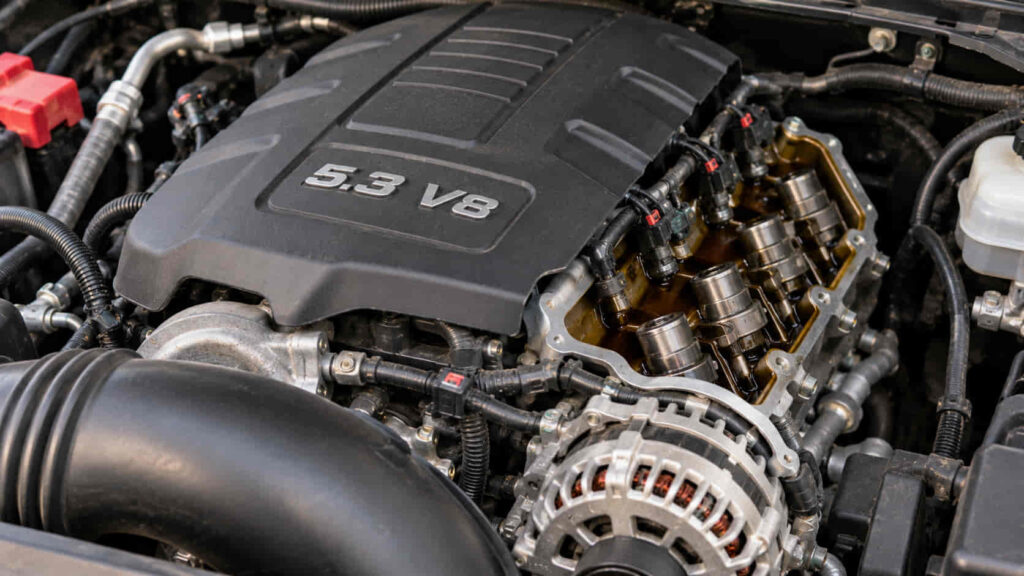
The GM 5.3 AFM years to avoid or inspect most carefully are 2007–2011, 2014–2018, and certain 2019–2021 configurations. These production periods are associated with documented concerns involving excessive oil consumption, collapsed hydraulic lifters, damaged camshafts, and cylinder-deactivation system failures.
However, not every GM 5.3L V8 engine uses the same cylinder-deactivation technology.
Earlier engines such as the LM7 generally do not have Active Fuel Management. Many 2007–2013 Chevrolet Silverado, GMC Sierra, Tahoe, Suburban, and Yukon models use Gen IV 5.3L engines equipped with AFM.
The redesigned 2014 Silverado and Sierra introduced the Gen V EcoTec3 L83, which retained AFM while adding direct fuel injection and other improvements.
Beginning with the redesigned 2019 Silverado and Sierra, GM offered two different 5.3L engines: the L82 with traditional AFM and the L84 with the newer Dynamic Fuel Management system.
Although DFM operates differently, certain 2020–2021 L84 engines have also been affected by documented lifter problems.
The strongest evidence for avoiding or carefully inspecting particular years comes from General Motors’ own service bulletins.
GM bulletin 10-06-01-008J addresses excessive oil consumption in certain 2007–2011 AFM-equipped vehicles, particularly those built before specified component revisions.
Bulletin 15-06-01-002N documents collapsed AFM lifters, damaged locking pins, bent pushrods, and possible camshaft damage in selected L83 applications.
For newer vehicles, preliminary information bulletin PIP5776F identifies a specific production window from September 1, 2020, through March 31, 2021, involving certain L84 and L87 engines.
These documents confirm that specific problems have occurred and provide diagnostic or repair procedures.
However, they do not establish a statistically verified failure-rate ranking for every model year.
The following seven groups are therefore ranked according to documented technical concerns, engine design, and the amount of inspection recommended before purchasing a used vehicle.
What Are the Worst GM 5.3 AFM Years?
The 2007–2010 GM 5.3 AFM engines and selected early-2011 examples deserve particular attention for oil consumption, while 2014–2018 L83 engines and certain 2020–2021 L84 engines warrant careful lifter inspection.
The main concern changes according to the engine generation.
Older AFM engines have documented oil consumption problems involving the crankcase ventilation system, oil spray, and piston ring deposits.
These problems can cause the engine to consume more lubricant than expected.
If the oil level is not maintained, lubrication-related damage may follow.
The L83 introduced a different generation of engine technology.
Its AFM system uses specialized hydraulic lifters that can collapse or become mechanically stuck.
The failure may produce a ticking noise, a misfire, or a bent pushrod.
In severe cases, the camshaft may also be damaged.
The L84 uses DFM rather than the older fixed-pattern AFM system.
However, it still relies on specialized deactivation lifters.
GM documented certain L84 lifter failures, including a particularly important production period spanning late 2020 and early 2021.
The most appropriate buying decision should therefore be based on the actual engine code, build date, symptoms, and repair history.
1. 2007–2008 GM 5.3 AFM — Early Oil Consumption Concerns
The 2007 and 2008 GM 5.3 AFM engines are among the first truck applications that deserve careful inspection because of documented oil consumption problems associated with the early cylinder-deactivation system.
GM introduced AFM more broadly into its half-ton truck and full-size SUV lineup for the 2007 model year.
Common 5.3L engine codes from this period include LMG, LC9, and LY5.
However, the exact engine code depends on the vehicle and configuration.
AFM allows the engine to deactivate four cylinders during certain low-load operating conditions.
The system improves fuel efficiency by reducing pumping losses when full V8 output is unnecessary.
However, certain early engines experienced excessive oil consumption.
GM bulletin 10-06-01-008J describes oil being drawn through the positive crankcase ventilation system.
It also identifies oil spray from the AFM pressure relief valve under certain operating conditions.
The resulting oil can contribute to carbon deposits around the piston rings.
These deposits may interfere with normal oil control.
Symptoms include frequent oil top-ups, fouled spark plugs, rough operation, and occasional diagnostic trouble codes.
However, these conditions are not present in every 2007 or 2008 engine.
A properly repaired example with controlled oil consumption can still be a useful vehicle.
The strongest buying precaution is to request a documented oil consumption history and check whether relevant GM updates were completed.
2. 2009–2010 GM 5.3 AFM — Oil Consumption and Piston Ring Deposits
The 2009–2010 GM 5.3 AFM engines remain important used-truck inspection candidates because they fall within the oil consumption conditions described in GM’s official service information.
These engines continued using the Gen IV small-block architecture.
They generally offered strong torque and familiar V8 performance.
However, the AFM system still used oil-controlled cylinder-deactivation components.
GM identified certain conditions in which excessive oil could be introduced into the combustion process.
This could contribute to deposits around the piston rings.
As deposits accumulated, oil consumption could increase.
Spark plugs might also become contaminated.
GM’s bulletin specifically identifies cylinders one and seven as locations where fouled or damaged plugs may be observed in affected cases.
However, the diagnostic process should not assume that every misfire in these cylinders is caused by oil consumption.
Ignition and fuel system problems can produce similar symptoms.
The engine’s PCV system should be inspected.
Previous repairs involving updated valve covers or AFM oil deflectors are also relevant.
A high-mileage 2009 or 2010 engine that consumes substantial oil may require more extensive repair than a simple valve cover replacement.
Therefore, buyers should investigate whether oil consumption has been measured and corrected.
3. Early 2011 GM 5.3 AFM — Important Manufacturing Breakpoints
Some early-built 2011 GM 5.3 AFM engines are particularly relevant because GM identified specific production dates for updated valve covers and AFM oil-control components.
The distinction between model year and actual manufacturing date is important.
GM bulletin 10-06-01-008J identifies February 1, 2011, as the production breakpoint associated with an updated valve cover.
The same bulletin identifies October 2010 as the relevant breakpoint for the AFM oil deflector.
These are component-specific dates.
They should not be interpreted as proof that every engine built afterward is free from oil consumption problems.
However, they are valuable when evaluating a used truck.
An early 2011 engine may have originally been equipped with the older valve cover or oil-control arrangement.
If excessive oil consumption occurred, the repair history may include installing updated parts.
In certain cases, cleaning carbon deposits from the piston rings was also part of the recommended service.
However, the correct repair depended on engine configuration and diagnosis.
The updated parts do not automatically restore piston rings that are already severely worn or damaged.
A buyer should therefore check both the engine’s manufacturing information and current mechanical condition.
An early-2011 truck with documented repairs and stable oil usage may be a better purchase than a later truck with unresolved symptoms.
4. 2012–2013 GM 5.3 AFM — Older Gen IV Engines Still Need Inspection
The 2012–2013 GM 5.3 AFM engines are not automatically among the worst years, but they still contain cylinder-deactivation hardware and deserve careful examination for oil consumption and lifter-related problems.
By this period, GM had introduced updates intended to address certain earlier oil-control concerns.
However, those updates did not remove the AFM system.
The Gen IV 5.3L remained in production for Silverado, Sierra, and related truck applications.
Common engine codes include LC9 and LMG, depending on configuration.
The 2014 revision of GM’s oil consumption bulletin also references selected 2012–2013 vehicles in its broader model coverage.
However, the bulletin’s component breakpoints remain important.
A 2013 engine is not necessarily equipped with the same original oil-control hardware as a 2007 engine.
Therefore, all engines from 2007 through 2013 should not be assigned an identical risk level.
When inspecting a 2012 or 2013 truck, the most useful questions concern actual oil usage, engine noise, maintenance history, and previous AFM repairs.
An engine that maintains the correct oil level between services is more attractive than one requiring frequent top-ups.
Persistent ticking or a cylinder-specific misfire also deserves investigation.
However, neither symptom automatically proves a failed AFM lifter.
The actual cause should be identified before estimating repair cost.
Read more: Best Years for 7.3 Powerstroke
5. 2014–2016 GM 5.3 L83 AFM — Collapsed Lifter and Camshaft Concerns
The 2014–2016 GM 5.3 L83 engines deserve special attention because General Motors documented AFM lifter failures that can produce ticking, misfires, bent pushrods, and camshaft damage.
The redesigned 2014 Silverado and Sierra introduced the Gen V EcoTec3 engine family.
The L83 retained the 5.3-liter displacement.
However, it introduced major changes compared with the older Gen IV Vortec engines.
These included direct fuel injection, variable valve timing, and an aluminum engine block.
The engine produced approximately 355 horsepower and 383 lb-ft of torque.
AFM remained part of the design.
The system used specialized hydraulic lifters to deactivate selected cylinders when appropriate.
However, these lifters could develop mechanical problems.
GM bulletin 15-06-01-002N identifies several possible failure conditions.
The lifter may collapse and remain stuck.
Its internal locking pin can become damaged.
A lifter may also become stuck in its bore.
The engine may develop a bent pushrod.
Symptoms can include persistent ticking, rough operation, a check engine light, and diagnostic trouble code P0300.
If the lifter roller or camshaft lobe becomes damaged, replacing only the affected lifter may be insufficient.
A thorough inspection is therefore essential.
However, the bulletin does not state that every L83 engine will experience these failures.
6. 2017–2019 GM 5.3 AFM — L83 and L82 Engine Identification Matters
The 2017–2019 GM 5.3 AFM engines should be evaluated carefully because the same model-year range includes different vehicle generations and engine configurations.
The L83 continued in Silverado and Sierra applications through the 2018 model year.
It also remained in certain full-size SUVs beyond 2018.
The 2019 Silverado LD and Sierra Limited retained the older-generation platform and L83 engine.
Meanwhile, the redesigned 2019 Silverado 1500 and Sierra 1500 introduced new powertrain options.
These included the L82 and L84 5.3L engines.
The L82 retained Active Fuel Management.
The L84 introduced Dynamic Fuel Management.
This distinction is extremely important.
A 2019 vehicle should not automatically be described as a DFM truck simply because it has a 5.3-liter V8.
Its engine code must be verified.
The L83 and L82 both use traditional AFM, although their components and vehicle applications differ.
For the L83, GM’s lifter service bulletin remains directly relevant.
The L82 has different service references, and its exact symptoms should be diagnosed accordingly.
A buyer should examine maintenance records, engine ticking, misfire history, and previous valvetrain repairs.
An older truck with completed repairs may be preferable to a newer example with unresolved problems.
The main lesson is that 2019 is a transition year, not a single uniform engine specification.
7. 2020–2021 GM 5.3 L84 DFM — Documented Lifter Failure Window
Certain 2020–2021 GM vehicles equipped with the 5.3L L84 DFM engine require particularly careful inspection because GM identified a specific manufacturing window associated with collapsed lifters and bent pushrods.
The L84 uses Dynamic Fuel Management rather than conventional AFM.
DFM can deactivate cylinders in multiple combinations.
This provides greater operating flexibility than the older fixed four-cylinder system.
However, the system still relies on specialized lifter mechanisms.
GM’s PIP5776F technical document addresses certain 2020–2021 Silverado and Sierra models.
It also includes specified 2021 Tahoe, Suburban, and Yukon vehicles.
The bulletin identifies a production breakpoint window from September 1, 2020, through March 31, 2021.
This date range is more precise than simply saying all 2021 engines are defective.
The documented condition involves misfires, collapsed lifters, lifters coming apart, and possible bent pushrods.
Diagnostic codes can include P0300 through P0308.
For affected vehicles diagnosed with the specified condition, GM provided different replacement instructions depending on mileage and production date.
However, this bulletin applies to a defined group of vehicles and does not prove that every L84 manufactured during the period will fail.
It also does not mean that DFM engines built outside the date range can never develop lifter problems.
Buyers should verify the actual build date, RPO code, and repair history.
What Is Active Fuel Management on a GM 5.3 Engine?
Active Fuel Management is GM’s cylinder-deactivation technology that temporarily disables four cylinders under selected low-load conditions to reduce fuel consumption.
When the engine does not require full V8 power, the ECM can command operation using four active cylinders.
The deactivated cylinders do not contribute normal combustion torque during that operating mode.
The system uses specialized hydraulic lifters and oil-control components.
Pressurized oil changes the internal locking state of selected lifters.
This allows the corresponding valves to remain closed during cylinder deactivation.
When more engine power is required, the ECM returns the engine to normal eight-cylinder operation.
The system can improve fuel efficiency.
However, it adds mechanical and electronic complexity.
The specialized lifters contain internal locking mechanisms.
Oil-control solenoids must also operate correctly.
If the lifter becomes mechanically stuck or its internal components fail, the engine may not operate normally.
A failure can affect valve movement even when the ECM is commanding ordinary V8 operation.
This is why a mechanical lifter problem cannot necessarily be corrected by changing software settings.
The design must be identified according to engine generation and RPO code.
When Did GM Start Using AFM on the 5.3?
GM introduced cylinder deactivation into selected 5.3L applications in the mid-2000s, before the technology became widespread in Silverado and Sierra half-ton pickups for the 2007 model year.
The earliest system was also known as Displacement on Demand.
For example, the 2005 Chevrolet TrailBlazer owner’s manual describes an optional engine system that could switch between four-cylinder and eight-cylinder operation.
However, not every 2005 or 2006 5.3L V8 had this technology.
The LM7 and certain other early engines used a conventional valvetrain without AFM.
In 2007, GM expanded cylinder deactivation into more truck and SUV configurations.
The 5.3L AFM family continued through the Gen IV generation.
The redesigned 2014 Silverado introduced the L83 EcoTec3 with AFM.
Traditional AFM also remained available in later L82 truck applications.
Therefore, it is inaccurate to claim that AFM started on every GM 5.3 in 2007.
The more precise answer depends on the vehicle and engine code.
This matters when selecting replacement engines or identifying the best non-AFM years.
What Is the Difference Between AFM and DFM?
AFM deactivates a fixed group of cylinders during certain operating conditions, while DFM can deactivate different cylinder combinations to provide more flexible fuel-saving operation.
Traditional AFM generally switches between V8 and V4 operation.
It uses a specific set of deactivation lifters.
DFM expands the operating strategy.
The system can select different patterns according to engine load and other conditions.
GM’s technical information describes numerous possible firing patterns.
The L84 5.3L is one of the engine families that uses DFM.
However, the mechanical components differ from those used in traditional AFM systems.
GM bulletin 20-NA-038 specifically distinguishes AFM, DFM, oil-control valves, and the relevant engine configurations.
The L82 uses AFM.
The L84 uses DFM in its standard configuration.
Therefore, replacement lifters and related parts should not be selected based only on engine displacement.
A part intended for an L83 should not automatically be assumed compatible with an L84.
The exact engine RPO code and VIN-specific parts catalog must determine compatibility.
Both technologies are designed to reduce fuel consumption, but their diagnostic procedures and components differ.
Are 2019–2021 GM 5.3 Engines AFM or DFM?
The 2019–2021 GM 5.3 engines can use either AFM or DFM depending on the engine code and vehicle configuration.
The L82 uses traditional AFM.
The L84 uses DFM.
Both engines appeared in redesigned Silverado and Sierra applications during this period.
This is important because the two engines can have similar advertised displacement and output.
However, their cylinder-deactivation hardware differs.
The owner should identify the engine code using the vehicle’s service information.
GM’s bulletin 20-NA-038 provides an official AFM and DFM usage chart.
The document is particularly useful for technicians diagnosing lifter problems.
It also identifies certain vehicles equipped with the RPO code YK9.
These trucks were produced with cylinder deactivation disabled by the factory control calibration.
However, they retained the related mechanical components.
Therefore, YK9 should not be described as proof that the engine contains ordinary non-deactivation lifters.
The exact engine and equipment configuration must be confirmed before choosing replacement parts or making assumptions about reliability.
Are GM 5.3 Engines Without AFM More Reliable?
GM 5.3 engines without AFM have fewer cylinder-deactivation components, which eliminates certain specialized lifter failure mechanisms, but this does not automatically make every non-AFM engine more reliable than every AFM engine.
Early non-AFM engines such as the LM7 are often preferred for mechanical simplicity.
They use conventional hydraulic lifters rather than specialized cylinder-deactivation lifters.
This removes the AFM oil-control system from the original engine design.
However, non-AFM engines still require maintenance.
They can develop oil leaks, ignition problems, fuel delivery faults, cooling system problems, and internal wear.
A poorly maintained LM7 may be less dependable than a carefully serviced L83.
Vehicle age is another concern.
An early 2000s Silverado is now more than two decades old.
Its transmission, electrical system, suspension, and chassis may require repairs regardless of engine condition.
The appropriate comparison should therefore consider the complete vehicle.
If minimizing cylinder-deactivation complexity is the highest priority, a verified factory non-AFM engine can be attractive.
However, the actual engine condition and maintenance history remain essential.
What Are the Best GM 5.3 Years Without AFM?
For buyers who want an original GM 5.3 engine without AFM, many 1999–2004 Silverado and Sierra applications equipped with the LM7 provide a straightforward starting point.
The LM7 is a Gen III 5.3L V8.
It uses a cast-iron block, aluminum cylinder heads, and port fuel injection.
The engine does not have traditional AFM cylinder-deactivation lifters.
This makes it attractive for owners who prefer a simpler original engine arrangement.
Certain later trucks also retained non-AFM engines.
However, engine identification becomes increasingly important as GM introduced cylinder-deactivation technology into additional applications.
A 2005 or 2006 5.3L should not automatically be assumed non-AFM.
Some vehicles were already using Displacement on Demand.
Likewise, a 2019 truck should not automatically be considered non-AFM or DFM-free because it has a different engine generation.
The engine RPO must be verified.
An older non-AFM truck can be a good purchase when well maintained.
However, the lower purchase price should be balanced against vehicle age and potential restoration costs.
Are 2022–2026 GM 5.3 Engines Better?
Newer GM 5.3L engines may benefit from production and service updates, but there is insufficient comparable public failure-rate data to declare every 2022–2026 engine reliably free from lifter problems.
The L84 continues the Gen V small-block design with direct injection and available DFM technology.
The engine provides approximately 355 horsepower and 383 lb-ft of torque in common applications.
GM’s June 2024 service bulletin 19-NA-218 includes various late-model engines and vehicles when discussing cold-start ticking and lifter concerns.
The bulletin identifies a lifter that has insufficient oil during initial operation as a possible cause of the noise.
However, a brief tick is not automatically proof of a collapsed lifter.
The correct diagnosis may require listening during startup, checking trouble codes, and inspecting valve operation.
Newer vehicles also have different warranty and service histories from older trucks.
However, a later production date does not eliminate every mechanical failure risk.
For 2022–2026 vehicles, buyers should check actual manufacturer service information, maintenance records, and any applicable warranty coverage.
They should not assume that the absence of a specific production-window bulletin means the engine has a guaranteed lifespan.
What Are the Signs of GM 5.3 AFM Lifter Failure?
The most recognizable symptoms of GM 5.3 AFM lifter failure include persistent engine ticking, rough idle, cylinder misfires, loss of power, and a check engine light.
A collapsed lifter may prevent its valve from opening correctly.
The engine can then develop a misfire.
The ECM may record P0300 or a cylinder-specific misfire code.
However, the code itself does not prove that a lifter has failed.
Spark plugs, ignition coils, fuel injectors, and mechanical timing problems can cause similar symptoms.
The sound of a mechanical fault also requires interpretation.
Direct-injection engines naturally produce certain injector noises.
An exhaust leak can create ticking that resembles valvetrain noise.
Therefore, a mechanic should identify the sound’s actual source.
If valve movement is abnormal, the affected lifters and pushrods may require inspection.
GM’s service bulletin also directs technicians to inspect the camshaft and lifter rollers.
A failed lifter can become a more expensive problem if associated camshaft damage develops.
Prompt diagnosis is therefore important.
How Does AFM Cause Excessive Oil Consumption?
Certain GM AFM engines can develop excessive oil consumption when oil enters the intake system through the PCV arrangement or when oil spray contributes to deposits around the piston rings.
GM describes these mechanisms in bulletin 10-06-01-008J.
Under certain conditions, oil can be pulled through the positive crankcase ventilation system.
The AFM pressure relief valve can also discharge oil spray inside the crankcase.
When the amount of oil reaching the combustion process becomes excessive, carbon deposits can accumulate.
These deposits may interfere with piston ring operation.
The engine may then consume additional oil.
However, this problem does not affect all AFM engines equally.
Engine configuration, manufacturing date, maintenance, and operating conditions matter.
GM introduced updated valve covers and oil deflectors for certain applications.
The correct repair depends on the cause.
An updated valve cover may reduce oil entering the intake.
However, severely worn or stuck piston rings may require additional work.
An owner should not assume that adding thicker engine oil will correct the underlying problem.
The appropriate diagnosis should measure actual oil consumption and inspect the relevant systems.
How Much Oil Consumption Is Too Much for a GM 5.3?
GM’s historical AFM oil consumption bulletin uses more than approximately one quart per 2,000–3,000 miles as a diagnostic reference for the specified affected applications.
However, this threshold is not a universal definition of acceptable oil consumption for every GM 5.3.
The bulletin addresses particular engine designs and production periods.
An engine that suddenly begins consuming substantially more oil should be inspected even if its rate does not match that reference exactly.
Oil loss can result from external leakage.
It may also result from internal combustion-related consumption.
The mechanic should first establish the correct oil level.
Oil use is then measured over a known distance.
The checking procedure must remain consistent.
A vehicle parked on an incline can produce misleading dipstick readings.
If consumption is confirmed, the PCV system, spark plugs, and relevant mechanical components should be inspected.
A high-mileage engine may also have ordinary piston ring or valve seal wear.
The correct repair depends on which condition is actually present.
Owners should never continue driving with a dangerously low oil level simply to complete an oil consumption test.
Can an AFM Disabler Prevent Lifter Failure?
An electronic AFM disabler can prevent the control module from commanding certain cylinder-deactivation modes on compatible vehicles, but it does not remove the specialized lifters or guarantee that they cannot fail.
This is a critical distinction.
The original AFM hardware remains inside the engine.
The specialized lifters still contain their mechanical locking components.
An electronic device does not replace worn parts.
It also cannot restore a lifter that has already collapsed or damaged its camshaft.
Certain owners use AFM-disabling devices because they want the engine to remain in V8 operation.
However, there is no manufacturer-backed evidence proving that such a device eliminates all lifter failure risk.
Compatibility also depends on the engine.
A device intended for traditional AFM should not automatically be used with a DFM-equipped L84.
Factory configurations using RPO YK9 provide another example.
GM identifies vehicles in which the cylinder-deactivation function was unavailable through the factory calibration even though the related mechanical hardware remained installed.
Any aftermarket modification should also be evaluated for warranty and emissions compliance.
A confirmed mechanical failure requires an appropriate repair rather than relying on electronic deactivation alone.
Does an AFM Delete Make the GM 5.3 More Reliable?
A complete mechanical AFM delete can remove the original cylinder-deactivation lifters when performed using compatible components, but it is not a guaranteed solution to every GM 5.3 reliability problem.
A proper mechanical conversion is more extensive than disabling the function electronically.
Depending on the engine, the work may involve replacing lifters, changing the camshaft, installing suitable oil-control components, and updating engine calibration.
However, the exact parts and procedures vary.
An L83 and an L84 should not automatically use identical conversion components.
The engine’s operating systems must remain compatible.
A poor installation can create new mechanical problems.
Removing AFM hardware also does not correct existing piston ring wear, inadequate oil pressure, or a damaged cooling system.
Legal and warranty considerations matter as well.
Changing the original engine control system may violate emissions requirements for road vehicles.
Therefore, a buyer should not assume that an AFM-deleted truck is automatically a better purchase.
The quality of the work, compatibility, operating condition, and legal compliance must be verified.
For an ordinary road vehicle, a correct factory-compatible repair is generally the more straightforward option.
How Much Does GM 5.3 AFM Lifter Repair Cost?
GM 5.3 AFM lifter repair can be expensive because accessing the lifters may require significant engine disassembly, and the total cost depends on whether the camshaft or other components are damaged.
A simple diagnostic appointment is substantially different from a complete valvetrain repair.
If a lifter has collapsed, the technician must determine which components have been affected.
The cylinder head may need to be removed according to the applicable engine service procedure.
The lifter guides must also be addressed.
GM bulletin 15-06-01-002N emphasizes that the camshaft and lifter rollers should be inspected.
If excessive wear is present, both the camshaft and lifters may require replacement.
However, the bulletin states that complete engine replacement is not necessarily required for the specified failure.
The same principle applies to newer DFM engines.
A bent pushrod or collapsed lifter must be repaired according to the relevant procedure.
Labor cost varies by vehicle and repair facility.
The total can increase when the engine has widespread internal damage.
A buyer should therefore request an itemized diagnosis rather than accepting a generic quotation for every ticking 5.3L engine.
Should You Replace the Entire Engine After AFM Failure?
A GM 5.3 engine does not always need complete replacement after an AFM lifter failure, particularly when damage is limited to repairable valvetrain components.
GM’s official service procedures distinguish between lifter damage and conditions requiring more extensive engine work.
A collapsed lifter may require replacing the affected lifters and guides.
If the camshaft has been damaged, the repair must address the corresponding components.
However, the crankshaft, engine block, and other internal parts may remain serviceable.
The correct repair depends on inspection.
If metal debris has circulated through the lubrication system, additional cleaning and component evaluation may be required.
A severe lubrication failure can also damage bearings and other internal surfaces.
In that case, replacing or rebuilding the complete engine may become economically reasonable.
However, such a conclusion should be based on the actual damage.
A truck that has a single confirmed lifter failure should not automatically be quoted for an entire engine without a technical justification.
Conversely, a repair that ignores substantial camshaft or oil-system damage may result in repeated problems.
The objective is to restore the complete engine system, not simply replace the first visibly damaged component.
How Long Do GM 5.3 AFM Engines Last?
A well-maintained GM 5.3 AFM engine can reach 200,000 miles or more, and some engines exceed 300,000 miles, but the potential for oil consumption or lifter failure makes actual condition more important than a general mileage estimate.
The 5.3L small-block architecture has a long history of commercial and passenger-vehicle use.
Its basic construction is designed to provide durable service.
However, cylinder-deactivation components introduce additional failure possibilities.
Some engines may require a major lifter repair well before reaching 200,000 miles.
Others continue operating for substantial mileage without such a failure.
The commonly discussed 200,000–300,000-mile lifespan is a practical reference rather than an officially verified average for every AFM engine.
Maintenance influences the outcome.
The correct oil and filter are important.
Oil level must also be maintained.
Cooling system problems should be repaired promptly.
A truck used for frequent heavy towing may experience different operating conditions from one used primarily on highways.
The engine’s repair history should also be considered.
A properly completed lifter repair may allow many additional miles of service.
A vehicle’s remaining lifespan cannot be predicted from the engine’s production year alone.
How to Identify Your GM 5.3 Engine Code
The most reliable way to identify whether a GM 5.3 uses AFM, DFM, or neither is to confirm its engine RPO code and factory configuration using the VIN or GM service information.
The engine code is more useful than the vehicle’s exterior appearance.
The early LM7 is generally associated with a non-AFM configuration.
Gen IV engines such as LMG and LC9 commonly use AFM.
The Gen V L83 uses AFM.
The L82 also uses traditional AFM in applicable Silverado and Sierra configurations.
The L84 uses DFM.
However, some vehicles have special equipment configurations.
The RPO code YK9 identifies certain trucks manufactured with cylinder deactivation unavailable in the factory calibration.
The mechanical components can still remain inside the engine.
Therefore, the code must be interpreted correctly.
On older GM vehicles, the Service Parts Identification label may list the RPO information.
On newer vehicles, the information may be accessible through manufacturer records or the vehicle’s electronic identification systems.
A dealership or qualified repair facility can verify the exact configuration.
This is essential before ordering replacement lifters, oil-control components, or a complete engine.
What Should You Check Before Buying a GM 5.3 AFM Truck?
A used GM 5.3 AFM truck should be inspected for oil consumption, cold-start noise, warm-idle ticking, misfire history, engine build date, and previous lifter or camshaft repairs.
A genuine cold start is useful.
However, a brief tick is not automatically proof of a failed lifter.
GM’s technical guidance specifically identifies some cold-start ticking conditions that require additional diagnosis.
The engine should also be inspected after reaching normal operating temperature.
Persistent mechanical noise deserves attention.
Diagnostic trouble codes should be checked.
Misfire codes such as P0300 through P0308 require investigation.
The oil level should also be evaluated.
A low oil level may indicate leakage, consumption, or neglected maintenance.
For 2007–2011 engines, records showing updated oil-control components can be relevant.
For L83 engines, previous lifter and camshaft repair history should be reviewed.
For L84 engines, the manufacturing window identified in PIP5776F deserves attention.
The complete vehicle must also be evaluated.
Transmission condition, frame corrosion, suspension, and electrical systems can affect ownership cost.
A professional pre-purchase inspection is particularly valuable when considering a truck with uncertain maintenance history.
Should You Buy a GM 5.3 AFM Truck With 150,000 Miles?
A GM 5.3 AFM truck with 150,000 miles can still be a reasonable purchase when its engine is mechanically healthy and the asking price reflects the complete vehicle’s condition.
The odometer alone does not establish reliability.
A truck with 150,000 miles may have received regular maintenance and appropriate repairs.
Another truck with substantially fewer miles may have unresolved oil consumption or valvetrain problems.
The buyer should examine maintenance records.
Oil change history is especially important.
The engine should be checked for unusual ticking and misfires.
Oil consumption should also be discussed with the seller.
A compression or cylinder leakage test may be appropriate when symptoms suggest mechanical wear.
The transmission should operate correctly.
A high-mileage truck may require substantial drivetrain work even if the engine remains healthy.
The most useful comparison is between the purchase price and expected future ownership costs.
A vehicle with documented lifter repairs may offer better value than an apparently original engine that already exhibits abnormal noise.
However, the quality and scope of the previous repair must be confirmed.
How to Make a GM 5.3 AFM Engine Last Longer
The best way to improve GM 5.3 AFM engine longevity is to maintain the correct oil level, follow the applicable service schedule, monitor unusual engine noise, and repair confirmed faults promptly.
The engine requires oil meeting the manufacturer-approved specifications.
The viscosity varies by engine generation.
Older Gen IV 5.3L applications commonly specify SAE 5W-30.
Many newer Gen V applications specify SAE 0W-20.
Therefore, one viscosity should not be applied to every 5.3L engine.
Oil capacity also varies.
The correct refill amount should be taken from the vehicle’s service documentation.
The engine’s Oil Life Monitor can help determine maintenance timing where equipped.
However, an oil-life percentage is not a direct measurement of the oil level.
The dipstick should still be checked.
This is especially important for engines with known consumption concerns.
Cooling system maintenance is another priority.
Overheating can damage engine components.
Persistent misfires or abnormal ticking should also be diagnosed before additional wear occurs.
A properly maintained engine may provide extensive service, but maintenance cannot guarantee that a specialized lifter will never fail.
Is the GM 5.3 AFM Worth Buying in 2026?
A GM 5.3 AFM engine can still be worth buying in 2026, but the best decision depends on the exact engine code, production period, maintenance history, and condition of the vehicle.
The 5.3L V8 remains popular because it provides useful torque and familiar small-block performance.
The engine also benefits from an extensive service and aftermarket parts ecosystem.
However, the AFM-related problems should not be dismissed.
Certain earlier engines have documented excessive oil consumption concerns.
Later L83 engines have documented lifter and camshaft-related problems.
The L84 introduced DFM and has its own service history.
Therefore, a buyer should not assume that the newest engine is automatically the most reliable.
Likewise, an older AFM engine should not automatically be rejected if it has been properly repaired and maintained.
The purchase price must reflect the risk.
A truck with a complete maintenance history and documented repairs is easier to evaluate than one with missing records.
For buyers prioritizing mechanical simplicity, a factory non-AFM 5.3 may be preferable.
For buyers seeking a newer vehicle, an L83 or L84 can still be a reasonable option after a thorough inspection.
The important decision is whether the individual truck offers good value, not simply whether its model year appears on an online list.
Final Verdict: Which GM 5.3 AFM Years Should You Avoid?
The GM 5.3 AFM years requiring the most careful consideration are 2007–2011 for oil consumption concerns, 2014–2018 for L83 lifter problems, and certain 2020–2021 L84 DFM engines for documented lifter failures.
The earlier Gen IV 5.3L engines have an important history involving oil entering the intake system and deposits developing around the piston rings.
GM identified specific component changes associated with October 2010 and February 2011.
Therefore, the production date and previous repair history are important.
The 2012–2013 engines retained AFM and still require inspection, but they should not automatically be assigned the same risk as every early production engine.
The redesigned 2014 Silverado introduced the L83.
Its AFM system has documented lifter failure modes involving internal locking pin damage, bent pushrods, and potential camshaft wear.
The 2019 model year introduced additional complexity because the L82 used AFM while the L84 used DFM.
The 2020–2021 L84 engines require careful attention to their production date, especially those within the September 1, 2020, through March 31, 2021, window described by GM.
However, these are technical risk categories rather than statistically established rankings of the worst individual years.
A service bulletin does not prove that every vehicle within its scope has failed.
The best non-AFM alternative is often a well-maintained early 5.3L such as the LM7.
However, an older truck also has age-related maintenance risks.
For anyone researching GM 5.3 AFM years to avoid, the most important recommendation is to verify the engine RPO code, check the production date and service history, and have the engine inspected for oil consumption, lifter noise, misfires, and camshaft-related symptoms before buying.
A properly maintained and mechanically healthy 5.3L can provide substantial service life regardless of whether it belongs to a commonly criticized production period.
However, a truck with unresolved oil consumption, persistent ticking, or a confirmed collapsed lifter should not be purchased without understanding the repair cost and potential extent of internal damage.