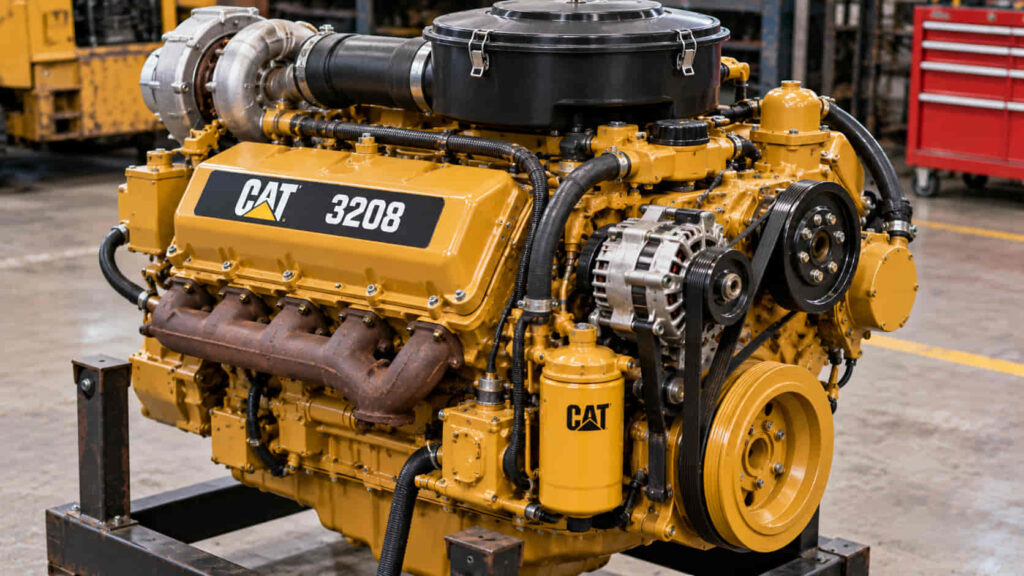
The Caterpillar 3208 is a 10.4-liter (636-cubic-inch), 90-degree V8 diesel engine with a 4.50-inch bore, 5.00-inch stroke, mechanical direct fuel injection, and two valves per cylinder. It was developed for medium-duty trucks, industrial machinery, generator sets, recreational vehicles, and marine propulsion applications.
The engine was offered in naturally aspirated, turbocharged, and turbocharged-aftercooled configurations. Depending on the application, documented industrial ratings include 175–250 horsepower, while Caterpillar’s marine performance literature identifies ratings ranging from 210 to 435 brake horsepower.
The 3208’s firing order is 1-2-7-3-4-5-6-8, and its crankshaft rotates counterclockwise when viewed from the flywheel end. Caterpillar’s marine maintenance manual identifies an intake valve lash of 0.015 inch and an exhaust valve lash of 0.025 inch.
However, 3208 Cat engine specifications vary considerably between truck, industrial, and marine installations.
For example, Caterpillar’s industrial engine maintenance manual lists oil and filter refill quantities ranging from 12 to 20 US quarts depending on the serial number and engine arrangement. Its 1998 marine manual identifies approximately 12 liters for certain naturally aspirated arrangements and 15 liters for turbocharged configurations with the applicable standard sump.
Compression ratio also varies. Caterpillar identifies 16.5:1 for several marine arrangements and 15.5:1 for its documented 435-horsepower configuration.
Another defining feature is the engine’s parent-bore cylinder block. Unlike larger Caterpillar engines equipped with removable wet cylinder liners, the 3208 uses cylinders machined directly into the block.
This design affects how the engine is rebuilt and helps explain why the 3208 has a different overhaul strategy from engines such as the Caterpillar 3306.
This guide explains Caterpillar 3208 engine displacement, horsepower, torque, bore and stroke, compression ratio, firing order, fuel injection, oil capacity, oil pressure, cooling requirements, engine weight, maintenance intervals, reliability, and common problems.
What Is the Caterpillar 3208 Engine?
The Caterpillar 3208 is a four-stroke, liquid-cooled diesel V8 designed to provide useful power in a relatively compact package for commercial, industrial, and marine applications.
The engine became established during the 1970s and was used extensively in subsequent decades.
Unlike many larger Caterpillar engines, the 3208 uses a V8 cylinder arrangement rather than an inline-six design.
Its eight cylinders are divided into two banks positioned at a 90-degree angle.
The engine contains two cylinder heads, one for each bank.
Each cylinder has one intake valve and one exhaust valve, giving the engine a total of 16 valves.
A camshaft located inside the engine block operates the valves through mechanical lifters, pushrods, and rocker arms.
The 3208 uses a mechanically controlled fuel injection system rather than the electronic common-rail technology found in modern diesel engines.
This comparatively simple arrangement is one reason the engine remains familiar to diesel mechanics.
However, the 3208 was produced in several different configurations.
Truck engines, generator engines, and marine engines may use different fuel settings, turbochargers, oil pans, cooling systems, and accessories.
The correct specifications must therefore be identified using the actual engine serial number and arrangement number.
Caterpillar 3208 Engine Displacement
The Caterpillar 3208 has a displacement of 10.4 liters, equivalent to approximately 636 cubic inches.
This is one of the engine family’s most consistent specifications.
The total displacement comes from the combined swept volume of eight cylinders.
Each cylinder has a bore of 114.3 mm and a stroke of 127 mm.
Together, these dimensions produce approximately 10.4 liters of displacement.
The engine is sometimes described as a 10.4L Caterpillar V8 or a 636 CID diesel.
These names refer to the same basic engine size.
However, displacement should not be confused with engine oil capacity.
A 10.4-liter engine does not require exactly 10.4 liters of lubricant.
The actual oil quantity depends on the sump and filtration system.
Displacement also does not establish horsepower.
Naturally aspirated engines produce less power than many turbocharged-aftercooled versions because they receive less combustion air under comparable conditions.
The same basic engine architecture can therefore support substantially different power ratings.
Caterpillar 3208 Bore and Stroke
The Caterpillar 3208 has a cylinder bore of 4.50 inches (114.3 mm) and a piston stroke of 5.00 inches (127 mm).
The bore is the nominal diameter of each cylinder.
The stroke is the distance traveled by the piston between top dead center and bottom dead center.
The 3208 has a longer stroke than bore, making it an undersquare engine.
This arrangement is common in diesel designs intended to produce substantial torque without requiring extremely high engine speed.
However, bore and stroke do not independently determine durability.
Combustion pressure, connecting rod strength, crankshaft design, bearing clearances, and lubrication also influence engine life.
The bore is especially important during rebuilding.
Because the 3208 uses a parent-bore block, cylinder wear must be evaluated directly in the block material.
A machinist may be able to restore worn cylinders using approved oversize machining and suitable pistons.
However, the available machining options depend on remaining cylinder wall condition and the applicable service specifications.
An excessively damaged block may require replacement or specialized machine work.
The exact wear limits should come from the relevant Caterpillar service manual.
Read more: Lawn Mower Oil Type
Caterpillar 3208 Horsepower Specifications
Caterpillar 3208 horsepower depends on the engine’s application, with older industrial configurations documented at 175–250 HP and marine configurations offered at 210–435 bhp.
The engine was developed for several operating environments.
An industrial engine powering machinery may require a conservative rating for sustained operation.
A medium-duty truck needs a power curve suitable for transportation.
A recreational boat may operate with a higher intermittent-duty rating.
These differences explain why horsepower varies so widely.
An earlier Caterpillar operation guide identifies industrial ratings of 175, 210, 225, and 250 horsepower at 2,800 RPM for specific configurations.
However, this should not be interpreted as an exhaustive list of every 3208 rating ever produced.
Other truck and specialized installations used additional calibrations.
Caterpillar’s marine propulsion specification identifies a broader range of 210–435 brake horsepower.
The rated output depends on turbocharging, aftercooling, fuel delivery, and intended duty cycle.
Therefore, an engine advertised as a Caterpillar 3208 should not automatically be assumed to produce 250 horsepower.
The engine’s identification plate and arrangement number should establish its actual factory rating.
Caterpillar 3208 Naturally Aspirated Horsepower
The naturally aspirated Caterpillar 3208 uses atmospheric intake airflow rather than a turbocharger, with documented industrial ratings including 175 and 210 horsepower.
Naturally aspirated engines have a comparatively straightforward air intake system.
They do not require a turbocharger to increase intake pressure.
This reduces the number of air-management components.
However, it also limits the amount of fuel that can be burned efficiently under load.
As a result, naturally aspirated versions generally produce less power than turbocharged variants.
Caterpillar’s marine brochure identifies a 210-bhp naturally aspirated configuration.
This engine is suitable for certain applications where high output is not the primary requirement.
Naturally aspirated engines can be attractive when mechanical simplicity is important.
However, they still require correct cooling, fuel filtration, lubrication, and valve adjustment.
A naturally aspirated 3208 should not be converted to a higher horsepower rating simply by increasing fuel delivery.
Additional airflow and cooling may be necessary.
The original engine’s components and duty rating must be considered before any performance modification.
Caterpillar 3208 Turbocharged Engine Specs
The Caterpillar 3208T uses turbocharging to increase intake airflow and provide greater power potential than the naturally aspirated version.
A turbocharger uses energy from the exhaust gases to drive a compressor.
The compressor increases the pressure of air entering the engine.
This allows more oxygen to enter the cylinders.
The engine can then burn additional fuel efficiently when correctly calibrated.
However, the turbocharged engine requires proper oil supply.
The turbocharger bearings depend on clean lubrication.
Excessive exhaust temperature and inadequate cooling can also contribute to turbocharger damage.
Different turbocharged 3208 arrangements have different ratings.
The installation may also use a different oil cooler or sump.
Caterpillar’s industrial service literature distinguishes some turbocharged configurations according to whether they have piston cooling jets.
These differences affect oil refill capacity.
A turbocharged engine without piston cooling jets may have different lubrication requirements from one with those components.
Therefore, a 3208T should be identified by serial number before selecting replacement parts.
The turbocharger model and fuel calibration must also match the intended application.
Caterpillar 3208TA and Turbocharged-Aftercooled Specs
The Caterpillar 3208TA uses both turbocharging and aftercooling, enabling higher factory horsepower ratings in selected marine and other applications.
Aftercooling reduces the temperature of compressed intake air.
Air becomes warmer when compressed by a turbocharger.
Cooling that air increases its density under suitable conditions.
This supports more effective combustion.
Caterpillar’s marine documentation identifies the turbocharged-aftercooled configuration as DITA.
Certain versions use a separate-circuit aftercooler.
The manufacturer published marine ratings including 375 and 435 bhp.
However, the higher-output arrangement is designed for a particular operating duty.
It should not automatically be treated as suitable for continuous full-load operation in any application.
The cooling system is especially important.
An aftercooler that becomes restricted can reduce performance and increase operating temperatures.
Marine installations also require attention to seawater passages and heat exchangers.
A high-output 3208TA should be inspected for proper cooling, fuel delivery, and turbocharger performance.
The exact rated speed and permitted operating duty must be confirmed from its Caterpillar arrangement.
Caterpillar 3208 Marine Horsepower Ratings
Caterpillar’s official 3208 marine propulsion literature lists a horsepower range of 210–435 bhp at rated speeds up to approximately 2,800 RPM for the documented configurations.
The 210-bhp version is associated with a naturally aspirated arrangement.
The 375-bhp and 435-bhp versions use turbocharging and aftercooling.
The manufacturer’s brochure identifies specific E-rated configurations intended for applications such as planing-hull pleasure craft and selected patrol or pilot boats.
However, an E rating describes an intermittent-duty application.
It should not be interpreted as permission to operate continuously at maximum power.
Marine engines are rated according to how the vessel is expected to operate.
A commercial displacement vessel may require a different duty rating from a recreational planing boat.
This can affect the appropriate horsepower selection.
The propeller must also be matched to the engine.
An incorrectly sized propeller can overload the engine and prevent it from reaching the intended rated speed.
Sustained overloading can increase temperatures and accelerate wear.
The correct marine horsepower should therefore be determined from the engine rating plate, performance documentation, and intended vessel use.
How Much Torque Does a Caterpillar 3208 Produce?
Caterpillar 3208 torque output varies substantially by horsepower rating, turbocharging arrangement, and engine speed.
Unlike displacement and firing order, torque is not represented by one universal figure.
Caterpillar’s official marine performance curves provide detailed torque values for the documented 435-bhp configuration.
The maximum-power curve identifies approximately 1,030 lb-ft of torque at 2,000 RPM.
That corresponds to approximately 1,397 Nm.
At its rated speed of 2,800 RPM, the same engine produces approximately 816 lb-ft.
This illustrates why peak horsepower and peak torque occur at different operating speeds.
However, these figures belong to the specific 435-bhp marine arrangement.
They should not be assigned to a naturally aspirated 210-horsepower engine.
A lower-rated 3208 has a different torque curve.
Truck and industrial versions may also use different fuel calibration and governor settings.
For accurate performance evaluation, the original Caterpillar performance sheet should be used.
The appropriate transmission or marine gear must also be rated for the engine’s output.
Caterpillar 3208 Compression Ratio
The Caterpillar 3208 marine engine has a published compression ratio of 16.5:1 for several configurations and 15.5:1 for the documented 435-horsepower arrangement.
The compression ratio describes the relationship between cylinder volume at bottom dead center and top dead center.
Diesel engines depend on high compression to increase air temperature before fuel injection.
This allows the injected fuel to ignite without spark plugs.
However, the compression ratio depends on piston and combustion chamber geometry.
Higher-output turbocharged engines may use different pistons from naturally aspirated versions.
The 435-bhp marine engine demonstrates this distinction.
Caterpillar specifically identifies a lower 15.5:1 ratio for that arrangement.
Therefore, not every 3208 should be described as having 16.5:1 compression.
The actual specification is important during rebuilding.
Installing pistons intended for another compression ratio can change combustion conditions.
Incorrect components may increase mechanical or thermal stress.
Replacement pistons and other internal parts should match the engine’s serial number and arrangement.
Caterpillar 3208 Firing Order
The Caterpillar 3208 firing order is 1-2-7-3-4-5-6-8.
This sequence is confirmed in Caterpillar’s marine and industrial service documentation.
The firing order identifies the sequence of combustion events across the eight cylinders.
The 3208 uses a 90-degree V8 arrangement.
Cylinder number one is located at the front of the engine on the left bank as defined in Caterpillar’s marine manual when the left and right sides are viewed from the flywheel end.
The firing order is important when checking fuel injection and mechanical timing.
The engine uses direct diesel injection.
It does not use a gasoline distributor or spark plugs.
Instead, the mechanical fuel injection system delivers fuel to each cylinder at the appropriate point in the combustion cycle.
The timing system must remain correctly synchronized.
An injection pump installed with incorrect timing can affect performance, starting, and exhaust characteristics.
The firing order should always be used together with the appropriate cylinder identification diagram.
Incorrectly identifying cylinders can lead to adjustment or diagnostic errors.
Caterpillar 3208 Valve Lash Specifications
Caterpillar specifies 0.015 inch (0.38 mm) intake valve lash and 0.025 inch (0.64 mm) exhaust valve lash for the documented 3208 marine engine.
These clearances apply to the specified adjustment conditions.
The engine must be stopped.
The valves should be allowed to cool before measurement.
Valve lash is the clearance between the valve train components when the valve is closed.
The correct clearance allows the valve train to accommodate thermal expansion during operation.
Excessive clearance can create abnormal ticking and affect valve operation.
Insufficient clearance may prevent a valve from seating correctly.
The 3208 uses mechanical lifters, pushrods, and rocker arms.
It therefore requires periodic valve lash inspection.
Caterpillar’s marine maintenance guide recommends an initial valve lash inspection after the first service period on new, rebuilt, or remanufactured engines.
It also specifies further inspections according to operating hours and fuel consumption.
However, the exact adjustment sequence should be taken from the applicable service manual.
A mechanic should not use a generic V8 valve adjustment procedure without checking Caterpillar’s cylinder order and crankshaft positioning requirements.
Caterpillar 3208 Fuel Injection System
The Caterpillar 3208 uses mechanically controlled direct diesel fuel injection rather than an electronic common-rail or HEUI system.
The engine’s fuel injection system includes individual pumping elements.
These meter and pressurize fuel for delivery to the engine’s injection nozzles.
A mechanical governor controls fuel delivery according to engine speed and load.
The system also incorporates automatic injection timing advance in documented configurations.
This helps manage fuel delivery timing across the engine’s operating range.
The design differs substantially from modern electronically controlled diesel engines.
The original 3208 does not require an ECM to command individual fuel injection events.
This can simplify certain diagnostic and maintenance procedures.
However, a mechanical fuel system still requires precision adjustment.
Injection timing, pump condition, and nozzle performance affect starting, power, smoke, and fuel consumption.
Contaminated fuel can damage injection equipment.
Air entering the fuel system may also cause starting or running problems.
The correct diagnosis should evaluate fuel supply, filters, injection timing, and the mechanical governor.
The fuel system components must match the engine’s actual arrangement.
Caterpillar 3208 Timing System
The Caterpillar 3208 uses a mechanically synchronized timing gear system to coordinate crankshaft, camshaft, and fuel injection functions.
The crankshaft drives the camshaft through its timing gear arrangement.
The camshaft operates the valves through the engine’s pushrod valvetrain.
The fuel injection system must also remain correctly timed to crankshaft rotation.
This arrangement is different from engines that use a long timing belt to drive the camshaft.
However, gear-driven timing does not mean that the system is immune to wear or incorrect assembly.
Gear condition and shaft alignment still matter.
During rebuilding, the timing components must be installed according to the manufacturer’s alignment marks and service procedure.
A fuel injection timing error can produce poor performance even when the engine’s basic mechanical components remain healthy.
Likewise, worn valve train components can affect operation.
The correct diagnostic process should distinguish injection timing problems from fuel delivery restrictions or low engine compression.
The timing system should be serviced using the exact engine serial-number-specific documentation.
Caterpillar 3208 Oil Capacity
Caterpillar 3208 oil capacity depends on the engine arrangement, with the manufacturer’s industrial and generator manual identifying several oil-and-filter refill quantities from 12 to 20 US quarts.
The documented quantities include 12, 14, 18, and 20 US quarts.
However, each value applies to a particular engine serial-number range or oil system configuration.
For example, certain early 90N-series engines were originally documented with a 12-quart capacity.
Caterpillar later specified a 14-quart capacity and dipstick recalibration for the affected engines.
Other industrial configurations use approximately 18 quarts.
Certain turbocharged versions with piston cooling jets require approximately 20 quarts.
The oil cooler configuration also matters.
Caterpillar’s manual distinguishes a shorter oil cooler on certain engines without piston cooling jets from a longer cooler used with the appropriate higher-capacity arrangements.
Therefore, an owner should not assume that every 3208 requires five gallons of oil.
Some configurations require substantially less.
The correct quantity must be determined from the engine’s serial number and installed sump.
Additional auxiliary oil filters can increase the refill requirement.
The final oil level should always be confirmed using the correct dipstick procedure.
Caterpillar 3208 Marine Oil Capacity
Caterpillar’s 3208 marine maintenance manual identifies approximately 12 liters for the 75V-series standard sump and 15 liters for the 01Z-series standard sump, including the standard oil filters.
These capacities correspond to approximately 13 and 16 US quarts after rounding.
Caterpillar’s marine product brochure expresses the quantities as approximately 3.2 and 4.0 US gallons.
The naturally aspirated arrangement is associated with the smaller refill quantity.
Turbocharged-aftercooled configurations commonly use the larger quantity in the documented marine literature.
However, the engine’s serial number and actual sump arrangement should be checked.
Marine installations may also include auxiliary filtration equipment.
Additional filters can require more oil.
The engine’s mounting angle can affect the correct dipstick calibration.
Therefore, the published quantity is an initial servicing reference.
The actual oil level should be checked after the engine has been filled, operated, and allowed the specified drain-back period.
A marine 3208 should not be filled using a truck-engine capacity without confirming compatibility.
Incorrect filling can affect lubrication and increase the risk of oil consumption or mechanical damage.
What Type of Oil Does a Caterpillar 3208 Use?
Caterpillar recommends suitable heavy-duty diesel engine oil, including SAE 10W-30 and SAE 15W-40, for the 3208 marine configurations covered by its 1998 maintenance manual.
The manufacturer identifies Caterpillar Diesel Engine Oil in both viscosity grades.
However, the appropriate viscosity depends on ambient temperature and operating conditions.
SAE 10W-30 may be suitable for cooler starting environments.
SAE 15W-40 is a common heavy-duty diesel lubricant in warmer operating conditions.
However, viscosity alone does not establish compatibility.
The oil must also meet the appropriate performance classification.
Caterpillar’s historical documentation identifies API categories such as CH-4, CG-4, and CF-4.
These classifications reflect the lubricant standards available when the manual was published.
For an engine maintained today, owners should confirm the compatibility of current heavy-duty diesel lubricants with the older engine’s requirements.
The correct choice should consider the engine’s operating environment, fuel quality, and maintenance program.
Caterpillar also notes that synthetic oil does not automatically authorize longer oil change intervals.
The lubricant should be selected according to engine-specific requirements rather than assuming that any modern diesel oil is interchangeable.
Caterpillar 3208 Oil Change Interval
Caterpillar 3208 oil change intervals vary according to application, oil capacity, operating hours, fuel quality, and the maintenance manual for the particular engine arrangement.
For the 1998 marine engine maintenance guide, Caterpillar identifies oil and filter changes every 250 service hours, annually, or after the specified amount of fuel consumption, whichever relevant limit occurs first.
The marine performance brochure also lists a 250-hour oil change interval.
However, older industrial engines may have different schedules.
Caterpillar’s industrial and generator manual identifies 200 service hours for certain naturally aspirated engines with a 14-quart sump.
It identifies 300 service hours for specified larger-capacity engines operating under the fuel and lubricant conditions stated in the document.
Therefore, 250 hours is not a universal 3208 oil change interval.
A truck may also use mileage-based maintenance guidance.
Industrial equipment generally relies more heavily on operating hours.
Marine engines operate under different load conditions.
Fuel sulfur content can also affect lubricant requirements and change intervals.
The correct schedule must follow the applicable engine manual.
Oil analysis may provide additional information about lubricant condition and internal wear.
Caterpillar 3208 Normal Oil Pressure
The Caterpillar 3208 marine maintenance manual identifies typical oil pressure of approximately 50–87 psi at rated speed when using the documented SAE 10W-30 or SAE 15W-40 oils.
This corresponds to approximately 345–600 kPa.
However, the figure applies to the relevant marine engine operating conditions.
It should not be considered the required pressure at every engine speed or temperature.
Oil pressure generally changes as the engine warms.
Cold oil may produce a higher reading.
Pressure also changes with engine speed.
A lower reading is expected at low idle than at rated speed.
However, a sudden pressure drop requires immediate attention.
The manual warns that operating without correct oil pressure can cause engine damage.
The oil level should be checked first when a pressure concern occurs.
However, low pressure can also result from a worn oil pump, excessive bearing clearance, or another lubrication-system problem.
An inaccurate gauge or pressure sender is another possibility.
The correct diagnosis should verify actual oil pressure and compare it with the engine-specific requirements.
A genuine low-pressure condition should be resolved before the engine returns to service.
Caterpillar 3208 Cooling System Capacity
Caterpillar 3208 cooling system capacity depends on the engine application and whether the specification describes the engine alone or the complete cooling installation.
For the documented industrial and generator configurations, Caterpillar lists approximately 24.5 liters for the engine-only cooling system.
The total capacity increases when a radiator is included.
The same manual identifies approximately 37.5 liters for one standard radiator configuration and 38 liters for a high-capacity radiator arrangement.
However, those values belong to the specific documented equipment.
Marine engines have different cooling arrangements.
The 1998 marine manual identifies approximately 47.3 liters for certain 75V configurations.
It lists approximately 52.8 or 56 liters for different 01Z configurations with factory-installed expansion tanks.
These values are associated with particular engine horsepower arrangements.
Additional vessel equipment may change the total cooling system capacity.
A boat’s cooling system can include heat exchangers and seawater-related components.
The engine should therefore be serviced according to its installed arrangement.
Correct coolant and corrosion protection are essential for long-term reliability.
Repeated overheating can damage cylinder heads, gaskets, and internal engine components.
Caterpillar 3208 Engine Weight
Caterpillar 3208 engine weight varies considerably according to whether the specification describes a basic industrial engine or a complete marine propulsion package.
One historical engine operation guide identifies a net dry weight of approximately 1,200 pounds, or 545 kg, for its documented basic engine configuration.
However, marine installations are substantially heavier.
Caterpillar’s marine brochure identifies approximately 1,592 pounds (722 kg) for the 210-bhp version.
The 375-bhp version weighs approximately 1,702 pounds (772 kg).
The high-output 435-bhp configuration weighs approximately 1,982 pounds (899 kg).
The difference reflects turbocharging, cooling equipment, manifolds, and other installed components.
Therefore, it would be inaccurate to assign one dry weight to every 3208 engine.
Engine weight is important during replacement.
Lifting equipment must be appropriate for the complete assembly.
A marine gearbox and other external equipment can increase the installed weight further.
Truck installations may also include different accessories.
For an engine swap, the actual dimensions and mass should be confirmed from the relevant arrangement drawing rather than relying on a generic catalog value.
Caterpillar 3208 Engine Dimensions
Caterpillar 3208 engine dimensions vary according to its turbocharging, cooling equipment, accessories, and intended installation.
The basic V8 architecture is relatively compact compared with many large inline-six industrial diesels of similar displacement.
However, different accessories change the engine’s external dimensions.
A naturally aspirated engine generally has fewer air-management components.
A turbocharged-aftercooled engine requires additional turbocharging and cooling equipment.
Marine installations may include heat exchangers, seawater pumps, and water-cooled exhaust manifolds.
These components increase the required installation space.
Caterpillar’s marine performance brochure provides separate dimensional illustrations for the relevant arrangements.
A naturally aspirated engine and a 435-bhp turbocharged marine configuration should not be assumed to occupy identical spaces.
This matters when repowering a vessel.
Engine compartment clearance, exhaust routing, shaft alignment, and maintenance access all influence feasibility.
The same considerations apply to truck and industrial replacements.
A 3208 from another application may require different mounts and accessories before it can be installed.
The correct arrangement drawings should be used for final engineering measurements.
Caterpillar 3208 Engine Applications
The Caterpillar 3208 was widely used in medium-duty trucks, buses, recreational vehicles, agricultural equipment, industrial machinery, generators, and marine vessels.
Its V8 configuration made it attractive where available engine compartment space was limited.
Medium-duty commercial trucks could use the engine for transportation and vocational work.
School buses and certain recreational vehicles also used 3208 engines.
Industrial applications included generator sets and powered equipment.
However, the output and supporting systems differed by application.
A generator engine may be configured for operation at a relatively constant engine speed.
A highway truck requires an operating range suited to changing road loads.
A marine propulsion engine must be matched to the vessel’s propeller and duty cycle.
Therefore, an engine removed from one application is not automatically a direct replacement for another.
Fuel calibration, cooling systems, flywheel housings, accessories, and engine mounts can differ.
The correct engine serial number and arrangement number are essential for determining compatibility.
Does the Caterpillar 3208 Have Cylinder Liners?
The Caterpillar 3208 uses a parent-bore cylinder block and does not have the factory-replaceable wet cylinder liners found in many larger heavy-duty diesel engines.
This is one of the most important mechanical characteristics of the engine.
The cylinder walls are machined directly into the engine block.
When the cylinders wear, they cannot simply be renewed by replacing a standard set of removable wet liners.
Instead, the block may need to be bored to an approved oversize.
The correct oversize pistons and rings must then be installed.
However, the amount of material available for machining is limited.
The block must also be inspected for cracks and other structural problems.
Specialized repair sleeves may be used by certain machine shops where technically appropriate.
However, these are not equivalent to the original engine having a factory wet-liner design.
The appropriate repair depends on block condition and machining feasibility.
This distinguishes the 3208 from engines designed for repeated in-frame overhauls using replaceable liners.
It also affects the cost and practicality of rebuilding a heavily worn engine.
Can You Rebuild a Caterpillar 3208 Engine?
A Caterpillar 3208 can be rebuilt, but its parent-bore block means the repair process differs from rebuilding a wet-liner diesel engine.
A proper rebuild begins with disassembly and inspection.
The cylinder bores must be measured for wear, taper, and out-of-round conditions.
The crankshaft journals also require dimensional inspection.
Connecting rods, bearings, pistons, and cylinder heads must be evaluated.
The fuel injection system may require separate service.
If the cylinder bores remain within repairable limits, machining and suitable replacement pistons may restore the block.
However, the engine’s specific service manual determines the permitted dimensions.
An oversize piston must match the final cylinder bore.
The correct piston compression height and combustion chamber design are also essential.
Cylinder head inspection should address valve seating and component wear.
The lubrication and cooling systems must also be restored to suitable condition.
However, an engine with severe block damage may not be economically rebuildable.
The choice between rebuilding and replacing the engine depends on component condition, available parts, machine shop capability, and the intended future workload.
Is the Caterpillar 3208 a Reliable Engine?
The Caterpillar 3208 can provide dependable service when properly maintained and operated within its intended duty rating, but its reliability varies with horsepower configuration, age, cooling condition, and maintenance history.
The engine has a comparatively straightforward mechanical fuel system.
It also uses a conventional pushrod valvetrain.
These features can make some maintenance operations less electronically complex than those on modern diesel engines.
However, the engine’s age is a significant consideration.
Many surviving 3208 installations have accumulated decades of service.
Cooling systems, fuel pumps, seals, and other components may require attention.
High-output turbocharged marine engines also operate under different demands from lower-rated industrial versions.
Sustained excessive load can increase exhaust temperature and mechanical stress.
The parent-bore block affects repair economics when severe cylinder wear develops.
However, this does not mean that every 3208 is inherently short-lived.
A properly maintained engine operating within its rating may provide extensive service.
The best reliability assessment should evaluate oil pressure, oil consumption, cooling temperature, fuel system performance, blow-by, and maintenance records.
A well-maintained lower-output engine may offer a more attractive long-term ownership proposition than an overloaded high-output engine.
Common Caterpillar 3208 Engine Problems
Common Caterpillar 3208 troubleshooting concerns include fuel injection faults, cooling system problems, oil leakage, turbocharger wear, low oil pressure, and age-related cylinder or bearing wear.
The mechanical fuel injection system is one important area.
Contaminated diesel fuel can damage injection components.
Restricted filters can reduce fuel delivery.
Incorrect injection timing may cause poor starting or abnormal exhaust smoke.
Turbocharged engines require additional inspection.
A damaged turbocharger can reduce boost pressure and increase oil consumption.
However, low boost can also result from intake restrictions or exhaust problems.
Cooling system condition is another major factor.
A restricted radiator or heat exchanger can cause elevated temperature.
In marine installations, seawater passages and cooling equipment require careful maintenance.
Oil leaks may develop as seals and gaskets age.
However, external leakage should be distinguished from internal oil consumption.
Excessive blow-by or low compression can indicate cylinder wear.
Low oil pressure may involve pump condition or internal bearing clearance.
The correct diagnosis should identify the underlying fault before major components are replaced.
How Long Does a Caterpillar 3208 Last?
Caterpillar 3208 engine lifespan depends on operating load, engine rating, service hours, fuel consumption, maintenance, and the condition of its internal components.
No single mileage or operating-hour figure guarantees how long every engine will last.
A school bus, generator, medium-duty truck, and marine propulsion engine experience different duty cycles.
Therefore, their operating histories are not directly comparable.
Caterpillar’s 1998 marine maintenance manual identifies fuel consumption as an important measure for overhaul planning.
The manual includes overhaul considerations at approximately 30,000 US gallons of fuel consumed.
However, this should not be interpreted as a mandatory overhaul point for every 3208 engine.
It is a planning reference for the documented marine applications.
Engine condition still matters.
Oil analysis, compression, blow-by, oil pressure, coolant condition, and operating performance can provide useful evidence.
A high-hour engine may remain serviceable if its critical components are healthy.
Conversely, an engine with fewer hours can require major repairs after overheating, poor lubrication, or prolonged overloading.
The appropriate overhaul decision should therefore be based on measured condition and the manufacturer’s maintenance guidance.
Caterpillar 3208 vs 3116 Engine
The Caterpillar 3208 and 3116 are different diesel engine families, with the 3208 using a 10.4-liter V8 design and the 3116 using a smaller inline-six configuration.
The 3208 uses mechanically controlled direct injection.
The 3116 was developed with a different engine architecture and fuel system design.
Its displacement is approximately 6.6 liters.
Despite being smaller, the 3116 was offered in several power configurations.
The engines also differ in physical dimensions and service procedures.
The 3208 has a relatively large V8 block.
The 3116 uses a straight-six arrangement.
Fuel injection diagnosis differs between the two designs.
The cooling and lubrication systems also use different components.
Therefore, the engines should not be compared solely by horsepower.
Their operating duty and mechanical condition matter.
A properly maintained 3208 may be preferable in an existing installation that already supports it.
However, replacing a 3208 with a 3116 can require substantial modifications.
The correct engine choice depends on available space, drivetrain compatibility, required power, maintenance access, and parts support.
Caterpillar 3208 vs 3306 Engine
The Caterpillar 3208 and 3306 have different engine designs, with the 3208 emphasizing compact V8 packaging and the 3306 using a heavy-duty inline-six architecture.
The 3208 has eight cylinders and approximately 10.4 liters of displacement.
The 3306 has six cylinders and a larger nominal displacement of approximately 10.5 liters in the common engine family.
Although their displacements are relatively close, their internal construction differs substantially.
The 3306 is associated with Caterpillar’s heavy-duty engine platform and replaceable cylinder liner design.
This can make certain overhaul operations different from those required for a 3208 parent-bore block.
The engines also have different external dimensions.
A 3306 may require a longer installation space.
A 3208 can be attractive when a V8 engine fits the available compartment more easily.
However, packaging is not the only consideration.
Power rating, torque curve, duty cycle, and service requirements must also be evaluated.
Neither engine should be selected solely according to an assumed reliability reputation.
The correct decision depends on the actual application and the condition of the available engine.
Is a Used Caterpillar 3208 Worth Buying?
A used Caterpillar 3208 can be worth purchasing when its mechanical condition, service history, and application-specific components justify the price.
The first consideration is engine identification.
The serial number and arrangement number should be documented.
The buyer should determine whether the engine is naturally aspirated, turbocharged, or turbocharged-aftercooled.
The factory power rating should also be confirmed.
A marine 435-bhp engine is not mechanically identical in every respect to a lower-output industrial version.
Maintenance records are particularly important.
The buyer should investigate previous overheating, oil consumption, fuel injection repairs, and turbocharger service.
Cold starting can provide useful diagnostic information.
Excessive smoke, unusual noise, or hard starting may indicate problems.
However, these symptoms require proper testing before conclusions are drawn.
Oil pressure should be evaluated under the manufacturer’s specified operating conditions.
Compression and crankcase pressure may also be assessed.
For marine engines, the cooling system and aftercooler deserve careful inspection.
The condition of the complete vehicle or vessel must also be considered.
A healthy engine installed in equipment with extensive additional problems may still be a poor purchase.
How to Identify Caterpillar 3208 Specs by Serial Number
The most reliable way to identify the correct Caterpillar 3208 specifications is to use the engine serial number and arrangement number with the appropriate Caterpillar service documentation.
Caterpillar’s industrial maintenance manual specifically explains that engines are identified using serial and arrangement numbers.
The manufacturer also uses modification numbers in some cases.
These identifiers establish which components were installed when the engine was manufactured.
They are especially important for the 3208.
The engine family includes different oil pans, fuel injection components, turbochargers, and cooling arrangements.
A replacement oil pump or piston should not be selected solely because it is advertised as fitting a Caterpillar 3208.
The part must match the actual configuration.
The same applies to fuel injection nozzles and crankshaft components.
A remanufactured engine may also have a reference serial number that affects the correct service specification.
Caterpillar specifically notes this distinction in its maintenance literature.
The engine identification plate should therefore be inspected before ordering parts.
An authorized Caterpillar dealer or qualified diesel engine specialist can help confirm compatibility.
Correct identification reduces maintenance errors and supports accurate repair planning.
Final Verdict: What Are the Caterpillar 3208 Engine Specs?
The Caterpillar 3208 is a 10.4-liter, 636-cubic-inch diesel V8 with a 114.3 mm bore, 127 mm stroke, mechanical direct injection, and two valves per cylinder.
Its firing order is 1-2-7-3-4-5-6-8.
The crankshaft rotates counterclockwise when viewed from the flywheel end.
The documented intake valve lash is 0.015 inch, while exhaust valve lash is 0.025 inch.
Horsepower varies according to engine application.
Older industrial configurations include ratings from 175 to 250 horsepower.
Caterpillar’s marine performance literature identifies versions producing 210–435 brake horsepower.
The high-output 435-bhp marine engine also has a different compression ratio from certain lower-output configurations.
For those documented marine engines, compression is typically identified as 16.5:1 or 15.5:1 depending on the arrangement.
Oil capacity varies substantially.
Certain industrial engines require 12–20 US quarts during an oil and filter change.
Marine configurations with the specified standard sumps use approximately 12 or 15 liters.
Engine weight also differs by installation.
Caterpillar identifies approximately 1,592 pounds for its 210-bhp marine engine and 1,982 pounds for the 435-bhp version.
The 3208 uses mechanical fuel injection and a pushrod valvetrain.
Its parent-bore block is another important characteristic because it does not contain factory-replaceable wet cylinder liners.
This influences rebuild procedures and replacement costs.
Long-term reliability depends on proper lubrication, clean fuel, correct valve adjustment, effective cooling, and operation within the intended engine rating.
For owners researching 3208 Cat engine specs, the most important step is to verify the exact serial number, arrangement number, and application before using horsepower, torque, oil capacity, weight, or maintenance information.
This ensures that the engine is serviced according to its actual mechanical configuration and helps preserve dependable operation throughout its remaining service life.