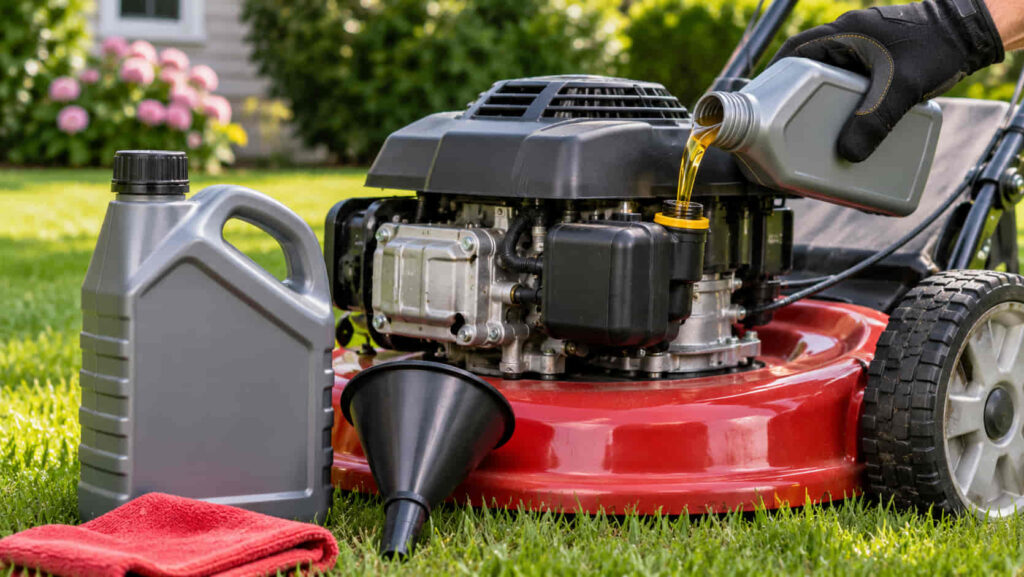
The best lawn mower oil type depends on the engine manufacturer, operating temperature, and whether the mower uses a 4-stroke or 2-stroke engine. For many conventional 4-stroke lawn mowers, SAE 30, SAE 10W-30, and full synthetic SAE 5W-30 are among the most commonly recommended choices.
Briggs & Stratton recommends SAE 30 for warm-weather operation above 40°F (4°C). SAE 10W-30 is suitable for a broader temperature range, although certain air-cooled engines may consume more oil when operating above 80°F (27°C). Full synthetic SAE 5W-30 provides additional flexibility across hot and cold conditions when approved for the engine.
However, these recommendations should not automatically be applied to every lawn mower.
Honda commonly recommends SAE 10W-30 for its 4-stroke power equipment engines. Kawasaki identifies several approved viscosity grades for its commercial and residential mower engines, while Kohler provides temperature-based recommendations for products such as the 7000 Series.
Engine design also matters. Most modern gasoline-powered lawn mowers use 4-stroke engines with a separate crankcase oil supply. Older 2-stroke mowers generally require a specified mixture of gasoline and 2-cycle engine oil instead.
The most important rule is to use an oil viscosity and performance classification approved for the exact engine model. Choosing the wrong oil can contribute to difficult starting, excessive oil consumption, insufficient lubrication, and premature engine wear.
Oil capacity is equally important. A small walk-behind mower may require less than one quart, while a riding mower or zero-turn mower with a twin-cylinder engine may require considerably more.
This guide explains the five main lawn mower oil options, how viscosity changes with temperature, what major manufacturers recommend, how much oil different engines require, and when oil changes should be performed.
What Type of Oil Does a Lawn Mower Take?
Most modern 4-stroke lawn mowers use detergent engine oil with a viscosity such as SAE 30, SAE 10W-30, or synthetic SAE 5W-30, provided it meets the engine manufacturer’s specifications.
The correct oil depends on several factors.
One is the engine’s internal design. Most walk-behind mowers use small air-cooled gasoline engines, while riding and zero-turn mowers frequently use larger single-cylinder or V-twin engines.
Another factor is operating temperature.
Air-cooled engines rely on airflow around their cooling fins to remove heat. Their lubricant must remain suitable under the temperatures encountered during mowing.
For many Briggs & Stratton engines, SAE 30 is a common warm-weather choice. Its single-grade viscosity makes it suitable for operation during typical summer mowing conditions.
However, SAE 30 can make starting more difficult when temperatures fall below 40°F.
A multigrade oil such as 10W-30 may be more convenient in climates where temperatures vary throughout the mowing season.
Full synthetic 5W-30 can provide additional cold-temperature flexibility when approved.
The oil must also meet the required performance classification.
Briggs & Stratton recommends a high-quality detergent oil meeting API service categories such as SF, SG, SH, SJ, or higher.
However, the actual engine manual should take priority over generic oil recommendations.
1. SAE 30 Lawn Mower Oil — Best for Warm Weather
SAE 30 is one of the most common oil types for 4-stroke lawn mower engines operating in temperatures above 40°F (4°C).
It is especially familiar in traditional Briggs & Stratton walk-behind mower engines.
SAE 30 is a single-grade lubricant.
Unlike a multigrade oil, its viscosity classification does not include a separate winter rating.
This makes it a straightforward choice for engines operating primarily during warm weather.
Many homeowners use their mowers only during spring and summer, when temperatures remain comfortably above freezing.
Under those conditions, SAE 30 may provide suitable lubrication when approved by the manufacturer.
However, temperature limitations matter.
Briggs & Stratton warns that using SAE 30 below 40°F can result in difficult starting.
The oil becomes less suitable for cold starting as ambient temperature decreases.
This does not mean SAE 30 is inherently inferior to multigrade oil.
It simply has a different operating-temperature application.
Owners who mow in consistently warm climates may find SAE 30 appropriate.
However, a mower used during cold mornings or across multiple seasons may benefit from another approved viscosity.
The engine manual should determine whether SAE 30 is recommended.
2. SAE 10W-30 Lawn Mower Oil — Best for Variable Temperatures
SAE 10W-30 is a widely used lawn mower oil type because it provides better cold-temperature starting characteristics than straight SAE 30 while maintaining a 30-grade viscosity classification at operating temperature.
Honda commonly recommends SAE 10W-30 for its 4-stroke power equipment engines.
Briggs & Stratton also identifies 10W-30 as suitable for varying temperatures.
Its published guidance includes a broad operating range of approximately 0–100°F for conventional 10W-30 in relevant small-engine applications.
However, the correct range depends on the product and engine.
One important limitation involves oil consumption.
Briggs & Stratton warns that using 10W-30 above approximately 80°F may increase oil consumption in certain air-cooled engines.
Therefore, owners should check the oil level more frequently during hot weather.
This does not mean every engine using 10W-30 will consume excessive oil.
Kawasaki and Kohler also approve 10W-30 for numerous mower engines when operating conditions are appropriate.
The correct choice depends on the engine’s published recommendations.
For a homeowner using a mower in moderate temperatures, an approved 10W-30 can provide a practical balance between cold starting and operating-temperature lubrication.
However, the oil’s API service classification must also meet the engine’s requirements.
3. Full Synthetic SAE 5W-30 — Best for All-Season Flexibility
Full synthetic SAE 5W-30 is an excellent all-season option for many Briggs & Stratton mower engines, especially when cold-weather starting and a broad operating-temperature range are important.
Briggs & Stratton identifies synthetic 5W-30 as one of its most versatile small-engine lubricants.
The manufacturer describes suitability for temperatures ranging approximately from -20°F to 120°F in its temperature guidance.
However, this range belongs to the applicable Briggs & Stratton recommendation rather than every engine manufactured by another company.
Synthetic oil uses specially formulated base oils and additives.
These formulations can provide favorable viscosity characteristics across a range of temperatures.
However, synthetic oil should not automatically be assumed compatible with every small engine.
The approved SAE grade and performance specification still matter.
Some manufacturers recommend different grades for specific operating conditions.
An owner should also distinguish full synthetic oil from conventional 5W-30.
Both carry the same SAE viscosity classification, but their formulations differ.
A synthetic formulation may offer additional advantages in cold starting and high-temperature stability.
Nevertheless, synthetic oil does not eliminate the need for maintenance.
Briggs & Stratton specifically states that using synthetic oil does not change the required oil change interval.
The oil level should still be checked regularly.
Read more: Ford 5.4 Triton Engine Problems
4. Conventional SAE 5W-30 — Best for Approved Cold-Weather Applications
Conventional SAE 5W-30 can be suitable for certain small engines used in colder conditions when the manufacturer specifically approves that viscosity and formulation.
The 5W winter designation indicates cold-temperature viscosity characteristics.
Compared with SAE 30, a multigrade 5W-30 can provide improved fluidity under cold conditions.
This can make starting easier when temperatures are low.
Briggs & Stratton includes conventional 5W-30 in its temperature-based oil recommendations for cold-weather operation.
However, the manufacturer also promotes synthetic 5W-30 as a more versatile option across a broader temperature range.
Conventional 5W-30 should not automatically be selected for a mower operating in extreme summer heat.
The engine manual must identify whether it is acceptable.
The distinction between viscosity and oil quality is important.
Two products can both display 5W-30 while using different base oil formulations and additive packages.
The oil must meet the necessary API service classification.
Using an unsuitable oil simply because it carries the correct viscosity label can be a mistake.
For owners who mow only during warm weather, another approved oil may be more appropriate.
Conventional 5W-30 is most relevant when the engine’s service guidance allows it and the operating conditions favor its characteristics.
5. Full Synthetic SAE 15W-50 — Best for Certain Commercial Mower Engines
Full synthetic SAE 15W-50 is recommended by Briggs & Stratton for certain demanding commercial applications, including continuous-use equipment operating in hot conditions.
Briggs & Stratton identifies Vanguard synthetic 15W-50 as a lubricant suitable for severe commercial use.
Its guidance includes a broad operating range extending into high ambient temperatures.
However, this recommendation should not be generalized to every walk-behind mower.
A small engine designed primarily for SAE 30 or 10W-30 may have different lubrication requirements.
Oil viscosity affects how the lubricant flows through the engine.
A higher viscosity grade is not automatically better.
Using excessively thick oil can interfere with lubrication under certain operating conditions.
It can also affect cold starting.
Therefore, 15W-50 should be selected only when approved by the relevant engine manufacturer.
Commercial zero-turn mowers frequently operate for extended periods.
They may also experience high ambient temperatures and significant engine loads.
These conditions make appropriate lubricant selection important.
However, the engine brand matters more than the mower’s commercial label alone.
A Kawasaki-powered zero-turn mower may have different oil guidance from a Vanguard-powered mower.
The actual engine model should determine the selected oil.
Is SAE 30 or 10W-30 Better for a Lawn Mower?
SAE 30 may be the better choice for a Briggs & Stratton mower used exclusively in warm weather, while an approved SAE 10W-30 can provide greater flexibility when temperatures vary.
The difference comes from viscosity behavior.
SAE 30 is a single-grade lubricant.
It is commonly used in small engines operating above 40°F.
SAE 10W-30 is a multigrade lubricant.
Its winter viscosity characteristics make it more suitable for colder starts.
However, using 10W-30 in certain Briggs & Stratton engines during hot weather can increase oil consumption.
The manufacturer advises checking the oil level more frequently when temperatures exceed approximately 80°F.
Honda provides a different example.
Its general power equipment guidance commonly favors 10W-30.
Therefore, SAE 30 should not automatically replace 10W-30 in a Honda engine simply because the weather is warm.
The engine’s lubrication system, published requirements, and expected temperatures should all be considered.
If both oils are approved, the operating environment can guide the decision.
If the manual specifies only one grade, that instruction should take priority.
What Is the Best Lawn Mower Oil for Hot Weather?
For warm-weather mowing, SAE 30 is a common choice for approved small engines, while certain commercial engines may use higher-viscosity synthetic oils such as 15W-50.
Hot weather creates demanding conditions for an air-cooled engine.
The engine must dissipate heat through its cooling fins and airflow system.
Its oil also experiences elevated temperatures during operation.
However, hotter weather does not automatically justify using a thicker lubricant.
The engine manufacturer determines which viscosity grades are suitable.
Briggs & Stratton recommends SAE 30 above 40°F in many conventional applications.
Its Vanguard 15W-50 formulation is intended for more demanding continuous-use conditions.
However, Honda and Kawasaki engines may have different recommendations.
A mower operating in hot weather should also have its cooling system maintained.
Grass clippings and debris can accumulate around engine cooling fins.
Restricted airflow may cause excessive temperature.
The oil level should be checked frequently, particularly when the engine is known to consume oil.
An approved lubricant cannot protect the engine adequately if the crankcase is nearly empty.
The best hot-weather strategy combines the correct oil with clean cooling passages and proper maintenance.
What Is the Best Lawn Mower Oil for Cold Weather?
Synthetic SAE 5W-30 is a useful cold-weather choice for Briggs & Stratton engines that approve it, while SAE 10W-30 is commonly recommended for many Honda engines.
Cold temperatures increase the resistance of engine oil to flow.
An unsuitable viscosity may make starting more difficult.
The engine also needs adequate lubrication immediately after startup.
Briggs & Stratton warns against using SAE 30 below 40°F because of starting difficulty.
Its synthetic 5W-30 recommendation covers a much broader temperature range.
However, a Honda engine may specify a different preferred grade.
Kawasaki also provides model-specific viscosity recommendations.
Therefore, owners should not choose a cold-weather oil based solely on brand recognition.
The actual SAE grade and applicable temperature chart matter.
Another consideration is fuel quality.
A mower that is difficult to start may have stale gasoline, a carburetor problem, or an ignition fault rather than an oil viscosity problem.
However, using an inappropriate oil can contribute to difficult starting.
For occasional winter operation, confirm that the selected lubricant remains suitable for the expected temperature.
What Oil Does a Briggs & Stratton Lawn Mower Use?
Briggs & Stratton approves several small-engine oil viscosities, including SAE 30, SAE 10W-30, synthetic SAE 5W-30, and selected commercial-use synthetic formulations.
The exact choice depends on temperature and engine application.
SAE 30 is a common warm-weather recommendation.
SAE 10W-30 is useful when temperatures vary.
Synthetic 5W-30 provides greater flexibility across different temperatures.
For demanding continuous-use applications, Briggs & Stratton also recommends Vanguard synthetic 15W-50.
However, these general recommendations should not replace the engine operator’s manual.
Briggs & Stratton specifies detergent oil meeting an acceptable API service classification.
The manufacturer also advises against using unnecessary oil additives.
Another important distinction concerns oil change intervals.
Most conventional engines require periodic oil replacement.
However, selected EXi engines use Just Check & Add technology, which has different maintenance instructions.
The engine model number should therefore be identified before servicing.
An older Briggs & Stratton engine and a newer EXi engine may not have identical requirements.
Correct maintenance includes both selecting suitable oil and maintaining its specified level.
What Oil Does a Honda Lawn Mower Use?
Honda commonly recommends SAE 10W-30 4-stroke engine oil for general use in its gasoline-powered lawn mower engines.
Honda’s official power equipment guidance identifies 10W-30 meeting API SJ for numerous applications.
However, the exact manual should be checked for the installed engine.
Popular Honda lawn mower engines include the GCV160, GCV170, GCV190, and GCV200.
These are 4-stroke gasoline engines.
They use separate oil and fuel supplies.
The engine oil should never be premixed with gasoline.
Honda also distinguishes between viscosity options according to temperature.
The applicable operator’s manual may permit other grades when operating conditions fall within the recommended range.
Oil capacity is another important consideration.
Honda identifies approximately 0.58 US quart, or 0.55 liter, for the GCV160 in its published technical specifications.
However, that amount should not be assumed correct for every GCV engine.
During servicing, the engine should be positioned level.
The oil should be checked using the method specified for the actual dipstick.
Some Honda engines require the dipstick to be inserted without threading it into the filler neck when checking the level.
The correct procedure helps prevent overfilling or underfilling.
What Oil Does a Kawasaki Lawn Mower Use?
Kawasaki approves multiple engine oil viscosities for its 4-stroke mower engines, with SAE 10W-30, 10W-40, 15W-50, and 20W-50 appearing among the grades identified in its manufacturer guidance.
However, the permitted grades depend on engine model and temperature.
Kawasaki produces several lawn mower engine families.
These include the FR, FS, FX, FT, and FD series.
Different models may have different lubrication systems, oil capacities, and operating requirements.
Kawasaki recommends checking the owner’s manual before choosing oil.
The company also offers KTECH 4-cycle engine oils and synthetic products.
However, an oil brand alone does not establish compatibility.
The viscosity and performance classification must meet the engine’s requirements.
For example, a Kawasaki FR-series engine used in a residential zero-turn mower may have different service requirements from a commercial FX-series engine.
The oil filter also matters.
Many Kawasaki V-twin mower engines use replaceable oil filters.
However, the correct filter part number depends on the engine model.
During an oil change, the technician should verify the refill quantity with or without filter replacement.
Using an oil capacity from another Kawasaki engine can lead to incorrect filling.
Can You Use SAE 10W-40 in a Kawasaki Lawn Mower?
SAE 10W-40 is an acceptable oil viscosity for certain Kawasaki mower engines when the manufacturer’s temperature chart and service requirements permit its use.
Kawasaki includes 10W-40 among the viscosities identified in its general mower oil guidance.
However, this does not mean every Kawasaki engine should use 10W-40.
The operating temperature and model are important.
A commercial mower working in hot conditions may have different needs from equipment used during cool weather.
The oil must also meet the relevant API service classification.
Using a higher viscosity grade should not be viewed as an automatic solution for an older engine.
Excessive oil consumption or unusual engine noise can indicate a mechanical problem.
Changing to thicker oil may not correct the underlying issue.
The correct approach is to verify the oil specification and inspect the engine when symptoms occur.
A Kawasaki engine should receive an approved oil that maintains suitable flow and protection under its expected conditions.
The owner’s manual remains the best reference.
What Oil Does a Kohler Lawn Mower Use?
Kohler recommends selecting engine oil according to operating temperature, with SAE 10W-30, SAE 30, and SAE 5W-30 appearing in the maintenance guidance for engines such as the 7000 Series.
Kohler’s service information recommends its own engine oils.
However, it also permits other high-quality detergent oils, including synthetic products, meeting API service class SJ or higher in the documented applications.
The appropriate viscosity depends on temperature.
This means a Kohler 7000 Series engine should not automatically receive the same oil as a small Briggs & Stratton push mower.
The engine’s operating environment matters.
Kohler produces several engine families for riding and zero-turn mowers.
These include the 7000 Series, Command PRO, and other commercial or residential engines.
Their oil capacities and service intervals may differ.
A twin-cylinder engine also contains more oil than many small single-cylinder walk-behind engines.
The correct service manual should therefore be consulted.
Oil level should be checked on level ground.
If the engine has an oil filter, the service procedure should identify whether it must be replaced during the oil change.
The final fill amount should always be confirmed using the dipstick.
What Oil Does a Toro Lawn Mower Use?
The correct oil for a Toro lawn mower depends on its installed engine rather than the Toro mower brand alone.
Toro sells a wide variety of lawn mowers.
Some are powered by Toro-branded engines.
Others use engines manufactured by Briggs & Stratton, Kawasaki, or other suppliers.
Therefore, the correct lubricant may differ between two Toro machines.
A small walk-behind mower may use a single-cylinder engine requiring a relatively small amount of SAE 30 or another approved oil.
A Toro zero-turn mower equipped with a Kawasaki engine may have different viscosity and oil filter requirements.
The correct engine model should be identified first.
The owner’s manual can then provide the approved oil specification.
If the engine was replaced during the mower’s service life, the original mower manual may not describe the currently installed engine.
The engine identification plate should be used.
The oil capacity must also match the engine.
Owners should not select oil based solely on whether the mower is labeled Recycler, TimeMaster, or TimeCutter.
The engine is the controlling factor.
What Oil Does a Husqvarna Lawn Mower Use?
Husqvarna lawn mower oil recommendations depend on the installed engine, with different specifications possible across walk-behind, riding, and zero-turn models.
Husqvarna uses several engine suppliers.
The engine manufacturer determines the appropriate viscosity and oil capacity.
A mower equipped with a Briggs & Stratton engine may use SAE 30, 10W-30, or an approved synthetic oil.
Another model with a Kawasaki engine may use different viscosity options.
The owner’s manual should identify the appropriate lubricant.
Husqvarna also manufactures other gasoline-powered outdoor equipment, including trimmers and chainsaws.
Many of those products use 2-stroke engines requiring premixed gasoline and oil.
However, that fuel mixture must not be used in a conventional 4-stroke lawn mower.
Husqvarna’s guidance for riding mowers specifically instructs owners not to mix oil with gasoline.
This distinction is important because consumers sometimes purchase oil based on brand rather than engine cycle.
The correct maintenance procedure depends on whether the equipment has a dedicated crankcase oil reservoir.
Oil type, oil capacity, and service schedule should be verified separately.
What Oil Does a Zero-Turn Lawn Mower Use?
Most gasoline-powered zero-turn mowers use 4-stroke engine oil, commonly SAE 10W-30 or another manufacturer-approved viscosity, depending on the engine.
Zero-turn mowers are available with many engine brands.
These include Kawasaki, Kohler, Briggs & Stratton Vanguard, and others.
Each engine family can have different oil requirements.
Commercial models also operate under demanding conditions.
They may be used for hours each day during the mowing season.
Therefore, oil level checks and appropriate change intervals are particularly important.
However, the term zero-turn refers to the mower’s steering and drive configuration.
It does not identify the engine oil specification.
Another important distinction involves the hydrostatic drive system.
Many zero-turn mowers use hydraulic transmissions or transaxles.
These components may require a separate lubricant.
The hydrostatic drive oil is not automatically the same as the engine oil.
Using the wrong fluid in a hydrostatic transmission can cause serious damage.
Owners should consult both the engine manual and the mower manufacturer’s drivetrain maintenance instructions.
The two lubrication systems must be serviced independently.
What Oil Does a Riding Lawn Mower Use?
Riding lawn mowers generally require approved 4-stroke gasoline engine oil, but the correct viscosity and refill quantity depend on the installed engine model.
Riding mowers frequently use larger engines than walk-behind models.
Some have single-cylinder engines.
Others use V-twin configurations.
These engines can have different oil capacities.
A riding mower with a Briggs & Stratton engine may follow that manufacturer’s temperature-based viscosity recommendations.
A Kawasaki-powered model may have a different selection of approved grades.
Kohler engines also have their own maintenance schedules.
Therefore, a riding mower’s horsepower rating does not provide enough information to determine oil type.
The owner should identify the engine model and consult its service manual.
A mower may also have a separate transmission lubrication system.
This is not necessarily serviced with engine oil.
During an engine oil change, the correct oil filter should be installed if the engine uses one.
The sump should be filled gradually.
After the engine has operated briefly, the final oil level should be checked according to the manufacturer’s instructions.
Maintaining the correct quantity is just as important as selecting the proper viscosity.
Do 2-Stroke and 4-Stroke Lawn Mowers Use the Same Oil?
No. A 2-stroke lawn mower requires oil formulated for its fuel-lubrication system, while a conventional 4-stroke mower uses engine oil in a separate crankcase.
This distinction is essential.
Most modern gasoline lawn mowers use 4-stroke engines.
These engines have a dedicated oil reservoir.
The crankcase oil lubricates internal components and is not intentionally mixed with the gasoline.
An older 2-stroke mower operates differently.
It typically receives a mixture of gasoline and 2-cycle oil.
The mixture provides lubrication as the engine operates.
The required ratio varies according to the manufacturer.
Common ratios include 50:1 and 32:1, but neither should be applied universally.
Briggs & Stratton instructs owners to use the ratio specified in the engine manual.
The company also advises mixing the fuel and oil in an approved container before filling the tank.
Putting 2-stroke oil into the crankcase of a 4-stroke mower is not an appropriate substitute for approved engine oil.
Likewise, filling a conventional 4-stroke mower with premixed gasoline can cause operating problems or engine damage.
Owners should identify the engine type before purchasing lubricant.
Can You Use Car Engine Oil in a Lawn Mower?
Automotive engine oil can be suitable for some lawn mower engines when its viscosity and performance classification meet the engine manufacturer’s requirements.
The important issue is not simply whether the oil container says automotive or small engine.
A lawn mower engine requires an appropriate viscosity grade and additive formulation.
Briggs & Stratton permits high-quality detergent oils meeting specified API service categories.
Honda also identifies API service requirements for its 4-stroke engines.
However, engine design and operating temperatures still matter.
Many lawn mower engines are air-cooled.
Their operating conditions can differ from those of liquid-cooled automobile engines.
Therefore, an automotive oil with the wrong viscosity should not be used merely because it is readily available.
A 5W-20 oil may be suitable for some specific engines but not for others.
Likewise, a 0W-20 automotive oil should not automatically replace the SAE 30 recommended for a particular mower.
The manufacturer’s temperature chart should determine the acceptable grade.
A suitable automotive oil may be an option when the exact specifications match.
However, the owner’s manual remains the authority.
Can You Use Synthetic Oil in a Lawn Mower?
Yes. Many modern 4-stroke lawn mower engines can use synthetic oil when the lubricant meets the appropriate viscosity and performance requirements.
Briggs & Stratton explicitly approves synthetic oils for relevant small-engine applications.
It identifies synthetic 5W-30 as a versatile option across different temperatures.
Kawasaki and Kohler also recognize suitable synthetic formulations within their published oil recommendations.
However, synthetic oil does not create universal compatibility.
An engine requiring a particular SAE grade must still receive an approved viscosity.
Synthetic oil also does not automatically permit longer maintenance intervals.
Briggs & Stratton specifically states that its recommended synthetic oil does not change the required oil change schedule.
The engine may still require an oil change every 50 operating hours or annually under the relevant instructions.
Synthetic oil also does not repair existing mechanical wear.
If the engine is losing oil because of worn piston rings or a leaking gasket, changing lubricant type may not address the cause.
The most useful benefit is selecting a quality-approved formulation appropriate for the engine and operating environment.
Can You Mix SAE 30 and 10W-30 Lawn Mower Oil?
Mixing SAE 30 and SAE 10W-30 is not the preferred routine maintenance approach because the resulting blend does not have a verified viscosity classification or manufacturer-approved operating range.
Both may be suitable oils for certain engines when used separately.
However, adding one to the other changes the lubricant mixture.
The exact resulting viscosity and additive balance cannot be confirmed from the bottle labels alone.
An emergency top-up with a compatible detergent engine oil may be less damaging than continuing to operate with dangerously low oil.
However, the correct action depends on the engine and available products.
For normal maintenance, use one approved oil grade.
If an unsuitable oil has been added, the crankcase should be serviced according to the manufacturer’s guidance.
The oil should never be mixed with gasoline in a conventional 4-stroke engine.
Owners should also avoid adding aftermarket oil treatments without manufacturer approval.
Briggs & Stratton specifically advises against unnecessary special oil additives.
Proper lubrication depends on the correct product and quantity rather than combining multiple products in an attempt to improve protection.
How Much Oil Does a Lawn Mower Take?
Lawn mower oil capacity varies widely, from approximately 15 fluid ounces in certain small walk-behind engines to more than two US quarts in some larger riding mower engines.
The correct amount depends on the engine model.
For example, Briggs & Stratton lists a 15-US-fluid-ounce oil capacity for its EX550 and EX625 push mower engines.
That is approximately 0.44 liter.
Honda identifies approximately 0.58 US quart, equivalent to 0.55 liter, for the GCV160.
However, a larger V-twin mower engine may require substantially more oil.
Filter replacement can also affect refill quantity.
Some engines have an oil filter.
Others rely on a simpler lubrication system without an external replaceable filter.
The oil capacity specified without filter replacement may differ from the amount required when a new filter is installed.
Owners should never fill the crankcase based only on mower deck width or engine horsepower.
The engine’s service manual provides the appropriate capacity.
After adding oil, the level should be checked according to the manufacturer’s procedure.
The correct dipstick reading is more important than forcing the entire amount from a purchased oil container into the engine.
How Often Should You Change Lawn Mower Oil?
Many conventional lawn mower engines require oil changes after an initial break-in period and then at regular operating-hour or annual intervals, but the correct schedule is engine-specific.
Briggs & Stratton recommends an initial oil change after the first five hours for relevant conventional new engines.
Its general maintenance guidance also identifies a 50-hour or annual service interval for many small-engine applications.
However, not every Briggs & Stratton engine uses the same schedule.
Kohler 7000 Series maintenance documentation identifies oil and filter replacement at 100-hour intervals for relevant models.
Other engines may have shorter service requirements.
Operating conditions also matter.
Heavy dust, high heat, continuous use, and difficult mowing conditions can justify more frequent maintenance where the manufacturer’s schedule requires it.
Oil level should be checked before use.
This is particularly important for engines that do not have a low-oil shutdown system.
The oil may become low between scheduled services.
Another important exception involves selected Briggs & Stratton Just Check & Add engines.
These engines have a different maintenance approach.
Therefore, a general 50-hour schedule should not be applied blindly.
The operator’s manual should determine the correct requirements.
Do Briggs & Stratton Just Check & Add Engines Need Oil Changes?
Certain Briggs & Stratton engines equipped with Just Check & Add technology are designed to operate without the conventional scheduled oil-change procedure specified for many older engines.
This feature is associated with selected Briggs & Stratton EXi and related engine models.
The manufacturer describes the system as allowing owners to check the oil and add more when necessary.
However, this does not mean the engine can operate without oil.
The correct level must still be maintained.
The owner should check the dipstick according to the engine’s instructions.
Oil must be added when the level becomes low.
The feature also does not mean every Briggs & Stratton engine is maintenance-free.
Air filter care, spark plug service, cooling system cleaning, and other maintenance tasks remain important.
A mower should only follow the Just Check & Add approach if its engine specifically carries that technology and the owner’s manual confirms it.
An ordinary engine that requires oil changes should not be serviced using the same approach.
This distinction helps prevent owners from accidentally neglecting oil changes on engines that still require them.
How to Check Lawn Mower Oil Level Correctly
The lawn mower oil level should be checked with the engine stopped, the machine positioned on level ground, and the dipstick used according to the manufacturer’s instructions.
The engine should be cool or allowed the appropriate drain-back time before measuring.
The area around the oil filler should be cleaned first.
This helps prevent grass, dust, and other debris from entering the crankcase.
The dipstick is removed and wiped clean.
It is then reinserted using the correct checking method.
However, not all dipsticks work identically.
Some must be inserted fully without threading the cap into the filler neck.
Others require the cap to be seated in a specific way.
The owner’s manual should determine the correct method.
The oil reading should fall within the approved operating range.
If the level is low, the correct lubricant should be added gradually.
Overfilling should be avoided.
An excessively high level can create operational problems.
The engine should also be inspected when oil consumption increases unexpectedly.
A properly maintained mower should not be operated when the oil level is outside the approved range.
How to Change Oil in a Lawn Mower
Changing lawn mower oil involves safely stopping the engine, draining the old lubricant, installing any required filter, and refilling the crankcase with the approved oil.
The engine should be warm enough for the used oil to drain effectively, but not dangerously hot.
The mower should be positioned on stable, level ground.
The ignition system must be secured against accidental starting.
For a conventional gasoline-powered mower, this commonly involves disconnecting the spark plug lead.
The manufacturer’s procedure should be followed.
The area surrounding the oil fill and drain points should be cleaned.
A suitable container should be placed beneath the drain opening.
The used oil can then be removed using the method specified for the engine.
Some walk-behind engines use a drain plug.
Others are designed for oil extraction or controlled draining through a specified opening.
The mower should not be tilted arbitrarily because fuel or oil may enter the wrong engine areas.
If the engine has a replaceable oil filter, it should be serviced according to the manual.
The crankcase is then filled with the approved oil.
The technician should add the oil gradually and verify the final dipstick reading.
After the engine has operated, the level and possible leaks should be checked again.
Used oil should be taken to an appropriate recycling or disposal facility.
What Happens if You Put Too Much Oil in a Lawn Mower?
Overfilling a lawn mower engine can cause abnormal crankcase operation, oil entering the intake system, excessive smoke, or other mechanical problems.
The crankcase is designed to operate with a specified amount of lubricant.
Excessive oil can be disturbed by moving engine components.
Under certain conditions, this may cause oil aeration or increased crankcase pressure effects.
Oil may also enter the air filter housing through the ventilation system.
The engine can then produce visible exhaust smoke.
However, white or blue smoke does not automatically prove that the engine was overfilled.
Other causes include incorrect mower tilting, worn piston rings, and certain internal engine problems.
The correct response begins by checking the oil level.
If the level exceeds the manufacturer’s maximum mark, the excess lubricant should be removed.
The engine should then be inspected for continuing symptoms.
Adding more oil than the specified amount does not provide additional protection.
The correct operating level allows the lubrication system to work as designed.
What Happens if You Use the Wrong Lawn Mower Oil?
Using an unsuitable lawn mower oil can contribute to difficult starting, abnormal oil consumption, poor lubrication, or premature wear, depending on the viscosity and engine requirements.
The severity depends on what was added.
A manufacturer-approved 10W-30 used in place of SAE 30 may be acceptable under certain temperatures.
However, an unapproved viscosity may create problems.
Using straight SAE 30 during very cold weather can make starting more difficult.
Briggs & Stratton also warns that 10W-30 may increase oil consumption at high temperatures in certain engines.
The wrong oil performance classification can also be problematic.
An engine that requires a detergent lubricant should not automatically receive a nondetergent product.
Another serious mistake is confusing 2-cycle and 4-cycle oil.
A conventional 4-stroke mower should not receive gasoline mixed with 2-cycle oil.
A 2-stroke engine should not be operated on gasoline alone when its design requires premixed fuel.
The engine manual should determine the correct product.
If the wrong lubricant has been added but the engine has not yet been started, the fluid should be corrected before operation.
If the engine has already run and developed abnormal symptoms, further inspection may be necessary.
Is 10W-30 the Best Lawn Mower Oil for Every Engine?
No. SAE 10W-30 is a versatile lubricant, but it is not universally the best oil for every lawn mower engine or operating temperature.
Honda commonly recommends it for general 4-stroke power equipment use.
Kawasaki and Kohler also permit it in many applications.
However, Briggs & Stratton frequently recommends straight SAE 30 for warm-weather operation.
The same manufacturer identifies synthetic 5W-30 as a strong all-season choice.
Commercial applications can have additional requirements.
Some approve higher-viscosity synthetic products.
Therefore, one oil grade cannot be treated as the best choice for every mower.
The engine’s manufacturing date, internal design, and operating temperature should be considered.
The correct API service classification is also important.
A mower operating in a hot tropical climate may have different needs from one occasionally used near freezing.
However, the engine manufacturer’s service information should always control.
Choosing the correct lubricant is more reliable than selecting one popular oil and using it in every piece of outdoor equipment.
How to Choose the Correct Lawn Mower Oil Type
The correct lawn mower oil type is determined by the engine model, 2-stroke or 4-stroke design, temperature range, viscosity requirement, and lubricant performance classification.
The engine manufacturer and model should be identified first.
The engine may be manufactured by Briggs & Stratton, Honda, Kawasaki, Kohler, or another company.
The mower’s exterior brand does not always identify the engine manufacturer.
The owner’s manual should then be checked.
It provides the approved oil viscosity and operating-temperature guidance.
The required API classification or other performance specification must also be considered.
The expected climate influences the selection when more than one grade is approved.
SAE 30 may be appropriate for warm-weather operation.
SAE 10W-30 may be preferable for certain variable-temperature applications.
Synthetic 5W-30 can provide broader temperature flexibility for engines that approve it.
Specialized commercial engines may use additional grades.
Oil capacity should be identified separately.
A correct oil type added in the wrong quantity can still cause problems.
The maintenance interval should also be verified.
Finally, the oil level should be checked before operation and after servicing.
This process provides a more dependable choice than using one universal oil recommendation.
Final Verdict: What Is the Best Lawn Mower Oil Type?
The best lawn mower oil type for many conventional 4-stroke engines is SAE 30 for warm-weather use, SAE 10W-30 for variable temperatures, or full synthetic SAE 5W-30 for broad temperature flexibility when approved by the manufacturer.
However, the engine owner’s manual must determine the final selection.
Briggs & Stratton recommends SAE 30 for many engines operating above 40°F.
It also recognizes 10W-30 and synthetic 5W-30 for different conditions.
Its Vanguard synthetic 15W-50 is intended for selected demanding commercial applications.
Honda commonly recommends 10W-30 for general 4-stroke mower engine use.
Kawasaki approves several viscosity grades depending on engine model and operating environment.
Kohler’s 7000 Series guidance includes SAE 30, 10W-30, and 5W-30 according to temperature.
The difference between 2-stroke and 4-stroke engines is equally important.
Most modern gasoline lawn mowers use 4-stroke crankcase oil.
Older 2-stroke equipment may require a specified fuel-and-oil mixture.
The two lubrication systems must not be confused.
Oil capacity also varies.
A small walk-behind engine may hold approximately 15–20 fluid ounces, while larger riding mower engines can require much more.
The manufacturer’s refill specification and dipstick procedure should always be followed.
Maintenance is another important part of engine protection.
Some conventional engines require an initial oil change after break-in and periodic changes afterward.
Selected Briggs & Stratton Just Check & Add engines have different requirements.
The safest approach is to identify the exact lawn mower engine, use an approved SAE viscosity and API service category, fill to the specified level, and follow the manufacturer’s maintenance schedule.
Correct oil selection and regular maintenance help protect the engine from avoidable wear and support reliable mowing performance throughout its service life.