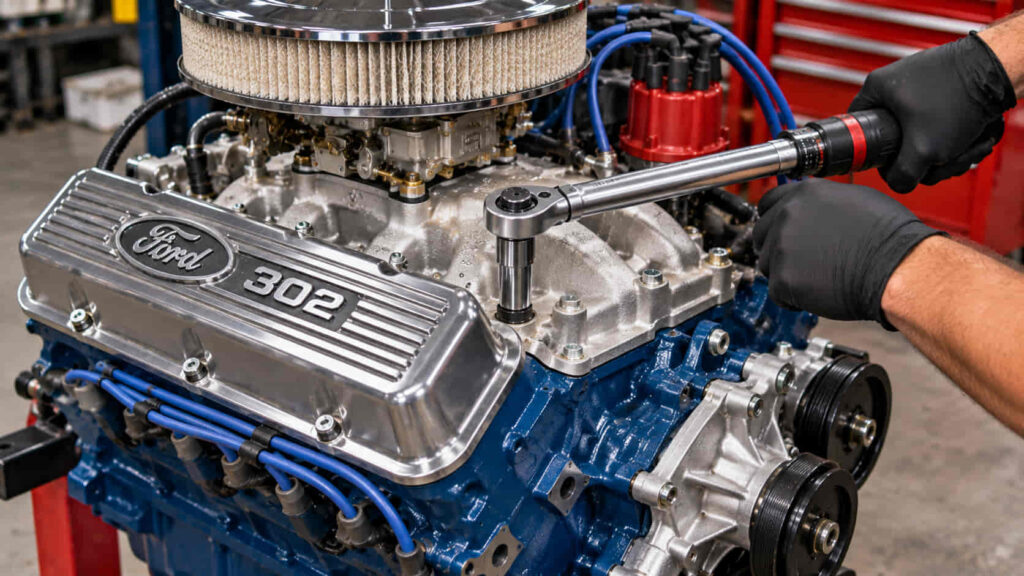
Ford 302 Torque Specs Guide: Head Bolts, Main Bearings, Rods & Assembly
Ford 302 torque specifications depend on the engine’s production year, fastener design, cylinder head material, and whether the engine uses factory or aftermarket hardware. For a conventional Ford 5.0L Windsor assembly, common specifications include 60–70 lb-ft for main bearing cap bolts, 19–24 lb-ft for original-style connecting rod fasteners, 40–45 lb-ft for the camshaft sprocket bolt, and 75–85 lb-ft for flywheel mounting bolts.
However, these figures are not universal for every Ford 302 engine.
The Ford 302 Windsor was produced in numerous configurations, beginning in 1968. Early carbureted engines, later fuel-injected 5.0L engines, Mustang High Output versions, and performance-built engines can use different components and tightening procedures.
Cylinder head bolts are particularly important. Ford specifies a conventional two-stage tightening procedure for certain original head bolts, while later torque-to-yield fasteners require a torque-plus-angle procedure.
Aftermarket fasteners create additional differences. For example, ARP specifies 70 lb-ft for its Ford 289–302 head bolt kit 154-3601 and 80 lb-ft for its head stud kit 154-4001 when installed with the specified ARP Ultra-Torque lubricant.
The correct Ford 302 torque specs must always match the actual fastener, engine block, cylinder head, and assembly instructions.
Using the wrong specification can cause damaged threads, distorted bearing clearances, head gasket leakage, oil leaks, or serious internal engine damage.
This Ford 302 torque specs guide covers cylinder head bolts, main bearings, connecting rods, intake manifolds, camshaft hardware, crankshaft dampers, flywheels, rocker arms, oil pumps, oil pans, and other common engine fasteners.
It also explains the differences between original Ford hardware, torque-to-yield fasteners, ARP bolts and studs, and modern Ford Performance engine components.
What Are the Ford 302 Engine Torque Specs?
Ford Racing’s M-6007-B50/B51/XE3/XB3 5.0L engine installation instructions provide a useful reference for many conventional 302 Windsor assembly specifications.
For this particular engine family, Ford specifies 60–70 lb-ft for the main bearing cap bolts.
The connecting rod nuts require 19–24 lb-ft.
The camshaft sprocket bolt requires 40–45 lb-ft.
The crankshaft damper retaining bolt requires 70–90 lb-ft.
Flywheel mounting bolts require 75–85 lb-ft.
Rocker arm fulcrum bolts require 18–25 lb-ft.
Cylinder head bolts have different procedures depending on their design.
Conventional head bolts are tightened to 55–65 lb-ft during the first stage and 65–72 lb-ft during the second stage.
For the torque-to-yield head bolts identified in Ford Racing’s instructions, the procedure uses 35 lb-ft, followed by 55 lb-ft, followed by an additional quarter-turn.
However, a separate Ford service bulletin for production 5.0L engines specifies an initial range of 25–35 lb-ft, followed by 45–55 lb-ft and a final 90-degree turn for the relevant torque-to-yield hardware.
This difference illustrates why the specific fastener instructions must take precedence over a generalized chart.
Additional torque values apply to the intake manifold, oil pump, timing cover, oil pan, and other components.
The following sections explain these specifications and their limitations in detail.
Why Do Ford 302 Torque Specs Vary by Year?
Ford 302 torque values differ because Ford revised engine components, cylinder head fasteners, valvetrain arrangements, and other mechanical details throughout the engine’s production history.
The Ford 302 belongs to the Windsor small-block V8 family.
Its basic architecture remained recognizable over several decades.
However, the components were not completely identical.
Earlier engines generally used conventional cylinder head fasteners.
Ford introduced torque-to-yield cylinder head bolts during the 1992 production period.
By the 1993 model year, Ford’s service information identifies torque-to-yield bolts as standard for the relevant production 5.0L applications.
These fasteners require a different installation method.
Other differences involve cylinder heads.
A conventional cast-iron cylinder head may have different intake manifold tightening requirements from an aftermarket aluminum head.
Performance engines can also use upgraded connecting rods and crankshaft hardware.
The Ford Performance Boss 302 block is another important example.
It uses different cylinder head fastener dimensions from a standard production Windsor block.
Therefore, a specification for the Boss 302 block should not automatically be applied to an original 302.
The engine’s actual hardware determines the correct torque.
Production year helps identify that hardware, but previous repairs and modifications can change the configuration.
Ford 302 Main Bearing Cap Bolt Torque
The Ford 302 main bearing cap bolt torque is 60–70 lb-ft for the conventional production-style configuration documented in Ford Racing’s 5.0L engine instructions.
The main bearing caps secure the crankshaft inside the engine block.
They must provide sufficient clamping force to maintain the intended bearing bore geometry.
Correct tightening is essential.
If the bolts are insufficiently tightened, the caps may not remain properly seated under operating loads.
Excessive tightening can affect the bearing housing geometry or damage the hardware.
During assembly, the bearing caps must return to their intended positions and orientations.
They are not generic interchangeable components.
The main bearing surfaces should be clean.
Bearing shells must also be correctly positioned.
The bolts should be installed according to the relevant lubrication requirements.
The final torque is applied using a calibrated wrench.
However, torque alone does not establish proper bearing clearance.
A qualified builder must measure the crankshaft journals and installed bearing bores.
A crankshaft that rotates with unexpected resistance may indicate incorrect bearing clearance, improper cap installation, or another mechanical problem.
The 60–70-lb-ft range should not be applied to aftermarket main studs or specialized four-bolt-main performance blocks without checking their individual instructions.
Ford 302 Connecting Rod Bolt Torque
The original-style Ford 302 connecting rod fasteners in the documented 5.0L production-based engine require approximately 19–24 lb-ft.
This specification appears in Ford Racing’s M-6007-B50 family instructions and in service information for several later 5.0L truck applications.
The connecting rod cap secures the large end of each rod around a crankshaft journal.
Correct fastener preload helps maintain the intended bearing geometry.
However, the torque figure depends on the connecting rod and fastener design.
This is particularly important during a performance rebuild.
Aftermarket connecting rods may use larger or stronger bolts.
They may also require specialized assembly lubricant.
Certain high-performance rod bolts are installed using a specified bolt-stretch measurement.
That procedure can provide a more direct indication of fastener elongation than relying exclusively on torque.
The builder should therefore identify the rod manufacturer and bolt part number.
The original 19–24-lb-ft figure must not automatically be used with every ARP rod bolt.
Likewise, a torque value published for a forged racing rod should not be applied to original production connecting rods.
During assembly, the rod caps must be installed in their matched positions.
Bearing clearance and crankshaft rotation should be checked before the engine is completed.
Ford 302 Cylinder Head Bolt Torque
Ford 302 cylinder head bolt torque depends primarily on whether the engine uses conventional head bolts, torque-to-yield head bolts, or aftermarket performance hardware.
For the conventional bolts documented in Ford Racing’s M-6007-B50 instructions, the procedure has two stages.
The first stage tightens the bolts to 55–65 lb-ft.
The second stage increases the torque to 65–72 lb-ft.
These values apply to the relevant Ford conventional fasteners.
However, later production engines may use torque-to-yield hardware.
These bolts are tightened to a specified initial torque and then rotated through an additional angle.
The procedure is designed to produce the intended clamping force through controlled fastener elongation.
It is not equivalent to tightening an ordinary bolt to a single final torque.
Ford’s service bulletin for the 5.0L specifies different procedures according to bolt type.
The bulletin also states that conventional and torque-to-yield head bolts must not be mixed on the same cylinder head.
Correct cylinder head clamping is essential for sealing combustion pressure, coolant passages, and oil passages.
The gasket manufacturer may also provide additional instructions.
If aftermarket head bolts or studs are installed, their instructions take precedence over the original Ford torque values.
Ford 302 Conventional Head Bolt Torque Sequence
Conventional Ford 302 cylinder head bolts should be tightened in the manufacturer’s specified sequence, beginning with the appropriate central fasteners and progressing outward in a balanced pattern.
The purpose of the tightening sequence is to distribute clamping force evenly across the cylinder head.
Uneven tightening can distort the head or place excessive pressure on localized areas of the gasket.
The cylinder head must be correctly seated on the engine block.
The head gasket should be installed in the proper orientation.
The threaded holes must be clean.
The fasteners should also receive the specified lubricant or thread sealant.
For the documented conventional Ford Racing fasteners, the initial tightening stage is 55–65 lb-ft.
The second stage is 65–72 lb-ft.
However, the exact position-by-position sequence should come from the correct Ford service manual or cylinder head manufacturer.
An informal description such as tightening from the center outward is not a complete substitute for the manufacturer’s numbered diagram.
The sequence must also be repeated correctly at each tightening stage.
A cylinder head that has been resurfaced or replaced may have additional requirements.
The engine builder should confirm gasket compatibility and surface condition before tightening.
Correct torque and sequence work together to establish reliable cylinder head sealing.
Ford 302 Torque-to-Yield Head Bolt Specs
Ford’s production 5.0L torque-to-yield head bolt procedure uses an initial tightening stage of 25–35 lb-ft, a second stage of 45–55 lb-ft, and a final additional 90-degree turn for the specified hardware.
The values are documented in Ford’s cylinder head bolt service bulletin.
The final stage is measured by bolt rotation rather than by a conventional final torque reading.
A torque-angle gauge can help achieve the required rotation accurately.
However, the bolts must also be tightened in the correct sequence.
Ford’s bulletin specifically identifies torque-to-yield fasteners as one-time-use components.
They must be replaced after removal.
Reusing stretched torque-to-yield head bolts can produce incorrect clamping force.
This increases the risk of head gasket leakage or fastener failure.
The fastener design must be identified before beginning assembly.
Ford distinguishes conventional non-flanged bolts from the flanged torque-to-yield design used in the relevant applications.
The bulletin also cautions against mixing fastener types on one head.
Certain Ford Performance engine kits contain their own torque-to-yield instructions.
For example, the M-6007-B50 instructions specify 35 lb-ft, 55 lb-ft, and an additional quarter-turn for the identified performance gasket kit.
Therefore, the actual fastener and gasket documentation must determine which procedure applies.
Did Ford Change the 302 Head Bolts in 1992?
Yes. Ford’s service documentation identifies 1992 as a transition year for 5.0L cylinder head bolts, with torque-to-yield hardware becoming standard in the relevant production engines for 1993.
This is an important detail when rebuilding a 1992 Ford 302.
Depending on the engine’s build date, it may have originally used conventional bolts or torque-to-yield bolts.
The production transition means that a model-year lookup alone may not always establish which tightening procedure applies.
Ford’s service bulletin explains how to distinguish the bolt types.
It also warns that the two designs must not be combined on the same cylinder head.
A vehicle may have undergone previous repairs.
Replacement hardware could differ from the original factory installation.
For that reason, the mechanic should inspect the actual fasteners.
When new bolts are purchased, the correct installation instructions should be followed.
A 1993 or later engine that originally used torque-to-yield bolts may also have been rebuilt with approved aftermarket conventional bolts or studs.
In that situation, the aftermarket hardware instructions become relevant.
The correct procedure should be selected according to the fastener being installed rather than simply copying a torque figure associated with the vehicle year.
Ford 302 ARP Head Bolt Torque Specs
ARP specifies a final tightening torque of 70 lb-ft for its Ford 289–302 head bolt kit 154-3601 when installed with the specified ARP Ultra-Torque assembly lubricant.
This kit uses 7/16-inch high-performance fasteners.
The published installation procedure requires tightening in three equal stages.
The cylinder head manufacturer’s tightening sequence must also be followed.
However, the 70-lb-ft figure is specific to the identified kit and lubricant.
ARP instructs installers to clean the block threads thoroughly.
The washer must be oriented correctly.
The chamfered side faces the bolt head to accommodate the radius beneath the head.
The company also distinguishes between blind threaded holes and holes entering the coolant jacket.
Where the threads communicate with the water jacket, ARP specifies its thread sealer.
For blind holes, the instructions call for the designated assembly lubricant.
The lubricant must also be used beneath the bolt head and at the specified washer surfaces.
These requirements affect clamping force.
Using ordinary engine oil in place of the specified lubricant may change the relationship between measured torque and actual bolt preload.
Therefore, a torque figure should never be separated from its associated lubrication instructions.
The current instructions supplied with the actual ARP kit must be followed.
Ford 302 ARP Head Stud Torque Specs
ARP’s Ford 289–302 head stud kit 154-4001 specifies a final nut torque of 80 lb-ft when installed using ARP Ultra-Torque lubricant.
This kit uses 7/16-inch studs designed for the applicable Windsor cylinder head arrangement.
ARP specifies that the studs should be threaded into the block hand-tight.
The installer should not use the final nut torque value to tighten the studs themselves into the block.
The cylinder head is placed over the installed studs.
Washers and nuts are then fitted.
The stud threads, nuts, and washers must receive the specified assembly lubricant.
ARP requires tightening the nuts in three equal stages to the final 80-lb-ft value.
The correct cylinder head tightening sequence must be followed.
However, the 80-lb-ft specification is not universal for every ARP head stud product.
Different materials, fastener dimensions, and kits may require different procedures.
The instructions for kit 154-4001 should not be transferred to a larger 1/2-inch stud arrangement.
Likewise, a Ford Performance Boss 302 block may have different head fastener requirements from a production Windsor block.
A reliable installation depends on identifying the actual hardware.
The correct torque, lubrication, thread engagement, and tightening sequence must all be verified.
Ford 302 Intake Manifold Bolt Torque
Ford 302 intake manifold torque varies by cylinder head and manifold configuration, with documented values ranging from 15–18 lb-ft for specified Ford Performance aluminum-head installations to 23–25 lb-ft for a 1996 F-150 5.0L factory application.
This difference is especially important during engine modifications.
Ford Performance’s M-6007-X302B/X302E crate engine guide specifies tightening the intake manifold bolts in two stages.
The first stage is 5–10 lb-ft.
The second stage is 15–18 lb-ft.
The manufacturer also instructs installers to repeat the final stage until the torque stabilizes.
However, these instructions apply to the identified crate engine and its specified intake hardware.
Ford’s 1996 F-150 5.0L service information identifies a higher factory intake manifold torque of 23–25 lb-ft for that application.
The two values should not be treated as interchangeable.
Cylinder head material, bolt grade, intake design, and gasket requirements influence the correct specification.
Ford Performance warns that excessive intake bolt tightening can affect cylinder head gasket sealing on 302 and 351 Windsor engines.
The installer should therefore use the instructions associated with the actual heads and manifold.
The intake should also be checked for proper alignment and sufficient thread engagement.
Ford 302 Intake Manifold Tightening Sequence
The Ford 302 intake manifold should be tightened in a progressive sequence that distributes clamping force across the manifold and cylinder head sealing surfaces.
Ford Performance’s crate engine instructions provide a specific numbered twelve-bolt tightening pattern.
The bolts are initially started by hand.
The manufacturer then requires a low-torque tightening stage before applying the final specification.
The purpose is to seat the manifold evenly.
An intake manifold that is pulled down unevenly may develop sealing problems.
Air leaks can affect idle quality and engine performance.
Coolant or oil leaks may also occur depending on the gasket arrangement.
The mating surfaces should be clean and correctly prepared.
Ford Performance instructs installers to inspect manifold-to-head alignment before assembly.
The guide also specifies checking the manifold end-rail clearance.
If the manifold bottoms against the block’s end rails before the intake sealing surfaces are properly clamped, leaks may result.
For the documented Ford Performance installation, the guide calls for a minimum 0.040-inch end-rail clearance during the specified trial fit.
However, gasket and sealant procedures vary.
The actual manifold and gasket manufacturer’s instructions should control.
A correct tightening sequence cannot compensate for incorrect manifold geometry or damaged gasket surfaces.
Ford 302 Camshaft Sprocket Bolt Torque
The Ford 302 camshaft sprocket retaining bolt requires 40–45 lb-ft for the conventional configurations documented by Ford Racing and in later 5.0L service information.
The camshaft sprocket is part of the engine’s timing system.
The timing chain connects the camshaft to the crankshaft.
This relationship controls valve opening and closing.
The camshaft sprocket must remain correctly secured.
A loose retaining bolt can compromise the timing assembly.
Excessive tightening may damage the bolt or related components.
The correct torque should be applied using suitable equipment.
The camshaft must also be prevented from rotating improperly during installation.
However, the retaining bolt torque does not determine camshaft timing by itself.
The sprockets and timing chain must be aligned according to the required timing marks.
A performance camshaft may also require degreeing.
The engine builder should follow the camshaft manufacturer’s installation procedure.
The condition of the timing chain and sprockets should be evaluated during rebuilding.
A worn timing set can introduce timing variation even when the retaining bolt has been tightened correctly.
The documented 40–45-lb-ft specification should be verified when using aftermarket timing hardware.
Read more: Are Jasper Engines Good
Ford 302 Camshaft Thrust Plate Torque
The camshaft thrust plate bolts on a 1996 Ford 5.0L truck engine are specified at approximately 9–12 lb-ft.
This corresponds to 108–144 inch-pounds.
The thrust plate helps control the camshaft’s longitudinal movement.
Excessive camshaft endplay can affect the timing system and valvetrain operation.
However, the thrust plate must also be installed correctly.
The bolts are relatively small compared with main bearing or cylinder head fasteners.
Using a large torque wrench intended for high-torque applications may make accurate tightening difficult.
An inch-pound torque wrench can be useful.
It is also important to understand the difference between pound-feet and pound-inches.
A specification of 108 inch-pounds equals 9 lb-ft.
It does not equal 108 lb-ft.
Confusing these units can destroy the threads or break a small bolt.
The thrust plate should be inspected for wear.
Its mounting surface must be clean.
If aftermarket camshaft retention components are used, the manufacturer’s instructions should be followed.
The correct torque protects the camshaft retaining assembly without overstressing the small fasteners.
Ford 302 Crankshaft Damper Bolt Torque
The crankshaft harmonic damper retaining bolt requires 70–90 lb-ft for the Ford 5.0L configurations documented in Ford Racing’s engine instructions and the 1996 F-150 service specifications.
This bolt secures the damper to the front of the crankshaft.
The damper helps control torsional vibration.
It is an important component because combustion events create alternating loads on the crankshaft.
The damper must remain correctly seated.
An improperly tightened retaining bolt can create a serious mechanical hazard.
Ford Racing specifically warns that the damper bolt must be tightened correctly.
However, the central damper bolt should not be confused with the smaller bolts attaching the crankshaft pulley to the damper.
Those fasteners have different specifications.
For a 1996 5.0L F-150, the pulley-to-damper bolts are listed at approximately 40–50 lb-ft.
The central damper retaining bolt uses the higher 70–90-lb-ft specification.
The correct values depend on the vehicle and hardware.
Aftermarket crankshaft dampers may have their own installation instructions.
The damper should also be installed using the appropriate tool.
Using the retaining bolt to force an incorrectly positioned damper onto the crankshaft can damage threads or related components.
Ford 302 Flywheel Bolt Torque
Ford Racing specifies 75–85 lb-ft for the flywheel-to-crankshaft bolts used in its documented 5.0L engine assemblies.
The flywheel connects the engine’s rotating assembly to the clutch on manual-transmission vehicles.
Automatic-transmission applications use a flexplate.
The attachment hardware must withstand repeated engine torque pulses.
Correct tightening helps keep the flywheel or flexplate securely attached.
The mating surfaces should be clean.
The flywheel must sit correctly against the crankshaft flange.
The bolts should be tightened in a balanced sequence.
However, the correct thread locking or sealing requirements depend on the actual hardware.
A performance flywheel may include its own installation instructions.
The fastener manufacturer’s specification should take precedence when the original hardware has been replaced.
Another important consideration is crankshaft balance.
The flywheel or flexplate must match the rotating assembly’s required external imbalance.
Using the correct torque will not compensate for the wrong balance weight.
Therefore, the engine’s balance configuration should be confirmed before installation.
Ford 302 Flywheel Balance: 28 oz vs 50 oz
Production Ford 302 engines built from 1968 through 1980 generally use a 28 oz-in external imbalance factor, while production engines built from 1981 through 2001 use a 50 oz-in factor.
This difference is essential when installing a flywheel or harmonic balancer.
Ford’s older small-block engines use external balancing components.
The appropriate flywheel and damper help compensate for the rotating assembly’s imbalance specification.
An early 302 should not automatically receive the same flywheel as a later 5.0L High Output engine.
However, the production year is not the only factor.
A rebuilt engine may contain an aftermarket crankshaft.
Certain performance crankshafts use a different balance specification.
Some assemblies are internally balanced.
The Ford Performance Boss 302-based engine family provides an example of specialized hardware that can differ substantially from standard production components.
Therefore, a mechanic should identify the actual rotating assembly.
The flywheel bolt torque must be correct, but so must the flywheel’s balance configuration.
An incorrectly matched flywheel can produce severe vibration.
This may damage the crankshaft, bearings, or other components.
The correct installation requires both proper fastener preload and compatible rotating hardware.
Ford 302 Rocker Arm Bolt Torque
Ford Racing specifies 18–25 lb-ft for the rocker arm fulcrum bolts used in its production-style 5.0L engine assembly.
The rocker arms transfer pushrod motion to the valves.
They must remain securely positioned while allowing the intended mechanical movement.
However, Ford 302 engines use different rocker arm arrangements.
Some use pedestal-mounted rockers.
Others use stud-mounted systems.
Performance engines may use adjustable rocker arms with poly locks or other specialized components.
The torque specification for a pedestal-mounted rocker arm should not automatically be applied to an adjustable stud-mounted arrangement.
The correct procedure depends on the hardware.
With pedestal-mounted rockers, lifter preload and pushrod geometry must also be correct.
A bolt can reach its specified torque while the valve train still has an incorrect operating geometry.
A performance camshaft or cylinder head modification may require different pushrods.
The installed hydraulic lifters also affect the correct adjustment procedure.
Therefore, rocker arm installation involves more than tightening one fastener.
The builder should verify that the rocker arms contact the valve stems correctly.
If aftermarket rocker studs are installed, their manufacturer must provide the applicable tightening specification.
The original Ford 18–25-lb-ft figure is not a universal rocker stud torque.
Ford 302 Oil Pump Bolt Torque
The Ford 302 oil pump retaining bolts require approximately 22–32 lb-ft in the documented 1996 F-150 5.0L service specifications.
The oil pump is one of the engine’s most important components.
It circulates lubricant through the bearings and other internal passages.
The pump must remain securely mounted to the engine block.
An improperly installed pump can affect lubrication reliability.
The mounting surface should be clean.
The pump and its drive mechanism must be compatible with the engine.
The retaining bolts should be installed using the prescribed torque.
However, the oil pump pickup tube has separate fasteners.
For the documented 1996 5.0L application, the pickup tube-to-pump bolts are specified at approximately 10–15 lb-ft.
The pickup tube support at the main bearing cap has a different torque requirement.
These values should not be confused with the main oil pump mounting bolts.
The pickup must also be positioned correctly inside the oil pan.
Incorrect pickup clearance can interfere with oil supply.
The engine builder should verify the appropriate distance for the installed pan and pickup combination.
After assembly, the lubrication system must be primed before the first engine startup.
Correct oil pump bolt torque does not eliminate the need for this procedure.
Ford 302 Oil Pan Bolt Torque
The 1996 Ford F-150 5.0L service information specifies approximately 9–11 lb-ft for the oil pan bolts.
This relatively low torque is appropriate for the documented oil pan and gasket arrangement.
The oil pan serves as the engine’s oil reservoir.
Its sealing surface must remain flat and properly clamped.
Excessive tightening can distort a stamped-steel oil pan rail.
It can also damage the gasket.
A distorted pan may develop leaks even when the bolts appear tight.
However, oil pan specifications vary across production years.
Earlier Ford 302 engines used different oil pan fasteners and gasket designs.
Some arrangements also distinguish between bolt sizes.
Aftermarket cast-aluminum oil pans can require different procedures.
The correct tightening specification must therefore match the installed pan and gasket.
The bolts should generally be tightened progressively rather than fully tightening one fastener before seating the others.
The gasket manufacturer’s sealant instructions should be followed.
Additional sealant should not be applied indiscriminately.
Too much sealant can interfere with sealing or enter the lubrication system.
A correctly installed gasket and appropriate bolt torque provide better results than simply tightening the pan bolts harder.
Ford 302 Timing Cover Bolt Torque
The Ford 302 timing cover retaining bolts are commonly specified at approximately 12–18 lb-ft for the relevant later production 5.0L truck applications.
The timing cover closes the front of the engine block.
It protects the timing chain and sprockets.
It also contains sealing interfaces associated with the front crankshaft seal and cooling system components.
The exact cover design differs between engine generations.
Some early engines use a conventional V-belt accessory arrangement.
Later engines may use serpentine-belt systems.
The timing cover and water pump configuration must match the intended installation.
Bolt length is important.
A bolt that is too long may bottom in its threaded hole before clamping the cover correctly.
A bolt that is too short may not provide adequate thread engagement.
The correct gasket and sealant must also be installed.
The timing cover should be positioned carefully around the crankshaft seal.
Improper alignment can contribute to front engine oil leakage.
The documented 12–18-lb-ft torque range applies to certain service configurations.
However, specialized covers or different fastener sizes may require other specifications.
The appropriate factory or aftermarket installation instructions should determine the final torque.
Ford 302 Water Pump Bolt Torque
The water pump retaining bolts on a 1996 Ford 5.0L truck engine are specified at approximately 12–18 lb-ft.
The water pump circulates coolant through the engine and radiator system.
It must be correctly secured to prevent leakage.
The gasket surfaces should be clean.
The correct gasket must be installed.
However, the Ford 302 engine family uses different water pump configurations.
Early engines generally used conventional accessory drives.
Later Mustang and truck applications introduced serpentine-belt systems.
Some serpentine configurations use reverse-rotation water pumps.
The pump’s rotation direction must match the belt arrangement.
A correctly torqued pump cannot function properly if it is designed for the wrong rotation.
Fastener length also matters.
Certain bolts may pass through areas requiring sealant or additional components.
Therefore, the technician should document bolt positions during disassembly.
The thermostat housing has a separate tightening specification.
For the referenced 1996 F-150 5.0L application, the water outlet housing bolts are listed at approximately 9–12 lb-ft.
These values should not be confused.
The correct gasket, bolt location, and torque are necessary for reliable cooling system operation.
Ford 302 Exhaust Manifold Bolt Torque
Ford’s 1996 F-150 5.0L service information identifies an exhaust manifold bolt torque range of approximately 18–24 lb-ft for that application.
However, exhaust manifold specifications can vary according to engine year and exhaust hardware.
A stock cast-iron exhaust manifold may use a different fastening arrangement from an aftermarket tubular header.
Exhaust components experience repeated heating and cooling cycles.
Thermal expansion influences the forces applied to the fasteners and gaskets.
The correct tightening procedure helps maintain sealing without overstressing the hardware.
Before installation, the exhaust manifold should be inspected for cracks or damaged sealing surfaces.
The cylinder head’s exhaust ports must also be clean.
A gasket should be installed where specified.
However, not every exhaust manifold arrangement uses the same gasket design.
Aftermarket headers may require special locking fasteners or tightening procedures.
Their instructions should take precedence over factory manifold values.
A leaking exhaust manifold can produce a ticking noise similar to a valvetrain problem.
For this reason, the exhaust system should be inspected before assuming that a Ford 302 has a failed hydraulic lifter.
Proper torque is important, but damaged or warped sealing surfaces must also be corrected.
Ford 302 Spark Plug Torque Specs
For the documented 1996 Ford F-150 5.0L application, the service specification lists spark plug torque at approximately 10–15 lb-ft.
However, the correct specification depends on cylinder head material and spark plug design.
The Ford 302 has been produced with cast-iron cylinder heads.
Many performance engines use aftermarket aluminum heads.
These materials have different thread characteristics.
A spark plug manufacturer may also specify a particular torque according to plug seat design and thread size.
The plug must be installed into clean, undamaged threads.
Cross-threading can damage the cylinder head.
This is particularly costly with aluminum heads.
The plug should be started by hand whenever practical.
A torque wrench is then used to achieve the required tightening force.
However, not every spark plug manufacturer recommends applying anti-seize compound.
Some modern spark plugs have plated threads designed for installation without additional thread lubricant.
Adding lubricant can change the torque-to-clamping-force relationship.
The correct procedure should come from the cylinder head and spark plug manufacturers.
The original factory torque should therefore be treated as a reference for the applicable production hardware rather than a universal specification for every aftermarket head.
Ford 302 Valve Cover Bolt Torque
Ford service information for the 1996 F-150 5.0L identifies approximately 10–13 lb-ft for the rocker or valve cover retaining bolts.
The valve cover seals the upper valvetrain compartment.
Its bolts must provide enough clamping force to compress the gasket properly.
However, excessive tightening can damage the gasket.
It can also distort certain stamped covers.
Aftermarket aluminum valve covers may have different hardware or gasket requirements.
The correct installation procedure depends on the cover material and gasket design.
Modern molded rubber gaskets may require less sealant than older cork-style arrangements.
A gasket manufacturer may also specify a different torque.
Therefore, the valve cover should not automatically receive the original factory value when an aftermarket component is installed.
The sealing surface should be clean.
The gasket must sit correctly in its groove or on the mounting surface.
Bolts should be tightened evenly.
An oil leak that persists after installation may result from a damaged gasket, distorted cover, or crankcase ventilation problem.
Simply increasing bolt torque can worsen the condition.
Correct sealing requires suitable gasket preparation and the appropriate clamping force.
Ford 302 Bellhousing and Transmission Bolt Torque
Bellhousing-to-engine torque specifications vary by transmission and vehicle application, with the 1996 F-150 5.0L service information identifying approximately 40–50 lb-ft for the relevant clutch housing or transmission attachment.
The transmission must remain accurately aligned with the engine.
Its bellhousing positions the transmission input shaft relative to the crankshaft.
Incorrect alignment can contribute to vibration, abnormal wear, or mechanical damage.
However, the tightening specification depends on the transmission arrangement.
Ford used multiple manual and automatic transmissions with the 302 engine.
These include different Mustang, F-Series, and other vehicle applications.
An engine swap may also use an aftermarket bellhousing.
The correct bolt lengths and fastening procedures must be confirmed.
A transmission with a different bellhousing design may not use the same torque specification.
The mating surfaces should be clean.
The transmission must be supported correctly during installation.
Bolts should not be used to force together components that are misaligned.
The input shaft, clutch, flexplate, and converter arrangement must be compatible.
A successful engine installation depends on correct mechanical alignment as well as bolt torque.
The exact vehicle or transmission service information should determine the tightening procedure.
Ford 302 Torque Specs for Aluminum Cylinder Heads
Aluminum cylinder heads can require different fastener specifications from original Ford cast-iron heads, particularly for intake manifold bolts, rocker studs, and specialized head fasteners.
Ford Performance’s M-6007-B50 engine instructions specify a maximum intake manifold torque of 18 lb-ft for the relevant aluminum-head arrangement.
However, the same value should not automatically be applied to every aftermarket cylinder head.
Different manufacturers provide different installation requirements.
Head bolts and studs are also important.
A cylinder head designed for standard 7/16-inch Windsor fasteners may use different hardware from a performance head designed for a specialized block.
Ford Performance’s Z304D7 cylinder head instructions, for example, identify 1/2-inch head bolts and a tightening procedure reaching 100 lb-ft in stages.
That specification applies to the particular hardware and application described in those instructions.
It is not an ordinary stock 302 head bolt torque value.
Likewise, aftermarket rocker stud torque can differ from factory pedestal-rocker specifications.
The installer should therefore identify the head casting and fastener arrangement before assembly.
The gasket, washer, and lubricant requirements must also be checked.
A specification taken from another cylinder head can produce incorrect clamping or damaged threads.
Ford 302 Boss Block Torque Specs vs Stock Windsor
The Ford Performance Boss 302 block should not be treated as mechanically identical to a factory production 302 Windsor block when selecting cylinder head and main bearing fastener specifications.
The Boss 302 aftermarket block was developed for performance applications.
It uses a stronger block design and additional main bearing support hardware.
Ford Performance’s block documentation identifies larger 1/2-13 UNC cylinder head fastener threads.
This differs from the 7/16-inch fasteners used in conventional production-style 289 and 302 Windsor head bolt kits.
Performance rotating assemblies can also use different main cap and connecting rod fasteners.
Ford Racing has published performance engine specifications requiring higher torque values than those used on stock 302 engines.
For example, the M-6007-A392/D392 performance engine documentation identifies 105 lb-ft for its main bearing fasteners and 50 lb-ft for its connecting rod hardware under specified lubrication conditions.
However, those values belong to a specialized performance engine.
They should not be copied into a factory 5.0L build.
The engine builder must identify the exact block and rotating assembly.
Main studs, cross-bolts, and aftermarket connecting rods may have separate procedures.
A stronger engine block does not automatically mean that all its bolts should simply be tightened harder.
Correct torque is determined by the actual fastener and assembly design.
How to Convert Ford 302 Torque Specs From lb-ft to Nm
Ford 302 torque specifications are usually published in pound-feet, but they can be converted to newton-meters when using metric torque tools.
One pound-foot equals approximately 1.356 newton-meters.
For example, a torque of 60 lb-ft is approximately 81 Nm.
A torque of 70 lb-ft is approximately 95 Nm.
Therefore, the conventional main bearing bolt range of 60–70 lb-ft corresponds to approximately 81–95 Nm.
The connecting rod torque range of 19–24 lb-ft corresponds to approximately 26–33 Nm.
The camshaft sprocket bolt range of 40–45 lb-ft corresponds to approximately 54–61 Nm.
The crankshaft damper bolt range of 70–90 lb-ft corresponds to approximately 95–122 Nm.
Flywheel bolts tightened to 75–85 lb-ft correspond to approximately 102–115 Nm.
However, conversions must be performed carefully.
Some reproduced manuals contain incorrect metric equivalents.
The original manufacturer’s stated units should be treated as authoritative when a conversion discrepancy is found.
Another important distinction involves inch-pounds.
Twelve inch-pounds equal one pound-foot.
Therefore, a specification written in inch-pounds must not be entered directly into a wrench calibrated in pound-feet.
Small fasteners can be damaged by this mistake.
How to Torque Ford 302 Engine Bolts Correctly
Correct Ford 302 engine assembly requires identifying the exact fastener, preparing the threads, using the prescribed lubricant, and tightening in the manufacturer’s specified sequence and stages.
The first step is inspecting the hardware.
A damaged or stretched bolt may not produce the intended clamping force.
The threaded holes should also be inspected.
Dirt, corrosion, oil, or leftover sealant can affect the tightening procedure.
However, cleaning methods must be appropriate for the engine block.
A damaged threaded hole may require professional repair.
The fastener manufacturer should determine whether the threads are installed dry, lubricated, or sealed.
This distinction is especially important for cylinder head hardware.
Some threaded holes communicate with the cooling system.
Those positions may require thread sealant.
Other bolts use engine oil or specialized assembly lubricant.
A torque value is only meaningful when used with the specified friction conditions.
The bolts should be started by hand to avoid cross-threading.
A calibrated torque wrench should be used for final tightening.
Where a multistage sequence is required, every stage must be completed correctly.
Torque-to-yield hardware also requires the specified angular tightening procedure.
The finished assembly should be checked for proper alignment and mechanical operation.
Should You Lubricate Ford 302 Bolts Before Torquing?
Ford 302 fasteners should be lubricated, sealed, or installed dry according to the instructions for the actual hardware rather than using one method for every bolt.
Lubrication affects friction.
The same indicated torque can produce different clamping force depending on whether threads are dry or lubricated.
This is why aftermarket fastener manufacturers publish their own torque specifications.
ARP, for example, requires its Ultra-Torque lubricant for the referenced head bolt and stud kits.
The company’s instructions distinguish water-jacket threads from blind holes.
The appropriate thread sealer is used where required.
Ford Performance also specifies particular lubricants and installation conditions for certain engine components.
However, those instructions should not automatically be applied to unrelated fasteners.
Some applications require thread locking compound.
Others require clean, dry threads.
Using excessive oil or lubricant in a blind threaded hole can also create problems.
Trapped fluid may interfere with bolt seating.
Therefore, the correct preparation is essential.
The best practice is to keep the relevant fastener instructions available during assembly.
A torque value should never be separated from the lubrication and installation method that accompanies it.
Can You Reuse Ford 302 Engine Bolts?
Whether Ford 302 bolts can be reused depends on their design, condition, and manufacturer instructions, with torque-to-yield cylinder head bolts specifically requiring replacement after removal.
Conventional fasteners may be reusable when the applicable service procedure permits it.
However, their condition must be inspected.
Threads should not be damaged.
The bolt should not show signs of stretching, corrosion, or overheating.
A fastener that has experienced an unknown failure condition may require replacement.
Torque-to-yield head bolts are different.
Ford’s service bulletin explicitly identifies the relevant 5.0L torque-to-yield fasteners as one-time-use components.
Reusing them is not permitted under that procedure.
Aftermarket bolts and studs may have other reuse requirements.
ARP provides specific instructions for its performance hardware.
However, the fact that a fastener is marketed as high strength does not mean it can be reused indefinitely.
Rod bolts are another critical category.
Certain performance rods use fasteners that should be inspected for stretch or replaced after specified service conditions.
The correct decision should be based on the fastener manufacturer’s instructions.
For a major engine rebuild, replacing questionable hardware is generally preferable to risking a mechanical failure.
Common Ford 302 Torque Spec Mistakes
The most common Ford 302 torque specification mistakes involve mixing different engine applications, confusing conventional and torque-to-yield bolts, using incorrect lubricants, and applying performance-engine torque values to stock components.
One serious mistake is assuming that all 302 cylinder head bolts use the same procedure.
Ford changed production head bolt designs during the early 1990s.
The conventional and torque-to-yield methods are different.
Another mistake involves aftermarket fasteners.
An ARP head stud kit does not necessarily use the same torque as an ARP bolt kit.
Likewise, hardware intended for a Boss 302 performance block may differ from a standard production Windsor.
Intake manifold torque is another common source of confusion.
Ford’s 1996 F-150 factory specifications differ from the instructions for certain Ford Performance aluminum-head crate engines.
Using the wrong value can damage threads or interfere with gasket sealing.
The crankshaft damper also has different fasteners.
The central retaining bolt should not be confused with the pulley mounting bolts.
Oil pan bolts can be overtightened.
Small camshaft thrust plate bolts are especially vulnerable when inch-pounds are confused with pound-feet.
Finally, the wrong lubricant can change clamping force.
A properly calibrated torque wrench cannot compensate for an incorrect specification or installation method.
Do Ford 302 Head Bolts Need Retorquing?
Whether Ford 302 cylinder head bolts require retorquing depends on the specific fasteners, head gasket, and installation instructions.
Ford’s service bulletin for the relevant production 5.0L cylinder head bolts states that retorquing after extended operation is not required when the specified procedure has been followed.
However, this does not establish one universal rule for every performance engine.
Aftermarket cylinder heads, gaskets, and fasteners may have different requirements.
The head gasket manufacturer should be consulted.
Certain specialized engine builds may include additional inspection or retorque procedures.
However, retorquing a torque-to-yield fastener without manufacturer authorization can be inappropriate.
These bolts are installed using controlled elongation.
Additional tightening may change the intended preload.
The distinction between head bolts and other fasteners also matters.
Ford Performance’s crate engine intake manifold guide instructs owners to retorque the intake manifold after ten engine heat cycles.
That instruction applies to the documented intake installation.
It should not be interpreted as a universal requirement to retorque the cylinder heads.
The correct procedure depends on the component being serviced.
How to Check Ford 302 Assembly After Torquing
After tightening Ford 302 engine components, the builder should verify mechanical movement, alignment, clearances, and the condition of the assembled systems before the engine is started.
The crankshaft should rotate smoothly.
Unexpected resistance may indicate incorrect bearing installation or another mechanical problem.
The camshaft timing should be verified.
The timing chain and sprockets must be correctly positioned.
Valve train operation also requires inspection.
Rocker arms, pushrods, and lifters must function according to the engine’s design.
Hydraulic lifter preload should be correct.
The intake manifold must seal properly.
The cooling system components should also be installed without leakage.
The oil pump and pickup must be correctly secured.
However, final tightening is not the end of assembly.
Ford Racing specifically instructs owners to prime the lubrication system before starting a new 5.0L engine.
For the relevant distributor-driven Ford 302 arrangement, the oil pump priming shaft is rotated counterclockwise using a suitable tool.
Oil pressure and lubricant flow should be verified before startup.
The ignition system must also match the camshaft’s firing order.
Many early standard 302 engines use 1-5-4-2-6-3-7-8.
The 5.0L High Output commonly uses 1-3-7-2-6-5-4-8.
Correct torque, proper timing, and adequate lubrication are all essential for a successful engine build.
Final Verdict: What Are the Correct Ford 302 Torque Specs?
The correct Ford 302 torque specifications depend on the engine’s exact configuration, but Ford Racing provides a well-documented starting reference for conventional production-style 5.0L Windsor assemblies.
For its M-6007-B50/B51/XE3/XB3 engine family, Ford specifies 60–70 lb-ft for main bearing cap bolts and 19–24 lb-ft for connecting rod fasteners.
The camshaft sprocket bolt requires 40–45 lb-ft.
The crankshaft damper retaining bolt requires 70–90 lb-ft.
Flywheel mounting bolts require 75–85 lb-ft.
Rocker arm fulcrum bolts require 18–25 lb-ft.
Cylinder head bolts require additional attention.
Conventional Ford head bolts use a staged procedure ending at 65–72 lb-ft in the referenced application.
Later torque-to-yield fasteners use a torque-plus-angle procedure.
Ford’s service bulletin identifies the 1992 production transition and specifies that torque-to-yield bolts must not be reused.
Aftermarket head fasteners use their own procedures.
ARP kit 154-3601 requires a final torque of 70 lb-ft with the designated lubricant.
ARP head stud kit 154-4001 requires 80 lb-ft.
However, these values apply only to the identified kits and installation conditions.
Intake manifold torque also varies.
A 1996 F-150 5.0L factory application specifies 23–25 lb-ft, while certain Ford Performance aluminum-head crate engines require 15–18 lb-ft.
Other engine fasteners have separate specifications.
The oil pump, timing cover, water pump, oil pan, and valve covers should not be tightened using generalized values taken from unrelated components.
The most important rule in any Ford 302 torque specs guide is to match the tightening procedure to the actual bolt, cylinder head, engine block, and manufacturer instructions.
Correct torque helps establish the proper clamping force, but successful assembly also requires clean threads, suitable lubrication, accurate clearances, correct timing, and adequate oil pressure.
For a factory restoration, the exact vehicle-year Ford service manual should remain the primary authority.
For a modified engine, the relevant Ford Performance, ARP, cylinder head, connecting rod, and gasket manufacturer instructions must be followed.
Using the correct specifications throughout the rebuild helps protect the engine from avoidable leaks, fastener damage, bearing problems, and premature mechanical failure.