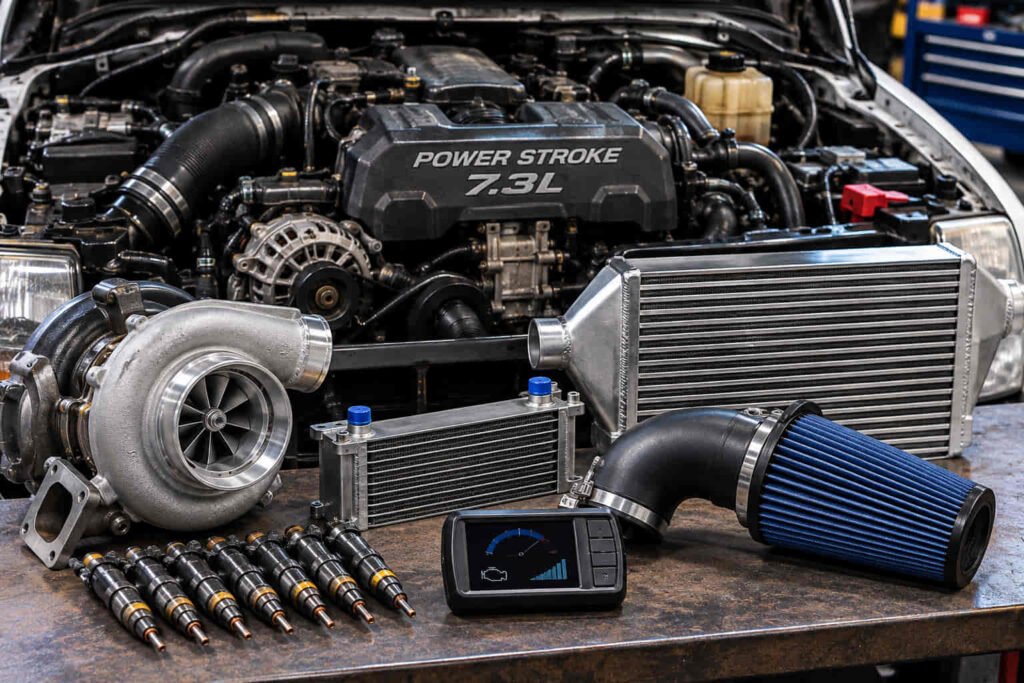
The best 7.3 Powerstroke upgrades improve horsepower, towing performance, throttle response, and long-term engine reliability without placing unnecessary stress on the fuel injection system or drivetrain. For most owners, the most effective improvements begin with proper engine maintenance, custom PCM tuning, a healthy fuel system, improved airflow, and monitoring equipment. More aggressive builds may require larger injectors, an upgraded turbocharger, additional high-pressure oil capacity, and stronger transmission components.
The Ford 7.3L Power Stroke is a 444-cubic-inch turbocharged V8 diesel engine manufactured by International and used in Ford trucks from the 1994 model-year transition through 2003. Factory horsepower ranged from approximately 210 to 275 horsepower, depending on model year, vehicle application, and transmission configuration. Its cast-iron engine block, durable mechanical construction, and hydraulically actuated electronic unit injection system have made it a popular platform for diesel performance modifications.
However, the best upgrade combination depends on whether the truck is used for daily driving, heavy towing, commercial work, or high-horsepower performance. A larger turbocharger may improve a heavily modified engine but reduce low-speed responsiveness on a stock-fueled towing truck. Likewise, performance injectors can increase power potential while exposing weaknesses in the high-pressure oil system and transmission.
Understanding how these components interact is essential for building a 7.3 Powerstroke that delivers useful power without sacrificing the durability that makes the engine desirable.
What Are the Best 7.3 Powerstroke Upgrades?
The best 7.3 Powerstroke upgrades for most trucks are quality custom tuning, reliable fuel delivery, improved turbocharger airflow, an efficient exhaust system, and appropriate engine monitoring. For higher horsepower targets, upgraded injectors, high-pressure oil system components, and transmission modifications become increasingly important.
The 7.3 Powerstroke responds well to improvements in combustion control and airflow because its original engine management and turbocharger systems were designed around factory power and emissions requirements.
A properly calibrated tuner can improve throttle response and adjust fuel delivery characteristics within the capabilities of the original hardware.
An improved air intake can help reduce restriction when the original system limits airflow, although a large horsepower increase should not be expected from a filter replacement alone.
Exhaust upgrades may reduce backpressure and improve operating efficiency under load.
Turbocharger modifications can increase airflow capacity or improve compressor efficiency, particularly when the factory unit is worn or operating outside its ideal range.
Fuel system upgrades help maintain adequate fuel delivery when larger injectors or increased engine output create additional demand.
However, these components should not be treated as independent modifications.
Diesel engine output depends on the relationship between air mass, injected fuel quantity, injection timing, combustion temperature, and drivetrain capacity.
Increasing fuel delivery without sufficient airflow may increase exhaust smoke and exhaust gas temperature rather than producing efficient power.
Similarly, installing a much larger turbocharger without increasing fueling may create unnecessary lag.
The most effective upgrade strategy begins with establishing a realistic performance goal and selecting components that support that goal.
For a stock or lightly modified towing truck, restoring reliable engine operation and improving calibration may provide greater practical value than installing oversized performance parts.
Why Is the 7.3 Powerstroke a Good Engine for Performance Upgrades?
The 7.3 Powerstroke is a popular upgrade platform because of its cast-iron construction, established aftermarket support, and electronically controlled HEUI fuel injection system.
The engine uses a 7.3-liter V8 configuration with a bore of approximately 4.11 inches and a stroke of 4.18 inches.
Its cast-iron block and cylinder heads provide a durable structural foundation.
The engine also uses an overhead-valve arrangement with two valves per cylinder and a camshaft positioned inside the block.
Compared with modern diesel engines that use complex emissions aftertreatment systems and highly integrated electronic controls, the 7.3 Powerstroke is mechanically straightforward in several respects.
However, its HEUI injection system introduces its own engineering considerations.
The fuel injectors rely on high-pressure engine oil to actuate internal components responsible for delivering diesel fuel into the cylinders.
This means the engine’s ability to support additional fuel delivery depends partly on the capacity and condition of its high-pressure oil pump.
The electronic injection system also allows engine calibration to influence fueling and combustion behavior.
As a result, tuning can improve performance without requiring immediate replacement of every major mechanical component.
The engine’s long production history has also created a substantial aftermarket.
Owners can find upgraded turbochargers, injectors, fuel system components, oil system modifications, and transmission parts designed specifically for different 7.3 Powerstroke generations.
Nevertheless, the engine is not indestructible.
Connecting rod construction changed during production, and not every engine has the same internal strength.
The condition of an engine that has accumulated hundreds of thousands of miles must also be considered before adding power.
The 7.3 Powerstroke’s upgrade potential is strongest when its mechanical condition is verified and the supporting components are selected as part of a balanced system.
What Should You Check Before Upgrading a 7.3 Powerstroke?
Before installing performance upgrades, a 7.3 Powerstroke should be inspected for oil pressure problems, injector faults, fuel pressure deficiencies, boost leaks, cooling system defects, and transmission wear.
Many surviving 7.3 Powerstroke engines are now more than two decades old.
Even an engine with a reputation for durability can develop age-related problems involving electrical connections, seals, sensors, and fuel system components.
A performance tune cannot correct an injector that is mechanically worn or an engine suffering from inadequate compression.
The camshaft position sensor is one component that deserves attention when the engine experiences intermittent stalling or starting problems.
The under-valve-cover wiring harness can also develop electrical faults affecting injector and glow plug operation.
Loose connections or damaged wiring may cause rough running, misfires, or poor cold-start performance.
The injector driver module, commonly called the IDM, is another important component.
It provides electrical control for the HEUI injectors.
If the module or its associated wiring is defective, fuel injection may become inconsistent.
The turbocharger and exhaust up-pipes should also be inspected.
Exhaust leakage before the turbine reduces the energy available to drive the turbocharger and can contribute to slow boost response.
Leaks in intercooler boots or intake connections may reduce the amount of compressed air reaching the cylinders.
The fuel system must maintain adequate pressure under load.
A weak fuel pump or restricted filter can limit performance even when the injectors and turbocharger are functioning correctly.
The high-pressure oil system also requires evaluation.
A worn high-pressure oil pump, leaking connections, or a malfunctioning injector pressure regulator can interfere with injector operation.
For automatic trucks, transmission condition is especially important.
Adding engine torque to a transmission with worn clutches or inadequate cooling may accelerate failure.
Addressing these problems first creates a reliable foundation for future modifications.
Are 7.3 Powerstroke Upgrades Different for OBS and Super Duty Trucks?
Yes. The 1994.5–1997 OBS 7.3 Powerstroke and the 1999–2003 Super Duty versions use different turbochargers, fuel delivery components, injector configurations, and supporting systems. Early and late 1999 engines also have important differences.
The term OBS refers to the older Ford body style used before the introduction of the Super Duty platform.
The 1994.5–1997 7.3 Powerstroke engines typically used a Garrett TP38 turbocharger without the factory intercooler fitted to later Super Duty trucks.
These engines also used a mechanically driven fuel supply pump.
Later Super Duty applications introduced an electric fuel pump mounted on the chassis.
The 1999 Super Duty added factory air-to-air intercooling, providing cooler charge air after compression by the turbocharger.
This was an important improvement for engine efficiency and thermal control under load.
However, the 1999 model year included additional changes.
Early 1999 engines used a different turbocharger and related intake and exhaust components from later 1999 engines.
Late 1999 and subsequent Super Duty applications generally used the Garrett GTP38 turbocharger.
The high-pressure oil pump configuration also evolved.
Earlier engines commonly used a pump identified by its 15-degree swash plate design, while later versions adopted a higher-volume arrangement commonly called the 17-degree pump.
Fuel injector configurations also changed across production years.
These differences affect turbocharger fitment, fuel system upgrades, tuning compatibility, and injector selection.
A component advertised for a 1999–2003 Powerstroke should not automatically be assumed to fit every early 1999 truck.
Some E-Series van applications also use different turbocharger and accessory configurations from pickups.
The engine’s build date, identification information, and original equipment should be verified before ordering performance parts.
Correct compatibility is essential because an incorrectly matched upgrade can create additional labor costs and mechanical problems.
Is Custom Tuning the Best First 7.3 Powerstroke Upgrade?
Custom tuning is often one of the most effective first performance upgrades for a mechanically healthy 7.3 Powerstroke because it can improve throttle response and torque delivery without immediately requiring extensive hardware changes.
The 7.3 Powerstroke uses electronic engine management to control its HEUI fuel injection system.
The powertrain control module calculates injection commands using information about engine operating conditions.
Its calibration affects fueling, injection timing, and other functions.
Aftermarket tuning modifies selected control parameters to change how the engine responds to driver input and load.
On suitable vehicles, custom tuning may improve acceleration and towing responsiveness compared with the original factory calibration.
However, the results depend on the engine’s existing components.
A stock turbocharger, original injectors, and standard high-pressure oil pump have physical operating limits.
A tune cannot create unlimited airflow or hydraulic injection capacity.
Increasing commanded fuel quantity beyond what the engine can efficiently burn may produce excessive smoke and exhaust heat.
Overly aggressive injection timing can also increase mechanical stress.
A quality calibration should be matched to the truck’s injectors, turbocharger, transmission, and intended application.
A towing calibration generally prioritizes controlled exhaust temperatures, predictable torque delivery, and stable operation under sustained load.
A high-performance calibration may produce stronger acceleration but place greater demands on the drivetrain.
Transmission calibration is particularly important for trucks equipped with the E4OD or 4R100 automatic transmission.
Changes in engine torque can influence shift quality and torque converter operation.
Not every tuning product supports the same engine configurations, and some modifications may affect emissions compliance.
Owners should select tuning that retains the vehicle’s required emissions functionality and complies with applicable laws.
For many stock-engine trucks, a conservative, properly developed calibration offers a more balanced improvement than an aggressive tune designed only to produce the highest possible power figure.
Do Cold Air Intake Upgrades Increase 7.3 Powerstroke Horsepower?
A quality air intake upgrade can reduce intake restriction and improve airflow under certain conditions, but an aftermarket filter or intake tube does not automatically produce a large horsepower increase on a stock 7.3 Powerstroke.
The air intake system supplies the turbocharger with filtered atmospheric air.
As engine load increases, the turbocharger must draw a greater quantity of air through the intake system.
Restrictions in the filter housing, ducting, or intake path can affect airflow when demand becomes high enough.
An upgraded intake may help reduce this restriction.
However, the benefit depends on the design and condition of the original system.
A clean factory intake operating within its intended airflow range may not be a major performance limitation.
Replacing it with a less restrictive system may therefore produce only a modest change.
Air filtration quality is particularly important for a diesel engine expected to operate for hundreds of thousands of miles.
A filter that allows excessive dust into the intake can accelerate wear on the compressor wheel and internal engine components.
This risk may be greater in dusty environments or vehicles used for construction and agricultural work.
An exposed performance filter may also draw warmer air from the engine compartment unless the intake design includes suitable shielding or ducting.
Warmer intake air is less dense at the same pressure, reducing the potential benefit of improved flow.
The most useful intake upgrade provides adequate filtration, suitable airflow capacity, and resistance to water ingestion.
The intake system should also be compatible with the selected turbocharger.
A turbocharger with a larger compressor inlet may require additional intake components.
For a stock or mildly modified 7.3 Powerstroke, maintaining a clean, well-sealed intake system is often more important than installing the largest available filter.
Is a 4-Inch Exhaust Worth It on a 7.3 Powerstroke?
A properly designed 4-inch exhaust system can reduce restriction on a modified 7.3 Powerstroke, particularly when additional fueling and turbocharger airflow increase exhaust flow. However, the performance gain depends on the original exhaust system and the complete engine combination.
The exhaust system carries combustion gases away from the engine after they pass through the turbocharger turbine.
Excessive downstream restriction can increase the pressure against which exhaust gases must flow.
Reducing this restriction may help improve turbocharger operating conditions.
Many aftermarket 7.3 Powerstroke exhaust systems use approximately 4-inch tubing.
This diameter is a common choice for trucks receiving mild to moderate performance upgrades.
However, exhaust diameter alone does not determine performance.
Pipe routing, bends, muffler design, and overall system construction also influence flow characteristics.
A stock truck may not gain substantial horsepower from replacing a functioning exhaust system.
The benefit may become more noticeable when increased fueling and airflow create greater exhaust volume.
An exhaust upgrade can also change engine sound.
Some owners prefer a louder exhaust note, while others prioritize low noise during long highway journeys.
For towing applications, a system that maintains acceptable sound levels while reducing unnecessary restriction may provide the best compromise.
The exhaust should also retain all emissions-related equipment required for the vehicle’s configuration and jurisdiction.
Although older 7.3 Powerstroke trucks generally lack the diesel particulate filters used on modern diesel vehicles, that does not mean every exhaust modification is automatically legal.
Vehicle emissions certification and local regulations still apply.
A well-matched exhaust upgrade supports the engine’s airflow requirements without compromising legal compliance or everyday drivability.
What Are the Best Turbo Upgrades for a 7.3 Powerstroke?
The best 7.3 Powerstroke turbo upgrade is one that matches the engine’s fuel delivery, intended horsepower, towing requirements, and desired low-speed response. A larger turbocharger is not automatically better.
The factory 7.3 Powerstroke uses a fixed-geometry Garrett turbocharger.
Earlier trucks generally used versions of the TP38, while later Super Duty models used the GTP38.
These turbochargers were selected to deliver suitable performance at factory fueling levels.
When fuel delivery is increased, additional airflow may be needed to maintain efficient combustion and control exhaust temperatures.
An upgraded turbocharger can provide greater compressor flow and improved efficiency at higher engine output.
However, turbochargers operate within specific airflow and pressure ranges.
A large compressor and turbine assembly may require greater exhaust energy before reaching its most effective operating speed.
This can produce slower low-RPM response on a truck with stock injectors.
For towing, this tradeoff matters because useful torque at moderate engine speeds is often more important than maximum airflow at high RPM.
A well-matched drop-in turbocharger may improve response and provide additional airflow without substantially changing the truck’s driving characteristics.
More aggressive turbocharger configurations are generally intended for larger injectors and specialized calibration.
The turbine side is equally important.
A restrictive turbine housing can increase exhaust drive pressure and temperature under load.
A larger housing may improve high-load exhaust flow but reduce low-speed spool characteristics.
The wastegate must also operate correctly.
Its function is to control turbine energy and prevent excessive boost under appropriate conditions.
Changing the wastegate actuator alone does not guarantee more efficient airflow or greater engine power.
Turbocharger selection should therefore be based on the complete performance combination rather than compressor size or advertised boost pressure alone.
Does a Wicked Wheel Upgrade Help the 7.3 Powerstroke?
An anti-surge compressor wheel can improve turbocharger behavior on certain 7.3 Powerstroke applications, particularly later GTP38 systems prone to compressor surge under specific operating conditions.
Compressor surge occurs when a turbocharger operates outside a stable region of its compressor performance range.
It may create a fluttering or barking sound during abrupt changes in engine load.
Repeated severe surge can place unwanted stress on turbocharger components.
Aftermarket compressor wheels are available to improve surge characteristics and airflow efficiency.
The term Wicked Wheel is commonly associated with this type of upgrade.
However, the original aftermarket anti-surge wheel has an important historical detail.
The early-style wheel was closely related to a compressor wheel originally used on earlier TP38 turbochargers.
Installing that same design into an earlier turbocharger may provide little benefit when the original component is already present and functioning correctly.
Later 1999.5–2003 GTP38 turbochargers used a different factory compressor configuration.
These engines are common applications for aftermarket anti-surge wheel modifications.
Newer billet compressor wheel designs may offer different aerodynamic characteristics from the original cast components.
However, not every compressor wheel is compatible with every TP38 or GTP38 arrangement.
Wheel dimensions, compressor housing clearance, shaft compatibility, and balancing requirements must be considered.
A compressor wheel upgrade is also not equivalent to replacing the entire turbocharger.
It does not automatically increase the turbine’s flow capacity or eliminate other turbocharger restrictions.
For a mildly modified 7.3 Powerstroke, an appropriate anti-surge wheel can be a useful refinement.
For substantially higher horsepower, a complete turbocharger upgrade may be more effective.
Read more: Rebuilt vs Remanufactured Engine
Is an Intercooler Upgrade Worth It for a 7.3 Powerstroke?
An intercooler upgrade can improve charge-air temperature control on a 7.3 Powerstroke, especially during heavy towing or sustained high-load operation. It is particularly relevant to older trucks that were not originally equipped with intercooling.
A turbocharger compresses intake air to increase the amount of oxygen entering the cylinders.
However, compression also raises air temperature.
As intake temperature increases, air density decreases at a given pressure.
An intercooler reduces the temperature of compressed air before it enters the engine.
Cooler charge air can support more efficient combustion and help manage thermal loads.
The 1994.5–1997 OBS Powerstroke trucks did not have a factory intercooler in their typical configurations.
Adding an intercooler to these vehicles can provide a meaningful improvement in charge-air temperature control, particularly when towing or using performance tuning.
The 1999–2003 Super Duty introduced an air-to-air intercooler as part of its factory engine system.
For these trucks, the original intercooler may already provide sufficient cooling for stock or mild performance use.
A larger aftermarket intercooler may become more useful when increased boost and fueling raise charge-air temperatures.
However, core size alone does not determine intercooler effectiveness.
Cooling performance depends on heat transfer, airflow through the core, pressure drop, and the quality of the intake connections.
A poorly designed intercooler can create excessive pressure restriction even if it has a large external appearance.
Intercooler boots and clamps must also be maintained.
A boost leak can reduce engine performance and make a healthy turbocharger appear inadequate.
For a towing-focused build, reducing intake temperature and maintaining a sealed charge-air system can be more valuable than chasing the highest possible boost pressure.
What Fuel Injector Upgrades Work Best on a 7.3 Powerstroke?
The best fuel injector upgrade for a 7.3 Powerstroke depends on the desired power level, turbocharger airflow, high-pressure oil capacity, and whether the truck is primarily used for towing or performance driving.
The engine uses hydraulically actuated electronic unit injectors, commonly called HEUI injectors.
Each injector relies on high-pressure engine oil to actuate its internal fuel delivery mechanism.
The injectors are electronically controlled, allowing the engine management system to determine injection timing and fueling behavior.
Larger aftermarket injectors can increase the engine’s potential fuel delivery.
However, an injector’s advertised size does not indicate the horsepower that a complete engine will automatically produce.
Injector flow is often described using displacement-related measurements, such as cubic centimeters of fuel capacity, along with nozzle specifications.
Different injector designs may produce different injection characteristics even when their advertised sizes appear similar.
Early 7.3 Powerstroke engines and later Super Duty models used different injector configurations.
Many early federal-emissions engines used single-shot injectors, while later engines commonly used split-shot designs.
Split-shot injection introduces a pilot fuel delivery event intended to influence combustion noise and operating characteristics.
Converting between injector types or installing high-output injectors requires compatible engine calibration.
A larger injector may increase fueling demand beyond the capacity of a worn or undersized high-pressure oil pump.
The fuel supply system must also maintain sufficient pressure.
For a stock or lightly modified towing truck, properly functioning original injectors or modestly upgraded units may be sufficient.
A heavily modified performance engine may require larger injectors, additional high-pressure oil volume, and substantially greater turbocharger airflow.
The most reliable combination is one in which injector capacity matches the engine’s airflow and hydraulic injection capability.
Installing oversized injectors without supporting modifications can create smoke, high exhaust temperature, and poor drivability rather than useful power.
Why Is the HPOP Important for 7.3 Powerstroke Upgrades?
The high-pressure oil pump is critical to 7.3 Powerstroke performance because it provides the hydraulic oil pressure and flow required to operate the HEUI fuel injectors.
The HPOP is a fundamental part of the engine’s fuel injection system.
Unlike a conventional mechanical diesel injection pump, it does not directly pressurize the diesel fuel before injection.
Instead, it supplies high-pressure engine oil to passages in the cylinder heads.
This oil activates the hydraulic mechanisms inside the injectors.
The injection pressure regulator controls the high-pressure oil system, while the injector control pressure sensor supplies feedback to the engine management system.
The amount of oil required depends on injector operation.
Larger injectors and more demanding calibrations can increase the hydraulic requirements.
If the HPOP cannot maintain sufficient pressure during acceleration or sustained load, the engine may fail to deliver the expected fuel quantity.
This can limit performance even when the fuel supply and turbocharger are otherwise suitable.
The 7.3 Powerstroke used different HPOP configurations during production.
Earlier engines generally used a lower-volume pump commonly identified as the 15-degree configuration.
Later 1999 and subsequent engines used a higher-volume arrangement commonly called the 17-degree pump.
However, replacing an earlier pump with a later version is not automatically a direct, appropriate upgrade for every early engine.
Installation compatibility depends on the engine configuration and associated fittings or components.
Aftermarket high-volume HPOP options are available for applications requiring additional hydraulic capacity.
Before purchasing one, the original system should be tested.
A faulty injector pressure regulator, high-pressure oil leak, or defective sensor can create symptoms similar to a worn pump.
Replacing the pump without diagnosing the actual problem may not improve performance.
For high-horsepower builds, the HPOP should be selected as part of the injector and tuning combination rather than treated as an isolated modification.
Do Fuel System Upgrades Improve 7.3 Powerstroke Reliability?
Fuel system upgrades can improve 7.3 Powerstroke reliability when they address inadequate fuel pressure, restricted filtration, uneven fuel supply, or increased demand from larger injectors.
The fuel supply system delivers diesel fuel to the cylinder heads, where the HEUI injectors use it for combustion.
Earlier 7.3 Powerstroke trucks used a mechanically driven fuel supply pump.
Later Super Duty models adopted an electric lift pump.
These systems were designed around the fuel requirements of the original engine configuration.
When the engine receives larger injectors or more aggressive tuning, fuel demand may increase.
If the supply system cannot maintain adequate pressure under load, injector operation and combustion consistency can be affected.
A quality fuel pump upgrade may improve supply capacity.
However, a larger pump is not always required for a stock truck with healthy original components.
Fuel filtration is equally important.
Contaminated diesel can damage precision injector parts and contribute to poor engine operation.
A replacement fuel system should provide effective filtration and water separation appropriate to the application.
Some owners install regulated-return fuel systems.
These arrangements are intended to improve control of fuel pressure and circulation through the cylinder head fuel passages.
Depending on the design, they can help stabilize fuel supply and reduce pressure differences across operating conditions.
However, a regulated-return system does not automatically create substantial horsepower.
Its benefit depends on the original fuel system and the engine’s fuel demand.
The correct fuel pressure must be established using appropriate service information and injector requirements.
Excessive or inadequate pressure can interfere with engine operation.
For a towing or daily-driving truck, maintaining clean fuel and reliable pressure is generally more valuable than installing a complex fuel system without a demonstrated need.
Should You Upgrade the 7.3 Powerstroke Transmission?
Transmission upgrades become increasingly important as 7.3 Powerstroke torque increases, especially on trucks equipped with the E4OD or 4R100 automatic transmission.
The engine’s ability to produce additional torque does not mean the transmission can reliably handle that torque indefinitely.
The 1994.5–1997 OBS trucks commonly used the E4OD four-speed automatic transmission.
The 1999–2003 Super Duty trucks used the related 4R100 four-speed automatic.
Both transmissions were designed around the vehicle’s original operating requirements.
As engine output increases, internal clutches, shafts, and the torque converter may experience additional loading.
Excessive heat can further reduce transmission durability.
A slipping torque converter clutch converts additional engine energy into heat rather than efficiently transferring power through the drivetrain.
Similarly, worn clutch packs may slip during shifts when torque exceeds their available holding capacity.
Transmission upgrades may involve improved clutch materials, valve body modifications, stronger internal components, and more capable torque converters.
The correct combination depends on the existing transmission and the intended engine output.
A stock or mildly tuned truck may not require a fully built performance transmission if the original unit is healthy and the additional torque remains within an acceptable operating range.
However, a high-horsepower build may exceed the reliable capacity of an original high-mileage automatic transmission.
For towing, cooling is especially important.
An improved transmission cooler may help manage fluid temperatures during sustained load.
The transmission should also receive the correct fluid and maintenance according to the applicable Ford service requirements.
Manual-transmission trucks have different considerations.
Older trucks used the ZF5 five-speed manual, while later Super Duty applications used the ZF6 six-speed manual.
Increasing torque can require a stronger clutch even when the gearbox itself remains serviceable.
A balanced 7.3 Powerstroke build therefore considers the transmission and drivetrain alongside the engine.
What Gauges Should You Install Before Adding Power?
A boost gauge, exhaust gas temperature gauge, and appropriate transmission temperature monitoring are among the most useful additions to a modified 7.3 Powerstroke.
Performance modifications can change engine operating conditions in ways that are not obvious from the driver’s seat.
A truck may accelerate more strongly while producing substantially higher exhaust temperatures under load.
Monitoring equipment helps the driver recognize conditions that could threaten reliability.
A boost gauge measures pressure within the intake system.
It can help identify abnormal turbocharger behavior, intake leaks, or changes in boost response.
However, greater boost pressure does not automatically indicate better performance.
Airflow efficiency depends on temperature, compressor operation, pressure losses, and engine fuel demand.
An exhaust gas temperature gauge, commonly called a pyrometer, measures exhaust temperature.
It is particularly useful for towing because sustained engine load can increase exhaust heat.
The probe location is important.
A sensor installed before the turbocharger generally records higher temperatures than one positioned farther downstream.
This means a temperature limit developed for one probe location should not automatically be applied to another.
Some diesel owners use approximately 1,250°F as a conservative reference for sustained pre-turbo exhaust temperature, but this is not a universal safe limit for every 7.3 Powerstroke configuration.
Allowable temperature depends on probe placement, engine setup, operating duration, component condition, and the recommendations of the engine builder or calibrator.
Automatic-transmission trucks also benefit from monitoring transmission fluid temperature.
This is especially relevant when towing heavy loads or using additional engine torque.
Modern electronic monitoring devices may also display available engine control data.
However, an electronic display cannot measure every parameter unless the appropriate sensor exists.
Monitoring equipment does not prevent mechanical failure on its own.
Its value comes from helping the driver recognize unusual conditions and adjust operation before damage develops.
What Reliability Upgrades Are Worth Doing on a 7.3 Powerstroke?
The most worthwhile reliability upgrades are those that correct known weaknesses in the specific truck rather than parts selected solely for their advertised horsepower potential.
Age-related electrical faults are common concerns.
The camshaft position sensor is important because the engine management system relies on engine position information.
An intermittent sensor failure can produce stalling or a no-start condition.
The under-valve-cover wiring harness and associated connectors also require attention.
Injector and glow plug circuits operate in a demanding environment, and deteriorated electrical connections can create intermittent faults.
The turbocharger exhaust up-pipes are another important area.
Leaks before the turbine reduce the exhaust energy available to drive the turbocharger.
Repairing these connections can restore lost performance without increasing the engine’s mechanical stress.
Oil leaks should also be addressed.
The turbocharger pedestal, high-pressure oil system connections, engine seals, and other components can develop leakage as they age.
The cooling system should be maintained with the correct coolant formulation and service procedures.
Overheating can damage an otherwise durable engine.
Glow plugs and their control system matter for cold-weather reliability.
A truck that starts poorly during cold weather may require glow plug diagnostics rather than performance injectors or tuning.
Fuel injector cups and seals should also be inspected when symptoms suggest fluid contamination or injector sealing problems.
However, replacing every component simply because a truck has high mileage is not always necessary.
Condition-based inspection provides better value.
For a 7.3 Powerstroke used primarily for work and towing, reliable starting, stable oil pressure, consistent fuel delivery, and dependable cooling are more important than achieving the highest possible dyno number.
Are Forged Connecting Rods Necessary for a High-Horsepower 7.3 Powerstroke?
Forged connecting rod upgrades become relevant when a 7.3 Powerstroke is being built for substantially increased horsepower, particularly if the engine originally uses powdered-metal connecting rods.
The 7.3 Powerstroke used different connecting rod designs during production.
Earlier engines generally used forged-steel connecting rods.
During the 2001 production period, International introduced powdered-metal connecting rods.
The change was not confined to one exact model-year boundary, so the engine serial number or physical component identification is important when determining the installed rod design.
Both rod types were intended to function reliably under their original operating conditions.
However, their behavior under very high cylinder pressure can differ.
Performance builders often regard forged rods as more suitable for demanding high-output applications.
Powdered-metal connecting rods can become a limiting consideration when fueling, turbocharger output, and engine torque are increased substantially.
Some performance builders use a conservative target near 400 rear-wheel horsepower for stock powdered-metal-rod engines.
However, this is a community-based planning guideline rather than an official Ford maximum horsepower rating or a guaranteed failure threshold.
Actual durability depends on rod condition, torque delivery, combustion pressure, tuning, and engine use.
A truck with forged connecting rods is not automatically capable of unlimited horsepower.
Pistons, bearings, crankshaft components, and cylinder head sealing still have mechanical limits.
For a moderate towing build, replacing healthy factory connecting rods may provide little practical benefit.
For a performance engine intended to operate well beyond stock output, upgraded rods should be considered as part of a complete internal engine design.
Do Head Studs and Internal Engine Upgrades Improve Durability?
Head studs and upgraded internal components can improve the durability margin of certain high-output 7.3 Powerstroke builds, but they are not essential modifications for every stock or mildly tuned engine.
The 7.3 Powerstroke has a strong engine block and cylinder head fastening arrangement.
Its original configuration was designed to withstand substantial diesel combustion pressures.
For normal towing and daily driving near factory output, correctly installed original-specification head fasteners are generally appropriate.
However, significantly increasing boost and fuel delivery can raise combustion pressure.
This places greater stress on the cylinder head gasket sealing system.
Performance head studs can provide a different clamping arrangement that may benefit engines designed for higher cylinder pressure.
However, studs do not compensate for damaged cylinder heads, incorrect gasket selection, or improper tightening procedures.
Surface preparation remains essential.
The cylinder head and engine block sealing surfaces must meet the required flatness and finish specifications.
Performance pistons and connecting rods may also be considered when the engine is rebuilt for substantially increased output.
Piston material, compression ratio, ring end gap, and piston-to-cylinder clearance influence durability under high load.
The camshaft and valvetrain can also be modified for specialized applications.
However, changing the camshaft affects valve timing, airflow behavior, and potentially the engine’s operating characteristics.
For a truck used primarily for towing, an aggressive performance camshaft may not provide the desired low-speed torque characteristics.
Internal upgrades should therefore be selected around the intended power level and operating conditions.
A balanced engine with appropriate fueling, airflow, lubrication, and cooling is generally more reliable than one containing expensive internal components that are poorly matched to its calibration.
How Much Horsepower Can You Add to a 7.3 Powerstroke?
The amount of horsepower a 7.3 Powerstroke can gain depends on the original engine configuration, tuning, injector capacity, turbocharger airflow, high-pressure oil supply, and drivetrain limitations.
Factory engine output varied considerably across the production run.
Early versions produced approximately 210 horsepower, while certain later manual-transmission Super Duty configurations were rated at 275 horsepower.
These figures represent engine output measured according to the original manufacturer ratings.
They should not be confused with rear-wheel horsepower measured on a chassis dynamometer.
Rear-wheel horsepower is generally lower because some engine output is consumed by drivetrain losses.
Performance modifications should therefore be compared using consistent measurement methods.
A stock-injector truck may respond noticeably to suitable tuning, but the potential gain is limited by the available fuel delivery and airflow.
Adding an improved turbocharger may create additional airflow capacity.
However, the engine will not necessarily produce significantly more horsepower unless sufficient fuel is supplied and the calibration can use the added airflow effectively.
Larger injectors can increase fuel delivery potential, but the HPOP and fuel supply systems must support them.
High-output engines may require additional internal and drivetrain modifications.
It is possible for extensively modified 7.3 Powerstroke engines to exceed factory horsepower by a substantial margin.
However, achieving a high dyno figure does not establish that the engine can sustain that output indefinitely under heavy towing conditions.
The intended duty cycle is critical.
An engine designed for short performance events may use components and calibrations that are unsuitable for prolonged high-load operation.
For a daily-driven or towing-focused truck, a moderate increase in usable torque and throttle response can provide greater practical value than chasing a maximum horsepower figure.
What Are the Best 7.3 Powerstroke Upgrades for Towing?
The best 7.3 Powerstroke upgrades for towing prioritize controlled exhaust temperatures, dependable fuel delivery, predictable torque, reliable transmission operation, and effective cooling.
Towing places sustained demands on the engine.
A truck pulling a trailer up a long grade may operate at high load for several minutes.
This is different from a short acceleration event where high power is required only briefly.
A conservative towing calibration can improve responsiveness while helping maintain appropriate combustion conditions.
However, it must be matched to the original injectors, turbocharger, and drivetrain.
An upgraded turbocharger may be useful when it provides better airflow without sacrificing excessive low-speed response.
For an older OBS truck, an intercooler can help reduce charge-air temperatures during sustained towing.
For later Super Duty trucks, maintaining the factory intercooler and ensuring that boots and connections are sealed may be sufficient for mild upgrades.
Fuel pressure should remain stable under load.
A weak fuel pump or restricted filter can contribute to poor performance and combustion inconsistency.
The transmission is another critical consideration.
An E4OD or 4R100 automatic that operates correctly during unloaded driving may develop excessive temperatures or clutch slip when subjected to greater torque and trailer weight.
An appropriate transmission cooler, healthy torque converter, and suitable transmission calibration can help manage these demands.
Exhaust gas temperature monitoring provides additional information about engine thermal loading.
The driver can adjust throttle input or gear selection when operating conditions approach the limits established for the particular engine setup.
Brake system condition, tires, suspension, and trailer equipment must also be considered.
Engine upgrades do not increase the truck’s official gross vehicle weight rating or gross combined weight rating.
For towing, the objective is reliable operation within the vehicle’s rated capacity rather than maximum dyno horsepower.
What Are the Best 7.3 Powerstroke Upgrades for Daily Driving?
For daily driving, the best 7.3 Powerstroke upgrades improve responsiveness, starting reliability, operating smoothness, and fuel system consistency without introducing unnecessary performance-related complexity.
A daily-driven truck spends much of its time at relatively low engine loads.
It may experience stop-and-go traffic, short trips, highway cruising, and occasional towing.
These conditions favor an upgrade strategy focused on usability.
A conservative custom calibration may improve throttle response and make the engine feel more responsive.
However, the calibration should not create excessive smoke or harsh transmission behavior.
The air intake and exhaust should remain properly sealed and maintained.
Replacing damaged intake boots or repairing exhaust up-pipe leaks can restore performance that was lost gradually through wear.
A healthy factory turbocharger may already provide enough airflow for the intended driving conditions.
Installing a much larger unit can create unnecessary cost and slower response without providing a corresponding benefit.
Fuel system reliability is another priority.
Clean fuel, effective filtration, stable pressure, and properly functioning injectors support smooth engine operation.
The electrical system also matters.
A healthy camshaft position sensor, injector wiring harness, IDM, glow plug system, and battery supply are important for dependable starting and consistent performance.
Transmission maintenance should not be overlooked.
A smooth-shifting automatic with adequate cooling may provide a more noticeable improvement in everyday drivability than aggressive engine modifications.
A daily-driving build should therefore emphasize restoring factory reliability and making measured improvements rather than maximizing horsepower.
How Much Do 7.3 Powerstroke Upgrades Cost?
The cost of 7.3 Powerstroke upgrades varies widely because basic monitoring and tuning require much less labor and hardware than complete turbocharger, injector, high-pressure oil, and transmission modifications.
A mild performance project may involve a compatible calibration device, monitoring gauges, replacement intake components, and necessary maintenance repairs.
The overall cost depends on whether the truck already has functioning original components.
A truck with fuel pressure problems, turbocharger leakage, and worn injectors may require substantial repair expenses before performance modifications become worthwhile.
Turbocharger upgrades introduce additional cost.
A replacement compressor wheel may cost substantially less than a complete turbocharger.
For example, 2026 supplier listings show certain 7.3 Powerstroke compressor wheel upgrades priced under $300.
Complete upgraded or remanufactured turbochargers can cost several hundred dollars to well over $1,000, depending on the design and included components.
These are examples of advertised U.S. parts pricing rather than fixed installation costs.
Fuel injector upgrades may involve replacing multiple injectors and paying for calibration appropriate to the new configuration.
An upgraded HPOP adds another expense when the original pump cannot support the required injection demand.
Automatic transmission work can become one of the largest costs of a higher-output build.
A torque converter or valve body modification may be less expensive than a complete performance transmission.
However, a heavily modified engine can require substantial internal transmission upgrades to achieve dependable operation.
Labor also matters.
Removing injectors, servicing the turbocharger, repairing high-pressure oil components, or replacing the transmission can require significant workshop time.
The best way to control costs is to choose a defined performance goal and avoid purchasing parts that do not contribute directly to that objective.
A coordinated upgrade package is often more economical than repeatedly replacing components because the original modifications were not properly matched.
Can 7.3 Powerstroke Upgrades Improve Fuel Economy?
Some 7.3 Powerstroke upgrades can improve operating efficiency under certain conditions, but higher horsepower does not automatically translate into better fuel economy.
Fuel consumption is influenced by vehicle weight, aerodynamic drag, gearing, driving speed, engine load, and combustion efficiency.
A correctly calibrated engine may deliver torque more effectively in certain operating conditions.
This can improve drivability and potentially reduce unnecessary fuel use.
However, the result depends on how the driver uses the additional power.
Frequent aggressive acceleration increases fuel demand.
Larger injectors and performance tuning can also increase consumption when they command additional fuel.
Turbocharger efficiency may influence fuel economy.
A turbocharger operating within an efficient range can help deliver the airflow required for combustion.
However, an oversized turbocharger may be less responsive during the lower-load conditions common in ordinary driving.
The engine’s original fuel and air systems should be inspected for restrictions or faults before seeking efficiency improvements.
A clogged fuel filter, leaking boost connection, faulty sensor, or worn injector can reduce engine performance and fuel efficiency.
Correcting these problems may restore lost economy without requiring a performance upgrade.
Tire pressure, axle gearing, transmission operation, and vehicle aerodynamics can also influence real-world fuel use.
For a truck used primarily for highway transportation, maintaining a suitable cruising speed and avoiding unnecessary load may produce more consistent savings than installing high-horsepower components.
Claims that a specific tuner, intake, or exhaust system will always deliver a fixed fuel economy improvement should be treated cautiously.
Actual results require controlled comparison under similar operating conditions.
Which 7.3 Powerstroke Upgrades Should You Avoid?
7.3 Powerstroke upgrades should be avoided when they exceed the engine’s supporting capabilities, compromise required emissions systems, or create performance characteristics unsuitable for the truck’s intended use.
One common mistake is installing larger injectors before ensuring adequate turbocharger airflow.
Excess fuel may increase smoke and exhaust temperature without producing efficient power.
Another mistake is choosing an excessively large turbocharger for a stock-fueled towing truck.
The engine may experience slower boost response and reduced low-speed drivability.
Aggressive tuning also creates risk when the transmission is already worn.
A substantial increase in torque can accelerate torque converter and clutch damage.
High-pressure oil system limitations must be considered.
A calibration demanding more injector actuation capacity than the existing HPOP can provide may produce inconsistent injection behavior.
Unverified fuel system modifications can also create problems.
A fuel pump that supplies unsuitable pressure or a poorly installed return system can interfere with injector performance.
Low-quality intake filtration is another concern.
A diesel engine expected to operate for hundreds of thousands of miles requires effective protection against dust and debris.
Performance parts should not be selected solely by advertised horsepower claims.
The actual outcome depends on the complete vehicle and the operating conditions.
Legal compliance is equally important.
The U.S. Environmental Protection Agency identifies certain engine calibrations and aftermarket devices that defeat required emissions controls as potential violations of federal law.
The age of the truck does not automatically exempt modifications from emissions requirements.
Owners should select components that comply with applicable federal, state, and local regulations.
A reliable upgrade should improve the truck’s intended performance without creating unnecessary mechanical or legal risks.
What Is the Best Order for Upgrading a 7.3 Powerstroke?
The most effective 7.3 Powerstroke upgrade sequence begins with restoring engine health, establishing reliable fuel and oil systems, monitoring operating conditions, and then adding tuning and airflow capacity according to the desired power level.
A worn engine should not be treated as a suitable foundation for aggressive performance modifications.
Before adding power, the truck should operate correctly at its current output.
Fuel pressure, injector condition, oil pressure, high-pressure oil system operation, and turbocharger performance should be checked.
Electrical faults and cooling system problems should be corrected.
Once the engine is healthy, monitoring equipment provides useful information about boost pressure, exhaust temperature, and transmission temperature.
A conservative calibration can then be considered.
The engine’s response should be evaluated under the conditions in which the truck is normally driven.
If the truck is used primarily for towing, the calibration should prioritize sustained reliability and manageable thermal loads.
Intake, exhaust, and intercooler improvements may be useful when airflow restriction or charge-air temperature becomes a limitation.
Turbocharger upgrades become more important as fuel delivery increases.
Larger injectors should be selected only after the engine’s airflow, high-pressure oil, and fuel supply requirements are understood.
Transmission modifications should be planned before substantially increasing torque rather than waiting for the original transmission to fail.
For high-horsepower builds, connecting rod design and other internal engine components must also be evaluated.
This sequence helps prevent situations where one modification creates a problem that requires another expensive modification to correct.
A balanced 7.3 Powerstroke upgrade plan improves the engine as a complete system rather than concentrating on isolated horsepower claims.
Final Verdict: What Are the Best 7.3 Powerstroke Upgrades?
The best 7.3 Powerstroke upgrades combine reliable engine maintenance, appropriate tuning, efficient airflow, dependable fuel delivery, and drivetrain improvements matched to the intended horsepower and towing requirements.
The 7.3L Power Stroke provides a strong foundation for modifications because of its cast-iron construction, established HEUI injection system, and extensive aftermarket support.
However, upgrading a 1994.5–1997 OBS truck requires different component choices from upgrading a 1999–2003 Super Duty.
Turbochargers, injector configurations, fuel pumps, high-pressure oil components, and intake systems changed during production.
For most daily-driven trucks, restoring fuel pressure, repairing boost leaks, maintaining the high-pressure oil system, and using a conservative custom calibration can provide meaningful improvements without extensive mechanical modifications.
For towing, charge-air temperature control, exhaust gas temperature monitoring, transmission cooling, and predictable low-speed torque are especially important.
Higher-horsepower builds may require larger injectors, a properly matched turbocharger, additional HPOP capacity, stronger transmission components, and internal engine upgrades.
However, additional horsepower must be supported by sufficient airflow, lubrication, cooling, and mechanical strength.
An expensive turbocharger or injector package will not deliver reliable results when the engine’s supporting systems are inadequate.
The most effective 7.3 Powerstroke upgrade is not necessarily the modification that produces the greatest horsepower. It is the combination that improves the truck’s real-world performance while preserving reliable operation under its intended workload.
By prioritizing mechanical condition, component compatibility, balanced tuning, and supporting drivetrain upgrades, owners can improve the performance of their 7.3 Powerstroke without unnecessarily compromising the durability that made the engine a favorite among diesel truck enthusiasts.