Dexter axle identification starts with locating the axle identification tag and checking its serial number, model information, and weight rating. These details help determine the axle’s specifications and identify compatible replacement components. If the identification tag is missing or unreadable, physical features and measurements can help narrow down the axle type, although manufacturer verification may still be required.
Dexter manufactures trailer axles for utility trailers, travel trailers, cargo trailers, and other towing applications. Its axle configurations include leaf spring axles and Torflex torsion axles, each with different suspension designs, mounting requirements, and replacement specifications. Identifying the correct axle is essential when replacing hubs, bearings, brake assemblies, or the complete axle.
The most reliable identification method is to record the available axle markings and verify them against Dexter’s manufacturer records. When those markings are unavailable, measurements such as hub face length, spring center distance, and mounting dimensions provide additional identification clues. However, these measurements alone cannot confirm an exact axle model or rated capacity.
This guide explains where to find Dexter axle identification information, how to interpret axle markings, how to identify an axle without a tag, and how to verify its capacity and dimensions before ordering replacement parts.
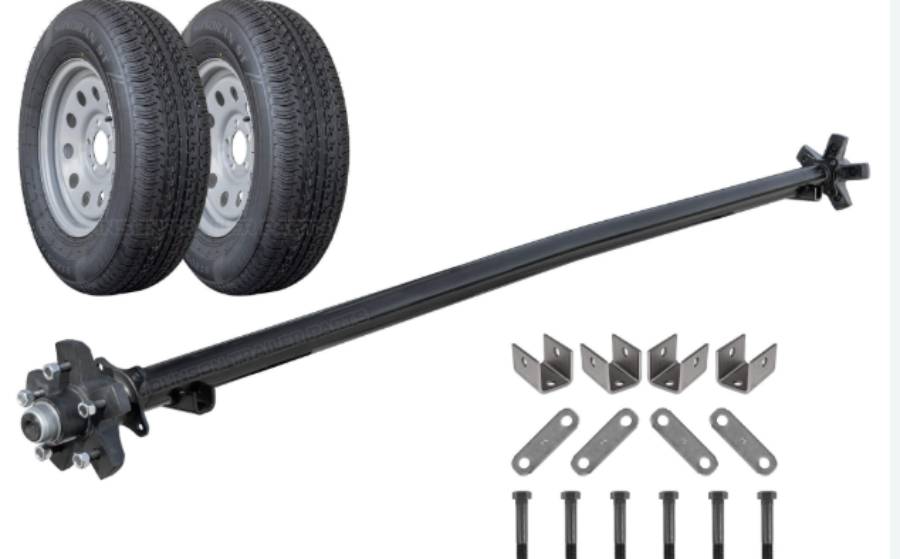
How Do You Identify a Dexter Trailer Axle?
To identify a Dexter trailer axle, locate its identification tag, record the serial number, and verify the axle’s model, weight capacity, and specifications. The identification tag provides the most reliable starting point because Dexter can use the recorded information to determine the axle’s original configuration. When the tag is missing, physical characteristics and axle measurements help narrow down the possible model.
There are four main steps to identifying a Dexter trailer axle:
- Locate the axle identification tag. Inspect the axle tube and other manufacturer-designated identification locations. Look for a label or marking containing a serial number or other identifying information. Dirt, corrosion, and road debris can make older labels difficult to read.
- Record the axle identification information. Write down the complete serial number and any available part number, model designation, or weight rating. Photograph the label before cleaning or handling it extensively. A complete serial number provides a more reliable reference than identifying an axle by appearance alone.
- Examine the axle configuration. Determine whether the trailer uses a conventional leaf spring axle or a Dexter Torflex torsion axle. Leaf spring axles connect to the trailer through external suspension springs, while Torflex axles use rubber torsion suspension components within the axle assembly. Also inspect the hub configuration, brake equipment, and mounting arrangement.
- Verify the axle specifications. Compare the recorded identification information with Dexter’s official documentation or contact the manufacturer. Confirm the axle’s rated capacity, dimensions, and component specifications before purchasing replacement parts.
For example, two Dexter axles may have similar tube dimensions and wheel bolt patterns but different weight ratings, spindle configurations, or brake assemblies. Matching only the visible dimensions does not establish that their components are interchangeable.
The axle serial number is the preferred reference for confirming the original axle specifications. Physical measurements provide supporting information, particularly when the identification tag is damaged or unavailable. Combining manufacturer identification with accurate measurements reduces the risk of selecting an incorrect replacement axle, hub, bearing, or brake assembly.
Where Is the Identification Tag Located on a Dexter Axle?
The Dexter axle identification tag is generally located on the axle assembly, with the axle tube being a primary inspection area on many conventional trailer axles. Depending on the axle model and manufacturing date, identification information may appear on an adhesive label, a metal tag, or a manufacturer-applied marking. The exact location and identification format vary between Dexter axle configurations.
Start by inspecting the center section of the axle tube and the accessible surfaces between the wheels. On trailers equipped with leaf spring suspension, examine the tube around the spring mounting areas and along its front and rear surfaces. For Dexter Torflex axles, inspect the axle beam and accessible mounting areas for manufacturer identification. Use a flashlight to check surfaces facing the trailer frame, where labels may be difficult to see.
A Dexter axle identification label may contain a serial number and additional manufacturing or specification information. The serial number is particularly useful because it can help Dexter identify the original axle configuration. Other markings may provide a part number, production information, or rated capacity, depending on the identification format used for that axle.
Road debris, moisture, corrosion, and protective coatings can make identification markings difficult to locate. Clean the suspected label area with a soft cloth and mild cleaning solution, removing surface dirt without damaging the printed information. Avoid wire brushes, abrasive tools, or aggressive solvents because they can permanently remove faded characters. Photograph any partially readable markings before attempting further cleaning.
If the identification tag cannot be found, inspect the trailer’s certification label for its gross axle weight ratings and other relevant specifications. This label is commonly attached to the trailer frame or another manufacturer-designated location. However, the trailer VIN and certification label do not replace the Dexter axle serial number, and the trailer’s stated axle rating does not independently confirm the exact axle model.
For example, a tandem-axle utility trailer may have two visually similar Dexter axles, but each axle should be checked individually when identification information is available. Recording the markings from both axles helps prevent assumptions about their original specifications or replacement compatibility.
When the tag is missing, damaged, or completely unreadable, record the axle’s physical characteristics and measurements before contacting Dexter or the trailer manufacturer. Useful information includes suspension type, hub face length, spring center distance where applicable, brake configuration, and photographs of the axle assembly. These details help narrow down the axle configuration, although they may not establish its exact original model.
How Do You Read a Dexter Axle Identification Tag?
To read a Dexter axle identification tag, locate the serial number and examine any additional markings that identify the axle’s manufacturing details, model configuration, or rated capacity. The serial number is the primary reference for verifying the axle’s original specifications through Dexter. However, identification formats vary by axle model and production period, so not every tag contains the same information.
A Dexter axle identification tag should be interpreted as a manufacturer reference rather than a universal specification chart. Individual characters in a serial number should not be assumed to represent axle capacity, manufacturing date, or model type unless Dexter documentation confirms that interpretation.
What Information Is Listed on a Dexter Axle Tag?
A Dexter axle identification tag can contain several types of information, depending on the axle series and manufacturing date. The most useful details are the serial number, part or model identification, manufacturing information, and axle capacity when those fields are provided.
The serial number identifies the axle within Dexter’s manufacturing records. It helps the manufacturer retrieve information about the original axle configuration, including specifications needed for maintenance or replacement. Record the entire serial number exactly as displayed, including letters, numbers, and any relevant prefixes or suffixes.
A part number or model designation, when present, provides additional information about the axle assembly. It may help distinguish between different configurations, such as idler axles, brake-equipped axles, and suspension designs. However, a model designation alone may not describe every component installed on the axle.
The axle weight rating indicates the load capacity assigned to the axle assembly under its specified operating conditions. This rating must be distinguished from the trailer’s gross vehicle weight rating (GVWR) and gross axle weight rating (GAWR). GVWR represents the maximum allowable loaded weight of the complete trailer, while GAWR represents the maximum allowable load on a particular axle system as specified by the trailer manufacturer.
For example, a trailer certification label showing a 3,500-pound GAWR does not automatically establish the exact Dexter axle model, spindle dimensions, or bearing specifications. These details require verification using the axle’s identification information or appropriate manufacturer documentation.
How Can You Look Up a Dexter Axle Serial Number?
To look up a Dexter axle serial number, record the complete identification number and use Dexter’s official technical resources or contact its customer support team. Dexter can use available manufacturing records to help identify the axle’s original configuration and determine which specifications are associated with that serial number.
Start by photographing the identification tag in sufficient lighting to capture every visible character. Compare the photograph with the physical label to distinguish similar characters, such as the number zero and the letter O. Record any additional part numbers, manufacturing markings, or capacity information visible on the axle.
Next, visit the official Dexter website and locate its technical documentation or customer support resources. Provide the axle serial number and request confirmation of the original model, rated capacity, and relevant component specifications. The information available depends on the axle’s production history and the completeness of its manufacturing records.
When requesting identification assistance, prepare the following details:
- Axle serial number: The complete number recorded from the identification tag.
- Trailer information: Manufacturer, model, and year, when known.
- Axle configuration: Leaf spring or Torflex torsion suspension.
- Physical measurements: Hub face length, spring center distance or torsion mounting dimensions, as applicable.
- Component details: Brake type, wheel bolt pattern, and photographs of the hub and axle assembly.
For example, a trailer owner replacing an electric brake assembly should verify the original axle specifications and brake configuration rather than selecting a replacement based only on the trailer’s weight rating. Axles with similar capacities can use different brake mounting arrangements or component specifications.
A verified Dexter serial number is the most reliable starting point for identifying the axle’s original factory configuration. If the serial number cannot be located or manufacturer records are unavailable, physical measurements and component identification provide an alternative method for narrowing down compatible replacement options. Final compatibility should still be confirmed before ordering parts.
How Can You Identify a Dexter Axle Without a Tag?
To identify a Dexter axle without an identification tag, examine its suspension design, axle tube, mounting configuration, hub assembly, and physical measurements. These characteristics help narrow down the axle type and specifications when the serial number is missing or unreadable. However, physical inspection alone cannot reliably confirm that an unmarked axle was manufactured by Dexter or establish its exact factory configuration.
Start by identifying the axle’s suspension system. Dexter leaf spring axles use external springs connected to the axle through spring seats and mounting hardware. Dexter Torflex axles use rubber torsion suspension within the axle assembly, with trailing arms supporting the wheel ends. This structural difference provides a practical starting point for distinguishing axle configurations without relying on manufacturer labels.
Next, inspect the axle tube and mounting components. Conventional leaf spring axles commonly use round or square axle tubes, depending on the design, while Torflex assemblies have a different internal suspension arrangement. Examine the spring seats, mounting brackets, spindle locations, and brake assemblies. These features help determine the axle configuration, but similar designs are also used by other trailer axle manufacturers.
Measure the axle to narrow down its replacement specifications. For a conventional trailer axle, hub face length is the distance between the wheel-mounting surfaces of the hubs. Spring center distance is measured between the centers of the spring seats. For Torflex axles, relevant measurements include mounting bracket locations, bracket orientation, and other manufacturer-specified dimensions. Measurements should be taken with the trailer safely supported and the axle accessible.
Axle tube diameter and wall thickness can provide additional information about the axle’s construction. However, these dimensions cannot independently establish its rated capacity. Spindle design, bearings, hubs, brakes, and other components also affect the specifications of the complete axle assembly. Assigning a weight rating based only on tube diameter can lead to an incorrect replacement selection.
For example, two unmarked trailer axles may share the same hub face length and wheel bolt pattern but use different spindle dimensions, bearing combinations, or brake assemblies. Even when their external dimensions match, their components may not be interchangeable. Accurate identification therefore requires checking the relevant parts rather than assuming compatibility from appearance.
If the original identification information is unavailable, contact Dexter or the trailer manufacturer with photographs, measurements, and available trailer records. Include the suspension type, hub face length, mounting dimensions, brake configuration, and any remaining markings. The manufacturer may be able to narrow down possible axle configurations, although an exact identification is not guaranteed without sufficient original records.
The safest approach is to treat an unmarked axle as unidentified until its critical specifications have been verified. Physical measurements can establish the dimensions needed for replacement, but they should not be used as proof of manufacturer identity, original load rating, or component compatibility. Confirm these details before purchasing or installing a replacement axle.
How Do You Identify the Type of Dexter Axle?
To identify the type of Dexter axle, examine its suspension system, mounting arrangement, and wheel-end components. Dexter trailer axles are available in different configurations, including conventional leaf spring axles and Torflex torsion axles. The suspension design is the primary visual distinction, while the hub, brake assembly, and identification markings provide additional information about the axle configuration.
Dexter axles can also be classified as idler axles or brake-equipped axles. An idler axle supports the trailer’s wheels without an integrated braking assembly, while a brake axle includes components for electric or hydraulic braking systems. These classifications describe the wheel-end equipment rather than the suspension type. Both suspension configurations can be manufactured with different braking options.
How Do You Identify a Dexter Torflex Axle?
A Dexter Torflex axle can be identified by its rubber torsion suspension system, which operates without conventional external leaf springs. The axle assembly contains rubber suspension elements that resist the movement of internal torsion components as the wheels travel over uneven surfaces. This design allows each wheel to respond through its own torsion arm mechanism.
The most recognizable feature is the trailing arm connecting the axle assembly to the wheel spindle. Unlike a conventional leaf spring axle, a Torflex axle does not rely on external spring packs, shackles, or equalizers to support the trailer. Instead, the axle assembly attaches to the trailer frame through mounting brackets designed for the specific Torflex configuration.
Inspect the axle beam, mounting brackets, and torsion arms to identify this suspension arrangement. The position and angle of the torsion arms can also provide clues about the axle’s configuration. However, arm position alone does not establish the axle’s original start angle, rated capacity, or exact model.
For example, a travel trailer equipped with Dexter Torflex suspension may have its axle assembly mounted directly beneath the frame using manufacturer-specified brackets. The absence of leaf springs and the presence of torsion arms help distinguish this design from a conventional spring axle. Confirm the exact Torflex series and specifications using manufacturer identification information whenever available.
How Do You Identify a Dexter Leaf Spring Axle?
A Dexter leaf spring axle can be identified by the external steel spring assemblies connecting the axle to the trailer frame. These springs support the trailer’s load and flex as the wheels move over road irregularities. The axle is attached to the springs through spring seats, U-bolts, and mounting plates, depending on the suspension configuration.
The most visible components are the curved or stacked steel leaf springs positioned between the axle and trailer frame. Single-axle trailers commonly use spring hangers at the ends of the suspension assembly, while tandem-axle trailers may include equalizers and additional suspension links. These components distinguish conventional leaf spring suspension from Dexter’s Torflex design.
Inspect the axle tube and spring mounting locations to determine whether the springs are mounted above or below the axle. This arrangement affects trailer ride height and replacement requirements. Also examine the spring center distance, spring seat orientation, and attachment hardware because these dimensions must match the trailer’s suspension geometry.
For example, a utility trailer with a round axle tube, two leaf spring assemblies, and U-bolt mounting hardware uses a conventional spring suspension configuration. However, these features are not exclusive to Dexter. The manufacturer and exact axle model must be confirmed through identification markings, original trailer records, or manufacturer verification.
The following table summarizes the primary differences between Dexter Torflex and conventional leaf spring axle configurations.
| Feature | Dexter Torflex Axle | Dexter Leaf Spring Axle |
|---|---|---|
| Suspension system | Internal rubber torsion suspension | External steel leaf springs |
| Wheel movement | Torsion arm mechanism | Spring flex and axle movement |
| Mounting arrangement | Axle mounting brackets | Spring seats, U-bolts, and hangers |
| External leaf springs | Not required | Required |
| Key identification features | Torsion arms and axle beam | Spring packs and spring mounting hardware |
| Replacement measurements | Hub face and torsion mounting dimensions | Hub face and spring center distance |
Suspension type identifies the axle’s general design, not its exact model or load capacity. After determining whether the axle uses Torflex or leaf spring suspension, verify its identification number, rated capacity, mounting dimensions, and wheel-end specifications. These details are necessary to select a compatible replacement axle or suspension component.
How Do You Determine the Weight Capacity of a Dexter Axle?
To determine the weight capacity of a Dexter axle, check its manufacturer identification information, verify the original axle specifications, and compare the results with the trailer’s Gross Axle Weight Rating (GAWR). The axle’s rated capacity represents the maximum load it is designed to support under specified operating conditions. Axle tube dimensions, wheel bolt patterns, and suspension appearance can provide identification clues, but they cannot independently establish the axle’s certified load rating.
The most reliable method is to verify the axle’s original rating through Dexter’s manufacturing records. Locate the axle identification tag and record its serial number, part number, and any available capacity markings. Dexter can use this information to help identify the axle’s original configuration and rated capacity. If the tag is missing, the trailer manufacturer may have axle specifications associated with the trailer’s original equipment records.
The trailer certification label provides another important reference. It lists the Gross Axle Weight Rating for each axle system, which represents the maximum allowable load assigned by the trailer manufacturer. GAWR must not be confused with Gross Vehicle Weight Rating (GVWR), which specifies the maximum permitted weight of the fully loaded trailer. The axle manufacturer’s component rating and the trailer’s GAWR are related but are not necessarily identical.
For example, a tandem-axle trailer with two axle systems each assigned a 3,500-pound GAWR has a combined axle-system rating of 7,000 pounds. However, this does not automatically mean the trailer has a 7,000-pound GVWR. Trailer GVWR also depends on the manufacturer’s design and certification, and part of the trailer’s weight may be supported by the tow vehicle through the hitch.
Axle tube diameter alone cannot confirm Dexter axle capacity. Although different axle families may use different tube dimensions, the complete axle rating also depends on its construction, spindle design, suspension components, and other manufacturer-specified characteristics. Two axles with similar external dimensions may have different load ratings or component configurations.
Wheel hubs, bearings, tires, wheels, and suspension components must also be considered when evaluating the trailer’s load-carrying system. For instance, installing an axle with a higher nominal capacity does not automatically increase the trailer’s certified GAWR or GVWR. Other components and the trailer structure may still impose lower operating limits.
If the original axle capacity cannot be verified, avoid assigning a rating based on visual inspection or measurements alone. Record the available axle information and consult Dexter or the trailer manufacturer before selecting replacement components. Use the verified manufacturer specifications and the trailer’s certified weight limits when determining whether an axle is suitable for its intended load.
How Do You Measure a Dexter Axle for Replacement?
To measure a Dexter axle for replacement, determine its hub face length, spring center distance or torsion mounting dimensions, and relevant wheel-end specifications. These measurements establish the axle’s fitment requirements and help identify a replacement that matches the trailer’s existing suspension and wheel configuration. Accurate measurements are essential because axles with the same weight capacity can have different lengths, mounting positions, and component specifications.
Hub face length is the distance between the two wheel-mounting surfaces of the axle hubs. Measure from the flat surface where one wheel contacts its hub to the corresponding surface on the opposite hub. This dimension establishes the axle’s overall wheel-mounting width and affects tire clearance relative to the trailer frame and fenders. Use a straight measuring reference and record the measurement in inches, preferably to the nearest 1/8 inch.
For conventional Dexter leaf spring axles, measure the spring center distance between the centers of the two spring seats. These seats are attached to the axle tube and determine where the axle connects to the trailer’s leaf springs. Measure from the center of one spring seat to the center of the opposite seat rather than measuring between their outside edges. An incorrect spring center measurement can prevent the replacement axle from aligning with the existing suspension.
For example, a conventional trailer axle might have a hub face measurement of 89 inches and a spring center distance of 74 inches. These are illustrative dimensions, not specifications for a particular Dexter model. A replacement axle must match the required mounting geometry and other verified specifications rather than simply having a similar overall width.
Dexter Torflex axles require different mounting measurements because they do not use conventional leaf spring seats. Record the hub face length, mounting bracket spacing, bracket orientation, and relevant frame attachment dimensions. Torflex replacement specifications may also depend on the suspension arm configuration, start angle, and axle mounting arrangement. Refer to the applicable Dexter technical documentation to determine which dimensions are required for the specific axle series.
In addition to axle length, inspect the wheel-end components. Record the wheel bolt pattern, hub configuration, brake type, and any available bearing or spindle identification information. A replacement axle with the correct hub face measurement may still be incompatible if its wheel bolt pattern, brake equipment, or mounting configuration differs from the original assembly.
Before measuring, park the trailer on a stable, level surface, secure it against movement, and support it according to appropriate lifting and safety procedures. Never work beneath a trailer supported only by a jack. Remove wheels or other components only when necessary and when the trailer is properly supported.
The correct replacement axle must match both the trailer’s mounting dimensions and its verified technical requirements. Confirm the axle capacity, suspension configuration, hub face length, mounting measurements, brake compatibility, and wheel specifications before ordering. When the original axle identification is unavailable, provide these measurements and photographs to Dexter or a qualified trailer axle supplier for compatibility verification.
How Do You Find Replacement Parts for a Dexter Axle?
To find replacement parts for a Dexter axle, identify the axle’s serial number, verify its original specifications, and match the required components using manufacturer part numbers and physical dimensions. Dexter axle replacement parts include hub assemblies, wheel bearings, grease seals, brake assemblies, and suspension components. Each replacement must match the axle’s specific configuration because parts from axles with similar weight ratings are not necessarily interchangeable.
The Dexter axle serial number is the preferred starting point for locating compatible replacement parts. When the serial number is available, contact Dexter or consult its official technical documentation to identify the original axle configuration and applicable components. Manufacturer records can help establish the correct hub, spindle, and brake specifications, reducing the risk of ordering parts based on incomplete measurements.
For hub and bearing replacement, verify the inner and outer bearing numbers, bearing dimensions, grease seal specifications, and hub configuration. Bearing identification numbers are commonly marked on the bearing components and can be used to locate matching replacements. If these markings are unreadable, precise spindle and bearing measurements may be necessary. A replacement hub must also match the axle’s spindle design, wheel bolt pattern, and intended load rating.
For example, two Dexter axles rated for 3,500 pounds may have similar hub assemblies but different brake configurations or other component specifications. Selecting a hub solely because it is advertised for a 3,500-pound axle does not guarantee compatibility. The bearing combination, seal dimensions, wheel mounting pattern, and brake drum specifications must also match the intended application.
Brake assembly compatibility depends on brake type, assembly dimensions, mounting configuration, and electrical or hydraulic specifications. Dexter trailer axles may use electric drum brakes, hydraulic drum brakes, or other braking configurations depending on the application. When replacing an electric brake assembly, confirm the brake diameter, shoe width, mounting flange pattern, and required left-hand or right-hand assembly. Hydraulic brake replacements also require verification of the appropriate hydraulic components and system compatibility.
Suspension replacement parts require separate identification. Conventional leaf spring axles use components such as spring seats, U-bolts, hangers, shackles, and equalizers, depending on the trailer configuration. Dexter Torflex axles use an integrated rubber torsion suspension system, so replacement requirements differ from those of conventional spring axles. Do not assume that suspension components are interchangeable between these designs.
When the original axle tag is missing, inspect the existing components for manufacturer markings and part numbers. Record the axle dimensions, wheel bolt pattern, bearing numbers, brake measurements, and suspension configuration. Compare these details with verified Dexter specifications or provide them to a qualified trailer parts supplier.
Correct Dexter axle replacement parts must match the original assembly’s functional specifications, not just its appearance or nominal capacity. Confirm component compatibility before installation, particularly for bearings, hubs, brakes, and load-bearing suspension hardware. Using mismatched parts can cause improper fitment, accelerated wear, braking problems, or wheel-end failure.
Read more: Jeep Axle Identification by VIN: Step-by-Step Guide
What Are the Most Common Dexter Axle Identification Mistakes?
The four most common Dexter axle identification mistakes are confusing the trailer VIN with the axle serial number, estimating axle capacity from tube dimensions, relying on incomplete axle measurements, and selecting replacement parts based on visual similarity. These errors can lead to incorrect axle identification, incompatible replacement components, and unsafe trailer operation.
Confusing the trailer VIN with the Dexter axle serial number is a common identification error. The Vehicle Identification Number (VIN) identifies the trailer as a complete vehicle, while the Dexter axle serial number identifies the axle assembly within the manufacturer’s records. Although the trailer manufacturer may have records connecting its VIN to the original axle specifications, the two identification numbers serve different purposes. Use the axle serial number when requesting axle-specific information from Dexter.
Estimating axle capacity from axle tube diameter can also produce incorrect results. Axle tubes with similar external dimensions may have different wall thicknesses, spindle configurations, or manufacturer-assigned load ratings. For example, measuring the diameter of an unmarked axle tube does not establish whether the complete assembly meets a particular weight rating. Confirm capacity through manufacturer identification records or verified specifications rather than relying on tube dimensions alone.
Using hub face length as the only replacement measurement is another frequent mistake. Hub face length determines the distance between the wheel-mounting surfaces, but it does not establish the correct spring center distance, torsion mounting configuration, or brake compatibility. Two axles with identical hub face measurements may require different mounting arrangements. Record all relevant dimensions before selecting a replacement.
Choosing replacement parts based on appearance or nominal axle capacity can result in incompatible hubs, bearings, or brake assemblies. Components designed for axles with similar capacities may use different bearing combinations, grease seals, spindle dimensions, or brake mounting patterns. For instance, two visually similar hub assemblies may require different inner bearings or seals, preventing proper installation.
The most reliable way to avoid these mistakes is to combine axle identification information with verified measurements and component specifications. Record the serial number whenever available, consult Dexter’s technical documentation, and confirm replacement compatibility before purchasing parts. Accurate axle identification requires matching the complete configuration rather than relying on a single number, measurement, or visual feature.
How Can You Confirm Your Dexter Axle Model With the Manufacturer?
To confirm your Dexter axle model with the manufacturer, provide the axle serial number, available identification markings, trailer information, and relevant axle measurements to Dexter’s customer support team. Manufacturer verification helps establish the axle’s original configuration, rated capacity, and replacement part specifications when identification labels or physical characteristics do not provide sufficient information.
Start by recording the complete axle serial number and any additional markings on the identification tag. Take clear photographs of the label, axle tube, suspension components, and hub assemblies. Include the trailer manufacturer, model, and production year when available. These details help Dexter locate relevant manufacturing information or narrow down possible axle configurations.
If the identification tag is missing, provide the axle’s hub face measurement, spring center distance or torsion mounting dimensions, wheel bolt pattern, and brake configuration. Describe whether the trailer uses leaf spring suspension or a Torflex torsion axle. Physical measurements can support the identification process, although they do not guarantee that the manufacturer can determine an exact model without original records.
Visit the official Dexter website to access manufacturer contact information and available technical resources. When contacting support, request confirmation of the axle model, original weight rating, and specifications required for replacement. If you need individual components, ask for the applicable part numbers and compatibility requirements.
Manufacturer confirmation is particularly important when replacing an unidentified axle or safety-critical components. Verified specifications help ensure that the replacement axle, hubs, bearings, brakes, and mounting hardware meet the trailer’s requirements. If Dexter cannot establish the original configuration, consult a qualified trailer service professional to determine the appropriate replacement specifications before installation.