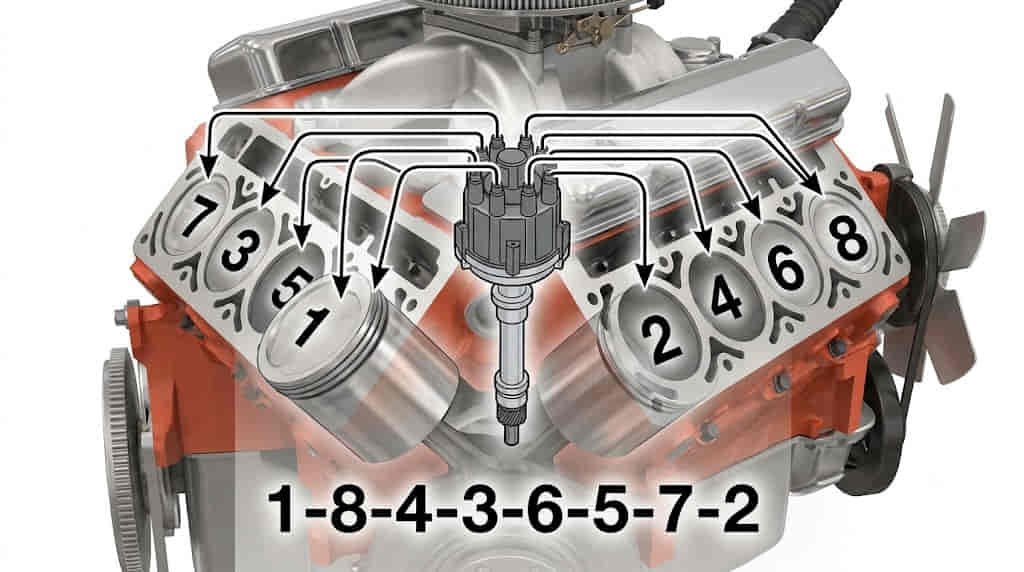
The Chevy big block firing order is 1-8-4-3-6-5-7-2 for traditional Chevrolet Big Block V8 engines. This sequence determines when each cylinder fires during the engine’s operating cycle. Understanding the correct firing order helps you connect spark plug wires properly, identify ignition problems, and maintain smooth engine performance. However, knowing the firing order alone is not enough to route the wires correctly. You also need to understand the cylinder numbering system and the position of the number one terminal on the distributor cap.
Chevrolet produced several big block engine families and displacements, including the 396, 402, 427, 454, and 502 cubic-inch engines. Although the traditional firing order is widely associated with these engines, the correct specifications should always be confirmed for the specific engine configuration. Distributor orientation, rotor direction, and the location of the number one terminal also affect spark plug wire routing.
This guide explains the Chevy big block firing order, how to identify each cylinder, and how to connect spark plug wires in the correct sequence. It also covers common wiring mistakes, ignition troubleshooting, and important differences between big block engine generations so you can identify the correct setup before working on your engine.
The firing order of a traditional Chevrolet Big Block V8 engine is 1-8-4-3-6-5-7-2. This sequence identifies the order in which the eight cylinders produce power during the engine’s operating cycle. The crankshaft, camshaft, and ignition system work together to coordinate combustion in this sequence, helping the engine deliver balanced power and operate smoothly. When installing spark plug wires or diagnosing an ignition problem, following the correct firing order is essential because each spark must occur when its cylinder is ready for combustion.
The firing order is different from cylinder numbering. Cylinder numbering identifies the physical location of each cylinder in the engine block, while the firing order specifies the sequence in which those cylinders fire. For example, cylinder 1 fires first in the listed sequence, followed by cylinder 8, then cylinder 4, cylinder 3, cylinder 6, cylinder 5, cylinder 7, and cylinder 2. This sequence repeats as the engine runs. Connecting spark plug wires according to cylinder position rather than firing order can cause misfires, rough running, or failure to start.
The 1-8-4-3-6-5-7-2 sequence is the standard reference for traditional Chevrolet Big Block V8 applications, including many 396, 402, 427, and 454 engines. However, engine modifications, camshaft specifications, and differences between engine families make it important to verify the correct information for the specific application. Before routing the spark plug wires, identify the engine configuration and confirm the firing order in the appropriate service manual. This prevents confusion between the engine’s firing sequence and the physical arrangement of the distributor terminals.
Read more: Chevy 5.3 Firing Order
Chevrolet Big Block V8 engines use a cylinder numbering system that identifies each cylinder by its position in the engine block. On a traditional Chevy big block, cylinders 1, 3, 5, and 7 are located on the driver’s side, while cylinders 2, 4, 6, and 8 are located on the passenger’s side when viewed from the driver’s seat. Both banks are numbered from the front of the engine toward the rear. This arrangement allows you to identify individual cylinders when connecting spark plug wires, checking spark plugs, or diagnosing an engine misfire.
Cylinder 1 is located at the front of the driver’s-side bank, nearest the water pump and front of the engine. Behind it are cylinders 3, 5, and 7, in that order. On the passenger’s side, cylinder 2 is at the front, followed by cylinders 4, 6, and 8 toward the rear. This alternating odd-and-even numbering system is important because the physical cylinder layout does not follow the firing order. For example, cylinder 8 sits at the rear of the passenger’s-side bank, but it fires immediately after cylinder 1 in the standard firing sequence of 1-8-4-3-6-5-7-2.
Correct cylinder identification is the foundation of accurate distributor wiring. If you mistake one bank for the other or count cylinders from the rear, you may connect a spark plug wire to the wrong distributor terminal. The resulting ignition sequence can cause rough idling, misfires, reduced engine performance, or starting difficulties. Before installing wires, identify the front of the engine, locate cylinder 1, and confirm the numbering arrangement for your specific big block application using the appropriate service manual. This is especially important when working on a modified engine or a vehicle with an unfamiliar engine installation.
To connect spark plug wires on a traditional Chevy Big Block V8, follow the firing order 1-8-4-3-6-5-7-2, starting at the distributor terminal connected to cylinder 1. The distributor sends high-voltage current to each spark plug in sequence, while the rotor directs the current to the appropriate terminal as it rotates. Correct wiring ensures that each cylinder receives a spark at the intended point in the engine’s operating cycle. If the wires are installed in the wrong sequence, the spark may reach a cylinder when it is not ready for combustion, resulting in misfires or poor engine operation.
Begin by identifying cylinder 1 and locating the distributor terminal that serves it. The number one terminal must be established from the engine’s actual distributor position and the rotor’s position when the engine is set to cylinder 1’s compression top dead center. Do not assume that the number one terminal occupies the same physical position on every engine, because distributor installation and engine configuration can vary. Once the number one terminal is confirmed, connect the remaining spark plug wires in the firing order, following the distributor’s direction of rotation. Traditional Chevrolet big block distributors commonly rotate clockwise, but verify the direction for the specific distributor before routing the wires.
Route each wire from its assigned distributor terminal to the matching spark plug, keeping the wires organized and clear of exhaust manifolds, sharp edges, and moving components. Use the correct wire lengths and retainers to reduce the risk of heat damage, abrasion, and electrical interference. Before starting the engine, recheck both ends of every wire against the cylinder numbering system and firing order. If the engine still runs poorly, verify the ignition timing, distributor installation, spark plug condition, and other ignition components rather than repeatedly rearranging wires without confirming the underlying cause. Always consult the service manual for the exact engine and distributor combination.
Incorrect spark plug wire connections can prevent a Chevy Big Block V8 from running properly because the cylinders receive sparks in the wrong sequence. When a wire connects a distributor terminal to the wrong cylinder, ignition timing at that cylinder no longer matches the intended combustion cycle. The engine may crank without starting, idle roughly, misfire under load, or produce less power than expected. In some cases, incorrect wiring can also cause backfiring through the intake or exhaust. These symptoms indicate a possible ignition problem, but they do not prove that the firing order is the cause.
One common mistake is connecting the wires according to the physical arrangement of the cylinders rather than the firing order. On a traditional Chevrolet Big Block V8, the firing order is 1-8-4-3-6-5-7-2, whereas the cylinders are numbered by their positions on the two engine banks. Another mistake is assuming that the number one distributor terminal always occupies a particular position on the distributor cap. Its location depends on how the distributor is installed and how the engine is positioned during setup. Even if the wires appear neatly arranged, a single incorrect connection can disrupt combustion and make the engine run poorly.
When an engine develops ignition symptoms after spark plug wires have been replaced, verify the firing order and confirm that each wire connects the correct distributor terminal to the corresponding cylinder. Inspect the distributor cap for cracks, carbon tracking, damaged terminals, or moisture, and check the wires and spark plugs for damage. If the wiring is correct but the symptoms continue, investigate ignition timing, distributor condition, fuel delivery, and cylinder compression. Avoid repeatedly swapping wires without a verified reference, because this can introduce additional faults and make the original problem more difficult to diagnose.
Diagnosing an ignition problem on a Chevy Big Block V8 starts with verifying the firing order, cylinder numbering, and spark plug wire connections. The standard firing order for traditional Chevrolet Big Block V8 engines is 1-8-4-3-6-5-7-2, but the wires must also connect to the correct distributor terminals. Begin by identifying cylinder 1, confirming the number one distributor terminal, and checking each wire against the firing sequence. This inspection is particularly important when the engine develops a misfire, runs roughly, or fails to start after ignition components have been replaced. Always use the correct service information for the specific engine and distributor configuration.
Next, inspect the ignition components for visible damage or poor connections. A cracked distributor cap, worn rotor, damaged spark plug wire, fouled spark plug, or loose electrical connection can interrupt the ignition process even when the firing order is correct. Check that the wires are fully seated at both the distributor cap and spark plugs, and look for heat damage where wires pass near exhaust components. If the engine cranks but does not start, verify that the ignition system produces spark using an appropriate spark tester and safe procedures. Avoid handling ignition wires while the engine is running because the ignition system generates high voltage.
If the wiring and ignition components appear correct, check ignition timing and distributor installation before investigating other engine systems. Incorrect base timing, a distributor installed in the wrong position, or a mechanical problem affecting valve operation can produce symptoms similar to incorrect spark plug wiring. Fuel delivery problems and low cylinder compression can also cause rough running or misfires. A systematic diagnosis separates these possible causes instead of assuming every ignition symptom comes from the firing order. For modified engines, aftermarket distributors, or engines with different camshaft specifications, consult the applicable manufacturer’s instructions and engine-specific service manual before making adjustments.
Most traditional Chevrolet Big Block V8 engines use the firing order 1-8-4-3-6-5-7-2. This sequence is commonly associated with Chevrolet big block displacements such as the 396, 402, 427, and 454 cubic-inch engines. The firing order determines the sequence in which the cylinders produce power, while cylinder numbering identifies their physical locations in the engine block. Although these engines share a familiar firing-order pattern, the correct specifications for an individual engine should be confirmed before ignition work begins.
Chevrolet big blocks span multiple engine generations, including Mark IV, Mark V, and Gen VI designs. These generations differ in construction details and engine configurations, so identifying an engine by displacement alone does not establish every service specification. Previous owners may also have installed an aftermarket camshaft, distributor, or other ignition components. Such modifications can affect setup procedures and ignition requirements, even when the conventional firing-order sequence remains applicable. For this reason, the engine identification code, distributor specifications, and relevant service documentation provide a more reliable basis for maintenance than assumptions based solely on engine size.
Before connecting spark plug wires, verify the firing order, cylinder numbering, distributor rotation, and number one terminal location for the exact engine configuration. This distinction is important because the firing order does not indicate the physical positions of the terminals on the distributor cap. A correctly identified engine and distributor allow the wires to be routed in the proper sequence, reducing the risk of misfires and starting problems. When working on a modified or unfamiliar Chevrolet Big Block V8, use the applicable service manual or component manufacturer’s instructions to confirm the correct procedure.