Low compression in one cylinder means that a cylinder produces a lower compression pressure than the engine manufacturer specifies or significantly less pressure than the other cylinders. This condition often indicates a problem with the combustion chamber’s ability to seal pressure during the compression stroke. Common causes include worn piston rings, leaking intake or exhaust valves, a damaged head gasket, a damaged piston, or cylinder wall wear. Identifying the actual cause requires testing because the compression reading alone cannot confirm which component has failed.
An engine with low compression in one cylinder may experience rough idling, engine misfires, reduced power, difficult starting, or increased fuel consumption. However, these symptoms can also result from ignition, fuel delivery, or engine management problems. A proper diagnosis should therefore begin with a compression test and continue with additional checks when the results indicate a mechanical problem.
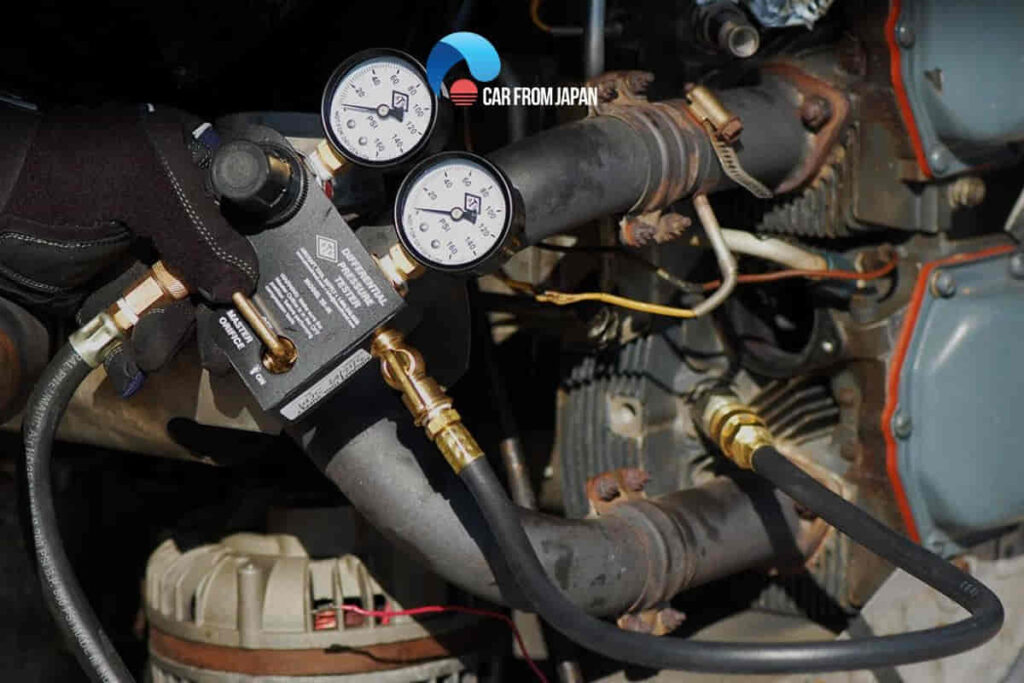
A leak-down test can help identify where compressed air escapes from the cylinder, making it easier to distinguish between valve leakage, piston ring problems, and possible head gasket damage. Once the source of compression loss is established, the appropriate repair may range from cylinder head or valve work to piston, ring, or cylinder repairs. Understanding the causes and diagnostic process helps prevent unnecessary parts replacement and supports a more accurate engine repair decision.
What Does Low Compression in One Cylinder Mean?
Low compression in one cylinder means that the pressure produced inside that cylinder during the compression stroke is below the engine manufacturer’s specification or noticeably lower than the readings from the other cylinders. During this stroke, the piston moves upward while the intake and exhaust valves should remain closed, allowing the cylinder to compress the air-fuel mixture in a gasoline engine or the air in a diesel engine. If the combustion chamber cannot retain pressure properly, the compression reading may fall below the expected level, reducing the engine’s ability to produce power efficiently.
The most important factor is the cylinder’s ability to maintain a seal. The piston rings help prevent compressed gases from escaping into the crankcase, while the intake and exhaust valves seal the combustion chamber at the appropriate time. The head gasket also prevents pressure from escaping between the cylinder head and engine block. Damage or excessive wear in any of these areas can cause compression loss. For example, an exhaust valve that does not seal correctly may allow compressed gas to escape through the exhaust port, resulting in a lower compression reading even when the piston rings remain in acceptable condition.
Low compression in one cylinder differs from low compression across the entire engine because the pattern of readings can help narrow the diagnosis. When only one cylinder produces an unusually low reading, a localized problem such as a leaking valve, damaged piston, worn piston rings, or a head gasket failure affecting that cylinder becomes a key consideration. When all cylinders produce low readings, testing conditions, valve timing, or general engine wear may require closer investigation. These patterns guide further testing, but they do not independently confirm a specific failure.
A compression test provides an initial measurement of cylinder pressure, while a leak-down test helps determine whether air escapes through the intake system, exhaust system, crankcase, or a possible head gasket leak. The results must be interpreted according to the engine’s design and service specifications. Different engines have different compression requirements, so there is no universal pressure value that defines a healthy cylinder in every vehicle. Comparing the readings with manufacturer specifications and the other cylinders provides a more reliable basis for deciding whether additional mechanical inspection is necessary.
Read more: Does 2 Stroke Oil Go Bad
What Causes Low Compression in One Cylinder?
Low compression in one cylinder usually occurs when the combustion chamber cannot seal pressure effectively during the compression stroke. The most common mechanical causes include leaking intake or exhaust valves, worn or damaged piston rings, a damaged piston, cylinder wall wear, and a leaking head gasket. Each fault allows compressed gas to escape through a different part of the engine, so identifying the correct cause requires more than a single compression reading. The engine’s service specifications, compression test results, and leak-down test findings help determine which component needs further inspection.
Worn or damaged piston rings can cause compression loss by allowing gases to pass between the piston and cylinder wall into the crankcase. Piston rings help maintain the seal required for compression while also controlling the oil film on the cylinder wall. When the rings wear, stick, break, or lose their ability to seal, the cylinder may produce less pressure than expected. Cylinder wall scoring or excessive wear can create a similar problem because the rings may no longer seal effectively against the cylinder surface. A wet compression test may help investigate this possibility if the reading increases after a small amount of oil is introduced into the cylinder according to the appropriate service procedure. However, this result is an indication rather than definitive proof of worn rings.
Leaking intake or exhaust valves are another important cause of low compression in one cylinder. The valves must close against their seats to seal the combustion chamber during compression. Carbon deposits, burned valve faces, damaged valve seats, bent valves, or incorrect valve clearance on engines that require adjustment can prevent proper sealing. When an exhaust valve leaks, compressed gas may escape through the exhaust port; when an intake valve leaks, pressure may escape through the intake system. A leak-down test can help distinguish these conditions by identifying where air escapes while the cylinder is pressurized. Further inspection may be necessary to confirm the exact valve or seat defect.
A damaged head gasket can also cause compression loss when the sealing surface between the cylinder head and engine block fails. Depending on the location of the damage, compressed gas may escape into an adjacent cylinder, the cooling system, or an external passage. A gasket failure may be accompanied by overheating, coolant loss, or other symptoms, but these signs are not always present. Damage to the piston, including cracks, holes, or severe deterioration, can also prevent the cylinder from retaining pressure. In these cases, the compression test establishes that a problem exists, while additional testing and mechanical inspection determine the extent of the damage.
Valve timing and other engine-specific mechanical problems should also be considered when the compression readings do not match the expected pattern. Incorrect camshaft timing can affect valve operation and produce abnormal compression results, while certain variable valve timing systems require model-specific diagnostic procedures. A fault that affects only one cylinder may point toward a localized sealing problem, but the final diagnosis should account for the engine’s design and test conditions. Confirming the cause before replacing parts helps prevent unnecessary repairs and ensures that the selected repair addresses the actual source of compression loss.
What Are the Symptoms of Low Compression in One Cylinder?
Low compression in one cylinder can cause rough idling, engine misfires, reduced acceleration, difficult starting, and lower engine performance. These symptoms occur because the affected cylinder cannot generate the pressure needed for normal combustion, reducing its contribution to the engine’s total power output. The severity depends on how much compression has been lost, the engine’s design, and whether other faults are present. A mildly affected cylinder may produce subtle performance changes, while a cylinder with severe compression loss may contribute very little power.
An engine misfire is one of the most recognizable symptoms because the affected cylinder may fail to burn the air-fuel mixture efficiently during some or all combustion cycles. The engine may shake at idle, vibrate during acceleration, or produce uneven power delivery. On vehicles equipped with onboard diagnostics, the check engine light may illuminate and a diagnostic trouble code such as P0301 may identify a misfire in cylinder 1. However, a misfire code does not prove that compression is low. Faulty spark plugs, ignition coils, fuel injectors, and wiring can produce similar symptoms, so mechanical testing is necessary to distinguish compression loss from ignition or fuel delivery problems.
Reduced engine power and poor acceleration may develop when the affected cylinder contributes less torque than the others. The driver may notice slower acceleration, uneven response under load, or difficulty maintaining normal performance on an incline. Fuel economy may also deteriorate if the engine management system adjusts fueling in response to the misfire or if combustion becomes inefficient. The exact effect varies by engine type and operating conditions, so reduced power or increased fuel consumption alone cannot establish that a cylinder has low compression.
Starting difficulties can occur when compression falls far enough to interfere with reliable combustion, particularly in engines that depend on sufficient cylinder pressure to ignite the fuel. A gasoline engine may still start with one weak cylinder, although it may run unevenly. A diesel engine can be more sensitive to compression loss because it relies on heat generated by compressing air to ignite the injected fuel. If the engine cranks normally but starts poorly, runs roughly, or repeatedly misfires, a compression test can help determine whether mechanical sealing is involved. The symptoms should be assessed alongside diagnostic codes, ignition and fuel system checks, and the engine manufacturer’s compression specifications.
How Do You Test Compression in One Cylinder?
A compression test measures the pressure each cylinder produces while the engine cranks, helping identify whether one cylinder seals less effectively than the others. The test requires an engine compression gauge that matches the spark plug thread or adapter specification, along with the correct procedure for the engine being tested. Comparing all cylinders is essential because a reading that appears acceptable in isolation may still be significantly lower than the readings from the other cylinders. The manufacturer’s service manual provides the appropriate pressure specifications and allowable variation for the specific engine.
Before testing, confirm the engine’s required temperature and preparation procedure. Many gasoline engines are tested warm, but the manufacturer’s instructions take priority, especially if the engine has a known mechanical fault or cannot be operated safely. Disable the ignition and fuel delivery using the approved procedure to prevent the engine from starting, then remove the spark plugs as specified. If the engine uses a different ignition or fuel system, follow its service documentation rather than applying a universal procedure. Keep hands, tools, and loose clothing clear of moving parts, and use appropriate precautions around hot engine components.
Install the compression gauge in the first cylinder’s spark plug opening and crank the engine for the number of revolutions specified by the service procedure, or until the gauge reading stops increasing. Record the result, then repeat the test under the same conditions for every cylinder. If one cylinder records substantially lower pressure than the others, repeat the measurement to rule out an inconsistent test setup. For example, if three cylinders produce similar readings while the fourth is distinctly lower, the difference supports further investigation of that cylinder’s sealing, but it does not identify the failed component by itself.
Interpret the readings using the engine manufacturer’s specifications rather than a universal pressure threshold. Results can be affected by engine temperature, battery condition, cranking speed, throttle position where applicable, gauge accuracy, and test technique. If one cylinder remains low, a cylinder leak-down test can help determine whether air is escaping through the intake valve, exhaust valve, piston rings, or head gasket area. This additional test narrows the diagnosis and helps prevent unnecessary replacement of engine parts.
How Can a Leak-Down Test Identify the Cause of Low Compression?
A cylinder leak-down test helps identify why one cylinder has low compression by measuring how much compressed air escapes from the combustion chamber and detecting where it leaks. Unlike a compression test, which measures the pressure generated while the engine cranks, a leak-down test introduces compressed air into a cylinder held at top dead center on its compression stroke. The results help distinguish between leakage past the intake valve, exhaust valve, piston rings, or head gasket. This distinction matters because each failure requires a different repair, ranging from cylinder head work to internal engine disassembly.
To perform the test, the engine must be positioned according to the manufacturer’s procedure, with the tested piston at top dead center on its compression stroke and both valves closed. A calibrated leak-down tester is connected to the cylinder through the spark plug opening, and regulated compressed air is introduced at the tester’s specified pressure. The gauge indicates the percentage of leakage or another measurement defined by the tool. Test procedures and acceptable leakage limits vary by engine and equipment, so the results should be compared with the manufacturer’s specifications rather than judged by a single universal percentage.
The location of escaping air provides the most useful diagnostic evidence. Air heard at the intake manifold or throttle body suggests leakage through the intake valve, while air escaping through the exhaust system points toward the exhaust valve. Air movement or noise from the crankcase or oil filler opening can indicate leakage past the piston rings or cylinder wall. Bubbles in the cooling system may suggest a leak connecting the combustion chamber to a coolant passage, potentially caused by a damaged head gasket, a cracked cylinder head, or a crack in the engine block. These observations are diagnostic clues, not automatic proof of a particular failed part, and they should be interpreted alongside other test results.
For example, a cylinder with low compression and noticeable air escaping through the exhaust system is consistent with an exhaust valve that does not seal properly. If the leak-down test instead reveals substantial crankcase leakage, worn piston rings or cylinder damage become stronger possibilities. When air appears to enter the cooling system, the cooling system and cylinder head area require further inspection. Combining the compression test, leak-down test, diagnostic symptoms, and service specifications gives a more reliable diagnosis and reduces the risk of replacing parts that are still functional.
How Do You Fix Low Compression in One Cylinder?
Fixing low compression in one cylinder requires identifying the failed component before choosing a repair. The correct solution depends on whether compression escapes through the intake valve, exhaust valve, piston rings, cylinder wall, head gasket, or a damaged piston. Replacing parts based only on a low compression reading can waste money because several mechanical faults produce similar symptoms. A compression test, leak-down test, and inspection of the affected cylinder provide the evidence needed to select an appropriate repair.
If a leaking intake or exhaust valve causes compression loss, the repair may require removing the cylinder head to inspect the valve, valve seat, and related components. A burnt, bent, damaged, or poorly seated valve may need replacement or professional machining, depending on the engine manufacturer’s repair specifications. Valve clearance or valve timing problems may also prevent a valve from closing correctly. When the problem originates from incorrect valve adjustment or a timing fault, correcting that issue may restore proper sealing without requiring a complete engine rebuild.
When worn piston rings or damaged cylinder walls allow combustion pressure to escape into the crankcase, the repair may involve internal engine work. Depending on the extent of wear and the engine design, a technician may need to replace the piston rings, hone the cylinder, machine the cylinder bore, or install replacement components. A damaged piston can also require engine disassembly and piston replacement. These repairs are more extensive than replacing external ignition components because the affected parts sit inside the engine. A leak-down test that reveals significant crankcase leakage helps support this diagnosis, but an internal inspection is often needed to determine the full extent of the damage.
A failed head gasket may allow combustion pressure to escape into an adjacent cylinder, a coolant passage, or the outside of the engine. Repair typically involves removing the cylinder head, replacing the gasket, and checking the head and block surfaces for warping, cracks, or other damage. Simply installing a new gasket without identifying the original cause may lead to another failure. If testing suggests a head gasket leak, additional checks of the cooling system and cylinder head can help establish whether the gasket alone is responsible or whether further repairs are necessary.
After completing the repair, repeat the compression test under the same conditions used for the original measurements and compare the results with the manufacturer’s specifications. If appropriate, perform another leak-down test to confirm that the cylinder seals correctly. The engine should also be checked for persistent misfires, abnormal noises, coolant loss, oil consumption, or warning lights. Verifying the result matters because restoring compression is only one part of confirming that the underlying mechanical problem has been resolved.
Can You Drive With Low Compression in One Cylinder?
Driving with low compression in one cylinder is not recommended until the cause and severity of the problem have been identified. An engine may continue running when one cylinder produces less pressure than the others, but the resulting imbalance can cause rough idling, reduced power, increased fuel consumption, and persistent misfires. Whether the vehicle can move under its own power depends on the engine’s condition and the extent of compression loss. Continuing to drive without diagnosing the fault can turn a manageable repair into more extensive engine damage.
The main risk is that the original mechanical problem may worsen during operation. For example, a damaged valve can continue leaking combustion pressure, while worn piston rings or a damaged piston can contribute to increasing oil consumption and poor engine performance. If a head gasket leak connects a cylinder to the cooling system, the engine may also overheat or lose coolant. These outcomes are not inevitable in every low-compression case, but warning signs such as overheating, severe engine shaking, unusual mechanical noises, or a flashing check engine light indicate that continued driving may be unsafe or damaging.
A low-compression cylinder can also affect other engine systems. An active misfire may allow unburned fuel to enter the exhaust, where it can overheat and damage the catalytic converter. The engine may struggle to accelerate or maintain speed, creating an additional safety concern in traffic. For instance, a vehicle that loses power while merging or climbing a hill may not respond as expected when the driver needs acceleration. The severity of these risks depends on the cause of the misfire, the engine management system, and the vehicle’s operating conditions.
If the engine runs roughly, the check engine light flashes, the temperature rises above normal, or unusual mechanical noises develop, stop driving when it is safe to do so and arrange professional inspection or towing. Even if the vehicle still appears drivable, schedule a compression test and, when indicated, a leak-down test to identify the cause. A confirmed diagnosis helps determine whether the engine needs a limited repair, cylinder head work, or more extensive internal engine repairs.
Is Low Compression in One Cylinder Different From Low Compression in All Cylinders?
Low compression in one cylinder differs from low compression across all cylinders because the pattern of pressure loss helps narrow down the possible causes. When one cylinder produces substantially lower pressure than the others, the problem is more likely to involve a localized fault, such as a leaking valve, damaged piston, worn piston rings, cylinder wall damage, or a head gasket leak affecting that cylinder. When compression readings are low across multiple cylinders, the investigation may need to consider broader issues, including incorrect valve timing, general engine wear, or a testing procedure that affects every measurement.
A single low cylinder is often easier to isolate because the remaining cylinders provide a direct comparison. For example, if three cylinders produce similar compression readings and the fourth records a significantly lower result, a mechanic can focus additional testing on the affected cylinder. A leak-down test can then help determine whether air escapes through an intake valve, exhaust valve, crankcase, or cooling system. However, a single-cylinder reading does not automatically prove that one particular component has failed, and the results must still be compared with the manufacturer’s specifications.
Low compression across several cylinders requires a broader diagnostic approach. If all cylinders show similarly reduced readings, incorrect camshaft timing may prevent the valves from opening and closing at the correct points in the combustion cycle. High mileage and widespread internal wear can also reduce cylinder sealing. Before concluding that the engine has extensive damage, the technician should verify battery condition, cranking speed, gauge accuracy, test preparation, and the manufacturer’s testing procedure. Inconsistent test conditions can make otherwise healthy cylinders appear to have low compression.
The distinction matters because repair costs and procedures depend on the actual cause and the number of affected cylinders. A localized valve problem may require cylinder head repair, while widespread wear may justify a more extensive engine assessment. If compression is low in one cylinder, begin by confirming the reading and performing a leak-down test. If multiple cylinders show low compression, compare their readings, verify valve timing and test conditions, and follow the engine manufacturer’s diagnostic procedure before deciding whether major repairs are necessary.