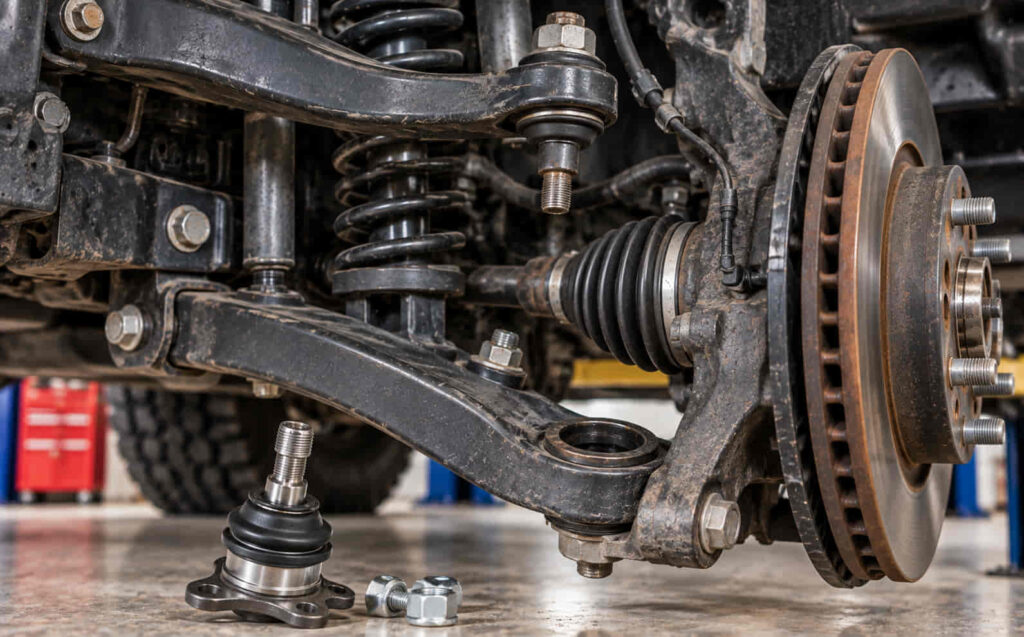
Chevy Silverado ball joints connect the front suspension control arms to the steering knuckles while allowing the wheels to move with both steering input and suspension travel. As these joints wear, clearance can develop inside the connection, creating excessive movement that affects how securely the suspension and wheel assembly are controlled. A severely worn ball joint is more than a noise problem because the joint is part of the mechanical connection that maintains the position of the steering knuckle relative to the suspension.
Common signs associated with worn Silverado ball joints include clunking or knocking from the front suspension, abnormal movement at the wheel, changes in steering behavior, and uneven tire wear. However, these symptoms do not confirm a failed ball joint by themselves. Tie rod ends, control arm bushings, wheel bearings, and other front-end components can produce similar symptoms, so the source of the movement or noise should be identified before parts are replaced.
This guide explains Chevy Silverado ball joint location, symptoms, wear mechanisms, diagnosis, safety risks, replacement, and repair cost. It also covers the differences between upper and lower ball joints, how ball joint problems can affect tire wear and alignment, and how to determine the correct replacement approach for a specific Silverado suspension configuration.
What Are Ball Joints on a Chevy Silverado?
Chevy Silverado ball joints are suspension joints that connect the control arms to the steering knuckles while allowing controlled angular movement as the wheels steer and the suspension moves. The joint maintains a mechanical connection between these components without locking them into a fixed position, allowing the front wheel assembly to respond to steering input and changes in suspension height.
A ball joint typically uses a ball-and-socket type connection to provide this movement. The stud connects the joint to the steering knuckle or related suspension connection, while the joint housing is integrated with or attached to the control arm depending on the specific suspension design. As the wheel moves upward and downward relative to the truck, the joint changes angle while continuing to hold the connected components together.
This combination of movement and structural connection explains why ball joint condition matters. A healthy joint controls movement at the connection while allowing the articulation required by the suspension. When internal wear creates excessive clearance, the steering knuckle can move in ways that are not part of normal suspension travel. That unwanted movement can contribute to noise, changes in steering response, and abnormal wheel behavior.
Ball joints also operate under repeated mechanical loading. Every steering movement and suspension cycle changes the forces acting through the joint. The internal surfaces must continue to articulate while maintaining controlled clearance, and the protective boot helps isolate the joint from contaminants that can accelerate wear. Damage to the boot can therefore become relevant even before severe mechanical play is present.
A ball joint should not be diagnosed as defective solely because the front suspension produces a clunk or the steering feels different. Several components participate in controlling the wheel and steering knuckle. The purpose of ball joint diagnosis is to determine whether excessive movement originates inside the joint rather than assuming that any front-end symptom identifies the ball joint as the failed component.
Where Are the Ball Joints Located on a Chevy Silverado?
Chevy Silverado ball joints are located at suspension connection points between the front control arms and steering knuckles, with their exact position and configuration depending on the truck’s model year and suspension design. These joints allow the steering knuckle and wheel assembly to move relative to the control arms without separating from the suspension structure.
An upper ball joint, when used in the applicable configuration, connects the upper portion of the suspension through the upper control arm and steering knuckle. The corresponding lower connection is associated with the lower control arm and lower portion of the steering knuckle. These positions create the articulated connections needed for suspension travel while allowing the steering knuckle to change direction as the driver turns the wheels.
The terms upper and lower describe the joint’s position within the suspension rather than two interchangeable parts. Their mounting designs, service procedures, and replacement components can differ. A replacement ball joint must therefore be identified by its actual suspension position and application rather than by searching for a generic Silverado ball joint.
Location also matters during diagnosis because movement detected at the wheel can originate from several nearby components. The steering knuckle connects or interacts with the ball joints, tie rod, wheel hub and bearing assembly, and other suspension or steering components. Movement observed during an inspection must therefore be traced to the connection where clearance actually exists.
For example, wheel movement caused by a worn wheel bearing should not be interpreted automatically as lower or upper ball joint play. Likewise, movement associated with a steering linkage component can produce looseness without the ball joint being the source. Observing the ball joint itself while the applicable load or movement is applied helps determine whether the joint contains excessive clearance.
The specific suspension configuration should also be identified before ordering parts or planning replacement. Model year, suspension application, ball joint position, control arm design, and verified fitment determine the correct component and service approach. The Chevrolet Silverado name alone does not establish that every truck uses the same ball joint arrangement or replacement procedure.
Read more: Chevy Silverado Oil Pan Gasket
What Are the Symptoms of Bad Ball Joints on a Chevy Silverado?
The main symptoms of bad Chevy Silverado ball joints include clunking or knocking from the front suspension, excessive movement at the affected joint, changes in steering behavior, and abnormal tire wear. These symptoms develop because internal ball joint wear can create clearance where the control arm and steering knuckle should remain securely connected while still allowing normal suspension articulation.
A clunk or knock can occur when excessive clearance allows the ball joint components to move against each other as suspension load changes. The sound may become noticeable when the wheel travels over bumps, the suspension changes direction, or vehicle weight shifts through the front suspension. The exact sound is not enough to confirm the diagnosis because control arm bushings, steering components, and other suspension connections can also produce front-end clunks.
Excessive movement at the joint provides stronger evidence than noise alone. A healthy ball joint must articulate, so movement itself is normal. The diagnostic concern is unwanted clearance within the joint rather than the designed angular movement of the suspension. When the ball joint develops excessive play, the steering knuckle can move relative to the control arm beyond the movement intended by the joint.
Steering behavior can also change as wear progresses. Because the steering knuckle is connected to the suspension through the ball joints, uncontrolled clearance can reduce the consistency with which the wheel assembly follows steering and suspension inputs. The driver may notice looseness or less predictable front-end behavior, but steering symptoms still need inspection because tie rod ends, wheel bearings, alignment problems, and other components can create similar effects.
Uneven or accelerated tire wear can develop when excessive suspension play allows the wheel to operate outside its intended position. The tire then contacts the road differently across its tread as vehicle load and suspension position change. However, tire wear is not specific to ball joints. Incorrect wheel alignment, worn control arm bushings, tire-pressure problems, and other suspension faults can produce abnormal wear patterns without a failed ball joint.
Visible damage to the ball joint dust boot is another condition that deserves attention. The boot helps protect the joint from water, dirt, and other contaminants. A torn or deteriorated boot does not prove that the joint already has excessive mechanical play, but it can expose internal surfaces to conditions that accelerate wear. The joint’s mechanical condition still needs to be evaluated.
The strongest evidence of a bad Silverado ball joint is therefore excessive play or another confirmed mechanical defect at the joint itself. Clunking, steering changes, and uneven tire wear indicate where diagnosis should begin, but they should not be treated as substitutes for inspecting the suspension connection.
What Causes Chevy Silverado Ball Joints to Wear Out?
Chevy Silverado ball joints wear when repeated suspension movement and mechanical loading gradually increase clearance within the joint, with contamination, loss of protection, and demanding operating conditions capable of accelerating that process. Ball joints are moving suspension connections, so wear occurs at surfaces that must articulate repeatedly while controlling the position of the steering knuckle.
Every driving cycle subjects the joints to changing forces. Steering changes the joint angle, suspension travel moves the connected components through their operating range, and vehicle load transfers forces through the front suspension. Over time, wear at the internal contact surfaces can increase clearance between components that originally moved with controlled tolerances.
The protective boot influences how quickly this wear can progress. When the boot remains intact, it helps isolate the joint from water, road debris, and abrasive contamination. If the boot tears or separates, contaminants can reach areas they were intended to stay outside. Abrasive material combined with repeated joint movement can accelerate deterioration of the internal contact surfaces.
Lubrication condition is relevant where the particular ball joint design depends on serviceable or retained lubrication. Lubrication reduces friction between moving surfaces, while contamination or an unsuitable lubrication condition can increase wear. The maintenance approach must match the joint design because not every Silverado ball joint should be assumed to have the same lubrication or service requirements.
Operating conditions can also influence the load applied to suspension components. Repeated impacts and demanding use can place greater stress on ball joints and related connections than smoother operating conditions. This does not create a universal failure mileage, however. Ball joint life depends on the component design, condition, operating environment, vehicle configuration, and accumulated mechanical wear rather than one replacement interval that applies to every Silverado.
Related suspension problems can further affect how forces are distributed through the front end. A worn component elsewhere in the suspension does not automatically cause ball joint failure, but multiple deteriorated components can change wheel control and complicate diagnosis. Inspecting the suspension as a connected system helps identify whether the ball joint is the only worn component.
A Silverado ball joint should therefore be replaced based on confirmed condition rather than mileage alone. The relevant evidence is deterioration such as excessive joint play, mechanical damage, or another condition that places the joint outside the acceptable service criteria for the specific suspension application.
How Do You Check Chevy Silverado Ball Joints for Wear?
Chevy Silverado ball joints should be checked for wear by inspecting the joint and protective boot, applying the appropriate movement or load to the suspension, and observing whether excessive play occurs inside the ball joint itself. The objective is to distinguish normal ball joint articulation from unwanted clearance between components inside the joint.
Visual inspection provides useful initial evidence. The ball joint area should be examined for a damaged or separated dust boot, contamination, corrosion, physical damage, or other visible deterioration. A compromised boot matters because it can allow water and abrasive debris to reach the joint. However, boot damage alone does not establish the amount of internal wear, so the mechanical condition of the joint still needs to be evaluated.
Mechanical inspection focuses on where movement occurs. The wheel and suspension can move for several legitimate reasons, and multiple front-end components can develop unwanted clearance. When the applicable inspection method places load on the suspension, the ball joint should be observed directly to determine whether the stud and housing exhibit excessive movement relative to each other. Movement elsewhere in the steering or suspension should not be attributed automatically to the ball joint.
This distinction is especially important because a ball joint is designed to move. Angular articulation that occurs as the steering knuckle changes position is part of normal operation. Wear is indicated by unwanted clearance within the connection rather than by the simple fact that the joint changes angle. Diagnosis therefore depends on identifying the type and source of movement, not merely detecting motion somewhere around the wheel.
The correct inspection method can depend on the Silverado suspension design and the position of the joint being tested. Suspension loading can affect how joint clearance becomes visible, so a test that is appropriate for one suspension arrangement should not automatically be treated as universal. Application-specific service information should determine the inspection procedure and acceptable service criteria when a precise wear limit is required.
Noise can support the diagnosis but should remain secondary to mechanical evidence. If a clunk occurs as suspension load changes and inspection also identifies excessive movement at the corresponding ball joint, the two observations create stronger evidence than the noise alone. The same principle applies to steering symptoms and abnormal tire wear: each symptom becomes more diagnostically useful when it can be connected to confirmed play at the joint.
A ball joint should therefore be considered worn based on confirmed excessive clearance, mechanical deterioration, or application-specific service criteria at the joint itself. This approach prevents normal suspension movement or looseness from another component from being mistaken for a failed Silverado ball joint.
How Do You Tell a Bad Ball Joint From Other Silverado Front-End Problems?
A bad Chevy Silverado ball joint is distinguished from other front-end problems by tracing the noise or unwanted movement to the ball joint instead of diagnosing the component from a shared symptom. Ball joints, tie rod ends, wheel bearings, control arm bushings, and other suspension connections can all contribute to looseness, noise, steering changes, or abnormal tire behavior.
Tie rod end wear can be confused with ball joint wear because both conditions can affect how securely the wheel responds to steering input. The difference is the source of the clearance. A worn tie rod connection produces movement within the steering linkage, while a worn ball joint produces excessive movement at the control arm-to-steering-knuckle connection. Observing both components while movement is applied helps identify which connection is actually loose.
Wheel bearing or hub problems can also produce wheel movement that appears similar to suspension-joint play. Detecting looseness at the wheel is therefore only the beginning of the diagnosis. The technician or vehicle owner needs to observe whether the movement occurs within the hub and bearing assembly, at a ball joint, or through another connected component. Replacing the ball joint without locating the movement can leave the original problem unchanged.
Control arm bushing deterioration creates another overlapping symptom pattern. Bushings allow controlled movement while isolating parts of the suspension from vibration, and deterioration can permit the control arm to shift more than intended. That movement can produce clunks or changes in wheel position even when the ball joint itself remains within acceptable condition. Watching the control arm, bushing, and ball joint during inspection helps separate these possible sources.
Abnormal tire wear is similarly nonspecific. Excessive ball joint play can contribute to inconsistent wheel positioning, but alignment settings, worn bushings, steering-component wear, wheel-bearing problems, tire pressure, and other conditions can also affect the tread. The wear pattern should therefore support a suspension inspection rather than function as proof that a particular ball joint has failed.
Front-end noise should be interpreted using the same principle. A clunk identifies a mechanical event but not necessarily the component producing it. The diagnostic value increases when the noise can be reproduced while visible or measurable movement occurs at a specific connection. This converts a general symptom into component-level evidence.
The key distinction is where the excessive movement originates. If unwanted clearance is observed inside the ball joint while the surrounding steering, hub, and suspension connections remain controlled, the evidence supports ball joint wear. If the movement originates elsewhere, replacing the ball joint does not address the diagnosed fault.
Accurate diagnosis therefore follows the mechanical connection rather than the symptom label. Front-end clunking, looseness, steering changes, and tire wear identify a system that requires inspection; confirmed excessive movement at the ball joint identifies the component that requires attention.
Can You Drive a Chevy Silverado With Bad Ball Joints?
A Chevy Silverado with a confirmed worn ball joint should be repaired promptly, and continued driving becomes unsafe when the joint has excessive play or has lost the ability to maintain a controlled suspension connection. Ball joints connect the control arms to the steering knuckles, so their condition affects more than ride noise. Increasing wear can allow unwanted movement in a connection that helps control the position of the wheel assembly.
The level of risk depends on the actual condition of the joint rather than the presence of one symptom. A minor front-end noise that has not been diagnosed is different from a ball joint inspection that confirms substantial mechanical clearance. Noise alone cannot establish failure severity because tie rod ends, bushings, wheel bearings, and other components can produce similar symptoms.
Once excessive ball joint play is confirmed, continued operation subjects the worn internal surfaces to repeated steering and suspension loads. The clearance does not perform a useful suspension function; it allows the connected components to move beyond the joint’s intended controlled articulation. This can reduce consistency in wheel positioning and place additional movement through the affected suspension connection.
A damaged protective boot also requires context. A torn boot can expose the joint to contamination and accelerate internal wear, but boot damage by itself does not establish that the joint is already near structural failure. The mechanical condition still needs to be inspected. By contrast, a joint with clearly excessive play or physical deterioration provides direct evidence that the suspension connection is no longer operating as intended.
Driving should not be justified simply because the truck still steers or because the ball joint has not separated. Ball joint deterioration occurs within a load-bearing mechanical connection, and severe wear can progress beyond noise and looseness. The appropriate response to confirmed excessive wear is to correct the defective connection rather than use continued vehicle operation as a test of how long the joint will remain intact.
The practical distinction is therefore suspected symptom → inspect the suspension → confirm the source → determine ball joint condition → repair confirmed excessive wear. A Silverado with an undiagnosed clunk needs diagnosis, while a Silverado with a verified severely worn ball joint needs the defective suspension connection addressed before normal driving continues.
What Happens if a Chevy Silverado Ball Joint Fails?
If a Chevy Silverado ball joint reaches severe mechanical failure, it can lose its ability to maintain the intended connection between the control arm and steering knuckle, causing the affected wheel assembly to move outside its normal controlled position. This is the critical consequence that separates ball joint failure from a minor suspension noise.
During normal operation, the ball joint allows angular movement while keeping the suspension components mechanically connected. Internal wear increases clearance within that connection. As deterioration becomes more severe, the joint has less ability to control the relationship between its stud, housing, control arm, and steering knuckle.
Before complete failure, increasing clearance can produce clunking, looseness, inconsistent wheel positioning, or changes in steering behavior. These symptoms occur because forces that should pass through a controlled joint are acting through a connection with unwanted movement. The progression is therefore internal wear → excessive clearance → reduced control at the suspension connection → risk of severe joint failure.
A severe failure can allow the steering knuckle and control arm to lose their intended relationship. Because the wheel hub and wheel are associated with the steering knuckle assembly, this can cause a major change in wheel position and compromise the driver’s ability to control the vehicle normally. The exact physical result depends on the suspension configuration and the manner in which the joint fails, so one failure pattern should not be presented as universal for every Silverado.
This consequence also explains why tire wear or front-end noise should not be the only criteria used to judge urgency. A worn ball joint is fundamentally a mechanical connection problem. Tire wear and noise are possible effects of that deterioration, while the structural condition of the joint determines the more important safety concern.
Ball joint wear should therefore be addressed before it progresses to a loss of controlled suspension connection. The objective of diagnosis is to identify excessive wear while the ball joint still connects the suspension components, not to wait for separation or another severe failure to confirm that the joint was defective.
How Do You Replace Ball Joints on a Chevy Silverado?
Replacing Chevy Silverado ball joints requires confirming the worn joint, identifying the specific suspension configuration, separating the affected control arm and steering-knuckle connection, and installing the correct replacement joint or control-arm assembly for that application. The exact procedure varies because Silverado model years and suspension configurations do not all use the same ball joint design or service method.
The repair should begin with a confirmed diagnosis rather than replacing a ball joint based only on clunking, steering changes, or tire wear. Once excessive play or another mechanical defect has been traced to the joint, the upper or lower position must be identified and matched to the truck’s suspension design. This determines both the replacement component and how the joint is serviced.
The truck must be safely supported before the suspension connection is disassembled. Removing the wheel provides access to the affected area, after which components connected to or obstructing the ball joint can be addressed according to the applicable service procedure. The steering knuckle and control arm connection must then be separated without damaging components that will remain in service.
How the old ball joint is removed depends on its design. A serviceable joint may require a specific removal and installation method to separate it from the control arm, while another application may make replacement of the applicable control-arm assembly the appropriate repair approach. This distinction should be established before disassembly because replacing an individual joint and replacing a complete control arm are not the same procedure.
The condition of the surrounding suspension should be inspected while the connection is accessible. A new ball joint does not correct excessive play originating from a tie rod end, control arm bushing, wheel bearing, or another worn component. Identifying related wear during the repair reduces the chance that a front-end symptom will remain after the diagnosed ball joint has been replaced.
Installation requires the replacement joint or assembly to seat and connect correctly within the suspension. The ball joint stud, steering knuckle, control arm, fasteners, and any application-specific retaining components must be assembled according to the relevant service procedure. Universal torque values should not be substituted for application-specific specifications because fastener requirements can differ between suspension designs.
After reassembly, the suspension should be inspected for correct component positioning and secure connections before the truck returns to service. Wheel alignment should also be considered according to the repair performed and the applicable suspension procedure. The repair is complete when the worn connection has been corrected and the front suspension operates without the excessive play attributed to the failed ball joint.
How Difficult Is Chevy Silverado Ball Joint Replacement?
Chevy Silverado ball joint replacement can range from a moderate suspension repair to a substantially more involved job depending on the joint design, corrosion, available access, required separation method, and whether the individual joint or complete control-arm assembly is being replaced. The physical size of the ball joint does not accurately represent the difficulty of replacing it.
Separating suspension components is one source of complexity. Ball joints operate in connections exposed to repeated mechanical loads and road conditions, so disassembly may require more than removing a few fasteners. Corrosion or a tightly seated connection can increase the effort required to separate components without damaging the steering knuckle or other parts intended for reuse.
An individually serviceable ball joint can add another requirement because the old joint must be removed from its mounting position and the replacement installed correctly. The removal and installation method must control how force is applied to the surrounding component. Improper force can damage the control arm, replacement joint, protective boot, or mounting area and turn a ball joint repair into a larger suspension repair.
Replacing a complete control-arm assembly changes the procedure but does not automatically make every application simple. The control arm connects to other parts of the suspension, and removal changes which connections must be disassembled and reinstalled. The appropriate strategy depends on the actual Silverado suspension design and the condition of the components involved rather than a universal preference for replacing either the joint or the complete arm.
DIY difficulty should therefore be evaluated from the complete repair path. Safe vehicle support, suspension disassembly, joint separation, application-specific installation requirements, suitable tools, and final inspection all matter. A vehicle owner should not judge the job solely by the cost of the replacement ball joint.
The most accurate assessment starts with the Silverado model year, suspension configuration, upper or lower joint position, joint mounting design, and applicable replacement procedure. These attributes determine the actual repair complexity and prevent a procedure for one Silverado configuration from being treated as universal for the entire model line.
How Much Does Chevy Silverado Ball Joint Replacement Cost?
Chevy Silverado ball joint replacement cost depends on the specific joint being replaced, the suspension design, whether the individual ball joint or complete control-arm assembly is serviced, and the labor required to complete the repair. The price of the ball joint alone therefore does not represent the total cost of restoring the suspension connection.
Labor can vary significantly with the replacement method. An individually serviceable ball joint requires access to the affected suspension connection, separation of the steering knuckle and control arm, removal of the worn joint, installation of the replacement, and reassembly. A repair involving a complete control-arm assembly changes both the parts cost and the amount of suspension disassembly required.
Upper and lower ball joint repairs can also involve different procedures because the joints occupy different positions within the suspension. The surrounding components, mounting method, and access available at each position influence labor. A price estimate should therefore identify which ball joint has failed rather than treating “Silverado ball joint replacement” as one identical repair.
Vehicle condition can change the final labor requirement as well. Corroded or difficult-to-separate suspension connections can require additional work compared with components that disassemble normally. If inspection also identifies a worn control arm bushing, tie rod end, or another defective front-end component, repairing that separate fault increases the total repair scope rather than the ball joint itself becoming more expensive.
Wheel alignment can become another cost consideration after suspension work. Whether alignment is required should be determined from the specific repair and applicable service procedure, but its potential cost should be considered when estimating the complete job rather than looking only at parts and installation labor.
A useful replacement estimate therefore begins with the model year, suspension configuration, failed ball joint position, replacement design, labor procedure, and any related suspension work that has been confirmed as necessary. These factors explain why a universal replacement price cannot accurately represent every Chevy Silverado.
Should You Replace One or Both Ball Joints on a Chevy Silverado?
You do not automatically need to replace both Chevy Silverado ball joints simply because one joint has failed; replacement should be based on the condition of each joint and the suspension configuration being serviced. The opposite-side or related ball joint should be inspected, but inspection and replacement are different decisions.
Ball joints on the same truck can experience similar mileage and operating conditions, which makes inspection of the remaining joints useful after one failure is identified. Similar exposure does not prove identical internal wear, however. One joint can develop excessive clearance while another remains within acceptable service condition.
The strongest replacement criterion is confirmed mechanical condition. If inspection identifies excessive play, physical damage, or another condition outside the applicable service criteria in a second ball joint, there is a mechanical reason to replace it. If the second joint does not show those conditions, replacing it solely because another joint failed is a preventive decision rather than a repair of a confirmed defect.
Labor overlap can influence the decision but should not replace diagnosis. When a repair already provides access to related suspension components, servicing another worn component at the same time may reduce duplicated disassembly later. This economic consideration is different from claiming that ball joints must always be replaced in pairs.
The same distinction applies to complete control-arm replacement. If the applicable ball joint is integrated with or serviced through a control-arm assembly, the condition and design of that assembly affect the repair decision. A rule developed for an individually serviceable ball joint should not automatically be transferred to a different suspension design.
The appropriate approach is therefore inspect the related joints, determine their actual condition, identify the service design, and replace components that have confirmed wear or another justified service reason. This avoids both leaving a defective joint in service and replacing a functional component solely because it is positioned opposite another failed joint.
What Is the Difference Between Upper and Lower Silverado Ball Joints?
Upper and lower Chevy Silverado ball joints differ primarily in their position within the front suspension and in how they connect the corresponding control arm to the steering knuckle. Their exact design, loading, serviceability, and replacement procedure depend on the specific Silverado suspension configuration.
An upper ball joint is associated with the upper control-arm connection in a suspension design that uses that arrangement. It allows the upper portion of the steering knuckle to articulate relative to the upper control arm as the suspension travels and the wheels steer. The lower ball joint performs a related articulation function at the lower control-arm connection.
Upper and lower therefore describe mechanical positions rather than interchangeable versions of the same replacement part. Their dimensions, mounting methods, stud orientation, control-arm relationship, and service procedures can differ. A replacement component listed for an upper position should not be assumed to fit or function in the lower position.
The amount and direction of load acting through each joint can also depend on suspension geometry. For that reason, it is not accurate to establish a universal rule that the upper or lower ball joint must always wear faster across every Silverado model year and configuration. Actual condition should be determined through inspection.
Symptoms can overlap as well. Either worn connection can contribute to unwanted suspension movement, noise, steering changes, or tire-wear concerns. The symptom alone does not reliably identify whether the upper or lower joint is defective. Observing the individual connections while the suspension is tested provides stronger evidence.
Part selection and repair planning should consequently distinguish the two positions from the beginning. Model year, suspension configuration, upper or lower location, control-arm design, and verified fitment should identify the required ball joint or assembly. This prevents a general Silverado ball joint search from being treated as sufficient fitment information.
How Do You Choose the Correct Ball Joint for a Chevy Silverado?
The correct Chevy Silverado ball joint should be selected by matching the truck’s model year, suspension configuration, upper or lower joint position, control-arm design, and verified part fitment. Searching by the Silverado name alone is not sufficient because different generations and suspension applications can use different ball joint designs and replacement methods.
The position of the worn joint is one of the first fitment attributes to identify. Upper and lower ball joints occupy different suspension connections and should not be treated as interchangeable parts. The replacement component must match the location of the joint that diagnosis has confirmed as worn.
Control-arm design also affects part selection because the repair may involve either an individual ball joint or a larger suspension assembly depending on the application. A ball joint that can be serviced separately requires a replacement designed for that mounting arrangement. When the applicable service design involves the control-arm assembly, ordering an individual joint based only on dimensions or appearance can result in the wrong repair approach.
Vehicle identification should therefore be combined with suspension information. Model year narrows the application, while the actual suspension configuration and ball joint position establish additional fitment requirements. When multiple replacement parts are listed for similar Silverado applications, the relevant vehicle and suspension details should be verified rather than assuming the first matching search result is correct.
OEM and aftermarket ball joints should be evaluated by correct application, construction, service requirements, and verified fitment rather than by the category name alone. An aftermarket component that matches the required suspension application is different from a part listed broadly for multiple Silverado configurations without sufficient fitment information. An OEM component likewise still needs to correspond to the specific vehicle and joint position being repaired.
The condition of the surrounding control arm also matters when deciding what to purchase. If the ball joint is worn but the applicable control arm remains serviceable and the joint is designed for separate replacement, an individual joint may address the diagnosed fault. If the repair design or condition of related components supports replacement of the complete assembly, the required part scope changes.
The selection process should therefore follow model year → suspension configuration → upper or lower position → control-arm and joint design → verified fitment. This connects the replacement part to the actual failed suspension connection instead of relying on the Chevy Silverado model name as the only compatibility criterion.
Can Bad Ball Joints Cause Uneven Tire Wear on a Chevy Silverado?
Bad Chevy Silverado ball joints can contribute to uneven tire wear when excessive joint play allows the wheel assembly to move outside its intended controlled position. The relationship develops through suspension geometry and unwanted movement rather than through the ball joint making direct contact with the tire.
A healthy ball joint allows the steering knuckle to articulate while controlling unwanted clearance at the connection. When internal wear becomes excessive, the position of the steering knuckle can become less consistent as suspension loads change. Because the wheel and tire are connected through the knuckle and hub assembly, unwanted movement at the joint can influence how the tire contacts the road.
Abnormal contact can accelerate wear across portions of the tread when the wheel no longer maintains the intended position consistently. The resulting tire wear is an effect of the suspension condition, not a diagnostic measurement of ball joint wear itself. The ball joint still needs to be inspected directly to determine whether excessive clearance exists.
Uneven tire wear also has several causes unrelated to ball joints. Wheel alignment, tire inflation, control arm bushings, steering components, wheel bearings, and other suspension conditions can influence how the tread wears. A worn tire should therefore trigger inspection of the relevant systems rather than automatic ball joint replacement.
The diagnostic sequence matters when both tire wear and front-end symptoms are present. Finding abnormal tread wear establishes that the tire has not been operating under ideal conditions. Finding excessive movement specifically at a ball joint establishes a mechanical fault capable of contributing to that condition. Combining these observations provides stronger evidence than using the tire pattern alone.
Replacing a confirmed worn ball joint corrects the excessive clearance at that suspension connection, but it does not automatically correct tire damage that has already occurred. Existing tread wear remains on the tire, and any additional alignment or suspension problems must be addressed separately.
The relationship is therefore ball joint wear → excessive suspension play → inconsistent wheel positioning → potential abnormal tire wear. This explains why uneven tire wear can support ball joint diagnosis without being treated as proof that a Silverado ball joint has failed.
Does a Chevy Silverado Need an Alignment After Ball Joint Replacement?
Wheel alignment should be checked or performed after Chevy Silverado ball joint replacement when the repair procedure or resulting suspension condition can affect wheel alignment, rather than assuming the same requirement applies to every ball joint repair. Ball joints are part of the suspension connection that controls steering-knuckle movement, so work in this area can be relevant to wheel geometry.
Alignment describes the controlled relationship between the wheels and suspension geometry. Ball joint replacement requires disassembly around components that help maintain that relationship. The extent to which the repair affects alignment depends on the suspension design, which components were removed or replaced, and whether their installed positions influence alignment settings.
Replacing a complete control-arm assembly can create a different alignment context from servicing an individual joint while leaving other suspension mounting points unchanged. Likewise, additional repairs performed at the same time can change the final suspension position. The complete repair scope should therefore determine the alignment decision.
A pre-existing worn ball joint can also complicate alignment. Excessive clearance allows the wheel position to change under load, which means alignment measurements taken while the joint is defective may not represent a stable suspension condition. Correcting confirmed mechanical looseness before final alignment allows the wheel geometry to be evaluated with the suspension connection restored.
Tire wear can provide another reason to evaluate alignment after the repair, but it does not establish the alignment condition by itself. A Silverado that has both a worn ball joint and abnormal tire wear may have experienced wheel-position changes from joint wear, an independent alignment problem, or both. Inspection and measurement are required to distinguish these conditions.
The practical sequence is repair confirmed suspension looseness → verify suspension assembly → evaluate wheel alignment → correct alignment when required. This prevents alignment adjustments from being used as a substitute for repairing a mechanically worn joint and helps ensure that the suspension is evaluated after the defective connection has been corrected.
How Can You Help Prevent Premature Ball Joint Wear?
Premature Chevy Silverado ball joint wear can be reduced by protecting the joint from contamination, maintaining it according to its specific design, identifying damaged protective boots early, and correcting suspension problems before excessive movement places additional stress on related components. Ball joints remain wear components, so preventive maintenance cannot guarantee unlimited service life, but it can reduce avoidable conditions that accelerate deterioration.
The protective boot is one of the first areas to inspect because it separates the ball joint’s internal moving surfaces from water, dirt, and road debris. A boot that is torn, cracked, or no longer sealing correctly can allow contaminants to reach the joint. Once abrasive material enters the connection, repeated suspension articulation can accelerate wear at the internal contact surfaces.
Lubrication should be handled according to the design of the installed ball joint. A serviceable joint and a sealed joint do not have identical maintenance requirements, so a universal lubrication procedure should not be applied to every Silverado ball joint. The correct approach is to identify the component design and follow its applicable service requirements rather than assuming every joint requires periodic grease application.
Regular front-suspension inspection can identify deterioration before excessive play becomes severe. A developing clunk, steering change, damaged dust boot, abnormal tire wear, or visible suspension deterioration provides a reason to inspect the mechanical connections. These symptoms should initiate diagnosis rather than automatic parts replacement because the same evidence can originate from ball joints, tie rod ends, control arm bushings, wheel bearings, or other front-end components.
Related suspension wear should also be addressed when it is confirmed. The front suspension functions as a connected mechanical system, and uncontrolled movement in one component can change how the wheel assembly behaves under steering and suspension loads. Replacing a worn ball joint while ignoring another verified loose connection can leave unwanted movement in the front end and make subsequent symptoms more difficult to diagnose.
Operating conditions influence the loads that suspension components experience as well. Repeated severe impacts and demanding road conditions can increase mechanical stress compared with smoother operation. Inspection becomes particularly useful when the truck regularly operates under conditions that place greater demands on suspension movement, but these conditions still do not establish a fixed ball joint replacement interval.
Tire condition can provide additional evidence about the suspension without functioning as a direct ball joint test. New or progressing uneven tread wear can justify checking wheel alignment and suspension components for uncontrolled movement. Finding the cause early can prevent a mechanical suspension problem from continuing while the tire develops additional wear.
The most useful preventive strategy is therefore condition-based inspection rather than mileage-based automatic replacement. Maintaining the applicable joint design, protecting the joint from contamination, inspecting damaged boots, diagnosing new front-end symptoms, and repairing confirmed suspension wear can reduce the likelihood that a developing ball joint problem progresses unnoticed.