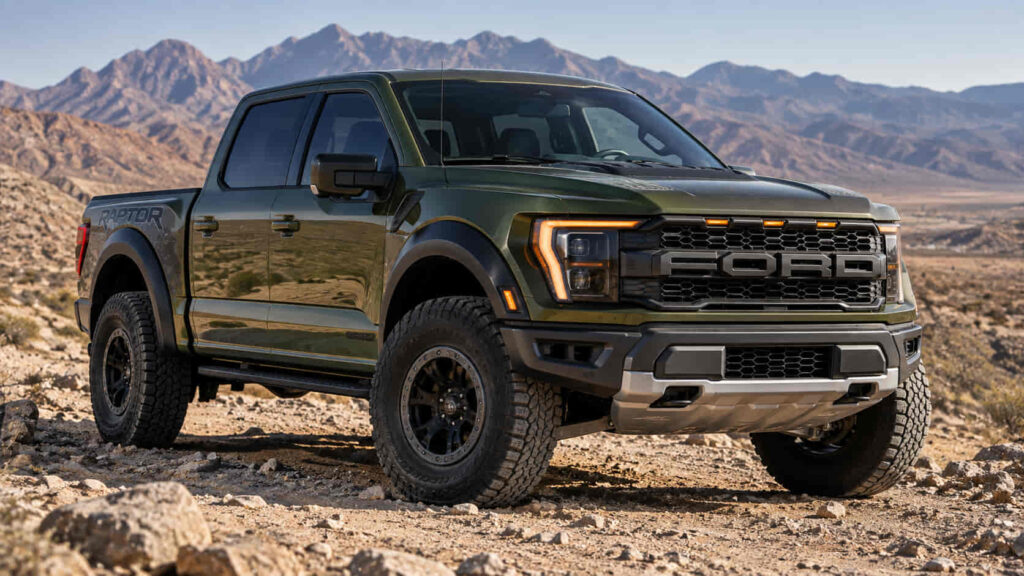
The 2026 Ford F-150 Raptor is available in seven exterior colors: Agate Black Metallic, Antimatter Blue Metallic, Avalanche, Carbonized Gray Metallic, Oxford White, Ruby Red Metallic Tinted Clearcoat, and Shelter Green Metallic. Ford offers a combination of included and extra-cost paint choices, giving buyers options ranging from neutral black, white, and gray finishes to blue, red, green, and Avalanche.
Choosing among Ford F-150 Raptor colors requires more than looking at a single color list because Ford changes paint availability between model years. Colors offered on an earlier Raptor may be discontinued, replaced, or returned in a later lineup. Paint pricing can also differ, and a color name available for one model year should not automatically be assumed to apply to every F-150 Raptor.
This guide uses the 2026 Ford F-150 Raptor as the current reference and explains each available exterior color, which paint choices cost extra, and how Raptor color availability has changed across model years. It also covers Raptor R color availability, discontinued colors, and Ford paint codes so owners and buyers can distinguish a marketing color name from the specific factory paint identification used for a vehicle.
What Colors Does the 2026 Ford F-150 Raptor Come In?
The 2026 Ford F-150 Raptor comes in seven exterior colors: Agate Black Metallic, Antimatter Blue Metallic, Avalanche, Carbonized Gray Metallic, Oxford White, Ruby Red Metallic Tinted Clearcoat, and Shelter Green Metallic. This lineup gives the Raptor three relatively neutral dark or light choices alongside blue, red, green, and Avalanche, while retaining the truck’s Raptor-specific exterior design as the central visual element.
Color availability needs to be tied specifically to the 2026 model year. Ford changes F-150 paint choices between production years, so a color found on an older Raptor is not necessarily available when configuring a new 2026 truck. This distinction becomes especially important when comparing dealer inventory, used Raptors, and online photographs because visually similar trucks may belong to different model years and carry different factory color names.
The seven colors also differ in price. Ford’s 2026 configurator identifies Agate Black Metallic as an included choice and currently shows no additional paint charge for Carbonized Gray Metallic or Oxford White. Antimatter Blue Metallic, Avalanche, and Shelter Green Metallic carry an additional $395 charge, while Ruby Red Metallic Tinted Clearcoat carries a $495 charge. These figures apply to the current 2026 configuration and should not be assumed to represent pricing for previous or future model years.
The color choice affects how strongly several Raptor exterior elements contrast with the body. The grille, wheel-arch treatment, wheels, tires, bumpers, graphics, and other dark exterior details can appear more or less prominent depending on the surrounding paint. A light body color such as Oxford White creates a different level of visual contrast from Agate Black Metallic, while colors such as Antimatter Blue Metallic and Shelter Green Metallic can change noticeably in appearance as lighting conditions change.
What Does Agate Black Metallic Look Like on the Ford F-150 Raptor?
Agate Black Metallic gives the Ford F-150 Raptor a dark metallic exterior that reduces the color contrast between the body and many of the truck’s black or dark exterior components. Instead of separating the body color sharply from the grille, wheel arches, tires, and other dark details, the black finish creates a more visually continuous exterior.
The metallic designation is also relevant to how the paint appears under changing light. The finish can reveal more visual depth when direct light reaches the painted surfaces, while shaded areas retain a predominantly dark appearance. This means the body contours and reflections can become more noticeable under bright exterior lighting even though black remains the dominant color.
Agate Black Metallic also illustrates why the exact Ford color name matters when researching Raptor colors. Searching only for a “black Ford Raptor” identifies the general appearance but does not establish the factory paint option or model year. Using the official color name provides a more precise connection between the vehicle, its configuration, and the corresponding factory paint identification.
For the 2026 F-150 Raptor, Agate Black Metallic is an included exterior paint choice in Ford’s current configuration. Buyers comparing it with extra-cost colors should therefore separate the visual decision from the paint-option price rather than assuming every metallic finish carries an additional charge.
What Does Antimatter Blue Metallic Look Like on the Ford F-150 Raptor?
Antimatter Blue Metallic gives the Ford F-150 Raptor a dark blue exterior whose perceived depth and brightness change with surrounding light. In lower-light conditions, its dark tone can make the body appear closer to a very deep navy, while stronger illumination makes the blue character easier to distinguish from black.
This lighting sensitivity matters when comparing Antimatter Blue Metallic with Agate Black Metallic from photographs. Vehicle photography, reflections, shade, camera exposure, and screen settings can make two dark paints appear more similar than they do in person. The factory color name is therefore more reliable for identifying the paint option than judging a dark Raptor from an online image alone.
The blue body also retains greater color separation from the Raptor’s black exterior components than Agate Black Metallic. Dark wheel arches, grille elements, tires, and other trim remain visually distinct from the blue-painted body, particularly when sufficient light reveals the metallic color. This provides a different exterior relationship without changing the Raptor-specific body and trim components themselves.
Antimatter Blue Metallic is an extra-cost choice for the current 2026 Raptor configuration, with Ford listing a $395 additional charge. That amount is specific to the current model-year configuration and should be checked again when researching another model year or purchasing from dealer inventory because Ford can change both color availability and option pricing.
What Does Avalanche Look Like on the Ford F-150 Raptor?
Avalanche gives the Ford F-150 Raptor a light exterior appearance that is visually distinct from the brighter Oxford White option. Its light body color creates strong separation between the painted panels and the Raptor’s darker grille, wheel arches, tires, lower-body details, and other exterior components.
This contrast makes the Raptor-specific dark elements more immediately visible than they are on Agate Black Metallic. The effect is especially apparent around the wheel openings and front fascia, where dark components sit directly next to large painted surfaces. As a result, changing from a dark paint to Avalanche alters the visual relationship between the body and trim even though the underlying exterior equipment remains the same.
Avalanche should not be identified simply as Oxford White under another name. Ford lists Avalanche and Oxford White as separate exterior choices for the 2026 Raptor, so they need to remain separate entities in a color guide. This distinction is also important when identifying a vehicle for paint repair because a general description such as “white” or “off-white” is not a substitute for the vehicle’s actual factory color information.
For the 2026 Ford F-150 Raptor, Avalanche currently carries a $395 additional charge. As with the other paint-option prices, this figure should remain attached to the 2026 model-year context rather than being applied to every Raptor on which the Avalanche name appears.
Read more: Gas Spews Out Of Tank When Filling
What Does Carbonized Gray Metallic Look Like on the Ford F-150 Raptor?
Carbonized Gray Metallic gives the Ford F-150 Raptor a medium-to-dark gray metallic exterior that sits visually between the lightest and darkest choices in the 2026 color range. The gray body remains distinguishable from the Raptor’s black exterior components without creating the high level of contrast produced by Oxford White or Avalanche.
The metallic finish also changes how the painted surfaces respond to available light. Brighter conditions make reflections and body contours more visible, while shade produces a darker and more uniform gray appearance. This variation is important when comparing dealer photographs because lighting and camera exposure can make Carbonized Gray Metallic appear lighter or darker than it does when viewed directly.
Carbonized Gray Metallic creates a relatively close relationship between the body and the Raptor’s dark wheel arches, grille, wheels, tires, and lower exterior details. However, unlike Agate Black Metallic, the gray body retains enough tonal separation for these components to remain visually distinct. The result comes from the contrast between the factory body color and Raptor-specific exterior elements rather than from any change to the truck’s equipment.
Ford currently offers Carbonized Gray Metallic on the 2026 F-150 Raptor without an additional paint surcharge shown in the configurator. The availability and pricing should still be treated as model-year-specific information because Ford can revise paint options between production years.
What Does Oxford White Look Like on the Ford F-150 Raptor?
Oxford White gives the Ford F-150 Raptor a bright white exterior with strong contrast against the truck’s black and dark exterior components. The difference is particularly visible around the grille, wheel arches, tires, bumpers, and other trim areas where dark components meet the white-painted body.
Oxford White and Avalanche should be treated as separate factory colors rather than grouped together as white Raptor options. Ford lists both independently for the 2026 F-150 Raptor, which means their names represent different exterior paint selections. This distinction matters when researching a vehicle, ordering paint-related products, or attempting to identify the factory finish of an existing truck.
The high contrast also makes Raptor-specific exterior details easier to distinguish visually. Black wheel-opening treatments and other dark elements stand out clearly against Oxford White, whereas the same components blend more closely into an Agate Black Metallic body. The underlying Raptor equipment does not change because of the paint; the body color changes how prominently those components appear.
Oxford White currently has no additional paint surcharge shown for the 2026 Raptor configuration. Buyers comparing the available colors can therefore evaluate it separately from premium paint choices such as Ruby Red Metallic Tinted Clearcoat, which adds to the configured vehicle price.
What Does Ruby Red Metallic Tinted Clearcoat Look Like on the Ford F-150 Raptor?
Ruby Red Metallic Tinted Clearcoat gives the Ford F-150 Raptor a red metallic exterior that creates strong color separation from the truck’s black grille, wheel arches, tires, and other dark details. It is the red option within the current seven-color 2026 Raptor palette and should be identified by its complete Ford color name rather than simply as “red.”
The words in the factory name also distinguish Ruby Red Metallic Tinted Clearcoat from other red paints Ford has offered during different Raptor model years. This distinction is important because similar general color descriptions do not establish that two vehicles use the same factory paint. For example, a previous Raptor advertised with another Ford red color name should not automatically be identified as Ruby Red based solely on photographs.
Light conditions influence how the metallic red surfaces appear across the Raptor’s body panels. Direct illumination can emphasize reflections and variation across curved surfaces, while shade produces a deeper appearance. Photographs taken under different conditions can therefore represent the same factory color differently, making the official color name and vehicle paint information more dependable for exact identification.
Ruby Red Metallic Tinted Clearcoat is currently the highest-priced exterior paint option among the seven 2026 Raptor colors discussed in this guide, with Ford listing an additional $495 charge. The amount applies to the current configuration and should not be generalized to previous model years that used Ruby Red or other red paint options.
What Does Shelter Green Metallic Look Like on the Ford F-150 Raptor?
Shelter Green Metallic gives the Ford F-150 Raptor a dark green metallic exterior that remains visibly distinct from the black Raptor trim while retaining a darker overall body appearance. It adds a green option to a lineup otherwise dominated by neutral colors plus blue and red.
The green character can become more or less apparent depending on lighting. Under stronger illumination, the distinction between Shelter Green Metallic and the truck’s black exterior elements becomes easier to see. Under lower light, the body takes on a substantially darker appearance, which can reduce the perceived contrast between the painted panels and surrounding trim.
This lighting behavior makes accurate color identification important when researching a Raptor through photographs. A dark image can obscure the green tone, particularly when the truck is photographed in shade or against dark surroundings. The factory color name provides a more reliable identification than assigning a color based only on how a vehicle appears on a screen.
Ford currently lists Shelter Green Metallic as an extra-cost 2026 F-150 Raptor color with a $395 additional charge. As with Antimatter Blue Metallic and Avalanche, the surcharge belongs to the current model-year configuration and can change if Ford revises its color lineup or pricing.
Which 2026 Ford F-150 Raptor Colors Cost Extra?
Four of the seven current 2026 Ford F-150 Raptor colors carry an additional paint charge in Ford’s configurator: Antimatter Blue Metallic, Avalanche, Shelter Green Metallic, and Ruby Red Metallic Tinted Clearcoat. The first three currently add $395, while Ruby Red Metallic Tinted Clearcoat adds $495.
Agate Black Metallic, Carbonized Gray Metallic, and Oxford White form the remaining three choices without an additional paint surcharge shown in the current configuration. This means exterior paint selection can change the configured price even when no other Raptor equipment is altered.
The price distinction should not be interpreted as a ranking of paint quality or appearance. An extra-cost color is an option Ford prices separately for that model year; it does not establish that the color is objectively better than an included paint choice. Color preference remains separate from factory option pricing.
Model year is also essential when using these prices. Ford can introduce a color, discontinue another color, or change the surcharge attached to an existing paint option. A $395 or $495 charge documented for a 2026 Raptor should therefore not be applied automatically when researching a 2025, 2024, or earlier truck. The model year, official color name, and applicable configuration need to be matched before comparing paint-option costs.
Does the Ford F-150 Raptor R Come in Different Colors?
The Ford F-150 Raptor R does not function as a completely separate color family from the F-150 Raptor; color availability must be checked against the specific model year and Raptor R configuration. The Raptor R is distinguished primarily by its powertrain and Raptor R-specific equipment, while its exterior paint choices come from the color availability Ford establishes for the applicable Raptor configuration.
This distinction matters because “Raptor R colors” and “Raptor colors” can produce overlapping search results without necessarily representing identical configurations. A color shown on a Raptor does not establish by itself that the same paint can be ordered with every Raptor R configuration. Equipment packages, graphics, model-year changes, and Ford’s ordering rules can affect how a particular exterior combination is configured.
The exterior color also interacts visually with Raptor R-specific graphics and dark exterior components. A lighter paint such as Oxford White creates stronger separation from black trim and graphics, while a darker paint such as Agate Black Metallic reduces that contrast. This changes the appearance of the truck without changing the underlying identity of the factory paint.
For buyers researching a Raptor R, the model year should therefore be established before comparing exterior colors. The correct sequence is to identify the model year, confirm the Raptor R configuration, and then verify which factory paint options Ford offered for that configuration. This prevents a color photographed on another Raptor model or another production year from being incorrectly treated as an available Raptor R paint option.
Have Ford F-150 Raptor Colors Changed by Model Year?
Ford F-150 Raptor colors have changed across model years as Ford introduces new exterior paints, retains selected colors, and removes others from later configurations. The current seven-color lineup should therefore be treated as a 2026 color set rather than a complete list of every paint ever offered on the F-150 Raptor.
The 2025 model year provides a clear example. Ford documentation for the 2025 F-150 Raptor included Agate Black Metallic, Antimatter Blue Metallic, Carbonized Gray Metallic, Oxford White, Rapid Red Metallic Tinted Clearcoat, Shelter Green, and Space White Metallic. The lineup overlaps with the current selection in several places, but it is not identical to the 2026 range.
Comparing 2025 with 2026 shows why exact color names matter. Space White Metallic appears in the documented 2025 lineup but is not part of the seven current 2026 Raptor colors covered earlier. Avalanche appears in the 2026 lineup instead. The red option also needs to be identified by its complete factory name rather than reduced to “red,” because the documented 2025 selection used Rapid Red Metallic Tinted Clearcoat while the current 2026 configuration uses Ruby Red Metallic Tinted Clearcoat.
The differences become greater when older generations are included. Ford documentation for the 2018 F-150 Raptor included color names such as Race Red, Ruby Red Metallic Tinted Clearcoat, Lightning Blue, Lead Foot, Guard, Magnetic, Shadow Black, Oxford White, and Ingot Silver depending on configuration. Several of these names do not appear in the current Raptor palette, demonstrating how substantially the available exterior colors can change over the life of the model.
Some color families continue even when the exact factory paint changes. A buyer might find black, white, gray, blue, or red Raptors across several production years, but those broad descriptions do not mean Ford used the same paint. Shadow Black and Agate Black Metallic, for example, are separate factory color names. Lightning Blue and Antimatter Blue Metallic should likewise not be treated as interchangeable simply because both belong to the blue color family.
Model-year qualification is therefore essential when identifying a Ford F-150 Raptor color. The accurate statement is not simply that “the Raptor comes in Oxford White” or that “the Raptor is available in blue.” The model year establishes which Ford paint palette applies, while the factory color name identifies the specific exterior option within that palette.
Which Ford F-150 Raptor Colors Have Been Discontinued?
A Ford F-150 Raptor color can be considered discontinued from a later lineup when Ford offered that factory paint for an earlier applicable model year but no longer lists it for the newer Raptor configuration being compared. Discontinued in this context does not necessarily mean Ford will never use the color name again; it means the paint is absent from the relevant later model-year offering.
Space White Metallic demonstrates this model-year relationship. It was included in Ford’s documented 2025 Raptor color availability but is not among the seven 2026 colors in the current lineup. A used 2025 Raptor can therefore legitimately be Space White Metallic even though a buyer configuring a current 2026 Raptor does not see that color in the present selection.
Older Raptors provide additional examples. Lightning Blue, Lead Foot, Guard, Magnetic, Shadow Black, and Ingot Silver appeared in Ford documentation for the 2018 Raptor lineup but are not current 2026 Raptor color choices. These names remain relevant when identifying used trucks even though they should not be inserted into a current-year color list.
A discontinued color also should not automatically be replaced with the nearest current color name. Shadow Black is not simply another name for Agate Black Metallic, and an older gray or blue paint should not be relabeled according to the closest 2026 option. Factory color names correspond to specific paint identification, making the original model-year information important for vehicle records, body repair, touch-up paint, and accurate used-vehicle descriptions.
For this reason, historical Ford F-150 Raptor colors are most useful when organized by model year rather than placed into one master list without qualification. The model-year structure preserves the relationship between the Raptor, its factory configuration, and the exterior paint Ford actually offered at that point in production.
How Do You Find the Paint Color of a Ford F-150 Raptor?
You can identify the paint color of a Ford F-150 Raptor by matching the vehicle’s factory paint information with the correct model year and Ford exterior color name rather than relying on visual appearance alone. This distinction is important because Ford has offered several black, white, gray, blue, red, and other Raptor colors across different model years, and two paints from the same general color family are not necessarily the same factory finish.
Start with the vehicle’s model year because it defines the relevant factory color range. A 2018 Raptor and a 2026 Raptor should not be compared against the same paint list. Ford documentation for earlier Raptors includes names such as Shadow Black, Lightning Blue, Lead Foot, Magnetic, and Ingot Silver, while the 2026 lineup uses names such as Agate Black Metallic, Antimatter Blue Metallic, Avalanche, and Carbonized Gray Metallic. Identifying the production year narrows the possible factory colors before the exact paint information is checked.
Visual inspection can help establish a general color family, but it is not precise enough for paint matching. Antimatter Blue Metallic, for example, can appear substantially darker under shade than it does in direct light. Photographs introduce additional variables such as camera exposure, white balance, reflections, editing, and screen calibration. A photograph may therefore help distinguish a blue Raptor from a red one without establishing the exact Ford paint specification needed for a repair.
The official color name provides greater precision because it separates visually related factory options. A truck described casually as black could belong to a model year that used Shadow Black or one that uses Agate Black Metallic. Likewise, identifying a Raptor simply as white does not distinguish Oxford White from another light factory color such as Space White Metallic or Avalanche. The complete factory name should be retained when accurate vehicle identification matters.
The paint code provides the next level of identification. It connects the vehicle to a specific factory paint specification rather than a broad visual description. This information is particularly useful when ordering touch-up paint or discussing a repair with a body shop because matching “gray” or “blue” is less precise than matching the vehicle’s documented paint identification.
Color identification should therefore follow the relationship model year → factory color name → paint code. Keeping these three pieces of information connected prevents a color from another Raptor model year from being selected merely because it looks similar in photographs.
Does the Ford F-150 Raptor Paint Code Change by Color?
The Ford F-150 Raptor paint code changes according to the factory exterior color, which means different Ford color names should not be assumed to share the same paint identification. Paint codes are more specific than general descriptions such as black, white, gray, or blue and are therefore useful when an exact factory finish needs to be identified.
Ford’s 2025 F-150 documentation demonstrates this relationship. For that model year, Agate Black Metallic is associated with paint code UM, Antimatter Blue Metallic with HX, Carbonized Gray Metallic with M7, Oxford White with YZ, and Shelter Green with DB. These codes distinguish factory paints that may otherwise be described only by their general visual color.
The code should always remain connected to its applicable factory documentation and model year. A paint code found in a Raptor article, forum discussion, parts listing, or search result should not automatically be applied to another truck simply because the color name appears similar. Ford changes its exterior palettes over time, and accurate paint identification requires matching the vehicle rather than choosing the closest-looking color.
This distinction becomes especially important with historical Raptor colors. Shadow Black and Agate Black Metallic are both black exterior paints in general language, but they are separate Ford color names. Lightning Blue and Antimatter Blue Metallic are likewise separate blue options from different Raptor lineups. Using the general color family alone removes information that is necessary for accurate factory paint identification.
Paint codes are particularly relevant for touch-up and body repair because replacement paint needs a more precise reference than the marketing appearance of the vehicle. Even after identifying the factory code, an existing truck’s finish can be affected by age, exposure, previous repairs, and other conditions. The factory identification establishes the correct starting specification rather than guaranteeing that every existing painted panel will visually match newly applied paint without professional color matching.
For owners researching a Ford F-150 Raptor, the most reliable approach is therefore to verify the vehicle itself before purchasing paint. The model year establishes the applicable color range, the factory color name identifies the exterior option, and the paint code provides the more specific paint reference required for matching and repair.
How Should You Choose a Ford F-150 Raptor Color?
You should choose a Ford F-150 Raptor color by comparing model-year availability, paint cost, contrast with Raptor exterior components, and the way the color appears under different lighting conditions. These factors provide a more useful basis for selecting a factory color than relying only on photographs or a general preference for black, white, gray, blue, red, or green.
Model-year availability should be checked first because not every Raptor color can be ordered every year. The 2026 lineup contains seven exterior colors, but earlier model years used different combinations of factory paints. A buyer interested in a specific color such as Space White Metallic, Lightning Blue, Lead Foot, or another historical option may therefore need to look at used Raptors from the model years in which that paint was offered rather than search the current configuration.
Paint cost is another practical distinction for buyers ordering a current Raptor. For the 2026 model year, some exterior colors are available without an additional paint surcharge, while Antimatter Blue Metallic, Avalanche, Shelter Green Metallic, and Ruby Red Metallic Tinted Clearcoat currently add to the configured price. The extra charge identifies the paint as a separately priced factory option; it does not establish that the color is more durable, higher quality, or objectively better looking than an included choice.
Exterior contrast can also change how prominently the Raptor’s design details appear. Oxford White and Avalanche create stronger visual separation from black wheel arches, grille elements, tires, and other dark components. Agate Black Metallic produces a more continuous dark appearance because the body color sits closer to those components. Carbonized Gray Metallic falls between these extremes, while Antimatter Blue Metallic, Ruby Red Metallic Tinted Clearcoat, and Shelter Green Metallic introduce more visible body color against the Raptor’s darker exterior details.
Lighting should be considered before making a final color decision, especially with darker metallic paints. Antimatter Blue Metallic and Shelter Green Metallic can appear considerably darker in shade than under direct illumination, while metallic surfaces can reveal additional reflections and visual depth in brighter conditions. Dealer photographs are useful for initial comparison, but differences in exposure, reflections, editing, and display settings mean they should not be treated as an exact representation of how a factory color will appear in person.
Buyers considering a used Raptor should also verify the factory color rather than relying solely on the seller’s description. General terms such as “black Raptor,” “blue Raptor,” or “white Raptor” do not distinguish between factory colors offered across different years. Matching the model year, official Ford color name, and paint code provides a more precise identification and can also help determine whether the visible finish corresponds to the vehicle’s original factory color.
The appropriate Ford F-150 Raptor color ultimately depends on the specific model year and configuration being purchased. Current buyers can compare the seven 2026 choices according to price and exterior appearance, while used-vehicle buyers have access to a broader historical range that includes colors no longer offered in the current lineup. Keeping model year, factory color name, and paint identification connected is the most reliable way to compare Raptor colors without mixing specifications from different production years.