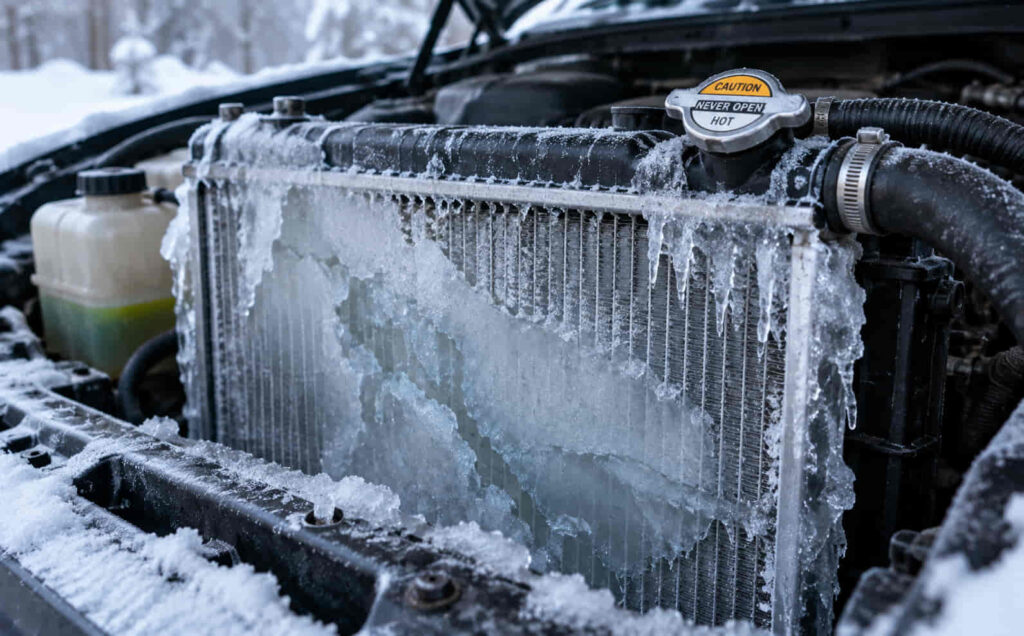
What Happens If Water Freezes in a Radiator?
Water in a radiator can freeze when its temperature falls to the freezing point, and the resulting ice can damage the radiator and other parts of the engine cooling system as it expands. The risk is greater when the system contains plain water or a coolant mixture that does not provide adequate freeze protection for the surrounding temperature.
Freezing is not limited to the radiator itself because coolant circulates through multiple parts of the engine cooling system. Water trapped in the radiator, hoses, engine passages, and connected components can stop circulating as it turns into ice. Expansion during this process can also place pressure on confined parts of the system. Whether actual damage occurs depends on where freezing develops, the amount of expansion the system can accommodate, and the condition of the affected components.
A frozen radiator should therefore be treated as both a circulation problem and a potential damage event. Simply allowing the ice to melt does not confirm that the cooling system is ready for normal operation. The system should be thawed safely and then checked for leaks, damaged components, coolant level, and normal circulation. This guide explains what happens when radiator water freezes, what damage can result, how to identify and thaw a frozen radiator, and how proper antifreeze protection helps prevent the problem from happening again.
What Happens If Water Freezes in a Radiator?
When water freezes in a radiator, it turns into ice, expands, stops circulating normally, and can place damaging pressure on the radiator and other confined parts of the cooling system. The immediate problem is therefore not simply that the water becomes cold. Freezing changes both the physical volume and the ability of the fluid to move through the system, creating a combination of restricted coolant circulation and potential mechanical damage.
Water expands as it changes from liquid to solid, which becomes important when freezing occurs inside a confined cooling-system component. A radiator and its connected passages provide limited space for expansion. As ice forms and occupies more volume, pressure can be transferred to the surrounding radiator core, tanks, connections, hoses, and other areas containing the fluid. Damage occurs when the force created in a confined area exceeds what the affected component or connection can tolerate.
Freezing also prevents the cooling system from circulating fluid normally. During regular operation, liquid coolant moves through the engine and radiator to transfer heat away from the engine. Ice can restrict or block this flow because frozen water cannot circulate through the system as liquid coolant does. Starting and operating the engine while a significant part of the cooling circuit remains frozen can therefore create a situation in which the engine generates heat without normal coolant circulation.
The effects can extend beyond the radiator because water is distributed throughout the cooling circuit rather than stored only inside the radiator. Hoses, coolant passages, connections, and other components can contain the same fluid and may also be exposed to freezing conditions. For this reason, finding ice or freeze-related damage at the radiator does not establish that the rest of the cooling system is unaffected.
Freezing does not mean that every radiator will automatically crack. The outcome depends on where ice forms, how much fluid freezes, the available space for expansion, the strength of the surrounding components, and whether the cooling system already has weakened areas. A system may thaw without visible damage, while another can develop a leak or structural failure after the same general type of freezing event.
The cooling system should therefore be inspected after a confirmed freeze even when the water has completely returned to liquid form. Thawing restores the physical state of the fluid, but it does not reverse a crack, weakened connection, or other damage that occurred while the water was frozen. Checking the system after thawing establishes whether the event caused damage before the engine returns to normal operation.
Read more: How To Fix Loud Muffler
At What Temperature Does Water in a Radiator Freeze?
Plain water in a radiator freezes at approximately 32°F (0°C) under standard conditions, while a properly formulated antifreeze and water mixture has a lower freezing point. This difference is why the actual freeze risk of a vehicle cannot be determined from outdoor temperature alone without knowing what fluid is inside the cooling system and its concentration.
A radiator containing mostly plain water has considerably less protection against freezing temperatures than one containing the appropriate coolant mixture. As the temperature of plain water reaches its freezing point, ice can begin forming within the radiator and other coolant passages. Freezing throughout the entire system does not necessarily occur at exactly the same moment because temperatures can vary between components and locations, but exposure around or below the freezing point creates a clear risk when sufficient plain water is present.
Antifreeze changes this behavior by lowering the freezing point of the coolant mixture. Automotive coolant combines antifreeze chemistry with water so the liquid can remain usable at temperatures where plain water would freeze. The exact freeze protection depends on the coolant formulation and its concentration, which means there is no single freezing temperature that applies to every vehicle containing antifreeze. A cooling system with an unsuitable or overly diluted mixture can lose part of the freeze protection expected from its coolant.
Repeatedly adding plain water can therefore change the protection level even when antifreeze was originally present. If coolant is lost through a leak and the system is repeatedly topped up with water, the resulting mixture becomes more diluted. In cold conditions, that change matters because the fluid may begin freezing at a higher temperature than a mixture maintained at the appropriate concentration.
The relevant question is consequently not only whether the outside temperature is below 32°F (0°C), but also what fluid is in the radiator and whether its concentration provides sufficient freeze protection for those conditions. When the coolant mixture is unknown, its freeze protection should be checked rather than assumed from its color or appearance. This establishes whether the cooling system is adequately protected before prolonged exposure to freezing temperatures.
What Damage Can Frozen Water Cause to a Radiator and Cooling System?
Frozen water can damage a radiator and cooling system by expanding inside confined passages, restricting coolant circulation, and placing pressure on components that were designed to contain liquid rather than expanding ice. The resulting damage can include cracked or leaking radiator sections, damaged connections, stressed hoses, and failures elsewhere in the cooling circuit. The exact component affected depends on where the water freezes and which part of the system becomes unable to accommodate the expansion.
The radiator is vulnerable because its internal passages must contain coolant while providing enough surface area to transfer heat. Water that freezes within these confined spaces occupies more volume than it did as a liquid. If the surrounding structure cannot accommodate that increase, the expanding ice can stress the radiator core, tanks, seams, or connections. A weakened or corroded area can become a failure point, and the resulting damage may only become obvious as a coolant leak after the ice has thawed.
Freeze-related damage can also occur outside the radiator. The cooling system contains fluid in hoses, connections, engine coolant passages, and other components connected to the radiator. Ice forming in one of these areas can create localized pressure or prevent fluid from moving through that section. This is why inspecting only the radiator can miss damage elsewhere in the same cooling circuit after a significant freeze.
Restricted circulation creates a separate problem even when no component has visibly cracked. The cooling system depends on liquid coolant moving between the engine and radiator to transfer heat. A frozen or partially frozen passage interrupts that process. If the engine produces heat while circulation remains restricted, the cooling system cannot perform normally even though another section of the radiator may already have begun to thaw.
The severity of damage is influenced by the amount of water present, the extent of freezing, the available expansion space, and the existing condition of the cooling-system components. A small amount of localized ice does not produce the same circumstances as extensive freezing throughout a system filled primarily with water. Likewise, a structurally sound component may tolerate conditions that expose an already weakened seam, connection, or corroded section.
Damage should therefore be assessed after the system has thawed rather than judged only by whether ice is still visible. A radiator can return to a liquid-filled state while retaining a crack or compromised seal created during freezing. Coolant loss, newly visible leaks, abnormal circulation, or an inability to maintain normal engine temperature after thawing can indicate that the freezing event affected more than the physical state of the fluid.
How Can You Tell If Water Has Frozen in the Radiator?
You can tell that water may have frozen in the radiator by combining recent exposure to freezing temperatures with evidence of frozen coolant, restricted coolant circulation, new leaks, or abnormal cooling-system behavior after thawing. No single symptom confirms a frozen radiator in every case, so the strongest diagnosis connects the environmental conditions with physical evidence from the radiator and the rest of the cooling system.
Visible ice or frozen fluid provides the most direct indication when the cooling system contains enough plain water to freeze. The radiator or coolant reservoir may show fluid that is partially or completely solid after prolonged exposure to low temperatures. However, visible liquid in one accessible part of the system does not prove that every coolant passage has thawed. Different areas can warm at different rates, leaving ice in less exposed sections even after fluid becomes visible elsewhere.
A lack of normal coolant circulation can also indicate that part of the cooling circuit remains frozen. Liquid coolant must move through the engine and radiator for the cooling system to transfer heat effectively. Ice that blocks or substantially restricts a passage interferes with that flow. This condition becomes particularly important before operating the engine because warming one area does not guarantee that the entire coolant path is open.
New coolant leaks appearing after a freeze can indicate that expansion damaged a radiator section, connection, hose, or another part of the cooling system. The leak may not be apparent while the fluid remains frozen because ice does not escape through a crack in the same way liquid coolant does. As the system thaws, water or coolant can begin leaking from a failure point created or exposed during freezing. A post-thaw leak therefore requires inspection rather than simply refilling the radiator.
Abnormal engine temperature after thawing can provide another warning that the cooling system is not functioning normally, but overheating alone does not prove that frozen water caused the problem. Low coolant level, trapped air, a leak, circulation problems, or unrelated cooling-system faults can also affect engine temperature. Recent freezing conditions make freeze damage more relevant to the diagnosis, but the cooling system still needs to be inspected to identify the actual cause.
The most reliable assessment therefore combines temperature history, coolant condition, evidence of leakage, fluid circulation, and post-thaw cooling-system operation. If the vehicle was exposed to temperatures capable of freezing its coolant mixture and the condition of the system cannot be verified, assuming that everything is normal simply because visible ice has disappeared can overlook damage or a remaining blockage.
What Should You Do If Water in the Radiator Is Frozen?
If water in the radiator is frozen, allow the cooling system to thaw before normal engine operation, then inspect it for leaks or freeze-related damage and restore the correct coolant protection before driving. Melting the ice is only the first part of the process because freezing can restrict coolant circulation and may have already stressed the radiator or other cooling-system components.
Avoid relying on the running engine as the primary method for thawing a frozen cooling system. An engine generates heat quickly, while ice can continue blocking coolant passages and preventing normal circulation. This creates an uneven condition in which the engine is producing heat before the cooling system can transfer that heat normally. The safer objective is to return the coolant throughout the system to a liquid state before depending on normal coolant circulation.
Move the vehicle to a warmer environment when this can be done without operating an affected engine, and allow the cooling system to warm gradually. The radiator, hoses, reservoir, and less exposed coolant passages may thaw at different rates, so visible liquid in one location does not confirm that every frozen section has melted. The entire cooling circuit needs sufficient time to return to a liquid state before the system can be evaluated properly.
Inspect the cooling system as thawing occurs because leaks can become visible only after frozen water turns back into liquid. Expansion during freezing can expose or create weaknesses in the radiator, connections, hoses, or other coolant-containing components. Water or coolant appearing beneath the vehicle, around radiator seams, or near cooling-system connections indicates that the system should be repaired rather than simply refilled and returned to service.
The fluid itself also needs attention after the system has thawed. A cooling system that froze because it contained plain water or an inadequately protected mixture remains vulnerable to another freeze unless the fluid composition is corrected. The appropriate coolant or antifreeze mixture should provide freeze protection suitable for the vehicle and operating conditions. Adding more plain water without considering concentration can further reduce that protection.
Normal operation should resume only after the cooling system has thawed and its basic integrity has been verified. The system needs to retain coolant, remain free of obvious leaks, and circulate fluid sufficiently to control engine temperature. If freeze damage, substantial coolant loss, or abnormal cooling-system behavior is present, repairing the underlying problem takes priority over driving the vehicle.
How Do You Safely Thaw a Frozen Radiator?
You safely thaw a frozen radiator by warming the cooling system gradually until the frozen water or coolant has returned to a liquid state, then checking the system for leaks and damage before normal engine operation. Moving the vehicle into a warmer environment is preferable when this can be done without running an engine whose coolant circulation may still be blocked. The objective is to thaw the complete cooling circuit rather than only the fluid that is visible inside the radiator or reservoir.
Gradual warming matters because different parts of the cooling system can thaw at different rates. The radiator is exposed at the front of the vehicle, while coolant also remains inside hoses, passages, and other connected components. Fluid visible in the reservoir may become liquid before ice in another part of the system has completely melted. For this reason, seeing liquid coolant does not by itself confirm that normal circulation has been restored throughout the cooling system.
Avoid using the engine as the primary heat source when significant freezing is suspected. The engine begins producing heat after startup, but a frozen section can restrict the movement of coolant between the engine and radiator. This creates the possibility of rising engine temperature while part of the cooling circuit remains blocked. Allowing the system to thaw before relying on engine-generated heat removes the ice restriction first and makes subsequent inspection more meaningful.
Thawing should also avoid methods that expose cooling-system components to uncontrolled or concentrated heat. A radiator contains relatively thin materials, seals, joints, and connections that are not intended to be heated unevenly for rapid defrosting. Gradual environmental warming provides a more controlled temperature change and allows frozen sections throughout the cooling circuit to thaw rather than concentrating heat on one visible area.
Inspect the radiator and surrounding cooling-system components while the ice returns to liquid. Freeze-related cracks or weakened connections can become apparent only at this stage because liquid can escape through openings that were previously occupied by ice. A newly developing leak around the radiator, hose connections, seams, or other coolant-containing areas indicates that thawing has exposed a problem that must be addressed before normal operation.
A fully thawed radiator is therefore not automatically a repaired radiator. Thawing removes the frozen condition; inspection determines whether freezing caused damage. Before returning the vehicle to normal use, confirm that the system retains coolant, has adequate freeze protection, and does not show evidence of leakage or abnormal cooling behavior. If these conditions cannot be verified, the cooling system requires further inspection before the vehicle is driven normally.
How Do You Check a Radiator for Damage After It Freezes?
To check a radiator for damage after it freezes, wait until the cooling system has completely thawed, then inspect for coolant leaks, cracks, damaged connections, fluid loss, and abnormal cooling-system operation. The inspection should extend beyond the radiator because freezing can affect any coolant-containing section where expanding ice or restricted flow created excessive stress.
Begin the inspection only after the frozen fluid has returned to a liquid state. Ice can temporarily block a crack or damaged connection, preventing fluid from escaping and hiding the problem. Once thawing occurs, the same opening can begin releasing water or coolant. Wet areas around the radiator, fluid collecting underneath the vehicle, or a coolant level that continues to fall after refilling can therefore reveal damage that was not visible while the system was frozen.
The radiator itself should be examined for changes around its core, tanks, seams, and hose connections. These areas contain or connect passages that normally hold liquid coolant under operating conditions. Expansion from freezing can stress an already weak section or create a new failure point when the surrounding material cannot accommodate the increased volume. A visible crack provides direct evidence of damage, while persistent seepage from a seam or connection indicates that the system is no longer retaining fluid correctly.
The connected cooling-system components also require attention because the radiator is only one part of the coolant circuit. Hoses and connections should remain intact without new leaks or obvious deformation, and coolant should remain contained within the system after it has thawed. Concentrating exclusively on the radiator can miss a failure elsewhere that produces the same practical result: coolant loss and reduced cooling-system performance.
Cooling behavior provides another layer of evidence after the initial visual inspection. If the system retains fluid but the engine temperature becomes abnormal after returning to operation, coolant circulation or another cooling-system function may still be affected. Abnormal temperature does not identify a specific freeze-damaged component by itself, but it indicates that the system should not be considered fully verified simply because no external leak is visible.
A cooling system that passes the post-freeze check should retain its fluid and return to normal operation without signs of leakage or abnormal temperature behavior. The coolant mixture should also provide sufficient freeze protection before the vehicle is exposed to low temperatures again. If the radiator leaks, coolant level continues to fall, or cooling performance remains abnormal, the underlying fault should be diagnosed and repaired rather than treating the completed thaw as proof that the system is undamaged.
Can You Drive After Water in the Radiator Has Frozen?
You should drive after water in the radiator has frozen only after the cooling system has completely thawed and has been checked for leaks, coolant loss, and abnormal cooling-system operation. A radiator that no longer contains visible ice is not automatically safe for normal use because freezing may have damaged a component or left another part of the cooling circuit restricted.
Driving while the cooling system is still frozen or partially frozen creates a cooling problem because the engine produces heat while coolant circulation may remain restricted. The radiator can remove engine heat effectively only when coolant can move through the required cooling passages. If ice blocks that movement, engine temperature can rise even though the surrounding weather is cold. Low outside temperature therefore does not compensate for inadequate coolant circulation inside the engine.
The vehicle should also remain out of normal operation if thawing reveals a coolant leak. A cracked radiator section, damaged connection, or other freeze-related failure can allow the system to lose fluid once the ice melts. Continuing to drive while coolant escapes reduces the amount of fluid available to absorb and transfer engine heat. A small visible leak can also become more significant as the cooling system reaches operating temperature and normal system conditions return.
If the system has completely thawed, retains coolant, shows no evidence of freeze-related leakage, and returns to normal cooling behavior, the freezing event alone does not mean the vehicle can never be driven again. The important distinction is between a system that was frozen and a system that remains damaged or unable to circulate coolant correctly. Post-thaw condition, rather than the previous presence of ice by itself, determines whether further repair is required.
Engine temperature should be monitored when normal operation resumes because abnormal temperature behavior indicates that the cooling system has not returned to its expected function. If temperature rises unexpectedly, coolant is lost, or a new leak appears, continued driving can increase the risk of overheating and further engine damage. The underlying cooling-system problem should be identified before normal driving continues.
The cause of the original freeze should also be corrected before the vehicle is exposed to freezing temperatures again. If the radiator contained plain water or a coolant mixture with inadequate freeze protection, leaving the same fluid condition unchanged recreates the original risk. Restoring the appropriate coolant concentration turns the repair from a temporary recovery after freezing into protection against another freeze event.
Can You Use Water Instead of Antifreeze in a Radiator?
Plain water should not be used as a permanent replacement for the correct antifreeze or coolant mixture in a radiator because it does not provide adequate freeze protection and lacks other protective properties supplied by automotive coolant. Water is an essential part of many coolant mixtures because it transfers heat effectively, but using water alone leaves the cooling system vulnerable when temperatures reach the freezing point.
The primary problem in cold conditions is that plain water freezes at approximately 32°F (0°C). If a vehicle containing water instead of properly mixed coolant remains exposed to temperatures at or below this range, ice can form inside the radiator and other cooling passages. As the water freezes, expansion can place stress on confined components, while the resulting ice can restrict the circulation required for normal engine cooling.
Antifreeze changes the freezing behavior of the fluid rather than eliminating water from the cooling system. In coolant formulations that are intended to be mixed with water, the two liquids work together to provide heat-transfer capability and lower-temperature protection. This is fundamentally different from filling the radiator with plain water and assuming that the cooling system is protected simply because sufficient liquid is present.
Freeze protection is also not the only reason to use the coolant specified for the vehicle. Automotive coolant is formulated to protect cooling-system materials and support operation across a broader temperature range than plain water alone. Using only water for extended periods removes these coolant-specific protections and can contribute to conditions such as internal corrosion and deposits, depending on water quality, system materials, and operating conditions.
Water may be added temporarily in an emergency when the correct coolant is unavailable and additional fluid is necessary, but that situation should not be treated as a permanent coolant strategy. Any temporary dilution changes the concentration of the fluid already in the system. Before the vehicle is exposed to freezing weather, the coolant concentration and freeze protection need to be restored to the level specified for that vehicle and coolant product.
The correct long-term approach is therefore to use the coolant type and mixture specified for the vehicle rather than choosing between water and antifreeze as if they perform identical functions. The coolant specification determines how the cooling system should be filled, while the resulting concentration determines how much freeze protection the mixture provides. This becomes especially important after a radiator has already frozen because refilling it with plain water recreates the same condition that allowed the freeze risk to develop.
How Does Antifreeze Keep Water in a Radiator From Freezing?
Antifreeze helps keep water in a radiator from freezing by lowering the freezing point of the coolant mixture below the 32°F (0°C) freezing point of plain water. When the antifreeze concentration is appropriate for the vehicle and climate, the coolant remains usable at temperatures where plain water would begin forming ice. This reduces the risk of frozen coolant blocking circulation or expanding inside confined cooling-system passages.
The protection comes from changing the physical behavior of the water-based coolant mixture. Antifreeze compounds mixed with water interfere with the formation of the organized ice structure that develops when plain water freezes. As a result, the mixture must reach a lower temperature before freezing becomes a problem. The exact level of protection depends on the coolant formulation and concentration rather than the presence of antifreeze alone.
Concentration is therefore a critical part of freeze protection. Adding antifreeze to a cooling system does not establish that the resulting mixture is suitable for every temperature. A mixture that has been excessively diluted with plain water provides less freeze protection than the intended concentration. This can occur after repeated water top-ups, coolant leaks followed by water replacement, or maintenance that leaves the system with an incorrect fluid ratio.
More antifreeze is not automatically equivalent to better protection either. Cooling systems and coolant products are designed to operate within specified concentration ranges, so the correct mixture should follow the vehicle manufacturer and coolant product requirements. This provides a more reliable standard than estimating protection from coolant color, fluid appearance, or the amount of antifreeze that was previously added.
Antifreeze also contributes to cooling-system protection beyond lowering the freezing point. Proper automotive coolant is formulated for the temperature range and materials found inside a vehicle cooling system, while plain water alone does not provide the same overall protection. Maintaining the specified coolant mixture therefore addresses both the immediate risk of freezing and the longer-term condition of components such as the radiator and coolant passages.
For a radiator that has already experienced frozen water, replacing or correcting the fluid after inspection is an essential part of preventing recurrence. Thawing removes the existing ice, but it does not change an inadequate coolant mixture. Restoring the specified coolant concentration lowers the freezing point of the fluid and addresses the condition that allowed plain or overly diluted water to freeze in the first place.
How Can You Prevent Water in a Radiator From Freezing Again?
You can prevent water in a radiator from freezing again by maintaining the correct coolant mixture, correcting leaks that lead to repeated water top-ups, and verifying freeze protection before the vehicle is exposed to freezing temperatures. The most important change is to eliminate plain water or an inadequately protected coolant mixture as the normal fluid condition inside the cooling system.
The coolant should match the specification required for the vehicle and be maintained at the appropriate concentration. Antifreeze lowers the freezing point of the water-based mixture, but its protection depends on the final concentration inside the cooling system. If the mixture becomes excessively diluted, the temperature at which freezing becomes a concern rises. Maintaining the specified mixture therefore addresses the direct cause of freeze vulnerability rather than relying on outside temperature management alone.
Coolant loss should also be corrected instead of repeatedly replacing the missing fluid with plain water. A leaking radiator, hose connection, or another cooling-system fault can gradually change coolant concentration when each loss is followed by a water-only top-up. The system may still appear full, but its freeze protection can be weaker than intended. Repairing the leak and restoring the correct coolant mixture prevents this dilution cycle from continuing.
Freeze protection should be verified when the previous fluid history is unknown or when substantial amounts of water have been added. Coolant appearance alone does not establish its freezing point because fluids with a similar color can have different formulations or concentrations. Checking the actual protection level provides more useful information about whether the cooling system is prepared for the lowest temperatures the vehicle is expected to encounter.
A vehicle that has already experienced a frozen radiator requires additional attention because prevention begins with confirming that the first freeze did not leave unresolved damage. A small leak created or exposed during freezing can cause future coolant loss, which can then encourage further water additions and dilution. Repairing freeze-related damage before restoring the proper coolant mixture breaks this sequence and returns the system to a stable condition.
Long-term prevention therefore depends on maintaining the cooling system as a complete fluid circuit rather than treating the radiator as an isolated container. The radiator must retain the specified coolant, connected components must remain leak-free, and the mixture must provide adequate freeze protection for operating conditions. When these conditions are maintained, the cooling system is substantially better protected against the expansion, circulation restriction, and potential component damage associated with frozen water.