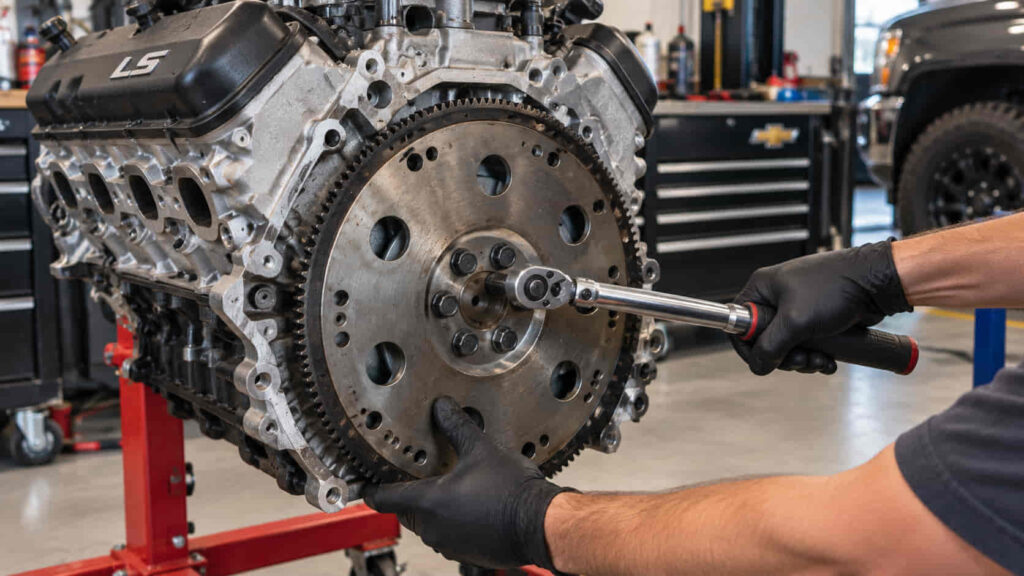
LS flexplate bolt torque must match the specific LS engine, flexplate fastener, and service procedure because there is no single torque value that should be applied universally to every LS application. Some LS flexplate-to-crankshaft fasteners use a staged tightening procedure that combines an initial torque value with additional angular rotation. Using the correct specification matters because these bolts create the clamping force that secures the flexplate to the crankshaft flange and transfers engine torque into the automatic transmission drivetrain.
Flexplate bolts should also not be confused with torque converter bolts. Flexplate bolts secure the flexplate directly to the crankshaft, while torque converter bolts connect the torque converter to the flexplate. The two fastener groups perform different functions and can require different torque specifications, bolt designs, and installation procedures.
Correct installation therefore requires more than finding a generic “LS flexplate torque” number. The engine application, fastener type, thread condition, tightening sequence, torque stages, and any specified torque angle must be identified before final tightening. This guide explains the correct LS flexplate bolt torque approach, how the bolts should be tightened, whether they can be reused, and how to verify the specification for a particular LS engine and fastener combination.
What Is the Correct LS Flexplate Bolt Torque?
The LS flexplate bolt torque is 100 N·m (74 lb-ft) as the final torque for many GM LS applications, reached through a three-stage tightening procedure rather than applied in a single step. GM service information for multiple 4.8L, 5.3L, 6.0L, and 6.2L V8 applications specifies tightening the six flexplate-to-crankshaft bolts first to 20 N·m (15 lb-ft), then to 50 N·m (37 lb-ft), and finally to 100 N·m (74 lb-ft).
The three-stage procedure progressively seats the flexplate against the crankshaft flange and distributes clamping force across the six fasteners. GM service information for a 5.3L LS application specifically notes that the flexplate does not initially seat completely against the crankshaft flange and is pulled into position by the flexplate bolts during installation. Applying the specified torque progressively is therefore part of the installation procedure rather than an optional method for reaching the same final number.
The 100 N·m (74 lb-ft) final specification appears across several LS-powered GM applications. Service information for 4.8L and 5.3L truck applications specifies the same 20 N·m, 50 N·m, and 100 N·m stages. GM service information for vehicles equipped with the 6.0L L76 and 6.2L LS3 also specifies 20 N·m (15 lb-ft) for the first pass, 50 N·m (37 lb-ft) for the second pass, and 100 N·m (74 lb-ft) for the final pass.
This specification applies to the flexplate bolts that fasten the flexplate to the crankshaft. It should not be substituted for a torque converter bolt specification. Torque converter bolts fasten the converter to the flexplate after the engine and transmission are assembled, so they represent a separate fastener connection with its own service specification.
The exact engine and fastener should still be identified before installation. The LS family spans different generations, vehicles, and aftermarket configurations, and a replacement fastener manufacturer can specify a procedure that differs from the original GM fastener procedure. For an OEM-style application covered by the GM three-stage specification, however, the relevant progression is 15 lb-ft, followed by 37 lb-ft, followed by a final 74 lb-ft.
Are LS Flexplate Bolts Torque-to-Yield?
LS flexplate bolts should not automatically be classified as torque-to-yield simply because an LS engine uses tightly controlled flexplate bolt torque specifications. The GM procedures cited for several common LS V8 applications use three numerical torque stages—20 N·m, 50 N·m, and 100 N·m—without an additional angular tightening stage. This differs from a typical torque-plus-angle procedure in which a fastener is initially torqued and then rotated through a specified number of degrees.
The distinction matters because torque-to-yield describes fastener behavior, not merely a high or staged torque specification. A staged torque procedure can be used to seat components and distribute clamping force progressively without establishing that the bolt is intentionally tightened into its yield region. For the common LS applications using the 15, 37, and 74 lb-ft sequence, the service procedure should therefore be followed as written rather than adding an assumed torque angle.
GM’s LS procedures also demonstrate why specifications from other GM engines should not be transferred to an LS engine based solely on the component name. Some non-LS GM applications use a flexplate procedure that combines an initial torque with additional angular rotation. That procedure does not make the same method correct for an LS application whose service information specifies three conventional torque stages.
Aftermarket bolts create another distinction. Fastener manufacturers can specify their own torque values, lubricant requirements, or installation procedures according to the bolt material and design. Installing an aftermarket flexplate bolt with the OEM GM torque specification without checking the fastener manufacturer’s instructions can produce a different clamping load from the one intended for that bolt.
The correct approach is to match the tightening method to the actual fastener and engine application. For the GM LS applications using the documented three-stage procedure, tighten the OEM-style flexplate-to-crankshaft bolts progressively to 20 N·m (15 lb-ft), 50 N·m (37 lb-ft), and 100 N·m (74 lb-ft) without adding an unlisted torque-angle step.
Read more: Dana 44 vs Dana 35
Can You Reuse LS Flexplate Bolts?
LS flexplate bolts should only be reused when the service procedure for the exact engine and the condition of the original fasteners permit reuse. Reuse should not be decided solely from the appearance of the bolt or from the assumption that every LS flexplate fastener is torque-to-yield. The documented three-stage procedure used on many LS applications specifies conventional torque stages of 20 N·m (15 lb-ft), 50 N·m (37 lb-ft), and 100 N·m (74 lb-ft), so bolt replacement requirements must be determined separately from the torque sequence.
A removed flexplate bolt must still be suitable for producing the intended clamping force. Damaged threads, corrosion, deformation, an incorrect fastener, or other physical damage can prevent the bolt from loading the flexplate correctly even when a torque wrench reaches the specified value. The condition of the crankshaft threads matters for the same reason because the bolted joint depends on both mating threads as well as the fastener itself.
Replacement bolts also need to match the application. Bolt diameter, thread pitch, length, material, and fastener design affect how the joint is clamped. Installing a bolt simply because it threads into the crankshaft does not establish that it has the correct dimensions or strength for securing the flexplate.
Aftermarket flexplate bolts require particular attention because their manufacturer may provide a torque value or thread preparation procedure different from the OEM specification. Torque is affected by friction at the threads and fastener contact surfaces, so a specification developed for a particular lubricant or thread treatment should be followed under the conditions stated by the fastener manufacturer. An aftermarket specification should not be replaced automatically with the OEM 74 lb-ft final value.
The practical rule is to identify the bolts before deciding whether to reuse or replace them. Follow the service information for OEM fasteners and the fastener manufacturer’s instructions for aftermarket bolts. Replace a fastener when the applicable procedure requires replacement or when its condition makes reliable reuse questionable.
What Is the Correct LS Flexplate Bolt Torque Sequence?
The LS flexplate bolts should be tightened progressively and evenly, with many GM LS applications using three torque passes of 20 N·m (15 lb-ft), 50 N·m (37 lb-ft), and 100 N·m (74 lb-ft). The purpose of multiple passes is to bring the flexplate into position against the crankshaft flange while distributing clamping force across the mounting interface instead of fully tightening one bolt while the remaining fasteners are loose.
The sequence begins after the flexplate is correctly positioned and all six bolts have been started in the crankshaft by hand. Starting every fastener before applying final torque helps confirm thread engagement and allows the flexplate to align against the flange. A bolt that does not thread normally should not be pulled into position with a torque wrench because resistance caused by damaged or crossed threads is not the same as useful clamping force.
The bolts are then brought through the specified torque stages progressively across the flexplate rather than taking one fastener directly to 100 N·m while the others remain loose. The first 20 N·m (15 lb-ft) pass begins seating the assembly. The second 50 N·m (37 lb-ft) pass increases clamping force, and the final 100 N·m (74 lb-ft) pass establishes the specified final torque for the GM LS applications using this procedure.
Even tightening matters because the flexplate-to-crankshaft connection transfers engine torque into the drivetrain. Uneven seating can prevent the mounting interface from being clamped as intended. The tightening process should therefore be treated as a complete sequence, not simply as six individual bolts that happen to share the same final torque value.
A different sequence should be used when the service information for the exact LS application or the instructions supplied with aftermarket fasteners specify one. The 15 lb-ft → 37 lb-ft → 74 lb-ft progression applies to the common GM LS procedures discussed here and should not be assumed to override application-specific service information.
How Do You Torque LS Flexplate Bolts Correctly?
Torque LS flexplate bolts correctly by preparing the crankshaft mounting interface, positioning the flexplate in the correct orientation, starting the correct fasteners by hand, and then tightening them through the specified stages with a calibrated torque wrench. Correct final torque depends on the entire installation process because a torque wrench measures resistance to fastener rotation rather than directly measuring the clamping force holding the flexplate against the crankshaft.
The crankshaft flange and flexplate mounting surfaces should seat as specified for the application. Dirt, damaged surfaces, incorrect orientation, or other interference at this interface can prevent the flexplate from sitting correctly. Tightening the bolts harder does not correct an improperly seated component; it only increases the load applied to the fasteners and mounting surfaces.
Thread condition must also match the installation procedure. GM service information for LS applications can specify threadlocking compound during flexplate installation. Thread treatment should therefore follow the service procedure rather than being selected by habit. Adding oil, anti-seize, a different threadlocker, or another lubricant when it is not part of the specified procedure changes thread friction and can alter the relationship between torque and resulting bolt preload.
Each bolt should engage normally by hand before a torque wrench is used. This provides a basic check for correct thread engagement and reduces the risk of using wrench force to overcome crossed or damaged threads. Once the bolts are seated appropriately, the six fasteners can be tightened progressively through the required passes.
For the common GM LS procedure covered here, the first pass brings the bolts to 20 N·m (15 lb-ft), the second raises them to 50 N·m (37 lb-ft), and the final pass reaches 100 N·m (74 lb-ft). The torque wrench should apply force smoothly until the target is reached. Additional tightening after the specified final torque should not be added simply as a safety margin because greater torque does not automatically create a better bolted joint.
The installation is complete only when the flexplate is correctly seated and every fastener has received the required final pass. The correct LS flexplate bolt torque is therefore a controlled installation procedure, not merely a 74 lb-ft number. Correct fasteners, mounting-surface preparation, thread treatment, progressive tightening, and the application-specific final specification work together to create the intended flexplate-to-crankshaft connection.
Should You Use Threadlocker on LS Flexplate Bolts?
Threadlocker should be used on LS flexplate bolts when the service procedure or fastener manufacturer specifies it, because thread preparation is part of the torque specification rather than a separate installation preference. For GM LS applications whose service instructions call for threadlocking compound, the specified compound and installation procedure should be followed before the bolts are tightened through their required torque stages.
Thread condition affects the relationship between torque and bolt preload. A torque wrench measures the rotational resistance encountered while tightening a fastener, but only part of that applied torque becomes useful bolt tension. A substantial portion is consumed by friction in the threads and beneath the fastener head. Changing the thread condition can therefore change the clamping force produced at the same indicated torque.
This is why oil, anti-seize, threadlocker, and dry threads should not be treated as interchangeable conditions. Applying an unapproved lubricant can reduce friction and allow a bolt to develop greater tension at the same torque setting. Conversely, contamination, corrosion, or damaged threads can increase resistance and cause the torque wrench to reach its target before the intended clamping load has developed.
Aftermarket flexplate bolts require the same application-specific approach. A fastener manufacturer may specify its own lubricant, threadlocker, or dry-thread torque procedure according to the bolt material and design. When those instructions differ from an OEM installation procedure, the torque value and thread preparation method should be treated as one matched specification rather than combining the aftermarket bolt with an unrelated OEM tightening method.
For this reason, threadlocker should not be added simply because the flexplate is a rotating drivetrain component. Use the thread treatment specified for the exact LS engine and flexplate bolt being installed, then apply the torque procedure that corresponds to that thread condition.
What Happens If LS Flexplate Bolts Are Too Loose or Too Tight?
LS flexplate bolts that are too loose can provide insufficient clamping force, while bolts that are overtightened can place excessive stress on the fasteners, threads, or mounting interface. Both conditions compromise the purpose of the bolted joint, which is to hold the flexplate securely against the crankshaft flange while engine torque is transmitted into the drivetrain.
Insufficient torque can leave the joint with inadequate preload. The flexplate and crankshaft flange are intended to remain clamped together rather than move independently at the mounting interface. When clamping force is inadequate, repeated drivetrain loading can promote movement between the components and place additional cyclic loads on the bolts. Loosening, abnormal noise, damaged mounting holes, or fastener-related damage can follow if the condition progresses.
Overtightening creates a different problem. Increasing torque beyond the specified value does not provide an unlimited increase in useful joint strength. Excessive tightening raises bolt tension and can overstress the fastener or threaded connection. The risk becomes greater when thread friction has already been reduced by an unapproved lubricant because the same torque-wrench reading can correspond to greater fastener tension than expected.
Incorrect tightening can also result from applying the correct final number through the wrong procedure. On LS applications using the documented three-pass method, taking individual bolts directly from loose to 100 N·m (74 lb-ft) bypasses the progressive seating procedure. The specified 20 N·m (15 lb-ft), 50 N·m (37 lb-ft), and 100 N·m (74 lb-ft) passes control how the flexplate is drawn against the crankshaft flange while the fasteners are progressively loaded.
More torque should therefore never be added as an arbitrary safety margin. The safest target is the specified torque achieved under the specified thread conditions and tightening procedure. This produces a controlled bolted joint instead of relying on the assumption that tighter always means more secure.
Is LS Flexplate Bolt Torque the Same as Torque Converter Bolt Torque?
LS flexplate bolt torque is not the same as torque converter bolt torque because these fasteners secure different components and form different bolted joints. Flexplate-to-crankshaft bolts attach the center of the flexplate to the crankshaft flange. Torque converter fasteners connect the torque converter to mounting points farther outward on the flexplate after the engine and automatic transmission are positioned together.
The difference can be understood through the drivetrain load path. Engine rotation begins at the crankshaft, passes through the flexplate-to-crankshaft connection, crosses the flexplate, and then reaches the torque converter through its separate mounting connection. Both fastener groups participate in transmitting power, but they operate at different mounting locations and use specifications developed for their respective joints.
This distinction is particularly important when searching for an LS torque specification online. A value labeled only as “flexplate torque” may refer to the bolts securing the flexplate to the crankshaft or to the fasteners connecting the torque converter to the flexplate. Applying a torque converter bolt specification to the crankshaft bolts, or applying the 100 N·m (74 lb-ft) flexplate-to-crankshaft specification to torque converter fasteners, can result in an incorrect installation.
Fastener terminology should therefore be confirmed before using any torque value. The LS flexplate bolt torque discussed in this article refers specifically to the bolts connecting the flexplate to the crankshaft. Torque converter fasteners require the specification for the particular transmission, converter, fastener, and vehicle application.
Keeping the two specifications separate also improves parts identification during an engine or transmission installation. A mechanic replacing the flexplate should verify the crankshaft fasteners and their torque procedure independently from the converter hardware. Once the transmission and converter become part of the installation, the applicable torque converter fastener specification should be obtained separately rather than inferred from the flexplate-to-crankshaft torque.
Does LS Flexplate Bolt Torque Change With Aftermarket Bolts?
LS flexplate bolt torque can change when aftermarket bolts are installed because the required tightening specification depends on the fastener design, material, thread condition, and lubricant specified by the bolt manufacturer. The OEM GM torque procedure should therefore not be transferred automatically to an aftermarket flexplate bolt simply because the replacement fastener fits the same crankshaft threads.
A torque specification is designed to produce an appropriate amount of bolt preload under defined installation conditions. The torque wrench provides a rotational measurement, while the actual objective is to create sufficient clamping force between the flexplate and crankshaft flange. Fastener material, thread geometry, surface finish, lubricant, and friction influence how much of the applied torque becomes bolt tension. Changing those variables can change the torque required to establish the intended preload.
Thread lubricant is particularly important with aftermarket fasteners. A torque value specified for lubricated threads cannot automatically be treated as equivalent to a dry-thread torque value. Lubrication reduces friction, allowing a greater proportion of the applied torque to create fastener tension. Applying a dry-thread specification to a lubricated aftermarket bolt can consequently produce more bolt preload than intended even though the torque wrench displays the expected number.
The same principle applies when a fastener manufacturer supplies a dedicated assembly lubricant or thread treatment. That product and the corresponding torque specification function as one installation system. Substituting another lubricant, applying additional anti-seize, or using an unrelated threadlocker changes the conditions under which the published torque value was established.
Bolt material and design can also differ from the original GM fastener. An aftermarket manufacturer may use a different alloy, strength specification, head design, or manufacturing process to produce a higher-strength replacement. The fact that the replacement bolt is stronger does not mean it should simply be tightened beyond the OEM specification. Its manufacturer should define the appropriate installation procedure for the fastener.
This creates two distinct torque contexts. An LS engine using the OEM-style flexplate fastener should follow the applicable GM service procedure, while an engine using aftermarket flexplate bolts should follow the specification supplied for those bolts when the manufacturer provides one. The engine application must still be correct because an aftermarket torque specification does not compensate for an incorrectly sized or incompatible fastener.
For this reason, the correct torque for aftermarket LS flexplate bolts is the torque specified for that exact fastener and its required thread preparation. The commonly documented GM progression of 20 N·m (15 lb-ft), 50 N·m (37 lb-ft), and 100 N·m (74 lb-ft) should not override a valid application-specific procedure supplied by the manufacturer of an aftermarket fastener.
How Do You Confirm the Correct Flexplate Bolt Torque for Your LS Engine?
Confirm the correct LS flexplate bolt torque by matching the engine application and installed fastener to the appropriate service or fastener-manufacturer specification before tightening the flexplate. This verification is more reliable than treating 74 lb-ft as a universal LS value because the LS engine family covers numerous production applications and is also widely used in engine swaps with aftermarket drivetrain components.
Engine identification establishes the first part of the specification. The exact engine, vehicle application, and model year can be used to locate the relevant service information. This matters because “LS” describes an engine family rather than one engine configuration. A torque value documented for a specific GM application has stronger technical relevance to that engine than an unlabeled specification copied from another LS build.
The fastener establishes the second part. Determine whether the engine is being assembled with the applicable OEM-style flexplate bolts or aftermarket hardware. OEM service information should govern an OEM installation when it covers that application. Aftermarket bolts should be checked against the fastener manufacturer’s instructions for torque, thread preparation, lubricant, and any other installation requirements.
The connection being tightened must then be identified. Flexplate-to-crankshaft bolts and torque-converter-to-flexplate fasteners are separate connections. The 100 N·m (74 lb-ft) final value discussed for common GM LS flexplate installations refers to the fasteners securing the flexplate to the crankshaft, not automatically to the torque converter hardware.
The tightening method must also match the specification rather than only its final value. For the common GM LS procedure covered in this guide, the six flexplate bolts are progressively tightened to 20 N·m (15 lb-ft), then 50 N·m (37 lb-ft), and finally 100 N·m (74 lb-ft). Treating 74 lb-ft as the only instruction removes the progressive seating process that forms part of the documented installation method.
Thread preparation provides the final verification point. Use the threadlocker, lubricant, or other treatment specified by the applicable procedure. A torque specification obtained for one friction condition should not be combined casually with another because doing so changes the relationship between torque and fastener preload.
The central rule is therefore straightforward: use 100 N·m (74 lb-ft) as the final flexplate-to-crankshaft bolt torque only when the service information for the LS application and fastener supports that procedure, and follow the complete 20 N·m → 50 N·m → 100 N·m tightening progression when specified. Verify a different procedure when the engine application or aftermarket fastener manufacturer calls for one. This preserves the intended clamping force at the crankshaft-to-flexplate connection without relying on a generic LS torque number outside its documented context.