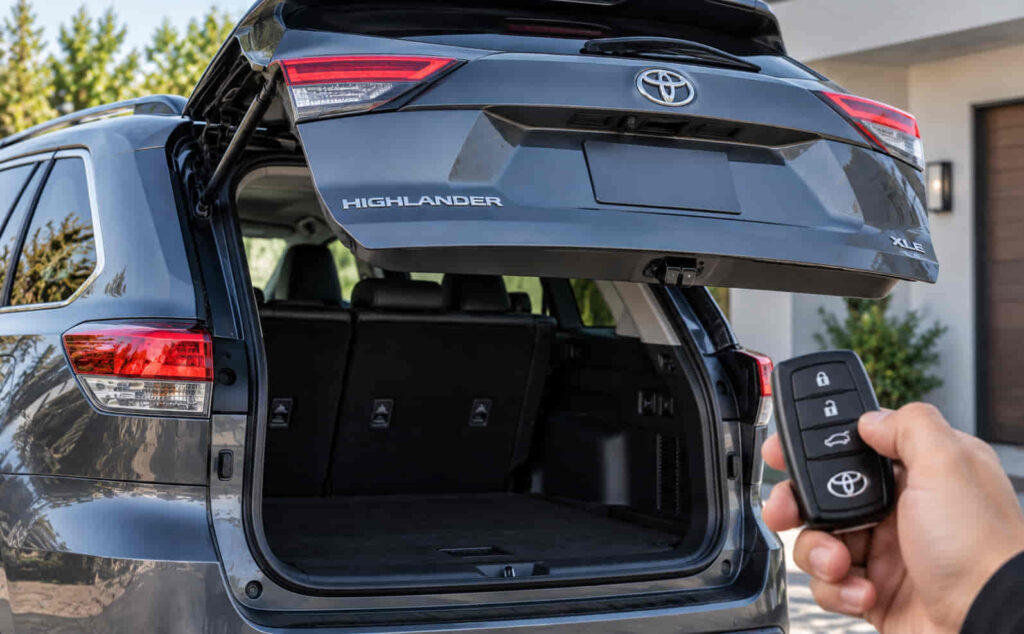
A Toyota Highlander rear hatch can stop working because the power liftgate function is disabled, the latch is not releasing correctly, the vehicle is not receiving a valid switch command, the 12-volt electrical supply is weak, or the liftgate drive system has developed a fault. The exact cause depends on what the rear hatch does when you try to open or close it. A hatch that does not respond at all has a different problem from one that beeps, starts moving and stops, or opens manually but will not operate automatically.
The most effective way to diagnose a Toyota Highlander rear hatch problem is to start with the operating settings and control switches before moving to the latch, electrical supply, reset procedure, and liftgate hardware. This approach helps separate a simple power back door setting or switch issue from a mechanical latch problem, weak battery condition, blown fuse, wiring fault, or failed liftgate motor or power strut.
This guide explains why a Toyota Highlander rear hatch is not working, how to identify whether the problem is electrical or mechanical, and which troubleshooting steps should be completed before replacing parts or taking the vehicle to a dealer.
Why Is My Toyota Highlander Rear Hatch Not Working?
A Toyota Highlander rear hatch usually stops working because the power back door function is disabled, the latch cannot release, the system is not receiving a valid switch command, electrical power is insufficient, or the liftgate drive mechanism has developed a fault. The exact cause can usually be narrowed down by observing what happens when you press the key fob, exterior hatch switch, or interior power liftgate control. A hatch that remains completely silent points toward a different failure than one that beeps, clicks at the latch, or starts moving before stopping.
A disabled power back door function should be checked before assuming that a motor or latch has failed. Toyota Highlander models equipped with a power liftgate rely on vehicle settings and control logic that determine whether powered opening and closing are available. If the system has been switched off or a relevant operating condition is not satisfied, the hatch may still be usable manually even though the powered function does not respond normally. This distinction is important because a hatch that opens manually proves that the door itself is not necessarily mechanically jammed.
The latch is another major cause when the Highlander rear hatch will not open or close correctly. The latch has to release when the hatch is opened and engage correctly when the door reaches the closed position. A latch that remains partially engaged can prevent the power liftgate from beginning its opening cycle, while a latch that does not recognize the closed position can prevent the system from completing a closing cycle. A clicking sound from the rear door without actual movement can therefore indicate that the vehicle is attempting to operate the latch even though the hatch does not release as expected.
Switch input problems create a different pattern. The Highlander may receive commands from several possible controls, including the key fob, an exterior hatch switch, and an interior control depending on the vehicle configuration. If one control fails while another continues to operate the rear hatch normally, the liftgate motor and main mechanical system are less likely to be the primary fault. The failure is more likely to involve the individual switch, its wiring, or the command path associated with that control. If none of the available controls operate the hatch, diagnosis should move toward system settings, electrical supply, latch status, or the liftgate drive system.
Electrical power also affects power liftgate operation. The rear hatch relies on the Highlander’s 12-volt electrical system to operate the latch actuator, control electronics, and powered lift mechanism. A weak battery or electrical supply problem can interfere with these functions, particularly when other electrical symptoms occur at the same time. Battery condition becomes a stronger suspect when the rear hatch problem appears alongside slow starting, electronic resets, unstable accessories, or other abnormal electrical behavior. An isolated hatch problem with no other electrical symptoms is more likely to originate within the liftgate system itself.
A liftgate motor, power strut, wiring fault, or control-system problem becomes more likely after settings, switches, latch operation, and electrical supply have been checked. These faults often produce repeatable symptoms. The hatch may begin moving and stop at the same position, move weakly, fail through every available control, or operate manually while powered assistance remains unavailable. Identifying the exact failure pattern before replacing components prevents a switch or latch problem from being incorrectly diagnosed as a failed liftgate motor.
How Do You Fix a Toyota Highlander Rear Hatch That Is Not Working?
Fix a Toyota Highlander rear hatch by checking the power liftgate settings and available controls first, then inspecting the latch and operating condition before moving to electrical, reset, and hardware diagnosis. This order is important because the simplest causes can produce symptoms that resemble an expensive motor or power-strut failure. Replacing parts before establishing whether the liftgate is enabled and receiving a valid command can lead to unnecessary repairs.
Begin by confirming that the power back door or power liftgate function has not been disabled. The exact settings and controls vary by Highlander model year and equipment level, so the vehicle-specific owner information should be used rather than assuming every Highlander uses the same switch or menu. If the hatch can be operated manually but does not respond to powered commands, system status and control settings deserve particular attention before mechanical parts are considered.
The next diagnostic step is to compare the available hatch controls. Try the key fob, exterior rear hatch switch, and any interior liftgate control fitted to the vehicle. The purpose is not simply to try the same action several times but to determine whether the failure affects one input or the entire system. If the key fob fails while the exterior switch opens the hatch normally, the core liftgate mechanism is still capable of operating. If every command produces the same failure, the problem is more likely to exist after the switch inputs, such as within the latch, power supply, control system, or liftgate drive hardware.
The latch should then be evaluated according to the symptom. A hatch that will not open may be receiving the command but failing to release mechanically. A hatch that lowers but refuses to stay closed may have a latch-engagement or position-recognition problem. Dirt, obstruction, misalignment, or a defective latch mechanism can interfere with normal operation because the power liftgate system depends on knowing whether the rear door is fully released or fully secured before completing its movement.
A restart or liftgate reinitialization can be considered when the mechanical parts appear free and the system has stopped operating normally after an electrical interruption or other system event. A reset should not be treated as a universal repair because software initialization cannot correct a physically damaged latch, broken wiring, or failed motor. The correct reset procedure can also vary by Highlander generation, which makes a model-specific procedure more reliable than applying one sequence to every Toyota Highlander.
Electrical diagnosis becomes more relevant when the liftgate has no powered response from any control. The 12-volt battery, applicable circuit protection, and liftgate power supply should be considered before concluding that the motor has failed. A weak battery is more convincing when other vehicle electronics also behave abnormally, while a blown fuse or circuit problem may produce a more isolated loss of power to the hatch system. Fuse identification should be based on the correct model-year diagram because fuse names and locations can vary across Highlander generations.
Hardware inspection belongs later in the troubleshooting process. If the hatch moves freely by hand, the power liftgate is enabled, several control inputs have been tested, the latch is functioning, and adequate electrical power is available, the remaining causes increasingly point toward the liftgate motor, powered strut assembly, wiring, or control electronics. A hatch that repeatedly starts moving and stops, moves unevenly, or remains powerless after these checks provides stronger evidence of a drive-system fault than a hatch that simply fails from one button.
Why Is My Toyota Camry Not Starting?
A Toyota Camry usually fails to start because of one of 8 main problems: a weak 12-volt battery, poor battery connections, a faulty starter, a starter-circuit fault, a Smart Key or immobilizer problem, insufficient fuel delivery, an ignition failure, or an engine-position sensor or control-system fault. The most important diagnostic step is to determine whether the engine does not crank at all or cranks normally but fails to start. These two conditions involve different systems and should not be diagnosed in the same way.
A Toyota Camry that does not crank should first be investigated through the electrical starting system. The 12-volt battery must provide enough current to operate the starter motor, and that current must travel through secure battery terminals, cables, grounds, relays, and control circuits. If any part of that path cannot carry the required current, the starter may turn slowly, produce a clicking sound, or fail to turn the engine at all. Dashboard lights may still illuminate because lighting and accessory circuits require much less current than the starter motor.
The battery is therefore one of the first components to evaluate when the engine will not crank or cranks unusually slowly. A discharged battery may produce rapid clicking, dim lights during a start attempt, repeated electronic resets, or a starter that turns too slowly to start the engine. Poor battery-terminal contact can create similar symptoms even when the battery itself still contains sufficient charge. Corrosion, looseness, or excessive resistance at a connection can prevent the large amount of current required by the starter from reaching it.
A starter-related failure becomes more likely when the battery and its connections are capable of supplying adequate power but the engine still does not crank. The starter motor physically rotates the engine during the starting process, while the starter solenoid and control circuit allow electrical power to reach the motor. A single click without engine rotation can be associated with the starter or a high-current connection, but that symptom alone does not confirm starter failure because a weak battery can produce similar behavior.
The diagnostic path changes when the Toyota Camry cranks at a normal speed but does not start. In that condition, the battery and starter have already provided enough energy to rotate the engine, so fuel delivery, ignition, engine-position information, and electronic control become more relevant. The engine requires the correct amount of fuel, properly timed ignition, and accurate crankshaft and camshaft information to begin combustion. A failure in one of these systems can allow the engine to crank normally without actually starting.
Fuel-delivery faults can create a crank-but-no-start condition when the engine does not receive sufficient fuel pressure or fuel flow. The fuel pump, its electrical supply, and related control components become more relevant in this branch of diagnosis. Ignition faults can produce the same overall symptom because fuel that enters the engine still requires correctly timed ignition to support combustion. Ignition coils, spark-related components, power supply, and engine-control signals may therefore require testing when cranking speed is normal.
Engine-position sensors also matter because the engine control module relies on crankshaft and camshaft information to determine engine position and timing. If a critical position signal is missing, the starter can continue rotating the engine while the control system cannot manage fuel and ignition correctly enough for the engine to start. This is why replacing the battery or starter is unlikely to solve a Toyota Camry that already cranks strongly and consistently.
Smart Key and immobilizer problems form another diagnostic branch, particularly on Camry models equipped with push-button start. The vehicle must recognize an authorized key and receive the required start conditions before allowing normal starting operation. A weak key-fob battery, key-recognition problem, brake-pedal input fault, or start-authorization issue can interfere with the starting process even when the vehicle’s main battery is not completely discharged.
The correct repair therefore depends on the failure pattern rather than the symptom “Toyota Camry not starting” by itself. A no-crank condition directs diagnosis toward battery power, connections, starter operation, and start authorization. A normal-crank condition redirects diagnosis toward fuel, ignition, sensors, and engine management. Separating those two paths first prevents unnecessary replacement of components that are already performing their intended function.
What Should You Check First When a Toyota Camry Won’t Start?
The first thing to check when a Toyota Camry will not start is whether the engine cranks, because this single observation separates the starting problem into two major diagnostic paths. Listen to what happens when the key is turned or the Start button is pressed. An engine that remains completely still, cranks slowly, produces repeated clicking, or cranks normally provides different information about which system is failing.
If there is no engine movement and the dashboard is also dark or unusually weak, battery power should receive immediate attention. The condition of the 12-volt battery, terminal connections, and main electrical supply determines whether the starter can receive enough current to operate. A weak electrical system may also cause instrument-panel lights to flicker or reset when the driver attempts to start the car because the voltage drops sharply under starter load.
If the dashboard lights appear normal but the engine still does not crank, the battery cannot be ruled out solely from that observation. Interior lights, gauges, and infotainment electronics consume much less current than the starter motor. A battery can therefore operate low-current accessories while failing when the starter demands substantially more current. The same symptom can also result from resistance at the battery terminals or ground connections, which is why visible power inside the vehicle does not automatically prove that the starting circuit has adequate power.
The sound produced during the start attempt provides another useful distinction. Rapid repeated clicking is more consistent with insufficient voltage or current reaching the starter circuit. A strong single click with no engine rotation shifts more attention toward the starter, starter solenoid, or high-current connection, especially after battery condition and terminal integrity have been verified. Complete silence can involve the battery, starter-control circuit, Smart Key authorization, brake switch, park/neutral input, relay, or related electrical controls.
The transmission position should also be considered when the engine does not crank. The starting system is designed to allow normal starting only when the vehicle recognizes an appropriate transmission position. If the vehicle does not correctly detect Park or Neutral, starter operation can be inhibited even though other electrical systems remain active. This makes a starting-interlock or position-signal problem more relevant when the battery appears healthy and the starter does not receive a normal start command.
For push-button-start Camry models, key recognition and brake-pedal input are also part of the initial diagnostic process. The vehicle must recognize the Smart Key and detect the required start conditions before it authorizes engine starting. A key-related warning, inconsistent key recognition, or a Start button that behaves differently from normal can direct diagnosis toward the Smart Key system rather than immediately toward the starter motor.
If the engine cranks at normal speed, diagnosis should move away from the basic starter circuit. Normal cranking confirms that the battery and starter are performing enough of their function to rotate the engine. The next questions are whether fuel is being delivered, ignition is occurring correctly, and the engine control system is receiving the information needed to manage combustion. Continuing to focus on the starter after establishing normal cranking wastes diagnostic effort because the starter has already completed its primary task.
The initial check should therefore establish the exact starting behavior before any part is replaced. No crank, slow crank, clicking, normal crank with no start, and start-then-stall conditions each point toward different systems. Treating these symptoms as separate diagnostic patterns makes the troubleshooting process faster and reduces the risk of replacing the battery, starter, fuel pump, or electronic components without evidence that they are actually responsible.
Read more: Toyota Bluetooth Not Working
Why Won’t My Toyota Highlander Rear Hatch Open?
A Toyota Highlander rear hatch may not open because the power back door function is disabled, the hatch is not receiving a valid opening command, the latch is failing to release, electrical power is insufficient, or the powered lift mechanism cannot begin or complete the opening cycle. The most useful diagnostic clue is what happens immediately after an opening command. A completely silent hatch requires a different diagnosis from one that beeps, produces a latch sound, opens a few inches, or works manually but not automatically.
Power liftgate status should be checked first when the hatch operates manually but does not open under power. Toyota has used different power back door controls and settings across Highlander generations. Some earlier Highlander configurations included a dedicated power door disable control, while newer systems integrate power back door functions into vehicle settings. Toyota documentation for earlier Highlanders specifically notes that a disabled power door function can make the liftgate appear inoperative even though the door itself has not mechanically failed. For this reason, the correct control location and setting should be confirmed for the specific model year rather than assuming that every Highlander uses the same switch arrangement.
The available opening controls can then be compared to determine whether the fault affects one command source or the complete liftgate system. If the rear hatch opens from the exterior switch but not from the key fob, the powered drive mechanism has already demonstrated that it can move the door. The failure is therefore more likely to involve the key-fob command, vehicle conditions required for remote operation, or that individual input path. If the key fob, exterior switch, and interior control all produce no powered response, the diagnosis should move toward the power back door setting, latch, electrical supply, or liftgate drive system.
A hatch that makes a release sound but remains closed places more attention on the latch and mechanical release process. The power liftgate cannot raise the door until the latch has released it from the body. If the latch remains partially engaged, is mechanically binding, or does not complete the release operation, the system may receive an opening command without being able to begin normal hatch movement. The same reasoning applies when the hatch requires repeated button presses or must be pulled before it begins opening. These symptoms provide stronger evidence of a latch or mechanical-release issue than a hatch that produces no response at all.
A different diagnosis applies when the hatch releases and starts moving but stops before reaching its normal opening position. This proves that the command, latch release, and at least part of the powered drive system are functioning. The remaining causes shift toward the liftgate drive mechanism, power support components, obstruction detection, stored opening-height settings, or electrical instability. Current Toyota Highlander documentation confirms that the power back door can stop when an obstruction is detected and that the maximum opening position can be customized on equipped systems. A door that consistently stops at exactly the same height may therefore require the programmed opening position to be distinguished from an actual mechanical failure.
Manual operation provides another useful test. If the rear hatch can be released and moved through its normal travel by hand without binding, a completely seized hinge or physically jammed door becomes less likely. Toyota documentation also confirms that on systems where the power back door has been disabled, the door can still be operated manually. Manual movement does not prove that the power components are healthy, but it helps separate basic door movement from the electrical and powered-assist functions responsible for automatic opening.
Electrical and drive-system faults should be investigated after these simpler causes have been separated. If every powered command fails, the liftgate is correctly enabled, the latch is free, and the door can move manually, the remaining fault becomes more likely to involve the 12-volt power supply, circuit protection, wiring, power back door unit, or related control electronics. This diagnostic order is more reliable than replacing a liftgate motor solely because the hatch does not open automatically.
Why Won’t My Toyota Highlander Rear Hatch Close?
A Toyota Highlander rear hatch may not close because an obstruction or jam-protection condition stops the door, the latch cannot engage correctly, the power liftgate cannot complete its travel, or the system is receiving an incorrect door-position signal. The position at which the hatch stops is the most useful clue. A hatch that never begins moving has a different fault from one that lowers most of the way and reverses or reaches the body but refuses to latch.
Obstruction detection should be considered when the power liftgate begins closing normally and then stops or moves back in the opening direction. Toyota uses jam-protection sensors on equipped power back doors to reduce the risk of trapping an object during automatic closing. Toyota’s Highlander documentation states that when the closing door detects an obstruction, the power back door can move slightly in the opposite direction and stop. Therefore, a hatch that repeatedly reverses during the closing cycle should first be checked for luggage, trim, weather seals, debris, or another condition interfering with normal door travel before a motor fault is assumed.
Jam protection also means that resistance does not have to come from an obvious object in the cargo opening. A misaligned component, unusual resistance around the hatch opening, or a mechanical condition that increases the force required to close the door can potentially create symptoms similar to an obstruction event. The important diagnostic pattern is that the liftgate can move under its own power but refuses to complete the closing cycle. That behavior indicates that the power system is not completely dead and shifts attention toward what is interrupting the movement.
The latch becomes the stronger suspect when the rear hatch travels all the way down but does not remain securely closed. The latch must mechanically engage the body striker and allow the vehicle to recognize the hatch as closed. If this process fails, the hatch may sit against the body without locking, require repeated attempts to close, or reopen after reaching the bottom of its travel. Dirt or a physical obstruction around the latch should be ruled out before a latch actuator or related component is condemned.
A hatch that closes manually but will not close automatically points toward a different group of causes. Normal manual travel demonstrates that the door can physically move toward the closed position, while the failed powered operation shifts attention toward the power back door setting, switch command, drive system, electrical supply, or control logic. This distinction is useful because replacing a latch is less justified when the latch engages normally every time the hatch is manually closed.
The power liftgate drive system becomes more relevant when the hatch starts closing but moves weakly, pauses repeatedly, or consistently stops before reaching the latch. A powered rear door must control a relatively heavy hatch through its complete range of motion. A fault in the powered drive or support system can therefore allow partial movement while preventing the door from completing the final portion of the closing cycle. The diagnosis becomes stronger when the same behavior occurs from every available closing control and no physical obstruction is present.
An electrical interruption should also be considered when the power hatch stops functioning after battery disconnection, replacement, or a broader vehicle electrical event. Toyota’s documentation for earlier Highlander power liftgate systems states that the power back door may require reinitialization after the battery has been disconnected. The correct procedure depends on model year and system design, so this symptom should lead to a vehicle-specific reset procedure rather than a generic sequence applied to every Highlander.
The closing symptom ultimately determines the next diagnostic branch. A hatch that reverses before reaching the body directs attention toward obstruction or jam protection. A hatch that reaches the bottom but will not remain shut directs attention toward the latch and closed-position recognition. A hatch that moves manually but has no powered closing function directs attention toward the electrical or powered drive system. Separating these behaviors first prevents unrelated components from being replaced simply because the rear hatch is described broadly as “not closing.”
Why Does My Toyota Highlander Liftgate Beep but Not Open or Close?
A Toyota Highlander liftgate that beeps but does not open or close is usually receiving a command but cannot complete the requested movement because an operating condition is not satisfied, the latch state is incorrect, the power back door function is restricted, or the liftgate system has detected a fault. The beep matters diagnostically because it shows that the vehicle is responding to an input. This is different from a completely silent liftgate, where the problem may lie earlier in the command, power, or control path.
The first step is to determine whether the liftgate is physically able to move. If the rear hatch can be opened and closed manually without binding, the door itself is not completely jammed. The failure then shifts toward the powered operating system, such as a disabled power back door function, an electrical condition, a latch-status issue, or a fault within the liftgate drive system. If the hatch is difficult to move manually, mechanical resistance becomes more relevant because the powered system may be stopping rather than forcing the door through abnormal resistance.
Latch status can also prevent powered movement even though the vehicle acknowledges the command with a beep. The system must know whether the rear hatch is securely latched, released, or positioned correctly before it can begin a normal opening or closing cycle. A latch that does not fully release can leave the hatch physically secured while the control system still recognizes that the driver requested an opening operation. Similarly, a hatch that reaches the closed position but does not engage the latch correctly may prevent the system from completing the cycle.
An obstruction or resistance condition becomes more likely when the liftgate begins moving, beeps, and then stops or reverses. Power liftgate systems use protective logic to prevent the hatch from continuing to move against excessive resistance. Luggage extending into the hatch path, displaced weather stripping, debris around the opening, or mechanical resistance can therefore interrupt powered operation even when the liftgate motor is still functional. A repeatable stop at the same point in the travel path is more diagnostically useful than the beep itself because it identifies where the operating cycle is being interrupted.
The power back door setting should also be checked when the hatch beeps but refuses to operate automatically. Toyota Highlander power liftgate controls vary by model year and equipment level, so the exact setting location is not identical across all vehicles. A disabled or restricted power function can leave manual operation available while automatic opening and closing no longer work as expected. This is why the vehicle-specific power back door setting should be verified before a motor, actuator, or powered strut is treated as defective.
The beep should not be interpreted as proof of one specific failed component. It only confirms that the system is acknowledging an event or condition. Diagnosis becomes more accurate when the beep is combined with another symptom, such as no movement, a latch click, partial movement, reversal, or successful manual operation. A Highlander that beeps and releases the latch but does not lift the door points toward a different failure than one that beeps without any mechanical sound or movement.
Why Does My Toyota Highlander Rear Hatch Open Manually but Not Automatically?
A Toyota Highlander rear hatch that opens manually but not automatically is more likely to have a problem with the power liftgate setting, control input, electrical supply, powered drive system, or related electronics than a completely seized rear door. Manual operation proves that the hatch can physically move through at least part of its travel, which helps separate basic mechanical movement from the components responsible for powered opening and closing.
The power back door function should be verified first because manual operation can remain available when powered operation has been disabled. This creates a symptom that can easily be mistaken for a failed liftgate motor. If the hatch opens and closes smoothly by hand but none of the automatic controls work, checking the power liftgate status is more appropriate than immediately replacing a motor or strut.
Comparing different command sources provides the next level of diagnosis. A hatch that opens automatically from the exterior switch but not from the key fob does not have a complete power liftgate failure because the powered mechanism is still capable of operating the door. The fault is more likely to involve the specific control input or the conditions required for that command. If the key fob, exterior switch, and interior control all fail while manual operation remains normal, the common failure lies deeper in the powered system.
Electrical supply becomes more relevant when every powered input fails. The liftgate relies on the vehicle’s 12-volt electrical system to energize the control electronics and powered drive components. A weak electrical supply can reduce or interrupt automatic operation while the hatch remains mechanically usable by hand. Battery condition is more convincing as a cause when other electrical systems also behave abnormally, but circuit protection, wiring, or a liftgate-specific power fault can produce a more isolated failure.
The powered drive mechanism should be investigated after settings, control inputs, and electrical supply have been ruled out. A failed or weakened liftgate motor or powered support component can leave the hatch completely usable by hand while automatic operation becomes weak, intermittent, or unavailable. A door that begins powered movement but stops under load provides stronger evidence of a drive-system problem than a door that never receives a powered command.
Manual operation can also help identify resistance in the hatch mechanism. The rear hatch should move through its normal range without excessive binding or an abrupt change in resistance. If manual movement is unusually heavy or uneven, the powered system may be responding to a mechanical problem rather than failing independently. This distinction matters because replacing an electrical component will not correct physical resistance in the hatch, hinge, latch, or support mechanism.
A successful manual opening therefore narrows the diagnosis but does not identify the failed component by itself. It shows that the rear hatch is not completely immobilized and directs troubleshooting toward the systems that create automatic movement. The next decision should be based on whether the power function is enabled, whether any control can activate the liftgate, whether adequate electrical power is available, and whether the powered mechanism attempts to move the hatch.
Why Is the Toyota Highlander Power Liftgate Button Not Working?
A Toyota Highlander power liftgate button may stop working because that individual switch or command path has a fault, the power back door function is disabled, the vehicle is not meeting the conditions required for powered operation, or the complete liftgate system has lost power or control. The fastest way to separate these possibilities is to compare the nonworking button with the other available liftgate controls.
An individual switch becomes the stronger suspect when every other liftgate control continues to work normally. If the exterior hatch switch operates the power liftgate but the interior button does not, the motor, latch, and main powered drive system have already demonstrated that they can perform the opening cycle. Diagnosis should therefore focus more closely on the nonworking control, its input circuit, or the conditions associated with that specific command.
The same reasoning applies to a key fob that no longer operates the rear hatch while the vehicle-mounted switches still work. A key fob problem does not represent a complete power liftgate failure because the rear hatch remains capable of automatic operation through another input. The diagnosis should remain specific to the failed command path rather than expanding immediately to the liftgate motor or powered struts.
A different pattern exists when none of the available buttons operate the hatch. Multiple controls failing at the same time make separate switch failures less likely because all of them ultimately depend on the same powered liftgate system. The diagnosis should then move toward the power back door setting, system power, latch status, electrical protection, wiring, or the liftgate control and drive components.
The response produced by the button also provides useful information. A button that causes a beep, latch click, or brief movement is successfully sending at least part of the command into the system. A button that produces absolutely no reaction while other switches work points more strongly toward the individual input. If every button produces an acknowledgement but the rear hatch still does not move, the common fault is more likely to exist after the input stage.
The power liftgate button should therefore be diagnosed as part of a control system rather than as an isolated part. Testing another control answers an important question immediately: whether the problem belongs to one input or the entire rear hatch operation. This simple comparison reduces unnecessary parts replacement and helps determine whether troubleshooting should remain at the switch level or move deeper into the Toyota Highlander’s power back door system.
How Do You Reset the Toyota Highlander Power Liftgate?
Resetting a Toyota Highlander power liftgate generally involves restoring the power back door system to a valid operating state and reinitializing it when electrical power has been interrupted. A reset is most relevant when the liftgate stopped operating after the 12-volt battery was disconnected, replaced, discharged, or when certain electrical work was performed. It is less likely to solve a hatch that has a physically damaged latch, failed drive component, broken wiring, or significant mechanical resistance.
The first check is whether the power back door system is enabled. On newer Highlander systems, Toyota provides a PBD or Power Back Door setting through the vehicle settings where the system can be enabled or disabled. The same settings area can also control functions such as the opening height and, on equipped vehicles, the hands-free kick sensor. A disabled PBD setting can therefore create a condition where the rear hatch remains mechanically usable but powered opening and closing do not function normally.
Reinitialization becomes particularly important after an interruption to the vehicle’s 12-volt electrical supply. Toyota documentation for multiple Highlander generations states that the power back door may need to be initialized after the battery has been disconnected. Some Toyota documentation specifies that when the 12-volt battery is reconnected while the back door is open, proper operation can be restored by completely closing the back door manually. This allows the system to establish a known closed position before powered operation resumes.
The required procedure is not identical across every Highlander model year, so a model-specific owner’s manual should be used before performing a reset. Earlier generations can use physical power-door controls and different initialization logic, while newer Highlanders integrate more power back door functions into vehicle settings. Applying a reset sequence from a different generation can therefore create confusion even when no component has actually failed.
Opening-height memory should also be distinguished from a complete power liftgate failure. On equipped Highlanders, the maximum opening position can be stored and adjusted. Toyota documentation describes a procedure for returning the programmed opening height to its default position by using the power back door switch, while newer systems can also offer opening adjustment through vehicle settings. A hatch that consistently stops at the same reduced height may therefore be following a stored opening position rather than suffering from a weak motor.
A successful reset provides diagnostic information as well as restoring operation. If the rear hatch begins working normally after reinitialization, the failure was more likely related to system state or loss of position information than permanent hardware damage. If the power liftgate remains completely inoperative after the PBD function has been enabled, the hatch has been properly initialized according to the correct model-year procedure, and the door moves freely by hand, troubleshooting should continue toward the electrical supply, latch, wiring, and powered drive system.
Can a Weak Battery Cause the Toyota Highlander Power Liftgate to Stop Working?
A weak Toyota Highlander 12-volt battery can contribute to power liftgate failure because the latch actuator, control electronics, and powered hatch mechanism depend on stable vehicle electrical power. Battery condition becomes especially relevant when the rear hatch problem appears after the battery has discharged, been disconnected, or been replaced, or when other electrical systems are also behaving abnormally.
The distinction between low voltage and lost initialization is important. A battery problem can prevent an electrically powered system from operating correctly while voltage is inadequate, but disconnecting the battery can also affect the operating state of the power back door even after electrical power has been restored. Toyota specifically notes on multiple Highlander generations that the power back door may require reinitialization following battery disconnection. This means a liftgate that stops working immediately after battery service does not automatically have a failed motor or actuator.
Other electrical symptoms make a weak battery diagnosis more convincing. If the Highlander also has slow starting, electronics that reset unexpectedly, dim or unstable accessories, or other systems behaving inconsistently, the common 12-volt supply deserves attention before individual liftgate components are replaced. By contrast, a vehicle that starts strongly and has no other electrical symptoms but consistently produces a latch click or partial liftgate movement may have a more localized rear hatch problem.
Battery voltage is only one part of the electrical diagnosis. The power liftgate also depends on circuit protection, wiring, connections, switches, control electronics, and the powered drive components. A healthy battery therefore does not prove that electrical power is reaching every part of the liftgate system. If all power liftgate controls stop working while the rest of the vehicle operates normally, the investigation should move toward the circuit and components dedicated to the power back door rather than repeatedly replacing or charging the battery.
A battery-related diagnosis should also consider the timing of the fault. A liftgate that worked normally before the battery was disconnected and stopped operating immediately afterward has a stronger connection to the electrical event than a hatch that gradually became weak over several months. In the first situation, initialization or system state should be checked early. In the second, repeated weak or partial movement may justify closer inspection of the powered drive mechanism after electrical supply has been confirmed.
Can a Blown Fuse Cause the Toyota Highlander Rear Hatch to Stop Working?
A blown fuse or another loss of electrical supply can prevent the Toyota Highlander power liftgate from operating, particularly when every powered rear hatch control becomes unresponsive at the same time. A fuse is more relevant to a complete loss of powered operation than to a hatch that still moves automatically but stops at one specific point, reverses because of resistance, or fails only from a single switch.
The purpose of a fuse is to protect an electrical circuit when excessive current occurs. If circuit protection for a component involved in power back door operation opens, electrical power to that part of the system can be interrupted. The resulting symptom depends on which circuit is affected, so a fuse-related problem should not automatically be assumed to produce the same behavior on every Highlander.
Fuse identification must be based on the specific vehicle rather than a generic fuse number copied from another Toyota Highlander. Fuse layouts and circuit design can change with model year, powertrain, equipment level, and generation. The correct owner’s manual or fuse-box diagram should therefore be used to identify the relevant circuit before inspection. Replacing unrelated fuses based solely on the phrase “rear hatch not working” does not establish whether the actual fault is electrical.
A fuse that has blown should also be treated as evidence rather than simply as a part that needs replacement. Fuses normally open because current exceeded the circuit’s designed limit. If a replacement fuse fails again, installing additional fuses does not correct the underlying electrical problem. A repeated failure requires diagnosis of the circuit for conditions such as damaged wiring, a short, or a component drawing abnormal current.
Electrical service can also affect power back door initialization. Toyota documentation for certain Highlander systems states that if a fuse is changed while the back door is open, the system may need to be initialized by completely closing the back door manually. The same document states that initialization is not required under that specific procedure when the fuse is changed while the back door is already closed. This demonstrates why a rear hatch can remain inoperative after electrical work even when electrical power itself has been restored.
Fuse diagnosis is therefore most useful when combined with the hatch’s behavior. If every powered control is dead but the rear hatch still moves freely manually, checking power supply and circuit protection is reasonable. If one switch fails while another successfully opens the liftgate, a common power fuse is less likely because the system is demonstrably receiving enough electrical power to operate. If the fuse is intact and no powered control works, troubleshooting should continue toward wiring, power back door control, latch state, and the liftgate drive components.
How Do You Know if the Toyota Highlander Rear Hatch Latch Is Bad?
A Toyota Highlander rear hatch latch is more likely to be faulty when the hatch reaches the closed position but does not stay latched, will not release after an opening command, requires repeated attempts to open or close, or produces a latch sound without allowing the door to move. The latch is responsible for mechanically securing the rear hatch and providing the system with a valid closed or released state. A problem at this point can therefore affect both manual operation and the power liftgate sequence.
A latch-related problem should first be distinguished from a completely dead power liftgate. If the hatch lowers under power all the way to the body but will not remain closed, the liftgate motor has already completed most of its job. Attention should shift toward the latch, striker alignment, closing mechanism, or the system’s ability to recognize that the hatch has reached the closed position. On equipped Highlanders, Toyota also uses a back door closer that automatically brings a slightly open rear hatch to the fully closed position. A hatch that reaches this final stage but fails to secure correctly therefore has a different diagnostic pattern from a hatch that never moves at all.
The opposite symptom can occur during opening. If the driver presses a working hatch control and hears a click or release sound but the rear hatch remains secured, the command is reaching at least part of the system. The latch may not be releasing completely, or mechanical resistance may be preventing the hatch from separating from the striker. This symptom provides stronger evidence of a latch or mechanical-release issue than a rear hatch that produces no sound or response from any control.
Physical inspection around the latch can also reveal conditions that imitate component failure. Dirt, cargo debris, displaced trim, corrosion, or striker misalignment can interfere with normal engagement or release. A hatch that requires extra force to close or only latches after several attempts should therefore not automatically be diagnosed as having a failed actuator. The closing surfaces and latch path need to be free of obstruction so the mechanism can engage at the intended position.
Door alignment matters because the latch and striker must meet at the correct position. A rear hatch that has been affected by body damage, previous repair, worn hinges, or another alignment problem can reach the lower part of its travel without entering the latch correctly. In this situation, replacing an electrical switch will not correct the underlying mechanical relationship between the hatch and body.
The behavior under manual operation provides another diagnostic clue. If the rear hatch consistently latches and releases normally by hand but fails only during powered operation, a complete mechanical latch failure becomes less likely. The power liftgate control, drive mechanism, electrical supply, or door-position information deserves more attention. If the same latch problem occurs whether the hatch is operated manually or automatically, the evidence for a mechanical latch or alignment fault becomes stronger.
A latch should therefore be diagnosed from where the operating cycle fails rather than from the broad symptom that the “rear hatch is not working.” Failure at the moment of release directs attention toward the opening side of the latch mechanism. Failure after the hatch reaches the body directs attention toward engagement and closed-position recognition. A hatch that latches normally but cannot move under power should be diagnosed through the power liftgate system instead.
How Do You Know if the Toyota Highlander Liftgate Motor or Power Struts Are Bad?
A Toyota Highlander liftgate motor or powered support component is more likely to be faulty when the hatch receives a valid command and releases normally but moves weakly, stops during travel, moves unevenly, or repeatedly fails to complete powered opening or closing. These symptoms place the failure after the command and latch stages, which makes the drive mechanism more relevant than a button or simple setting problem.
A hatch that starts moving under its own power provides important information. The power liftgate function is enabled, the vehicle has accepted the command, the latch has released, and electrical power is reaching at least part of the operating system. If movement then becomes slow or stops before the programmed opening position, diagnosis should focus on what prevents the drive system from carrying the hatch through the remainder of its travel.
The stopping position matters. A power liftgate that consistently stops at the same reduced height is not automatically suffering from a weak motor because equipped Highlanders can have a customizable maximum opening position. Toyota documents adjustable opening-height functions on its power back door systems. The stored opening position should therefore be ruled out before a normal programmed stop is interpreted as hardware failure.
Jam protection must also be separated from drive-system weakness. Toyota’s power back door system can stop or reverse movement when it detects resistance during operation. A rear hatch that changes direction around the same portion of travel may therefore be reacting to an obstruction, abnormal resistance, weather stripping, cargo interference, or another mechanical condition. A motor should not be condemned until the hatch path has been checked and the door can move normally through the same area manually.
Manual resistance provides useful evidence about the support and hinge system. If the hatch is unusually heavy, difficult to control, or noticeably different from its previous behavior when operated by hand, the components supporting the hatch may require closer inspection. The powered system must overcome the hatch’s weight throughout its travel, so abnormal mechanical load can make a functioning drive system appear weak. Replacing the motor without correcting that extra resistance can leave the original symptom unresolved.
Repeated behavior from every control strengthens the case for a drive-system fault. If the key fob, exterior switch, and interior control all release the hatch but powered movement fails in the same way, three separate switches are unlikely to be the cause. The common path after those inputs includes the power back door control and drive components. The diagnosis becomes even stronger when electrical supply is confirmed and the hatch moves normally by hand without obstruction.
Noise can add context but should not be used alone to identify a failed motor. A drive sound followed by little or no hatch movement shows that the system is attempting powered operation, but the cause can still involve mechanical resistance or another component in the drive path. Silence, by contrast, may indicate that the motor is not being commanded or powered at all. Before replacing a motor because it is silent, power liftgate settings, control inputs, fuse protection, wiring, and system power should already have been checked.
A hardware diagnosis is strongest when several conditions occur together: the hatch releases correctly, powered commands are recognized, battery and circuit power are adequate, the door path is unobstructed, opening-height settings are normal, and the failure repeats through multiple controls. At that point, the liftgate motor, powered support assembly, or related drive hardware becomes substantially more plausible than a simple operating-setting problem.
How Do You Know Whether the Toyota Highlander Rear Hatch Problem Is Electrical or Mechanical?
A Toyota Highlander rear hatch problem is more likely electrical when the door moves normally by hand but powered controls fail, while a mechanical problem is more likely when the hatch binds, will not release, will not latch, or encounters abnormal physical resistance during both manual and powered operation. The most reliable diagnosis comes from comparing what the rear hatch can do mechanically with what happens when electrical commands are applied.
Manual movement is the first useful separator. If the rear hatch can be released, raised, lowered, and latched smoothly by hand, the basic hinges, door path, and latch are capable of mechanical operation. A loss of automatic operation under those conditions shifts the investigation toward the power back door setting, switch inputs, 12-volt supply, fuse protection, wiring, control electronics, or powered drive system. It does not identify which electrical component has failed, but it reduces the likelihood of a completely jammed hatch.
Mechanical resistance produces a different pattern. A hatch that is difficult to lift manually, sticks at the same point, refuses to release from the latch, or cannot engage the striker correctly has a physical problem that powered operation cannot reliably overcome. Jam-protection logic can make this appear electrical because the power system may stop or reverse the hatch when resistance is detected. Toyota’s documented power back door operation includes protective behavior when an obstruction interferes with closing, so automatic reversal should not immediately be interpreted as an electronic control failure.
Comparing multiple switches helps determine whether the fault exists before or after the command stage. If the key fob fails but the exterior hatch switch operates the liftgate normally, the major mechanical components and powered drive mechanism are functioning. The problem is more likely associated with the individual command or its operating conditions. If every switch produces no response while the hatch operates normally by hand, a common electrical or control-system fault becomes more plausible.
A mixed symptom can occur when the electrical system is functioning but the mechanical system prevents completion of the cycle. For example, the driver may press the hatch button, hear the latch actuator and see the door begin moving, but the hatch then stops where physical resistance increases. Electrical operation clearly exists in this situation, yet the root cause can still be mechanical. This is why the presence of motor noise, beeping, or partial movement does not prove that the mechanical components are healthy.
The latch provides another dividing point. If powered movement lowers the hatch correctly but the door cannot remain closed even when pushed down manually, the problem is more likely mechanical or latch-related. If the hatch latches perfectly by hand but automatic closing stops before reaching the striker, the power drive, control logic, obstruction detection, or electrical supply requires closer attention.
Electrical problems also become more likely when the failure coincides with other power-related symptoms. A liftgate that stops working after battery disconnection, loses all powered response from several controls, or operates intermittently with other electrical abnormalities should be evaluated through the 12-volt supply and electrical path. Toyota documents the need for power back door initialization following certain electrical interruptions on Highlander systems, which is another reason to distinguish loss of system state from physical component failure.
The most useful diagnosis therefore follows the operating sequence rather than guessing from one symptom. The command must be recognized, the latch must release, the powered system must move the hatch through its travel, and the latch must engage again at closing. Identifying the exact stage where that sequence stops makes it possible to separate switch and electrical faults from latch, alignment, resistance, and drive-mechanism problems before parts are replaced.
Can the Toyota Highlander Kick Sensor Cause the Rear Hatch Not to Open?
A Toyota Highlander kick sensor can prevent hands-free rear hatch operation when the sensor does not detect the foot movement correctly, the hands-free function is disabled, the detection area is obstructed, or the conditions required for hands-free operation are not satisfied. This applies only to Highlander models and trim levels equipped with the Hands Free Power Back Door. A failed kick-sensor operation does not mean that the complete power liftgate system has failed.
The easiest way to isolate a kick-sensor problem is to compare hands-free operation with the other rear hatch controls. If the power liftgate opens normally from the key fob, exterior back door switch, or interior control but does not respond to a foot movement beneath the rear bumper, the liftgate motor, latch, and main power back door system have already demonstrated that they can operate. Troubleshooting should therefore remain focused on the hands-free function rather than moving immediately toward the liftgate motor or power struts.
The sensor also requires a specific type of foot movement. Toyota’s Highlander documentation describes moving a foot close to the lower rear bumper and pulling it back rather than leaving the foot underneath the bumper. On current documented systems, the kick sensor detects this movement and then commands the power back door to open or close. The exact detection area and equipment availability depend on the vehicle configuration.
Conditions around the rear bumper can interfere with sensor operation even when no component has failed. Toyota states that dirt or snow on the lower center portion of the rear bumper can prevent the kick sensor from operating correctly. The manufacturer also notes that objects near the bumper, such as moving grass or similar surroundings, can affect the function. Cleaning the relevant bumper area and moving the vehicle away from interfering objects can therefore distinguish an environmental detection problem from an actual sensor fault.
The hands-free function can also be enabled or disabled independently on equipped systems. This creates a situation where the normal power back door continues to work from conventional switches while the kick sensor appears completely inactive. A driver should therefore confirm the hands-free or kick-sensor setting before treating the sensor itself as defective. This distinction is particularly important after vehicle settings have been changed or another driver has used the Highlander.
Sensor damage becomes more plausible when the problem begins after an impact near the rear bumper or when the kick sensor remains nonfunctional after its operating conditions and surrounding area have been checked. Toyota specifically advises inspection when the sensor or surrounding area has been subjected to a strong impact and the function no longer operates correctly. A sensor-specific failure should still leave other power liftgate controls available, so testing those controls remains the quickest way to determine whether the problem belongs to the hands-free function or the entire rear hatch system.
The kick sensor should therefore be treated as one command source within the larger Toyota Highlander power liftgate system. If hands-free opening fails but every conventional switch works, diagnosis can remain localized to the sensor, settings, detection conditions, or associated input. If the kick sensor and every other power liftgate control fail together, the common cause is more likely to exist deeper in the power, control, latch, or drive system.
When Is a Toyota Highlander Rear Hatch Problem Likely to Be a Wiring or Control System Fault?
A Toyota Highlander rear hatch problem becomes more likely to involve wiring or control electronics when several liftgate functions fail together, the fault is intermittent, basic power and mechanical checks are normal, or the system receives inconsistent information from switches, sensors, and the latch. Wiring and control faults should generally be considered after simpler causes such as disabled settings, latch obstruction, battery problems, fuse failure, and individual switch faults have been narrowed down.
Multiple failed inputs provide an important diagnostic clue. The key fob, exterior switch, interior control, latch system, safety sensors, and powered drive components do not all perform the same function, but they ultimately interact through the power back door control system. If several independent commands stop working simultaneously while the rear hatch remains mechanically free, one shared electrical or control path becomes more plausible than several switches failing at exactly the same time.
Intermittent behavior can also point toward an electrical connection problem. A liftgate that works normally on one attempt, becomes completely unresponsive on another, and changes behavior without any adjustment to its settings does not match the pattern of a simple programmed opening height. Wiring connections, electrical terminals, sensor inputs, or control electronics become more relevant when the symptom repeatedly appears and disappears under similar physical conditions.
Movement of the hatch itself can place stress on electrical paths routed between the vehicle body and the rear door. A fault that changes as the hatch moves through its travel therefore deserves electrical investigation after mechanical resistance has been eliminated. This does not prove that a wire is broken, but it provides a useful diagnostic pattern: a problem that consistently appears at a specific door position may involve either physical resistance or a connection affected by hatch movement. Each possibility should be tested rather than selecting one from the symptom alone.
Safety sensors are another part of the control path. Toyota documentation states that sensors installed along the edges of the power back door are involved in automatic closing and warns that the door will not close automatically if a relevant sensor is disconnected. This illustrates why a power liftgate can have a healthy motor and adequate battery voltage but still refuse to complete an automatic operation. The control system depends on valid sensor information as well as electrical power.
A control-system fault becomes more plausible when the rear hatch is mechanically normal, adequate 12-volt power is available, relevant circuit protection is intact, multiple command inputs have been tested, and the problem remains unchanged after the appropriate initialization or reset. At this stage, repeatedly replacing switches or resetting the vehicle provides diminishing diagnostic value. The remaining investigation may require electrical testing of power, ground, continuity, sensor signals, and control-system inputs.
This is also the point where professional diagnosis becomes preferable to replacing electronic components by trial and error. A control unit should not be condemned simply because the power liftgate does not work. A missing power supply, damaged connection, invalid latch signal, disconnected safety sensor, or wiring fault can prevent a functioning controller from operating the hatch. Accurate fault isolation requires determining which expected input or output disappears before selecting a component for replacement.
When Should You Take a Toyota Highlander to a Dealer for a Rear Hatch Problem?
Take a Toyota Highlander to a dealer or qualified automotive technician when the rear hatch has mechanical binding, repeatedly stops or reverses without an obvious obstruction, remains inoperative after basic power and initialization checks, or shows evidence of a latch, powered drive, sensor, wiring, or control-system fault. Professional diagnosis becomes most valuable after the owner-level checks have narrowed the problem but cannot identify the failed component.
A completely dead power liftgate does not automatically require dealer service. If the hatch moves normally by hand, checking whether the power back door is enabled, comparing the available control switches, verifying battery condition, using the correct fuse information, and performing any model-year-appropriate initialization can eliminate several common causes. Professional diagnosis becomes more justified when these checks produce no change and every powered command remains unavailable.
Mechanical binding is a stronger reason to stop repeated powered operation. Toyota warns that excessive load caused by conditions such as ice between the back door and frame can contribute to power back door malfunction. Toyota also cautions against excessive force on the power back door and against damage to safety sensors and back door spindles. A hatch that is visibly misaligned, unusually difficult to move, or repeatedly encounters physical resistance should therefore be inspected rather than repeatedly forced through automatic cycles.
Repeated reversal without a visible obstruction can also justify deeper diagnosis. Jam protection is designed to stop or reverse power back door operation when resistance is detected, so repeated activation may indicate either a physical condition or incorrect sensor information. If the hatch path is clear and the same failure continues, inspection can determine whether the cause lies in door alignment, safety sensing, drive hardware, or electrical control rather than assuming that the motor itself is defective.
A professional inspection is also appropriate when the rear hatch has been affected by an electrical event and correct reinitialization does not restore operation. Current Toyota Highlander documentation notes that after the 12-volt battery is reconnected, the back door may need to be manually closed so the power back door can operate properly. If the system remains nonfunctional after the applicable model-year procedure has been completed and electrical supply is normal, diagnosis should move beyond initialization toward the underlying circuit or component.
Kick-sensor failure can warrant inspection when other power liftgate controls work but the hands-free function remains unavailable after the sensor setting, detection area, bumper cleanliness, and operating technique have been checked. Toyota specifically recommends dealer inspection in certain cases where the kick sensor remains inoperative or its surrounding area has suffered a strong impact. This is a sensor-specific diagnosis rather than evidence that the complete rear hatch assembly requires replacement.
The most useful information to provide during service is the exact stage at which the rear hatch fails. A technician can narrow the diagnosis faster when the symptom is described as no response from any control, a latch that clicks but does not release, powered movement that stops at a repeatable position, a hatch that reverses during closing, normal manual operation with no automatic operation, or a hands-free function that fails while other controls work. These descriptions identify where the normal sequence is interrupted and provide substantially more diagnostic value than stating only that the Toyota Highlander rear hatch is not working.