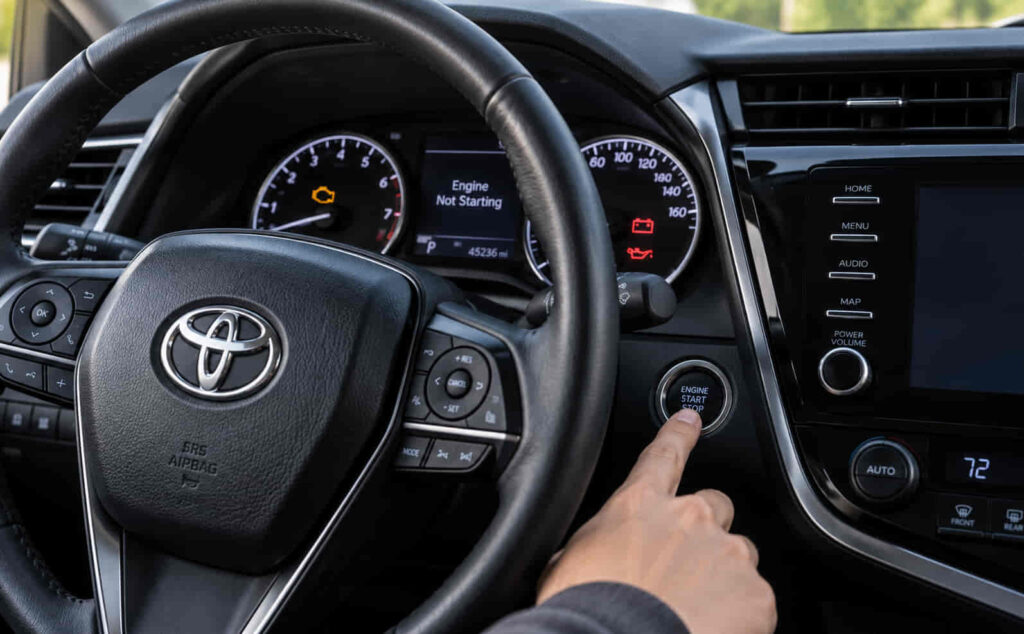
A Toyota Camry may not start because of a weak 12-volt battery, poor battery connections, a faulty starter, a problem with the Smart Key system, an electrical fault, insufficient fuel delivery, an ignition problem, or a failed engine-position sensor. The fastest way to narrow down the cause is to identify what happens when you try to start the car.
If the engine does not crank at all, the problem is more likely related to the battery, battery terminals, starter motor, starter relay, ignition authorization, or starting circuit. If the engine cranks at normal speed but does not start, diagnosis should shift toward the fuel system, ignition system, crankshaft or camshaft position sensors, and engine-control inputs. A Toyota Camry that clicks without cranking often points to insufficient battery current, a poor electrical connection, or a starter-related fault.
Dashboard lights do not prove that the battery is healthy because accessories require far less current than the starter motor. Likewise, replacing the starter, fuel pump, or battery before identifying the failure pattern can lead to unnecessary repair costs.
This guide explains why a Toyota Camry will not start, how to distinguish a no-crank condition from a crank-but-no-start problem, what to check first, and when the problem requires professional diagnosis.
Why Is My Toyota Camry Not Starting?
A Toyota Camry usually fails to start because of one of 8 main problems: a weak 12-volt battery, poor battery connections, a faulty starter, a starter-circuit fault, a Smart Key or immobilizer problem, insufficient fuel delivery, an ignition failure, or an engine-position sensor or control-system fault. The most important diagnostic step is to determine whether the engine does not crank at all or cranks normally but fails to start. These two conditions involve different systems and should not be diagnosed in the same way.
A Toyota Camry that does not crank should first be investigated through the electrical starting system. The 12-volt battery must provide enough current to operate the starter motor, and that current must travel through secure battery terminals, cables, grounds, relays, and control circuits. If any part of that path cannot carry the required current, the starter may turn slowly, produce a clicking sound, or fail to turn the engine at all. Dashboard lights may still illuminate because lighting and accessory circuits require much less current than the starter motor.
The battery is therefore one of the first components to evaluate when the engine will not crank or cranks unusually slowly. A discharged battery may produce rapid clicking, dim lights during a start attempt, repeated electronic resets, or a starter that turns too slowly to start the engine. Poor battery-terminal contact can create similar symptoms even when the battery itself still contains sufficient charge. Corrosion, looseness, or excessive resistance at a connection can prevent the large amount of current required by the starter from reaching it.
A starter-related failure becomes more likely when the battery and its connections are capable of supplying adequate power but the engine still does not crank. The starter motor physically rotates the engine during the starting process, while the starter solenoid and control circuit allow electrical power to reach the motor. A single click without engine rotation can be associated with the starter or a high-current connection, but that symptom alone does not confirm starter failure because a weak battery can produce similar behavior.
The diagnostic path changes when the Toyota Camry cranks at a normal speed but does not start. In that condition, the battery and starter have already provided enough energy to rotate the engine, so fuel delivery, ignition, engine-position information, and electronic control become more relevant. The engine requires the correct amount of fuel, properly timed ignition, and accurate crankshaft and camshaft information to begin combustion. A failure in one of these systems can allow the engine to crank normally without actually starting.
Fuel-delivery faults can create a crank-but-no-start condition when the engine does not receive sufficient fuel pressure or fuel flow. The fuel pump, its electrical supply, and related control components become more relevant in this branch of diagnosis. Ignition faults can produce the same overall symptom because fuel that enters the engine still requires correctly timed ignition to support combustion. Ignition coils, spark-related components, power supply, and engine-control signals may therefore require testing when cranking speed is normal.
Engine-position sensors also matter because the engine control module relies on crankshaft and camshaft information to determine engine position and timing. If a critical position signal is missing, the starter can continue rotating the engine while the control system cannot manage fuel and ignition correctly enough for the engine to start. This is why replacing the battery or starter is unlikely to solve a Toyota Camry that already cranks strongly and consistently.
Smart Key and immobilizer problems form another diagnostic branch, particularly on Camry models equipped with push-button start. The vehicle must recognize an authorized key and receive the required start conditions before allowing normal starting operation. A weak key-fob battery, key-recognition problem, brake-pedal input fault, or start-authorization issue can interfere with the starting process even when the vehicle’s main battery is not completely discharged.
The correct repair therefore depends on the failure pattern rather than the symptom “Toyota Camry not starting” by itself. A no-crank condition directs diagnosis toward battery power, connections, starter operation, and start authorization. A normal-crank condition redirects diagnosis toward fuel, ignition, sensors, and engine management. Separating those two paths first prevents unnecessary replacement of components that are already performing their intended function.
What Should You Check First When a Toyota Camry Won’t Start?
The first thing to check when a Toyota Camry will not start is whether the engine cranks, because this single observation separates the starting problem into two major diagnostic paths. Listen to what happens when the key is turned or the Start button is pressed. An engine that remains completely still, cranks slowly, produces repeated clicking, or cranks normally provides different information about which system is failing.
If there is no engine movement and the dashboard is also dark or unusually weak, battery power should receive immediate attention. The condition of the 12-volt battery, terminal connections, and main electrical supply determines whether the starter can receive enough current to operate. A weak electrical system may also cause instrument-panel lights to flicker or reset when the driver attempts to start the car because the voltage drops sharply under starter load.
If the dashboard lights appear normal but the engine still does not crank, the battery cannot be ruled out solely from that observation. Interior lights, gauges, and infotainment electronics consume much less current than the starter motor. A battery can therefore operate low-current accessories while failing when the starter demands substantially more current. The same symptom can also result from resistance at the battery terminals or ground connections, which is why visible power inside the vehicle does not automatically prove that the starting circuit has adequate power.
The sound produced during the start attempt provides another useful distinction. Rapid repeated clicking is more consistent with insufficient voltage or current reaching the starter circuit. A strong single click with no engine rotation shifts more attention toward the starter, starter solenoid, or high-current connection, especially after battery condition and terminal integrity have been verified. Complete silence can involve the battery, starter-control circuit, Smart Key authorization, brake switch, park/neutral input, relay, or related electrical controls.
The transmission position should also be considered when the engine does not crank. The starting system is designed to allow normal starting only when the vehicle recognizes an appropriate transmission position. If the vehicle does not correctly detect Park or Neutral, starter operation can be inhibited even though other electrical systems remain active. This makes a starting-interlock or position-signal problem more relevant when the battery appears healthy and the starter does not receive a normal start command.
For push-button-start Camry models, key recognition and brake-pedal input are also part of the initial diagnostic process. The vehicle must recognize the Smart Key and detect the required start conditions before it authorizes engine starting. A key-related warning, inconsistent key recognition, or a Start button that behaves differently from normal can direct diagnosis toward the Smart Key system rather than immediately toward the starter motor.
If the engine cranks at normal speed, diagnosis should move away from the basic starter circuit. Normal cranking confirms that the battery and starter are performing enough of their function to rotate the engine. The next questions are whether fuel is being delivered, ignition is occurring correctly, and the engine control system is receiving the information needed to manage combustion. Continuing to focus on the starter after establishing normal cranking wastes diagnostic effort because the starter has already completed its primary task.
The initial check should therefore establish the exact starting behavior before any part is replaced. No crank, slow crank, clicking, normal crank with no start, and start-then-stall conditions each point toward different systems. Treating these symptoms as separate diagnostic patterns makes the troubleshooting process faster and reduces the risk of replacing the battery, starter, fuel pump, or electronic components without evidence that they are actually responsible.
Read more: Toyota Camry Touch Screen Not Working
Why Won’t My Toyota Camry Crank?
A Toyota Camry that will not crank usually has a problem with battery power, battery connections, the starter motor, the starter solenoid, the starter-control circuit, or the system that authorizes starting. A no-crank condition means the starter is not rotating the engine when the driver turns the key or presses the Start button. This is different from a crank-but-no-start condition, where the starter turns the engine normally but combustion does not begin.
Battery power should be checked first because the starter requires a much higher current than most other electrical components. A weak battery may still illuminate the dashboard, operate the radio, and power interior lights while failing to deliver enough current to turn the starter motor. The failure becomes more consistent with a battery problem when the engine cranks slowly, the lights dim sharply during the start attempt, or electrical systems reset as soon as the starter is engaged.
Battery connections can produce the same no-crank symptom even when the battery itself is charged. The starter current must pass through the positive battery cable and return through the vehicle ground path. A loose, corroded, or high-resistance connection can limit that current enough to prevent the starter from operating correctly. Intermittent starting is particularly relevant because a poor connection may allow the vehicle to start normally on one attempt and fail on another.
The starter becomes a stronger suspect after battery voltage and high-current connections have been verified. The starter motor must convert electrical energy into the mechanical rotation needed to turn the engine. If the starter receives the correct power and control signal but does not rotate, an internal starter or solenoid fault becomes more likely. A single click without cranking can fit this failure pattern, although the click alone does not prove that the starter is defective.
A no-crank Toyota Camry can also have a problem on the control side of the starting system. The vehicle must recognize the correct transmission position, receive the required brake or ignition input, authorize the key, and activate the starter-control circuit before the motor can operate. A problem with a starter relay, start switch, Smart Key system, brake switch, park/neutral signal, or related wiring can therefore prevent cranking even when the starter and battery are mechanically capable of working.
The useful distinction is whether the starter lacks electrical power, lacks an authorization signal, or receives both but fails to operate. Establishing that distinction is more reliable than replacing the starter based only on a no-crank symptom.
Why Does My Toyota Camry Click but Not Start?
A Toyota Camry that clicks but does not start most often has insufficient current reaching the starter or a starter-related fault, and the type of clicking helps narrow down the cause. Rapid repeated clicking and a single strong click represent different electrical behaviors, so they should not be treated as the same symptom.
Rapid clicking is commonly associated with low battery voltage or excessive resistance in the battery connections. When the starter solenoid engages, the electrical load causes voltage to drop. If voltage falls too far, the solenoid releases, voltage rises again, and the circuit attempts to engage repeatedly. This creates the fast clicking sound heard during the start attempt. A discharged battery, weak battery, loose terminal, corroded connection, or poor ground can all produce this cycle.
A single click with no engine rotation shifts more attention toward the starter motor, starter solenoid, or high-current electrical path. In this condition, the control side of the circuit may be functioning well enough to activate the solenoid, but the starter motor does not rotate the engine. The cause can still be inadequate battery current, which is why battery condition and cable connections should be confirmed before diagnosing the starter itself.
Clicking should also be interpreted together with dashboard behavior. If the instrument lights dim heavily or reset while clicking occurs, the electrical supply is more likely to be weak. If the lights remain relatively strong and a single click occurs consistently, starter or high-current circuit problems become more relevant. These observations do not replace electrical testing, but they help determine which system deserves attention first.
A Toyota Camry should not be diagnosed with a bad starter based on sound alone. The starter depends on the battery, cables, grounds, relay, solenoid, and control circuit, so a failure elsewhere can create a similar audible symptom. The correct sequence is to confirm battery capability and electrical connections before replacing the starter motor.
Can a Bad Battery Cause a Toyota Camry Not to Start?
A weak or discharged 12-volt battery can prevent a Toyota Camry from starting by supplying too little electrical current to operate the starter motor at the required speed. The battery is especially relevant when the engine does not crank, cranks slowly, produces rapid clicking, or causes the dashboard and interior electronics to dim during a start attempt.
The starter motor places one of the highest electrical demands on the vehicle. Accessories such as the radio, dashboard, and interior lighting require much less current, which is why they can continue to operate from a battery that is too weak to start the engine. This explains why visible dashboard lights are not enough to rule out a battery problem.
A weak battery can also create inconsistent symptoms. The Camry may start normally after driving, fail after sitting for an extended period, or crank more slowly under conditions that place greater demand on the battery. A battery that has lost capacity can still hold enough surface voltage to operate accessories while its voltage drops sharply when the starter load is applied.
Jump-start response can provide useful diagnostic information. If the Toyota Camry does not crank or cranks slowly but starts normally when sufficient external battery power is supplied, the battery or its electrical connections become stronger suspects. A successful jump-start does not automatically prove that the battery itself is defective because poor charging, parasitic electrical drain, or connection problems can leave an otherwise functional battery discharged.
A battery that repeatedly becomes discharged requires diagnosis beyond simply recharging or jump-starting it. The battery may have lost capacity, the alternator may not be restoring charge correctly while the engine runs, or an electrical load may continue drawing power after the vehicle is turned off. The no-start symptom is therefore the immediate result of insufficient battery energy, while the reason that energy became insufficient can originate elsewhere in the electrical system.
Why Does My Toyota Camry Have Power but Won’t Start?
A Toyota Camry can have dashboard lights, radio operation, and other electrical power but still fail to start because accessory power does not prove that the battery can supply enough current to operate the starter. The starting system has a substantially higher electrical demand than most cabin electronics, so a partially discharged battery can create the impression that the vehicle has normal power while still being unable to crank the engine.
The next diagnostic step depends on whether the engine actually cranks. If the lights operate but the engine does not crank, the battery, terminals, starter, starter-control circuit, Smart Key authorization, and transmission-position input remain relevant. Electrical accessories only confirm that some power is available; they do not confirm that the high-current starting path is functioning.
If the engine cranks normally while the dashboard remains powered, the problem changes category. Battery and starter function become less likely to be the primary cause because they have successfully rotated the engine. Diagnosis should then move toward fuel delivery, ignition, engine-position sensors, and electronic control inputs required for combustion.
Push-button-start systems introduce another distinction. The Camry may power accessory or ignition electronics while refusing to crank because the vehicle does not detect the correct brake-pedal input, transmission position, or authorized Smart Key. In that situation, electrical power is present, but the system has not completed all conditions required to command the starter.
The phrase “has power but won’t start” is therefore not a diagnosis by itself. The important information is whether the available power is sufficient under starter load and whether the engine cranks. Once those two points are established, the troubleshooting path becomes much narrower.
Can Loose or Corroded Battery Terminals Stop a Toyota Camry From Starting?
Loose or corroded battery terminals can stop a Toyota Camry from starting by creating electrical resistance between the battery and the starting system. The battery can remain charged while the starter receives insufficient current because the connection, rather than the battery itself, limits electrical flow.
Starter operation requires a high-current path with low resistance. Even a connection that is good enough to power the dashboard or radio can fail under starter load. When resistance at a battery terminal increases, voltage can drop across the connection as starter current rises. The result can be slow cranking, repeated clicking, a complete no-crank condition, or electronics that flicker when starting is attempted.
Connection problems can also produce intermittent failure. The Camry may start normally several times and then suddenly fail because vibration, temperature change, or movement alters contact at a loose terminal. This pattern differs from a completely discharged battery, which usually produces more consistent low-power symptoms until it receives additional charge.
Corrosion is not the only connection fault to consider. The positive cable, negative battery connection, engine ground, chassis ground, and starter cable all form part of the high-current circuit. A clean battery terminal does not prove that resistance is absent elsewhere in the path.
Battery-terminal inspection should therefore be treated as part of electrical diagnosis rather than a cosmetic check. If the battery tests correctly but the Toyota Camry still cranks slowly, clicks, or starts intermittently, the high-current connections and grounds should be verified before the starter is replaced.
How Can You Tell If the Toyota Camry Starter Is Bad?
A Toyota Camry starter is more likely to be bad when the battery and main electrical connections are functioning correctly but the engine still does not crank or only produces a single click during a start attempt. The starter motor is responsible for turning the engine fast enough for combustion to begin, so a starter fault belongs primarily to the no-crank branch of diagnosis rather than the crank-but-no-start branch.
Starter failure should be considered after the battery has been checked because both problems can produce similar symptoms. A weak battery can create slow cranking, clicking, or complete failure to crank, which means replacing the starter before confirming battery capability can lead to an incorrect repair. The distinction becomes stronger when the battery maintains adequate power, the dashboard remains stable, and the starter still fails to rotate the engine.
A single click can indicate that the starter solenoid is receiving a start command but the starter motor is not turning. The solenoid acts as an electrical switch that connects the high-current battery supply to the starter motor. If the solenoid operates but the motor is internally worn, mechanically stuck, or electrically open, the driver may hear one click without any engine rotation. The same symptom can still result from a high-resistance cable or weak battery, so the sound should be treated as diagnostic evidence rather than proof of a failed starter.
Intermittent no-crank behavior can also point toward a deteriorating starter. A worn starter may work normally on one attempt and fail on another because internal electrical contacts, brushes, or mechanical components no longer operate consistently. This pattern becomes more meaningful when battery voltage, terminals, grounds, and starter-control signals remain normal during the failure.
A starter problem is less likely when the engine cranks at normal speed. Once the starter is clearly rotating the engine, it has already completed its primary function. If the Toyota Camry cranks strongly but does not fire, diagnosis should move toward fuel delivery, ignition, engine-position sensors, or engine management rather than continuing to focus on the starter.
The most reliable starter diagnosis therefore confirms three conditions: the battery can supply sufficient current, the starter circuit delivers the correct power and command, and the starter still fails to rotate the engine. When those conditions are present together, starter replacement becomes more justified than when diagnosis relies only on clicking or a general no-start complaint.
Can a Starter Relay or Fuse Keep a Toyota Camry From Starting?
A faulty starter relay or an open fuse can prevent a Toyota Camry from cranking by interrupting the electrical control path that activates the starter. These components do not physically turn the engine, but they allow electrical power and control signals to reach the starting circuit. A failure in either part can therefore create a no-crank condition even when the battery and starter motor themselves are functional.
The starter relay allows a relatively low-current control signal to switch the much higher current required by the starting system. If the relay does not close correctly, the starter solenoid may never receive the command needed to engage. The resulting symptom can be complete silence when the driver attempts to start the car, although similar behavior can also occur with Smart Key authorization faults, brake-switch problems, ignition-switch faults, or wiring issues.
A fuse protects the electrical circuit from excessive current. If the relevant starting or control circuit fuse opens, part of the starter-control system can lose electrical power. The correct fuse cannot be identified reliably from the Toyota Camry name alone because fuse assignments can vary by model year, engine, trim level, and electrical configuration. The vehicle-specific fuse diagram or owner information should therefore be used instead of applying one fuse number to every Camry.
A fuse that fails once may have opened because of an abnormal electrical event, but a fuse that repeatedly fails indicates a deeper problem. Replacing the same fuse again without finding the cause can leave a short circuit, damaged wire, or faulty electrical component unresolved. Repeated fuse failure should therefore move the repair from simple fuse replacement to electrical diagnosis.
Relay and fuse problems should also be separated from battery faults by observing the overall electrical behavior. A discharged battery often affects multiple systems and can cause dim lights, slow cranking, or rapid clicking. A control-circuit problem can leave the dashboard and accessories operating normally while the starter receives no activation command. This difference helps narrow the diagnostic path but still requires confirmation before parts are replaced.
Why Won’t My Toyota Camry Start With the Push Button?
A Toyota Camry with push-button start may fail to start because the vehicle does not detect the Smart Key, does not detect the required brake-pedal input, does not recognize Park or Neutral correctly, or has a fault in the starting or electrical system. Push-button starting adds an authorization process before the starter operates, which means a no-start condition can occur even when the battery and starter motor are physically capable of working.
The Smart Key must be recognized before normal starting can proceed. If the vehicle cannot verify an authorized key, the system may prevent the starter from operating. Key-recognition problems become more relevant when the dashboard displays a key-related message, the vehicle intermittently detects the key, or starting behavior changes depending on where the key fob is positioned.
The brake-pedal signal is another required input on push-button-start vehicles. The system normally expects the driver to press the brake before authorizing engine start. If the brake switch does not provide the expected signal, the vehicle may enter an accessory or ignition mode instead of commanding the starter. This creates a situation where the dashboard powers on but the engine does not crank.
Transmission-position recognition can create a similar symptom. The starting system must confirm an acceptable gear position before allowing the starter to operate. If the vehicle does not correctly recognize Park or Neutral, the driver can have full electrical power inside the cabin while the starting command remains blocked.
A push-button-start problem should not automatically be diagnosed as a Smart Key problem. The vehicle can recognize the key correctly and still fail to start because of a weak 12-volt battery, bad starter, relay fault, poor electrical connection, or another no-crank condition. The useful distinction is whether the start authorization process is failing or whether authorization occurs but the electrical starting system cannot complete the next step.
Can a Dead Key Fob Battery Stop a Toyota Camry From Starting?
A weak or dead key-fob battery can interfere with normal Smart Key detection, but it should not be confused with a discharged 12-volt vehicle battery. The key-fob battery powers communication functions in the remote, while the vehicle’s 12-volt battery supplies the electrical energy needed for the starting system and other vehicle electronics.
Key-fob battery failure is more relevant when the Toyota Camry has difficulty recognizing the key while the dashboard and other vehicle electrical systems continue to operate normally. The driver may also notice reduced remote-locking range or inconsistent response from Smart Key functions before a starting problem occurs. These symptoms point toward key communication rather than a loss of main vehicle power.
The exact backup procedure for starting with a weak key-fob battery can vary with the Camry model year and Smart Key system, so one emergency-start sequence should not be treated as universal for every vehicle. The appropriate method should follow the instructions for the specific model and key system.
A dead key-fob battery also does not explain a Toyota Camry that cranks normally but fails to start after start authorization has already occurred. Once the engine is rotating normally, diagnosis should move toward fuel, ignition, sensors, or engine control. Keeping key detection separate from combustion-related faults prevents unrelated systems from being diagnosed under the same no-start symptom.
The main diagnostic distinction is therefore straightforward: key-fob problems affect recognition and start authorization, while the 12-volt battery affects the electrical power available to operate the vehicle and starter. Identifying which stage is failing makes the next troubleshooting step much clearer.
Why Does My Toyota Camry Crank but Not Start?
A Toyota Camry that cranks at normal speed but does not start most likely has a problem with fuel delivery, ignition, engine-position sensing, or another engine-control input rather than the starter motor itself. Cranking confirms that the 12-volt battery and starter are providing enough energy to rotate the engine. The next diagnostic step is therefore to determine why combustion does not begin.
An internal-combustion engine needs the correct amount of fuel, a properly timed ignition event, adequate compression, and accurate control information to start. If one of these requirements is missing, the starter can continue turning the engine without producing sustained combustion. This is why a Toyota Camry that cranks strongly should not be diagnosed the same way as a vehicle that does not crank at all.
Fuel delivery is one of the main systems to evaluate. The fuel pump must deliver fuel at sufficient pressure, the injectors must receive the appropriate commands, and the engine-control system must manage delivery according to operating conditions. A failure in the pump, its electrical circuit, related relay or control system can create a situation where the engine rotates normally but does not receive enough fuel to start.
Ignition failure can produce an almost identical symptom. The engine may receive fuel but fail to ignite it correctly because the ignition system does not generate or deliver spark at the required time. Ignition coils, spark plugs, electrical supply, engine-control signals, and related components can therefore become relevant when normal cranking is present but combustion does not begin.
Engine-position information is also essential. The engine control module uses crankshaft and camshaft position signals to determine engine speed and position so it can control ignition and fuel injection at the correct time. A failed or missing sensor signal can allow the starter to rotate the engine while preventing the control system from synchronizing the events required for startup.
The key diagnostic point is that normal cranking changes the troubleshooting direction. Battery and starter checks remain relevant only if cranking becomes weak or inconsistent. When cranking speed is normal, continued replacement of starting-system parts is unlikely to solve a fuel, ignition, sensor, or engine-control fault.
Can a Bad Fuel Pump Cause a Toyota Camry to Crank but Not Start?
A failed or weak fuel pump can cause a Toyota Camry to crank normally without starting because the engine cannot begin sustained combustion without adequate fuel delivery. The starter can continue rotating the engine because the electrical starting system is functioning, but the engine will not run if fuel pressure or fuel flow is insufficient.
The fuel pump’s role is to move fuel from the tank toward the engine under the conditions required by the fuel-injection system. If the pump stops operating, receives inadequate electrical power, or cannot produce the required pressure, the injectors may not receive a usable fuel supply. The visible symptom can therefore be normal cranking with no engine start.
A fuel-pump problem becomes more relevant when the vehicle showed fuel-delivery symptoms before the complete no-start condition. Extended cranking, intermittent hard starting, loss of power under demand, or a vehicle that previously required multiple start attempts can support further fuel-system diagnosis. These symptoms are not exclusive to the fuel pump, so they should be evaluated alongside electrical and engine-control information rather than used as proof of pump failure.
The pump’s electrical circuit also matters because a functional pump cannot operate without power and control. A fuse, relay, wiring fault, connector problem, or control issue can interrupt fuel delivery while leaving the pump itself mechanically intact. Replacing the pump without confirming its electrical supply can therefore result in an unnecessary repair.
Fuel-pressure requirements also differ between Toyota Camry engines and model years, so one universal pressure specification should not be applied to every vehicle. The correct test must use specifications for the exact engine and fuel system. The useful diagnostic principle remains the same: normal cranking combined with inadequate fuel delivery can prevent the engine from starting even when the starter and battery are functioning correctly.
Can Ignition Problems Keep a Toyota Camry From Starting?
Ignition-system faults can keep a Toyota Camry from starting when the engine cranks normally but the air-fuel mixture is not ignited at the correct time. The ignition system must generate and deliver a sufficiently strong spark under engine-control command. If that process fails across enough cylinders, the engine can rotate without beginning sustained combustion.
Ignition coils and spark plugs are part of this process, but a crank-but-no-start condition should not automatically be attributed to worn spark plugs. A complete no-start is more significant than the rough running or misfire that can result from a problem affecting only one cylinder. When several ignition outputs are lost simultaneously, diagnosis should also consider shared electrical supply, control signals, sensor inputs, and engine-control functions.
The ignition system also depends on accurate engine-position information. The engine control module must know where the crankshaft and camshaft are in their rotation before it can command ignition at the appropriate moment. A missing position signal can therefore appear to be an ignition problem even when the coils themselves are still capable of producing spark.
Intermittent ignition faults can create hard-start behavior before a complete failure develops. The Camry may crank longer than normal, start inconsistently, or briefly fire before failing to continue running. These symptoms should be interpreted with fuel-delivery and sensor data because incomplete combustion can result from several systems that interact during startup.
The correct diagnostic question is therefore not simply whether the vehicle has spark plugs or ignition coils that could fail. The relevant question is whether the ignition system is receiving power, valid control information, and the commands needed to create correctly timed ignition during cranking.
Can a Crankshaft Position Sensor Stop a Toyota Camry From Starting?
A failed crankshaft position sensor can prevent a Toyota Camry from starting because the engine control module needs crankshaft-position and speed information to coordinate fuel injection and ignition. The starter may still rotate the engine normally, which makes this fault part of the crank-but-no-start diagnostic branch rather than the basic starting-motor branch.
The crankshaft position sensor provides the control system with information about engine rotation. Without a valid signal, the engine control module may be unable to determine when to trigger ignition or fuel-injection events correctly. The engine can therefore sound as though it is cranking normally while never transitioning into sustained operation.
The camshaft position sensor is closely related because it provides additional timing and cylinder-position information. The exact behavior caused by a failed crankshaft or camshaft sensor depends on the engine-management strategy, but either signal can be important enough to create hard-starting, intermittent stalling, or a no-start condition.
Sensor failure can also be intermittent. Heat, wiring damage, poor connector contact, or internal sensor deterioration can cause a signal to disappear only under certain conditions. This can explain a Camry that starts normally when cold but later refuses to restart, or one that stalls and then cranks without restarting until conditions change.
A sensor should not be replaced solely because the engine cranks but does not start. Fuel delivery, ignition output, wiring, power supply, diagnostic trouble codes, and sensor data all help determine whether the missing input is actually responsible. The sensor becomes a stronger suspect when the engine-control system lacks the expected position or speed signal during cranking.
Why Does My Toyota Camry Start and Then Die?
A Toyota Camry that starts and then dies has completed the initial combustion process but cannot maintain the fuel, ignition, electrical, or control conditions required to keep the engine running. This failure pattern is different from a vehicle that never fires at all because the engine has demonstrated that at least some fuel, ignition, and compression were available during the initial start.
Fuel delivery can cause this symptom when the system provides enough fuel for initial startup but cannot maintain the required supply after the engine begins running. An electrical interruption to the fuel system, unstable pressure, or a control problem can allow the engine to fire and then stall shortly afterward.
Electrical and engine-control faults can create the same pattern. A sensor signal that becomes invalid after startup, an intermittent wiring connection, or a control-system problem can cause the engine to lose the information required for continued operation. The exact cause becomes easier to identify when the stall pattern is repeatable, such as dying immediately after every start or only after the engine warms.
Security and immobilizer behavior can also be relevant when start authorization is interrupted, although the exact system response depends on the Camry model year and security configuration. A security indicator or key-related warning occurring at the same time as the stall provides more useful evidence than assuming the immobilizer is responsible solely because the vehicle starts and dies.
A start-then-die symptom should therefore be treated as a separate diagnostic condition rather than grouped automatically with no-crank or crank-but-no-start problems. The engine initially operates, which means the diagnostic focus should shift toward what is being lost immediately after startup.
Can a Bad Alternator Cause a Toyota Camry Not to Start?
A bad alternator usually causes a Toyota Camry not to start indirectly by allowing the 12-volt battery to discharge; the alternator itself does not normally provide the initial cranking power used to start the engine. The battery supplies the energy required by the starter during startup, while the alternator replenishes battery charge and supports the electrical system after the engine is running.
If the alternator cannot charge correctly, the Camry can continue operating for a period by consuming energy stored in the battery. As battery charge decreases, electrical systems may begin behaving abnormally and the engine can eventually stop. After the vehicle is shut off, the discharged battery may no longer have enough energy to crank the engine on the next start attempt.
This relationship explains why a vehicle can appear to have a battery problem when the underlying cause is the charging system. Jump-starting may restore enough electrical energy for the engine to start, but the battery can discharge again if the alternator does not restore that energy during operation.
Charging-system failure becomes more relevant when a no-start condition follows previous electrical symptoms while driving, repeated battery discharge, or a battery that becomes weak again after being charged or replaced. A new battery that repeatedly loses charge should not automatically be blamed for the next no-start event without checking whether the charging system is maintaining it correctly.
The diagnostic distinction is important: the battery provides startup power, while the alternator maintains electrical energy after startup. A failed alternator can eventually produce a no-start condition, but it usually does so by leaving the battery discharged rather than by directly preventing the starter from operating.
Can Cold Weather Cause a Toyota Camry Not to Start?
Cold weather can contribute to a Toyota Camry not starting by reducing 12-volt battery performance and increasing the electrical and mechanical demand required to crank the engine. Cold temperature is usually a contributing condition rather than a standalone failure. A healthy starting system should still operate within its designed temperature range, while a weak battery, deteriorated electrical connection, or marginal starter may become much more noticeable when temperatures fall.
Battery performance is especially important because chemical reactions inside a lead-acid 12-volt battery slow as temperature decreases. The battery can therefore deliver less starting power at the same time that the starter requires substantial current to rotate a cold engine. A Camry that starts normally in warmer weather but cranks slowly, clicks, or fails to crank during colder conditions should have the battery and high-current electrical connections evaluated before more complex components are replaced.
Cold weather can also increase the resistance the starter must overcome. Engine oil becomes more viscous at lower temperatures, which increases the effort required to rotate internal engine components during startup. The starter must draw sufficient electrical current to overcome this additional resistance. A battery or starter that operates near its minimum acceptable performance level in warm conditions may therefore fail to provide adequate cranking performance in colder weather.
The diagnostic pattern remains important. Rapid clicking or slow cranking during cold weather directs attention toward battery capacity and electrical connections. A strong single click with adequate electrical power can shift attention toward the starter or high-current circuit. Normal-speed cranking with no engine start should move diagnosis toward fuel, ignition, sensors, or engine control instead of assuming the battery is responsible simply because the weather is cold.
A cold-weather no-start problem that repeatedly returns should therefore be diagnosed as a weakness in the starting or engine-management system rather than treated as normal behavior. Temperature often exposes an existing marginal condition; it does not eliminate the need to identify the component that is failing to perform correctly.
How Can You Tell Whether the Problem Is the Battery, Starter, or Fuel System?
You can distinguish a Toyota Camry battery problem, starter problem, and fuel-system problem primarily by determining how the engine behaves during the start attempt. Slow or absent cranking points toward the electrical starting system, while normal cranking with no engine start shifts diagnosis toward fuel delivery, ignition, sensors, or engine control.
A battery problem is more likely when the starter turns slowly, rapid clicking occurs, interior or dashboard lights dim substantially during cranking, or electronic systems reset during the start attempt. These symptoms indicate that available voltage or current drops when the high electrical load of the starter is applied. A Camry that starts after receiving adequate external power also provides additional evidence that battery charge or the high-current electrical path deserves attention.
A starter problem produces a different pattern. The vehicle may have normal dashboard power, a battery capable of supplying sufficient current, and secure electrical connections but still fail to rotate the engine. A repeated single-click condition with no cranking can support starter diagnosis when battery and cable problems have already been excluded. Intermittent no-crank behavior can also occur when internal starter components are deteriorating.
Fuel-system problems generally appear after the starting system has already succeeded in rotating the engine. A Toyota Camry that cranks at normal speed but does not start is not showing the typical symptom of a completely failed starter because the starter is clearly performing its main function. Fuel delivery becomes more relevant when combustion never begins despite consistent cranking.
The distinction becomes even clearer when diagnosis includes ignition and sensor faults. Normal cranking does not prove that the fuel pump is defective; it only moves troubleshooting beyond the basic starter system. The engine still requires fuel, correctly timed ignition, engine-position information, and proper control signals. A crank-but-no-start condition therefore requires confirmation of these functions before a fuel-system component is replaced.
A Toyota Camry that starts with a jump but later develops the same no-start condition introduces another diagnostic path. The immediate problem involves insufficient battery energy, but the reason for that condition may be a deteriorated battery, charging-system problem, parasitic electrical drain, or poor connection. A jump-start identifies a useful pattern, but it does not determine the final failed component on its own.
The most efficient diagnosis therefore uses engine behavior to eliminate entire categories. Slow or no cranking keeps battery, connections, starter, and start-control components near the top of the diagnostic path. Normal cranking moves the focus toward fuel, ignition, sensors, and engine management. This distinction prevents the battery, starter, and fuel pump from being treated as interchangeable explanations for every Toyota Camry no-start condition.
Should You Jump-Start a Toyota Camry That Won’t Start?
A jump-start is appropriate when a Toyota Camry shows symptoms of a weak or discharged 12-volt battery, such as slow cranking, rapid clicking, weak electrical operation, or insufficient power to operate the starter. It is a diagnostic and temporary starting method for low-battery conditions, not a universal solution for every no-start problem.
A successful jump-start shows that adding an external electrical source allowed the starting system to perform when the vehicle’s available battery power was insufficient. This makes battery charge, battery condition, terminal connections, and the charging system more relevant. It does not automatically prove that the battery must be replaced because an otherwise functional battery can become discharged if the vehicle has been left unused, an electrical load remained active, or the alternator failed to restore sufficient charge.
A jump-start is much less useful when the engine already cranks at normal speed. In that condition, the starter has sufficient electrical energy to rotate the engine, so adding another battery does not address a missing fuel supply, ignition failure, crankshaft-position signal, or another engine-management problem. Repeatedly attempting to jump-start a Camry that already cranks normally can delay the diagnosis of the system that is actually preventing combustion.
The behavior after a successful jump-start also matters. If the engine starts and continues operating normally but fails to restart after being shut off, the battery may not be storing adequate energy or the charging system may not be replenishing it. If the vehicle starts after a jump but electrical problems develop while the engine is running, charging-system diagnosis becomes increasingly relevant.
Jump-starting should also be performed only with the correct procedure for the vehicle because incorrect cable placement or polarity can damage electrical components. Toyota’s model-specific instructions should take priority over generalized starting procedures, particularly on vehicles with different electrical configurations.
A jump-start should therefore answer a diagnostic question rather than serve as the final repair. If additional battery power restores normal cranking, determine why the original battery could not provide that power. If the Camry already cranks normally, move directly toward fuel, ignition, sensor, and engine-control diagnosis instead of continuing to add external electrical power.
When Should You Stop Trying to Start the Toyota Camry?
Stop repeated start attempts when the Toyota Camry produces abnormal electrical or mechanical symptoms, because continued cranking can overheat the starter, drain the battery further, or worsen an existing electrical fault. Repeated attempts are not useful when the vehicle continues showing the same failure pattern without any change in diagnostic conditions.
Extended cranking places substantial electrical demand on both the battery and starter motor. The starter is designed for short operating periods rather than continuous rotation. Repeated long attempts can generate heat inside the starter and wiring while simultaneously reducing the remaining battery charge. A vehicle that initially cranks strongly can therefore begin cranking more slowly simply because repeated attempts have depleted the battery.
A burning smell, smoke, unusually hot cables, or visible electrical damage requires an immediate stop to further starting attempts. These signs can indicate excessive resistance, a short circuit, overheating connection, or another electrical fault. Continuing to apply starter current under those conditions can increase component damage rather than provide useful diagnostic information.
Abnormal mechanical sounds also justify stopping. Grinding, harsh metallic engagement, or other noises that differ from normal starter operation can indicate a mechanical problem between the starter and engine or another rotating component. Repeatedly operating the starter while abnormal mechanical contact is occurring can turn a limited repair into damage involving additional components.
Repeated clicking should also lead to diagnosis rather than endless start attempts. If rapid clicking continues, the battery or electrical connection requires attention. If a single click repeatedly occurs despite adequate battery power, starter or high-current circuit diagnosis becomes more useful than pressing the Start button again.
A Toyota Camry that cranks normally but never starts should similarly not be cranked indefinitely. Normal cranking has already established that the starter can rotate the engine. Further diagnosis should determine whether fuel, ignition, engine-position signals, or control functions are missing. Repeatedly rotating the engine does not correct the absent requirement.
The correct point to stop is therefore when repeated attempts no longer provide new diagnostic information or when abnormal electrical, thermal, or mechanical symptoms appear. At that stage, testing the failed system is more effective than continuing to operate the starter.
How Much Does It Cost to Fix a Toyota Camry That Won’t Start?
The cost to fix a Toyota Camry that will not start depends on which component is preventing the starting process, because “not starting” is a symptom rather than a single repair. A discharged battery, poor battery connection, failed starter, fuel-delivery problem, sensor fault, Smart Key issue, or wiring failure can all create a no-start condition, but they require different parts, diagnostic time, and labor.
Battery-related repairs are generally simpler when the problem is limited to a discharged or deteriorated 12-volt battery. The repair becomes more involved when the battery is repeatedly losing charge because the underlying cause may be a charging-system problem, parasitic electrical drain, or high-resistance connection. Replacing the battery without identifying why it became discharged can restore starting temporarily while leaving the original fault unresolved.
Battery cables and terminal connections can also create a relatively small repair or a more complex electrical diagnosis depending on where resistance is located. Cleaning and securing an accessible connection is different from repairing a damaged cable, ground path, connector, or wiring section. This is why a Toyota Camry that clicks or starts intermittently should have its high-current electrical path evaluated before the starter is automatically replaced.
Starter replacement becomes more relevant when the battery and main connections are functioning correctly but the starter still cannot rotate the engine. The final repair cost depends on the engine configuration, starter location, labor required for access, and whether an OEM, remanufactured, or aftermarket component is used. The important point is that starter replacement should follow diagnosis rather than being selected solely because the vehicle makes a clicking sound.
A crank-but-no-start problem can involve a broader range of repair costs because the failure may be located in the fuel, ignition, sensor, or engine-control system. A failed electrical relay or sensor requires a different level of repair than a fuel pump or complex wiring fault. The same visible symptom can therefore lead to substantially different repair paths once fuel pressure, ignition output, sensor signals, and control-system information are tested.
Smart Key and push-button-start problems also vary in scope. A weak key-fob battery is fundamentally different from a vehicle-side key-recognition fault, brake-switch problem, immobilizer issue, or starting-control circuit failure. The repair should target the stage of the authorization process that is failing rather than treating every push-button no-start condition as a defective key.
Diagnostic labor has its own value because correct diagnosis can prevent replacement of expensive components that are still functioning. A Toyota Camry that has power but will not start could have a weak battery, starter-control fault, failed starter, Smart Key problem, or crank-but-no-start condition depending on what the engine actually does. Identifying that failure pattern before ordering parts usually reduces the risk of paying for a battery, starter, fuel pump, or electronic component that does not solve the problem.
The most accurate repair estimate therefore comes after the vehicle has been classified as no-crank, slow-crank, click-no-start, crank-but-no-start, or start-then-stall. Once the failed system is identified, the cost can be estimated from the specific part, labor requirement, Toyota Camry model year, engine configuration, and choice between OEM and aftermarket components.
Should You Fix a Toyota Camry No-Start Problem Yourself or Call a Technician?
You can handle basic Toyota Camry no-start checks yourself when the diagnosis involves battery condition, visible terminal problems, a correctly performed jump-start, or a clearly identified fuse, but starter-circuit, fuel-system, immobilizer, sensor, and wiring faults usually require professional diagnosis. The practical boundary is whether the next step requires electrical testing, fuel-pressure measurement, scan data, component removal, or access to vehicle-control systems.
Owner-level diagnosis is most useful before invasive repairs begin. Observing whether the engine cranks, listening for rapid clicking or a single click, checking whether dashboard lights dim, inspecting accessible battery terminals, and determining whether a jump-start changes the symptom can narrow the problem significantly. These checks establish whether diagnosis should remain in the battery and starting circuit or move toward fuel, ignition, and engine management.
Battery replacement or connection correction can also be straightforward when the fault has already been confirmed and the owner can follow the correct vehicle procedure. The key difference is confirmation. Replacing a battery because the Camry will not start is not the same as replacing a battery that has been tested and shown to be unable to provide adequate starting power. The same principle applies to fuses: an identified failed fuse can be replaced with the correct rating, but a fuse that fails repeatedly requires diagnosis of the electrical fault that is causing it to open.
Starter diagnosis is more appropriate for a technician when the battery and connections test correctly but the engine still does not crank. Confirming starter failure can require checking the high-current supply, voltage drop, ground path, control signal, relay operation, and starter response under load. Without those checks, a failed cable or control circuit can be mistaken for a defective starter motor.
Crank-but-no-start conditions generally justify professional diagnosis sooner because several systems must operate correctly at the same time. Fuel pressure, injector operation, ignition output, crankshaft and camshaft signals, diagnostic trouble codes, and live engine data may need to be evaluated together. Replacing the fuel pump, ignition coils, or sensors without confirming which required input is missing turns diagnosis into parts swapping.
Push-button-start and immobilizer problems can also require specialized testing when the vehicle does not recognize an authorized key or does not complete the start-authorization sequence. A weak key-fob battery is simple to correct, but vehicle-side key detection, brake-switch input, immobilizer communication, and module-related faults require a different diagnostic process.
Professional help becomes more urgent when the vehicle shows signs of an electrical or mechanical fault that could worsen with repeated start attempts. Burning smells, overheated cables, smoke, grinding noises, repeated fuse failure, or severe electrical instability indicate that continued troubleshooting through repeated cranking is no longer appropriate.
The best DIY boundary is therefore based on evidence rather than component difficulty alone. Battery checks, basic connection inspection, jump-start testing, and vehicle-specific fuse checks can provide useful information without dismantling the vehicle. Once diagnosis requires measuring starter circuits, fuel pressure, sensor signals, immobilizer communication, or intermittent wiring faults, a qualified technician can identify the failed system more accurately and reduce the chance of replacing the wrong component.